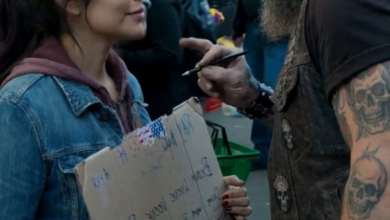
A Biker Took a Blind Man’s Phone at a Bus Stop — A Number on the Call Changed Everything
Part 1 — Teaser
I snatched a phone from a blind man's hand at a bus stop just as he began reading a number aloud, and the woman behind us screamed because all she saw was a biker robbing an old man.
My name is Jonah Reed. I was fifty-eight, with a beard nearly white at the ends, a heavy black riding vest, and a right hand made crooked by years of work as a machinist. The man was Amos Bell, though I did not know his name yet. He wore dark glasses and held a white cane against his knee while standing beneath the shelter on a windy afternoon in Pittsburgh. We had been waiting for the same downtown bus. I was third in line, close enough to hear his phone because its speaker volume was turned up over traffic.
The voice said it was calling from a bank's security department. It spoke quickly, as if a delay would be expensive. Amos asked the caller to slow down so his phone's screen reader could finish announcing the notification that had just arrived. I heard the caller say something about a disputed transaction. Then he asked Amos to repeat the number from the new message. The pace was doing part of the work. Amos sounded careful, not foolish. He asked why the caller needed it. The voice answered with a phrase that sounded practiced and gave him a short deadline.
I knew the trick because my sister had once nearly lost access to an account after a stranger called pretending to help her stop a charge. I had no proof that this was the same scheme. I could hear only one side of the conversation clearly through the speaker, and I had not seen the message on Amos's phone. I said, “Sir, don't give that number yet.” The bus sighed at the corner as its brakes caught. Amos turned his head toward my voice, but the person on the line kept speaking. He raised the phone closer to his mouth. A warning drowned by a practiced voice can disappear before it lands.
“Five,” Amos began. I reached forward and took the phone.
He recoiled, his cane sliding between our shoes. I held the phone where he could hear me, then realized that was the wrong first gesture. He could not see my open hand or how little distance I had moved. To him, the device had simply vanished. “Give it back,” he said. The woman behind me shouted for the driver to call police. I told the person on the line that the call was over and disconnected it, then placed the phone in Amos's open palm. I had interrupted one risk by creating another in his body: the fear of a stranger taking away the tool he used to navigate his day.
The bus doors opened. The driver looked from Amos's cane to my vest and asked whether he was safe. Amos said, “I don't know what just happened.” That was the honest answer, and I stepped back so the people at the shelter could stand beside him. I said what I had heard about the number, but I did not claim authority over his account or his phone. The caller immediately rang again. The screen reader announced an unfamiliar number; Amos did not answer. The woman who had shouted held her own phone ready to call for help.
My friend Caleb had arrived at the stop on his motorcycle to return a wrench I had left at his garage. He saw the crowd and asked me quietly why I had my hands up like a suspect. I told him to stay back. An impatient crowd can make a blind person into a prop in a stranger's explanation, and we were already close to doing that. The driver offered to wait a minute before pulling out; another bus was behind him, so the offer had limits. Amos chose to remain at the shelter. He said he wanted someone to help him call the bank through a number he already trusted. He chose the next step.
The woman, whose name was Nina, asked if Amos wanted her to stay. He said yes. I asked if he wanted me gone. “Not yet,” he said. “I want to hear what you heard.” That gave me a task I could carry out without touching him. I repeated the caller's exact words as best I remembered, including the short deadline and the request for a number. Amos listened and said the caller had used his full name and a recent purchase, details that had persuaded him to remain on the line. That frightened me more than the voice's urgency.
Nina fetched a transit supervisor from the booth at the nearby station. I stood by the shelter rail, hands away from Amos's cane and phone. When the supervisor arrived, Amos took a bank card from his wallet and asked her to read the number printed on the back so he could place the call himself. The woman did, but before Amos pressed the last digit, his phone announced another incoming message. He listened to the screen reader, and his face changed. Had the caller already done something while we were arguing over who had the right to intervene?
Part 2
Amos did not read the new message aloud. He asked the transit supervisor, Teri, whether the crowd could move farther away. She asked us to do so. I stepped back with Caleb; Nina remained nearby because Amos had asked her to stay. A minute later Teri told me that Amos was calling a verified bank number using his own phone and wanted me available to describe what I heard. The distinction mattered to him. He had never asked me to make decisions about his account. He had asked for a witness to the other call.
I had known my sister's experience too well. Her phone had rung one evening with a number that resembled a service line. The caller knew enough about her recent purchase to sound informed and urged her to read a code that arrived by message. She ended the call and contacted her bank through a number she already used, and the account was secured before she lost money. Ever since, I had been alert to that particular pressure: urgency, a code, no room to check. Awareness did not give me permission to seize a stranger's device. It did make me recognize the risk quickly.
Amos lived alone and managed his own finances with accessible apps and help only when he chose it. He had learned the bus routes by their stop announcements and the changed texture of the sidewalk at the station. A stranger snatching his phone interrupted more than a conversation. It removed a map, a way to call home, and the device he used to read messages. He told me that later, not to punish me, but because I kept apologizing for frightening him without understanding what I had taken.
The bank representative on the new call asked Amos questions privately. Teri and Nina gave him room. No one at the stop read his messages or asked for his password. Amos described the first call and said he had begun speaking one digit before Jonah stopped him. The representative explained steps for checking his account and securing it; Amos wrote reminders in his own voice notes. He chose whether he wanted Nina to hear the instructions. I was not part of that conversation except when Teri waved me over and asked me to repeat the words I remembered from the caller.
The incoming message that had changed Amos's face was an alert saying a security setting had been changed. The bank confirmed the status after reviewing his account. I did not hear the details, and I would not invent them to make myself more useful. The legitimate representative helped Amos take the steps available to him and documented the attempted deception. Stopping one sentence had not erased the other parts of the scam.
Teri brought a chair from the station booth when the call ran longer than expected. Amos thanked her and asked whether its back faced the street, so he could still hear buses arriving. She turned it for him. She also asked a waiting passenger to stand clear of his cane rather than move the cane herself. Small courtesies made the next half hour possible: a seat, enough quiet to hear, a person he had chosen beside him, and no strangers reading over his shoulder. The mechanics of privacy mattered as much as good intentions.
When the next bus arrived, Amos chose not to board. His grandson had agreed to meet him at the station entrance. I offered to wait. He said Nina and Teri were already there. Caleb put his hand on my shoulder before I could argue. “He answered you,” he said. I stayed across the pavement with my bike, where Amos could call if he changed his mind. The cold metal of the handlebar gave my restless hands a place to go.
Amos's grandson, Daniel, arrived out of breath and asked if someone had assaulted his grandfather. Amos said a biker had grabbed his phone and then returned it. He also said the biker had heard a caller asking for a code. Daniel looked at me with a complicated expression. I gave my name and phone number to Teri in case a report was needed, then told Amos I was sorry I had taken the device without his consent. He said, “You frightened me. You may also have interrupted a thief. We'll talk about both when I know what happened.” He refused the clean ending everyone around us wanted.
Part 3
The woman who had shouted at me was a librarian named Nina Park. She later told me she had heard Amos say “Give it back” and seen his cane on the pavement. From her position she could not hear the voice on the call. She had been right to challenge me. I had been right to worry about the code. The situation did not require us to agree on which fact canceled the other because neither one did.
A transit camera had recorded the phone being taken and returned. It did not record the caller's words. Nina's phone video began after Amos asked for his device back. A rider from our club posted online that I had saved a man's retirement account. I asked him to take it down. We did not know what Amos had in that account or what had been secured. We did not have permission to turn his disability into our club's advertisement. He removed the post, then asked why we could not celebrate a good outcome. I said a good outcome belonged to Amos first.
Two days later, Amos called me from the number Teri had saved. His grandson was sitting with him, but he did the talking. The bank had helped him restore control of the affected settings and review his activity. He had made a report about the fraudulent call. No money had been taken from the account he checked. That was welcome news, not evidence that the attempt had been harmless. Amos asked if we could meet at a coffee shop near the station because he wanted to reconstruct the conversation from another witness's hearing.
I brought Caleb. Amos brought Daniel. Nina joined us at Amos's invitation. He had arranged us around a table so he could follow who was speaking. When we arrived, he said everyone's name and asked us to say it back from our seats. I had assumed he needed a guide. He needed the room organized so he could direct the discussion. The meeting was his.
We went through the first call in order. Amos remembered the initial claim about a disputed purchase. I remembered the caller's interruption when the screen reader began speaking and the precise moment the caller switched from reassurance to deadline. Nina remembered hearing Amos ask why a number was needed. We had been pieces of one event. Amos saved a voice note of the order we settled on and said he would add it to the report if asked. Nobody guessed the caller's identity or nationality. The sound of a voice would not establish either.
Afterward he turned toward me. “What would you do differently?” he asked. I said I would say, “I can hear them asking for a code. Please pause and call the number on your card,” loud enough to compete with the speaker. I would ask the driver to wait and get another witness if time allowed. If he kept reading the code while the risk felt immediate, I did not know whether I would stop myself from reaching again. Amos considered that. “You could ask me to end the call,” he said. “Tell me exactly what you heard. I can make the choice.” He was teaching me the intervention he could actually use.
Daniel asked whether his grandfather wanted a printed summary of the meeting. Amos said his own voice note would be easier to search and replay. Daniel caught himself reaching for the phone to set it up, then put his hand back on the table. Amos smiled without being asked to. I had thought I alone needed to learn this lesson, but everyone who loved him had habits to examine. Familiarity can become its own kind of assumption. We practiced saying what we offered and waiting for an answer.
Daniel wanted to ask why Amos had answered an unknown number at all. Amos told him he had been expecting a call about a delivery and the voice had known his name. Daniel apologized for the way his question sounded. We each had to learn not to turn a clever fraud into a test an older person had failed. The caller had supplied enough true details to invite a conversation, then worked to hurry it. Amos had asked a sensible question before I acted. His carefulness had delayed the code; my interruption had ended the call. The success was shared and imperfect.
At the bus stop the following week, I saw a man arguing with a caller on speakerphone and almost stepped toward him. Then I saw he was asking for directions to a plumber and backed away. Alertness without humility is another kind of noise. I began wearing an earbud when I waited for the bus after a night shift, partly to stop myself from searching every stranger's conversation for a threat. When someone actually asked me for help, I could still take it out.
Part 4
Amos chose to tell his own story at a community meeting the library hosted about confusing phone calls. He began by saying a biker had grabbed his phone at a bus stop. A few people laughed nervously. Then he said the caller had been asking him to read a number from a message and that both events had frightened him. “The second fear didn't erase the first,” he told the room. I sat near the back. I had expected him to say I saved him. Instead he gave the audience something more practical: how to help without taking control.
Nina read aloud a short outline Amos had written, and he interrupted her twice when he wanted a sentence phrased differently. He said his screen reader might take a moment to finish announcing a notification, and a caller's insistence that he hurry had made verification harder. He also said an accessible device is often how a blind person contacts family, navigates travel, and reviews information. If you think someone is being deceived, speak to the person, state the specific concern, and leave room for them to respond. A trained professional from a local consumer support group covered reporting options, while Amos described only what had happened to him.
I stood up when asked and admitted taking the phone. A man in the audience said he would have done the same, maybe faster. Amos answered before I could: “You don't know whether I would have stopped after Jonah's warning. He didn't give me a chance.” I felt my face heat. It was true. I had heard one digit and believed every fraction of a second mattered; that belief was understandable, yet the person in front of me still had a mind and a decision. We did not have to pretend I was a villain to learn from it. We did have to stop calling the grab the whole rescue.
After the meeting, a woman who used a mobility aid told me that strangers sometimes grabbed her chair handles to move her out of their way “for safety.” She said the unexpected motion frightened her more than the crowded sidewalk. I did not compare her experience exactly with Amos's phone. I listened, thanked her, and told her I would remember the difference between offering assistance and taking an object someone relies on. Her story widened the lesson without making her a character in mine.
The club invited Amos to our garage for coffee. I asked him first. He accepted on the condition that nobody photograph him without permission or ask for his bank details. Boone, our president, laughed and said those were sound rules for everyone. Amos brought a chess set with raised squares and pieces he could identify by touch. I lost to him in twenty-seven moves while Caleb insisted he had seen my mistake coming at move eight. A man could be a fraud target and a ruthless chess opponent in the same week. He had been both long before he met us.
Caleb tried the chess set after Amos offered. At first he announced every move as if narrating for a broadcast. Amos asked him to say only the square and let the pieces speak for themselves. The game grew quieter and better. I watched Caleb absorb the correction with the same embarrassed look I had worn at the bus stop. Later he said the set had changed how he thought about design: a useful object did not need an audience to explain why it worked. Amos asked him to play again on a day without spectators.
Nina became a friend too. She and Amos updated the library's small stack of large-print and audio materials on recognizing suspicious calls. She checked that the materials worked with the library's screen reader rather than assuming a printed warning could reach everyone. The bank case and the false call were for Amos and the appropriate people to handle; the public meeting did not uncover the scammer. It gave neighbors a way to ask better questions of themselves and one another.
Sometimes a stranger recognized me from the transit clip and demanded the triumphant version. I could tell them only that I had heard a concerning request, interrupted a call abruptly, returned the phone, and later listened to the man whose phone it was. If they wanted a lesson in how to handle their own account, I directed them to their bank's official channel or the library meeting's resources rather than reciting details from a stranger's case. The most useful facts were not mine to release.
Part 5
Spring arrived with a late snow that made the bus shelters smell of wet wool and road salt. Amos and I rode the same route most Thursdays. We did not always sit together. Some mornings he wanted to listen to a book through his earbuds, and I wanted to stare out the window until work became a thought I could face. Our friendship was more convincing for those ordinary silences than for the crisis at its beginning.
One Thursday he asked if I would accompany him to a repair shop because the button on his cane had loosened. I said I could fix it at our garage; he said he preferred the shop that supplied the cane and wanted me along for the bus transfer. I agreed. I learned to offer an elbow when he asked, narrate a curb or a changed platform when it mattered, and keep quiet when he already knew where he was going. His route had a logic older than my arrival in it.
At the repair shop, he told the technician what felt wrong with the handle. She listened, tightened the part, and handed it back for him to test. He walked a short stretch and asked for one more adjustment. I did not hover. On the ride home he asked whether my bike was difficult to ride with my crooked hand. I told him about a small change to the grip that made long rides comfortable. He asked to feel it at the garage sometime. The questions went both ways.
The club's annual ride raised money for a neighborhood technology lab. Amos suggested that part of it pay for accessibility testing rather than more devices stacked on shelves. The lab agreed to bring in people who used screen readers and other tools every day, and to pay them for reviewing equipment. Boone had expected a ribbon-cutting photo. Amos asked who would keep the software updated after the photo, and Boone crossed the ribbon off the plan. Access is maintained, not unveiled once.
Nina helped the lab arrange a monthly drop-in time for people to bring devices that had stopped working with a recent update. Amos attended the first one and found a navigation setting that had changed without warning. A volunteer wanted to reset his entire phone; he asked them to demonstrate a smaller fix first. They did. A person who had been targeted by a caller was now shaping a service other people relied on, and nobody needed to retell his frightening call to justify his expertise.
I kept the first meeting's notes in my toolbox, not as a script for intervening in every stranger's call but as a reminder that I was prone to act before explaining. When a younger rider called me from a parking lot to ask if he should confront someone who seemed to be giving personal information over the phone, I told him to speak plainly from where he stood and ask whether the person wanted help checking the caller. The rider said the woman ended the call on her own. She thanked him and drove away. Nothing else happened. Nothing else happening can be a good result.
Amos heard that story and made me repeat the part where the woman chose to hang up. He said, “See? Sometimes you can give somebody a second to think.” Then he laughed because he knew I would hear it in his voice every time I grew impatient. I told him I still thought taking the phone had stopped a real attempt to get his code. He said, “Maybe it did. I still want my phone in my hand.” That was the durable shape of our disagreement. It did not prevent us from taking the bus home together.
Part 6
Months later, a caller tried again. Amos received a message urging him to call a number about an account issue. He did not call that number. He contacted his bank through the contact he had already saved and learned the message was not from them. He told me afterward, not because I was his guardian but because he knew I would be interested. I asked whether he had been shaken. He said, “A little. Then I made tea.” His answer kept the scale right. He was cautious without arranging his life around a criminal's voice.
Caleb replaced the garage's old phone with a speaker model so Amos could join a call about the technology lab if he wanted. Amos tested it, then told us it distorted certain consonants. We returned it and chose one he liked better. Caleb muttered that he had thought the first model was excellent. “For you,” Amos said. He was right. The lab's work began with that simple habit: ask the person who would use the thing.
At the summer street fair, Nina ran a table with resources on misleading calls. Amos sat for one hour to answer questions, then left to hear a jazz group in the park. I helped pack the pamphlets. A young man recognized the bus stop story and asked Amos whether he still talked to the biker who stole his phone. Amos pointed his cane at me and said, “He bought the tickets.” It was the closest thing to a joke about that afternoon he had offered in public. I accepted it without trying to turn it into a speech.
After the music, Daniel offered to drive him home. Amos said he would take the bus with me because he liked the new stop announcement, which gave the street name clearly. Daniel smiled and went ahead in his own car. Amos could choose a ride or refuse one without it becoming a test of independence. On the bus he checked the weather on his phone and put it away. I watched the city slide by without looking at the screen. Trust can sound like a quiet seat beside someone.
The jazz group played under a striped tent. Amos identified a tune before I could place it. He told me which musician had changed the tempo and how the bass line held the piece together. I let him explain without interrupting with a question about the scam. A life stays wide when we stop shrinking it to one event.
Part 7
I still pass the old shelter when I ride to the garage. The city replaced one cracked panel, but the bench has the same dent where Amos once rested his cane. On wet days the buses hiss at the curb, and everyone pulls their bags closer. I remember the moment I took his phone. I do not tell myself I was wholly right or wholly wrong. I heard a thief's request and stopped the sentence. I also took away a tool from a man who needed it and could not see where it went. Both memories are mine to carry.
Last Thursday Amos arrived at the stop before me. He was using his phone to listen to a weather forecast. I said his name so he would know who was beside him, then waited while the voice finished. He reached into his pocket and offered me a paper chess score from our previous game. He had recorded the moves in a format he could use and printed a copy for me. It showed I had lost on move twenty-six, not twenty-seven. I accused him of wanting the correction in writing. He said of course he did.
The bus came. Amos put the phone away himself, gathered his cane, and stepped toward the door. I asked whether he wanted my elbow because the curb was slick. He said yes. I offered it and waited until his hand found my sleeve. This time he knew exactly what I was doing.
Follow our page for more biker stories about listening before acting, admitting mistakes, and finding friendship in the quieter moments after danger passes.
CAPTION 1
The biker grabbed a blind man's phone just as the older man began reading a number aloud. The bus driver opened the doors and saw the man's white cane slide across the pavement.
I was the biker. I had been standing behind Amos at the Pittsburgh stop, close enough to hear the caller through his speaker. The voice said it was from a bank security department. It spoke fast, warned of a disputed charge, and told Amos he had only moments to give the number arriving by message.
I tried to warn him. The bus brakes hissed, traffic rose, and the caller kept talking over me. Amos lifted the phone to his mouth. I reached out before thinking through what losing that device would feel like to him.
“Give it back,” he said. A woman behind us shouted that I was robbing him. I disconnected the call and returned the phone to his hand, then stepped back.
The unfamiliar number rang again. Amos didn't answer. He asked for space to call his bank through a contact he trusted.
While a station worker helped, another alert reached his phone. He listened, and his expression changed.
Read what happened next in the first c0mment.
VIDEO PROMPT 1
Create exactly 10 seconds of vertical 9:16 teaser footage in real-life cinematic video style, high-quality realistic footage, natural handheld camera movement, authentic everyday-life atmosphere, emotionally believable acting. Pittsburgh bus shelter on a windy afternoon. Jonah, broad 58-year-old white American biker with long white-gray beard, tattooed arms, plain leather vest and boots; Amos, 76-year-old Black American blind man with dark glasses and white cane; Nina, adult waiting passenger; bus driver. 0–2s: immediate shocking close view as Jonah takes Amos's phone from his hand while Amos protests and his cane slips beside their shoes; nearby Nina cries out. 2–5s: Jonah disconnects the call, returns the phone to Amos's open palm and steps away with visible empty hands; bus doors open and driver watches. 5–7.5s: phone rings again with unreadable screen, speaker gives only indistinct urgency, Amos refuses to answer. 7.5–10s: Amos listens to a new notification, his expression changes, Jonah stops speaking and waits as a transit worker approaches; hard CUT before what the alert means. No readable banking data. No text, no logo, no readable patches. No POV. No flashback, no explanatory montage, no final twist, no resolved conflict, no happy-ending payoff; cut at the peak of mystery.
CAPTION 2
A stranger in a biker vest took the blind man's phone at the bus stop. From the queue, Nina saw his cane fall and heard him demand it back. She shouted for the driver to call police.
What Nina couldn't hear was the voice coming through the phone's speaker. Jonah, the biker, stood closer. The caller claimed to be helping with a disputed bank purchase and was pressing Amos to repeat a number from a new message. Amos had asked why. The voice answered so quickly his screen reader could barely finish.
Jonah told Amos to pause. A bus arrived, its brakes hissing over the warning. Amos started to speak one digit, and Jonah took the phone. Seconds later he put it back into Amos's open palm.
Amos did not thank him. He said he had been frightened and wanted to know exactly what Jonah had heard. Nina stayed because Amos asked her to, while the bus driver offered a brief wait.
The phone rang again from an unfamiliar number. Then a second alert arrived. Amos listened to it alone before asking the transit worker to help him call a trusted contact.
Read what happened next in the first c0mment.
VIDEO PROMPT 2
Create exactly 10 seconds of vertical 9:16 teaser footage in real-life cinematic video style, high-quality realistic footage, natural handheld camera movement, authentic everyday-life atmosphere, emotionally believable acting. Same Pittsburgh bus stop, Jonah, large 58-year-old white American biker with gray beard, tattooed arms and plain leather vest; Amos, 76-year-old Black American blind man in dark glasses with white cane; Nina, woman in the line; bus driver. 0–2s: start from Nina's side as a biker abruptly takes Amos's phone; white cane slides, bus doors hiss open, Nina shouts for help. 2–5s: Jonah immediately places device back in Amos's hand and steps back; Amos asks him what he heard while driver looks toward them. 5–7.5s: tight on Amos choosing not to answer a repeated incoming call, unreadable screen; his thumb finds the phone's accessibility control. 7.5–10s: a new notification plays indistinctly, Amos freezes and asks the transit supervisor for a quiet place to call; Jonah's expression hardens, hard CUT. No readable numbers or text. No text, no logo, no readable patches. No POV. No flashback, no explanatory montage, no final twist, no resolved conflict, no happy-ending payoff; cut at the peak of mystery.