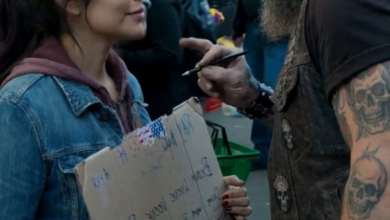
A Biker Blocked a Mother’s Van in a Parking Lot — She Called Police with Three Children Inside
Part 1 — Teaser
I put my motorcycle across the only clear lane out of the parking lot and made a mother of three stop her van, then watched her lock every door and call the police because she thought I was trapping her.
My name is Wade Kessler. At fifty-three I stood six foot three, wore a beard silver at the chin, and had the kind of scarred knuckles people notice before they listen to what I say. I had stopped at a grocery store outside Columbus, Ohio, to pick up bread for the garage. The woman in the van was Elena Brooks. I did not know her name yet. I knew only that she was backing away from a parking space with three children buckled inside and that I had seen something wrong with a rear tire when I walked past.
It was a thin opening along the sidewall, low enough to hide in shadow and deep enough that a pale layer showed inside the rubber. The wheel had been turned while she loaded groceries, which made the split briefly face me. I had worked on tires for thirty years. A sidewall damage like that was a reason to stop driving and have a professional look, especially before joining the highway a half mile down the road. I could not tell her how long it would hold.
I waved as she climbed behind the wheel. She was speaking to a small girl in the passenger side of the second row and did not see me. I stepped back to avoid the moving van, ran toward my bike, and rolled it across the parking aisle several yards ahead of her. There was room to stop. There was also no path around my motorcycle without crossing a curb. I lifted both hands and pointed at the tire. From inside the van she saw an imposing man blocking her way and waving toward the back of her vehicle. She put the transmission in park and reached for her phone.
“Move,” she shouted through a crack in the window. She had reason to. My leather vest and the idling bike offered no explanation, and three children's faces were turned toward me. One little boy started asking why we were not going home. I called, “Your tire.” She shut the window before I finished. When a grocery cart worker crossed behind me, I asked him to stay on the sidewalk and tell her what he could see. He had not noticed the damage. He moved closer to look, and Elena honked. The boy behind the windshield began crying.
I killed my engine. That did not make me less frightening in the first ten seconds. I moved well away from her door and toward a light pole so she had a clear view of my hands. I could have taken a picture of the tire and held it up; I worried that advancing with a phone would feel like another step toward her children. I chose to wait for the police she had already called. She did not owe me trust simply because I believed I was right.
The store manager came out after someone reported a biker preventing a customer from leaving. He asked me to move the motorcycle immediately. I asked him to look at the left rear tire first. He bent beside the van, then straightened so fast I thought he had scraped his head on the wheel arch. “Ma'am,” he said through the passenger window, “I think he saw something.” Elena shook her head. “Have him move, then we'll talk,” she answered. The manager asked me to roll the bike aside. I did, leaving the van free to go. A warning had to be a choice she could hear.
She did not go. She waited with the doors locked, watching us from behind the glass while her eldest child held up a small stuffed fox to comfort the youngest. A police cruiser came through the entrance. Officer Tran stopped between my motorcycle and the van, asked for my account, then spoke to Elena without me standing beside him. I could not hear what she said. I could see her shoulders lower once, then tighten again when Tran pointed toward the wheel.
He crouched and looked at the tire. His expression changed. He did not put a hand into the cut or announce that the van would certainly crash. He asked Elena if she would step out and see it herself after her children were safe in their seats. She opened the driver door slowly and kept the keys in her fist. I stayed by my motorcycle. I was the reason she had called for help; I could not also demand to be the person who comforted her.
Elena walked around the rear of the van. Tran showed her the damage. She stared at it, then at the three seats inside, as if she were measuring the distance from that tire to each child. A mechanic's truck turned into the lot. The manager had called him while we waited. He had not yet looked at the tire, so I did not give Elena a diagnosis.
“I checked those tires last week,” she said. Her voice was steady, but the keys in her hand made a small metallic sound. She glanced toward an envelope stuck under the rear wiper, one I had mistaken for advertising when I walked by. Who had touched the van between last week and now?
Part 2
I had missed the envelope until Elena looked at it. It was a plain white envelope caught beneath the wiper, wet along the edge from a passing shower. I did not touch it. A note on a vehicle and a slit in a tire close together can suggest an ugly story, but a suggestion is not evidence. Officer Tran asked Elena whether she recognized it. She said no. He took a photograph with her permission, then asked the manager if the store cameras covered that row. We needed facts before a suspect.
Elena had worked a morning shift at a school cafeteria. She had picked up the children from different locations and stopped for groceries because a storm was coming. The eldest, Sofia, was nine and had a school presentation in the morning. The twins, Mateo and June, were five. Elena was their sole parent at home, but she did not introduce herself that way to explain why she was cautious. She had three children strapped into a vehicle and a stranger blocking its exit. Caution required no biography.
The manager, Mr. Patel, brought water to the van and asked whether the children wanted to wait inside the store. Elena chose to leave them buckled until she understood whether the lot was safe. The mechanic arrived in a small service truck. His name was Rosa Jimenez, and she knelt by the wheel with a light. She did not even try to sell a roadside patch. She said the damage was on the sidewall and the tire should be replaced before the van was driven. A tow or an on-site wheel change would be safer than attempting the short trip to her shop. A short distance can still include the highway ramp.
I told Rosa she could use my floor jack if she needed it; she said hers was already in the truck. I stepped back. Mechanics can become possessive when they know a problem, but Elena was now talking to a professional she had chosen to trust in front of an officer and the store manager. The best contribution I could make was to give an accurate witness statement: the wheel's position when I first saw the split, the time on my receipt, the direction in which Elena had been backing. I did not say I had watched anyone damage it. I had not.
Tran asked why I had not simply called out instead of blocking the lane. I explained that I had tried to wave and she had not seen me. He said I could have gone to the store manager first. That was true. In the moment I pictured a mother turning onto a fast road before anybody caught her attention. My quick decision had stopped her; it had also frightened her children and left her thinking a stranger intended to keep her there. Outcomes do not erase the cost of the method. I apologized to Elena from a distance. She did not respond immediately, and I let the silence stand.
Sofia asked from the open sliding door whether the wheel had been broken. Rosa explained in ordinary words that the rubber was too badly damaged to drive on and that she would put on a safe replacement or arrange a tow. Sofia looked at her mother. “Did the biker do it?” she asked. Elena's face tightened. “We don't know who did it,” she said. I was grateful she had not made me answer for a suspicion we had no way to settle yet. Rosa told Sofia that the next thing was to keep the van parked while she worked. Children often need a next step more than a theory.
The envelope contained a blank folded sheet. Patel's camera later showed a passerby placing it under the wiper without going near the rear wheel; it appeared to be a store advertisement someone had reused. The timing was unsettling, but it did not identify the source of the cut. Rosa said a sharp object had likely damaged the sidewall, though a tire alone could not tell her whether it was deliberate. Elena had checked the tires the previous week, not every day since. The mystery was real, but it did not need a villain invented in the parking lot.
Part 3
Rosa did not have a matching tire in her truck. She could mount the van's spare if it was in usable condition, but the temporary wheel was not a sensible choice for a crowded highway trip with three children and groceries. Elena called a friend who owned a sedan. The friend could collect the children while Rosa arranged a tow to her shop. Patel kept the groceries refrigerated inside. I offered to pay for the tire. Elena said she needed to see the cost first. “I don't want to owe a man I met because he blocked my car,” she said. That was a boundary, not an insult.
I called Boone, our club treasurer, and asked whether the garage had an emergency transportation fund for a family whose car failed in a public lot. He said yes, but it was designed to work through a partner repair shop so no one had to accept cash from a stranger. I asked Rosa if her shop used the program. It did. She could tell Elena what it covered, leaving her free to decline. I gave Elena the information and then walked away to the bench beside my motorcycle. She chose to call the shop herself.
Her friend arrived in twenty minutes. The twins were sleepy and wanted to know if they could eat the bananas before they got home. Sofia carefully collected their backpacks, the stuffed fox, and the little cardboard model for her school presentation. Elena checked every seatbelt in the friend's car. I had imagined a dramatic moment when she turned to tell me I had saved them. Instead she was making sure the youngest had not left a shoe in the van. The real work of getting three children home was still happening.
Tran took a report because Elena wanted one, given the possibility that the tire had been cut. He requested available footage and told her what information she could provide if she noticed anything else. He did not promise to find an offender. He also asked if she felt safe with Wade remaining nearby. She said yes as long as I kept my distance. Hearing my name in her voice felt less like a welcome than a measured decision. I respected it.
Before leaving, she came over with the stuffed fox tucked under one arm. “Thank you for seeing it,” she said. “Please never block me in again.” I said I would not. I did not explain my fear one more time. I had already given it to the officer. Elena needed to get home. She held my gaze for a second, then returned to her children. I saw Sofia look back from the sedan's rear window, trying to reconcile the frightening biker and the fixed route home.
Rosa's tow arrived as rain began. She photographed the damage before moving the vehicle. She took the old tire to the shop for Elena to see in daylight and stored it until the report was complete. The cut appeared deep and clean enough that she continued to suspect a sharp tool, but she refused to state more than the evidence allowed. Nobody found footage of someone at that wheel. In the weeks that followed, Elena became more careful about where she parked without changing her life into a hunt for an unknown person. Uncertainty had to be managed, not fed.
The video from a shopper's phone had meanwhile turned me into the parking-lot villain. It showed my motorcycle across the lane and Elena inside with her doors locked. It did not show the tire. Boone wanted to post Rosa's photographs and the police report. I said those belonged to Elena. The club could say a safety concern had been reported and the lane was reopened, but I was not going to publish her children's faces or her vehicle details to improve my reputation. We knew how a cropped clip felt. We did not have to answer it with another family exposed.
Elena called Rosa two days later to ask if she could bring the children when she collected the van. Rosa invited them to see the replacement tire from a safe distance and to ask questions. She explained that a tire with damage on the side is not repaired by a plug, and that no one should drive it just because it still holds air while parked. That was a general safety lesson from a mechanic to a customer, not a dramatic promise that a crash would certainly have happened. The avoided risk was serious enough without predicting a tragedy.
Part 4
I saw Elena again at the shop because Rosa had asked me to help move a lift. I was under the van next to it, not hers, when I heard Sofia ask if the biker was there. I crawled out and let her decide whether to come closer. She stood beside her mother holding the cardboard model for her presentation. It had survived the day in the parking lot, though one paper tree had bent. I told her I was glad it was intact. “The wheel wasn't,” she said. I agreed. She asked why I had parked in front of them, and I told her I had made a fast choice because I wanted the van to stop before leaving the lot. “Mom thought you were bad,” she said. Elena answered, “I didn't know him, and I kept us safe while I found out.” That was a lesson I could support.
Rosa gave Elena an itemized bill, showed her the tire and explained the repair. The partner fund covered the tire and tow after Elena accepted its terms; she paid for an unrelated worn wiper herself. It mattered to her that the help had a clear receipt and did not leave a personal debt to me. She signed the paperwork, checked the spare and the new wheel, and made an appointment for a routine inspection later in the season. She had solved the immediate problem with a professional, not with my declaration that everything was fine.
The police found no usable footage of damage to the tire. The blank envelope was a dead end. Elena told me that a former coworker had once threatened her after a dispute, but she did not want that speculation in a public story and had shared the information with Tran. I never contacted the person. I understood the urge to find a human shape for a sharp cut, but suspicion on its own was a poor substitute for evidence. A mother deserved safety without having to supply a villain for an audience.
The clip kept circulating. One commenter wrote that any mother who locks the doors on a stranger deserves credit. Another wrote that I must have sabotaged the tire myself. The first was generous to Elena; the second was not supported by anything. I asked a customer who reposted the clip to remove the children's faces. He blurred them but kept the video. I could live with people discussing what they saw, as long as we did not pretend the first seconds contained the full account. The store manager later posted a short note about the tire and the service truck, with Elena's permission and no family details. It helped some people understand. It did not control everyone.
Elena invited Denise and me to a school fundraiser because Rosa had told her Denise coordinated the garage's donation table. We arrived in our truck, and I left my vest on the seat. Sofia recognized me anyway. Her model was displayed beside seven others, and she took five whole minutes explaining why her paper trees represented different seasons. I tried to listen without watching the parking lot. At one point she said, “You look less scary without the bike.” I said, “I probably do.” She was allowed to have noticed that.
Elena told me over lemonade that she had been ready to take the highway because the children had homework and she had a shift early the next morning. She did not need me to turn the near miss into a prophecy about rolling the van. She had seen Rosa's assessment. “I can be glad we stopped,” she said, “and still tell you the way you stopped us was awful.” I said she could. It was a more durable conversation than a thank-you speech because both of us kept the parts of the story the other might have preferred to erase.
After the fair, Elena asked whether the club's roadside fund required her to attend an event or let anyone photograph the van. I told her it did not. She looked relieved, then irritated that she had expected a catch. I did not try to argue her out of that feeling. A friend of hers had once accepted a donated appliance and then found pictures of her kitchen used to promote the giver's business. Elena wanted the tire, the receipt, and her family life kept separate. Help with a wheel should not claim the rest of a household.
Part 5
After the fundraiser, our club rewrote a small portion of its roadside-help guidance. If a rider spots a problem on someone else's parked vehicle, signal from a safe distance, speak to staff or call assistance, and avoid putting a motorcycle across the only exit if there is time for another option. We kept an exception for immediate danger, but insisted that the person being warned must be able to understand and choose. Boone read it aloud and asked for objections. Travis said the rules were making us sound like insurance adjusters. Rosa, who had come to talk about tire safety, replied that a safe warning is still a warning. Travis laughed and wrote that down.
Elena's van became a little different after the repair. She kept a pressure gauge in the console and made the children a game of finding numbers on the side of a parked bus while she checked the tires before a long trip. She did not tell them to crawl behind wheels or treat every scratch as sabotage. They learned that vehicles need maintenance and adults can ask mechanics when they are unsure. Sofia was especially interested in Rosa's truck. Rosa let her look at the tool drawers when the engine was off and promised nothing about a future career.
The emergency fund needed replenishing after several unrelated jobs. We held a weekend breakfast at the garage, with coffee and pancakes. Elena came by to pay a few dollars into the fund, and Boone tried to stop her. She said the assistance had been useful, and she wanted the next family to have the same clear receipt. Boone took her donation without turning it into a public symbol. Receiving help had not taken away her right to give it.
Once in a while I wondered what would have happened if Elena had simply driven around my bike. I could imagine several outcomes, some harmless and some terrible. It was tempting to choose the worst one so my decision would look necessary. Rosa would not let me. “The tire was unsafe,” she said. “That is enough.” She was right. Our world contains hazards we can verify and consequences we cannot. A true danger needs no invented ending.
Tran stopped by the garage months later to close the report with no identified offender. Elena had already received the notice. He asked how we handled reports from other drivers. I showed him the revised guidance. He pointed at the line about keeping exits open and nodded. He had seen too many people create traffic hazards while trying to prevent mechanical ones. I asked whether he thought Elena had been wrong to call him. “She had three children and a stranger blocking her path,” he said. “Of course she called.” I repeated that answer at the next club meeting.
At the school spring fair, Sofia set a painted tire on the craft table. It was a small cardboard ring she had made for a game, bright yellow with green dots. She called me over and told me not to worry because it was not a real wheel. I told her I would check with Rosa anyway. She laughed, and Elena did too. That laughter did not erase the panic in the parking lot. It showed that their memory of me had room for another afternoon.
Sofia's teacher asked her to explain the project to visitors. She described how circles roll and why they sometimes need replacing, then moved straight to the colors she had chosen. She did not mention me, a police cruiser, or the person who had damaged the van's tire. Elena stood nearby but did not steer her toward the story adults kept wanting. When the display came down, Sofia took her cardboard wheel home in the same grocery bag that carried her lunchbox. Her project was allowed to be about paint.
Part 6
On a Saturday in June, I saw Elena at a fuel station with all three children. The van was clean except for the usual fingerprints along the sliding door. She was checking the rear tires before a drive to visit her sister. I stayed where I was, and she waved first. Sofia held the stuffed fox up to the window like a passenger with its own seat. The twins had discovered a song everyone sang loudly on the way to the lake. Their road trip was finally an ordinary road trip.
I asked Elena if the tire had given her any trouble. She said no, then grinned and told me Rosa would give her a lecture if she skipped the scheduled rotation. We talked about a road closure and whether the lake parking lot charged on weekends. We did not revisit the stranger blocking her in, although it sat quietly between us as part of how we met. She had come to know that I would step back when asked. I had come to know that her first instinct in the van had been to keep her children safe.
At the club we continued to help drivers, mostly in unremarkable ways. A rider lent a flashlight to a trucker changing a wheel. Another stayed with an older neighbor until the tow service arrived. We did not chase cars to deliver safety lessons or use an encounter as material for a heroic clip. Sometimes a driver turned down an offer, and we let them. Good intentions do not create a right to the driver's door.
Rosa expanded the emergency repair fund with two other shops. She was clear that her shop needed records and fair prices, not stories of desperate families circulated online. Elena helped her write a short form customers could use without explaining every personal detail in front of a waiting room. I occasionally carried paperwork across town when the garage printer failed. That was my place in the project: not the star of a tire story, just a man with a reliable truck and time on Thursdays.
At one meeting Rosa showed us three ordinary tires removed for different reasons. She explained to the riders that we could point out visible damage but should leave final assessment to the trained mechanic and let the driver decide where to seek help. I thought about the way I had stood by my bike while Elena spoke to her. That step back had felt like doing nothing. In fact it had let the person with tools and responsibility give an answer Elena could use. Knowing when to hand over a problem is part of noticing it.
Part 7
At the end of summer, Sofia left a drawing at our garage. It showed a green motorcycle parked beside a yellow van, with a large empty lane between them. Above the lane she had painted three children riding toward a blue lake. Her drawing did not place me in front of their vehicle. I put it on the wall where the men who wrote the roadside guidance could see it. The empty space was the part she remembered best.
Elena drove by with the twins one evening to collect the drawing after Sofia changed her mind about leaving it. She wanted it for her bedroom. I gave it back without asking for a replacement. Elena asked if I had checked their tires with my eyes when they pulled in. I admitted I had. “They're fine,” she said. I said, “Good,” and kept my hands off the van.
Some people still ask whether I saved a family on the highway. There was no highway crash to see and no way to know what would have happened at speed. The rear tire had a deep sidewall cut. Rosa replaced it before Elena drove again. The children went home with a friend that rainy afternoon, and their mother made the choices that followed. Those facts are large enough for me.
When the van left the garage, I waited until it had turned safely into the street before I rolled out on my motorcycle. Sofia waved the stuffed fox through the back window. I lifted one hand. The road ahead belonged to them.
Follow our page for more biker stories about paying attention, making amends, and remembering that the people we help still choose their own way home.
CAPTION 1
A biker swung his motorcycle across the exit of a grocery parking lot and stopped a mother with three children in her van. She locked the doors and called police.
I was that biker. I'd seen something while walking past her rear wheel, but she had already started backing out. I waved. She didn't see me. The highway ramp was less than a mile away, so I moved my bike ahead of her and raised both hands.
From her seat I must have looked like a stranger trapping her family. One child began crying. She shouted for me to move, and I tried to explain, but she shut the window before I finished. A store manager came out and ordered me to clear the lane. I asked him to look at the back of the van first.
He crouched near the wheel and stood up suddenly. Then he told me to move my motorcycle. I did. The mother was free to leave, but she kept the transmission in park as a police cruiser pulled up.
The officer spoke with her first, then knelt by the same wheel. His expression changed before he said a word.
Read what happened next in the first c0mment.
VIDEO PROMPT 1
Create exactly 10 seconds of vertical 9:16 teaser footage in real-life cinematic video style, high-quality realistic footage, natural handheld camera movement, authentic everyday-life atmosphere, emotionally believable acting. Ohio grocery parking lot, overcast. Wade, imposing 53-year-old white American biker with silver beard, scarred hands, plain black leather vest and boots; Elena, 34-year-old Latina American mother behind the wheel of a family van; three children ages 9, 5 and 5 strapped inside; store manager and police officer. 0–2s: immediate paradox, Wade parks a motorcycle across Elena's exit lane and holds up his hands while she locks the van doors and grabs her phone; no establishing shot. 2–5s: store manager asks Wade to move; he rolls the bike aside, giving Elena a clear path while children watch anxiously. 5–7.5s: manager crouches by the left rear tire in shadow, his face changes but the damage stays partly obscured. 7.5–10s: arriving officer speaks to Elena, then looks toward the wheel; her keys tremble in her fist, hard CUT before the mechanic explains. No readable plates or screens. No text, no logo, no readable patches. No POV. No flashback, no explanatory montage, no final twist, no resolved conflict, no happy-ending payoff; cut at the peak of mystery.
CAPTION 2
The mother held her keys so tightly they rattled when she stepped out of the van. Ten minutes earlier, a gray-bearded biker had blocked her only path out of the parking lot while her three children watched.
Elena had just bought groceries before an early shift the next day. The children were tired; the highway home was close. A large man in a leather vest appeared ahead of her with his motorcycle across the lane. He pointed at the back of her van. She locked every door and called police.
The store manager asked the biker, Wade, to move. He obeyed but insisted the manager look at the left rear wheel. The manager bent down, then went inside to call a mechanic. Elena could have driven away. Instead she waited for the officer to speak with her from a safe distance.
Her eldest held up a stuffed fox to comfort the twins. The officer finally asked Elena to come look at the wheel herself. Near the rear wiper sat a damp envelope she didn't recognize.
She whispered, “I checked the tires last week.” The mechanic's truck turned into the lot.
Read what happened next in the first c0mment.
VIDEO PROMPT 2
Create exactly 10 seconds of vertical 9:16 teaser footage in real-life cinematic video style, high-quality realistic footage, natural handheld camera movement, authentic everyday-life atmosphere, emotionally believable acting. Same Ohio grocery lot, Wade, broad 53-year-old white American biker with gray beard and plain leather vest; Elena, 34-year-old Latina American mother; Sofia, 9, holding stuffed fox in family van beside five-year-old twins; adult officer and mechanic Rosa. 0–2s: start inside van framed outward as Wade's motorcycle abruptly blocks the lane at a safe distance, Elena locks the doors and the twins recoil. 2–5s: from outside Wade raises open hands, steps away and moves the motorcycle aside at manager's request; Elena remains parked by choice. 5–7.5s: officer crouches beside shadowed left rear tire, mechanic's service truck enters behind him; no instructional close-up or full reveal. 7.5–10s: Elena steps out with keys shaking, looks where the officer points, then notices a damp blank envelope under her wiper; hard CUT before her reaction. No text, no readable brand or plate. No text, no logo, no readable patches. No POV. No flashback, no explanatory montage, no final twist, no resolved conflict, no happy-ending payoff; cut at the peak of mystery.