The Biker Cut an Insulin Pump Tube from a Schoolgirl on a Moving Escalator—Then Knelt Beside Her Until the Daughter Who Hated Him Arrived
Part 2 — The Blue Circle Hidden Inside Hammer’s Vest
My name is Elena Morales, and the first thing I did after Sofia’s condition stabilized was apologize to the man whose face I had struck.
Hammer stood inside the mall security office with one wrist cuffed to a metal bench. A purple bruise had formed across his cheek, and dried blood marked his beard.
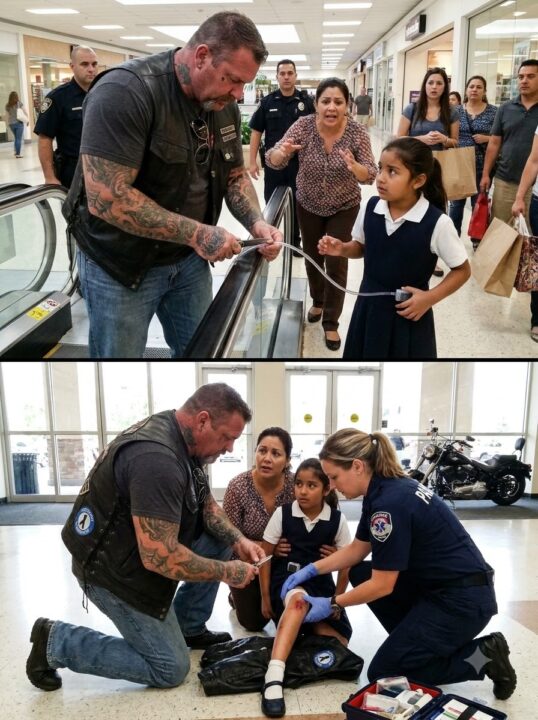
The guard had detained him because someone reported a knife attack before witnesses explained the escalator.
Camera footage had already confirmed the truth.
Hammer had seen Sofia’s tubing tighten. He ran toward her, supported her body, cut the trapped line, and carried her over the landing.
My daughter’s injury amounted to a scraped knee, a bruised infusion site, and several frightening minutes without a functioning delivery line.
Without his intervention, the outcome might have been much worse.
“I hit you,” I said.
He shrugged.
“You saw a knife near your kid.”
“That doesn’t excuse it.”
“No. But it explains it.”
Hammer did not make forgiveness easy or dramatic. He simply refused to use my panic as another weapon against me.
Emily stood near the doorway finishing her report. She had not addressed him again since helping Sofia.
The resemblance between them became clearer whenever neither was speaking. They shared the same gray eyes, square jaw, and habit of turning pain into work.
Hammer watched her repack the medical bag.
Emily ignored him.
When security released the cuff, he rubbed his wrist and picked up his vest. The lining opened long enough for me to see the blue circle again.
It was hand-stitched, uneven, and faded by years of sweat.
“You knew about pumps because of her,” I said.
Hammer nodded.
Emily finally looked toward us.
“He knew enough to disappear whenever things got hard.”
Her voice was controlled, but control is not the absence of anger. Sometimes it is anger trained to stand still.
Hammer slipped one arm into his vest.
“That’s not for here.”
“You don’t decide where it belongs anymore.”
The security guard became interested in his paperwork. I wanted to leave them privacy, but Sofia held Hammer’s hand from the wheelchair.
“Please don’t go yet,” she said.
He stayed.
Emily closed the office door and told us the history her father would not.
She had been diagnosed with Type 1 diabetes at eight years old, when Hammer was thirty-two and recently discharged from the Army.
His wife Caroline—Emily’s mother—had died from an aneurysm six months earlier.
Hammer was grieving, injured, and raising a child whose life suddenly required measurements, supplies, alarms, appointments, and decisions no frightened parent felt qualified to make.
He learned anyway.
He memorized carbohydrate counts. He attended pump training with tattooed hands folded across a notebook covered in Emily’s cartoon stickers.
He checked her glucose at midnight, 2:00 a.m., and 4:00 a.m., then repaired trucks during the day.
When Emily’s first pump alarmed during a school concert, Hammer climbed across six rows of folding chairs carrying juice and a backup kit.
“He embarrassed me constantly,” Emily said.
Hammer almost smiled.
“You were twelve.”
“I was playing a tree.”
“You were the best tree.”
For one brief second, they sounded like family.
Then Emily’s expression closed.
Hammer’s military injuries led to prescription pain medication. After years of controlled use, a surgery increased the dosage, and dependence followed.
He missed an endocrinology appointment.
Then another.
Bear and Marisol tried helping, but Hammer lied to them. He claimed the medication remained necessary and insisted he could still manage Emily’s care.
One winter night, he fell asleep in the garage while her pump alarmed upstairs.
Emily handled the problem herself.
She was sixteen.
That incident broke something neither of them knew how to repair.
Hammer entered treatment after Bear found him unconscious beside the Harley. He remained sober for fourteen months, relapsed once, and started again.
Emily left for college.
She trained as an emergency medical technician, then a paramedic, partly because she never wanted another person to feel abandoned beside a medical alarm.
Hammer sent letters.
Emily returned them unopened.
“He wanted credit for getting sober,” she told me. “I wanted the father who should never have left.”
Hammer accepted the sentence.
He did not remind her about his injuries or defend addiction as something stronger than intention. He understood explanations could become excuses when offered to the person who survived the consequences.
Sofia listened quietly.
Teenagers possess an uncomfortable instinct for adult hypocrisy, but she also recognized the expression of someone managing a body that demanded constant attention.
“You still wear a pump?” she asked Emily.
“Yes.”
“Did yours ever get caught?”
Emily glanced at Hammer.
“When I was fourteen, the tubing snagged on a grocery cart. Dad cut it before the site tore.”
That explained his speed.
He had seen the exact danger before.
Yet another detail remained.
Why were twelve bikers and a supply van waiting outside the mall?
Iron Mercy Riders had planned a charity collection that afternoon for Ride the Numbers, a local program delivering diabetes supplies, transportation, food, and emergency lodging to families facing medical crises.
Hammer founded it after Emily stopped speaking to him.
He refused to name the program after her because he believed using her identity without permission would become another way of taking control.
Inside his saddlebag, he carried sealed emergency kits prepared by licensed clinicians. He never distributed medical supplies on his own or pretended road experience replaced professional care.
“He built a whole program for strangers,” Emily said, “because strangers couldn’t reject his apologies.”
Hammer looked at the floor.
“That’s not why.”
“Then why?”
“Because they needed it.”
Emily laughed without humor.
“I needed you.”
That was the sentence he could not answer.
Sofia squeezed his hand.
An officer entered with new information before anyone spoke again.
Mall maintenance had inspected the escalator after the incident. A protective side brush designed to discourage loose clothing and objects from nearing the gap had been removed during repairs.
Three technicians reported the problem.
Management reopened the escalator anyway.
Worse, the security office had received a warning that morning after another shopper’s shoelace became caught.
Nobody shut the machine down.
The mall’s attorney arrived twenty minutes later and offered to cover Sofia’s medical expenses if I signed a preliminary confidentiality agreement.
Hammer read the first page.
Then he tore it in half.
The attorney threatened to have him removed.
Hammer placed the pieces on the desk.
“She signs nothing today.”
The lawyer turned toward me.
“Is this man representing you?”
I looked at the biker whose face still carried the mark from my hand.
“He is now.”
That decision pulled all of us into a fight none of us understood yet, because Rivergate Center was not merely hiding one neglected escalator.
The company maintaining it belonged to the last person Hammer expected to see.
Emily’s husband.
Part 3 — The Video That Made Hammer Look Like a Monster
By Sunday morning, a twelve-second video of the incident had received more than two million views.
The recording began after Hammer drew his knife and ended before the trapped tubing appeared. It showed an enormous biker restraining a struggling schoolgirl while her mother attacked him.
The caption called him “a knife-wielding biker cutting insulin from a diabetic child.”
Nothing in the clip showed the escalator pulling Sofia backward.
Nothing showed Hammer lifting her over the landing.
Nothing showed the mangled tubing recovered from inside the machine.
The account posting it belonged to a Rivergate Center marketing contractor.
Mall management claimed the contractor acted independently, yet the edited video conveniently shifted public attention away from the missing safety component.
People identified Hammer within hours.
They posted photographs of the Iron Mercy clubhouse, insulted Emily, and accused Ride the Numbers of collecting medical equipment for illegal resale.
Anonymous complaints reached the charity’s partner clinics.
Two sponsors suspended donations.
A restaurant canceled an upcoming fundraiser.
Hammer refused to answer publicly.
“If we respond,” Bear argued, “we show the full video.”
“The full video shows the kid’s pump site,” Hammer said. “Her medical information isn’t club property.”
“We can blur it.”
“Then ask Elena.”
Every face turned toward me.
I wanted the lie corrected. I wanted the world to see precisely what Hammer had done before someone threatened him or Sofia.
My daughter said no.
“I don’t want millions of people watching me scream.”
Bear rubbed both hands over his beard.
Without our footage, the club could release the security angle, but the mall controlled it. Attorneys claimed the recording belonged to an active investigation.
Iron Mercy’s younger members demanded direct action. One prospect suggested surrounding the mall with motorcycles until management released the video.
Marisol shut him down.
“Children use that entrance. We don’t turn their weekend into our protest.”
Another rider proposed identifying the marketing contractor online.
Hammer refused that too.
“We know what it feels like when strangers decide guilt from twelve seconds. We don’t do it back.”
His restraint divided the club.
Members had lost jobs over the accusations. Bear’s daughter received threats at her diner, and someone spray-painted CHILD HURTER across the clubhouse door.
Hammer removed his president patch and placed it on the table.
“If protecting the patch costs Sofia her privacy, the patch costs too much.”
Nobody picked it up.
That afternoon, Emily’s husband arrived at the clubhouse.
His name was Nathan Cole, a mechanical engineer and regional manager for Apex Vertical Systems, the company responsible for Rivergate’s escalators.
He wore a pressed jacket, expensive shoes, and an expression suggesting the building itself smelled unacceptable.
Emily stood when he entered.
She had not told us Nathan’s company maintained the mall.
Nathan insisted Apex documented the missing brush and recommended closure. Rivergate management overruled them because Saturday shopping traffic was expected to be heavy.
He produced an email supporting that claim.
Hammer studied it.
The message contained no signature from Nathan.
“Who sent the warning?”
“One of my technicians.”
“Name?”
“I’m not discussing personnel.”
Emily crossed her arms.
“Why?”
Nathan looked toward her.
“Because this is a legal matter.”
“No. This is a child matter.”
The room tightened.
Nathan admitted that Apex technicians removed the safety brush while awaiting a replacement. Company procedure required the escalator to remain closed, but a supervisor allowed Rivergate staff to restart it.
Hammer asked who approved the restart.
Nathan avoided the question.
That was answer enough.
Emily stared at her husband.
“You approved it.”
Nathan’s face changed.
“Temporarily.”
Apex faced financial penalties whenever equipment remained unavailable during contracted service windows. Rivergate threatened to terminate the agreement if the escalator stayed closed over the weekend.
Nathan authorized operation for forty-eight hours.
He believed the remaining safeguards were sufficient.
“You knew the side protection was missing,” Emily said.
“The escalator still met the minimum operational threshold.”
Sofia stood beside me.
“My body wasn’t part of your threshold?”
Nathan looked away.
Hammer moved toward him.
Bear rose.
So did Marisol.
Every person in the clubhouse remembered Hammer’s history: combat trauma, addiction, years of anger, and a daughter who associated him with abandonment.
Nathan seemed to remember only the size of the man approaching.
Hammer stopped one foot away.
“You’re going to tell the truth.”
Nathan straightened his tie.
“I will tell investigators what the records establish.”
“That’s not what I said.”
Emily stepped between them.
“Dad, don’t.”
The word escaped before she could stop it.
Hammer froze.
Nathan noticed.
He smiled faintly, believing the family connection weakened her judgment.
“You are too involved,” he told Emily. “Go home.”
She removed her wedding ring.
Nathan’s confidence disappeared.
“You chose a service contract over a warning involving children,” she said. “Then your client released an edited video blaming the man who prevented the injury.”
“I did not release anything.”
“But you knew they had.”
Silence confirmed it.
Nathan had learned about the misleading video Saturday night. He said nothing because public anger against Hammer protected Apex from immediate scrutiny.
Emily placed the ring on the clubhouse table.
“I’m staying here.”
Nathan left with an attorney fifteen minutes later.
The marriage did not end in a dramatic shout. It ended with a small circle of gold beside Hammer’s discarded president patch.
We believed exposing Nathan’s authorization would clear Hammer.
Instead, the crisis deepened.
Apex attorneys produced Hammer’s criminal record. They described him as a former addict with an assault conviction and argued his use of a knife created an unnecessary secondary hazard.
The conviction came from an incident eight years earlier.
According to the court summary, Hammer attacked a pharmacy employee during a dispute over insulin.
Emily read the document twice.
Then she looked at her father.
“You told me you were arrested for possession.”
Hammer said nothing.
She stepped closer.
“That wasn’t true.”
“No.”
“Whose insulin?”
His scarred hands closed.
“Yours.”
Emily’s face emptied.
The returned letters, the estrangement, and the blue circle inside his vest suddenly pointed toward a history she had never been allowed to see.
But before Hammer could explain, Sofia’s pump alarm sounded.
Her glucose had begun rising after the disrupted infusion and the stress of the afternoon.
Emily immediately moved toward her.
Hammer stepped backward.
He understood knowing how to help did not give him permission to interfere.
Sofia checked her monitor with my assistance, following the care plan provided by her medical team. Emily remained nearby until the reading stabilized.
Only then did Sofia look toward Hammer.
“You protected her insulin too, didn’t you?”
Hammer picked up the old court document.
“No,” he said. “I failed her first.”
Part 4 — The Pharmacy Door Hammer Broke Eight Years Earlier
Hammer’s letters were stored inside a black toolbox beneath his workbench.
There were ninety-six of them.
One for every month Emily had refused contact.
Most envelopes remained unopened, their corners softened from years inside his saddlebag. Several bore forwarding labels, while others carried the red stamp RETURN TO SENDER.
The first letter explained the pharmacy.
Eight years earlier, Emily was twenty-four and studying to become a paramedic. She was living alone, working nights, and paying for medical supplies through a combination of insurance, discount programs, and borrowed money.
A paperwork error interrupted her coverage.
The pharmacy would not release part of her prescription until the issue was resolved.
Hammer learned about it through Marisol, not Emily.
He arrived angry.
That part of the police report was true.
He demanded the pharmacist release the supplies, offered cash, and refused to leave after employees explained they could not legally process the order without authorization.
The situation escalated.
A security guard grabbed Hammer from behind. Hammer turned, struck him, and broke the pharmacy’s glass door during the struggle.
Nobody inside knew that a licensed clinic across town had already arranged an emergency supply for Emily.
Hammer was arrested.
His actions solved nothing.
They made Emily’s crisis public, frightened employees, and confirmed every fear she carried about the father whose anger had dominated her childhood.
She visited him once in jail.
“Did you think breaking a door would make insulin appear?” she asked.
Hammer had no answer.
Emily told him never to contact her again.
He agreed because he believed compliance was the only apology still available.
Then his court-appointed attorney discovered something important. The insurer had repeatedly sent cancellation notices to an apartment Emily had left two years earlier.
Hammer had received copies at his home because the policy originated when she was a minor.
He ignored them.
He was sober, but he was ashamed to admit how poorly he understood the paperwork. He placed the letters inside a drawer and planned to ask Emily later.
Later never came.
The coverage lapse resulted partly from his silence and his embarrassment.
When the pharmacy refused the order, Hammer attacked the final obstacle he could see rather than accepting that the first failure had happened at his kitchen table.
He pleaded guilty to assault and property damage.
He served fourteen months.
During that time, he completed addiction counseling, anger-management treatment, and every diabetes-family education course the facility offered.
He wrote Emily monthly.
He never mailed the first eleven letters because he had promised not to contact her. After his release, a counselor convinced him that sending one apology without expectation might be reasonable.
Emily returned it.
Hammer kept writing anyway, not because he expected forgiveness, but because the letters forced him to describe his failures without shouting over them.
The final envelope remained unsealed.
It was dated the morning of the mall incident.
Emily opened it.
Inside, Hammer had written about Ride the Numbers and the charity collection scheduled at Rivergate. He explained that the program had helped 214 families without using her name.
At the bottom was one line.
“I finally learned that protecting someone is not the same as controlling them.”
Emily sat on the garage floor with the letter across her knees.
Hammer remained outside.
He would not enter unless she invited him.
Sofia found something else inside the toolbox: a faded photograph of Emily at fourteen, standing beside a grocery cart with severed pump tubing in one hand.
A much younger Hammer knelt beside her holding the same folding knife he had used in the mall.
On the back, Caroline had written:
Ray cut the line before it pulled her down. Emily called him her road guard all week.
Emily read the words.
“I forgot this.”
Hammer answered from the doorway.
“I didn’t.”
The knife was not a weapon he carried because he expected violence. It was the rescue tool he had kept since that grocery-store accident.
Every year, he cleaned it, sharpened it, and considered removing it from his vest.
Every year, he remembered the sound Emily made when the cart caught her tubing.
He kept it.
That explained the blade.
It did not explain why Nathan knew about Hammer’s record before Apex attorneys introduced it.
Emily searched her husband’s shared files.
She found correspondence with Rivergate’s legal team dating from Saturday night. Nathan had provided Hammer’s full name, club affiliation, and criminal history.
He also supplied confidential details about Emily’s estrangement, suggesting opposing attorneys portray Hammer as obsessed with diabetic children because of his daughter.
Nathan had not merely remained silent.
He had built the defense around destroying his wife’s father.
Emily forwarded every message to investigators.
Then she walked outside.
Hammer stood beside his Road King with both hands resting on the worn handlebars. Cold rain darkened his shirt, but he had not moved beneath the garage roof.
“You should have told me about the notices,” she said.
“Yes.”
“You should not have broken that door.”
“No.”
“You should have called after jail.”
“I promised not to.”
“You wrote ninety-six letters.”
“Ninety-seven.”
Emily held up the unsealed one.
“Why keep writing if you believed I’d never read them?”
Hammer looked down at the fuel tank.
“So I wouldn’t rewrite history in my head.”
That answer reached her where excuses could not.
He had not preserved the letters as evidence of devotion. He preserved them as a record of accountability.
Emily stepped closer.
“I’m not ready to forgive you.”
“I know.”
“I may never be.”
“I know.”
“But Sofia could have been pulled into that escalator.”
Hammer’s hands tightened.
“Yes.”
“And you saw it.”
“Yes.”
Emily took a breath.
“Thank you.”
Hammer closed his eyes.
He did not hug her.
He did not ask for more.
He simply nodded, accepting the smallest opening without trying to widen it.
Then Bear entered the garage carrying news that Rivergate Center had offered me a settlement. The amount would cover Sofia’s medical costs, education, and years of pump supplies.
The condition was simple.
I had to release the mall from liability and publicly state that Hammer’s decision to use a knife caused the greatest danger.
Sofia read the offer.
She looked at me.
Then she tore it exactly where Hammer had torn the first agreement.
“No.”
The word belonged to both of us.
We rejected the settlement.
That choice placed our family, Iron Mercy, and Emily against a corporation prepared to spend more money defending one neglected machine than repairing every escalator in the building.
For the first time, Hammer did not stand in front of us.
He stood beside us.
Part 5 — What the Camera Above the Pretzel Stand Recorded
The truth came from a camera Rivergate management forgot it did not own.
A pretzel-shop operator named Arjun Patel had installed a private security system after repeated thefts near his register. One camera faced the lower escalator landing.
Its footage began seven minutes before Sofia’s accident.
A small boy’s shoelace caught briefly near the same side gap. His father pulled him free and notified a mall employee.
The employee placed a yellow cone near the escalator.
A supervisor removed it two minutes later because shoppers were gathering around the obstruction.
Nathan appeared next.
He examined the missing side brush, spoke with the supervisor, and used his access key to restart the escalator after a brief shutdown.
The video contained no audio.
It needed none.
Nathan knew.
Rivergate knew.
Both chose traffic flow over caution.
The same camera recorded Hammer entering from the parking garage with Bear and two sealed donation boxes. It showed him stop, turn his head, and focus on Sofia before she stumbled.
Then came the moment millions of people had not seen.
The tubing tightened.
Sofia’s body snapped backward.
Hammer ran.
He supported her with one arm, cut the trapped line with the other, and lifted her clear before the final step folded beneath itself.
The recording showed my first strike landing while Hammer still held Sofia away from the machinery.
It showed him release the knife immediately.
It showed him kneel.
Arjun gave copies to investigators, our attorney, and local news without demanding payment.
Rivergate attempted to block publication.
The judge refused.
Within hours, the full footage replaced the edited clip across social media. People who had called Hammer a monster began calling him a hero.
He disliked both words.
“Same strangers,” he said. “Different twelve seconds.”
Reporters gathered outside the clubhouse. Hammer refused interviews that centered him rather than the safety failure.
Emily agreed to speak.
She stood beside Sofia and explained that cutting the trapped tubing interrupted insulin delivery but prevented immediate mechanical injury. She emphasized that medical emergencies require professional guidance and that Hammer acted in a unique, rapidly unfolding entrapment.
Then Sofia approached the microphones.
She wore her pump securely beneath her shirt, with the tubing arranged according to advice from her care team.
“The biker did not cut me away from insulin,” she said. “He cut me away from an escalator.”
That sentence appeared everywhere.
Ride the Numbers received thousands of donations. Hammer insisted the club suspend online fundraising until an independent accountant could review every contribution.
He had spent years building trust quietly and would not let sudden attention transform children’s medical needs into entertainment.
The brotherhood accepted the decision, although some members feared losing the moment.
Bear put it differently.
“A viral week feeds the ego. A clean ledger feeds families.”
The club reinstated Hammer’s president patch after a unanimous vote.
He did not immediately wear it.
He placed it beside Emily’s first returned letter, reminding himself that authority did not erase accountability.
Nathan resigned from Apex before the company terminated him. State investigators suspended his engineering license pending review, while Rivergate faced penalties, civil claims, and mandatory safety upgrades.
Emily filed for separation.
She did not move into Hammer’s home or pretend their relationship had healed overnight. She rented a small apartment near the ambulance station and agreed to meet her father for coffee every Thursday.
The first meeting lasted eleven minutes.
The second lasted seventeen.
During the third, Hammer apologized for falling asleep while her pump alarmed sixteen years earlier.
Emily did not tell him everything was fine.
“It wasn’t fine,” she said.
“I know.”
“But you remember.”
“Every beep.”
That was enough for another Thursday.
Sofia joined them once. She asked Hammer why the blue patch inside his vest carried Emily’s name if Emily had rejected him.
Hammer opened the lining.
The patch had been cut from the first diabetes-awareness shirt Emily wore after diagnosis. Caroline stitched it into his vest before she died.
Beneath the blue circle was a narrow transparent pocket.
Inside rested a small strip of clear insulin-pump tubing.
It came from the grocery-cart accident when Emily was fourteen.
Hammer had kept the severed piece for eighteen years.
Sofia laughed.
“That’s weird.”
“Yeah.”
“Why keep broken tubing?”
Hammer considered his answer.
“Some broken things remind you what didn’t break.”
Emily looked away, but her mouth softened.
Sofia asked whether she could add her own piece from the escalator.
I expected Hammer to refuse because the damaged tubing remained evidence. After investigators released it months later, he cut a clean one-inch section and placed it beside Emily’s.
Two clear lines rested inside the vest.
One belonged to the daughter he failed and later saved.
The other belonged to the stranger who brought that daughter back into his life.
The club began offering Tangle-Free Days with local diabetes educators, school nurses, device representatives, and emergency responders.
They did not provide medical treatment or encourage bikers to handle pumps. Their role was transportation, setup, fundraising, and listening.
Emily led the clinical sessions.
Hammer carried folding tables.
Children loved asking why the enormous man obeyed the smaller paramedic.
“She’s the boss,” he said.
Emily corrected him.
“I’m the professional.”
The distinction mattered.
Hammer had spent half his life confusing love with the need to take control. Now he practiced standing nearby without stepping across someone else’s expertise.
Sofia watched closely.
She had also changed.
Before Rivergate, she sometimes hid equipment problems because she feared I would restrict her independence. Afterward, we created a new agreement with her diabetes team.
She would speak when something felt wrong.
I would listen before reacting.
Freedom would not mean silence, and protection would not mean control.
That promise helped us more than any dramatic rescue.
One Thursday, Emily arrived at Murphy’s Diner carrying an old cardboard box. She placed it between herself and Hammer.
Inside were every birthday card he had mailed to Marisol for safekeeping after Emily began returning his letters.
Marisol had not delivered them.
She respected Emily’s boundary while preserving the cards in case that boundary ever changed.
Emily opened the first.
A cartoon motorcycle carried eight candles.
Hammer had drawn it badly.
She laughed before she could stop herself.
He heard the sound and looked toward the window, granting her privacy even while sitting across the table.
Emily opened another card.
Then another.
They stayed until the waitress stacked chairs around them.
When they left, Hammer did not ride home alone.
Emily climbed onto the passenger seat of his Road King for the first time since she was sixteen.
He handed her a helmet with a blue circle painted near the back.
“Too much?” he asked.
She examined it.
“A little.”
“You want another?”
Emily put it on.
“Next time.”
Those two words gave Hammer something forgiveness could not yet provide.
A next time.
Part 6 — Thursdays at Murphy’s Diner
Hammer and Emily continued meeting every Thursday at 6:30.
Some evenings they spoke for an hour. Other evenings they drank coffee in silence while the diner’s refrigerator hummed behind the counter.
Hammer never brought the ninety-seven letters unless Emily requested one.
She read them slowly, sometimes taking a single envelope home for several weeks. Several letters made her angry enough to skip the following meeting.
Hammer still arrived.
He sat in the same booth, ordered two coffees, and left hers untouched until closing.
When she returned, he did not ask where she had been.
That became their ritual.
Sofia and I joined the Iron Mercy Riders during monthly Ride the Numbers deliveries. I drove the supply van while she checked inventory under Emily’s supervision.
Hammer handled boxes and loading ramps.
His Road King usually led the route, its V-twin rumble rolling through the Ohio mornings before stopping outside apartments, clinics, rural schools, and family shelters.
The club never photographed recipients without permission.
Hammer understood help becomes humiliation when the giver needs an audience.
At Rivergate Center, the repaired escalator reopened after an independent inspection. New protective features lined both sides, and maintenance records appeared beside a public inspection certificate.
Sofia avoided it for six months.
Nobody pressured her.
When she finally returned, Hammer waited on the lower level while Emily and I stood behind her.
Sofia secured her pump and stepped onto the first moving stair.
Her hand locked around the rail.
Hammer looked up.
He did not climb toward her or tell her she was safe. He remained still, letting Sofia reclaim the machine without turning courage into another performance.
She reached the bottom.
Then she raised both arms.
Hammer nodded once.
Emily smiled.
The pretzel-shop owner rang a small counter bell, and shoppers nearby began applauding without understanding why.
Sofia hated the attention.
She also bought two cinnamon pretzels.
Rivergate offered her family a new settlement without the dishonest public statement. Part of the agreement funded independent safety audits and a community emergency-access program.
We accepted after our attorney reviewed it.
Sofia donated a portion to Ride the Numbers, but Hammer required the money to pass through the independent board rather than the club.
“Trust needs paperwork,” he said.
That sentence made Emily laugh because it was precisely what the younger Hammer had refused to understand.
On the first anniversary of the accident, she returned his original folding rescue knife.
Investigators no longer needed it.
The handle carried scratches from the grocery cart, pharmacy door, and Rivergate tile. Hammer turned it over without opening the blade.
Emily gave him a small engraved case.
The message contained five words:
CUT THE DANGER, NOT THE TRUST.
Hammer read it twice.
Then he placed the closed knife inside.
He no longer carried it in his vest. A certified rescue tool remained secured with the club’s emergency equipment, available only for appropriate situations.
The old knife stayed in his garage beside the letters.
Some objects had completed their work.
The blue patch remained inside his cut.
So did both pieces of tubing.
Whenever a child asked about them, Hammer never described himself as the rescuer. He told them one line belonged to Emily and one belonged to Sofia.
“What do they mean?” children asked.
He always gave the same answer.
“Pay attention before you panic.”
I knew the sentence was intended for him as much as anyone else.
Part 7 — The Escalator Ride They Chose Together
Three years after the Rivergate incident, Sofia began volunteering with Emily during family education events for teenagers using diabetes technology.
She never presented herself as a medical expert.
She spoke about fear, embarrassment, school hallways, clothing choices, and the exhausting desire to look ordinary when your body required visible equipment.
Hammer attended every event.
He parked outside, carried boxes, arranged chairs, and made sure nobody ran out of coffee.
Most families knew his story, although new parents sometimes became uneasy when they saw the giant biker standing near children’s medical supplies.
Hammer never corrected their first impression.
He let his behavior do the work.
At the final event before Sofia left for college, the group met inside Rivergate Center’s community room. Afterward, she asked Hammer to walk with her toward the escalator.
Emily followed.
So did I.
Sofia stopped at the top and looked down toward the exact place where Hammer had cut her tubing years earlier.
The polished metal reflected overhead lights. Shoppers moved around us without recognizing the location where millions of strangers once judged a man from twelve seconds.
Sofia secured her equipment.
Then she offered Hammer her hand.
He stared at it.
“You sure?”
“Yes.”
They stepped onto the escalator together.
Hammer stood one stair below, not holding her body or checking her pump. His hand rested loosely in hers because this time she had invited him.
Emily stepped behind them.
Halfway down, Hammer looked over his shoulder at his daughter.
She looked back.
No apology passed between them. No perfect forgiveness erased the nights Emily faced alarms alone or the years Hammer spent writing to an address that returned everything.
Yet they were moving in the same direction.
At the bottom, Sofia released Hammer’s hand. Emily did not.
She kept holding her father’s scarred fingers as they crossed the landing.
Hammer looked toward her.
“Coffee Thursday?”
Emily shook her head.
His face fell slightly.
Then she smiled.
“Dinner Sunday.”
Hammer nodded.
“Sunday.”
Outside, twenty-seven Iron Mercy Riders waited beside their motorcycles. Bear handed Sofia a helmet for the farewell ride to her college orientation.
She climbed behind me instead of Hammer.
He pretended to be offended.
“I saved your life.”
“You cut my tubing.”
“Same afternoon.”
Emily climbed onto her father’s Road King.
That answer silenced him.
Hammer started the engine. The familiar V-twin pulse traveled across the pavement, but he waited until every rider was ready before leaving.
Inside his vest, two clear pieces of tubing rested above his heart.
One reminded him of the daughter he almost lost through his failures.
The other remembered the girl he refused to lose to a machine.
The motorcycles turned toward Route 35.
Emily’s arms tightened around her father.
He rode more slowly than the others.
Nobody passed him.
Leave “HAMMER” below if you want the next update about Sofia, Emily, and the biker who waited eight years for Sunday dinner.
Follow our page for more powerful biker stories about misunderstood actions, broken families, quiet redemption, and rough-looking strangers who stay when everyone else walks away.