Part 2: A Grieving Mother Knelt to Remove a Biker’s Boots in a Crowded Supermarket—But They Belonged to Her Firefighter Son Who Died Fifteen Years Earlier
Part 2 — The Firefighter Who Never Called Himself a Hero
Evan Brooks entered my garage on a rainy Thursday in 2007, wearing firefighter station pants, a gray T-shirt, and the same black engineer boots his mother later removed from my feet.
He was twenty-six then, broad-shouldered but lean, with close-cropped brown hair and a habit of listening until everyone else had wasted their words. Evan did not own a Harley, although he had wanted one since high school.
He came to Dawson Iron Works because his truck would not start.
I repaired the corroded battery connection and refused payment. Evan returned the following Saturday with two smoke detectors, a toolbox, and a written list of safety violations inside my garage.
“You fix motorcycles around gasoline and sleep upstairs,” he said. “Your wiring looks like a drunk octopus built it.”
I was offended because the description was accurate.
At forty-one, I had been sober for less than six months. I still treated concern like an insult and every boundary like a challenge issued by somebody who underestimated me.
Evan did not care.
He replaced three faulty outlets, mounted extinguishers, labeled the electrical panel, and installed detectors near the upstairs office. When I asked what I owed, he pointed toward my motorcycle.
“One ride.”
I took him along Route 66 the next morning.
Evan wore borrowed gloves and those black boots. The left heel carried a crescent burn from a small kitchen fire, while three red stitches held one buckle where he had repaired it himself.
He loved the motorcycle without pretending it made him fearless.
During our first stop, he admitted that highway speed frightened him. Then he climbed back on because fear, in Evan’s words, was information rather than an order.
The Iron Lanterns accepted him slowly.
We had veterans, mechanics, roofers, truck drivers, and men whose criminal records made clean introductions difficult. A firefighter with a wife, son, and respectable job seemed almost suspicious among us.
Evan understood complicated people.
His father had struggled with alcohol. His mother, Martha, worked two jobs and raised him through years when their refrigerator contained more determination than food.
Evan became a firefighter because an engine crew once saved their apartment building. He remembered the firefighter who carried Martha downstairs while she argued that she could walk.
“That man didn’t ask whether she deserved the stairs,” Evan told me. “He just gave them back.”
Evan’s son, Caleb, was eight when we met.
The boy loved fire engines but disliked motorcycles. He believed Harleys were too loud and told the Iron Lanterns they dressed like villains who had lost their map.
Tiny Ruiz gave him a compass.
Caleb refused it.
Evan laughed harder than anyone.
Two years later, Evan became an Iron Lantern prospect. He never sought a reputation, and he refused the skull patch several riders wanted to give him after he rescued a driver from an overturned truck.
“Put the driver’s name on something,” he said. “Mine already fits on my license.”
That was Evan.
He distrusted hero stories because they removed everyone else from the scene. A rescue included dispatchers, medics, firefighters, witnesses, hospital staff, and frightened people who followed instructions.
Then came the fire that reduced all of them to his name.
The blaze began inside Dawson Iron Works shortly after midnight on October 14, 2009. An overloaded circuit failed behind a wall, igniting old insulation above the storage bay.
I was upstairs.
I had relapsed that evening after 932 sober days.
Nobody in the club knew.
I drank alone inside the office and fell asleep while the fire moved beneath me. One detector failed because I had removed its battery after it began chirping.
The second alarm woke a neighbor.
Evan’s engine company arrived within minutes.
He saw my Road King outside.
He knew I was upstairs.
That knowledge led him through the door.
Fifteen years later, his mother knelt on a supermarket floor because I had never finished walking out of that building.
Part 3 — The Night the Roof Came Down
The official report states that Evan entered Dawson Iron Works with Firefighter Marcus Hale, following a charged hose line through the east service bay while another crew attacked the fire from the rear.
They found me unconscious near the office stairs.
Marcus carried my upper body. Evan took my legs. Together they moved me through heat, falling debris, and smoke thick enough to erase the reflective stripes on their coats.
I remember none of it.
My first memory is cold pavement against my cheek and somebody shouting for oxygen. The garage windows glowed orange while water rolled across the asphalt beneath my hands.
Evan knelt beside me.
His face mask hung loose, and one gloved hand pressed against my shoulder.
“You alone inside?” he asked.
I told him yes.
Then I remembered Tiny.
Tiny had planned to sleep in the back room after repairing a clutch. I did not know he had gone home an hour earlier.
I said his name.
Evan stood.
Marcus grabbed his coat.
“Command says defensive.”
Evan looked toward the back-room window.
I repeated Tiny’s name because fear had taken every useful word from me.
Evan informed his officer that someone might remain inside. The crew reassessed amid rapidly worsening conditions.
What happened next became the argument that split our club and Evan’s family for fifteen years.
Evan entered the rear section with authorization during a brief search attempt. The roof structure failed before they reached the room.
Marcus escaped with injuries.
Evan did not.
Tiny arrived twenty minutes later after hearing the dispatch address. He was alive, uninjured, and standing beside me when firefighters recovered Evan.
I had sent him back for nobody.
Martha reached the hospital before dawn.
Caleb arrived with his aunt. He was ten years old, wearing dinosaur pajamas beneath a winter coat, and searching every firefighter’s face for his father.
No one told him Ray Dawson had been drunk.
Not that morning.
The fire department protected medical privacy. The Iron Lanterns protected me. Tiny claimed Evan entered because he believed club equipment remained inside, while other riders described the decision as an unavoidable rescue tragedy.
Martha asked me directly.
“Why did my son go back?”
I lied.
“I don’t know.”
She looked at the bandage around my hand, the soot across my face, and the hospital bracelet identifying me as the rescued civilian.
“You were inside.”
“Yes.”
“Did he save you?”
“Yes.”
“Did he go back for somebody else?”
I said nothing.
Silence answered.
At Evan’s funeral, the Iron Lanterns placed his borrowed prospect vest beside the casket. Firefighters folded a flag for Martha, while Caleb sat rigid beside his mother and refused to touch me.
Evan’s personal riding boots remained inside his firehouse locker.
Martha retrieved them after the service.
She carried them to the parking lot where I stood beside a borrowed motorcycle. My Road King had survived near the entrance, but the garage and everything above it were destroyed.
Martha placed the boots against my chest.
“You will wear these.”
I shook my head.
“They’re Caleb’s.”
“They’re too large.”
“Keep them until he grows.”
“That isn’t my right.”
Martha’s fingers tightened around the leather.
“My son died carrying you out. If you disappear into a bottle, you make his last trip worthless.”
I could not look at her.
She forced the boots into my hands.
“Wear them one year. Every time someone asks, say his name before yours.”
“What happens after one year?”
“You bring them home when you can say Evan without saying sorry.”
I heard something different.
I heard a sentence.
Keep walking until his name no longer needs you.
The first promise belonged to Martha.
The second belonged to my guilt.
I combined them because punishment felt easier than returning home.
The Iron Lanterns rebuilt Dawson Iron Works. I returned to recovery treatment, accepted support, and began the long work of sobriety again.
Caleb watched none of that.
He saw only the man his father saved continuing to ride.
When I visited three months after the funeral, Caleb stood behind Martha’s screen door and stared at the boots.
“Those are Dad’s.”
“Yes.”
“Why are you wearing them?”
“Your grandmother asked me.”
“She asks for a lot.”
I removed them on the porch.
Caleb did not take them.
“Keep them,” he said. “Dad liked you more.”
The words came from a grieving child.
I carried them as a verdict.
Part 4 — Fifteen Years of Roads Without Home
The boots were half a size too small.
During the first year, they blistered both heels, pinched my toes, and reminded me with every mile that another man’s life could not be made to fit mine.
I wore them anyway.
At fire stations, riders asked about the red stitches. At gas stations, strangers noticed the burned heel. Each time, I said, “They belonged to Firefighter Evan Brooks.”
Then I told the whole truth, except to his son.
I spoke about Evan’s patience, his fear of highway speed, the smoke detectors he installed, and the son who thought bikers looked like lost villains.
I also spoke about my relapse.
That confession angered several Iron Lanterns.
They believed revealing my condition stained Evan’s memorial. I believed hiding it reduced him to a firefighter who died inside a building for reasons nobody could explain.
Martha agreed at first.
She allowed me to speak during recovery meetings, firehouse visits, and safety fundraisers. She asked only that I never describe Evan’s death as sacrifice caused by my drinking.
“He made his decision as a firefighter,” she said. “Your relapse belongs to your repair, not his blame.”
I respected that boundary.
During the second year, the boots carried Evan’s name through twelve states. The Iron Lanterns created a smoke-alarm fund in his honor, but Martha refused ceremonies that placed my motorcycle at the center.
She wanted alarms installed.
Not engines photographed.
Caleb wanted none of it.
At thirteen, he stopped attending memorial events. At fifteen, he told Martha he hated hearing strangers describe his father as if one burning night contained the entire man.
I understood.
I sent Caleb a letter apologizing for every public story that belonged privately to him.
He returned it unopened.
At seventeen, he asked me to stop contacting the family.
I obeyed.
Martha stopped writing too.
For eight years, the boots never returned to Tulsa.
I resoled them five times. A cobbler replaced the right buckle but preserved Evan’s three red stitches beneath it. Another repaired the lining without covering the pressed initials.
Inside each insole, I placed one annual road record. The paper listed meaningful miles rather than every grocery trip: firehouse visits, recovery meetings, memorial rides, smoke-alarm installations, and families who asked about Evan.
The mileage reached 211,608.
Yet I did not visit his grave.
That omission mattered more than every road.
I could say Evan’s name to strangers because strangers did not ask whether I had forgiven myself. Martha would ask. Caleb might not speak at all.
The Iron Lanterns praised my dedication.
Tiny called the boots sacred.
Clay Maddox said nobody else had earned the right to wear them. Without intending to, the club turned borrowed leather into a relic and my guilt into proof of loyalty.
Martha saw the problem before we did.
Caleb eventually entered the fire academy.
He did not tell me.
During training, an instructor recounted the Dawson Iron Works fire as part of a building-collapse case study. The lesson identified Evan as the firefighter killed during a search for a civilian reported missing inside.
Caleb knew his father rescued me.
He did not know Tiny was the person we feared remained behind.
He contacted Tiny.
The conversation lasted three hours.
Tiny told him everything: my relapse, the mistaken belief that he was inside, Evan’s search, and the club’s decision to hide details from a ten-year-old boy.
Caleb’s anger shifted.
It did not disappear.
He blamed the club for turning silence into protection and protection into fifteen years of incomplete history.
Then he asked about the boots.
Tiny said I still wore them.
Caleb told Martha.
She bought a bus ticket to Flagstaff.
She did not call first.
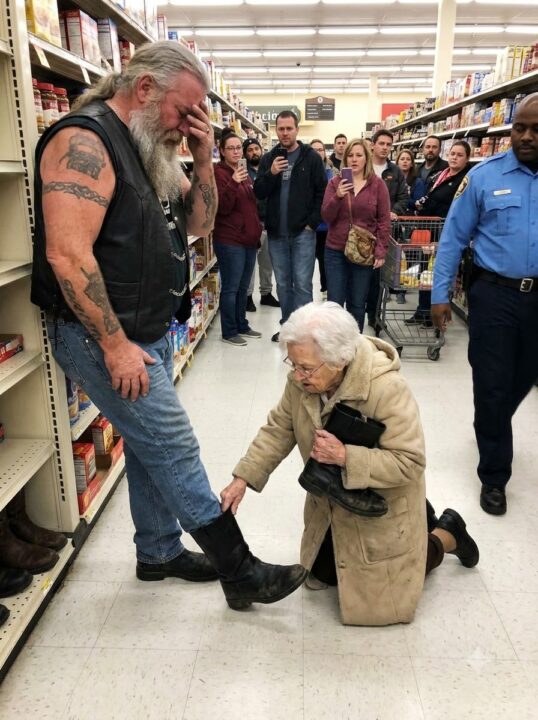
Three weeks later, she saw my boots beside the supermarket freezer aisle and dropped her basket before I could say her name.
Part 5 — The Key Beneath the Insole
The brass key that fell from the right boot did not belong to any lock at Dawson Iron Works.
Martha recognized the stamped number.
“Evan’s firehouse locker.”
I stared at it.
The key had remained beneath the insole for fifteen years, protected inside a narrow leather pocket I assumed was part of the boot’s construction.
Martha had never known it was there.
Neither had Caleb.
We left the supermarket with my groceries, both boots, and a pair of cheap store slippers the manager refused to let me pay for.
Martha rode behind me to the Iron Lantern clubhouse in a taxi. I followed on the Road King wearing slippers that barely survived three miles.
Tiny saw the boots in Martha’s arms.
His face hardened.
“You taking them?”
Martha looked at him.
“They were never yours.”
“They’re Evan’s memorial.”
“They’re my son’s property.”
“Ray carried them fifteen years.”
“That makes him a caretaker.”
Tiny glanced toward me.
Brotherhood faced the same test it had failed after Evan’s death. We could protect an object because it had become important to us, or return it to the family that never surrendered ownership.
I removed my leather vest.
“Boots go with Martha.”
Clay objected.
“What about the promise?”
Martha answered.
“The promise was one year.”
Every rider looked at me.
I admitted what I had done. I had extended her words into a sentence without an ending because guilt gave me a road I understood.
Martha placed the boots on the table.
“My son did not save you so you could spend fifteen years pretending pain was repayment.”
No rider defended me after that.
We traveled to Tulsa that evening.
The boots rode inside Martha’s suitcase rather than on my feet. I purchased ordinary motorcycle boots from a dealership before entering the highway.
They felt wrong.
That was the first proof they were mine.
Evan’s former firehouse had been renovated, but the original locker row remained in a storage area. The chief granted access after verifying the key and consulting department records.
Locker 29 opened.
Inside hung an old gray sweatshirt, a cracked photograph of Caleb at age eight, a fire-service notebook, and a sealed plastic bag containing an unfinished leather name strip.
The strip read:
BROOKS—IRON LANTERNS.
Evan had planned to sew it inside his prospect vest.
Beneath it lay an envelope addressed to Caleb.
The postmark area remained blank.
Evan wrote the letter during a twenty-four-hour shift two weeks before the fire. He intended to leave it inside Caleb’s lunchbox but forgot.
Caleb arrived at the firehouse wearing his academy uniform.
He was twenty-five, tall, broad through the shoulders, and carrying Evan’s eyes beneath an expression built to reveal nothing.
He saw me.
Then he saw the boots.
“Take them off,” he said.
“They’re already off.”
That answer nearly became a smile.
Martha handed him the locker key.
Caleb opened his father’s letter.
Evan wrote about fear. Caleb had recently refused to sleep alone after hearing about a house fire, and Evan wanted him to know firefighters were afraid too.
He described courage as knowing what fear is warning you about, then choosing with other people beside you.
Near the end, Evan mentioned me.
He called me Hammer, described my early sobriety, and said the Iron Lanterns often mistook stubbornness for strength.
Then he wrote:
IF RAY STAYS SOBER, IT WON’T BE BECAUSE I SAVED HIM. IT’LL BE BECAUSE HE FINALLY LET PEOPLE WALK WITH HIM.
Caleb read that line twice.
He looked at the fifteen road records inside the boots.
“Did people walk with you?”
“Eventually.”
“You told strangers about Dad.”
“Yes.”
“You stayed away from us.”
“Yes.”
“Why?”
“Cowardice dressed like respect.”
Caleb folded the letter.
The truth did not produce immediate forgiveness.
It produced room.
He asked me to attend graduation the next morning.
Not as his father’s replacement.
Not as guest of honor.
As the man wearing ordinary boots.
Evan’s boots would occupy the empty chair reserved for fallen firefighters.
That was why Martha had knelt in the supermarket.
She was not simply taking them home.
She was moving Evan’s name from the man who carried it for fifteen years to the son finally ready to decide what it meant.
Part 6 — The Empty Chair at Graduation
The Tulsa Fire Academy graduation began beneath a clear October sky.
Thirty-one recruits stood in uniform before their families, while an empty chair near the front carried Evan’s boots, his helmet photograph, and the unfinished Iron Lantern name strip.
The boots looked smaller without my legs inside them.
For years, they had entered rooms before me. Their burned heel and red stitches invited questions, while their history gave my rough appearance a reason people could understand.
Without them, I was only Ray Dawson.
That was enough.
Caleb crossed the stage when his name was called. Martha stood beside me, gripping the program with both hands while applause moved through the crowd.
When the ceremony ended, Caleb approached the empty chair.
He did not put on the boots.
They were worn, repeatedly resoled, and unsuitable for firefighting or daily riding. Their working life had ended.
Caleb carried them to me.
“I don’t want to wear Dad’s road.”
Martha inhaled sharply.
Caleb continued, “I want to build mine.”
He asked whether Dawson Iron Works could create a display case using wood salvaged from the rebuilt garage. The boots would travel between the fire academy, Evan’s former station, and community safety events.
The Iron Lanterns could help.
They could not own it.
I agreed.
Tiny apologized to Martha before she asked.
“I made a shrine out of something you loaned.”
She touched his arm.
“You loved him.”
“Still wrong.”
“Yes.”
Both truths remained.
The display case included no mileage total on its front. Caleb refused to make the miles more important than his father’s life.
Inside, we placed one road strip, the locker key, the unfinished name patch, and the photograph of Caleb at eight.
The other fourteen records went to Martha.
She kept them in a kitchen drawer beside recipes, batteries, and unpaid coupons.
That location would have pleased Evan.
Nothing about him needed another altar.
Part 7 — The Name That Learned to Walk Alone
Five years have passed since Martha removed Evan’s boots in the supermarket.
Caleb now serves as a firefighter outside Tulsa. He married, bought a small house, and refuses every attempt by the Iron Lanterns to purchase his first motorcycle.
He prefers an old pickup.
Tiny gave him another compass.
Caleb finally accepted it.
The boot display travels only when Caleb or Martha approves. Most months, it remains at the fire academy beside a smoke-safety education room funded by donations raised in Evan’s name.
Children notice the burned heel.
Instructors tell them about repairing alarms, planning exits, respecting firefighters’ directions, and calling for professional help during emergencies.
They do not begin with how Evan died.
They begin with how he lived.
Martha is seventy-eight now. Arthritis makes kneeling difficult, although she jokes that supermarket floors were never designed for mothers chasing fifteen-year promises.
She still carries the brass locker key.
I wear ordinary motorcycle boots.
I replace them when the soles fail. I do not preserve every scratch, and nobody asks whose name lives inside them.
At first, that silence frightened me.
Then it became freedom.
I still say Evan’s name. I speak at recovery meetings when invited and accept responsibility for the relapse that placed me inside the garage.
I no longer describe wearing his boots as repayment.
A life cannot be repaid through discomfort.
Last October, the Iron Lanterns joined a fire-safety event at Caleb’s station. Martha sat beneath a canopy while children climbed through a demonstration smoke trailer.
Caleb displayed Evan’s boots beside his own clean station boots.
They did not match.
That mattered.
When the event ended, Caleb asked me to help return the case to storage. We carried it between us, each holding one side.
At the doorway, he stopped.
“Dad wrote that people had to walk with you.”
“I remember.”
“You still letting them?”
“Trying.”
Caleb nodded.
Then he released his side only after I had a secure grip.
For fifteen years, I believed keeping Evan’s name alive required wearing the dead man’s boots until the leather failed.
His mother understood what I did not.
A name survives when someone remembers the person, tells the truth, and eventually allows the next pair of feet to choose its own road.
Outside the station, I started the Road King. The V-twin settled into a deep rumble while Caleb closed the storage door behind Evan’s boots.
Martha waved from the curb.
I rode away wearing my own.
Follow our page for more unforgettable biker stories about misunderstood promises, grieving families, and rugged men who finally learn when love means letting go.