A Tattooed Biker Burst Into A Classroom During A State Test And Carried A 9-Year-Old Girl Out — The School Called The Police Before They Learned Why
Part 2
I need to tell you what I didn’t know that morning. Because almost everything that went wrong came down to what nobody told me, and what I didn’t ask.
Maya Delgado was diagnosed with Type 1 diabetes when she was six.
Her pancreas doesn’t make insulin. She wears a small insulin pump on her belly and a continuous glucose monitor on the back of her arm. A little round sensor, the size of a quarter, that reads her blood sugar every five minutes and sends the number to her phone.
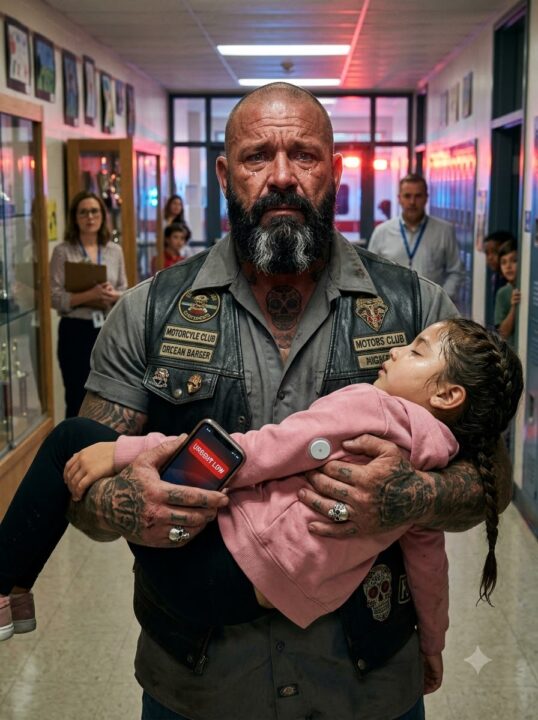
If her blood sugar drops too low, the phone alarms.
If it keeps dropping, it alarms louder. Faster.
That’s what was buzzing in my basket.
The monitor doesn’t just send to her phone. It sends to a list of “followers.” People who get the same alerts on their own phones, wherever they are.
Maya’s list had four people on it.
Her mom, Rosa, an operating room nurse at the hospital in Idaho Falls.
Her dad, Eddie, an ironworker.
The school nurse.
And a man named Bo Jessup.
Eddie Delgado was forty kilometers away that morning. About twenty-five miles. On a bridge deck over I-15 near Blackfoot, sixty feet in the air, bolting steel. His phone was in his chest pocket.
Rosa was scrubbed into a surgery. Her phone was in a locker.
The school nurse position had been empty for three months. The woman who held it had quit in January. The district hadn’t hired anyone. Nobody had removed her from Maya’s follower list. Her phone number now belonged to someone in Twin Falls who had no idea.
That left Bo.
Bo Jessup is forty-eight. He owns Jessup Tire and Brake, a little four-bay shop on Yellowstone Avenue, four blocks from Sagebrush Elementary.
He rides a black Harley Fat Boy with the Portneuf Riders. Twenty-some members. Eddie Delgado is one of them. They’ve ridden together for nine years.
When Maya was diagnosed, Bo asked Eddie to teach him everything. How to read the numbers. What the arrows meant. What low looks like. What high looks like. How to use glucagon, the emergency shot.
“Why?” Eddie asked him.
Bo told him. I’ll tell you later.
Eddie added him to the follower list. Bo picks Maya up from school every Tuesday while Eddie works late. She calls him Tío Bo.
Here’s how that morning went, from their side. I pieced it together from Eddie and Bo, from the 911 recording, from the timestamps on Maya’s monitor.
At 9:15, Maya’s blood sugar was 82. Normal. But dropping. She’d had a smaller breakfast than usual because she was nervous about the test.
At 9:22, the first alert. LOW. 68 mg/dL. A soft buzz.
That’s when she raised her hand the first time.
At 9:31, LOW. 54. A harder alarm. URGENT LOW.
That’s when Bo’s phone went off on his workbench.
He was under a Silverado on a lift. He heard the tone. He knew it. He rolled out and grabbed his phone.
URGENT LOW. 54. ↓↓
Two arrows down. Falling fast.
He called Eddie. Eddie didn’t pick up. Sixty feet up, wind, impact wrenches.
He called the school office.
Busy.
He called again. Busy. State testing day. The secretary had taken the phone off the hook to keep the building quiet. Or it was ringing through to a voicemail nobody was checking.
He looked at the screen again.
URGENT LOW. 47. ↓↓
That’s when Maya raised her hand the second time.
Bo put his phone on speaker and dialed 911 while he was running.
He didn’t take the Harley. Four blocks. He ran.
I’ve heard the recording. The dispatcher asked his emergency. He told her, between breaths, running down Yellowstone Avenue in his boots:
“Nine-year-old. Type 1 diabetic. Sagebrush Elementary. Her monitor says forty-seven and dropping. She’s not answering. Nobody at the school’s answering. Send an ambulance to the front gate. I’m going in to get her.”
The dispatcher told him to wait for the ambulance.
“She can’t wait,” Bo said.
At 9:41, LOW.
Not a number anymore. Just the word.
The monitor stops reading numbers below forty. It just says LOW.
That’s when Maya raised her hand the third time. When she asked me for her phone.
When I told her no devices during testing.
At 9:45, Eddie finally felt his phone vibrating against his chest on that bridge. He saw the alerts. He saw LOW. He saw three missed calls from Bo.
He called Bo back.
Bo answered running up the school’s front steps.
“I got her, brother,” Bo said. “Ambulance is coming. I’m going in.”
At the front office, Mrs. Pratt buzzed him in. She thought he was a parent picking up. Then he said, “Room fourteen, Maya Delgado, diabetic, where’s the nurse,” and Mrs. Pratt said, “We don’t have a nurse right now, and they’re testing, you can’t—”
He was already gone. Down the hall.
At 9:47, he opened my door.
Part 3
He walked out of my classroom with Maya in his arms.
I followed him.
I left twenty-three children alone in the middle of a state test. The protocol I’d been so terrified of breaking. I didn’t think about it. I just ran after him.
“Put her down! Put her down right now!”
He kept walking. Not fast. Steady. Down the main hallway, past the trophy case, past the cafeteria.
Doors opened all along that hall. Teachers stepping out. Kids peeking around them. Somebody screamed. A kindergarten aide pulled her line of children back into a classroom and slammed the door.
Mrs. Pratt was behind the front counter on the phone with 911. I could hear her.
“A man just took a student! A big man, tattoos, leather — he’s walking out the front with her!”
Our assistant principal, Mr. Dorsey, came out of his office. He saw Bo. He saw Maya. He stepped in front of the front doors and put his arms out.
“Sir, stop. Stop right now.”
Bo stopped.
He looked at Mr. Dorsey. Then down at Maya. Her head was against his chest. Her mouth was open. Her lips were pale. She wasn’t moving.
“Look at her,” Bo said quietly.
Mr. Dorsey looked.
“Her blood sugar is too low to read,” Bo said. “She’s diabetic. She’s passing out. I called the ambulance. It’s at the gate. Walk with me if you want. But get out of my way.”
Mr. Dorsey looked at her face for one more second.
Then he opened the door.
We walked out together. Bo. Mr. Dorsey. Me. Across the front walk. Past the flagpole. Through the playground, where a third-grade class was having recess and the kids all stopped and stared.
At the front gate, an ambulance was pulling in. Lights going. No siren.
And right behind it, a Pocatello police cruiser. Lights and siren both.
Halfway across the playground, Maya’s body changed in his arms.
I saw it. Her arms had been hanging loose. Now they went completely slack. Her head rolled back. Her breathing went shallow and strange.
She was unconscious.
Bo didn’t run then either.
But he walked faster.
The paramedics jumped out of the ambulance with a stretcher. Two of them. They saw him coming and ran toward him.
The police officer got out of his car at the same time. Young. Hand on his belt.
“Sir! Stop where you are! Put the child down!”
Bo kept walking toward the stretcher.
“Sir! STOP!”
Bo laid Maya down on the stretcher. Gently. Like setting down an egg.
Then he turned around, put both hands up, and stood still.
The officer came at him. Spun him around. Pushed him against the side of the ambulance. Pulled his arms behind his back.
Handcuffs.
Bo didn’t resist. Didn’t say a word. He just turned his head so he could see the stretcher.
The paramedics were bent over Maya. One of them had a little machine. A glucometer. She pricked Maya’s finger.
I was standing ten feet away with my hand over my mouth.
I thought I’d just helped a kidnapper carry a child out of my school.
I thought she was dying in front of me, and I’d let him take her.
Part 4
The paramedic read the number off the glucometer.
“Twenty-eight.”
She looked up at her partner. Her voice changed.
“Twenty-eight. Get me D10. Now.”
Her partner was already ripping open a kit.
Twenty-eight milligrams per deciliter.
Normal is somewhere between seventy and a hundred and forty.
Below fifty-four is dangerous. Below forty, seizures can start. Below thirty, unconsciousness, brain damage, death.
Twenty-eight.
They got an IV into her arm on the stretcher, right there at the gate. Sugar water. Straight into her vein.
I watched her.
Thirty seconds.
A minute.
Then her eyelids fluttered.
Two minutes. Her fingers moved.
Three minutes. She opened her eyes. Confused. Looking around at the sky, the flashing lights, the strangers.
“Where’s Tío Bo?” she whispered.
The paramedic looked over her shoulder at the man in handcuffs pressed against the ambulance.
“Is that him?”
Maya turned her head and saw him.
She smiled. A small, weak, nine-year-old smile.
“That’s my Tío Bo,” she said.
The officer’s face changed.
He looked at the girl. At the man. At me.
Bo said, very calmly, still facing the ambulance with his hands cuffed behind him:
“Officer. My phone’s in my left pocket. The screen’ll show you her alerts. Her dad’s name is Eddie Delgado. He’s on the line right now.”
The officer took the phone out of Bo’s pocket.
On the screen, the monitor app was still open. A graph. A line falling off a cliff. And a box at the top in red.
URGENT LOW — LOW
Under it, a list of every alert from the last forty minutes. 68. 54. 47. 41. LOW.
And on the call screen, a phone call still connected. Forty-two minutes long. EDDIE.
The officer put it to his ear.
I heard a man’s voice coming out of it. Frantic. Crying. Wind behind it. An engine roaring.
“Is she okay? Is my daughter okay? Bo? BO?”
The officer stood there for a second.
Then he said, “Sir, this is Officer Lindgren, Pocatello PD. Your daughter’s awake. Paramedics have her.”
He took the handcuffs off Bo.
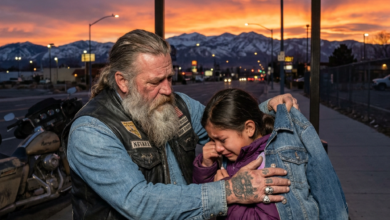
Bo didn’t rub his wrists. Didn’t say anything. He just walked over to the stretcher and put his big tattooed hand on top of Maya’s head.
She grabbed his finger.
I stood there.
And then it hit me.
Twenty-eight.
She’d raised her hand three times.
I feel weird.
My hands are shaky.
My phone. It’s beeping.
Every one of those was a symptom. Confusion. Shaking. Sweating. Slurred speech.
Every one of them was her body telling me she was in danger.
And the phone in the basket on my desk, buzzing and buzzing for twenty minutes while I walked the rows with my clipboard, was a machine screaming the same thing.
She’d told me. Three times.
And three times I told her to focus on her test.
I sat down on the curb by the ambulance.
I couldn’t stand up anymore.
Mr. Dorsey came and stood next to me. He didn’t say anything.
The paramedics loaded Maya into the back of the ambulance. Bo climbed in with her. Nobody stopped him.
Before the doors closed, he looked out at me.
I waited for him to say something. To yell. To blame me.
He didn’t.
He just nodded once.
Then the doors closed and the ambulance pulled away toward Portneuf Medical Center, and I sat on that curb in front of my school with twenty-three children still alone in a classroom upstairs.
Part 5
Maya spent the night in the pediatric unit at Portneuf Medical Center.
Her doctors said a few more minutes might have meant a seizure. A little longer, and they didn’t want to say.
Bo had called the ambulance from the street before he ever walked into the building. That’s the only reason it was already at the gate.
If he’d waited for someone at the school to answer the phone, nobody would have.
If he’d waited at the gate for the paramedics to find her room, they’d have lost minutes they didn’t have.
If he’d stopped to argue with Mrs. Pratt, or Mr. Dorsey, or me.
He didn’t.
I went to the hospital that evening. I didn’t know if I’d be allowed in.
Eddie Delgado was in the hallway outside her room. Still in his work boots and his reflective vest. Concrete dust in his hair. He’d driven from Blackfoot in nineteen minutes.
I told him who I was.
I told him about the three times.
I waited for him to scream at me.
He looked at me for a long time. Then he said something I didn’t expect.
“Did anybody tell you she was diabetic?”
I stopped.
Nobody had.
I’d been handed a seating chart and a testing manual at 7:45 that morning. Twenty-four names. No notes. No medical alerts. No mention of the 504 plan, the official document that says Maya keeps her phone at all times, can eat or drink in class, and must be allowed to see the nurse whenever she asks.
That document existed. Eddie had signed it in August.
It was in a filing cabinet. In the health office.
Locked.
That’s what the district investigation found, over the next six weeks.
Sagebrush Elementary had six students with chronic medical conditions that required daily monitoring or emergency response. Two with Type 1 diabetes. Two with epilepsy. One with a severe peanut allergy. One with a heart condition.
Not one classroom teacher in the building had been trained to recognize or respond to any of them.
Every one of those students’ medical plans was kept in a locked filing cabinet in the health office.
The health office was open only when the nurse was in. Regular hours.
The nurse had quit in January.
The position had been empty for three months.
The key to the filing cabinet was in the principal’s desk. The principal was at a district meeting across town that morning.
And in that locked cabinet, along with Maya’s 504 plan, was her emergency glucagon kit. The shot that could have saved her in one minute, sitting forty feet from my classroom, behind a lock nobody in the building could open.
Bo came out of Maya’s room while I was standing there with Eddie.
He’d been sitting with her all afternoon. His leather vest was draped over the back of the chair by her bed.
He saw me. He walked over.
I started to apologize. I couldn’t get the words out.
He put up one big tattooed hand.
“You were following the rules,” he said. “The rules were wrong. That’s not on you.”
“I told her to focus,” I said. “Three times.”
He was quiet.
Then he told me why he’d asked Eddie to teach him everything, when Maya was diagnosed.
“I had a little sister,” Bo said. “Lupe. Type 1. Same as Maya. Diagnosed at eight.”
He looked down the hallway.
“Seventh grade. She went low in gym class. Told the coach she felt sick. He told her to run it off.”
He didn’t finish.
He didn’t have to.
“That was 1991,” he said. “I was fifteen. I been mad about it for thirty-three years. Did some stupid things with that mad. Did three years in St. Anthony for some of ’em.”
St. Anthony. The juvenile and then state facility up north. I didn’t ask.
“When Eddie’s girl got the same thing,” Bo said, “I figured I’d better learn what nobody taught that coach.”
He picked his vest up off the chair. Put it on.
“And I figured I’d better keep my phone on.”
Part 6
The school board meeting in June was packed.
Parents. Teachers. Local news. Eddie and Rosa Delgado. Bo, in the back row, in his vest, with eleven Portneuf Riders lined up along the wall behind him.
Maya sat in the front row in her pink sweatshirt, swinging her feet.
The district superintendent announced the changes that night.
Every school in the district would complete emergency response training for chronic medical conditions before the start of the next school year. Diabetes. Epilepsy. Severe allergies. Asthma. Cardiac conditions. Every teacher, every aide, every substitute, every front-office secretary.
Every student’s emergency medical plan would be kept in two places. The health office. And a sealed red folder in their homeroom classroom, with a one-page summary on top in plain language.
Every homeroom teacher of a student with a continuous glucose monitor would be offered access to the follower app on their school-issued phone, with the family’s permission.
During state testing, medical devices would stay with the student. Always. Written into the protocol in bold letters.
And Sagebrush Elementary would hire a full-time school nurse before August.
They did. Her name is Joanne. She’s wonderful.
When the meeting ended, I walked down to the front of the room.
There was a sign-up sheet on the table for the first summer training session. Forty spots. Nobody had signed it yet.
I picked up the pen.
I was the first name on it.
That was two years ago.
Today, I run the program.
I didn’t plan to. I took the training in June. Then the advanced first-aid course through the Red Cross. Then a diabetes educator certification over the next winter. The district asked me to coordinate the training for our building. Then for three buildings. Now all of them.
I teach teachers what I didn’t know.
I teach them what low looks like.
I tell them about the three times.
Every single session, I tell them about Maya’s hand going up, and what I said back.
Some of them cry. I let them.
Bo comes once a year. To the first session in August. In his vest, with his phone on the table in front of him.
He doesn’t say much. He stands at the front of the room and he shows them the screen. The graph. The line falling off a cliff.
Then he tells them about Lupe.
Then he tells them about Maya.
And at the end, he says the same thing every year.
“If a kid tells you she feels weird,” he says, “believe her the first time.”
Part 7
This April, Sagebrush Elementary gave the state test again.
Maya’s in sixth grade now. Middle school next year. Taller. Braids longer. Still wears a pink sweatshirt every chance she gets.
By coincidence, or maybe not, I was assigned to proctor her room.
I set up the desk at 7:45. Phones in the basket. Every phone except one.
On the corner of my desk, separate from the others, I set a small clear plastic box with a label on it. I made the label myself. Laminated, of course.
MEDICAL DEVICES — ALWAYS ON
Maya’s phone was in it. Screen up. Facing me.
And on my own phone, lying beside it, was the follower app. Eddie and Rosa had added me in the fall.
At 9:20, almost the exact same time, my phone buzzed.
LOW. 72. ↘
Not urgent. Just a heads-up. Drifting down.
I looked up.
In the third row by the window, Maya was already raising her hand.
I was already walking.
I crouched down beside her desk with a juice box from the drawer I keep stocked now.
She looked at me. She looked at the juice box.
She grinned.
“I was gonna tell you,” she whispered.
“I know,” I said.
I stuck the straw in and handed it to her.
She drank it. We sat there together, her and me, in the quiet of the testing room, pencils scratching all around us, until my phone buzzed again.
88. →
Steady.
She gave me a thumbs-up and went back to her test.
I went back to my clipboard.
I didn’t tell her to focus.
She already was.
👉 If this story stayed with you, follow our page for more stories from the road — and from the ones who believe a kid the first time. 🏍️