A Biker Rode Off From an Alabama Gas Station With a 10-Year-Old Girl on the Back of His Motorcycle While Her Foster Father Screamed—Deputies Set Up a Roadblock, Until They Opened Her Backpack
Part 2 — Roadblock
Pastor Glenn Haskell was sixty-six now. He had silver hair, a big chest, and a Grace Fellowship Church polo shirt tucked into pressed khakis. The last time I saw him, I was fifteen, climbing out a bathroom window at two in the morning.
He didn’t recognize me.
Thirty years, prison tattoos and a shaved head will do that.
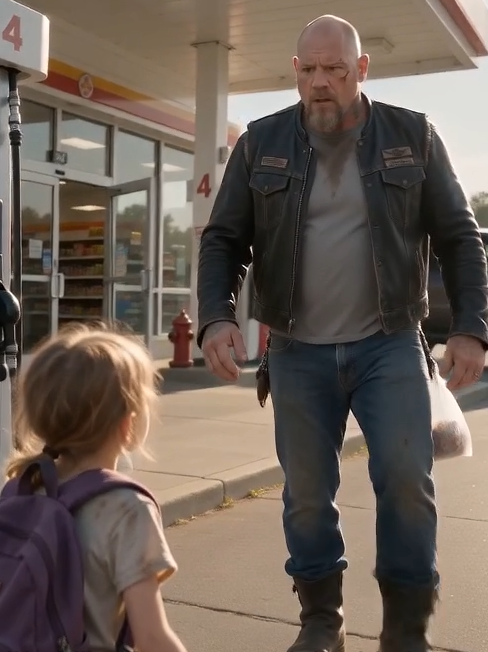
“Please!” he shouted, running across the Chevron lot. “Somebody stop him! That’s my foster daughter!”
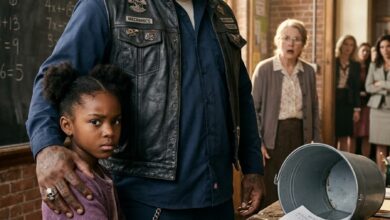
The girl, Ruby, grabbed the back of my vest.
“Don’t let him take me back,” she whispered. “Please. Please.”
I made a decision I’d been making in my head for thirty years.
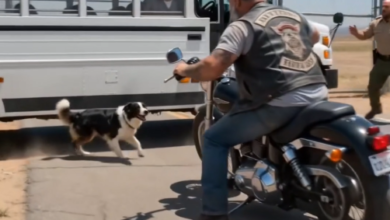
I swung my leg over the bike, started it up, and pulled out onto Highway 278, slowly and carefully. I wasn’t running. I was driving toward the Cullman Police Department, two miles east.
With my free hand, I dialed 911.
“Ma’am, my name is Silas Reed. I have a ten-year-old girl on my motorcycle. She climbed on and asked me to get her away from her foster father. I’m bringing her straight to Cullman PD on Second Avenue. Please have someone meet me there.”
The dispatcher kept me on the line. I could hear her typing.
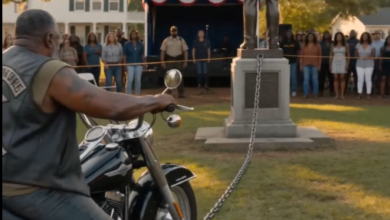
The deputies didn’t let me make it to the police station. They set up a roadblock at the intersection of 278 and Second Avenue, three blocks short, with three cruisers.
They pulled me off the bike in front of a crowd from the Dollar General parking lot, all filming.
They pulled Ruby off too. She screamed and kicked and grabbed for my jacket.
“He didn’t take me! I asked him! I asked him!”
Nobody listened.
Pastor Glenn arrived two minutes later and wrapped her up in his arms, crying for the cameras. He took her backpack from the deputy.
“Her things,” he said gently. “She’ll want her things.”
I watched that backpack go into the back of his Ford Expedition.
By nightfall, the Dollar General video had three million views. Biker Abducts Foster Girl From Pastor at Alabama Gas Station. The comments were exactly what you’d expect. Look at him. Of course.
I sat in the Cullman County Detention Center charged with kidnapping in the first degree, and I made myself think it through.
Ruby was ten. Kids in foster care run. Kids make things up. I didn’t know her. I didn’t know anything about her life in that house now. All I knew was what had happened to me there thirty years ago.
Maybe I’d let an old scar make the decision for me. Maybe I’d just traumatized a little girl, wrecked a good man’s reputation, and gotten myself charged with a Class A felony because I’d never gotten over being fourteen.
At midnight, a guard brought me my personal property bag so I could sign for it.
My leather jacket was folded on top. When I picked it up, something crinkled in the inside pocket.
It was three sheets of notebook paper, folded small, covered in a ten-year-old’s pencil handwriting.
THE RULES OF THE HASKELL HOUSE, by Ruby Collins.
Rule 1: Grace before supper, or the Quiet Room.
Part 3 — The Sparrow
Thirty-two years ago, the creek behind the Haskell farmhouse on County Road 1435 smelled like honeysuckle and red clay.
I was fourteen. I’d been in Alabama foster care since I was six. The Haskell place was my seventh home. It was the biggest one, a white farmhouse with a green porch and eight foster kids, run by the young pastor of Grace Fellowship and his wife, Darlene.
My favorite thing about it was Tammy Collins.
She was seven, with no front teeth and a laugh like a screen door slamming. She followed me everywhere. I taught her to skip rocks. I taught her to whistle through her fingers. One night on the porch steps, I carved her a little sparrow out of a pine branch with my pocketknife. I chipped one wing by accident.
“It’s perfect,” she said. “Birds fly away when they want to.”
She tied it to her shoelace and never took it off.
But there was one place in that house nobody talked about.
The closet under the stairs. Pastor Glenn called it the Quiet Room. It was three feet wide, with no light, and an old brass skeleton-key lock on the outside of the door. The key hung on a nail beside it.
“Grace before supper,” Pastor Glenn would say, smiling at the table. “Or the Quiet Room.”
If you forgot grace, if you talked back, if you wet the bed, you went in. Sometimes for an hour. Sometimes all night.
The night I turned fifteen, Pastor Glenn locked Tammy in there for crying at supper.
At two in the morning, I took that brass key off its nail. I opened the door and carried Tammy back to her bed. Then I put the key in my pocket so it could never lock anybody in again.
“Take me with you,” Tammy whispered, holding her wooden sparrow.
“I’ll come back for you,” I told her. “I promise.”
Then I went out the bathroom window.
I still have that key.
Part 4 — Thirty Years of Service
Pastor Glenn didn’t press charges personally. He let the State of Alabama do it.
He came to see me at the Cullman County Detention Center on Monday morning with his wife, Darlene, and a caseworker from the Alabama Department of Human Resources named Brenda Toler.
“I want you to understand who we are,” Glenn said gently, sitting down across the glass. “Because I don’t think you do.”
Brenda slid a folder through the slot.
The Haskells had held a state foster care license for thirty-one years. They’d fostered forty-four children. They’d received the Alabama DHR Foster Family of the Year award twice. There were glowing monthly home-visit reports, signed by Brenda Toler, going back twelve years.
Home clean and well-organized. Children appear happy and well cared for. No concerns.
“And Ruby,” Brenda said softly, “has a documented history of fabrication. Three runaway attempts this year. Her therapist notes say she has a vivid imagination.”
She slid over a page of a ten-year-old’s handwriting, a story Ruby wrote for school about a dragon who lived under a staircase.
“Ruby’s mother was Tammy Collins,” Darlene said quietly. “She was one of our girls, years ago. Tammy struggled her whole life. Drugs, men, jail. She died of an overdose in Birmingham two years ago.” Darlene wiped her eyes. “When DHR called and said Tammy’s daughter needed a home, we said yes. Because we loved Tammy.”
Then Glenn leaned forward.
“I remember you now,” he said. “Silas Reed. You ran away in ’93. You stole two hundred dollars from my desk. Do you know what that did to Tammy? She waited at that window for months. She told everyone you’d come back. You never did.” His voice cracked. “I think that’s where her troubles started, son. With you.”
Then Brenda slid over one last page. It was my juvenile record. Runaway. Theft from foster placement. Aggravated assault, age 17.
“A man with this record,” Brenda said, “put a ten-year-old girl on the back of a motorcycle without permission. Mr. Reed, the State is going to prosecute.”
They left.
I sat there with my head in my hands.
It was all true. The two hundred dollars, and I did steal it. The assault at seventeen, which was a fight in a Birmingham group home, but still. And I never went back for Tammy.
Maybe Glenn was right. Maybe I was the one who broke her.
But Ruby’s handwriting was folded in my property bag. Rule 1: Grace before supper, or the Quiet Room.
And Glenn had just sat across from me and said they loved Tammy.
They had never once mentioned the closet under the stairs.
Part 5 — Rule Number One
My public defender was a fast-talking woman from Birmingham named Rhonda Sims. She’d been doing child-welfare cases for twenty years. She’d read Ruby’s pages twice before she even sat down.
There were nineteen rules, in a ten-year-old’s careful pencil.
Rule 1: Grace before supper, or the Quiet Room.
Rule 4: Don’t tell Miss Brenda anything. She is Mrs. Darlene’s sister.
Rule 7: When Miss Brenda comes, we wear the Sunday clothes. After she leaves, we give them back.
Rule 11: Supper is only for kids who finished chores. The little ones don’t have to do the chicken houses. Unless Pastor Glenn is mad.
Rule 15: If you say “therapy,” Mrs. Darlene says we went to therapy. We never go.
Rule 19: Don’t run. Si ran. Mama said Si ran and never came back. I’m not going to be like Si. But I can’t stay.
I had to stop reading.
Rhonda didn’t stop.
She pulled the Alabama DHR payment records for the Haskell home. Six foster children were placed there right now, ages five to twelve. Every one of them was certified as “therapeutic foster care,” the state’s highest reimbursement tier for children with severe emotional needs. That came to $1,950 per child per month. That’s $11,700 a month, $140,400 a year.
Then she pulled the Alabama Medicaid billing.
For three years, a licensed counselor named Kendra Pruett had billed Medicaid for weekly therapy sessions for all six children. That was 936 sessions.
Kendra Pruett was Darlene Haskell’s cousin. Her office address was a P.O. box in Hanceville.
“There’s no therapy,” Rhonda said quietly. “There’s no office. Rule fifteen.”
Then the caseworker.
Brenda Toler had been the assigned DHR caseworker for the Haskell home for twelve years. Rhonda found her maiden name on her marriage license at the Cullman County Probate Office.
Brenda Lynn Haskell Toler.
She was Glenn’s younger sister, not Darlene’s. Ruby had gotten it slightly wrong. But she’d gotten the important part right.
“His own sister has been signing his inspections for twelve years,” Rhonda said. “Every monthly visit. ‘No concerns.'”
Then she pulled the Chevron security footage.
It showed Ruby walking out of the store alone at 3:14 p.m. She saw my bike and stood there. She looked back at the Haskells’ Expedition, where Glenn was pumping gas. Then she climbed onto my seat on her own. When I came out, she held up something to me, the photograph. I froze. She said something. Then I took off my jacket and put it on her.
And there was the 911 recording. Rhonda played it in the visiting room on her phone.
“Ma’am, my name is Silas Reed. I have a ten-year-old girl on my motorcycle. I’m bringing her straight to Cullman PD.”
“This is not a kidnapping,” Rhonda said. “You were driving a child to the police station at forty-five miles an hour with 911 on the line.”
“Then why am I still in here?”
Rhonda’s jaw tightened.
“Because Brenda Toler just filed for an emergency transfer,” she said. “Effective Friday. Ruby is being moved from the Haskell home to a ‘therapeutic boarding facility’ in southern Missouri. Without a hearing.” She paused. “It’s run by a church Glenn Haskell’s denomination sponsors.”
Part 6 — Bond Denied
The judge denied my bond on Wednesday. “Flight risk,” he said, reading my juvenile record out loud in open court. “A man who has run from placements his whole life.”
The Cullman Times ran my booking photo above the fold. Biker With Violent Past Denied Bond in Pastor’s Foster Child Abduction.
Grace Fellowship held a prayer vigil for the Haskell family on Wednesday night. Four hundred people came. Pastor Glenn spoke about “the darkness that walks among us on two wheels.”
Someone threw a brick through the window of my tattoo shop on Third Street. Someone else spray-painted CHILD SNATCHER across the door.
My riding brothers from Decatur and Huntsville sat outside the jail Thursday night. Thirty bikes. WAFF-48 News ran it. Biker Gang Rallies Outside Jail in Cullman Abduction Case.
Rhonda filed an emergency motion with the Chevron footage, the 911 call, and Ruby’s nineteen rules. She requested an independent investigation by the Alabama Law Enforcement Agency.
“They’ll look at it,” she told me. “But not by Friday.”
Friday was when Ruby would be put in a van to Missouri.
I lay on my bunk Thursday night staring at the ceiling, and I thought about a little girl at a window in 1993, waiting for a boy who never came back.
At 11:30 p.m., a guard rapped on my bars.
“Reed. Visitor. After hours, which I’m not supposed to allow, but she says she’s from ALEA.”
The woman in the visiting room was in her forties, in a dark windbreaker, with an Alabama Law Enforcement Agency badge on her belt. Her name was Special Agent Leah Burkett.
“Mr. Reed,” she said, “I read Ruby’s rules tonight. All nineteen.” She set a file on the steel table. “I was in foster care in Jefferson County. I don’t need anyone to explain the Quiet Room to me.”
She opened the file.
“But before I go after a pastor with thirty years and two state awards, I need to know something. Glenn Haskell says you stole from him and abandoned Tammy Collins. Is that true?”
I looked at her for a long time.
“Yes,” I said.
Part 7 — What I Took
I told Agent Burkett everything, in the visiting room of the Cullman County Detention Center, with my hands flat on the table.
“I took two hundred and twelve dollars from his desk drawer,” I said. “The night I ran. I needed bus money. I bought a ticket to Birmingham and lived under the Morris Avenue bridge for two weeks.”
“And Tammy?”
My throat closed.
“She was seven. She was standing in the hallway in her nightgown, holding that wooden sparrow. She said, ‘Take me with you, Si.’ And I said, ‘I’ll come back for you.'” I stared at the table. “I meant it. Then DHR picked me up in Birmingham and put me in a group home. Then another one. Then I got into a fight at seventeen and spent a year at Mount Meigs. By the time I aged out at eighteen, I was so ashamed I couldn’t make myself drive back up I-65 to that house. I told myself she’d been adopted. I told myself she was fine.”
“She wasn’t,” Burkett said quietly.
“No.” I wiped my face. “She stayed there until she was eighteen. Then she spent the rest of her life running from it. Pills, jail, bad men. She died in a motel on Highway 280 with that sparrow in her pocket. And her little girl went right back into the same house.”
I reached into my vest, which they’d let me keep, and set something on the table between us.
It was an old brass skeleton key, worn smooth, with a little ring at the top.
“This is the key to the Quiet Room,” I said. “I took it the night I left so he couldn’t lock Tammy in again. I’ve carried it every day for thirty years. I thought it meant I’d saved her.” I shook my head. “All it meant was that I left.”
Burkett picked up the key and turned it over in her fingers.
“Glenn Haskell told you he loved Tammy,” she said. “Did he ever mention this key?”
“No.”
“Did he ever mention a closet with a lock on the outside?”
“No. Neither did Brenda. They said nothing about the Quiet Room at all.”
Burkett set the key down and looked at me for a long time.
“Grace Fellowship is holding Foster Family Sunday this weekend,” she said. “Every year, the first Sunday in June. They honor the Haskells in front of the whole congregation. It’s livestreamed. This year, they’re giving Glenn a plaque for thirty-one years of service.” She paused. “And Brenda’s van to Missouri doesn’t leave until Monday morning now. Ruby’s being ‘celebrated’ at the service first.”
“Can you get me out?”
“I can get you a federal hold on the transfer and a bond hearing tomorrow at nine,” Burkett said. “With the Chevron tape and the 911 call, I think a judge will let you out.” She slid the key back across the table. “Bring this.”
Could a pastor who’d lied for thirty years tell the truth in front of his own church?
Part 8 — Foster Family Sunday
Grace Fellowship Church sits on a hill off Highway 31 in Cullman. It’s a big brick building with a white steeple and a sanctuary that holds eight hundred people. On the first Sunday in June it was full.
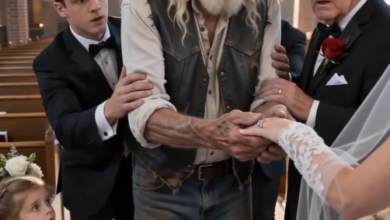
A banner hung over the altar. FOSTER FAMILY SUNDAY: THANK YOU, GLENN & DARLENE.
Six foster children sat in the front pew in matching Sunday clothes, white shirts and blue dresses, freshly ironed. Ruby sat on the end. She stared at her shoes.
A camera on a tripod streamed the service to the church’s Facebook page. WBRC Fox 6 from Birmingham had a reporter in the back.
Agent Leah Burkett sat in the last pew with two ALEA investigators.
I came in through the side door ten minutes after the service started. The judge had released me on bond at 9:40 that morning, after watching the Chevron footage twice.
Behind me, quietly, thirty bikers in leather vests filed in and stood along the back wall with their arms crossed.
Eight hundred heads turned.
Ruby looked up and saw me.
Her whole face changed.
On stage, Pastor Glenn Haskell faltered for one second. Then he smiled.
“Church family,” he said into the microphone, “some of you know the man who just walked in. He’s the one who tried to take our Ruby. I forgive him. Jesus forgives him.” He spread his hands. “And I’ll say this, because I’m tired of the lies on Facebook. In thirty-one years, Darlene and I have never once locked a child in anything. That closet under our stairs hasn’t even had a lock on it since that thief ran off with the old skeleton key in ’93—”
He stopped.
The sanctuary went silent.
Agent Burkett stood up in the back.
“Pastor Haskell,” she said clearly, “you just told this congregation that the closet under your stairs had a lock on it until 1993. And that the key was taken by the boy who ran away.”
She held up a sealed evidence bag. Inside was a small, worn brass skeleton key.
“Why does a closet under the stairs in a foster home need a lock on the outside of the door?”
Eight hundred people turned to look at the man on the stage.
Glenn’s mouth opened. Nothing came out.
Agent Burkett held up something else, a clear plastic sleeve with three pages of a child’s pencil handwriting.
“Rule One,” she read aloud. “Grace before supper, or the Quiet Room. Written by a ten-year-old in your care, Pastor. Last month.”
At the end of the front pew, Ruby stood up.
So did the other five foster kids, one by one, in their matching Sunday clothes.
The smallest one was a boy of about five. He pointed straight at Darlene Haskell and said in a voice that carried through the whole sanctuary:
“That’s where she puts us when we cry.”
Darlene put her face in her hands.
In the third row, Brenda Toler stood up, grabbed her purse, and started walking fast toward the side exit.
The two ALEA investigators were already standing at the door.
Pastor Glenn looked out at his congregation. He looked at the camera, at his sister, and at thirty bikers standing silent along the back wall.
Then he looked at me.
What was he going to say?
Part 9 — The Sparrow Flies
He didn’t say anything. He set down the microphone and walked down off the stage. The ALEA investigators met him at the bottom of the steps.
Glenn and Darlene Haskell were arrested on the steps of Grace Fellowship Church that afternoon. They were indicted in Cullman County for willful abuse of a child, aggravated child abuse, and Medicaid fraud, and federally for wire fraud. Kendra Pruett, the counselor with the P.O. box, pleaded guilty and testified against them. The 936 therapy sessions she’d billed had never happened.
Brenda Toler was fired by Alabama DHR and charged with falsifying public records. She’d signed 144 home inspections without ever opening the door to the closet under the stairs.
Glenn Haskell was sentenced to eighteen years. Darlene got twelve. Brenda got four.
Every child who’d ever lived in that house could request their records. Forty-four of them did. Nineteen came forward and testified. They described the Quiet Room, from 1990 to last spring.
The kidnapping charge against me was dismissed. The judge read the 911 recording into the record before she did it.
The six children from the Haskell home went to new placements, licensed and inspected by someone who wasn’t related to anybody.
Ruby went home with me.
It took eleven months, a home study, a parenting course, a background check that went all the way back to my juvenile record, and a long letter to the judge. In it, I wrote down everything I told Agent Burkett in that visiting room, including the two hundred and twelve dollars and the promise I never kept.
The judge read the whole thing. Then she approved the adoption.
On a bright morning in May, Ruby and I walked out of the Cullman County Courthouse with a stack of papers, a Cullman County deputy holding the door, and my club lined up along the sidewalk on their bikes.
My motorcycle was parked at the curb.
Ruby stopped beside it.
A year earlier, she’d climbed onto the back of that bike at a gas station, uninvited, and begged a stranger to take her away.
This time, I knelt and buckled a brand-new helmet on her head. It was purple, her color, and it fit perfectly.
Then I took off my leather jacket and wrapped it around her shoulders. It still came down past her knees.
“It’s still too big,” she said, grinning.
“You’ll grow,” I said.
She climbed onto the seat behind me. Before she wrapped her arms around my waist, she reached down and unclipped something from her backpack zipper.
It was the little wooden sparrow, carved from pine, with one wing chipped.
She held it up so I could see it.
“Mama said you made this,” she said. “On the porch. Before you left.”
“I did.”
“She said birds fly away when they want to.” Ruby turned the sparrow over in her small fingers. “But she said you’d come back.”
I couldn’t say anything for a minute.
Then I reached into my vest pocket and pulled out the old brass skeleton key. Agent Burkett had given it back to me after the trial.
I threaded the little sparrow onto the key ring, right beside the key that used to lock children in the dark. Then I put it in Ruby’s hand and closed her fingers around it.
“I’m sorry it took thirty years,” I said.
Ruby leaned her helmet against my back and held on tight.
“You came back for her,” she said. “You just came back for me instead.”
I started the bike. The deputy on the courthouse steps tipped his hat. Thirty engines started up behind us.
And this time, when we pulled away, nobody screamed.
If Silas and Ruby’s story stayed with you, follow our page. We’ve got a lot more biker stories coming, and some of them hit even harder than this one.