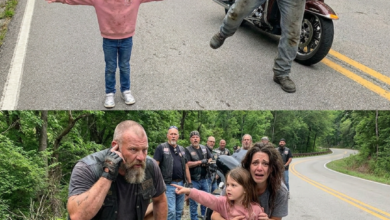
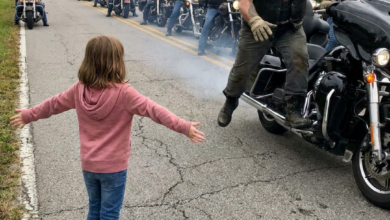
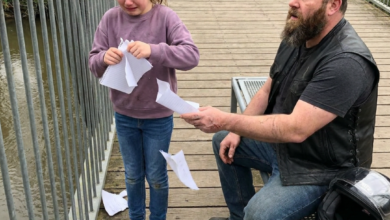
A Thirteen-Year-Old Girl Tore the Sacred Patch From a Biker Captain’s Vest and Stomped on It—Forty Riders Knew Her Father Had Left a Message for That Exact Moment
Part 2
Daniel Hale had been part of the Iron Harbor Riders for seven years before he died.
We called him Sparks because he worked as an industrial electrician and because the man could create an argument in an empty garage. He was forty-two, narrow-shouldered, quick to grin, and completely unable to drink coffee before it went cold.
He was not my closest friend when he joined.
He became one.
Our club had rules about charity rides because charity did not make machinery safer. Riders submitted proof of licensing and insurance, attended the briefing, rode within the formation plan, and agreed that anyone showing impairment or illness stayed behind.
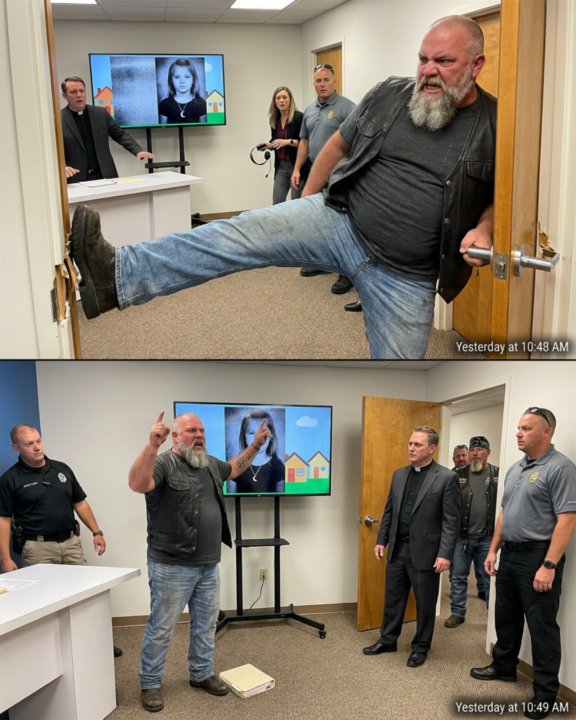
Daniel helped write those rules.
He had seen too many fundraising rides operated like parades without planning. He believed good intentions did not shorten stopping distance.
The morning of his last ride, Daniel arrived early. He carried a manila envelope containing sponsor checks for the county pediatric rehabilitation center.
The event raised money for adaptive equipment that insurance often did not fully cover. Daniel cared about that program because his younger nephew had received a customized communication device through it.
Nothing about the ride was spontaneous.
The route was permitted where required. We had a support truck, two riders with current first-aid training, and contact information for each participant.
The weather was cool and clear.
At the safety meeting, Daniel rubbed the back of his neck.
I noticed.
“You good?”
“Didn’t sleep.”
“Headache?”
“Little one.”
I told him to sit out if it worsened. He made a joke about me becoming his mother.
That exchange stayed inside me for years.
We left the clubhouse shortly after eight. Daniel rode near the front, behind Ruth Calder, a retired paramedic and our ride coordinator.
Twenty-seven miles later, we stopped at a gas station outside Logan.
Daniel bought water but no coffee.
That was unusual.
Ruth asked him to smile. She later told me his face appeared even and his speech was clear. He lifted both arms without weakness. He said the headache had faded.
We believed him.
Before remounting, he called Karen. She did not answer because she was driving Lily to a friend’s house. Daniel left a voice message promising dinner and saying he loved them.
That message became the last thing Lily was willing to hear for six months.
Nine miles after the gas stop, Daniel drifted toward the center line.
I sounded my horn.
He corrected.
Then his left hand released the grip.
His motorcycle began slowing, not because he braked, but because his body was folding toward the fuel tank.
Ruth moved ahead to clear space. I rode beside Daniel, shouting his name. His eyes were open, but they were not tracking me.
We entered a section with a wide gravel shoulder.
I placed my left hand against his upper arm and guided his direction while easing my own bike outward. Luis came behind us, slowing traffic within the formation.
Daniel’s Harley crossed onto the shoulder at low speed.
It tipped.
So did mine.
The crash people later imagined never happened.
There was no high-speed impact.
No car struck him.
No guardrail crushed his motorcycle.
Daniel’s engine guard hit gravel. My vest dragged beneath his shoulder as I tried to keep his head from striking the ground.
That was when the bottom edge of my patch tore.
It was also where the dark abrasion came from.
Ruth reached us within seconds. She recognized unequal facial movement and weakness on Daniel’s left side. Someone called 911 while she noted the symptom time from my helmet camera.
We removed no helmet until emergency responders directed it. We stabilized him, kept the airway clear, and gave dispatch accurate information.
The ambulance reached us in nine minutes.
Daniel was transported to a hospital capable of advanced stroke treatment. Karen arrived shortly afterward.
Lily did not.
That was her mother’s decision, supported by the hospital team, while doctors worked to stabilize him. By the time she was brought in later, Daniel was sedated and connected to equipment that frightened her.
He had suffered a major stroke.
Doctors removed a clot and restored some blood flow. For a while, the treatment seemed to give part of him back.
On the second day, Daniel woke enough to speak in short sentences.
He asked for Karen.
Then Lily.
Then me.
The nurse warned us that fatigue could arrive quickly. Daniel’s voice was weak, his right hand bruised from IV attempts, and one side of his mouth still sagged.
Yet his first words to me were clear.
“You scratched my bike?”
I laughed once.
Then I turned away because my face had stopped obeying me.
Daniel asked what Lily had been told.
Karen said only that he became sick during the ride.
He closed his eyes.
“She’ll blame you.”
“She won’t,” I said.
He opened them again.
“She’s thirteen, Mack. She’ll blame gravity if it gives her somewhere to put this.”
Later that day, he asked for a recorder.
I thought he wanted to leave a normal goodbye.
He wanted something more difficult.
Part 3
Daniel recorded the message in pieces.
The first attempt lasted twenty-three seconds. His speech became slurred, and he pushed the recorder away.
The second ended when a monitor alarmed and a nurse entered.
During the third, he spoke for almost four minutes.
Karen remained beside the bed. A patient advocate witnessed the recording because Daniel wanted his instructions understood, not interpreted through our grief later.
I stood near the window.
He began with Lily’s childhood nickname.
“Bug.”
Then he stopped for so long I thought he had fallen asleep.
His eyes opened.
“If you’re hearing this, you’re mad.”
Karen pressed her fist against her mouth.
Daniel continued.
“Good. Means you still got fire.”
His sentences were short. The effort showed in the muscles of his neck. Every few words, he rested.
He told Lily the ride had not killed him.
He explained that something failed inside his body while he happened to be on the motorcycle. He admitted the headache had been stronger than he told us.
That detail cut me.
He had lied at the gas station.
Not maliciously.
Not because the club pressured him.
Because Daniel hated missing commitments, and because adults often reduce symptoms until the body removes their authority to decide.
“Don’t put that on Mack,” he said into the recorder. “He asked. Ruth asked. I told them I was fine.”
I stared at the floor.
Daniel saw me.
“Look at me, brother.”
I did.
“You got me off the road.”
I started to speak.
He shook his head.
“Three days.”
At the time, none of us knew there would be only three.
Daniel did not mean he expected to die on that schedule. He meant that the rapid response had given him time he would not otherwise have had—time to see Karen, speak to Lily when she visited briefly, settle decisions with doctors, and record the message.
He told his daughter not to make the patch into a weapon against herself.
He knew Lily.
She would believe that loving him required hating whatever had been near him when he died.
“If you need to hate the club, hate them awhile,” he said. “They can take it.”
A weak smile moved across his face.
Then came the instruction that kept us silent for six months.
“Don’t give her this right away.”
Karen leaned closer.
“When?”
Daniel breathed through his nose, gathering strength.
“When she’s angry enough to need it.”
The patient advocate asked him to clarify.
He tried.
“Not when she’s crying. Everybody talks at crying kids. Wait till she’s done listening. Wait till anger is the only door left.”
Karen asked how they would recognize that moment.
Daniel looked toward me.
“Mack will.”
I did not want that responsibility.
He gave it to me anyway.
The recording ended with a message only for Lily. I heard it once in the hospital room and never again until the day she tore off my patch.
That night, Daniel’s condition worsened. Swelling increased. He became less responsive.
On the third day, doctors explained the damage and prognosis to Karen. There were decisions no family should have to make while vending-machine coffee cools beside an unsigned parking receipt.
Daniel died with Karen holding his hand.
Lily had visited earlier, during one of his quieter periods, but he had been too exhausted to speak clearly. She remembered machines, bruises, and her father trying unsuccessfully to lift his hand.
Afterward, grief simplified everything.
Daniel went riding.
Daniel was injured.
Daniel died.
The club became the shape around those facts.
At the funeral, Lily refused to enter while motorcycles remained near the church. We moved them to another lot.
She refused the folded club bandanna Daniel had kept in his saddlebag. We placed it in the wooden box.
She would not attend the memorial ride. We canceled it.
That decision divided our members.
Several believed Daniel deserved a final procession. Others said Lily’s grief should not control a club tradition. Boone, our sergeant-at-arms, argued that canceling made us look guilty.
I let him finish.
Then I said, “We’re not proving anything to a child at her father’s funeral.”
The memorial ride stayed canceled.
Two members resigned over it.
Brotherhood sounds strong when everybody agrees. The test comes when honoring a dead man requires surrendering the ceremony that would make the living feel better.
For six months, we waited.
Karen updated me occasionally. Lily stopped wearing the motorcycle jacket Daniel had bought her. She removed his club photographs from her room. At school, she punched a boy who called her father reckless.
She received counseling but changed therapists after refusing to speak during four appointments.
Then she began tearing pages from a scrapbook.
One page showed Daniel beside me, both of us wearing the same patch.
She destroyed his half.
She kept mine.
Karen brought that torn photograph to the clubhouse.
“Is this the moment?” she asked.
I studied the clean vertical rip between us.
“No.”
“How much worse does it need to get?”
“I don’t know.”
That answer angered her.
It angered me too.
Then came the winter-coat project.
Daniel had helped establish it. Karen wanted Lily to see that something he built still existed beyond the road.
I agreed, though every instinct warned me we were forcing the timing.
When Lily entered the courtyard and saw my patch, I understood what Daniel had meant.
She did not look sad.
She looked betrayed.
She grabbed the loosened edge created when I protected her father’s head.
Then she tore the symbol of that rescue from my back.
The anger had finally found its door.
Part 4
After Lily stepped on the patch, Boone moved.
He had served as sergeant-at-arms for eight years. His job was to protect the clubhouse, manage conflict, and keep members from making emotional situations worse.
That afternoon, emotion reached him first.
I raised one hand.
“Stay.”
He stopped, but the tendons in his jaw stood out.
Lily saw that.
She had expected retaliation. Part of her may even have wanted it. If we frightened her, she could finally make the outside match what grief had built inside.
I refused to give her that relief.
I picked up the patch, brushed off the gravel, and handed it back.
The dark abrasion crossed the embroidered lantern. Several original stitches still hung from the edge, mixed with the new threads Lily had broken.
“What happened here?” she asked.
“Your father.”
Her fingers tightened.
“You said the bike crashed.”
“No. Other people said that.”
“You let them.”
That landed cleanly.
She was right.
We had corrected family members privately, but we had not issued public explanations. Medical information belonged to Karen and Lily. Daniel’s death certificate was not a press release.
Still, silence had created space for the easiest story.
I looked at Karen.
She nodded.
“The ride didn’t cause your dad’s stroke,” I said. “He became sick while riding. We got him stopped.”
“You’re lying.”
“I wish I was.”
“He had road rash.”
“On his elbow. From the low-speed fall.”
“His helmet was at the hospital.”
“Because he was wearing it.”
Her breathing accelerated.
“And you expect me to believe you saved him?”
“No.”
That answer stopped her.
I pointed toward the clubhouse.
“Your father expects you to hear what he said.”
I retrieved the wooden box from the safe. Daniel’s handwriting appeared across the lid in black marker:
FOR LILY—WHEN SHE NEEDS THE TRUTH MORE THAN SHE NEEDS SOMEONE TO BLAME.
Karen had seen that sentence before.
Lily had not.
Her knees bent. Ruth brought a chair, but Lily pushed it away.
“Did everybody know?”
“Know what?”
“That he talked.”
Karen answered.
“I knew.”
Lily looked at her mother as though a second patch had just been torn.
“You had his voice?”
“I knew Mack had a recording.”
“And you didn’t give it to me?”
“Your dad asked us to wait.”
“He was dying!”
“Yes.”
“You listened to him instead of me?”
Karen’s face tightened, but she did not defend herself.
“Yes.”
There are moments when honesty sounds cruel because anything softer becomes another lie.
Lily turned toward me.
“What if I never ripped it?”
“I would have kept waiting.”
“For how long?”
“I don’t know.”
“Forever?”
“If that’s what your mother chose.”
She looked down at the box.
The club did not legally control Daniel’s message. Karen did. At her request, I stored the recorder because Lily searched closets and drawers during the worst weeks after the funeral, trying to find things adults might be hiding.
Daniel’s instructions were not a binding order from beyond the grave.
They were a request.
Karen could have changed her mind at any time.
That mattered, though it did not make Lily feel less betrayed.
We offered her the private meeting room. Karen asked to enter with her.
Lily said no.
Then she looked at me.
“You too.”
I unlocked the room, placed the box on the table, and showed her how to operate the recorder.
The patch remained folded beneath her arm.
“If I break this?” she asked.
“It’s a recorder.”
“I mean his voice.”
“You won’t.”
I stepped outside.
Lily shut the door.
The first playback lasted four minutes.
Then silence.
A minute later, the recording started again.
Forty bikers waited in the courtyard. Nobody returned to sorting coats. Nobody started an engine.
Boone sat on an overturned milk crate, elbows on his knees.
“You knew she’d do that?” he asked.
“No.”
“Daniel did?”
“He knew she’d do something.”
Boone stared at the bare outline on my vest where the patch had been.
“I almost grabbed her.”
“I know.”
“I would’ve scared her.”
“I know.”
He rubbed both hands across his face.
“Brother, I’m sorry.”
That apology was not only for the step he took.
Boone had been one of the men who wanted a memorial ride despite Lily’s objection. Now he understood that we had been asking a child to watch the symbol she blamed fill an entire highway.
Inside the room, Daniel’s voice began a third time.
Then a fourth.
After roughly forty minutes, Karen knocked softly.
Lily told her to go away.
Karen sat on the floor outside the door.
At seventy minutes, I brought water. Lily opened the door only wide enough to take it.
Her face was swollen from crying.
The patch was still in her lap.
At one hour and fifty-three minutes, the door opened.
Lily emerged holding the recorder in one hand and my patch in the other.
She had learned three things.
Her father’s stroke began before the motorcycle tipped.
I had damaged my vest while cushioning his fall.
And the men she blamed had given Daniel the three days in which he recorded his goodbye.
But the last thing Daniel said changed her more than any fact.
His recorded voice had grown faint.
“Bug, don’t spend your life protecting me from a thing that already happened.”
He paused.
Then:
“Build something I didn’t get time to finish.”
Lily crossed the courtyard and stopped before me.
“I tore it.”
“Yes.”
“Can it be fixed?”
“Yes.”
“Will you fix it?”
I looked at the patch.
“No.”
Her face fell.
Then I handed her the small sewing kit Ruth kept in the office.
“You will.”
Part 5
Lily had never sewn leather.
Neither had most of the men offering advice.
Ruth cleared one folding table and found heavy upholstery thread, leather needles, a thimble, and a pair of pliers. She explained that pushing a needle through an old vest required patience and that the patch could be professionally restored later if Lily wanted.
Lily shook her head.
“No later.”
She placed my vest on the table.
The club formed an uncertain semicircle around her. I told everyone to back up and return to the coat boxes.
Nobody returned to the coat boxes.
Lily aligned the patch badly.
The left side sat nearly half an inch higher than the right. The silver lantern tilted toward my shoulder blade. She pushed the first needle through the wrong place and stabbed her thumb.
A small bead of blood appeared.
She sucked in a breath.
Boone reached for the first-aid kit.
“I’m fine.”
He stopped.
Six months earlier, he might have ignored those words and taken control. That day, he placed the kit within reach and walked away.
Lily continued.
Each stitch was too large. Some overlapped. Others left gaps. She had to use pliers to pull the needle through the thickest section.
The work took nearly three hours.
During that time, Karen sorted winter coats alone at the far table. She did not hover. Every few minutes, Lily glanced toward her, checking that she remained there.
She did.
When the final knot slipped, Lily cursed under her breath.
Several bikers pretended not to hear.
Ruth showed her how to secure it.
Lily lifted the vest.
The patch was visibly crooked.
The border buckled along the bottom. Old road damage crossed the lantern, and fresh dust remained trapped inside one row of stitches.
“It looks terrible,” Lily said.
“It does,” I answered.
Ruth struck my arm.
Lily almost smiled.
I put the vest on.
The uneven patch pulled the leather toward one side. One stitch scratched through the lining near my shoulder. It was uncomfortable and impossible to ignore.
Perfect.
Daniel’s patch had always represented belonging. After Lily repaired it, it represented something harder.
Belonging after damage.
We finished the coat project after dark. Lily packed three boxes, though nobody asked her to. Before leaving, she placed Daniel’s recorder back inside the wooden box.
“You can keep it now,” I told her.
She looked at Karen.
“Not at home yet.”
That was her choice.
The box returned to the safe, but the terms changed. Lily could listen whenever she wanted. Nothing was being withheld.
For the next year, she visited roughly once a month.
Sometimes she played the recording.
Sometimes she did not.
She helped inventory donation receipts, entered coat sizes into a spreadsheet, and corrected riders who forgot to keep fuel reimbursements separate from charitable expenses.
Her father had been careless with coffee and meticulous with receipts.
She inherited one of those traits.
At fourteen, Lily discovered that the club’s charity fund depended too heavily on handwritten records. She built a basic digital ledger for a school technology project.
At fifteen, she insisted the fund publish an annual summary.
Some members resisted.
“People should trust the patch,” one said.
Lily pointed at the crooked emblem on my back.
“Trust needs stitching too.”
The summary was published.
Donations increased.
Not because every donor adored bikers. Because they could see where the money went.
The club incorporated the charitable program separately, appointed an outside bookkeeper, and added community members to its oversight committee. Lily attended meetings as a youth observer with Karen’s permission.
She did not become our mascot.
We refused requests to tell the patch story at fundraisers while she was a minor. Her grief did not belong to our marketing.
That refusal cost us publicity.
It protected something more important.
At eighteen, Lily left for college to study nonprofit administration and accounting. Before leaving, she asked whether I planned to repair the patch professionally.
“No.”
“The thread could fail.”
“Then you’ll fix it again.”
“You’re emotionally manipulating free labor from a teenager.”
“Your father taught me.”
She laughed.
It was the first joke about Daniel that did not leave an apology behind it.
Four years later, Lily returned to Zanesville with a degree, two internships, and a color-coded financial system that made half our officers nervous.
Our charity director planned to retire.
Lily applied for the paid position.
She did not automatically receive it.
An independent committee interviewed her alongside five other candidates. She submitted budgets, references, and a plan to expand adaptive-equipment grants without mixing charitable decisions with club membership.
She got the job.
Not because Daniel had worn our patch.
Because she was the strongest applicant.
On her first morning, she unlocked the office safe and removed the wooden box.
She carried the recorder home.
The safe remained open for several seconds after she left.
For years, I believed the box held Daniel’s last unfinished duty.
I finally understood it had been holding Lily’s future only until she could carry it herself.
Part 6
I wore the crooked patch for nine years.
Rain darkened the thread. Sun faded the silver lantern. The left edge sagged, and one of Lily’s original stitches broke during a ride through West Virginia.
I did not replace it.
She repaired that stitch at twenty-one, using the same oversized pattern she had used at thirteen.
“Still ugly,” she said.
“Tradition.”
By then, Lily managed grants for mobility equipment, family transportation, and rehabilitation costs. She required receipts from every applicant and every club officer, including me.
Especially me.
Once, I submitted a fuel receipt without noting the event.
She returned it with a yellow flag.
I reminded her I was club captain.
She reminded me her budget did not wear patches.
Daniel would have enjoyed that.
Each year on the anniversary of his stroke, we did not hold a memorial ride. We met at the rehabilitation center and assembled equipment requested by staff—adjustable desks, sensory kits, storage carts, or wheelchair tool packs.
The ritual began quietly.
No engines revved.
No vest photographs were required.
Lily chose it.
The first time she addressed volunteers, she brought the recorder but left it inside her bag. She did not play Daniel’s final message for anyone.
His voice belonged to her.
She spoke about the three days instead.
Not as stolen time.
As time created by people who noticed something was wrong and acted quickly.
Ruth taught annual stroke-recognition sessions at the clubhouse. Riders learned to treat sudden weakness, facial drooping, speech changes, confusion, or severe unusual headache as emergencies—not inconveniences to be ridden through.
We also changed the pre-ride policy.
A rider reporting a new severe headache, neurological symptom, chest pain, or unexplained dizziness did not continue until medically evaluated. No captain could diagnose a person beside a gas pump, but we could stop pretending determination overruled symptoms.
That policy angered riders twice.
It may have helped one.
A fifty-six-year-old member named Pete developed slurred speech before a spring ride. His friends noticed because Ruth had drilled the signs into them. EMS transported him before the group departed.
He survived.
When Pete returned months later, he touched the crooked patch on my vest.
“Sparks still working?”
I looked across the room.
Lily was reviewing grant applications beneath the framed drawing Daniel’s nephew had made years earlier.
“Yeah,” I said.
“He is.”
Part 7
On the ninth anniversary of the day Lily tore off my patch, I retired as club captain.
The Iron Harbor Riders gathered in the same gravel courtyard. Many of the original forty remained. Some had gray beards now. Three used canes. Ruth had sold her motorcycle but still corrected everyone’s first-aid kits.
Lily was twenty-two.
She stood beside the donation tables with a laptop beneath one arm and Daniel’s wooden box beneath the other.
My replacement captain completed the formal transfer. I removed my vest and handed it over only long enough for the membership pin to be moved.
The patch stayed mine.
Club emblems usually return when a member leaves under certain circumstances. Retirement in good standing was different, but I still expected debate over whether such a damaged patch should appear in official photographs.
Nobody raised the question.
The crooked stitching had outlived the argument.
Afterward, Lily asked to see the inside of the vest.
She turned it over.
Her first stitches were still visible beneath the lining—uneven black loops made by a thirteen-year-old whose hands would not stop shaking.
“You really never had this fixed?”
“No.”
“Not even the alignment?”
“No.”
“Why?”
I could have told her it honored Daniel.
That was only part of it.
I could have said it reminded the club what restraint looked like when forty angry men allowed one grieving child to attack their most important symbol.
That was closer.
Instead, I gave the answer Daniel would have preferred.
“It held.”
Lily ran her thumb over the oldest knot.
Then she opened the wooden box.
The hospital wristband remained inside. So did Daniel’s Harley key and the folded bandanna she once refused to touch.
The recorder was gone.
She kept that at home.
In its place lay a new patch—not a club emblem, but a small embroidered symbol for the charity foundation she now managed: a silver spark rising from an open hand.
“I’m not putting that on my vest,” I said.
“It isn’t for you.”
She crossed the courtyard and pinned it to the canvas bag used to carry grant applications.
Daniel had asked her to build something he did not have time to finish.
She had.
Before leaving, Lily hugged me. She was no longer the child who needed somewhere to put her anger, and I was no longer the man responsible for deciding when she was ready to hear the truth.
Engines started along the wall.
Leather creaked.
Gravel shifted beneath heavy boots.
I put on the old vest one final time.
The lantern still leaned left. Dust from the day Lily stepped on it remained trapped beneath one crooked seam. Nine years of rain had not washed it free.
I never wanted it washed away.
The patch stayed crooked.
So did the truth.
Both held.
Follow the page for more biker stories about grief, loyalty, second chances, and the quiet promises people keep long after the engines fall silent.