Part 2: A Biker Smashed My Son’s Birthday Cake in Front of Twenty Horrified Guests—Then a Sharp Metal Shard Slid from the Frosting, and He Quietly Replaced Everything
Part 2 — The Invitation Beneath Booth Seven
I first met Ray Dawson eight months before my son’s birthday, though “met” is a generous word for what happened.
He entered the Desert Star at 6:10 on a Thursday morning, carrying the cold smell of highway air, gasoline, and worn leather. Outside, his Harley’s V-twin ticked as the engine cooled. Inside, every spoon seemed to pause against every coffee cup.
Ray chose booth seven.
“Eggs hard. Wheat toast. Coffee.”
Those were the first seven words he ever said to me.
He returned the next Thursday at the same time, then the Thursday after that. He always arrived alone. He never complained when the eggs were overcooked, never asked for a refill before I offered, and never left without wiping the table with his napkin as though trying to erase proof that he had occupied space.
People supplied their own stories about him.
A trucker told me Ray had spent time in prison. A retired deputy claimed he had once broken a man’s jaw at a gas station. One of our cooks said the Iron Saints motorcycle club used to collect debts for people who didn’t send invoices.
Most of it was wrong.
The prison story belonged to Ray’s younger brother. The broken jaw had happened when Ray stopped a drunk man from dragging a waitress into a pickup. The Iron Saints did collect things, but mostly winter coats, school supplies, and overdue utility payments for veterans too proud to ask.
Ray never corrected the rumors.
“Folks need their monsters,” he once told me. “Keeps their own mirrors clean.”
Noah saw him differently from the beginning.
Every Thursday before school, my son sat at the end of the counter doing homework while I finished the breakfast rush. He noticed that Ray broke his toast into small pieces and put them in a napkin. He followed him outside one morning and found him kneeling beside an old brown dog that lived behind the dumpster.
Ray’s massive tattooed hand was flat on the pavement. The dog ate from his palm.
“You’re not supposed to feed him toast,” Noah said.
Ray looked over his shoulder. “That right?”
“It isn’t good for dogs.”
“What is?”
Noah considered himself an expert because he had read three library books about animal care. “Plain chicken. Maybe carrots.”
The next Thursday, Ray brought plain chicken.
That became their friendship.
It consisted mostly of short conversations about motorcycles, dogs, and whether pancakes counted as dessert. Ray never talked down to Noah. He answered every question seriously, including how rain felt against a face at sixty miles per hour and whether motorcycles became lonely in garages.
“Machines don’t,” Ray said. “Men do.”
Noah remembered that answer.
When he made his birthday invitations, there were twelve names from school, two cousins, our landlord, and Ray. He drew a black motorcycle on Ray’s envelope and wrote the sentence about coming if he had no other party.
I almost removed it.
Ray was kind to Noah, but kindness across a diner counter was different from bringing a feared biker into a room filled with children. Then I hated myself for the thought. I had spent years resenting people who judged me as a broke single mother, yet I was ready to judge a man by leather, tattoos, and rumors.
Noah left the invitation beneath Ray’s coffee cup.
Ray found it after we walked to school. According to Maggie, the morning cashier, he read it three times. Then he asked what day of the week August seventeenth fell on.
“Saturday,” she said.
Ray gripped the card so hard its purple edges bent.
Maggie expected him to refuse.
Instead, he asked, “What does a nine-year-old want?”
That afternoon, Ray rode to the garage behind a feed store where the Iron Saints kept tools and spare parts. His club president, Calvin “Preacher” Brooks, later told me what happened there.
Ray stood at a welding bench and emptied a coffee can filled with washers, nuts, and short lengths of steel wire. He selected each piece carefully. When a prospect reached for a grinder, Ray shook his head.
“My hands.”
For three nights, he built Noah’s little motorcycle. He welded the frame, shaped handlebars from wire, and polished the metal until nothing could cut a child’s finger.
Preacher watched him file the same edge for nearly twenty minutes.
“It’s smooth, brother,” he said.
Ray ran his thumb across it again.
“Smooth ain’t the same as safe.”
On Friday evening, the night before the party, the Iron Saints gathered for another reason. Every August seventeenth, they rode west before sunrise to a small cemetery outside Winslow. They had made that ride for nineteen years.
Ray always led.
Nobody asked why anymore.
That year, he told them he would meet them after four.
Preacher studied the purple invitation protruding from Ray’s vest.
“You’ve never been late to Molly’s ride.”
“I know.”
“You sure about this?”
Ray looked at the handmade motorcycle on his workbench. Then he touched the inner pocket of his vest, where he kept something none of the newer members had seen.
“A kid asked me to show up,” he said. “You show up.”
The club left for Winslow without him.
At 3:40 the next afternoon, Ray parked outside the Desert Star and shut off his engine. Through the diner window, he saw nine candles waiting on a blue cake.
For several seconds, he remained astride the Harley with both boots on the pavement.
Then he removed his gloves.
His left hand was steady.
His right was not.
Part 3 — The Silver Line Beneath the Sugar Road
The party had already become louder than the diner’s back room could comfortably hold when Ray entered. Children chased one another between chairs. A balloon had lodged against a ceiling fan. Someone spilled punch beneath the gift table, and two mothers were debating whether a napkin placed over the puddle counted as cleaning it.
Ray filled the doorway.
Conversations stopped in layers.
First the parents nearest him. Then the children who noticed their parents staring. Finally the entire room, until the only sound was the ceiling fan batting the trapped balloon against the plaster.
Noah broke the silence.
“Hammer!”
He ran straight at him.
Ray glanced at me, perhaps asking permission without words. I nodded. Noah wrapped his arms around the biker’s waist, and Ray rested one hand on his back with the caution of a man touching cracked glass.
The room began breathing again.
Ray handed me his knife. It was not a performance. He saw the parents watching, understood their fear, and removed one reason for it.
Then he gave Noah the motorcycle.
Noah turned it beneath the fluorescent lights, studying the tiny wheels and welded fuel tank. “You made this?”
“Mostly argued with it.”
“Does it run?”
“If you push it.”
Noah laughed. Ray almost did.
For the next forty minutes, he stood against the wall and drank coffee while children opened gifts and ate pizza. He declined every attempt to pull him into conversation, but when a six-year-old girl lost the wheel from a plastic truck, he knelt, found it under a booth, and snapped it back into place.
The girl’s father lowered his phone.
Not everyone relaxed. A man named Tyler kept watching Ray with the rigid suspicion of someone waiting to be proved right. When Ray moved, Tyler moved. When Ray reached into his vest for reading glasses to inspect a child’s magic trick, Tyler placed one hand on the back of his chair.
I noticed.
Ray did too.
He said nothing.
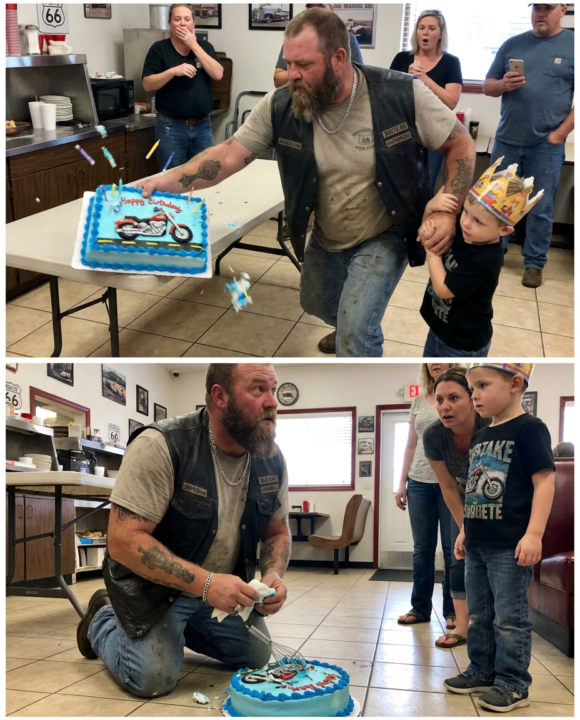
At four fifteen, Maggie dimmed the lights while I carried in the cake. The children cheered. Noah stood at the center table, cheeks flushed, paper crown tilted over one eyebrow.
The blue frosting reflected candlelight. The sugar motorcycle sat on a raised strip of black icing meant to look like Route 66.
I set the cake down.
Ray’s coffee cup stopped halfway to his mouth.
Later, he told me he noticed three things.
First, the motorcycle decoration leaned slightly although the cake had not moved.
Second, a narrow groove ran through the frosting behind it, too straight to be made by a spatula.
Third, when I pushed a plastic server beneath the bottom layer, he heard a faint scrape.
Metal against metal.
It was almost nothing. A tiny sound beneath clapping, laughter, and twenty voices struggling through the same birthday song at different speeds.
Ray heard it anyway.
He stepped away from the wall.
Tyler stood immediately.
Ray moved closer. The candles trembled in the air pushed by the ceiling fan. Noah squeezed his eyes shut, making a wish.
“Laura,” Ray said.
I was singing. I didn’t hear him.
He looked at the black icing again. A silver line had appeared beneath the sugar motorcycle, no wider than a strand of hair.
He knew that curve.
“Stop.”
Nobody stopped.
Noah bent forward.
Ray crossed the distance in two strides.
Everything happened at once.
His left forearm swept across Noah’s chest.
His right fist came down.
The table jumped. Candles flew. Frosting struck the wall. The cardboard base folded, and the cake rolled over the edge, hitting the tile upside down.
Noah cried out.
I struck Ray across the face.
Tyler seized the back of his vest. Another father shouted for someone to call 911. Children scattered toward the walls while their parents pulled them close.
Ray could have thrown Tyler aside.
He didn’t.
“Let go,” he said.
“You attacked a kid.”
“Let go.”
Tyler tightened his grip.
Then came the ping.
Small. Bright. Final.
The piece of metal slipped from the ruined cake and spun across the tile. It stopped beside Noah’s sneaker, one jagged end stained blue with frosting.
Everyone saw it.
Tyler released Ray’s vest.
I stared at the metal, then at the place where it had been hidden. It had run lengthwise through the upper layer, directly beneath the sugar highway. If Noah had pressed his face into the cake, as several children had jokingly encouraged him to do, the point would have been aimed toward his mouth.
My knees weakened.
Ray stepped between Noah and the shard.
“Back up,” he told everyone. “There may be more.”
His voice had changed. It was flat and controlled, the voice of a man forcing panic into a locked room inside himself.
He took napkins from the counter and lifted the shard without touching it. He examined the rounded bend, the broken tip, and the thin streak of dried chocolate batter caught near its base.
“Commercial whisk,” he said.
“How do you know?” Tyler asked.
Ray didn’t answer.
He asked Maggie for a clean food container, sealed the shard inside, and told me not to throw away the cake. He photographed the bakery label, the lot number, and the remaining slices in the kitchen.
Then his control cracked.
Only for a second.
His eyes moved from the shard to Noah’s face, and the color left him. His right hand shook so violently that the container rattled against the counter.
“Molly,” he whispered.
Preacher called at that moment.
The Iron Saints had finished their cemetery ride. They were waiting beside the highway for Ray to join them. I heard a rough voice through the phone asking where he was.
Ray looked at Noah, who stood beside the ruined cake trying not to cry.
“Change of route,” Ray said.
He walked outside.
Through the window, I watched him sit on his motorcycle without starting it. His shoulders rose once, then dropped. He pressed both hands against the handlebars and bowed his head.
Inside, the party collapsed.
Two parents took their children home. Another demanded that I call the bakery. Noah slipped beneath the birthday banner and sat alone with blue frosting on his sneaker.
“I didn’t get my wish,” he said.
I knelt in front of him.
“You still can.”
“The candles are broken.”
Across the parking lot, Ray lifted his phone.
He called Preacher again.
“Need a cake,” he said. “Nine candles. No metal decorations. Check every inch.”
There was a pause.
Then Preacher answered, “On our way.”
Forty minutes later, eleven V-twins rolled into the parking lot with a sound that rattled the diner windows. Parents rushed toward the glass, expecting trouble.
The Iron Saints arrived carrying cake.
One rider had two boxes of pizza strapped behind her seat. Another carried three bags of ice cream in a cooler. Preacher held a plain sheet cake from a grocery store forty miles away, still sealed in its plastic container.
Ray inspected it beneath the kitchen lights.
He removed the lid. He checked the frosting. He lifted the cardboard base. He passed a clean plastic knife through every section where no slice would be taken, then wiped it and did it again.
Only then did he carry the cake to Noah.
The remaining children gathered around. The bikers stood along the back wall, leather shoulders nearly touching. No one sang loudly this time.
Ray lit nine candles.
Noah looked at him. “Are you staying?”
“Till they’re out.”
Noah inhaled.
Nine flames disappeared.
Everyone applauded, but Ray watched the smoke rising from the wicks as though it belonged to another room, another year, and another child.
When the applause ended, he began cleaning blue frosting from the floor.
That was when the flattened number-eight candle slipped from inside his vest.
Preacher saw it.
His face changed.
And I finally understood that the sharp piece of steel inside Noah’s cake was not the first one Ray Dawson had ever found.
Part 4 — The Birthday Ray Could Not Finish
I followed Ray into the parking lot after the guests left.
The desert evening had cooled, but heat still rose from the blacktop. Eleven motorcycles stood in a row, their chrome catching the last orange light. The riders spoke quietly near the road while Ray sat alone on the curb behind the diner.
The flattened candle lay in his palm.
It had once been white with a red border. Time had yellowed the wax. The wick was burned, and a dark crack ran through the middle of the number eight.
“Molly?” I asked.
Ray closed his fingers around it.
For a while, I thought he would refuse to answer.
Then he moved aside, leaving space on the curb.
Molly Dawson was his daughter.
She had been born when Ray was twenty-eight and still working twelve-hour shifts maintaining industrial kitchen equipment across northern Arizona. He was already big, already tattooed, already riding an old Harley that leaked oil onto every driveway it visited. But the photograph he eventually showed me revealed a different face—less weathered, less guarded, with a little girl sitting on his shoulders and holding both sides of his beard.
Molly loved birthdays.
Not just hers. Everyone’s.
She made cards for mechanics, grocery clerks, teachers, and neighbors. If she discovered someone’s birthday had passed unnoticed, she insisted on repairing the mistake with a candle pushed into whatever food was available.
Once, she put six candles in her father’s meatloaf.
At eight, she wanted a motorcycle cake.
Ray ordered one from a bakery near Winslow. It had pink frosting, chocolate wheels, and a curved sugar road. He picked it up after work, strapped it inside his truck, and drove home while Molly watched from the front window.
During the party, Ray noticed a silver mark near one of the decorations.
He assumed it was edible glitter.
Molly blew out the candle. She took the first bite from the place where the sugar motorcycle stood.
Then she covered her mouth.
The party stopped.
A broken stainless-steel wire from the bakery’s mixer had separated during preparation and disappeared into the batter. The piece cut deeply inside Molly’s mouth and throat. She panicked, inhaled, and collapsed while the adults around her struggled to understand what had happened.
Ray froze.
That fact mattered more to him than anything that came afterward.
He had maintained machines capable of removing fingers. He had pulled injured riders from ditches. He had faced men twice as angry and half as sober without backing away.
But when his daughter reached for him, he stood motionless for several seconds.
His wife, Annie, called 911. A neighbor began first aid. The ambulance came quickly, but Molly’s airway had been badly injured. She died that evening at a hospital in Flagstaff.
Ray told the story without decoration.
No dramatic pauses. No speech about grief. Just facts sharpened by nineteen years of repetition.
“The bakery didn’t know the whisk was damaged,” he said. “Health department found the missing tine after. Hairline crack at the hub.”
He opened his hand and looked at the candle.
“I saw the shine. Didn’t move.”
“You couldn’t have known.”
“Knew enough to look.”
“You saw glitter.”
“I saw something.”
The Iron Saints had not yet existed then. Ray formed the club two years after Molly’s death with Preacher and four other riders from a grief-support meeting for veterans, widowers, and fathers who had lost children. They did not announce that origin. They simply began showing up when people needed engines, muscle, money, or witnesses.
Every August seventeenth, they rode to Molly’s grave.
Every year, Ray placed a tiny metal motorcycle beside the headstone. Every year, he lit an eight-shaped candle, allowed it to burn for one minute, then extinguished it between his gloved fingers.
That morning had been the first time in nineteen years he had not gone with them.
Noah’s invitation shared Molly’s birthday.
The coincidence nearly kept him away.
“What changed your mind?” I asked.
Ray watched my son through the diner window. Noah was helping Maggie collect paper plates.
“Card said I could come if I didn’t have another party.”
“You did have another one.”
Ray rubbed his thumb across the cracked candle.
“That one ended a long time ago.”
Preacher approached us carrying the sealed container with the metal shard. He explained that he had called the county health department and Sweet Mesa Bakery. An inspector was meeting them there.
The bakery’s owner, Elena Ruiz, was waiting when we arrived.
She was sixty-one, silver-haired, and still wearing an apron dusted with flour. Her daughter and two employees stood behind her. All three were crying.
Elena did not argue. She did not hide behind a lawyer or blame the delivery driver. She shut down every mixer, locked the front door, and placed her records on the counter before the inspector asked.
The missing piece came from a balloon whisk attachment purchased secondhand six months earlier. A weld near the center had cracked. The employee cleaning it that morning noticed one wire sitting slightly lower than the others but assumed it had bent.
It had broken into the chocolate batter.
There could have been more fragments.
Elena gave the inspector a list of every cake produced from that batch. The club divided the addresses among themselves and began knocking on doors before the official recall had even been issued.
Ray took the farthest address.
Preacher stopped him beside his motorcycle.
“You haven’t been to the cemetery.”
Ray fastened his helmet strap. “Later.”
“Molly won’t mind?”
Ray looked back through the bakery window at Noah, who had insisted on coming with me and now sat on a flour sack drawing motorcycles on a receipt.
“No,” Ray said. “Don’t reckon she will.”
That was the first twist I understood.
Ray had not missed Molly’s birthday ride.
He had simply ridden it somewhere else.
Part 5 — What the Broken Whisk Brought Back
The health department found no additional metal in the other cakes, but three remained unopened and were destroyed as a precaution. Sweet Mesa Bakery closed for twelve days. Elena replaced both mixers, rewrote her inspection procedures, and invited an independent equipment technician to examine every moving part in the kitchen.
Ray volunteered.
He spent two full days inside the bakery without accepting payment. He checked welds, guards, shafts, paddles, and electrical connections. He taught the employees how to photograph each attachment before and after use so even a small change would be visible.
Elena tried to thank him.
Ray handed her a file containing inspection sheets.
“Use those.”
“I could have killed that boy.”
“You didn’t.”
“Because you were there.”
Ray looked at the silent mixer.
“Then make sure nobody needs me next time.”
He did not forgive her in a grand speech. He also did not punish her forever for a mistake she was willing to confront. Ray’s version of mercy came with checklists, replacement parts, and the expectation that a person would do better once they knew better.
The story spread through Holbrook.
At first, people told it badly.
They said a biker had punched a cake. They said a motorcycle gang had surrounded a bakery. They said Ray had discovered a knife, a razor blade, or a deliberate attempt to hurt a child.
None of that was true.
The truth was quieter: one damaged machine, one nearly invisible line in blue frosting, and one man who had spent nineteen years remembering the cost of looking away.
Tyler, the father who had grabbed Ray’s vest, came to the diner the following Thursday. Ray was seated in booth seven with coffee and eggs.
Tyler stood beside him.
“I owe you an apology.”
Ray cut his toast.
“Kid okay?”
“Yes.”
“Then we’re square.”
“I put my hands on you.”
Ray looked up. “Would’ve done the same.”
That answer bothered Tyler more than anger would have. He sat in the opposite booth and bought Ray breakfast. They ate without talking.
Noah recovered faster than the adults.
For several weeks, he refused decorated cakes, but he still ate Maggie’s brownies and grocery-store cookies after inspecting them under the light. Ray never told him not to be afraid. He sat beside him and checked the food too.
One morning, Noah asked, “Do you check everything because of Molly?”
Ray’s fork stopped.
I had not told Noah the entire story, only that Ray’s daughter had once been hurt by something hidden in food.
“Most things,” Ray said.
“Does checking make you less scared?”
“No.”
“What does it do?”
“Gives my hands a job.”
Noah thought about that.
Then he broke his toast in half and handed one piece to Ray.
On the first Saturday after the bakery reopened, Elena invited Noah to inspect the kitchen. He wore a paper cap and carried a flashlight. She showed him the new whisk attachments, each numbered and photographed. She demonstrated how employees counted every wire before mixing and again after cleaning.
Ray stood by the door.
Noah asked question after question. Elena answered every one.
At the end, she placed a plain cupcake on the counter. No topper. No hidden support. No hard candy. Just chocolate cake and blue frosting.
Noah did not touch it.
Elena’s eyes lowered.
Then Ray picked up a plastic knife, cut the cupcake into four pieces, and opened each one.
“Clear,” he said.
Noah ate one quarter.
Elena turned away, pressing both hands over her face.
Ray pretended not to notice.
The second revelation came later that afternoon, when Preacher gave me a small wooden box from the club garage. Inside were nineteen metal motorcycles, one for each year since Molly’s death. Ray had made them annually, but only eighteen had reached her grave.
The nineteenth was Noah’s birthday gift.
I understood then why Ray had polished every edge until his fingers hurt. He had not simply made my son a toy. He had taken the object he normally left with the child he lost and given it to a child still alive.
When I confronted him, Ray frowned as if I had uncovered something he considered private.
“That one was Molly’s?” I asked.
“Was metal.”
“You know what I mean.”
He drank his coffee.
“Noah needed wheels.”
“And Molly?”
Ray looked toward the diner window, where sunlight flashed across his Harley.
“She’d tell me to make another.”
So he did.
That evening, I found him in the club garage bending wire beneath a yellow work lamp. A new miniature motorcycle waited on the bench. Beside it lay the cracked number-eight candle.
He finished the frame, filed every weld, and ran his thumb over each edge.
Smooth was not the same as safe.
At dawn, Ray rode alone to the cemetery outside Winslow.
Noah and I followed in my car, though Ray had not invited us. We found him kneeling before a small headstone marked Molly Anne Dawson, 1998–2006.
He placed the new motorcycle in the grass.
Then he set down nine blue candles.
Eight for the child Molly had been.
One for the birthday she had helped save.
Part 6 — Nine Candles at the Desert Star
A year passed.
Sweet Mesa Bakery recovered slowly. Some customers never returned, but others did after Elena began offering monthly kitchen tours and publishing every equipment inspection near the register. She kept the broken whisk sealed in a clear case in her office—not for customers to see, but for employees.
Ray refused to enter that office.
He had seen enough.
Noah turned ten at the Desert Star. He asked for the same back room, the same blue frosting, and the same sugar motorcycle. When I suggested something simpler, he shook his head.
“If we never do it again, the bad birthday wins.”
Those words came from Noah, not Ray.
But they sounded like something Hammer might have said if he used more than five words at a time.
This time, Elena baked the cake herself. She invited Noah to watch the entire process. He counted every whisk wire before it went into the mixer and afterward. He inspected the pan, the cooling rack, the cardboard base, and each decoration.
Ray watched from the doorway, arms folded.
At the party, twenty-three children arrived.
So did eleven bikers.
No parent raised a phone when the Iron Saints entered. Tyler saved them an entire table and complained that Preacher had cheated during last year’s balloon game. Maggie served coffee in a row of mismatched mugs. The old brown dog from behind the diner slept near Ray’s boots after eating plain chicken.
When I carried out the cake, the room quieted.
Not from fear.
From memory.
Ray stood beside Noah. He did not touch the cake. He did not inspect the frosting. He only placed his hands behind his back and waited.
Noah looked up at him.
“You checked it, right?”
“Twice.”
“Mom checked it?”
“Three times.”
“Elena?”
“She may have named every wire.”
Noah smiled.
We sang.
He leaned toward ten candles and paused. Ray’s shoulders tightened. The entire room seemed to feel it.
Then Noah blew.
Nothing happened except darkness, smoke, applause, and a little frosting on his nose.
Ray exhaled.
Later, he helped cut the cake. His slices were uneven and far too large. Children lined up anyway.
The ritual continued every year.
At eleven, Noah asked for a helmet.
At twelve, he learned to change oil.
At thirteen, Ray let him sit on the parked Harley and showed him how the clutch felt beneath his hand.
At fourteen, Noah stopped calling him Hammer.
He called him Ray.
Nobody else did.
Each August, after Noah’s candles went out, Ray rode to Molly’s grave. Sometimes the Iron Saints followed. Sometimes Noah and I did. The number of small metal motorcycles in the grass increased, though the cemetery groundskeeper eventually asked Ray to take some home before the mower found them.
Ray built a wooden shelf in his garage.
Eighteen motorcycles stayed there.
One belonged to Noah.
The newest always went to Molly.
As for the sharp shard from the cake, the county returned it after the investigation. I expected Ray to throw it away.
Instead, he mounted it on a square of plain wood and hung it inside the Iron Saints’ garage beside the first-aid cabinet. Beneath it, he attached no inspirational quotation, no explanation, and no photograph.
Only a date.
August 17.
Every new club member was shown the metal before receiving a patch.
Preacher would point to it and say, “We look twice.”
That was enough.
Part 7 — The Candle He Finally Let Burn
Five years after the ruined birthday, Ray arrived at the Desert Star without his motorcycle.
That alone frightened me.
His Harley was being repaired after a delivery truck backed into it outside the feed store. Ray had not been hurt, but he walked into Noah’s fourteenth birthday carrying his helmet as though someone had taken a piece of him.
Noah met him at the door.
“You came in a car?”
“Don’t spread it around.”
The cake that year was shaped like a road curving through the Arizona desert. Fourteen candles stood along the black icing. Elena had baked it, inspected it, photographed it, and delivered it herself.
Before the song, Ray reached into his vest.
He removed the flattened number-eight candle.
For twenty-four years, he had carried it every August seventeenth. He had lit newer candles at Molly’s grave, but never that one. It was the last candle she had blown out, recovered from the kitchen floor after the ambulance left.
Ray pressed its base into an empty corner of Noah’s cake.
I looked at him.
He nodded once.
We lit fifteen flames—fourteen straight candles and one old, crooked eight.
The wax softened. The crack through its center widened. Ray stood behind Noah with both hands resting on the back of a chair.
“Together?” Noah asked.
Ray shook his head.
“That one’s yours.”
Noah understood.
He blew out his fourteen candles but left the old one burning.
For nearly a minute, nobody moved. The small flame descended toward the cracked wax, consuming what remained of a birthday interrupted twenty-four years earlier.
Ray watched until the wick went dark by itself.
Then he picked up a plastic knife.
“Cake,” he said.
It was the closest he came to announcing that something inside him had changed.
We ate beneath the buzzing neon sign while motorcycles rolled past on Route 66. Ray sat in booth seven with blue frosting on one scarred knuckle. Noah placed the little metal motorcycle Ray had made years earlier beside his plate.
Near closing time, the repaired Harley arrived on a trailer.
Ray rolled it down the ramp, checked the tires, and started the engine. The V-twin rumble filled the parking lot, deep and uneven, strong enough to tremble through the diner windows.
He fastened his helmet.
Noah called after him. “Where are you going?”
Ray glanced west, toward Winslow.
“Got one more birthday.”
Then his taillight disappeared down Route 66.
Follow our page for more unforgettable biker stories about the rough-looking strangers who quietly stay until every child’s final candle goes dark.