Young Riders Mocked an Old Biker for Refusing to Race Them Through the Arizona Mountains — Then They Learned Who Had Died the Last Time He Rode Fast
Part 2 — The Man We Called Slow
Before that Saturday, I believed the word biker described anyone who owned a motorcycle and wore enough black.
Silas Boone taught me otherwise without ever offering a definition.
The Canyon Hounds consisted of six riders: Zach Ellis, Tyler Boone—no relation to Silas—Marcus Lee, Jordan Pike, Danny Cruz and me.
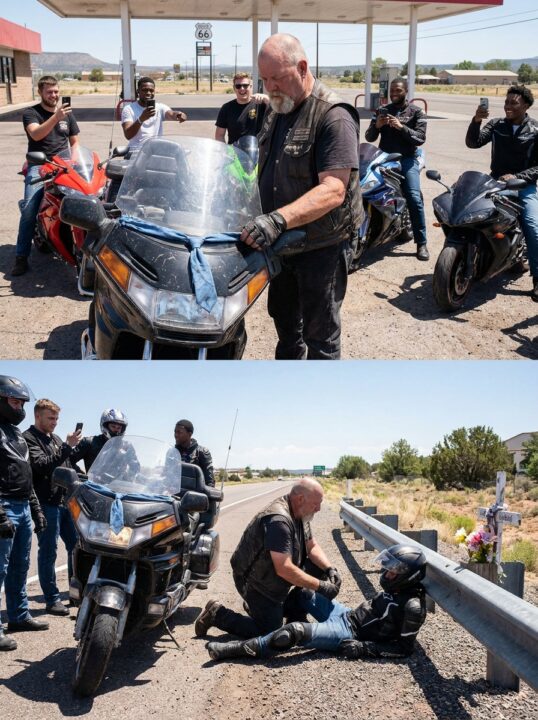
We had met through online riding groups around Phoenix. None of us belonged to an established club. We ordered matching black hoodies, designed a snarling coyote emblem and began filming weekend rides.
The videos performed best when something nearly went wrong.
A close pass.
A hard lean.
A surprised driver.
A speedometer climbing beyond what we would admit to police.
We called those moments content.
Zach was the loudest among us. He was twenty-six, handsome and fearless in the way people appear fearless when consequences have always chosen someone else.
He rode a bright red motorcycle, kept his helmet camera running and treated every rider ahead of him as an insult.
I followed because Zach made recklessness feel like membership.
Silas required none of that.
He rode an old black Harley Road King with a scratched windshield, dented right saddlebag and weathered leather seat. The engine produced a low, steady V-twin pulse instead of the sharp metallic scream of our machines.
His passenger foot pegs stayed down.
Always.
The blue cloth beneath the rear grab rail had once been part of a bandanna. Wind reduced it over the years until only a narrow strip remained.
At the gas station, Silas purchased eight dollars of fuel, black coffee and a package of peanut-butter crackers. He checked the motorcycle methodically: tires, lights, straps, oil marks beneath the engine and the small tool roll inside his saddlebag.
We saw delay.
He saw responsibility.
Red Mesa Fuel was owned by June Alvarez, a sixty-one-year-old Latina American woman who had worked that counter for twenty-seven years. When Silas entered, she placed the coffee beside the register before he asked.
“You’re late,” she said.
“Had a school bus with a bad alternator.”
“You fixing buses again?”
“Children complain when they have to push.”
June smiled.
We heard none of that.
Outside, Zach had already noticed the faded patches on Silas’s vest and decided they indicated a man clinging to an image he could no longer support.
The center patch had been removed years earlier, leaving lighter leather behind. Only a small winged wheel and the word ANCHOR remained, neither readable from where I filmed.
Anchor was Silas’s road name.
We assumed it meant he held everyone back.
It meant something else.
Silas had once served as road captain of the Copper Saints, a touring club based in northern Arizona. In the late 1990s and early 2000s, he raced motorcycles on sanctioned desert tracks during weekends and repaired diesel engines during the week.
He was good.
Not social-media good.
Good enough that track organizers knew his number. Good enough that younger riders studied how he moved through corners. Good enough to collect seventeen trophies, three broken ribs, one shattered wrist and the dangerous belief that skill could negotiate with chance.
Silas’s son, Nathan, worshipped him.
Nathan grew up inside the garage, sleeping on folded riding jackets while engines cooled. By sixteen, he could rebuild a carburetor. By eighteen, he wanted nothing except to ride like his father.
Silas taught him.
He also performed for him.
Fathers rarely admit how much they need their sons to admire them. Silas carried that need like fuel—useful until it found a spark.
Nathan’s mother, Elaine, worried about their riding. She asked Silas to keep speed on the track and patience on public roads.
Silas promised.
Most days, he kept the promise.
On October 14, eighteen years before we met him, he did not.
Nathan was twenty-one. His girlfriend, Leah, was pregnant, though Nathan had not yet told his father.
The Copper Saints stopped at Red Mesa Fuel during a memorial ride. Another rider from Nevada questioned whether Silas remained fast enough to lead the club.
It was an ordinary insult.
The kind men could leave unanswered.
Silas did not.
He accepted a race through the first mountain section of Highway 89A. Nathan insisted on following.
Silas told him to stay back.
Then he accelerated hard enough to make the instruction meaningless.
A son who had spent his life studying his father did what Silas had taught him without words.
He followed.
Part 3 — Fourteen Miles of Pride
We left Red Mesa Fuel at 10:42 that Saturday morning.
Zach led. Tyler followed. I rode third with my phone’s upload still processing inside my jacket pocket.
The road descended through red rock and pine, narrowing as it approached the canyon. Traffic increased near overlooks. Sunlight moved through tree shadows in sharp intervals.
Silas remained at the station.
That pleased us.
We interpreted absence as defeat.
At the first long bend, Zach increased the pace. Our line stretched. Marcus dropped farther back because he disliked blind curves, and Danny waved for him to catch up.
No formal race had been declared.
That made the behavior no safer.
Informal challenges produce no flag, no official start and no person willing to admit responsibility afterward. They live inside small decisions—closing distance, refusing to be passed, entering one bend faster because somebody might be watching.
Zach kept pulling away.
I followed long enough to become afraid, then remained fast enough to hide it.
Near mile marker fourteen, loose gravel had washed from a turnout toward the edge of the lane. A maintenance sign warned of shoulder work farther ahead, but nothing marked the scattered stones.
Zach entered the bend first.
His rear tire shifted.
The motorcycle moved sideways, recovered for a fraction of a second and then slid toward the guardrail. Zach separated from it and rolled along the pavement.
His motorcycle struck metal.
He stopped several yards beyond it.
Tyler braked so hard his rear wheel lifted. I crossed toward the center line before correcting. Marcus and Danny stopped near the shoulder without enough distance between motorcycles.
For several seconds, none of us moved.
Zach lay on his side.
His helmet remained on. His right leg bent at an angle that frightened me, though the eventual injury was less severe than it appeared.
I ran toward him.
Tyler reached for the helmet strap.
A Harley engine approached behind us.
Silas entered the bend at a controlled speed, assessed the scattered motorcycles and stopped well before the debris. He positioned the Road King diagonally with its hazard lights visible to approaching traffic.
“Leave the helmet.”
Tyler froze.
Silas moved toward Zach and knelt.
“Can you hear me?”
Zach answered with a groan.
“Name?”
“You know my name.”
“Good. Tell me anyway.”
“Zach.”
“Where are you?”
“Road.”
Silas almost smiled.
“Specifics need work.”
He asked Zach to move his fingers, then his toes. He checked for visible bleeding without twisting him and told us to call emergency services.
I had been holding my phone.
Not dialing.
Recording.
The realization shamed me enough that I nearly dropped it.
I called.
Silas directed Marcus around the bend to warn traffic from a safe position. He told Danny to shut off the damaged motorcycle and Tyler to collect loose objects only if he could remain away from the lane.
He gave each frightened person one task.
The chaos became smaller.
Zach looked at him through the visor.
“You followed us?”
“Same road.”
“You could’ve passed.”
“Wasn’t going where you were going.”
Zach tried to laugh and winced.
Then he said, “You could’ve beaten us.”
Silas’s face lost whatever softness it carried.
“I already won that race once.”
He looked beyond the guardrail.
A small metal roadside marker stood among scrub and red earth. Weather had dulled its surface. A faded blue ribbon was tied around the base.
The strip on Silas’s Harley matched it.
I saw the name but could not read it from the road.
Sirens approached twelve minutes later.
The ambulance stopped beside Silas’s motorcycle. A young female paramedic stepped out carrying a trauma bag.
She was twenty-two, with light brown skin, dark hair braided close to her head and calm hazel eyes. Her name patch read MARA BOONE.
She saw Silas.
“Grandpa?”
“I’m fine. Rider down.”
She looked past him toward the marker.
Then at the six of us.
Mara knelt beside Zach and took over his care. Silas answered her questions clearly: estimated speed unknown, helmet remained in place, no loss of consciousness observed, right-leg pain, intact finger and toe movement.
Zach was transported with a fractured ankle, bruised ribs and road rash beneath his protective clothing. Painful injuries, but not life-ending ones.
Before the ambulance departed, Mara pulled Silas aside.
“Same place?”
“Close.”
“You okay?”
“Wasn’t my kid this time.”
Mara’s jaw tightened.
“You don’t have to keep saying that.”
Silas looked toward the marker.
“Don’t I?”
She touched his arm.
“No.”
Then she left with Zach.
Police arrived. Statements were taken. Our speed and video evidence created questions none of us wanted.
The officer cited Zach after reviewing his camera. The rest of us received warnings and a long roadside conversation about unsafe riding.
Silas was free to go.
He stayed.
He helped load the damaged motorcycle onto a tow truck from his own repair shop. He called Zach’s mother because Zach’s phone screen had shattered and he could not remember her number under medication.
Silas knew where to find emergency contacts inside the motorcycle registration packet.
We had never created emergency cards.
He gave each of us a blank one from his saddlebag.
Tyler accepted his without looking up.
I kept filming until Silas noticed.
“You got enough?”
I lowered the phone.
“No.”
“That wasn’t a request for more.”
I stopped.
The original gas-station clip had already passed 300,000 views.
Comments praised us for humiliating a cowardly old rider.
I looked at the roadside marker again.
This time, I walked close enough to read it.
NATHAN BOONE
BELOVED SON AND FATHER
1985–2006
Nathan had been twenty-one.
My age when I purchased my first motorcycle.
Part 4 — The Race Silas Won
Silas did not explain the marker on the roadside.
June did.
After the tow truck left, Silas rode toward the hospital to check on Zach. The five of us returned to Red Mesa Fuel because none of us wanted to continue into the canyon.
June saw our faces.
“Where’s the red bike?”
Tyler told her about the crash.
She looked toward the road, then counted us.
“Silas found you?”
“Yes.”
“Of course he did.”
I asked about Nathan.
June stopped wiping the counter.
“What did you boys do?”
Nobody answered.
My viral video was visible on the phone beside the register. Someone had sent it to her.
She watched the clip without sound.
“You called him afraid to die.”
I nodded.
June placed the phone facedown.
“He wishes dying had been the price.”
Eighteen years earlier, Silas accepted the roadside challenge from the Nevada rider. They entered the mountain section ahead of the Copper Saints.
Nathan followed on a smaller motorcycle.
Silas knew.
He saw his son’s headlight in the mirrors.
Instead of slowing, he treated the light as an audience.
The Nevada rider fell behind after several bends. Silas had won before he reached the section where Nathan died.
Yet he continued.
Nathan entered a tightening curve too fast. He crossed toward the center line, corrected, struck the guardrail and went over it.
Silas heard the impact behind him.
He turned around.
Nathan remained alive for nineteen minutes.
Silas removed his helmet despite another rider telling him not to. He pulled Nathan toward him and held his head against his chest.
The decision may or may not have worsened the injury. Doctors could never say.
Silas remembered only blood on his hands, his son asking whether he had kept up and the sound of Elaine screaming when the club returned without him.
Nathan died before an air ambulance reached the hospital.
Three days later, Leah told Silas she was pregnant.
Mara was born seven months after her father’s funeral.
Silas did not ride for two years.
He sold his race motorcycles, removed the Copper Saints center patch and gave every trophy to a scrap dealer except one.
The retained trophy came from the final sanctioned race Nathan attended as a child. Silas had found a crayon note taped beneath its base:
DAD IS FASTEST. I WILL BE NEXT.
He kept it not as an achievement, but as evidence of the lesson his son had absorbed.
When Silas returned to riding, he chose the Road King because Nathan had once called touring motorcycles “old-man couches.”
He kept the passenger foot pegs lowered.
Nobody sat there.
The blue fabric tied beneath the seat came from the bandanna Nathan wore on his final ride.
I asked June why Silas still traveled Highway 89A.
“Because avoiding the road didn’t bring Nathan back,” she said.
Every October 14, Silas rode to the marker at the posted speed. Copper Saints members followed behind him, maintaining the same pace.
They called it Nathan’s Last Slow Ride.
Silas led from the front.
Nobody passed.
The name Anchor had not been given because he slowed the club down. It came from what he did after Nathan’s death.
Several riders blamed the Nevada challenger. Others blamed road maintenance, the guardrail, Nathan’s inexperience or the culture of racing inside the club.
Silas refused every easier answer.
“I opened the throttle,” he said. “My son followed the man who taught him to follow.”
He anchored the truth before grief could drag everyone toward a more comfortable story.
June showed us an old newspaper clipping kept behind the register. It pictured Silas in racing leathers holding a trophy beside a teenage Nathan.
The old man we mocked had once been faster than any of us.
His slowness was not inability.
It was discipline purchased at a price none of us would volunteer to pay.
My phone vibrated.
The video had passed half a million views.
I deleted the original post.
Copies remained everywhere.
A deleted match does not extinguish the fires it starts.
I recorded a correction in the gas-station parking lot. I explained the crash, Silas’s response and the marker.
I did not reveal Nathan’s full story because Silas had not given permission.
Viewers called the correction damage control. Some accused us of staging Zach’s crash to extend the video.
The internet preferred the first version.
It was shorter.
Part 5 — What We Owed the Man We Filmed
Silas visited Zach at Flagstaff Medical Center before any of us arrived.
Zach’s mother, Denise, met him in the hallway. She recognized Silas from the viral video and initially ordered him away from her son.
Mara intervened.
“He kept Zach from being moved.”
Denise looked from her daughter? No—Mara was not related to her. She looked from Mara to Silas, then toward Zach’s room.
“You’re the man they called scared.”
“Yes.”
“You still followed them.”
“Road went the same direction.”
Silas entered only after Denise allowed it.
Zach lay with his ankle immobilized and an abrasion along one cheek. He seemed smaller without the helmet and riding jacket.
“Did I total it?” he asked.
“Likely.”
“Insurance?”
“Depends whether they see the video.”
Zach closed his eyes.
Silas placed Zach’s broken phone on the bedside table.
“You filmed everything.”
“Yeah.”
“Good.”
Zach opened his eyes.
“I thought you hated cameras.”
“I hate missing information.”
The helmet camera contained the entire ride. It showed our speed, Zach’s widening line, the gravel and Silas arriving after the crash.
It also captured the gas-station confrontation from Zach’s perspective. Unlike my recording, it continued after we laughed and turned away.
Silas remained by his Harley.
June stepped outside and asked whether he was all right.
Silas answered:
“They’re riding like Nathan.”
June said, “You can’t save every young fool.”
“No.”
“Then why follow?”
Silas fastened his helmet.
“Maybe one.”
Those words changed the public story.
Zach released the footage through his mother. A local reporter verified the timeline and interviewed Mara, June and the responding officer.
The mockery slowed.
Then praise arrived.
People called Silas a hero.
He rejected that word as firmly as he rejected coward.
“I rode behind them,” he told the reporter. “Then I did what anybody with first-aid training should do.”
The reporter asked about Nathan.
Silas looked toward Mara.
She nodded.
For the first time in eighteen years, Silas described the race publicly.
He did not blame the challenger.
He did not blame Nathan.
He did not blame the road.
“I ran fast once because another man questioned me,” he said. “My boy followed. I reached the bottom first. He never reached it.”
The reporter asked whether he had forgiven himself.
“No.”
“Do you think you should?”
“Different question.”
“What would you tell younger riders?”
Silas looked toward us.
“I wouldn’t tell them not to ride hard where it belongs. Tracks have rules, barriers, medics and people who consent to the risk. Public roads have families, gravel, workers and strangers who never agreed to join your race.”
He never told us to become him.
He told us to know where pride had no right to choose for others.
Zach watched the interview from his hospital bed.
When Silas finished, Zach asked me to remove every Canyon Hounds video that encouraged street challenges. Some clips had been copied already, but we removed what we controlled.
Tyler resisted.
The channel had begun earning money.
“We can change the content,” he said. “Safety reviews, road planning, gear checks.”
Marcus agreed.
Danny wanted to shut everything down.
Our fragile brotherhood faced its first real test. Until then, we had been friends because riding together was enjoyable. Now staying together required admitting that our shared habits could hurt someone.
We chose to rebuild.
The Canyon Hounds name disappeared.
We did not become a motorcycle club. We became a small rider-education channel supervised by two certified instructors and Mara, who reviewed our emergency information.
Silas refused to appear.
“Already starred in enough.”
Zach asked whether he would teach us group-riding discipline.
Silas said no.
Then he arrived the following Sunday at six in the morning with route maps, emergency cards and six reflective vests.
That was his version of yes.
Part 6 — Nathan’s Last Slow Ride
October arrived with cold desert mornings and clear light across the red rock.
Silas invited none of us to Nathan’s Last Slow Ride.
Mara did.
“Grandpa won’t ask,” she said. “That doesn’t mean he wants to ride alone.”
The Copper Saints gathered at Red Mesa Fuel before sunrise. Forty-three motorcycles formed two lines. Most riders were older, their leather faded and boots softened by long use.
Silas stood beside the Road King.
The passenger pegs remained down.
The blue fabric moved in the morning wind.
Zach attended on crutches. His replacement motorcycle had not arrived, and he was not medically cleared to ride. He traveled in June’s pickup instead.
The rest of us rode near the back.
Before departure, Silas addressed the group.
No prayer.
No speech about life.
“Posted limit. Four-second spacing. Nobody passes.”
He looked toward us.
“If that feels slow, leave now.”
Nobody left.
The ride entered Highway 89A at sunrise. Silas maintained a steady pace through every bend. Cars accumulated behind us briefly, then passed at designated areas when safe.
For the first time, I saw the canyon instead of conquering it.
Pine shadows crossed the road. Red cliffs appeared between trees. Morning light reached the guardrail where Nathan died.
Silas stopped at the turnout.
Mara walked to the marker carrying a fresh blue bandanna. She removed the weathered cloth and tied the new one around the base.
Silas kept the old strip.
Zach approached on crutches.
“I called you afraid to die.”
Silas nodded.
“I was wrong.”
“Usually happens when people guess.”
Zach looked toward Nathan’s name.
“Are you afraid to ride fast?”
“Yes.”
The honesty surprised us.
Silas continued.
“Courage isn’t making fear disappear. Sometimes it’s letting fear remember for you.”
He placed the old blue cloth inside his vest.
Then he returned to the Harley.
The club rode the remaining miles at the same steady pace.
Nobody passed.
Part 7 — Fast Enough to Come Home
One year after Zach’s crash, we met Silas at Red Mesa Fuel again.
Not to challenge him.
The six of us were helping with a beginner ride for young motorcyclists. Before departure, Silas inspected routes and emergency cards while Mara explained what to do after a collision.
A seventeen-year-old rider stared at Silas’s old Harley.
“That thing slow?”
Silas looked at the motorcycle.
“Depends what’s chasing it.”
The teenager pointed toward the lowered passenger pegs.
“Someone ride with you?”
Silas touched the blue strip.
“Used to.”
He offered no further explanation.
He did not owe every stranger his wound.
June brought him coffee. Silas drank half before fastening his helmet.
The beginner group pulled onto Route 66 in a disciplined line. Silas rode at the rear, where he could watch every young rider without becoming someone they felt compelled to chase.
I rode ahead of him.
In my mirror, the black Harley remained steady—never crowding, never disappearing, never asking anyone to prove they belonged.
Near the first intersection, a rider missed the green light and stopped behind.
Silas stopped too.
The group waited safely at the next turnout.
No one laughed.
No one revved impatiently.
When the rider rejoined us, Silas raised one gloved thumb.
That small gesture carried more respect than every reckless video we had filmed.
At sunset, we returned to Red Mesa Fuel. Silas parked beside the same pump where we once called him afraid to die.
Zach asked whether he had enjoyed the ride.
Silas looked toward the younger riders removing their helmets and calling their families.
“Everybody arrived.”
“Is that enough?”
Silas started walking toward the station.
“It’s the whole job.”
His Road King ticked softly as the engine cooled. The passenger pegs remained lowered, and a faded blue thread moved beneath the empty seat.
He had once ridden fast enough to lose his son.
Now he rode slowly enough to bring other people’s children home.
Follow our page for more biker stories about misunderstood riders, hard-earned restraint, and the quiet courage hidden behind roads deliberately traveled slowly.