THE RELIEF CHAIR SLAMMED A LITTLE GIRL’S TOY BOX SHUT AND CALLED THE BIKER A THIEF, THEN THE GIRL SAID, “I ASKED HIM TO COME.”
THE RELIEF CHAIR SLAMMED THE LID ON A BOX OF RESCUED TOYS AND CALLED THE BIKER REACHING FOR IT A THIEF.
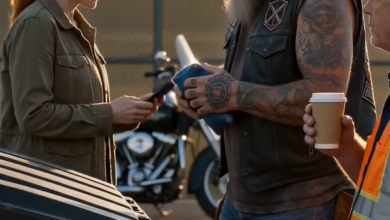
On a Saturday in late May, Mara Bennett stood outside a fire station in Chillicothe, Ohio, holding two paper cups she had forgotten to drink from. Her nine-year-old daughter, June, wore the yellow raincoat she’d slept in twice that week. The sun had dried the sidewalk. June kept the coat zipped anyway. Beside her sat a gray tote containing the twenty-five stuffed animals the firefighters had carried out of her bedroom.
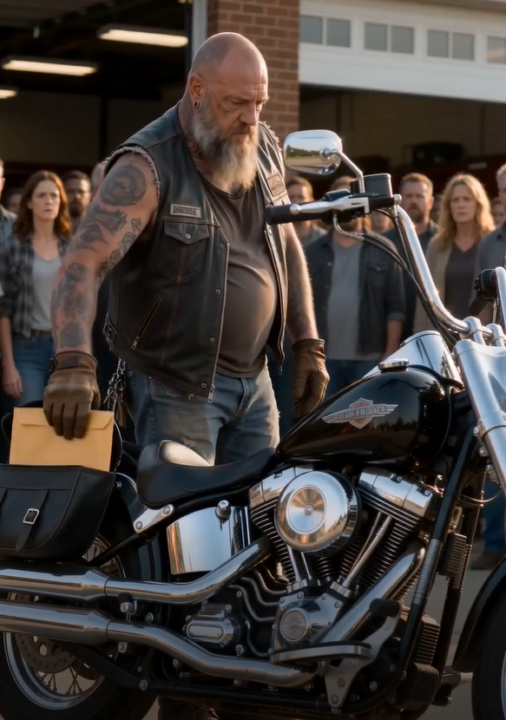
Hank Ellis had barely reached for the tote handle when Darlene Pike, chair of the relief committee, slammed the lid shut. His hand came back empty. The sound traveled farther than her voice needed to.
“Taking a little girl’s toys now? I know what you people do when nobody’s watching.”
A man holding a tray of grocery-store cookies stopped walking. Two volunteers at the coffee table looked at Hank’s tattoos, then at each other. Mara saw a phone come up behind them. She set the cups down so fast that one tipped.
Hank didn’t raise his voice. He was six foot four, broad through the chest, with a shaved head and a long gray beard that brushed the collar of his black leather vest. He took his hand off the table and let it hang open by his side. His old motorcycle ticked as it cooled. Mara could smell hot metal and the coffee soaking into the tablecloth.
Darlene moved the tote behind her elbow. “I told him we were keeping it here until pickup. He came up behind me and tried to walk off with it.”
She sounded rattled. Mara had heard that same voice on the night Darlene found them a motel room, when she’d stayed on hold until midnight and called Mara back to make sure the clerk had given her two keys. Mara started to say she was sorry.
Hank turned toward his motorcycle. The back of his vest showed a stitched bridge with one pale span. No lettering. Mara had seen that bridge somewhere before, small enough to hide under a child’s thumb. She couldn’t place it.
He pulled off one worn glove, finger by finger. Someone near the cookies said, “He’s leaving.” Hank stopped at the right saddlebag and opened the buckle. In the space he’d left between himself and the table, Mara finally saw her daughter. June had gone up on her toes to see over the tote. Her hand was still curled as if she were holding one of her toys.
“Did you come for that box?” Mara asked.
Hank looked at June first. “I told her I’d be here Saturday.”
Mara knew his face from the station. She remembered him sitting at the far end of a bench while June waited for the firefighters to bring out the tote. She hadn’t realized the two of them had spoken.
Darlene drew breath to answer for him. Hank lifted a yellow envelope from the saddlebag. He held it by one corner, with the flap still closed. June looked right at Mara. For the first time since they’d arrived, she let go of the drawstring on her coat.
“Mom, I asked him to come.”
Part 2
Mara took her hand off the table. “What did you ask him, honey?”
June looked at the envelope. Hank brought it over and laid it beside the spilled coffee, well away from the wet edge. He waited until June nodded before he opened it.
Inside was a sheet of motel stationery folded in quarters. One side had twenty-five circles, some with ears, some with tails. The last circle had an arrow pointing to a square with three windows. June had drawn a small person in each window. Mara could pick herself out because the person in the middle had an apron with a crooked pocket, like the one she wore at work.
June tapped the other side. “That’s the part I asked.”
The first line was in pencil. The next two had been pressed hard enough to leave ridges.
Could you come when the lady takes their picture? She keeps saying I can hold the bear. I want to hold all of them.
Darlene looked down at the tote. “I would’ve let her.”
“You said one,” June said.
Mara remembered hearing that exact instruction. She’d been signing for a grocery card with Darlene’s pen, thinking about how many breakfast shifts she’d already missed. She’d told June to pick whichever toy she wanted people to see. In the car afterward, June had asked whether the others still belonged to her. Mara had said of course. She hadn’t asked why June needed to hear it.
“Can we open the box now?” Mara asked.
Hank tipped his chin toward Darlene. “Her mom’s here.”
Darlene lifted her elbow. June undid both catches herself. She took out the bear with the bent nose and checked the blue stitching across his belly. Her hands settled once she’d found it.
Mara recognized the bridge patch then. There was a little version of it sewn inside the canvas laundry bag the firefighters had used to carry the loose toys. She’d seen June pinch it between her fingers at the motel while Mara counted the animals.
“That bag was yours?” Mara asked.
Hank nodded. Captain Ruiz came out of the station carrying a roll of paper towels. He stopped when he saw how everyone was standing.
“Bridge found the tote for us,” Ruiz said. “He drove over with it while we were still working. Half those toys had wet seams. He and two of my people spread them out so we could see what we’d recovered.”
Darlene looked at Hank. “You could’ve said you were with the fire department.”
“I fix their trucks,” he said.
Ruiz handed Mara the paper towels. Hank’s repair shop was two streets over. When the station needed a truck moved without losing a crew member for half the morning, he was usually the one who came for the keys. Mara had been waiting for a reason to trust him. June had already spent an hour watching him wait with her.
A young volunteer set the cookie tray down. Mara knew him as Darlene’s nephew, Cody. He had been carrying boxes and pouring coffee all morning.
He turned his phone screen toward Mara and kept his voice low.
“Before anybody signs for pickup, you should see where she was sending that tote.”
Part 3
The message on Cody’s screen was from Darlene. It told him to take the tote to a furniture showroom after the fire-station event, once they had a photograph of June holding the bear. The toys would stay in the showroom window through the end of June.
Mara read it twice. “A month?”
“Until the end of the drive,” Darlene said. “They’d be behind glass.”
“Were you going to ask me today?”
“I was going to explain it when the photographer got here.”
June was close enough to hear. She began taking toys out of the tote and setting them against the back of the table, where Darlene’s elbow had been. She stood the rabbit up twice before giving in and laying him on his side. Mara watched her make room for the smallest ones.
Cody slid his thumb back one message. There was a photograph of the tote with a white pickup tag looped through the handle. Cody had written the number on it himself. In the committee spreadsheet, the number belonged to a box of donated children’s items.
“I thought she meant the new stuff from the grocery store,” he said. “Then I carried this out and heard June count them. I left the tag loose.”
A paper loop was still caught beneath the handle. Mara pulled it free and flattened it against the table with the heel of her hand.
The committee had given them six motel nights. They had also paid for a pair of work shoes after Mara turned up at the diner in borrowed sneakers and skidded by the dish sink. She could believe Darlene had done both those things because she cared. She could also see how much Darlene had come to expect for them.
“Is the motel money tied to that display?” Mara asked.
Darlene looked at the faces around the table. “We have commitments to the sponsor.”
“Did they tell you that?”
“The whole point is to keep people giving after the first week. People see a pile of new toys and think the family’s fine. When they see what came out of that house, they understand.”
Mara looked at the bear. She’d seen June hold him by the belly while brushing her teeth because setting him on the sink meant letting go. She wondered what a shopper passing a window could possibly understand about that.
Darlene reached for her phone. “If he tries to take that tote again, I’ll call an officer over. I have somebody’s video.”
“The video starts when you shut the lid,” Cody said. “I was standing right there. You waved him over because the handle was stuck under the tablecloth.”
Hank lifted the corner of the cloth. One handle had caught in the clip underneath. The other had the loose paper loop Cody had shown her. Mara could see how little time it would’ve taken to move the cloth and how quickly Darlene had made something else of the gesture.
June tucked the bear under her elbow. “Can they go somewhere I pick?”
Mara heard herself say, “We can take them straight back to the room.”
June shook her head and looked at Hank. “Did you bring the other paper?”
Part 4
Hank went back to the motorcycle. From beneath a folded shop rag he took a road atlas with a cracked green spine. A sheet of graph paper stuck out halfway through. He opened it on the hood of Mara’s car, where June could lean against her mother’s hip and see.
There were names and states penciled down the page. Some had question marks. Ohio had Hank’s name next to it. Arizona said Cal, New York said Denise, and Maine said Paul. Mara counted twenty-five lines.
“Where did this come from?” she asked.
“Your girl asked if the bear could go for a ride.”
June pointed at Arizona. “I asked if he could see the big hole.”
“The Grand Canyon,” Hank said.
“I know. I just like calling it that.”
She had asked him on the bench, while they waited for the toys. First she wanted to know if stuffed animals fit in saddlebags. Then she’d asked about the bear and the canyon, because she’d heard him tell Ruiz about a man he rode with in Arizona. By the time Mara had come off the phone, June had wanted to know if the other toys could each go somewhere too.
Hank told her he would check who was willing. He had called riders from the fictional club whose bridge he wore, people he knew through years of trips and helping one another find parts or a place to stay. Riders in twenty-five states had offered to take one animal on a ride in their own state. Most had picked an outing they could make in a morning. He had written down twenty-five possible days.
“Who’s driving all the way across the country?” Mara asked.
“Boxes go to the riders first,” he said. “Each rider does their own state. One photo comes back every day.”
June ran her finger down the edge of the paper, stopping just before the bottom. “And then the animals come back.”
“Every one.”
Mara wanted to ask what he could possibly know about every one. Packages got left in rain. People forgot things. A flat tire on the way to a canyon could turn into a phone call from a stranger with an apology she’d have to deliver to her daughter.
She was ready to say they should wait until things calmed down. Then June traced the square with three windows on the motel paper and said, “Can I draw where they come back to after we know?”
Mara’s throat tightened. Their latest motel booking ended the following Friday. June knew that. She had heard Mara ask for the checkout date at the desk and had drawn the square anyway.
Hank closed the atlas to keep the wind from lifting the page. “My shop can be the return address,” he said.
Darlene crossed the apron with her phone in one hand and a printed form in the other. Mara could see her own signature through the paper before Darlene laid it on the hood.
“I already told the sponsor you agreed,” Darlene said. “You signed right there.”
Part 5
Mara knew the signature was hers. The first stroke had gone through the paper because she’d signed it against the steering wheel the day Darlene brought the grocery card. She remembered the amount on the card. She remembered being grateful. She read the heading this time.
“Permission to use a photograph,” she said.
“Which is what they were expecting.”
“It says I agreed to a photograph of us at the station.”
Darlene rubbed the side of her phone against her cardigan. “I sent them a mock-up. I needed them to see what they were paying for.”
Cody came around the car with two cold bottles of water. He offered one to his aunt. When she didn’t take it, he set it on the hood, clear of the papers.
“You said the display was your idea,” he said. “You said if it worked, they’d pay you to run the fall drive.”
Darlene looked past him toward the table. Two volunteers were folding the spare tablecloth. The man with the cookies was stacking paper plates, slowly enough to hear.
Mara understood why a paid job might matter to Darlene. She had heard her take calls from families while ringing up customers at the hardware store. What Mara couldn’t get past was the month in the showroom, the pickup tag, and the way Darlene had waited for the photographer to make refusal difficult.
“You’re welcome to tell them what I signed,” Mara said. “I’m withdrawing it. No photo of June. No display.”
Darlene picked up the form. “Your room’s paid through Friday. I don’t have another week to give you.”
For a second Mara felt her decision in her stomach. She could picture putting the bear in June’s arms and asking for one smile. She had made it through plenty of shifts by doing a small unpleasant thing and putting the money away afterward.
June looked up from the atlas. Mara moved the tote into the back seat.
Before they left, Hank tore the sheet of graph paper from the atlas and gave it to June. “You can change anything on there,” he said.
That evening, Darlene posted a short video that began with the lid coming down. Her caption said she’d stopped a biker from removing a child’s fire keepsakes. A woman from Mara’s morning shift sent her the link and asked if the box was safe. Mara put her phone facedown on the motel bed. When she turned it back over, three other people had sent the same clip.
Cody texted a little after eight. He had found the woman whose phone had been up by the cookie table. She’d started recording before Hank reached for the handle because she’d been filming the donation setup. She agreed to send the full clip to Mara and the committee.
Mara heard Darlene’s voice before she saw Hank on the screen.
“Sir, could you get that handle for me?”
June had been brushing her teeth. She came back into the room with foam on her lower lip and pointed at the phone.
“Play the part before that again,” she said. “That’s me asking for my box.”
Part 6
Mara played it again. In the first few seconds, June’s voice was low enough that Mara had to put the phone close to her ear.
“Can I take them home after the picture?”
Darlene, standing sideways to the camera, told her they would discuss it later. Then she beckoned to Hank. When June leaned over to put both hands on the tote, Darlene shut the lid before either of them touched it. The clip held long enough for Mara to hear herself start to apologize.
She watched that part once. Once was plenty.
She sent the full clip to the committee’s treasurer with the signed photo form and Cody’s screenshots. She asked for a written correction to the theft accusation and a review of the way the tote had been listed. She left June out of the messages she sent to the diner.
At breakfast June asked if the trip was still possible. She had the graph paper under her cereal bowl and had drawn a check box by each name.
“What if I say yes and feel different tomorrow?” she asked.
“Then we wait,” Mara said.
They tried an afternoon first. Hank took the smallest toy, a green frog named Pickle, on a ride to a shaded pull-off outside town. He sent a single test photo to Mara, with Pickle sitting beside his glove on a picnic bench. Before dinner he brought the frog back. June checked the seam under his chin and asked whether the bench had been cold.
“Little bit,” Hank said.
“Did you put him in your coat after?”
“Back in the bag.”
“That works.”
Over the next few days, June made each toy a card. She drew the rabbit’s stiff ear so Denise would know it already looked like that. The bear’s card said his nose bent left and he hated having his shirt pulled over his head. Mara helped pack twenty-four boxes on Hank’s workbench while he finished a repair. Each outgoing box had a return label with the shop address. Pickle stayed with Hank for the Ohio ride.
The treasurer called while they were putting the rabbit in his box. She said the motel payment through Friday was already settled and the committee would continue reviewing requests for help separately from fundraising. Then she said something Mara hadn’t expected. The showroom owner had seen the mock-up and asked Darlene whether the family had agreed. Darlene had told him they’d volunteered the toys.
“Will he put that in writing?” Mara asked.
“He already has.”
After she hung up, she found June holding the tape dispenser over the rabbit’s box. June had been the one to choose the trip. She had also slept with the rabbit tucked under her chin every night since the fire.
“We can keep him here,” Mara said.
June pressed down the tape with both thumbs. Then she looked at the card sticking out of the box and pulled it free.
“Can I write one more thing before he goes?”
Part 7
The extra line on the rabbit’s card said, Please tell me what it sounded like.
The first official photo came from Hank, on a Monday morning. Pickle sat on a folded shop rag by the side of an Ohio canal towpath. There was dirt on Hank’s boot at the edge of the picture and a crooked reflection of the frog in the water. June asked Mara to print it with the boot still there. She wanted to remember who had brought him.
Each morning after that, one rider sent a photograph. The span of twenty-five days gave the riders room to work around shifts, weather and the distances they had to cover. They checked in with Hank ahead of their turns. Cal had to move his Arizona ride up by two days to get around a shift change. He held the photo until his day.
In Kentucky, a plush possum sat beside a diner plate with one untouched biscuit. In New Mexico, a lamb’s white ears glowed pink in the low light outside an adobe building. A rider in Michigan photographed a stuffed mouse beside an empty pair of work gloves on a lakeside bench and sent along a sentence about how cold the metal felt even in June.
“Did the mouse sit on the gloves?” June asked.
Mara enlarged the picture. One little paw was tucked in a finger.
“Looks like it.”
“Good,” June said. “His butt gets cold.”
On day eleven, Cal’s photograph arrived. The bear sat against a low stone wall with the Grand Canyon spread behind him, his felt nose bent left as always. He wore a tiny blue bandana Cal had cut from a clean shop rag. Mara thought June would ask what it was like to see that much rock all at once.
June said, “He looks small there.”
Mara put her arm on the back of the chair. “He is pretty small.”
“I know. He looked big in the box.”
Mara watched her study the photograph. She had spent weeks measuring their life by what would fit in that tote. That morning June asked for a second copy of the picture so she could take one to school and leave one taped beside her bed.
On the rabbit’s day, Denise rode to Niagara Falls and photographed him from the walkway, with mist hanging behind his stiff ear. She sent a short message underneath. It sounded like a hundred bathtubs going at once. I had to say his name pretty loud.
“Was he scared?” June asked.
Mara started to answer for the rabbit. Then she handed June the phone and let her dictate a reply.
That afternoon, Mara found an email from the committee asking her to attend its next meeting. She could bring Cody if she wanted. The treasurer said they had a draft correction and wanted her to read it before it went up.
Mara expected to find the words a misunderstanding somewhere near the top.
Instead, the first line asked her to confirm exactly who had summoned Hank to the table.
Part 8
Mara got to the meeting after her shift with fryer oil still in the cuffs of her shirt. Cody had saved her the chair beside him. Across the folding table, Darlene sat with both hands around a closed folder. Hank took a seat near the door.
The treasurer played the uncut video once. Nobody asked her to replay it. Then she read the email from the showroom owner, including the part where he’d asked about permission and been told the family had offered the display. Cody slid over a printout of the pickup tag record. Mara watched Darlene reach toward it and stop.
“Did you know those toys were in the donated inventory?” the treasurer asked her.
“I knew what code I told Cody to use.”
“Why that code?”
“It was the only one I could print a pickup tag for.”
“You could’ve asked me to add one for property going back to a family,” Cody said.
Darlene looked at him. He’d spent months doing her Saturday pickups. Mara saw him put his hands under the table, as if he needed somewhere to keep them.
“I could have,” Darlene said.
The treasurer asked about the fall job. Darlene opened the folder herself. Inside was a proposal with a fee on the last page. She said the summer display was meant to show the sponsor what she could do for a bigger campaign. When she’d realized June expected to take the box home after the picture, she’d tried to keep control of the pickup. She admitted she had waved Hank over to free the handle.
“I thought if I could get the box out of there, I’d have time to talk you into it,” she told Mara.
“And when he put his hand out?”
“I wanted people to look at him.”
Mara looked at Hank. He’d sat through the entire meeting without taking his gloves off. At that, he pulled one loose and laid it over the other on his knee.
“Use my name in the correction,” he said. “Leave June’s out.”
The committee voted to remove Darlene as chair and take away her access to the donation records and social page. The proposed showroom display and fall contract were dropped. The next morning, the committee posted its correction naming Hank and stating that he’d been asked to help with the tote. Darlene removed her clip and posted the correction herself. Mara saved a screenshot and went back to her shift.
On the twenty-fifth morning, the last photograph arrived from Maine. A stuffed seal sat on a harbor bench beside a glove with a hole worn through the thumb. The rider had packed the toy for return after the outing and sent Hank the tracking number. Most of the others were already at the shop, waiting for the final boxes to arrive.
Mara expected June to ask when she could open all twenty-five. Instead, June took the first photo down from the motel wall and slid it into a binder beside the last.
“Can I bring this when we go get them?” she asked. “I think I know what to say now.”
Part 9
The last box arrived on a Thursday. Hank waited until Saturday, when Mara could come without trading a shift, and laid all twenty-five animals out on two clean worktables at the shop. He put the frog in front, where June could see him from the door. The air smelled of coffee, rubber and the oil that never quite came out of the concrete.
Mara had found them a short-term apartment above a tailor’s shop. The deposit had used up most of what she’d saved, and there were still two grocery bags where a dresser ought to be. June had already claimed the wide windowsill. She brought the gray tote to Hank’s shop empty and asked if they could line the toys up on it after they got home.
Mara thought she meant the windowsill. Then she saw June had drawn a little square on the side of the tote in washable marker. Three windows, just like the one in the envelope. This time the third window had a bear in it.
Cody came by after his morning shift with a stack of prints the shop had ordered for the riders. Darlene had given him an envelope for Mara. Inside was an apology written by hand. She had called Hank a thief after asking him to help, she wrote. She had used June’s belongings to make a promise she had no right to make. She offered to tell the same thing to anyone who’d heard her say otherwise.
Mara folded the letter and put it away. June was holding up the rabbit, comparing the angle of his ear to the picture from Niagara. She hadn’t seen the envelope. She was busy telling Cody he should try saying her rabbit’s name over a hundred bathtubs.
Then she got to the bear.
For a while after the fire, every conversation about him had started the same way. A grown-up would ask how he got the bend in his nose. June would say it happened when the firefighters found him. Somebody would ask about the house, or about the room, or whether she remembered the smoke. Mara used to see June’s hand close over the bear’s nose before she even answered.
Cody pointed to the canyon picture. “How’d he get that bandana?”
June sat down on the shop stool. “Okay,” she said. “First you have to know about Cal.”
Mara stayed by the table, listening. There were twenty-five stories June could tell now, and she could decide which one came first. When June finished, she set the bear down and asked Hank if he had a favorite picture.
Hank picked out the Ohio photo. “This one was my ride.”
June turned it toward herself and looked at the edge, where his boot was. “I know,” she said. “I told Mom to keep you in it.”
Hank brushed his thumb over the corner of the print. A few weeks earlier, Mara had seen a roomful of people look at his leather and tattoos and believe what they’d been told about him. She had nearly done the same. Here was June making sure he got to stay in the picture.
At home, June put the bear on the sill facing the street. She turned the rabbit around so he could see the room.
Follow the page for more stories about the people who show up.