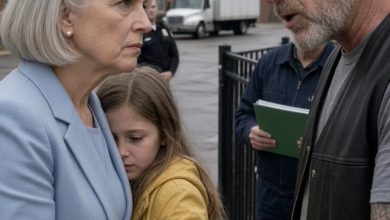
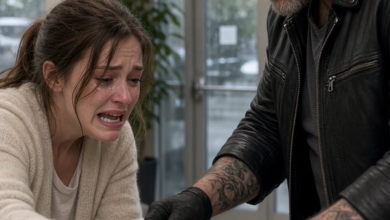
A Biker Kicked Open My Husband’s Fundraising Studio and Pointed at an “Orphan” on the Screen—Then Asked Why We Were Collecting Money for His Living Daughter
Daniel reached beneath the desk.
For the panic button, I thought.
He pressed the switch that killed the broadcast monitor instead.
The room seemed to lose a window. One moment, thousands of strangers were with us. The next, there was only the soft electrical hum and my niece breathing against my shoulder.
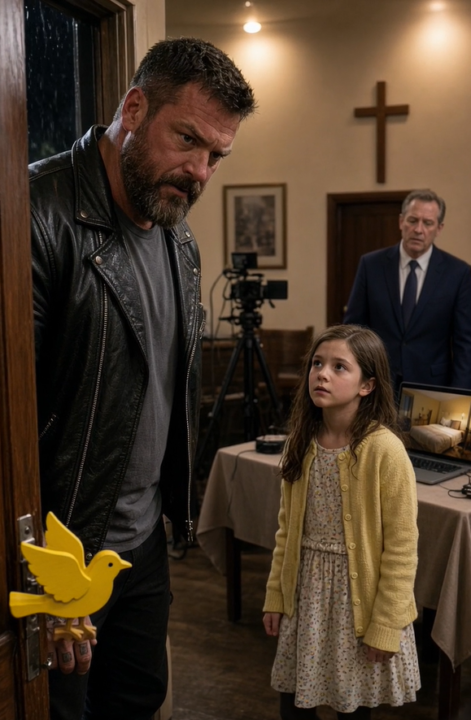
“Claire, take her upstairs.”
My husband used his Sunday voice. Calm, disappointed, certain that the rest of us would eventually recover our manners.
Marcus stood beside the broken door, both hands open. Splinters lay against his boots. He didn’t come any closer to Sadie.
“Don’t turn that into another disappearance,” he said.
Daniel looked at me.
“You know why he isn’t allowed around her.”
I did know something.
An arrest. A wreck. My sister crying in our kitchen while her husband sat in county jail. There had been a court order about contact, and Hannah had asked me to help keep their daughter safe.
My certainty came back so quickly it frightened me.
I shifted Sadie behind me.
Marcus noticed.
His hands lowered an inch, then opened again.
“Ask for the current paperwork,” he said. “Don’t ask him. Ask somebody who doesn’t work here.”
Our production assistant, Nina, stood beside the camera with her phone raised. She had called police when the door broke. She told the dispatcher nobody had been struck and the child was with her aunt.
The studio clock kept moving while nobody spoke. On the floor beside the donation desk, a shopping bag held children’s pajamas for the next promotional photograph. One pair still had a store tag attached. I had bought them that morning, pleased with myself for remembering the right size. Now I couldn’t remember whether anybody had asked the child what she wanted to wear.
Sadie tugged my sleeve.
“He has my bird.”
Marcus held a small wooden bird between his thumb and forefinger. Yellow paint. One wing repaired backward.
I recognized it.
I had watched him carve it at my sister’s kitchen table years earlier, complaining that no bird had ever actually looked like that.
Daniel stepped between the camera and the doorway.
“This man has a documented history.”
“So do I,” Marcus said. “I’m standing here with it.”
The police arrived through the outer office. Marcus set the bird on a chair before following their instructions.
He didn’t explain away the door. He said he had called twice, come earlier that afternoon, and been told Sadie wasn’t there. Then he heard her crying through the studio wall while the broadcast showed her photograph.
“I thought they were taking her out the back,” he said.
It wasn’t permission to break anything.
It was an explanation I couldn’t stop hearing.
An officer asked about Sadie’s legal guardian.
“I am,” I said.
Daniel answered at the same time.
“We are.”
The officer looked between us.
I explained that I had temporary kinship guardianship following Hannah’s death four months earlier. Marcus had been incarcerated then. I had believed nobody could find him afterward.
He gave the officer his release papers and his attorney’s number.
Six weeks free.
An address.
A job at a motorcycle repair shop.
A phone number that worked.
Daniel’s jaw tightened when the officer wrote it down.
I looked at my husband, then at the blank monitor where we had just called Sadie an orphan with nobody left.
If her father had been reachable all this time, who had decided we shouldn’t reach him?
When Sadie was three, Hannah invited us over for dinner in their little duplex outside Dayton.
Marcus cooked spaghetti wearing a work shirt with one clean sleeve. Sadie sat beside him, handing him sandpaper as if she were assisting with surgery.
He was finishing the yellow bird.
Its broken wing had gone back on backward. Sadie refused to let him fix it.
“It waves,” she said.
Hannah laughed so hard she had to put down the colander.
On the refrigerator sat a blue metal lunch tin. Hannah kept family letters inside, tied with red ribbon. Marcus was starting a job that would take him away during the week.
“Postcards go in the sky box,” Sadie instructed him.
He tapped the lid twice, then once slowly.
Their little answer to goodbye.
Daniel smiled from the doorway. He blessed the meal. Nobody at that table imagined that someday our family would need permission to speak to itself.
That memory lasted less than a minute.
I returned to the studio office, where Sadie was eating crackers from a paper cup while officers spoke separately with the adults.
The yellow bird rested beside her.
She moved it nearer the cup whenever someone looked at it.
“Can Daddy have dinner?” she asked.
“Not here tonight.”
“Because he broke the door?”
“Partly.”
She considered that.
“He can say sorry.”
I wished adult damage worked on a child’s schedule.
The bird had spent part of Marcus’s sentence among his stored belongings. Hannah had taken it to his sister to repair the wing, and he collected it after his release. I learned that later. At the time, all I could see was Sadie’s thumb following a paint chip precisely where her father’s thumb had rested when he held it out.
The officer explained that Marcus would be taken in over the forced entry. Any decision about parental contact belonged with the existing case and the appropriate court, not with a conversation in our office.
I nodded.
It was the first sensible boundary anybody had given me that evening.
Daniel asked whether we could finish the fundraiser later. Nina stared at him.
“Not tonight,” she said.
The words sounded startling coming from someone twenty-three years old who usually apologized before asking him to check a microphone.
I drove Sadie to my mother’s house. She slept there often, and I wanted one evening she wouldn’t spend hearing adults whisper outside a door.
Mom met us in slippers.
“Was he really there?”
“Marcus? Yes.”
She pressed a hand to her chest.
“Daniel said the number on his release notice wasn’t current.”
I took my keys out of the ignition, then put them down again.
“You saw a release notice?”
“It came with the things from Hannah’s apartment.”
“When?”
Mom looked toward Sadie, already walking down the hall with her bird.
“Before Easter.”
The fundraiser had gone live in May.
Daniel had known before the campaign began.
I waited until Sadie was out of earshot.
“Why didn’t you call me?”
“He said you knew.”
In the kitchen, my mother opened a drawer and removed an envelope she had kept because she never threw away anything bearing a court seal.
Marcus’s name was on the front.
My husband’s handwriting was on the back.
What else had come through our house addressed to somebody Daniel didn’t want us to hear?
The first packet made Marcus look dangerous again.
Daniel laid it on our kitchen island before I could ask him about the envelope.
Photographs of a damaged truck. A court order. A discharge summary from an alcohol-treatment program Marcus had left early years before his last conviction.
“You remember your sister,” he said.
I did.
Hannah had called me from a gas station once because Marcus had been drinking and she refused to let him drive her home. Sadie wasn’t in the vehicle that night. That didn’t make his decision harmless.
I pressed my fingers against the counter.
“I haven’t forgotten.”
“Then don’t let a wooden toy do your thinking.”
It was a cruel sentence.
It was also close enough to a reasonable warning that I couldn’t dismiss it.
Daniel said the campaign images and captions were handled by a media contractor, Dana Holt. The term orphan had been an error. He had understood that the pictured children had no available parents.
He showed me an email asking Dana to verify consent.
A real email.
A real request.
I had watched him ask questions like that in board meetings: measured, responsible, always leaving a record that he had expected someone else to check. I used to admire it. Sitting beside the kitchen island, I began wondering how often I had mistaken a question on an email for the effort required to learn the answer.
For a moment, the shape of the story changed. Maybe my husband had been careless rather than calculating. Maybe he had relied on a professional and a family already exhausted by grief.
Then he opened the fundraising account dashboard.
“The money is held for housing. Nothing has been stolen.”
A balance appeared.
More money than I had ever had in my own account.
I felt my anger lose its footing.
The next morning, I called the lawyer who had helped with Sadie’s temporary placement. I asked her to review Marcus’s current circumstances and the contact restrictions.
She didn’t tell me he was safe because he was sad.
She told me the papers Daniel showed me did not answer the present questions. Some were old. Some required review alongside later orders and filings.
She would help me obtain the complete record.
Then I called Dana.
She asked whether I was recording.
“No.”
“You should keep what I send you.”
Her contract had been terminated that morning. Daniel said she had misrepresented children’s circumstances and damaged the ministry’s reputation.
Dana emailed the original campaign brief.
The instructions described Sadie as a child who had lost both parents. Another attachment identified me as her guardian and authorized the use of her image.
My signature was genuine.
The line above it said campaign participation, not the story Daniel’s team had attached to her face.
Dana had asked whether the father was deceased.
The reply came from Daniel’s ministry address.
NO LIVING PARENT INVOLVED. PROCEED WITH THE APPROVED STORY.
He could argue about those words.
I knew he would.
But the next email was harder.
Dana asked for photographs of completed homes to match the claim on the donation page.
Daniel replied that she should use the model property already photographed.
The homes would follow the giving.
If that money had been waiting untouched for construction, why had the advertisements said the children were already living in houses we had built?
There were no houses.
Not unfinished houses.
Not houses delayed by a difficult contractor.
No completed homes belonging to the project at all.
The three addresses in the donor brochure led to a furnished rental used for photographs, an empty lot, and a private home occupied by people who had never heard of our children’s housing program.
I visited the rental with Dana and the owner’s permission. The cheerful yellow bedroom was smaller than it looked in the photograph.
A rental inventory number had been stitched into the bedspread.
I sat on the edge of the bed where Sadie had posed with a donated backpack.
She had gone home to my mother after the shoot.
Thousands of donors had been told she slept there every night.
The other children in the brochure had families too, though their circumstances differed. I wasn’t entitled to inspect their lives. Their guardians received requests through proper channels to review what had been said and what they had actually authorized. One mother called me afterward. She asked whether donors thought she had abandoned her son. I couldn’t give her an answer that helped.
I took photographs without putting a child in any of them.
Our lawyer advised me to preserve the records I could lawfully access and give the concerns to the appropriate authorities. I did. I didn’t take passwords, impersonate anyone, or attempt to seize the account.
I was the charity’s unpaid secretary. I had access to meeting minutes, approved budgets, and invoices because I had signed some of them.
That fact became less comforting with every page.
A large transfer had left the campaign account as a property reservation expense.
The recipient was a company controlled by Daniel’s brother.
Another series of payments covered consulting, transportation, and donor development. The invoices were thin. The descriptions repeated.
The account balance Daniel had shown me wasn’t imaginary.
It was simply the part that remained.
I found an invoice for family stabilization housing.
Our address appeared beneath it.
The amount matched payments toward our mortgage.
I put the page down and walked into the laundry room, where the dryer was thumping against a shoe Daniel had forgotten to remove.
For months, I’d believed his speaking engagements were covering the shortfall after I reduced my hours to help with Sadie.
The donation money had been supporting us.
Whether I understood it or not, I had benefited.
When I returned, Dana was standing by the kitchen doorway. She had brought paper copies of the campaign approvals.
“Did you know?” she asked.
“Not about that.”
She looked at the invoice.
“About what, then?”
I couldn’t answer immediately.
The lawyer later sent me records from the placement file. Daniel had provided a written account of efforts to locate Marcus. It said available contact information had failed.
The dates included days when Marcus was still at a facility whose address appeared on the envelope my mother kept.
Nobody had needed to find a man hiding in the wilderness.
They had needed to send a letter to the address already in our kitchen drawer.
That evening, the ministry announced that Daniel was taking personal time after an attempted attack.
The photograph beneath the announcement showed Marcus halfway through the broken studio door.
Sadie’s face had been cropped out.
What could my husband do with a picture once he no longer needed to explain who was missing from it?
He could make me the next missing person.
Not physically.
Professionally. Socially. In the story our congregation told itself.
My access to the ministry office ended that afternoon. A staff message said I was exhausted, grieving, and receiving help.
Nobody had asked whether I wanted help described that way.
My closest church friend arrived with soup and a suggestion that I stop speaking with Dana until I felt stronger.
I asked whether she had watched the full studio recording.
“Daniel said there wasn’t any reason to.”
I put the soup in the refrigerator.
She left carrying the empty bag as if I had refused something much larger.
Marcus’s attorney arranged for him to provide records through the placement lawyer. He did not come to my house or try to collect Sadie.
That mattered more to me than any promise he could have shouted through a door.
Sadie’s counselor asked me to keep adult explanations short and predictable. I wrote visiting arrangements on a paper calendar at Mom’s house. When something changed, I told her before she put on her shoes. It sounded small until I watched how long she stood beside the front window whenever the time on that calendar approached.
His records included completed treatment, work details, and copies of attempts to contact Hannah before learning she had died.
There were letters to Sadie too.
One described a crooked-wing bird looking for a place to land.
I read it twice and went outside because the walls felt too close.
Then Daniel filed an emergency request seeking restrictions around Sadie’s placement. He described Marcus’s entry into the studio and my supposed willingness to expose her to him.
The forced entry was real.
I hated that he could use a true thing to carry so many false ones.
At the hearing, the judge didn’t decide parenting by looking at leather or listening to Daniel’s speaking voice. The lawyers addressed the current orders, Sadie’s circumstances, and the need for an assessment.
An interim arrangement kept her with my mother while the adults’ roles were reviewed. Any contact with Marcus would follow the process established for the case.
I could see her.
But I couldn’t bring her home and pretend none of this had reached her.
In the courthouse bathroom, I cried with my back against the stall door until my lawyer knocked gently.
“There’s something else you need to tell me,” she said.
I knew what she meant.
She had asked earlier whether I had ever seen communication from Marcus before the livestream.
I had said I didn’t remember.
That wasn’t an answer.
It was a place to hide.
Two months earlier, an envelope had come to our house addressed to Sadie, care of me. The handwriting was familiar. I hadn’t opened it.
I put it on Daniel’s desk.
He told me Hannah would have wanted us to keep chaos away from her child.
I said, “Just handle it.”
Now every version of that sentence sounded like permission.
I washed my face and went into the hallway. My lawyer waited beside a vending machine, holding a paper cup nobody had touched.
“I saw a letter,” I said.
She nodded once.
“Start there.”
If I wanted the truth to bring Sadie’s father back into her life, what would it take out of mine?
It took the version of me who had only been deceived.
I wanted to keep her.
The grieving aunt. The loyal wife. The woman who had trusted a man everyone else trusted too.
But I had signed things.
I had ignored things.
And when Sadie asked why her father never wrote, I had told her grown-ups sometimes couldn’t do what children needed.
She had carried that sentence instead of his letters.
I gave my lawyer a full written account. I corrected the information I had supplied in the placement process. I identified the envelope I’d handed Daniel and the campaign consent I’d signed without demanding the finished copy.
Then I told her something worse.
I had seen the word orphan before the fundraiser.
Not only on the live screen.
In a draft appeal two weeks earlier.
I asked Daniel whether it was right. He said children could be functionally orphaned when a parent was unavailable. He said the money would build somewhere safe for children like Sadie.
I told him to make the wording less harsh.
I didn’t tell him to stop using it.
The lawyer set her pen down.
“Why?”
I looked at the wedding ring I hadn’t taken off yet.
“Because saying no to the campaign felt like saying no to the houses.”
That was part of it.
The other part was uglier. I liked being thanked for helping. I liked being the aunt who had stepped in and the pastor’s wife who always managed.
I hadn’t wanted a difficult father returning to complicate the picture.
I remembered a woman thanking me after Sunday service. She said Sadie was lucky to have us. I had accepted the compliment while my niece stood beside my skirt holding a drawing for someone who wasn’t there. I could still picture the folded paper. I couldn’t remember whether I had ever asked who she hoped would see it.
Marcus heard that from me in a meeting arranged through counsel. He sat across the table with his hands around a paper cup.
I apologized without asking whether he understood.
He didn’t make it easier.
“She asked if I forgot her birthday,” he said.
I stared at the table.
“Did you tell her I called?”
“I didn’t know about the call.”
“You knew enough to ask.”
I nodded.
He had lost time through his own drinking and the consequences of it. He said that plainly. He would keep doing the work needed to rebuild contact.
But he wouldn’t let his mistakes make every missing month his fault.
Neither could I.
At my mother’s house that evening, I told Sadie I had made mistakes about her father’s letters. Her counselor had helped me choose language that didn’t make her responsible for forgiving an adult.
“He wrote?” she asked.
“Yes.”
She looked toward the blue lunch tin on Mom’s shelf. We’d brought it from Hannah’s apartment with her recipes and photographs.
“Then why is the sky box empty?”
I couldn’t answer in one sentence she deserved to hear.
I sat beside her while she cried.
Across town, donors were demanding a public accounting. The charity’s independent board members scheduled a meeting, with counsel present and financial records preserved.
Daniel announced he would speak live to clear his name.
Would he still sound like a man telling the truth when the people listening already had the documents?
We kept Sadie out of the room.
That was the first condition I insisted on.
No child beside a microphone. No photograph of her behind a donor total. Whatever happened, she would not have to perform the damage again.
I also asked Nina to preserve the original studio footage through the lawyer. It showed the forced door, Marcus’s actions afterward, and Sadie reaching toward him. No cropped version could make that evening simple. He had frightened people. He had also been telling us who the child was. We needed a record capable of holding both facts.
The board used the church fellowship hall. They streamed the adult discussion but disabled the donation link and asked speakers not to identify children.
Daniel arrived carrying a Bible and a thin folder.
Dana arrived with three thick binders.
An outside accountant explained the records reviewed so far. The project had not built the houses described in its appeals. Several payments required explanations the existing invoices did not supply.
A statement about the parallel investigation was read without pretending the meeting could decide criminal guilt.
Then Daniel stood.
He said ambitious ministries sometimes moved faster than their administration.
He said contractors had failed him.
He said his family had suffered a frightening incident, and a former employee was exploiting the confusion.
Dana did not interrupt.
The board chair displayed her question about completed homes and his instruction to use the model property.
Daniel called it shorthand.
The chair displayed the invoice listing our home as family stabilization housing.
Daniel called it support for a guardian household.
My name was on an approval sheet. I stood when the chair recognized me.
“I approved expenses without checking them,” I said. “That was wrong. I have given the records and my account to counsel.”
Daniel looked almost relieved.
A shared mistake. A softened landing.
Then I asked about the letters.
He closed his folder.
“That is a private child-welfare matter.”
“You made her circumstances the reason people gave money.”
The chair allowed questions about what the campaign knew, keeping Sadie’s name off the microphone.
Daniel said he had believed the father unavailable. He said no meaningful contact had reached the family.
The chair read a date from a delivery record for correspondence sent to our address.
Daniel spread his hands.
“I didn’t personally review every envelope.”
I looked at him.
“Did you decide not to give them to her?”
“Claire, enough.”
“Did you?”
He leaned forward, forgetting the microphone was still live.
“I wasn’t putting prison letters in that blue tin. Her mother put good memories in there.”
The hall became very quiet.
The tin hadn’t appeared in the campaign records. I hadn’t mentioned its color or purpose at the meeting.
He knew because he had handled what belonged inside it.
The board chair asked how many letters there had been.
Daniel looked at the camera, then away.
“Five. Maybe six.”
A minute earlier, he hadn’t reviewed every envelope.
Now he could count them.
The chair asked whether he knew the father was alive when the campaign described the child as having lost both parents.
Daniel pressed his palm against the closed Bible.
“Alive doesn’t mean useful.”
Marcus sat beside his attorney at the back. He didn’t stand. He didn’t need to break another door.
Daniel began explaining what he had meant, but the chair returned to the original question and waited.
Without a child beside him to make people feel something else, how long could my husband avoid answering it?
Long enough for his attorney to ask him to stop speaking.
Not long enough to change the recording.
The board removed him from control of the project and authorized independent management of the remaining funds. Regulators and investigators continued their work after the fellowship hall emptied.
There wasn’t a single night when everything became right.
There were bank records, interviews, donor claims, and months when every envelope made my stomach tighten.
Eventually, Daniel admitted responsibility in the fraud case. His brother’s transactions were addressed separately. Money that could be recovered went into the process established for restitution; nobody promised every donor would be made whole.
The congregation hired an interim minister who stopped mentioning growth from the pulpit.
My own approvals were examined too. I supplied records, answered questions, and dealt with the financial benefit our household had received. I found full-time work at a dental office and moved into a smaller apartment.
I didn’t describe the move to Sadie as a sacrifice.
She had already heard enough adults use children to explain their choices.
Marcus resolved the forced-entry case through his lawyer. He paid for the door and accepted the consequences attached to the agreement.
His parental relationship followed a different timetable.
There were assessments, scheduled visits, and questions nobody answered by pointing to a blood test or a wooden toy. He came when he said he would. He followed the restrictions while they applied. When a visit ended badly because Sadie didn’t want him to leave, he returned for the next one.
Sometimes she was angry with him.
Sometimes she was angry with me.
Neither of us corrected her into gratitude.
Once, she asked why people on the internet had thought she was alone. I told her adults had used words about her that weren’t true. She asked whether the money meant she had to be extra good now. I said no before she finished the question. Then I said it again, slowly enough for her to believe I meant it.
Months later, the court approved a plan that increased his parenting time in steps. My mother and I remained part of Sadie’s life, with boundaries clearer than anything our family had managed before.
I filed for divorce.
Daniel wrote that I had abandoned our calling.
I put the letter in the file for my lawyer and went to work.
The letters for Sadie were different. Several had been recovered among retained household papers after they were formally requested. Marcus also had copies of some he’d sent.
She didn’t read them all at once.
One Sunday, she chose the birthday letter. Marcus sat at my mother’s table while she read it silently. Her lips moved over a word she didn’t know.
He helped only when she asked.
Then she put it in the blue tin.
Two taps.
One slow tap.
Marcus answered on the table, his thick fingers suddenly gentle.
Later, Sadie brought him the yellow bird. The backward wing had loosened again.
He asked whether she wanted it repaired properly this time.
She shook her head.
“It waves.”
He smiled, then reached for the glue.
I washed three mugs at the sink. No camera watched us. Nobody needed the room to look larger than it was.
Sadie waited while the repair dried, holding the bird carefully in both hands.
“Can you come back Tuesday?”
“Tuesday,” he said.
And when Tuesday came, could we finally let showing up mean more than everything we’d promised?