The Waitress Chained a Confused Biker to a Diner Chair and Ran Into the Storm—Then He Learned Whose Daughter Had Refused to Let Him Ride
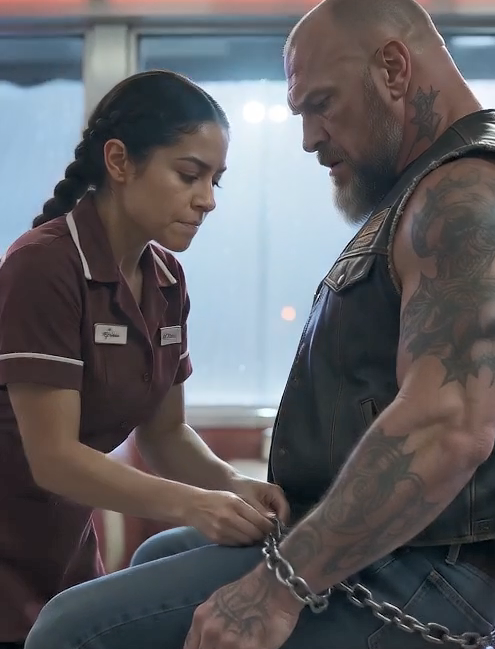
I wrapped a steel chain around the biker’s chair, snapped the padlock shut behind his leather vest, and ran into the storm while everyone in my diner screamed that I had finally lost my mind.
My name is Nora Alvarez. I was thirty-one years old, five months behind on my truck payment, and working double shifts at the Mile Marker 17 Diner outside Kingman, Arizona, when Ray “Hammer” Dawson forgot what year it was.
Nobody else noticed at first.
They noticed the motorcycle.
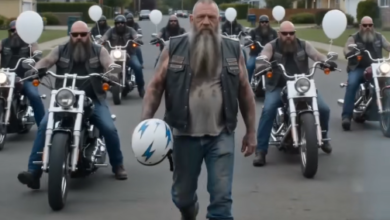
Hammer’s black touring Harley rolled beneath our awning at 6:42 on a Thursday evening, its V-twin rumble fighting the first thunder of a desert storm. Rain had begun striking Route 66 in hard silver sheets. Wind shoved tumbleweeds across the highway, and emergency alerts were warning drivers about flash flooding near the Sacramento Wash.
Hammer walked inside alone.
He was fifty-six, six feet four, and close to 285 pounds. His head was shaved. A thick salt-and-pepper beard covered most of his chest, while faded tattoos ran from both shoulders to scarred knuckles. He wore a plain black leather vest over a damp shirt, blue jeans, a chain wallet and boots heavy enough to announce every step.
Three tourists stopped talking when he entered.
A father quietly moved his son away from the counter. Someone near the window lifted a phone, perhaps because people are more comfortable filming intimidating strangers than meeting their eyes.
Hammer ignored them.
He sat on the third stool from the register and ordered black coffee.
“Where’s Emma?” he asked.
I thought he meant another customer.
“I don’t know an Emma.”
His eyes moved around the diner. “She was right here.”
I poured his coffee and asked whether Emma was his wife.
“My daughter.”
“How old is she?”
“Nine.”
The answer came quickly. Too quickly.
Hammer looked through the rain toward his Harley, then checked the clock above our pie cabinet. Thirty seconds later, he asked where Emma was again.
That was when I really looked at him.
His pupils appeared even. His mouth was not drooping, and his speech was clear, but the tension in his face had changed. It was not anger. It was terror wearing an angry man’s features.
He knew his name. He knew he had ridden from Flagstaff. He could tell me the make of his motorcycle and the route he had taken until the storm began.
But he could not remember ordering coffee.
He could not remember asking about Emma.
And every ninety seconds, his eyes returned to the highway as if a child were waiting somewhere beyond the rain.
“I have to pick her up,” he said.
“From where?”
“The hospital.”
He stood.
I saw the name embroidered inside his vest as the leather shifted: R. Dawson. Beneath it was an old tattoo of an eagle with one damaged wing.
My father had drawn that same tattoo from memory for twenty-three years.
I reached across the counter and took Hammer’s motorcycle key.
He stared at my hand. “Give that back.”
“You can’t ride right now.”
“Lady, I’m fine.”
He asked where Emma was again.
Several customers began watching. A trucker told me to stop provoking him. My manager, Dale, whispered that I should return the key before Hammer tore the counter apart.
Then Hammer reached into his vest.
He pulled out a laminated card containing the emergency contact for Leon Brooks, his club brother. I called the number, but the storm had knocked out our landline, and my cell showed no signal.
Hammer moved toward the door.
I blocked him.
He did not touch me. He only looked over my head at the Harley and said, “My little girl is waiting.”
I knew he could move me with one hand. He knew it too.
That was why the way he stepped around me frightened me more than a threat would have.
I grabbed the security chain we used to lock our patio furniture. When Hammer paused beside a heavy steel-framed chair, I pushed it behind his knees. He sat from surprise, and I looped the chain around the chair frame, through the open sides of his leather vest and around the support post beneath the counter.
I kept the chain loose enough for him to breathe and move his arms.
Then I snapped the padlock shut.
The diner erupted.
A woman shouted that I was attacking him. Dale tried to take the key from me. Two men stood, uncertain whether they should free Hammer or restrain me.
Hammer looked down at the chain.
Then he looked at my face.
“Do I know you?”
The question nearly stopped me.
“Not anymore,” I said.
I grabbed my raincoat and ran outside because I had seen the amber lights of a county rescue truck struggling through traffic half a mile down the highway. Behind me, customers believed I had chained a vulnerable stranger to a chair and abandoned him.
They did not know why I recognized his tattoo.
They did not know Emma had been dead for eleven years.
And Hammer no longer remembered that twenty-three years earlier, he had entered floodwater with a chain around his own waist and dragged my father back from the dead.
Want to know why Hammer believed his daughter was still waiting and what my father left for the biker who saved him? Drop CHAIN in the comments—I’ll share the rest below.
Part 2 — The Empty Place Beside the Coffee Cup
Rain struck me sideways the moment I left the diner. Within ten steps, my uniform was soaked beneath the raincoat, and water had risen over the toes of my work shoes. The county rescue truck moved slowly along the opposite shoulder, its amber lights blurred by the storm.
I ran into the road waving both arms.
The driver braked hard.
Deputy paramedic Tessa Monroe lowered her window and shouted that I was going to get myself killed. I told her there was a disoriented man inside the diner who intended to ride a motorcycle into the storm.
“Stroke signs?”
“Repeating questions. Missing years. Knows his name, not the date.”
She called for an ambulance while turning into our lot.
By the time we entered, one customer had cut partway through the patio chain with a small pair of bolt cutters from his truck. Hammer remained seated, but his shoulders were rigid and his right hand had closed around the chair frame.
Dale was yelling.
The tourists were filming.
A woman stood near Hammer telling him that the police would arrest me. He appeared not to understand why he was chained or why so many strangers knew more about his situation than he did.
Then he saw me.
“Where’s Emma?”
Tessa stopped beside him. “Ray, my name is Tessa. I’m a paramedic. I need to ask you a few questions.”
“I have to get my daughter.”
“What day is it?”
“Thursday.”
“What month?”
He looked toward the window.
Rainwater moved across the parking lot in brown sheets. Lightning flashed behind the gas station sign, but Hammer’s expression suggested he was looking through a different window in a different year.
“January,” he said.
It was August.
“What year?”
He gave a date eleven years earlier.
I heard several customers lower their phones.
Tessa asked Hammer to smile, lift both arms and repeat a sentence. His movements were even. He knew the president’s name from the wrong year. He remembered the road he had traveled that afternoon but could not retain anything that happened after entering the storm.
Every new fact disappeared within minutes.
The chain, however, remained.
He looked down at it repeatedly and asked who had put it there.
I answered every time.
“I did.”
“Why?”
“Because you were going to ride.”
“Why would you stop me?”
“Because the road isn’t safe.”
“Where’s Emma?”
That cycle repeated five times before the ambulance arrived.
Tessa warned us that memory loss could indicate a stroke, seizure, head injury, medication reaction or another neurological emergency. Nobody was allowed to assume it would pass. Hammer needed hospital imaging immediately.
He refused.
Not angrily. Firmly.
“My girl is waiting.”
The ambulance crew tried to persuade him. Dale unlocked the supply cabinet and brought me the spare key to the patio chain, but I hesitated. If we freed Hammer before the paramedics had a safe plan, he could reach the Harley in seconds.
The customers began arguing again.
One man said restraining Hammer without permission was illegal. Another said releasing him into the storm would be worse. A woman asked whether we could call his family.
I still had his emergency card.
This time, standing beside the rescue truck’s radio, Tessa reached Leon Brooks.
Leon answered on the first call.
He and six members of the Iron Lanterns Motorcycle Club had been searching for Hammer since he failed to meet them at a fuel stop near Seligman. His motorcycle’s tracking device had placed him at our diner, but the storm slowed their trucks.
“Do not let him ride,” Leon said.
He did not ask why Hammer was chained.
He did not tell us to wait for the club.
He said, “Whatever you have to do, keep my brother inside.”
I put the radio microphone near Hammer.
Leon’s voice came through the static. “Hammer, listen to me. Emma isn’t waiting at the hospital.”
Hammer’s face hardened.
“You don’t know that.”
“I do, brother.”
“You’re lying.”
Leon’s breath caught over the radio. He changed his approach immediately.
“Okay. Then let the doctors check you first. Emma needs you steady.”
Hammer looked at the chain.
“Who tied me?”
“The waitress.”
“Why?”
“Because she’s trying to keep you alive.”
That answer stayed with him perhaps thirty seconds.
Then it vanished too.
When we finally unlocked the chair, two paramedics stood beside him and Tessa held his motorcycle key. Hammer rose without resistance, though his eyes remained fixed on the storm.
As they guided him toward the ambulance, he stopped in front of me.
“Do I know you?”
My father’s old drawing of the damaged-wing eagle was folded inside my wallet. I wanted to show it to him. I wanted to tell him my name, explain the flood and ask why he disappeared before my family could thank him.
Instead, I said, “You knew my father.”
Hammer studied me as if searching a room with the lights off.
“I’m sorry,” he whispered. “I don’t remember.”
Then he climbed into the ambulance carrying no memory of the life he had once saved—or the daughter he could no longer save.
Part 3 — Twelve Seconds Without the Storm
The hospital ruled out a major stroke first. A CT scan showed no bleeding. Additional imaging found no new injury, and blood tests did not reveal alcohol, dangerous drugs or a severe metabolic problem. Hammer’s vital signs stabilized after the ambulance left the highway.
By midnight, a neurologist suspected transient global amnesia, a rare episode in which a person remains awake and retains identity and basic skills but temporarily loses the ability to form new memories. Stress, physical strain and sudden temperature changes can precede it. The storm might have been a trigger, but the diagnosis required observation and the exclusion of more dangerous causes.
There was no instant guarantee.
Leon arrived at the hospital before the rain stopped. He was fifty-two, broad through the shoulders, with a short gray beard and the calm voice of a man accustomed to being obeyed without raising it. Five other bikers came behind him, all soaked despite arriving in a pickup truck.
I expected anger.
Leon thanked me.
“Ray would’ve ridden,” he said.
“He kept asking for Emma.”
The club members went still.
Leon looked toward Hammer’s room. “What year did he think it was?”
I told him.
He closed his eyes.
Eleven years earlier, Emma Dawson had spent the last months of her life in a hospital in Flagstaff. She was nine. Hammer had driven to see her every day, often arriving before sunrise and leaving after the nurses changed shifts.
Emma died on a Thursday.
The lost year inside Hammer’s mind had carried him to the worst day of his life.
He had not been trying to ride home. He believed his daughter was waiting for him to reach her hospital room before it was too late.
The memory episode had not invented his urgency.
It had removed everything that came after it.
At 2:10 in the morning, Hammer asked Leon why he was at the hospital. At 2:14, he asked again. At 2:19, he noticed the chain marks pressed lightly into his vest and wanted to know who had restrained him.
Leon answered each time.
“The waitress saved your hide.”
Hammer frowned. “What waitress?”
“Nora Alvarez.”
The name meant nothing.
I returned to the diner before dawn because Dale could not close alone. Mud covered the entrance, three ceiling tiles leaked, and the coffee warmer had burned down to a black crust. Someone had left the cut patio chain on the counter.
The video appeared online before breakfast.
It began with me pulling the chain behind Hammer’s chair. It captured his confused expression, my statement—“You don’t get to leave”—and the moment I ran from the diner.
The video ended there.
No one saw me stopping the rescue truck.
No one heard Hammer repeat the same question.
No one saw the ambulance.
The caption claimed a waitress had chained a biker after a personal dispute and fled before police arrived. Within hours, strangers identified the diner. Some called to congratulate me for “standing up to a gang member.” Others called me cruel, unstable or dangerous.
Neither side knew what happened.
Dale suspended me.
He said he believed I had meant well, but the diner’s insurance company wanted an investigation. Until lawyers decided whether the emergency justified physical restraint, I could not work.
I went home carrying the chain.
My father’s house had become mine after his death fourteen months earlier. I had not changed his bedroom. His work boots remained near the closet, and a row of labeled coffee cans still held screws, washers and old keys he claimed might become useful.
Inside the bottom dresser drawer lay a brown envelope marked for me.
Dad had given it to me during his final week but told me not to open it until I found “the man with the broken-wing eagle.”
I had assumed grief medication made him confused. I put the envelope away.
Now I opened it.
Inside was a newspaper clipping from August 2002. The photograph showed floodwater crossing Route 66 and a young biker kneeling beside an injured man. Most of the biker’s face was turned away, but his right forearm displayed the same damaged-wing eagle.
The caption did not identify him.
Beneath the clipping was a letter in my father’s careful handwriting and a rusted chain link wrapped in gauze.
Nora,
If you ever find him, tell him I got forty-three more years.
Tell him you were nine when he pulled me out, and I lived long enough to watch you graduate, marry badly, leave bravely and come home stronger.
Tell him he did not save one life.
He saved every day that followed it.
At the bottom, Dad had written a name he had learned only months before dying.
Ray Dawson.
I drove to the hospital carrying the letter.
Hammer was awake when I arrived. His memory had begun holding again, though nearly six hours remained blank. He remembered the storm forming near Seligman. He remembered rain striking his helmet.
He did not remember the diner.
Leon explained what I had done.
Hammer looked at the chain marks in his vest, then at me.
“So you’re the waitress.”
“Yes.”
“Why did you know I wasn’t right?”
“Because you kept asking for someone who couldn’t be there.”
Pain moved across his face, but he contained it.
Then I placed my father’s newspaper clipping on the hospital table.
Hammer stared at the younger version of himself.
I told him Miguel Alvarez had survived.
I told him he had lived forty-three more years.
Hammer’s scarred hands began to shake.
But before he could read the letter, the hospital door opened and a state investigator entered carrying a printed complaint about unlawful restraint.
The customer who cut the chain had accused me of assault.
And Hammer was the only witness who could clear my name.
He remembered nothing.
Part 4 — The Flood Hammer Never Counted
The investigator’s name was Caleb Shaw. He was not cruel, but his job required questions that made the event sound simple.
Did I have Hammer’s consent to restrain him?
No.
Did Hammer threaten me?
No.
Did he strike anyone or behave violently?
No.
Did I consider less restrictive alternatives?
I took his key, blocked the door and tried calling for help. He kept moving toward the Harley.
Why did I run away after locking the chain?
To stop a rescue truck.
Could anyone confirm that?
Tessa could. So could the rescue driver. The truck’s camera eventually would.
Caleb wrote everything down.
Hammer listened from his hospital bed with both hands folded over the blanket. When the investigator asked whether he wanted charges filed, Hammer shook his head.
“She stopped me from riding into a flood.”
“You don’t remember that.”
“No.”
“Then how can you be certain?”
Hammer looked at Leon.
“Because he’s telling me she did. Because the paramedics are telling me. And because I’m here.”
Caleb reminded him that intent did not automatically make every method lawful. Hammer nodded.
“Then put my statement down exactly. I don’t want her punished for keeping me alive.”
The investigation continued, but I was not arrested. Tessa’s body camera, the rescue truck recording and the diner’s security footage confirmed the sequence of events. Medical records established that Hammer was experiencing an acute neurological emergency.
The chain had been loose. His limbs were not bound. He remained able to breathe and use his hands. I released him as soon as trained help established control.
The complaint eventually closed without charges.
But the legal question was not what broke Hammer open.
My father’s letter did.
Hammer read it after Caleb left.
Twenty-three years earlier, Hammer had been riding west through a summer monsoon when a pickup truck slid into a flooded drainage channel. Miguel Alvarez was trapped inside, his leg pinned beneath the steering column as water rose through the floor.
Emergency crews had not arrived.
Hammer carried a tow chain on his motorcycle because his old Harley frequently needed help. He wrapped one end around a highway guardrail and the other around his own waist, then entered the water.
He broke the truck’s rear window.
The current knocked him against the cab twice. He cut Miguel’s seat belt, pushed his shoulders through the opening and pulled until both men reached the limit of the chain. Two motorists grabbed the dry end and dragged them toward the shoulder.
Hammer stayed long enough to confirm Miguel was breathing.
Then he left.
The official report listed him as an unidentified motorcyclist. Dad remembered the damaged-wing eagle, the beard and one sentence Hammer shouted while the water rose.
“Hold the chain. I’m coming back.”
Why had Hammer disappeared?
The answer carried a less flattering history than my father imagined.
At twenty-three, Ray Dawson was riding with a suspended license. He had missed a court hearing after a bar fight and believed an outstanding warrant would send him to jail. When he heard sirens approaching, he panicked.
He had just risked his life for a stranger.
Then he ran from accountability.
Both things were true.
Hammer was arrested three months later on unrelated charges and served eleven months in county jail. He joined no heroic rescue organization afterward. He did not contact my father because he never learned Miguel’s name and assumed the man had died after the ambulance arrived.
“I left him,” Hammer said.
“You pulled him out.”
“I ran.”
“He lived.”
Hammer looked at the rusted chain link inside the envelope. Dad had found it beside the guardrail after leaving the hospital. He kept it in his toolbox for four decades.
The chain was why I reacted so quickly in the diner.
My father had told me the flood story hundreds of times. He taught me that confused or injured people sometimes fight the very thing keeping them safe. He also made me promise never to enter floodwater after another person. Chains, he said, were for anchoring, not bravery.
I recognized Hammer’s tattoo before I recognized his medical emergency. When he kept repeating Emma’s name, those two facts collided inside me: this was the man Dad had searched for, and he was about to disappear again.
That was why I said, “You don’t get to leave.”
I did not mean the diner.
I meant my father’s story.
Hammer read the letter a second time. Then he pressed the chain link into his palm until its rust stained his bandage.
“Did he have a good life?” he asked.
“He complained through most of it.”
Leon laughed quietly.
I told Hammer that Dad repaired school buses for twenty-eight years, raised me after my mother died, hated tomatoes, loved boxing, and kept a photograph of my college graduation taped inside his toolbox. He survived prostate cancer, two bad knees and my marriage to a man he disliked correctly.
He lived long enough to become difficult.
Hammer lowered his head.
“That’s good,” he said.
I thought the story’s debt had finally been paid.
Then Leon asked why Dad learned Hammer’s name only months before dying.
The answer waited inside a second folded page.
Miguel had found Hammer because Emma once saved him too.
Part 5 — The Hospital Bracelet in My Father’s Toolbox
Dad’s second page described an afternoon at Flagstaff Medical Center nine years after the flood.
He had driven there for knee surgery. While waiting near the admissions desk, he saw a large tattooed man kneeling beside a little girl in a wheelchair. The child wore a knitted purple cap and held a paper cup filled with crayons.
Dad recognized the broken-wing eagle.
He tried to approach, but a nurse stopped him because the girl’s immune system was severely compromised. Dad watched from across the lobby as the biker adjusted her blanket, accepted a purple crayon and allowed her to draw directly across his scarred hand.
The child noticed Dad staring.
She waved.
Dad waved back.
Then she told her father something and pointed toward the empty chair beside her. Hammer looked over, but an orderly pushed the wheelchair toward the elevator before Dad could speak.
Later, Dad found a purple crayon beneath the chair. Wrapped around it was a pediatric hospital identification band bearing the name Emma Dawson.
Dad took the bracelet to the information desk, but privacy rules prevented staff from giving him the family’s address. He kept the band, believing he would return it when he found Hammer.
Emma died before he did.
For years, Dad searched charity-ride photographs and local motorcycle pages. He saw Iron Lanterns vests but never a clear image of Hammer’s tattoo. Only after Emma’s story appeared in a hospital fundraising article did he connect Ray Dawson to the unnamed biker from the flood.
By then, Dad was in hospice.
The bracelet remained inside his toolbox beneath the chain link.
I had not known.
After leaving the hospital, I drove home and searched until I found it inside a coffee can labeled SMALL THINGS THAT MATTER. The plastic band had yellowed, but Emma’s name and the faded date were still visible.
I returned the next morning.
Hammer was sitting beside the window in ordinary clothes, his leather vest folded across the visitor chair. His memory had returned except for the hours inside the diner. The neurologist warned that recurrence was uncommon but advised follow-up evaluation, rest and no riding until cleared.
Hammer hated the final instruction.
Leon had already loaded the Harley onto a trailer.
I placed Emma’s bracelet on the hospital table.
Hammer stopped breathing.
He touched it with one finger, then withdrew his hand as if the plastic were hot. Leon moved toward the door, giving him space, but Hammer told him to stay.
“Where did you get this?”
I repeated Dad’s account of the hospital lobby.
Hammer remembered the day.
Emma had noticed my father because he looked frightened before surgery. She gave him the purple crayon through a nurse and said grown men were allowed to be scared as long as they still showed up.
The bracelet must have slipped from her wrist when the nurse adjusted her blanket.
Hammer had searched their car and hospital room afterward. Emma believed a frightened person had taken it because they needed courage.
She had been right.
Dad carried the bracelet through surgery. He held it while learning to walk with a cane. He kept it through every later hospital visit because the little girl’s sentence had become a private command.
Still show up.
Emma’s lost bracelet had helped the man Hammer pulled from the flood continue living. Dad’s story about Hammer had taught me to recognize a person who needed anchoring. The chain returned to him in a diner at precisely the moment his own memory failed.
No one had planned any of it.
That made it harder to dismiss.
Hammer finally lifted the bracelet. His fingers were steady now.
“My girl gave your father courage,” he said.
“And you gave him time.”
He looked at me. “Then what did you give me?”
“A chair you couldn’t leave.”
Leon made a rough sound behind us. Hammer’s mouth moved slightly beneath his beard.
It was the first time I saw him smile.
The club settled the practical debts next. They did not threaten Dale or the customer who reported me. Hammer refused that kind of repayment. Instead, Leon provided the diner with medical-event training through the county fire department. Tessa taught staff how to recognize stroke warning signs, seizures, diabetic emergencies and sudden memory disturbances.
Dale reinstated me with back pay.
The Iron Lanterns replaced the cut patio chain with a quick-release safety restraint intended only for securing furniture, never people. The old chain was divided into three pieces.
One stayed in Dad’s toolbox.
One went into Hammer’s left saddlebag beside Emma’s bracelet.
The final piece hung beneath the diner counter.
Not as a trophy.
As a reminder that sometimes keeping someone safe looks wrong for the few seconds strangers choose to record.
Hammer returned to the diner two weeks later in Leon’s truck. His doctors had not cleared him to ride.
He sat on the same steel chair.
I poured his coffee.
“Where’s Emma?” I asked softly.
His eyes lifted to mine.
He knew exactly who I meant.
“Not waiting anymore,” he said.
Then he placed my father’s hospital bracelet—the one Miguel had worn after the flood—beside Emma’s on the counter.
Hammer had recovered it from an old evidence envelope through the county hospital archive. Two plastic bands rested side by side, separated by nine years and joined by the same family debt.
One belonged to the man he saved.
The other belonged to the daughter he lost.
Neither had reached him until I locked the chain.
Part 6 — The Table Nobody Wanted to Replace
The Mile Marker 17 Diner became busier after the truth emerged. Dale hated admitting that controversy helped business, but truckers began stopping to ask about the chained biker, and local families attended the emergency workshops held in our back room.
We never displayed the viral video.
We did not hang newspaper articles or name a sandwich after Hammer. He threatened to leave permanently when Dale suggested “The Chained Rider Breakfast.”
The steel chair stayed.
Its frame carried shallow marks where the chain had rubbed against it. Dale offered to replace the chair, but Hammer said damage did not make an object useless.
He had a habit of saying things that sounded ordinary until you knew his history.
Once a month, Hammer came for black coffee and pecan pie. During the first three visits, Leon drove him. Later, after neurological follow-up and medical clearance, Hammer returned on his Harley.
He no longer rode alone through storm warnings.
The Iron Lanterns adopted a weather rule: when the National Weather Service issued a flash-flood alert, every rider checked in with another member. Nobody crossed a flooded wash. Nobody dismissed confusion, repeated questions or sudden behavior changes as stubbornness.
Hammer placed an emergency information card inside his vest and another beneath his motorcycle seat. The card listed Leon, his physician, his prior episode and the sentence most likely to make him cooperate.
Emma is safe. Let Leon take you home.
He disliked the card.
He carried it anyway.
My relationship with Hammer did not become sentimental overnight. He remained impatient, private and difficult to thank. When I tried returning the money the club raised during my suspension, he pushed the envelope beneath a sugar dispenser and left.
I used the money to replace Dad’s leaking roof.
Hammer inspected the work afterward and complained about the contractor’s flashing. He spent an entire Saturday repairing it without asking permission. I fed him dinner and did not call the meal payment because he would have refused it.
The chain link from Dad’s toolbox traveled with him now. He drilled a small hole through the rusted metal and attached it beside his motorcycle key—not as decoration, but where it struck the fuel tank softly whenever the bike idled.
Clink.
Clink.
Clink.
A smaller sound than the engine.
A stronger memory than the missing hours.
On the anniversary of Dad’s death, Hammer rode with me to the flooded culvert. The highway had been rebuilt, and concrete barriers replaced the old guardrail. Water moved quietly beneath the road.
I brought Dad’s work gloves.
Hammer brought Emma’s purple crayon, preserved inside a clear tube.
We placed neither object in the water. Dad would have called that littering, and Emma probably would have agreed.
Instead, we sat on the barrier while trucks passed behind us.
“I don’t remember his face,” Hammer said.
“He remembered yours.”
“Mostly the tattoo.”
“He said your language wasn’t appropriate for a nine-year-old.”
Hammer nodded. “Fair.”
I told him Dad had never believed he was abandoned. He understood why a frightened young man with a suspended license fled from sirens. What mattered was that Hammer entered the water before anyone knew his name.
Hammer rubbed the chain link between his fingers.
“I should’ve stayed.”
“You came back.”
It took him a moment to understand.
Not to the flood.
To our family.
Part 7 — The Night He Chose Not to Ride
One year after the diner storm, another monsoon crossed Kingman.
The warning reached our phones shortly before closing. Rain hammered the roof, traffic slowed on Route 66, and muddy water began collecting near the edge of the lot.
Hammer’s Harley was parked beneath the awning.
He sat in the third seat from the register, drinking coffee while Leon studied weather radar on his phone. The club had planned to ride north before sunset, but the storm arrived early.
Nobody moved toward the motorcycles.
A tourist looked outside and asked whether men like them were afraid of rain.
Leon answered first.
“Not rain. Stupid decisions.”
Hammer finished his coffee and placed the cup on the counter. For a moment, he watched water run down the windows with the distant expression that had frightened me the year before.
I asked the question we had agreed upon.
“What year is it, Ray?”
He answered correctly.
“Where are you?”
“Mile Marker 17.”
“Who am I?”
“The woman who overcooks eggs and steals motorcycle keys.”
I held out my hand.
Hammer dropped the key into it.
No chain.
No argument.
Leon drove him home in the club truck while the Harleys remained beneath our awning. Before leaving, Hammer touched the rusted link hanging beside his ignition and looked toward the steel chair.
“I remember this one,” he said.
The next morning, the storm had cleared. Hammer returned before sunrise with coffee for the entire staff. He waited until the highway department reopened the flooded section, checked the road report twice and inspected the Harley before starting it.
I brought his key outside.
He did not take it immediately.
Instead, he handed me a small wooden box made from dark walnut. Inside lay two hospital bracelets, Emma’s purple crayon and a copy of my father’s letter. A narrow space remained beside them.
“For what?” I asked.
Hammer placed the final chain link inside.
“For the part I almost forgot.”
He closed the box and returned it to me. I kept it beneath the diner counter, close to the chair but out of public view. Some stories do not need a display. They need a safe place to remain whole.
Hammer climbed onto the Harley.
The engine turned over, settling into its heavy V-twin rhythm. He looked toward the clear highway, then back at me.
“Your dad got forty-three years?”
“He did.”
Hammer nodded.
“Good trade.”
“It wasn’t a trade.”
“No,” he said. “Guess not.”
He rode west after the storm had passed, with Leon beside him and six Iron Lanterns following at a careful distance. The chain link tapped softly against his fuel tank until the sound disappeared beneath the engines.
This time, nobody had to make him stay.
Follow our page for more powerful biker stories about misunderstood strangers, quiet debts and the people who refuse to let a good man disappear twice.