A Biker Ripped the Engagement Ring Off a Young Woman’s Finger at a Truck Stop at Midnight—Her Fiancé Screamed for Help and Truckers Called 911, Until He Read What Was Engraved Inside the Band
Part 2 — Evidence
“Hello, Dalton,” Charles Davenport said. “It’s been a long time.”
Twenty-three years, to be exact.
The last time I’d seen that face, it was on the witness stand in Courtroom 2A of the Charleston County Judicial Center. He was swearing under oath that I walked into Davenport Fine Jewelers on King Street with a pistol on the night of January 12th, 2002, and took a ring from the case.
This ring.
Now he was seventy, silver-haired, in a navy blazer at midnight, standing in a truck-stop parking lot. He wasn’t scared of me. He was annoyed.
The girl stood between us in my leather jacket, looking from one to the other.
“Mr. Davenport?” she said. “You know him?”
“I’m afraid I do, sweetheart.” Charles put a fatherly hand on her shoulder. “This man robbed my store at gunpoint before you were born. He spent twelve years in prison for it.” He looked at the ring in my fist. “And it appears he’s just robbed you.”
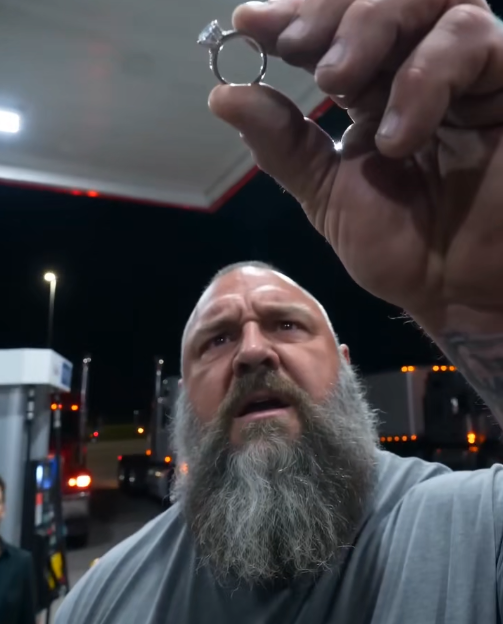
The truckers murmured. The siren got closer.
The young man, Preston, his son, pulled the girl behind him.
“Emma, get in the car.”
Emma.
My chest went tight.
Two South Carolina Highway Patrol cruisers pulled into the lot with their lights going. Corporal Ben Hatcher listened to Charles, then to Preston, then to two truckers holding up their phones. Then he turned to me.
“Sir, did you take this ring from her hand?”
“Yes.”
“Then you’re under arrest for strong-arm robbery.”
He took the ring from my palm and dropped it into a plastic evidence bag.
I’d seen that happen once before.
As they put me in the back of the cruiser, Emma looked at me through the window. She was still wearing my jacket. She glanced down at my left wrist, at the tattoo, and her lips moved. That’s my birthday.
Then Preston pulled her into the Range Rover, and they were gone.
I sat in a holding cell at the Dorchester County Detention Center until dawn, staring at my wrist.
Emma Grace. 3·21·02.
I got that tattoo at Broad River Correctional Institution in 2002, from a lifer named Tiny who used a guitar string and a motor from a CD player. It was the day a guard handed me a letter from Lauren’s lawyer. It said the baby was born, and that if I ever tried to contact her, the Pryce family would make sure I died in prison.
I’d never seen her face. I’d never been allowed to.
And that night in the cell, I made myself ask the ugly question.
How did I know?
Lots of girls are named Emma. Lots of rings look alike. I’d spent twelve years in prison and ten more out, alone, thinking about that baby. Maybe I’d wanted it so badly I saw it in the first girl who looked at me kindly on a dark highway.
Maybe I’d just ripped a stranger’s engagement ring off her hand because I’d finally lost my mind.
At six a.m., a guard rapped on the bars.
“Rourke. You’ve got a phone call. Says she’s your daughter.”
I stood up so fast I nearly fell.
“Hello?”
There was a long silence. Then a young woman’s voice, shaking.
“My mother told me my father died in a motorcycle crash before I was born,” Emma said. “So who are you?”
Part 3 — Ride or Die
In the winter of 2001, the garage on Folly Road where I fixed bikes smelled like WD-40 and the pluff mud from the marsh out back.
I was twenty-five. Lauren Pryce was twenty-two. She was a senior at the College of Charleston, the daughter of Harlan Pryce, the richest real estate developer in the Lowcountry. She’d brought her Vespa in with a dead battery and kept coming back long after it was fixed.
She called me Doc. She said I could fix anything. Nobody else called me that. Not my club, not my mama. Just Lauren.
When she told me she was pregnant, I walked into the Folly Road Pawn & Gold that afternoon and put nineteen hundred dollars I didn’t have down on a one-carat solitaire. The owner, an old man named Ike Washington, gave me a handwritten receipt on carbon paper. He let me borrow his engraving tool, and I scratched four words inside the band myself.
D + L. Ride or Die.
Then, because I’m a mechanic and couldn’t leave anything alone, I took a jeweler’s file and nicked the left prong, just slightly.
“So I’ll always know it’s ours,” I told her.
She cried and said yes, on the back of my bike in the parking lot of Bowen’s Island Restaurant, with the sun going down over the marsh.
I kept the carbon receipt from Ike’s pawn shop in the zippered inside pocket of my old leather jacket, folded small, like a love letter.
Three weeks later, her father found out.
Two weeks after that, I was arrested for armed robbery.
That jacket went into a box in my sister Rita’s attic the day I went to prison.
I never thought about that receipt again.
Part 4 — The Prosecutor’s Friend
Charles Davenport came to see me himself the next afternoon, in the visiting room of the Dorchester County jail, with his son.
“I want to clear the air,” he said, sitting down. He folded his hands on the table like a man at a board meeting. “For Emma’s sake.”
Preston sat stiffly beside him. He was twenty-seven, handsome, nervous. He kept glancing at me and then away.
“First,” Preston said, “I didn’t abandon her. I want you to know that. We were fighting, and she told me to pull over and let her out. She said she’d call an Uber. I drove up one exit and came right back.” He held up his phone and played a dashcam clip, timestamped. 11:52 p.m.: car stops, she gets out, car pulls away. 12:04 a.m.: car returns, shoulder is empty. “Twelve minutes. You’d already picked her up. I’ve been sick about it all day.”
Then Charles slid a thick folder across the table.
It was my trial transcript, and a South Carolina Court of Appeals decision affirming my conviction in 2004. There was a photograph of the evidence ring, a plain one-carat solitaire, with an inventory tag from Davenport Fine Jewelers.
“The ring in that photo had no engraving,” Charles said quietly. “The jury saw it. Your lawyer argued about an engraving and a pawn shop receipt, and no receipt was ever found. Twelve jurors decided you were lying.” He sighed. “I’m sorry for what you’ve been through, Mr. Rourke. Truly. But I’m not the one who put you there.”
“Then who did?”
Charles hesitated, as if it pained him.
“Harlan Pryce. Emma’s grandfather.” He lowered his voice. “Harlan was beside himself when Lauren got pregnant by a…” He gestured at my tattoos. “Harlan pushed the solicitor’s office. Harlan paid for the private investigator. I was just the store owner who got robbed. I testified to what I believed I saw.”
“And the ring on Emma’s finger?”
“Harlan gave it to Preston when he proposed,” Charles said smoothly. “He said it was a Pryce family piece. I had no idea it was anything else.” He looked me in the eye. “If that’s truly your ring, Mr. Rourke, then Harlan Pryce kept a piece of evidence from your trial for twenty-three years. And he’s the man you should be asking.”
Harlan Pryce was seventy-nine, dying of pancreatic cancer in a house on the Battery overlooking Charleston Harbor, and nobody got in to see him.
I went back to my cell and lay on the bunk, thinking.
It all fit. Harlan hated me. Harlan had money. Harlan had his daughter’s ear and his granddaughter’s future.
But one thing scratched at me.
Charles had called it a Pryce family piece, something Harlan “gave” Preston for the proposal. But Preston had said something at the truck stop that Charles didn’t seem to remember.
“Dad’s been saving that ring in his safe since before I was born.”
So which was it?
Part 5 — Folly Road
My sister Rita drove to Dorchester County with a cardboard box on the passenger seat.
“Your stuff from the attic,” she said through the glass. “Your lawyer said bring anything from 2001.”
My lawyer was Keisha Moultrie, a law professor who runs a wrongful-convictions clinic at the University of South Carolina School of Law. She’d taken my case the day Emma called the clinic hotline, crying, and begged someone to look at it.
In the bottom of the box was my old leather jacket.
Keisha unzipped the inside pocket with gloved fingers.
Out came a folded square of yellowed carbon paper, soft as cloth.
Folly Road Pawn & Gold. Jan. 3, 2001. One round solitaire, approx. 1 ct., 14k yellow gold, 6-prong. $1,900, layaway. Customer engraving: “D + L Ride or Die.” — I. Washington.
Keisha sat back in her chair and exhaled.
“This is the receipt your trial lawyer said didn’t exist.”
It got worse, or better, depending on how you look at it.
Keisha pulled the original trial exhibits from the Charleston County clerk’s archives. The evidence ring presented to the jury was a plain one-carat solitaire. But the property report from the night of my arrest, written by the officer who searched my saddlebag, described the ring he found as “engraved inside band, partially legible, ‘D + L.'”
Two different rings.
Someone had swapped the engraved ring I bought for a plain one from Davenport’s inventory before trial, and kept mine.
Then Keisha pulled the insurance file. Davenport Fine Jewelers filed a claim with Lloyd’s of London in January 2002 for the “armed robbery.” Total loss: $186,000 in diamonds and gold. The store was three months behind on its lease. It closed for good eighteen months later.
“There was no robbery, Dalton,” Keisha said. “There was an insurance claim. They needed a robber. Harlan Pryce needed you gone. And somebody put your ring in your saddlebag the night they arrested you.”
Then she found the money.
In February 2002, Harlan Pryce wired $250,000 to a newly formed LLC called Ashley River Consulting. The registered agent was Charles Davenport.
There was one more document. It was a copy of Harlan Pryce’s estate trust, filed with the Charleston County probate court when he got sick. Fourteen million dollars, held in trust for his only grandchild, Emma Grace Pryce. It would be released to her outright on her twenty-fifth birthday.
March 21st. Five weeks away.
Unless she was married by then. In that case, the trust named her husband as co-trustee, with full signing authority.
Davenport Development, Charles’s real estate company, was underwater on two failed condo projects on Daniel Island. Keisha found the liens. Forty-one million dollars in debt.
“He sent his son to marry your daughter,” Keisha said quietly. “With your ring.”
I put my head down on the steel table.
Keisha’s phone buzzed. She read the screen and went pale.
“Dalton. Emma just texted me.” She turned the phone around.
They moved the wedding up. It’s Saturday. Mom says if I don’t go through with it, she’ll never speak to me again.
Part 6 — Strong-Arm Robbery
The Dorchester County solicitor charged me with strong-arm robbery that Thursday. It’s a felony in South Carolina and carries up to fifteen years. Because of my 2002 conviction, the judge called me “a recidivist who has targeted the same family twice” and denied bond.
Charles Davenport did the rest from the outside.
He gave an interview to WCSC Live 5 News from the porch of his house on Sullivan’s Island, with the ocean behind him.
“Twenty-three years ago, this man robbed my family at gunpoint,” he said, his voice heavy. “Last week, he followed my future daughter-in-law to a dark truck stop and tore the ring off her hand. I believe in second chances. But some people never change.”
The truck-stop video had three million views. In the comments, people called me a predator and a stalker.
The ring itself, my ring, was still sitting in the Dorchester County evidence room. The same thing had happened in 2002.
My club came to the jail the first night. Thirty-eight bikes sat in the parking lot until a deputy came out and told them to leave or he’d start writing tickets. Live 5 ran that too. Biker Gang Rallies Behind Jailed Robbery Suspect.
Keisha filed an emergency motion with the receipt and the property report. The judge set a hearing for Monday.
The wedding was Saturday.
On Friday night, Emma came to see me.
They let her in as a family member, because she told the front desk, “He’s my father.” I watched her say it through the glass, and I had to look away.
She sat down across from me. She wasn’t wearing a ring.
“Preston says the receipt could be fake,” she said. “He says you could’ve made it in prison. His father says you’re obsessed. My mother won’t talk about you at all.” She was trembling. “Tell me why I should believe you, and not every single person who raised me.”
“Because I’m not asking you to,” I said. “Read the paperwork. Then decide.”
“I did.” Her voice cracked. “The receipt matches the ring. The property report matches the ring. Mr. Davenport’s company got a quarter million dollars from my grandfather. And Preston…” She pressed her lips together. “Preston admitted to me last night that his father told him to propose before my birthday. He said he didn’t know why. He said it was romantic.”
“Do you believe him?”
“I don’t know who to believe anymore.”
She stood up to leave. Then she turned back.
“There’s one more thing you should know,” she said. “My mother’s lawyer called this morning. She’s going to testify at your hearing on Monday. For the prosecution.”
Part 7 — What Lauren Did
Lauren Pryce walked into the jail visiting room on Saturday morning, the day of the wedding. I hadn’t seen her in twenty-three years.
She was forty-six now, still beautiful, with silver threads in her dark hair. She wore pearls and a cream sweater, and she looked like she hadn’t slept in a week.
She sat down and didn’t speak for a long time.
“I came to tell you the truth before I tell a judge something else,” she finally said.
“Which truth, Lauren?”
She flinched.
“The night you were arrested,” she said, “my father asked me where you kept the ring. I told him.”
I stared at her.
“I told him you kept it in your saddlebag, in the little velvet box, until you had money for a better one. I told him you never locked it.” Her voice broke. “He said he only wanted to ‘talk’ to you. I was twenty-two and pregnant and terrified. I knew if I married you, my father would cut me off and I’d be raising a baby in a single-wide off Folly Road. So I told him.”
“And when they arrested me for armed robbery?”
“I knew it was a lie. The night of the ‘robbery,’ you were with me at the hospital for my ultrasound. I had the printout with the timestamp.” She pressed her hand over her mouth. “I never gave it to your lawyer. My father said if I did, he’d take the baby. So I let them convict you. And I let my daughter believe you were dead, because a dead father was easier to explain than one I’d sent to prison.”
The room was very quiet.
I’d spent twenty-three years hating Harlan Pryce. I had never once let myself hate Lauren. I’d told myself she was a scared kid who’d been controlled by a powerful man.
She was. She’d also handed him the knife.
“Why are you telling me now?” I asked.
She reached into her purse and slid something under the glass slot. It was a faded, glossy hospital printout, curled at the edges.
MUSC Women’s Health. Ultrasound. Patient: Lauren Pryce. Jan. 12, 2002. 9:14 p.m.
In the bottom corner, in faded ballpoint, someone had written: Doc held my hand the whole time.
The robbery at Davenport Fine Jewelers was reported at 9:20 p.m.
“I kept it for twenty-three years,” Lauren whispered. “Behind the backing of a picture frame in my closet. I never knew why. I think I always knew this day would come.”
“And the wedding?”
She looked at her watch.
“Starts at four o’clock. At Middleton Place. Charles had the date moved up six weeks.” She swallowed. “He’s livestreaming it for the guests who can’t make it. Four hundred people on the lawn. Three thousand more online.”
“And Emma?”
“She’s in the bridal suite right now,” Lauren said. “Wearing her dress. She called me an hour ago. She asked if I’d lie to her one more time, or if I’d finally tell her the truth in front of everyone.”
She stood up.
“I’m going to the solicitor’s office right now with this printout,” she said. “Your lawyer says it should be enough to get you in front of a judge by two.”
She looked at me one last time, and for a second she was twenty-two again, on the back of my bike at Bowen’s Island.
“Can you get there by four, Doc?”
Part 8 — Middleton Place
The judge signed my release at 2:41 p.m. with the ultrasound printout in front of her. She also signed a second order: Release of evidence item #DC-0347 to defense counsel.
The ring.
At 3:52 p.m., the low rumble came up Ashley River Road.
Thirty-eight motorcycles rolled two by two past the live oaks and the old rice ponds and parked along the gravel drive at Middleton Place. They cut their engines one by one. The bikers walked onto the edge of the great lawn in leather vests and stood under the oaks with their arms crossed, silent.
Four hundred guests in linen and seersucker turned around in their white chairs.
A man with a gimbal camera was livestreaming the ceremony from beside the altar.
Charles Davenport stood near the front in a gray morning suit. When he saw me walking up the aisle beside Keisha Moultrie, his face went white for one second. Then he recovered, smooth as ever.
“Security,” he said calmly. “That man is a convicted armed robber.”
“Not anymore,” Keisha said. She held up a stamped court order. “His conviction is under review as of 2:41 this afternoon. And I’m here as an officer of the court to return a piece of property.”
Then the music started, and the bride came out.
Emma walked down the aisle alone, in white, with no one on her arm. When she saw me, she stopped halfway.
Then she kept walking until she reached me. She held out her left hand.
Keisha handed me a small velvet box. I opened it.
The ring was inside. One carat, six prongs, a tiny nick on the left prong.
“Mr. Davenport,” Emma said, loud enough for the camera to hear. “Before I marry your son, I have one question. Where did this ring come from?”
Charles smiled at the crowd, patient and fatherly.
“Sweetheart, we’ve been through this. It was a family piece. And this man is a disturbed ex-convict who robbed my store in 2002.” He turned toward the guests. “A stranger, folks. I’d never laid eyes on him before the night he walked into my store with a gun.”
“Never?” Emma asked.
“Never.” He laughed, a little too loud. “I didn’t even know his name until the police told me. Doc Rourke, some grease monkey off Folly Road. Harlan said Lauren was running around with him, and I said—”
He stopped.
The great lawn at Middleton Place went completely silent.
“Doc,” Keisha repeated slowly. “Mr. Davenport, in twenty-three years of police reports, trial transcripts, appeals and press coverage, Dalton Rourke has never once been called Doc. Not by the police, the prosecution, or the newspaper.”
She turned toward the camera.
“Only one person ever called him that,” she said. “Lauren Pryce. Which means you heard that nickname from Lauren, or from Harlan Pryce, before the robbery. Before you ever ‘laid eyes on him.'”
From the front row, Lauren Pryce stood up in her silk dress.
“I called him Doc,” she said, her voice shaking. “Only me. My father repeated it, sneering, the night he planned the whole thing. In front of you, Charles. In my father’s study. With the $250,000 check on the desk.”
Four hundred people turned to look at Charles Davenport.
Preston took a step back from his father at the altar.
“Dad,” he said quietly. “You told me the ring was Grandma’s.”
Charles’s mouth worked. Nothing came out.
Emma looked down at the ring in the velvet box. Then she looked at me.
Then she turned slowly to the man who’d almost become her father-in-law, and asked one final question.
“Mr. Davenport,” she said. “What exactly were you going to do with my fourteen million dollars?”
Part 9 — Ride or Die
Charles Davenport didn’t answer. A Charleston County sheriff’s deputy walked him off the lawn at Middleton Place in his gray morning suit while three thousand people watched it live.
South Carolina has no statute of limitations on felony prosecutions.
Charles was indicted that summer for insurance fraud, perjury, obstruction of justice, and conspiracy to deprive a person of liberty. The Lloyd’s investigators brought their own lawyers. Davenport Development filed for bankruptcy in August. Charles pleaded guilty in November and was sentenced to fourteen years. That’s one year more than I served.
Harlan Pryce died in March, three days before Emma’s twenty-fifth birthday. Before he died, he gave a videotaped statement to Keisha Moultrie from his bed on the Battery. He confessed to everything: the payment, the planted ring, the threats to his own daughter. He never apologized. He said only, “I did what I thought would protect the family name.”
The Charleston County Court of General Sessions vacated my 2002 conviction that December. The judge stood up from the bench to say it.
“Mr. Rourke, you are innocent. This court is ashamed.”
Lauren testified against Charles. The solicitor gave her immunity for withholding the ultrasound printout. She told Emma everything, every lie, in a counselor’s office in Mount Pleasant over six long weeks. Some days Emma left in tears. Some days she stayed.
Lauren and I don’t talk much. But last month she sent me a photo, the one from Bowen’s Island, the two of us on my bike with the sun going down over the marsh. On the back, she’d written: I’m sorry, Doc. That was enough. It had to be.
Preston didn’t know about the robbery. He did know about the trust money, and that his father wanted the wedding before March 21st. He told the judge the truth and was never charged. He sent Emma a handwritten letter apologizing. She hasn’t answered it. Maybe someday.
On the night of her twenty-fifth birthday, Emma asked me to take her somewhere.
So I took her for a ride.
We went up I-26 in the dark, her arms around my waist, wearing my old leather jacket from Rita’s attic. The zipper pocket still held the carbon receipt from Folly Road Pawn & Gold. She wouldn’t let me take it out.
At midnight, I pulled onto the shoulder at mile marker 182. It was the same stretch of interstate where I’d found her shivering in a cocktail dress a year earlier.
We stood under the stars while the trucks roared past.
I took the velvet box out of my vest.
“This was supposed to go to your mother,” I said. “It went to a lot of places it shouldn’t have. I think it’s done traveling.”
Emma held out her right hand, not her left.
I slid the ring slowly onto her finger, the same ring I’d ripped off her hand in front of a crowd of truckers a year before.
This time I did it as gently as I’ve ever done anything in my life.
She turned her hand under the starlight. The tiny nick on the left prong caught the glow of a passing truck.
Then she reached over and turned my left wrist up, so the faded tattoo showed. Emma Grace. 3·21·02.
“You put my name on your arm in prison,” she said, “before you ever saw my face.”
“I didn’t need to see your face,” I said. “I knew who you were.”
She looked at the ring. Then at me.
“D plus L,” she said softly. “Ride or die.”
“That was your mom and me,” I said.
Emma shook her head and smiled. It was the first time I’d seen her really smile.
“Not anymore,” she said. “Now it’s D plus E.”
She swung her leg over the back of my bike and wrapped her arms around me.
“Take me home, Dad.”
If Dalton and Emma’s story stayed with you, follow our page. There are a lot more biker stories on the way, and some of them hit even harder than this one.