The Ten-Year-Old Girl Feared Every Man Who Arrived by Car—But a Retired Biker’s Roaring Harley Became the Only Sound That Made Her Feel Safe
Every man who arrived in a car made my ten-year-old daughter hide and shake—but when our enormous tattooed neighbor fired up the loudest Harley in eastern Kentucky, she ran toward the fence.
My name is Rachel Cole. I was thirty-five that fall, working the morning shift at a pharmacy outside Hazard, Kentucky, and raising my daughter Lily in a rented farmhouse along Lost Creek Road.
Lily feared men.
Not certain men. All of them.
When the propane driver pulled into our yard, she locked herself in the bathroom. When our landlord sent a plumber, she crawled beneath her bed and pressed both hands over her mouth. Even the elderly delivery man who left groceries on our porch could make her knees fold beneath her.
I knew why.
Nobody else did.
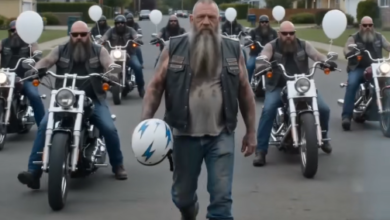
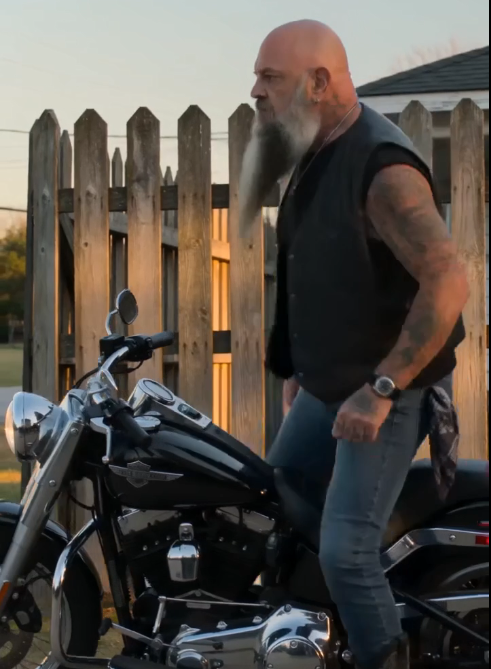
Across the narrow gravel road lived Wade “Rook” Mercer, a sixty-year-old retired mining-equipment mechanic who stood six-foot-four and weighed close to 270 pounds. His arms carried faded sleeve tattoos. A black raven climbed the side of his neck, and scarred letters crossed his knuckles. He wore a weathered leather cut, heavy boots and a silver skull ring that made church women look away in the Dollar General checkout line.
Rook lived alone.
Every few Sundays, five or six members of his riding club gathered beside his garage. Their laughter rolled across the hollow, their boots struck concrete, and their Harleys shook our kitchen windows.
The first time they came, I expected Lily to came, I expected Lily disappear.
She did not.
She stood at our chain-link fence in her socks, gripping the wire while Rook’s black Harley-Davidson Road King settled into a rough, chest-deep idle.
Potato-potato-potato.
The sound rattled a spoon inside our sink.
Lily smiled.
Rook saw her and lowered one tattooed hand from the throttle. He did not wave immediately. He looked toward me first, silently asking permission.
I nodded.
Only then did he lift two fingers.
Lily waved back.
The same child who cried when a male mail carrier stepped onto our porch moved closer to the loudest, most frightening man in the hollow.
That made no sense to anyone except me.
Over the next few weeks, Rook began noticing the pattern. Lily vanished whenever a car door slammed near our house. Yet if his motorcycle started, she appeared at the fence.
One Tuesday, a repairman arrived to inspect our broken water heater. Lily saw him climb out of a white van and dropped her cereal bowl. Milk spread across the floor while she backed into the pantry, trembling so hard that the canned food clicked against the shelves.
The repairman stopped outside.
Before I could reach Lily, Rook’s Harley started across the road.
The V-twin rumble passed through the kitchen wall.
Lily’s breathing slowed.
She moved toward the window and whispered, “Rook’s home.”
That evening, he waited beside our mailbox while I returned from work. In the fading light, his beard looked silver and his tattooed hands rested open against the fence.
“I need to ask you something,” he said.
I already knew what it was.
“Why ain’t she scared of me?”
The truth had sat inside my throat for almost three years. I had hidden it from neighbors, coworkers and every parent at Lily’s school because pity followed children longer than rumors did.
But Rook had noticed too much.
“Her father drove a car,” I said. “A silver sedan.”
Rook waited.
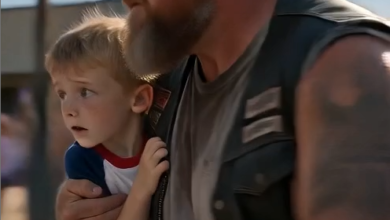
“He hurt her. More than once. Now every unfamiliar man who arrives in a car feels like him.”
Rook looked toward our dark kitchen window. Lily was standing behind the curtain, watching us.
“And the motorcycle?” he asked.
“She has never been hurt by anyone on a motorcycle.”
Rook lowered his head.
For several seconds, the only sound along Lost Creek Road was water moving beneath the culvert.
Then he asked one more question.
“What does she think when she hears my bike?”
I looked at my daughter’s small outline behind the curtain.
“She thinks you’re home,” I said. “She thinks nobody can get to her while you’re across the road.”
Rook did not promise anything. Men like him rarely trusted promises.
The next morning, at exactly 7:06, his Harley started as Lily stepped outside for the school bus.
She stopped at the fence.
Rook sat astride the motorcycle wearing jeans, work boots and an old gray sweatshirt. He let the engine idle until her bus disappeared around the bend.
Then he shut it off.
He never left his driveway.
The same thing happened Wednesday.
Then Thursday.
Then every school morning for the next six weeks.
At 7:06, the engine came alive. Lily shouldered her backpack, touched the fence and walked toward the bus while the sound followed her down the gravel road.
People complained that Rook was disturbing the hollow.
They did not know he was not warming up his motorcycle.
He was telling one frightened child, in the only language she trusted, that someone safe was awake.
Then one icy morning, a silver sedan turned onto Lost Creek Road while Rook’s garage remained closed—and Lily recognized the man behind the wheel.
She dropped her backpack and ran, but before I reached her, the garage door across the road began rising and Rook’s Harley answered from the darkness.
Part 2 — The Man Across Lost Creek Road
Rook had lived across from us for eleven months before I learned his first name was Wade. The mail carrier called him Mr. Mercer, the men at Calhoun’s Garage called him Rook, and most people in our hollow called him “that biker” when they thought he could not hear.
He heard.
He simply did not answer.
His house was a one-story block building with a tin roof, a narrow porch and a detached garage that smelled of oil, cold metal and burned coffee. A black flag bearing his club’s raven emblem hung inside, invisible unless the door stood open. Nothing occupied his porch except one straight-backed chair and a pair of muddy boots.
Children invented stories about him. They said he had been in prison, slept with a shotgun and buried money beneath his garage. Only the first rumor was partly true.
Rook had served fourteen months in county jail when he was twenty-seven after breaking a man’s jaw outside a bar. He did not deny it or polish the story into something heroic.
“I was drunk,” he once told me. “I was angry. He got hurt. I earned the cell.”
After jail, he quit drinking and spent thirty-one years repairing underground mining equipment. He could identify a failing bearing by sound, weld in spaces too narrow for most men’s shoulders and bring machines back to life after their owners had given up.
Coal dust remained embedded in the lines of his hands long after retirement.
The Iron Ridge Riders were not criminals. They were miners, roofers, mechanics and veterans who raised money for families after cave-ins and escorted funeral processions when a miner died without enough relatives to fill the road.
They looked frightening because the road had weathered them in public.
Rook looked frightening because life had weathered him in private.
The morning ritual began quietly. At 6:58, he opened his garage. At 7:02, he rolled the Road King onto the concrete apron. At 7:06, when Lily stepped through our door, he started it.
He never revved the engine.
He simply let it breathe.
At first, I assumed he needed to maintain the battery during the cold. Then I noticed he did it even after returning from a long ride the previous afternoon. Some mornings he wore slippers beneath his jeans. Once, he came out carrying an oxygen-colored inhaler after a chest infection, started the Harley and coughed into his elbow until Lily’s bus arrived.
He was not preparing to go anywhere.
He was reporting for duty.
Lily began planning her mornings around that sound. She brushed her hair when Rook’s garage light appeared. She zipped her coat when the motorcycle rolled outside. When the first heavy pulse entered our kitchen, she picked up her backpack.
Rook never crossed the road unless invited.
That mattered.
Adults often tried to help Lily by approaching her. They bent down, softened their voices and reached toward her shoulder without asking. Each well-intentioned step made her retreat farther.
Rook understood distance.
If Lily stood at the fence, he stayed beside the motorcycle. If she waved, he waved. If she did not, he kept both hands visible and looked somewhere else.
One Saturday, she found a rusted bolt near our mailbox. She carried it to the fence and placed it on the wooden post between our properties.
Rook noticed it an hour later.
“Mine?” he asked.
Lily nodded.
He did not walk over. He brought a coffee can, placed it on his side of the fence and backed away. Lily dropped the bolt into it.
That became their first game.
For weeks, Lily collected washers, nuts and small pieces of harmless scrap that had fallen from farm trucks. Rook sorted them on a magnetic tray and told her which machines might have used them.
“That one held a guard plate,” he said from across the fence.
“What does a guard plate do?”
“Keeps dangerous parts away from people.”
Lily rolled the bolt between her fingers. “Like a fence?”
“Sometimes.”
“Like you?”
Rook looked down at his boots.
“Sometimes.”
Their friendship grew through objects and sound, never touch. He gave her a pair of child-sized ear protectors, not because his Harley frightened her, but because he wanted her to control how much noise entered her world.
She wore them around her neck.
“Don’t need them for your bike,” she told him.
“You might someday.”
“No.”
Rook did not argue. “Keep the choice anyway.”
That was another thing he understood.
Choice.
In November, three Iron Ridge riders arrived in pickup trucks for a club meeting. Lily saw the men climb out and ran inside before they reached Rook’s porch. Ten minutes later, all three vehicles backed down the road.
The riders returned on foot.
They had parked at an abandoned church half a mile away because Rook told them cars near our house were not welcome that morning.
One of them protested. I heard him from my porch.
“Brother, it’s freezing.”
Rook zipped his vest. “Then walk faster.”
The club could have laughed at him. They could have decided one neighbor’s frightened child did not control where grown men parked.
Instead, they walked.
Rook introduced them from his side of the fence. Bear was a retired electrician. Finch delivered medical oxygen. Leon had spent twenty-two years as a school custodian.
None stepped closer until Lily asked a question.
“Did you all come on motorcycles?”
“No, ma’am,” Bear answered.
Lily disappeared behind me.
The next week, the men returned on their Harleys.
She remained outside.
That was when the club began to understand: it was not the men alone, and it was not simply noise.
It was how they arrived.
Part 3 — The Silver Car
Lily’s father, Daniel Voss, had not always frightened her.
That was the part people struggled to understand.
He once cut pancakes into stars. He taught her to say “Kentucky” before she could pronounce her own last name. When she was four, she waited at the window each evening for the headlights of his silver Ford Fusion to sweep across our living-room wall.
Then his temper sharpened.
He began punching doors. He accused me of hiding money and men. He drove too fast when angry, one hand gripping the steering wheel while the other struck whatever he could reach.
The first time he hit Lily, she was seven.
She had unbuckled her seat belt because he was shouting at me, and she wanted to climb between the front seats. His hand moved backward without him looking.
Her lip split against the window.
He apologized before we reached home. He bought her a stuffed rabbit and told her she had startled him.
The second time, there was no toy told her she had startled him.
The second time,.
I left that night.
A domestic-violence advocate helped us reach a shelter in Lexington. Daniel found us twice. After he violated a protective order, the court sent him to jail for eighteen months.
By the time Lily and I moved to Lost Creek Road, Daniel had been released under supervision. He was forbidden to contact either of us.
A court order is paper.
Fear does not care about paper.
Lily learned every car sound on our road. Pickup tires scattered gravel differently from sedans. Delivery vans carried a hollow rattle. The school bus groaned before the bend.
A sedan came quietly.
That was why the icy morning in December broke through the safety we had built.
Rook’s garage door remained closed at 7:06.
Lily stood on the porch holding her backpack, waiting for the Harley. I checked my phone and found no message. There was no rule requiring him to start the bike, no promise that he would be home every morning.
Still, his absence changed the air.
“Maybe he overslept,” I said.
Lily stared across the road.
At 7:09, headlights appeared beyond the bare sycamores.
The silver sedan turned slowly onto Lost Creek Road.
Lily knew it before I did.
Her backpack fell from her shoulder.
“Mom.”
One word.
Then she ran.
She did not run toward the house. Panic does not follow maps. She crossed the frozen yard toward the drainage ditch behind our property, where creek water moved beneath a skin of ice.
I went after her.
The silver car stopped beside our mailbox.
Daniel stepped out.
He looked thinner than I remembered, his hair cropped close and his jaw covered in three days of beard. He raised both hands as though arriving peacefully made his presence legal.
“I only want to talk.”
“Get back in the car.”
“Rachel, she’s my daughter.”
“She has a protection order too.”
He glanced toward the ditch, where Lily had slipped behind a rusted farm gate. His expression changed when he saw her.
“Lily!”
She screamed.
Not loudly. The sound came from somewhere beneath breath.
Daniel stepped off the road.
I placed myself between them and called 911. My fingers shook so hard that I entered the wrong code twice.
Then Rook’s garage door began rising.
The bottom edge lifted six inches. A strip of yellow light appeared. The Harley’s front wheel rolled into view, followed by Rook’s boots.
He was not wearing his leather cut. He wore flannel pajama pants beneath a heavy coat, one boot unlaced and a white bandage wrapped around his left hand.
Later, I learned he had cut his palm repairing a furnace vent before dawn and driven himself to urgent care. That was why the engine had not started on time.
He had returned through the back road and seen Daniel’s car.
Rook rolled the Harley outside.
Daniel turned. “This isn’t your business.”
Rook did not answer him.
He looked at Lily.
She had crouched behind the gate with her hands over her ears—not against the motorcycle, but against her father’s voice.
Rook swung one leg across the Road King.
The starter clicked.
Once.
Twice.
Cold had weakened the battery.
Daniel took another step.
Rook tried again.
The engine caught.
The sound struck the hollow like a door slamming shut. Deep pulses moved through the frozen yard, shook ice from the gutter and reached the ditch where Lily was hiding.
Her hands lowered.
She looked across the road.
Rook did not rev. He did not threaten Daniel, block the car or reach beneath his coat. He remained on his own property, one bandaged hand on the handlebar, the Harley idling beneath him.
Lily stood.
“Rook’s home,” she whispered.
I heard it from twenty feet away.
Daniel heard it too.
The difference in him was immediate. He had arrived believing I was alone with a frightened child. Now a six-foot-four biker sat across the road, and three Iron Ridge motorcycles were already approaching from the east.
Rook had sent one message before rolling out his bike.
Need brothers. No cars.
Bear arrived first, followed by Leon and Finch. They stopped beside Rook’s driveway but did not surround Daniel. They shut off their engines and stood where Lily could see their empty hands.
Their restraint mattered more than their size.
Daniel looked from them to me.
“You called a gang on me?”
“No,” Rook said.
It was the first time he addressed him.
“She called the law.”
A sheriff’s cruiser appeared beyond the bend.
The sight of another car pushed Lily backward, but Rook kept his Harley running. Its uneven rhythm remained beneath the cruiser’s tires, beneath the radio chatter and beneath the click of the deputy’s door.
The deputy approached Daniel and asked him to step away from us.
Daniel argued. He said he only wanted forgiveness. He said I had poisoned his daughter against him. He said a man should be allowed to explain.
Rook’s jaw tightened, but he stayed on the motorcycle.
He never made himself the hero.
The deputy checked the order, placed Daniel in handcuffs and seated him in the cruiser. When the silver sedan was towed, Lily remained beside the gate.
Only after both cars disappeared did Rook shut down the Harley.
The sudden silence felt wrong.
Lily crossed the road before I could stop her. She walked to the edge of Rook’s driveway and stood three feet from his motorcycle.
Closer than she had ever gone.
“You were late,” she said.
Rook looked at the bandage on his hand.
“Yeah.”
“I thought you left.”
He rested both boots on the ground.
“Had to get stitched.”
“Are you leaving tomorrow?”
“No.”
“How do I know?”
Rook looked at the Harley, then at her.
“You’ll hear me.”
We believed the danger had passed.
We did not yet understand what that promise would cost him.
Part 4 — The Morning Rook Refused to Ride
Two days after Daniel’s arrest, the Iron Ridge Riders were scheduled to leave before sunrise for a children’s hospital fundraiser in Knoxville. Rook had helped organize the ride for six months. He was supposed to lead twenty-seven motorcycles across the state line.
At 6:40, the riders assembled outside the abandoned church.
At 6:55, Bear came to Rook’s garage.
Lily’s school bus would arrive at 7:12.
“You coming?” Bear asked.
Rook checked the clock.
“After.”
“We’ve got weather moving over Black Mountain. We need to roll.”
“Then roll.”
“You planned the route.”
“You know it.”
Bear glanced toward our dark farmhouse. “This is about the kid?”
Rook’s face closed.
“That engine has to start at seven-oh-six.”
Bear lowered his voice. “Brother, one morning won’t undo her.”
Rook’s answer came flat.
“You don’t know that.”
Bear had ridden beside him for eighteen years. He had helped Rook through a heart procedure, two mine funerals and the winter Rook stopped answering his phone. Their club rule was simple: the road captain never abandoned a run he had promised to lead.
Rook was breaking it for a child who was not his.
Bear did not understand.
Neither did I.
At 7:06, the Harley started.
Lily stepped outside. The twenty-seven riders waiting down the road heard Rook’s engine but did not hear it coming closer.
He remained in his driveway until the bus arrived.
Only then did he pull on his gloves.
Bear stood beside the road, angry enough that the muscles in his jaw moved. “You held twenty-seven men for a school bus.”
Rook fastened his helmet.
“No. I told you to leave.”
“You’re road captain.”
“Not before seven-twelve.”
Bear stared at him for several seconds.
Then he noticed Lily waving from the bus window.
Rook raised two fingers.
Bear’s anger faded, but not his confusion.
He followed Rook into the garage while I watched from my porch. Their voices stayed low. A few minutes later, Bear walked across the road and asked whether we could speak.
“What is that engine to her?” he asked.
I told him.
Not every detail. Just enough.
Bear removed his cap. His forehead carried a pale line where his bandanna usually sat.
Then he told me something about Rook that nobody in the hollow knew.
Rook had once had a daughter.
Her name was Emily.
She was twenty-eight when she died.
For years, Rook had refused to explain the circumstances. The club knew only that Emily had married a man Rook disliked, stopped visiting and called her father one final time from a gas station outside Knoxville.
Rook did not answer.
He was leading a ride through the mountains. His phone sat inside his saddlebag. By the time he listened to the voicemail, Emily’s car had left the road.
Police called it an accident.
Rook called it the last mile of a marriage everyone had pretended was normal.
Emily’s husband had controlled her money, isolated her and struck her more than once. Rook had suspected something, but Emily always said she was fine. He had accepted the answer because pushing might have driven her farther away.
On the night she died, she had been trying to leave him.
Her voicemail lasted seventeen seconds.
“Dad, I’m scared. Can you just stay on the phone until I get somewhere safe?”
Rook never heard the request while she was alive.
The following year, he stopped riding for eleven months. He kept the Harley beneath a cover because its engine reminded him of the road he had chosen over one ringing phone.
Then Bear found him sitting in the garage with Emily’s voicemail playing through an old speaker.
“Why’d you start riding again?” Bear had asked.
Rook looked at the covered motorcycle.
“Silence didn’t bring her back.”
That explained the small object hanging from his key ring—a faded yellow plastic bead shaped like a star. Emily had placed it on her father’s keys when she was eight.
It also explained why Rook never ignored a frightened child.
The Harley was not only Lily’s safe sound.
It was Rook’s second chance to answer.
Bear returned to the waiting riders and told them the Knoxville run would leave at 7:15 every year from then on. Anyone who objected could ride alone.
Nobody objected.
They reached the hospital late. They still delivered every toy.
The next morning, Rook started his Harley at 7:06.
This time, twenty-seven motorcycles did not gather behind him.
Twenty-seven riders waited at the abandoned church in silence until Lily’s school bus passed. Then, one by one, they started their engines after she waved.
The club had not been weakened by one frightened child.
It had learned her rules.
Part 5 — Building a Language Without Touch
Daniel returned to jail for violating the protective order, but his arrest did not erase the silver car from Lily’s mind.
For three weeks, she refused to ride the school bus. The deputy’s cruiser had blended with her father’s sedan in memory, turning every official uniform and vehicle into another warning.
Rook did not tell her to be brave.
He changed the ritual.
At 7:06, he started the Harley. At 7:08, he switched it off for ten seconds. Then he started it again.
One start meant he was home.
Two starts meant the bus was safe to approach.
The idea came from Lily.
“If you stop it,” she told him through the fence, “I can listen for it coming back.”
Rook nodded. “Your signal.”
The first morning, she reached the bus steps but did not climb aboard.
Rook restarted the bike.
She placed one foot on the first step.
The driver waited without speaking. I stood behind Lily, close enough to catch her but far enough not to push.
The engine settled into its rough idle.
Lily climbed aboard.
Rook shut it down only after she reached her seat.
Her counselor, Marissa Greene, began visiting our home each Tuesday. She explained that safety signals could help, but Lily also needed choices that did not depend entirely on one man or one machine.
Rook listened from his side of the fence.
Marissa gave Lily a grounding exercise: name five things she could see, four she could touch, three she could hear, two she could smell and one she could choose.
Lily changed the order.
The first thing she named was always the Harley.
Marissa did not correct her.
The club helped without turning her recovery into a spectacle. Leon parked his pickup at the church and walked to Rook’s house. Finch removed his sunglasses before speaking to her. Bear stopped wearing a chain that clattered against his vest because the metallic sound made Lily flinch.
Small things.
But frightened children live inside small things.
One Saturday, Rook placed a socket wrench on the fence post.
Lily looked at it.
“What’s that for?”
“Loose mirror.”
“On your bike?”
“Yeah.”
“You can fix it.”
“Could.”
He waited.
Lily put on her ear protectors and crossed through our gate. She stopped ten feet from the Harley. Rook remained beside the garage with both hands in his pockets.
“Closer?” he asked.
Lily shook her head.
“Then that’s close enough.”
He repaired the mirror from ten feet away while explaining each movement. No surprises. No sudden engine. No reaching toward her.
The next Saturday sudden engine. No reaching toward her.
The next, Lily stood eight feet away.
Then six.
After two months, she touched the leather seat with one finger.
Rook looked toward me before moving.
I nodded.
He crouched beside the front wheel, making himself smaller without pretending he was not a large man.
“Want to hear it start from here?” he asked.
Lily’s face tightened.
“No.”
Rook removed the key.
“All right.”
That answer changed something.
Men in Lily’s past had treated “no” as the opening of an argument. Rook treated it as the end.
She came back the next day.
This time she asked him to start it.
The sound was enormous at six feet. She flinched and grabbed the fence, but she did not run. Rook shut the engine off immediately.
“I didn’t say stop,” Lily told him.
“You didn’t have to.”
She considered that.
“Again.”
He started it again.
A month later, a male electrician came to repair our damaged breaker box. His van stopped beside the road, and Lily’s body went rigid.
Rook’s Harley was silent.
He stood across the road with both hands visible.
Lily looked at him.
“Can you start it?”
Rook did.
The electrician waited beside his van until Lily opened our front door herself. Before entering, he told her his name, showed her his tools and asked where she wanted him to stand.
She chose the kitchen.
He obeyed.
For the first time in three years, an unfamiliar man entered our home without Lily hiding.
She stayedShe beside me, gripping my sleeve.
But she stayed.
That evening, she carried the rusted bolt from their first game across the road and handed it directly to Rook.
No fence between them.
Rook accepted it with both palms open.
“I think this is yours,” she said.
He studied the bolt.
“Guard plate.”
“To keep dangerous parts away from people?”
“Yeah.”
Lily looked at him. “You can keep it now.”
Rook placed it in the left pocket of his leather cut, directly above his heart.
Part 6 — When the Safe Sound Went Silent
The following spring, Rook missed 7:06 again.
This time no silver car appeared.
His garage remained dark, and the Harley stood inside beneath its cover. Lily waited on our porch with her backpack. At 7:09, she looked at me.
“Something’s wrong.”
We crossed the road together.
Rook was lying on his kitchen floor beside an overturned coffee cup. He was conscious, but his speech dragged and one side of his face had fallen.
I called emergency services.
Lily stood in the doorway while the ambulance arrived. Two male paramedics stepped out. The sight of them—and the white emergency vehicle—pulled her backward.
She began to shake.
Rook could not start the Harley.
Bear arrived on foot before the ambulance crew entered. He looked at Lily, then at the covered motorcycle.
“Want me to start it?” he asked.
Lily stared at the garage.
Rook’s Harley had a distinct idle, slightly uneven after years of repairs. Bear knew the machine, but the key hung inside Rook’s kitchen.
Lily would have to enter the room where two unfamiliar men were treating him.
She took my hand.
We walked inside.
One paramedic explained every movement before making it. The other knelt beside the door and gave Lily space. She found Rook’s keys beneath the table, the yellow star bead pressed against her palm.
Bear started the Road King.
The familiar rumble filled the yard while the paramedics carried Rook to the ambulance. Lily stood beside the open doors, frightened but present.
Rook lifted his bandaged hand from the stretcher.
Two fingers.
Lily raised hers.
The ambulance left.
Bear kept the Harley idling until it disappeared.
Rook had suffered a minor stroke. Doctors expected a strong recovery, but he spent nine days in the hospital and another three weeks with his sister in Lexington.
Every school morning during his absence, one Iron Ridge rider came to his garage.
They never used their own motorcycle.
They started Rook’s.
Bear on Monday. Leon on Tuesday. Finch on Wednesday.
At first, Lily watched from the porch to make sure the right engine made the sound. Later, she accepted that different hands could deliver the same message.
Safe did not have to mean only one man.
On the fifteenth morning, she walked across the road and told Bear not to start it.
“You sure?” he asked.
Lily nodded. “I want to see if I can get on the bus without it.”
Bear held the key but did not turn it.
The bus came around the bend.
Lily’s shoulders rose. Her fingers tightened around her backpack strap. She named five things she could see, four she could touch and three she could hear.
Birds.
Creek water.
The click of Bear placing the Harley key in his pocket.
She boarded the bus.
The engine remained silent.
When Rook returned home, walking with a cane, Lily waited beside his garage. The Iron Ridge Riders had formed a loose line along the road, but nobody started a motorcycle.
Rook stopped in front of her.
“Heard you fired my morning shift,” he said.
“Only some days.”
“Fair.”
She gave him the yellow star key ring.
“Emily made this?”
Rook looked toward Bear. Bear suddenly became interested in his boots.
“Yeah,” Rook said.
“Was she scared too?”
“Sometimes.”
“Did the motorcycle help her?”
Rook closed his fingers around the star.
“No. Answering helped her.”
Lily reached out and touched his scarred hand.
“Then answer when I wave.”
Rook lifted two fingers.
“Every time.”
Part 7 — The Lullaby Across the Hollow
By the next school year, Rook no longer started the Harley every morning.
Lily chose the days.
If she placed a red coffee can on our fence post before 7:00, he rolled the Road King outside and let it idle until the bus came. If the post remained empty, the garage stayed quiet.
Some weeks she needed the sound three mornings.
Some weeks none.
Rook never asked what had frightened her. He never demanded proof that the fear was serious enough. The red can appeared, and he answered.
On Lily’s eleventh birthday, the Iron Ridge Riders brought no parade and made no public display. They parked at the abandoned church and walked down Lost Creek Road carrying a small wooden box.
Inside were thirty-one bolts, washers and harmless pieces of metal, one from each rider’s garage. Every object had a handwritten card explaining what it once held together.
Lily read them at the fence.
A brake bracket.
A hospital-bed rail.
A school-bus mirror.
A porch swing.
At the bottom rested the rusted guard-plate bolt she had given Rook had given months earlier. He had polished only half of it.
“Why leave the other side rusty?” she asked.
“So you can see where it came from.”
She returned it to his vest pocket.
That afternoon, Lily sat on Rook’s stationary Harley for the first time. The engine was off. Her feet did not reach the ground, and Rook stood several steps away while I held the handlebars.
“You want the key?” he asked.
“Not today.”
He pocketed it.
“Your choice.”
Months later, a blue sedan stopped at our house. A male social worker had arrived to review the final extension of Daniel’s protective order.
Lily froze beside the porch.
Across the road, Rook was repairing his gutter. He did not climb down or reach for the motorcycle.
He waited.
Lily looked toward the garage, then toward the social worker. The man remained beside his car and introduced himself from a distance.
“My name is Thomas. Your mother invited me. Where would you like me to wait?”
Lily breathed slowly.
“By the mailbox.”
He waited there.
She did not ask for the Harley.
That evening, Rook sat on his porch while sunlight left the Kentucky hills. Lily walked across the road with the red coffee can under her arm.
“You didn’t put it out this morning,” he said.
“I know.”
“Tomorrow?”
She looked toward the black motorcycle inside his garage.
“Maybe.”
Rook nodded. “I’ll be here.”
Lily placed the can beside his chair, climbed onto the opposite end of the porch and listened to crickets gathering near the creek.
For years, people in our hollow had complained that Rook’s Harley was too loud. They heard metal, fuel and thunder trapped beneath a garage roof.
Lily heard something else.
A man answering.
A neighbor awake.
A door that would open if she needed it.
The following morning, the red can appeared on the fence.
At 7:06, the Harley came alive.
Lily did not run toward it. She did not hide from it. She stood on our porch, adjusted her backpack and raised two fingers across Lost Creek Road.
Rook answered with two of his own.
The school bus carried her around the bend while the V-twin rhythm rolled through the hollow, steady and low.
Only then did he turn the key.
The loudest sound in Kentucky fell silent.
Its promise remained.
Follow our page for more powerful biker stories about intimidating riders, quiet protection and the unexpected kindness hidden behind worn leather and roaring engines.