THE ORGANIZER SHOVED THE BIKER FOR CUTTING THE POWER—THEN HE REMOVED HIS GLOVES AND THE CROWD DISCOVERED HE WAS AN ELECTRICIAN.
PART 1
FOUR HUNDRED PARENTS BOOED WHEN THE BIKER KILLED THE CHILDREN’S CONCERT—THEN HE POINTED AT THE WATER UNDER THEIR DRESS SHOES.
Sarah Blake had spent the morning ironing a shirt her eight-year-old son would outgrow before Christmas. Now Owen stood in the front row of a forty-child choir at Pine Hollow Park in Springfield, Missouri, holding a folded lyric sheet in his left hand. Fine rain drifted beneath the stage canopy. Sarah pulled her maroon raincoat tighter and raised her phone.
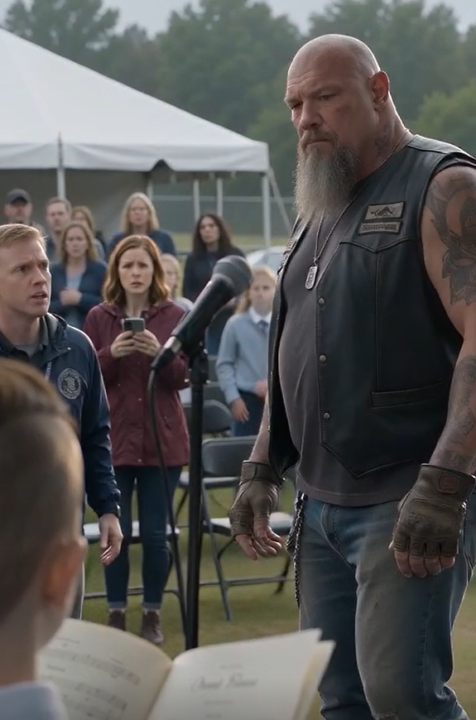
The first verse had barely begun.
A huge man in a black sleeveless leather vest stepped onto the low stage edge beside the covered sound station. His shaved head shone with rain. Tattoos covered both arms. A long gray beard brushed his charcoal shirt.
He reached into the supply enclosure.
The main connector came free.
Speakers fell silent.
The decorative lights went dark.
For a second, the children kept singing.
Then they stopped.
“What is wrong with you?” somebody shouted.
Sarah lowered her phone.
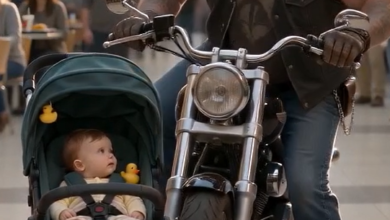
The man looked nothing like the parent volunteers she knew. Muddy brown boots. Blue jeans. A chain at his hip. His old V-twin cruiser stood beyond the audience fence.
“Get him out!” another parent called.
Nolan Voss, the rental company’s site manager, hurried from behind the sound desk.
He put both hands against the biker’s chest and shoved.
The man stepped back onto the grass.
He did not shove back.
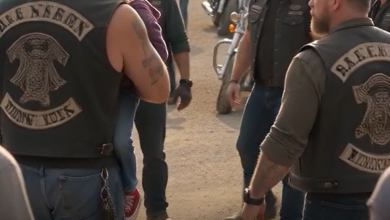
Rain tapped the shoulders of his leather vest. On its back, a stitched lantern rested beneath an open hand. His worn gloves made a soft rubbing sound as he pulled them off.
“Keep it off,” he said.
Nolan turned toward the audience.
“We’re sorry, folks. Someone decided to make this about himself.”
A few people laughed angrily.
Sarah felt her own face grow hot.
Owen had practiced for three weeks. He sang while brushing his teeth, in the back seat, beneath the grocery-store hand dryer.
Now he stood motionless behind a dead microphone.
“You’ve scared the children,” Nolan told the biker.
The man looked past him.
Toward Owen.
“Move them back.”
“You don’t give orders here.”
The choir director raised both hands, uncertain whether to restart without the speakers.
The biker took out a work credential and held it toward Nolan.
“Electrician.”
Nolan barely glanced at it.
“That doesn’t give you permission.”
Sarah stepped closer to the stage.
Owen was staring at his right hand.
His lyric sheet trembled in the other.
The biker saw it, too.
He lowered the credential.
“Don’t touch that stand again, son.”
Nolan reached toward the supply enclosure.
The biker’s voice changed.
“Leave it.”
Not loud.
Enough.
Sarah stopped beside the front row of chairs.
The man pointed toward Owen’s shoes.
She followed his hand.
A shallow sheet of rainwater had gathered beneath the microphone stand. At its edge, beside the children’s feet, a black cable lay bent beneath a metal support.
Its outer covering was split.
Part 2
The split opened where the cable bent beside the metal support.
Sarah stared at it.
Not a loose shoelace.
Not a shadow.
The black covering had pulled apart, and water shone around it.
“Everybody back,” the biker said.
The sound technician behind the console looked toward the disconnected supply, checked his equipment, and called that the stage feed was isolated.
The choir director began moving the children away from the front.
Owen stayed where he was.
Sarah lifted one foot onto the low step.
“Sweetheart?”
He looked at her.
“It bit me.”
“What did?”
He raised his right hand.
“The microphone.”
The biker turned toward him.
Then Owen’s knees folded.
His lyric sheet dropped first.
Sarah would remember that separately from everything else: cream paper landing flat in the water, the blue ink of a song she had heard a hundred times.
“Owen!”
She reached him as the biker stepped onto the stage.
Roughly ten seconds had passed since the speakers stopped.
That number would later come from a parent’s video.
Sarah knew only that her son had been standing.
And now he was not.
A woman in the audience called that she was a nurse. Someone else ran toward the first-aid station.
The biker knelt beside Owen.
He checked him, looked toward the nurse, and said, “Not breathing normally.”
Sarah made a sound she did not recognize.
The nurse came down beside them.
“Mom, stay where he can see you when he wakes.”
When.
Sarah held onto the word because there was nothing else.
The biker began CPR. The nurse worked beside him while a volunteer called emergency services and another brought the first-aid station’s defibrillator.
There was no speech.
No brave sentence for the crowd.
Only short words between people who understood what needed to happen.
Sarah stayed near Owen’s head, saying his name.
She could not remember deciding to say it.
“Owen. Owen, honey. Owen.”
Nolan stood beyond the stage edge.
The man who had pushed the biker was no longer explaining anything.
The children were being taken beneath the pavilion at the far side of the lawn. A little girl was crying because Owen had dropped his song.
Sarah saw none of that directly.
She learned it later.
What she saw was her son’s loosened tie.
The biker’s bare forearms.
The nurse reaching for the equipment.
Then the emergency crew arrived, and somebody made room without asking Sarah to leave.
She backed away just far enough.
A paramedic said something to another.
Owen moved.
Sarah leaned forward so quickly the nurse caught her elbow.
“Let them work.”
His eyes were not open yet.
But he had moved.
The biker sat back on his heels.
Sarah looked at him.
For the first time, she noticed that his hands were shaking.
Behind him, Nolan said, “We need to establish exactly what he unplugged.”
The biker did not turn.
The sound technician did.
Part 3
The technician’s name was Luis Moreno.
Sarah heard it while the paramedics prepared Owen for transport, because an officer asked him to repeat what he had seen.
Luis pointed toward the supply enclosure.
“He disconnected the feed.”
“Before or after the child fell?”
“Before.”
Nolan moved closer.
“Luis, we don’t know whether pulling that connection caused—”
“The boy jerked before the music stopped.”
Sarah turned.
The sentence reached her through the noise of the ambulance doors and the nurse explaining where her purse had gone.
“Before?”
Luis nodded.
“I saw his hand come away from the stand.”
Nolan shook his head.
“It was a performance. Children move.”
The officer held up one hand.
“I’ll take separate statements.”
Sarah climbed into the ambulance.
She did not stay to hear the rest.
Owen was awake by then, frightened and exhausted. A paramedic spoke to him in a voice that belonged to an ordinary school morning.
“What do you like to be called?”
“Owen.”
“Good name. I’m Chris.”
“Where’s my mom?”
“Right here.”
Sarah bent where he could see her.
His eyes found her face.
“Did I mess up?”
She pressed her knuckles against her mouth before answering.
“No, sweetheart.”
“I forgot the last part.”
“You didn’t mess up.”
At the hospital, the questions changed.
Medical history.
Medication.
What had he touched?
What happened next?
Sarah answered what she knew and said when she did not know.
A doctor told her Owen would remain under observation while they assessed the electrical injury and monitored his heart.
She did not promise everything was fine because he was talking.
Sarah was grateful for that later.
At the time, she wanted a promise more than she had ever wanted anything.
Her husband, Daniel, arrived wearing his grocery-store work apron beneath a rain jacket.
He had left without taking it off.
“Where is he?”
She pointed.
Daniel stopped at the doorway, drew one breath, and went inside smiling.
“Hey, buddy.”
Owen tried to smile back.
Sarah watched her husband look at the monitoring equipment without turning his head.
An officer came later to collect her account.
“Did you record any of the concert?”
“My phone was up at the beginning.”
“Would you preserve the original?”
She found the video.
It showed Owen singing.
Then his right hand closed around the microphone stand.
His shoulder jolted.
His face changed.
Only afterward did the speakers go silent.
There was another voice on the recording, too.
Her own.
“Get him away from them.”
She had said it while the biker was pointing toward the floor.
Sarah listened without lowering the volume.
The officer did not tell her she should have known. She asked what Sarah had been able to see from her seat.
“His back,” Sarah said. “The cable in his hand. The lights going out.”
“Not the damaged lead?”
“No.”
The officer wrote that down.
Sarah watched her son’s expression again.
The biker had not interrupted the song before something happened.
Something had already happened.
At the edge of the recording, beneath the first angry shouts, a man’s voice said, “Power. Get the power.”
Sarah turned the phone toward the officer.
“Is that him?”
The officer listened.
Then she asked Sarah to play it from the beginning.
Part 4
Sarah learned the biker’s name from the hospital visitor sheet.
Jack Lawson.
He had left a number with the responding officer and asked whether the family wanted contact.
Sarah had said yes.
Now he stood outside Owen’s room holding a paper cup he had not drunk from.
Without the rain and shouting, he looked tired.
Not smaller.
Just tired.
His black vest hung open over the charcoal shirt. The lantern patch beneath the open hand was partly visible when he turned to let a nurse pass.
“May I?”
Sarah stepped aside.
Owen looked up from the bed.
“You’re the man.”
Jack nodded.
“Jack.”
“Did you break the speakers?”
“No.”
“Okay.”
That seemed to settle something important.
Daniel pulled out a chair.
“Please sit.”
Jack sat carefully, as though the hospital furniture had been built for somebody else.
Sarah stood near the window.
“You said you were an electrician.”
“Twenty-eight years.”
“Still working?”
“Two trucks. Mostly commercial repairs.”
“How did you know?”
Jack looked at Owen before answering.
“Could hear something wrong near the stand. Saw the cable. Then saw him pull away.”
“So the noise told you?”
“Noise made me look.”
That distinction mattered.
He had not heard an invisible danger and somehow known everything.
He had looked.
At the water.
At the damaged lead.
At a child’s reaction.
“I called to the desk,” he said. “Didn’t get through.”
Sarah remembered the speakers covering everything.
Then the sudden silence.
“You knew first aid, too?”
“Work training. Keep it current.”
He touched the paper cup with both hands.
“The nurse helped. Crew had the defibrillator.”
He seemed determined that the room remember everyone.
Owen watched him.
“Were you scared?”
Jack’s eyes moved toward Sarah.
Then back.
“Yes.”
“Me too.”
“Figured.”
For the first time since the ambulance, Sarah felt something loosen without actually becoming relief.
She pulled another chair closer.
“Why were you at the concert?”
“Mrs. Hart invited our riding group.”
“The choir director?”
He nodded.
“Taught my daughter years back. We help with their music fund.”
Sarah looked toward the lantern patch.
She had seen three similar vests near the back of the lawn and assumed the men had wandered over from the road.
“You paid for the concert?”
“Songbooks. Not all this.”
He gestured vaguely, meaning the hospital, the equipment, perhaps the entire afternoon.
Daniel handed him a fresh cup of coffee from the hallway.
Jack accepted it.
Before he left, Sarah asked whether anyone had told him what happened after the ambulance pulled away.
He shook his head.
Her phone held a new message from the officer.
The preliminary inspection had found a problem beyond the damaged cable.
The protective equipment listed in the rental contract had not been installed.
Sarah read the sentence aloud.
Jack set his coffee down.
Part 5
“Listed as installed?” Jack asked.
Sarah looked at the message again.
“Yes.”
He was quiet for several seconds.
Daniel leaned against the windowsill.
“What does that mean?”
“Means somebody needs to check the paperwork against the equipment.”
“Could that have stopped this?”
Jack looked toward the corridor.
“Let the investigator explain what failed.”
Sarah noticed the restraint.
He could have filled the room with technical certainty and anger.
Instead, he gave her the question she needed to ask.
The inspector called the following morning.
Owen was eating half a piece of toast while Daniel cut the other half into squares he no longer needed.
Sarah stepped outside.
The inspector explained that the temporary stage supply lacked the ground-fault protection specified in the event documents.
The damaged cable had created a dangerous electrical fault involving wet equipment around the microphone position.
“The normal breaker didn’t prevent the shock,” Sarah said.
“It’s not the same protection.”
She wrote that down.
Her handwriting looked like somebody else’s.
“So the stage company forgot something?”
“We’re investigating how it came to be omitted.”
“Was my son the only one at risk?”
The inspector paused.
“Other children and adults could have been exposed. We’re not assigning identical risk to everyone who stood there.”
Sarah appreciated the careful answer.
It was frightening enough without turning forty children into a single impossible statistic.
At the end of the call, she asked about the contract.
“The protection was included in the price,” the inspector confirmed.
Included.
Sarah thought of the parents buying raffle tickets to help cover the rental.
The bake sale.
The music teacher returning a donation envelope because someone had accidentally put too much cash inside.
They had counted dollars.
Someone else had charged them for something that was not there.
Inside the room, Owen was asking Daniel whether hospital toast came from a toaster or a machine.
Sarah put the phone away before he could see her face.
That afternoon, Nolan sent the parents an email.
It described an unfortunate incident during an unexpected weather change and said an unauthorized individual had interfered with the sound equipment.
It did not name Jack.
It did not need to.
Sarah read it twice.
Then she opened the rental paperwork attached to the music fund’s parent portal.
A protection package appeared as a separate line item.
Paid in full.
She forwarded both documents to the investigator without adding a public accusation.
A few minutes later, her phone rang.
A young woman introduced herself as Lena Ortiz.
“I worked setup,” she said.
Sarah sat in the hallway.
“What is it?”
Lena breathed into the phone.
“I have a photograph from before the children got there.”
Part 6
Lena was twenty-four and had worked event setup for one summer.
Sarah met her only after the investigator had taken her statement.
They sat outside a small municipal office while rainwater dripped from a blocked gutter.
Lena kept her hands around a vending-machine cup.
“I don’t want to make excuses.”
“Then don’t,” Sarah said.
The words came out sharper than she intended.
Lena nodded.
She had photographed the supply enclosure during setup because a component listed on the checklist was missing.
She had sent the picture to Nolan.
His reply told her that the replacement arrangement had been approved and that she should finish dressing the stage.
“What replacement arrangement?” Sarah asked.
“That’s what I asked.”
“What did he say?”
“That the senior crew knew.”
Lena looked at her cup.
“I was temporary. I thought there was somebody above me checking.”
Sarah remembered all the times she had thought exactly that.
At the school door.
At the dentist.
At the foot of a stage holding forty children.
Someone above me.
Someone qualified.
Someone paid to know.
“Did you see the cable split?” she asked.
“Not then. That part wasn’t visible in my picture.”
Lena did not try to claim she had recognized the whole danger.
That made Sarah listen harder.
The photograph did not explain everything.
It established that the protection was absent before Jack touched anything.
The message established that someone had been told.
Later, the investigator confirmed that the equipment had not been damaged or removed by Jack’s intervention.
Nolan’s email could no longer carry that suggestion unchallenged.
Sarah wanted to send a reply to every parent.
The investigator asked her to preserve the material and let the evidence process continue.
She agreed.
Then she went home and stood in Owen’s doorway.
He had been discharged with instructions, follow-up appointments, and permission to rest.
He was drawing on a clipboard beneath a blanket.
“What’s that?”
“A new stage.”
She stepped closer.
He had drawn forty stick figures.
One microphone.
A large black shape beside the stage steps.
“Is that a speaker?”
“No. Jack.”
She sat on the bed.
“Why’s he down there?”
“Watching.”
Sarah touched the blanket rather than the drawing.
“Would you like him to visit?”
Owen nodded.
Then he asked, “Do the other kids think I did it?”
“Did what?”
“Stopped the song.”
Sarah closed her eyes.
Across town, adults were arguing over cables, liability, invoices, and reputations.
Her son was worried the choir blamed him for a song that had ended halfway through.
Before Sarah could answer again, the doorbell rang.
Daniel brought in a large envelope from the choir.
Inside were thirty-nine small cards.
Some had music notes. Some had dogs. One showed a dinosaur wearing Owen’s blue tie.
Mrs. Hart had written on the envelope that there was no need to answer them all.
Owen sorted the cards across his blanket.
“Thirty-nine,” he said.
“Yes.”
“They counted me out?”
“They left a place for your card.”
He looked at the drawing on his clipboard.
Then he slid it into the empty envelope.
Sarah waited while he wrote his name.
For the first time, he seemed to believe the other children were waiting for him rather than judging him.
She opened her phone and called Mrs. Hart.
The teacher answered on the second ring.
Before Sarah finished explaining, Mrs. Hart said, “We need to talk about the next concert.”
Part 7
“There doesn’t have to be another concert for him,” Sarah said.
Mrs. Hart was quiet.
“That isn’t what I meant.”
“He doesn’t owe anybody a brave ending.”
“No,” the teacher said. “He doesn’t.”
Sarah let out a breath.
She had not realized she had been waiting for someone to argue.
Mrs. Hart continued.
“We’re asking every family. Indoors if necessary. Different equipment. Independent inspection. Children can sing, sit with their parents, or stay home.”
“And Owen?”
“Gets the same choice.”
Sarah looked toward his room.
“Thank you.”
Two days later, Jack arrived with a book of paper airplanes.
No hospital balloons.
No toy microphone.
Owen approved immediately.
Daniel cleared the kitchen table, and Jack showed Owen one fold before the boy took over and changed it.
“That won’t fly,” Daniel said.
Owen launched it.
The paper struck the refrigerator and fell into the dog’s water bowl.
Jack studied the result.
“Short route.”
Owen laughed.
Sarah had missed that sound so fiercely that she had stopped expecting it.
While Daniel found a towel, she asked Jack about the lantern beneath the open hand on his vest.
“Nightbridge Riders,” he said.
“What does it mean?”
“Keep a light for the next person.”
“Did you start it?”
“No. Just showed up enough.”
She looked at his hands.
The same hands had disconnected the equipment, held her son on the stage, and now pressed a crease into a sheet of printer paper.
She had made them frightening before knowing anything they had done.
Her phone rang.
The investigator.
The rental company’s records were being examined beyond the park concert.
Sarah stepped into the hall.
“How far beyond?”
“Twelve earlier events this summer.”
She leaned against the wall.
“Same missing protection?”
“The same substitution practice appears in the records. We’re checking each event.”
“Were children at those?”
“Some.”
Sarah watched Jack retrieve the wet airplane while Owen explained why the next design needed wings like a gull.
Twelve events.
Birthday celebrations.
Community performances.
People standing beneath lights they assumed somebody had checked.
The investigator asked whether Sarah would provide her original video for the upcoming public review.
“Yes.”
“Not the version shared through social media. The original file.”
“I have it.”
After the call, she returned to the kitchen.
Jack looked up.
“Everything all right?”
She told him about the twelve events.
He set the wet paper in the sink.
For once, he had no short answer.
Owen looked between them.
“Are you mad?”
Sarah knelt beside his chair.
“Not at you.”
He considered that.
Then he pushed a dry sheet toward Jack.
“Can we make this one stay up?”
Jack placed both hands flat on the table.
“We can try.”
Part 8
The public review was held ten days after the concert.
Sarah arrived with Daniel and a folder she had checked three times.
Owen stayed with his grandmother.
He had asked whether there would be singing.
“No, sweetheart.”
“Then I’m okay not going.”
Jack stood near the back of the room with two riders wearing the same lantern patch.
They did not line the walls or make a display of themselves.
They found seats.
Lena sat beside an older woman Sarah later learned was her mother.
Nolan arrived with the company’s owner and a representative.
He wore the same navy event jacket Sarah remembered from the park, though it was dry now and zipped neatly to the collar.
The chairwoman explained what the review could establish and what remained under investigation.
Sarah was grateful for the boundaries.
She had become suspicious of people who sounded certain before looking.
The first exhibit was the contract.
The second was the setup photograph.
Then came Lena’s message thread.
Nolan’s representative described a misunderstanding between temporary staff and experienced crew.
The inspector asked who had approved the replacement arrangement.
Nolan said he understood it had been cleared.
“By whom?”
He named a supervisor.
The supervisor’s written statement said he had not attended the setup and had not approved an alternative.
The room grew quiet.
The company owner began speaking, then stopped when his representative touched his sleeve.
Sarah watched the chairwoman turn a page.
Invoices from twelve earlier events showed the same protection package.
Equipment records showed a pattern of leaving the specified units off the trucks.
An internal instruction called it a cost-saving substitution.
The phrase sat on the screen above the table.
Sarah thought of Owen asking whether he had ruined the song.
The chairwoman asked to see the audience video.
Sarah’s recording played.
Owen sang.
His hand touched the stand.
His shoulder jerked.
Only then did Jack move toward the supply.
The sound stopped.
Nolan pushed him.
Parents shouted.
The recording continued.
Sarah had warned the chairwoman about the collapse. They stopped before showing that part to the room.
There was enough.
An electrical expert explained that the fault could have been fatal. The protection billed to the event was intended to reduce precisely that kind of danger.
No one claimed every child would have suffered the same injury.
No one needed to.
Nolan looked toward Sarah.
For a second, she thought he might apologize.
Instead, he said, “We couldn’t have known the weather would change that quickly.”
The inspector looked down at Lena’s photograph.
“This was missing before the rain.”
Sarah’s hands stopped moving against the folder.
That was the sentence.
Not loud.
Not dramatic.
A fact placed where an excuse had been.
At the back of the room, Jack lowered his eyes.
The chairwoman turned to the company owner.
“How many other contracts billed for equipment you did not provide?”
Part 9
The company was suspended from city event work while the broader proceedings continued.
The penalties that followed included substantial fines and the loss of contracts.
Sarah did not turn every update into a family conversation.
Owen knew the adults responsible for the stage had been held accountable.
That was enough for him.
The city adopted an independent electrical signoff requirement for temporary stages at permitted outdoor events.
The music fund changed its own process, too.
A paid line on an invoice would no longer be treated as proof that someone had checked the equipment.
Lena found work with another crew.
Months later, she sent Sarah a photograph of her first completed training certificate.
Sarah replied with one sentence.
Thank you for keeping your photograph.
But when she remembered that season, she returned most often to something that happened before the fines, before the final reports.
The second concert.
Two weeks after the first.
The children had chosen to sing beneath the park’s permanent pavilion, with a different contractor and an independent inspection completed before rehearsal.
Owen’s doctor had cleared his return.
Sarah had still asked him three times whether he wanted to go.
The third time, he put down his cereal spoon.
“Mom. I can say no.”
She nodded.
“Yes, you can.”
“I’m saying yes.”
On concert day, the sky stayed clear.
Sarah wore the same maroon coat anyway.
Jack stood beside his old cruiser beyond the chairs, uncertain whether the invitation Mrs. Hart had sent was meant as a courtesy.
Owen spotted him first.
He left his place in line and hurried over.
“Mrs. Hart says you’re in the last row.”
Jack glanced toward the empty seats.
“Back there?”
“No. Our last row.”
“Don’t sing much.”
“You can stand.”
Jack looked toward Sarah.
She smiled.
“He’s giving you a choice.”
Jack took off his gloves.
“All right.”
The choir had made room between two taller children.
Jack stood behind them, enormous and visibly uncomfortable, his leather vest dark against the white shirts.
Nobody asked him to remove it.
The final song began without a speech about heroes.
Owen watched Mrs. Hart.
Then, halfway through the verse, he looked toward his mother.
This time he smiled.
Sarah kept her phone in her pocket.
She wanted the song while it happened.
Near the end, Owen reached backward without turning.
Jack lowered one hand.
The boy touched two fingers to his knuckles, then returned both hands to his lyric sheet.
A tiny exchange.
Enough.
Afterward, someone offered Jack the microphone.
He shook his head and pointed toward the children.
Their turn.
Sarah thought about how quickly she had decided what his vest meant.
Now it meant a place in the back row.
Follow this page for more stories about the people worth looking at twice.
This time, the children finished the song.