The Man in the Vest Was Asked to Leave the Church — Until the Priest Stopped Everything
They asked him to leave the church—not because he caused a disturbance, but because the vest on his back made people uneasy.
Sunday morning had wrapped the town in its usual stillness. Cars lined the curb outside the church, doors closing softly, voices lowered out of habit rather than instruction. Inside, sunlight filtered through stained glass and landed in patches across the wooden pews like spilled color.
Everything felt familiar. Predictable. Safe.
The man in the vest stood near the back.
He hadn’t slipped in late.
He hadn’t chosen the back to hide.
He stood there because that’s where he always stood.
Hat in both hands. Shoulders relaxed. Boots placed carefully so they wouldn’t scuff the floor. The leather vest over his white shirt was old—not the polished kind worn for attention, but the kind softened by years of use. A faint smell of oil and leather clung to it, subtle but present.
At first, people noticed him without really noticing him.
Then someone leaned forward and looked again.
A whisper moved.
Then another.
A woman nudged her husband.
A man across the aisle frowned openly.
A mother tightened her grip on her child’s hand.
The vest became the loudest thing in the room.
The usher noticed the looks before he noticed the man. He adjusted his jacket, straightened his posture, and began walking down the aisle with careful, measured steps. He stopped beside the man and lowered his voice.
“Sir,” he said, polite but firm, “this is a place of worship.”
The man nodded once. “Yes.”
“There have been concerns,” the usher continued, eyes flicking briefly to the vest. “We’d like to ask you to step outside.”
The words were soft.
The meaning wasn’t.
The man didn’t ask who complained.
Didn’t ask why.
He lowered his head slightly—the quiet posture of someone who had learned that resistance only sharpened suspicion—and turned toward the aisle.
A few people exhaled.
Then the priest looked up.
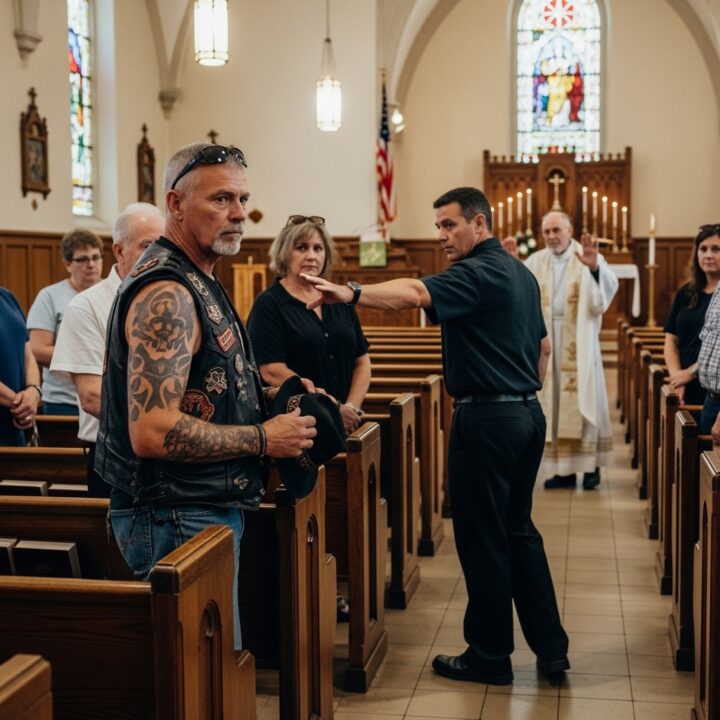
The priest stopped mid-sentence.
He had spoken those words dozens of times before—about humility, grace, and seeing others clearly—but something about the movement near the back pulled his attention away.
An usher guiding a man toward the door.
A congregation holding its breath.
“Just a moment,” the priest said calmly into the microphone.
The room stilled.
The man in the vest stopped walking. The usher hesitated, hand hovering uncertainly in the air.
“Sir,” the priest called gently, stepping down from the altar, “would you mind staying where you are for now?”
A ripple moved through the pews.
Some faces relaxed.
Others tightened.
The usher leaned closer, whispering urgently, “Please don’t make this harder.”
The man met his eyes. Calm. Steady. The look of someone who had been judged enough times to know when silence was safer than explanation.
“I’m not trying to,” he said softly.
The priest walked closer. With every step, details emerged that hadn’t been obvious before: gray at the man’s temples, a thin scar above his eyebrow, hands that looked capable but careful.
Details that complicated the simple story people had already decided on.
A voice broke the silence. “Father, is this really necessary?”
Another followed, sharper. “We have children here.”
The word children carried weight.
The priest stopped a few feet from the man. “You’re welcome here,” he said evenly.
The usher stiffened. “Father, we’re just being cautious.”
Cautious.
The man in the vest finally spoke again. “If you want me to leave,” he said, voice low and steady, “I will.”
He wasn’t angry.
He wasn’t defensive.
That unsettled people more than shouting would have.
Phones came out. Someone angled a camera from the aisle. A few congregants leaned away, as if distance itself could provide safety. Fear moved quickly, dressed up as concern.
The priest studied the man’s face. “What brings you here today?” he asked.
The man hesitated.
Then answered.
“I’m here because of my brother,” the man said.
A murmur spread through the sanctuary.
“Is he attending?” the priest asked gently.
The man shook his head once. “He passed.”
The room grew heavier.
“There’s no funeral scheduled today,” someone whispered loudly enough to be heard.
“I know,” the man said. “It was last year.”
A pause followed.
“I couldn’t come then,” he continued. “Didn’t feel right. Today felt like the right day.”
A woman near the front looked uncomfortable. A man folded his arms tightly across his chest.
“And the vest?” someone asked from the aisle, sharper than necessary.
The man glanced down at it. “I don’t take it off.”
That answer landed wrong.
A congregant stood halfway. “So you refuse basic respect?”
The man said nothing.
The priest raised a hand. “Please.”
But the tension had already climbed too far.
The usher stepped forward again, voice firmer now. “Sir, I’m going to have to insist you step outside.”
The man nodded.
Again.
No protest.
No argument.
Then he reached into the inside pocket of his vest.
Several people gasped.
A mother pulled her child closer.
Someone whispered, “Oh my God.”
The priest stiffened—but didn’t step back.
The man pulled out his phone.
“I need to send a message,” he said quietly.
“To who?” the usher demanded.
The man didn’t answer.
He typed slowly. Deliberately. As if weighing every word. Then he slipped the phone back into his pocket and lifted his eyes to the priest.
He spoke one short sentence.
Not loud.
Not threatening.
Just certain enough to make the room feel suddenly, dangerously small.
The priest’s expression changed.
Not to fear.
To recognition.
And in that instant, everyone in the church understood—
Whatever story they thought they were in… they had not reached the truth yet.
The sound came before anyone spoke.
Not shouting.
Not sirens.
Engines.
Low. Even. Controlled.
At first, it was distant—barely more than a vibration through the old wooden beams of the church. A few heads turned instinctively, confused. Someone near the middle pew frowned and whispered, “Do you hear that?”
The priest did.
His eyes shifted briefly toward the doors at the back of the sanctuary.
The man in the vest didn’t move.
He stood exactly where he was, hat still in his hands, shoulders relaxed, posture steady. He looked less like someone waiting to be defended and more like someone who already knew what was coming.
The engines grew louder.
Not revving wildly.
Not aggressive.
Just present.
The usher swallowed. “Father,” he said under his breath, “should we—”
Before he could finish, the doors opened.
Cold air rolled in, carrying the faint smell of fuel and leather.
Four bikers stepped inside.
Men and women. Mid-thirties to late fifties. Sleeveless shirts beneath jackets they didn’t bother zipping. Tattoos visible, not displayed. Sunglasses pushed up onto heads or hooked at collars. They didn’t fan out. They didn’t scan the room.
They stopped just inside the doorway.
In a line.
Quiet.
The sanctuary went completely still.
A few congregants instinctively rose halfway from their seats, unsure whether to sit or stand. A child whispered, “Mom?” and was pulled closer without an answer.
One of the bikers nodded once toward the man in the vest.
That was all.
The priest exhaled.
He stepped forward, not away from them—but toward them.
“Thank you for coming,” he said calmly.
The room shifted.
Not dramatically.
Subtly.
The priest turned back toward the congregation. His voice remained even, but something in it had changed—not louder, not firmer, but unmistakably settled.
“For those of you who are uncomfortable,” he said, “I understand that this is unexpected.”
He gestured gently toward the man in the vest.
“This man was not asked to leave because he did anything wrong,” the priest continued. “He was asked to leave because people made assumptions.”
A murmur rippled through the pews.
The usher’s face tightened. “Father, we were only—”
“Trying to protect,” the priest finished for him. “Yes.”
He turned slightly, looking out at the congregation. “But protection without understanding is how fear disguises itself as virtue.”
No one responded.
The priest stepped closer to the man in the vest. “You said you came for your brother.”
The man nodded once.
The priest placed a hand briefly on the back of the pew beside him—not on the man, not in display—just grounding himself there.
“He was one of the volunteers who rebuilt this church after the fire,” the priest said.
The words didn’t land all at once.
They settled.
“A year and a half ago,” he continued, “this building was ash and water damage. Insurance stalled. Permits dragged on. We held services in a community hall.”
Some faces in the congregation shifted.
“He and his club,” the priest said, glancing toward the bikers at the door, “came at night. After work. No announcements. No photos. They replaced beams. Rewired lights. Fixed the roof.”
The priest paused.
“They never asked to be named.”
Silence pressed down hard now.
A woman in the third pew covered her mouth.
The usher stared at the floor.
The priest looked back at the man in the vest. “Your brother insisted on wearing that vest while he worked,” he said quietly. “Said it reminded him who he was accountable to.”
The man swallowed.
Outside, the engines went quiet.
The truth didn’t explode.
It settled.
Slowly. Heavily.
No one clapped.
No one stood.
The kind of silence that followed wasn’t awe—it was reckoning.
The priest turned toward the congregation again. “This church,” he said, “was rebuilt by hands many of you were taught to fear.”
A man near the aisle shifted uncomfortably. A woman wiped at her eyes without looking at anyone.
The priest didn’t press further.
He didn’t need to.
He turned back to the man in the vest. “You’re welcome to stay,” he said simply.
The man nodded.
That was all.
He moved toward the back pew, sliding into a seat near the aisle. He didn’t take center space. Didn’t look around to see who was watching him now.
He placed his hat on the bench beside him. Rested his hands on his knees. Sat straight.
The bikers by the door didn’t move.
They waited.
The service resumed.
The words of the sermon sounded different now—not because they had changed, but because everyone listening had.
When the final hymn ended, people stood more slowly than before.
Some glanced toward the back pew, unsure what to do.
A woman approached first. Hesitant. “I’m sorry,” she said quietly. “I didn’t know.”
The man in the vest nodded once. “It’s alright.”
She lingered, then stepped away.
Others followed. Short apologies. Awkward silences. Avoided eyes.
The man accepted none of it as currency.
When the service ended, he stood, slipped his hat back on, and turned toward the exit.
The priest met him halfway down the aisle.
“You don’t owe anyone an explanation,” the priest said.
The man met his eyes. “I know.”
He paused, then added, “Thank you for stopping it.”
The priest nodded. “It needed stopping.”
Outside, the bikers waited. Engines still off.
The man stepped through the doors. The group shifted, giving him space without ceremony. One of them opened a saddlebag and handed him a folded jacket.
He shook his head.
“No,” he said. “I’m good.”
He mounted his bike.
As the engines started—one by one, controlled, unhurried—the church doors closed behind them.
Inside, people stood in the quiet they had created for themselves.
And on the back pew, where the man had sat, the leather crease from his vest remained for a long time after everyone left.
No plaque was added.
No announcement made.
But from that Sunday on, no one in that church ever looked at a vest the same way again.