THE GAS STATION OWNER DEMANDED A MOTHER PAY FOR THE MOTORCYCLE HER DAUGHTER KICKED OVER—THEN THE BIKER LOOKED AT WHAT SLID OUT FROM UNDER HIS SEAT.
A 7-YEAR-OLD GIRL SPRINTED ACROSS A GAS STATION PARKING LOT AND KICKED A BIKER’S MOTORCYCLE OVER WITH EVERYTHING SHE HAD.
It was 3:15 on a blistering Thursday afternoon in August at Boyd’s Fuel Stop on Highway 90 outside Dry Creek, Texas.
The heat came off the concrete in waves. Pickup trucks idled at the pumps. A hand-painted sign by the door promised cold drinks and boiled peanuts.
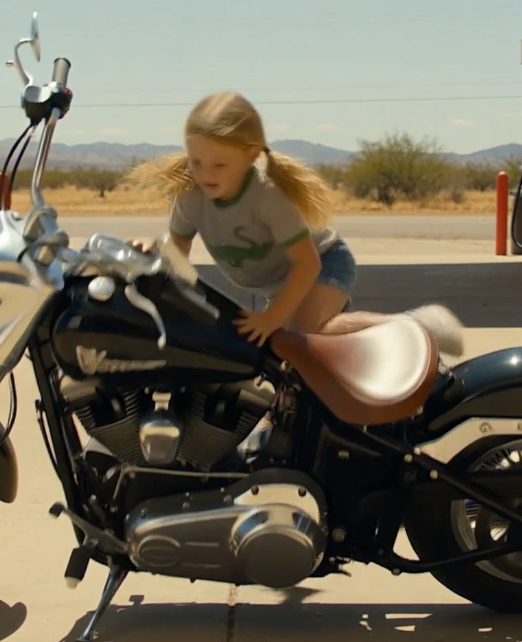
Carrie Talley was pumping gas into her dusty minivan. Her seven-year-old daughter, Birdie, stood beside her in pink sneakers and a sun-faded T-shirt with a lizard on it.
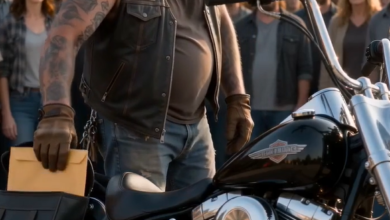
Parked twenty feet away was a black V-twin motorcycle with a brown leather seat shining in the sun.
Its owner had just gone inside.
Birdie went very still.
Then she ran.
Before Carrie could even shout her name, Birdie sprinted across the parking lot. She planted both hands on the motorcycle’s fuel tank and shoved with every ounce of her forty-eight pounds. Then she kicked the side of the seat as hard as she could.
The motorcycle tipped.
It went over with a crash that echoed across the whole station. Metal hit concrete. A mirror snapped. Chrome scraped against the ground.
“BIRDIE!”
Carrie dropped the gas nozzle and ran.
The front door of the store banged open.
A heavyset man in his sixties stormed out with a cowboy hat and a name tag that said CURTIS, OWNER.
“Hey! HEY!” he bellowed. “What the hell is wrong with your kid?”
Customers at the pumps turned to stare. A trucker lowered his coffee.
Behind Curtis, the motorcycle’s owner stepped out of the store.
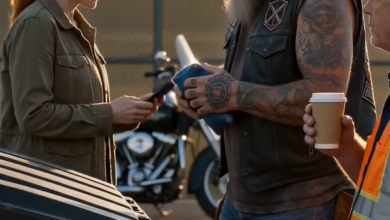
He was enormous, six-five at least, with a gray beard down to his chest and a black short-sleeved leather biker jacket. He was holding a cup of coffee and a bag of beef jerky.
He looked at his motorcycle lying on its side.
He didn’t yell. He didn’t move.
He just stood there in the doorway, frozen.
Carrie reached Birdie and grabbed her by both shoulders.
“I’m so sorry,” she gasped to the biker. “Sir, I’m so, so sorry. I don’t know why she did that. She’s never done anything like this. We’ll pay for it. I promise we’ll pay.”
“Damn right you’ll pay,” Curtis said. “That’s vandalism. I’ve got cameras on every inch of this lot.” He turned to the biker. “Sir, you want me to call the sheriff? Paint job on a bike like that runs eight hundred bucks easy.”
The trucker shook his head. “Kids these days.”
A woman at pump two muttered, “Somebody needs a spanking.”
Carrie’s face burned. She didn’t understand. Birdie was the gentlest kid she knew.
But Birdie wasn’t crying, and she wasn’t running away.
She was standing perfectly still, breathing hard, staring at the motorcycle on the ground.
Then she raised one small, shaking hand and pointed at the seat.
The biker followed her finger.
So did Carrie.
So did Curtis.
At first, there was nothing. Just the fallen bike, the brown leather seat, and the hot concrete.
Then something moved underneath the seat.
It was slow and thick and the same brown as the leather.
A rattlesnake slid out from beneath the fallen motorcycle onto the pavement. It was at least four feet long, as thick as Carrie’s wrist, its diamond pattern glinting in the sun.
Its tail lifted and began to buzz.
The whole parking lot gasped. The trucker stumbled backward. The woman at pump two screamed.
The snake had been coiled on the warm leather seat in the sun, perfectly camouflaged. The biker had been walking straight toward it, about to sit down.
A teenage attendant ran out with a long push broom and herded the snake toward the bushes at the edge of the lot.
The biker set down his coffee. He walked over and knelt slowly on the hot concrete, until his eyes were level with Birdie’s.
Birdie was shaking all over.
She turned and pointed across the lot at the old ice machine beside the store.
“That’s where the one that killed my grandpa was,” she whispered.
Part 2
The biker didn’t look at the ice machine right away.
He kept his eyes on Birdie.
“Your grandpa,” he said quietly. His voice was deep and slow, with a West Texas drawl. “A snake got him? Here?”
Birdie nodded. Her chin was shaking.
“Last summer. He came to get ice for the cows’ water trough. And it was in the shade behind the machine. And it bit his hand.” She swallowed. “He drove home and didn’t tell anybody for an hour because he didn’t want to scare us.”
Carrie made a small sound behind her and put both hands over her mouth.
“Then he got really sick,” Birdie whispered. “And the hospital in Dry Creek didn’t have the medicine. They had to fly him to El Paso. And he died two days later.”
The parking lot was silent except for the hum of the ice machine and the cicadas in the mesquite.
The trucker had taken off his cap.
“So I read every book about snakes,” Birdie said. “Every single one in the library. So I’d know.” She looked at the giant biker with enormous, frightened eyes. “I saw it move on your seat. I tried to yell, but I couldn’t. So I just pushed.”
The biker closed his eyes for a moment.
“I’m sorry I broke your motorcycle,” Birdie said. “I didn’t want anybody else to die like Grandpa.”
The big man reached out very slowly and put one huge, tattooed hand on top of her small head.
“Sweetheart,” he said, and his voice cracked, “you can knock my bike over every day for the rest of my life.”
Carrie started crying.
Then Curtis Boyd cleared his throat loudly.
“Now hold on,” he said. “Let’s not get carried away here.” He stepped forward, adjusting his cowboy hat. “Kid, I’m sorry about your granddaddy. I truly am. But he wasn’t bit here. The insurance people looked into it. He got bit out in his own pasture.” He gave Carrie a look of practiced sympathy. “Grief does funny things to kids. They get ideas.”
Birdie’s face crumpled.
The biker stood up slowly and turned around.
He looked at Curtis for a long time.
Then he looked at the ice machine.
Part 3
Carrie Talley knew exactly what Curtis Boyd had told the insurance company. She had the letter in a kitchen drawer at home.
Her father-in-law, Gene Talley, was seventy-one when he died. He’d ranched cattle on four hundred acres outside Dry Creek his whole life. He was Birdie’s whole world. When Carrie’s husband, Danny, was deployed to Germany with the Army, Gene drove Birdie to school every morning and picked her up every afternoon in his old blue pickup.
On August 14th of last year, he drove to Boyd’s Fuel Stop around 6:30 in the evening to buy six bags of ice for the cattle’s water trough. It was a hundred and six degrees.
He came home holding his right hand against his chest.
He didn’t say anything to anybody for almost an hour, because that’s how Gene was. When Carrie finally saw his hand, it was swollen to twice its size and turning purple.
The little hospital in Dry Creek didn’t have enough antivenom. They called for a helicopter. Gene died in El Paso two days later.
He’d had a small accidental death policy through his ranching association. When Carrie filed the claim, the insurance company called Boyd’s Fuel Stop.
Curtis Boyd told them he’d never seen a rattlesnake on his property in twenty years. He said Gene Talley must have been bitten in his own pasture and confused about where he’d been.
Because Gene died before he could tell anyone exactly where it happened, the insurance company believed him.
The claim was denied.
Birdie’s grandmother, June, had been struggling to keep the ranch ever since.
Now Curtis stood in the parking lot with his thumbs hooked in his belt.
“Ma’am, about the damage to this man’s motorcycle,” he said to Carrie. “Broken mirror. Scratched-up tank. That’s on you. I’ll need your information for my records.”
“Nobody’s paying for anything,” the biker said.
Curtis frowned. “Sir, with respect, she vandalized your property on my lot. I’ve got liability to think about.”
“She saved my life on your lot,” the biker said.
Curtis’s jaw tightened. He glanced toward the bushes where the snake had disappeared.
“Frankly,” he said, a little louder now, so the customers could hear, “I’d bet that snake rode in on your bike. Fella rides across the desert all morning, parks a motorcycle with a warm leather seat, and a snake crawls up into it somewhere out on the highway. Happens all the time.” He shook his head. “That snake didn’t come from here. It came from wherever you came from.”
A few customers nodded.
Carrie looked at the biker. Could Curtis be right? Maybe the snake really had come in on the motorcycle.
Then she felt someone at her elbow.
It was the teenage attendant, the one with the push broom. He was seventeen, skinny, in a red polo shirt. His name tag said ELI.
He wasn’t looking at Curtis. He was looking at the biker.
“It didn’t come in on your bike,” Eli said quietly. “They live in the culvert behind the ice machine. There’s a whole den. I’ve been telling him for a year.”
Part 4
The biker turned to the boy.
“Say that again, son.”
Eli glanced nervously toward the store door. Curtis had stepped inside to answer the phone.
“There’s a big drainage culvert behind the ice machine,” Eli said, keeping his voice low. “It runs under the parking lot to the creek. The rattlesnakes come out at dusk in the summer because the concrete holds the heat. I’ve seen them almost every week since I started working here.” He swallowed. “I write it down in the station log every time. Twenty-three times since last June. I asked Mr. Boyd to call somebody to clear it out.”
“What’d he say?” the biker asked.
“He said to quit writing it down. He said if a state inspector saw the log, they’d shut us down.” Eli’s voice dropped even lower. “Then after Mr. Talley died, he tore those pages out of the log.”
Carrie stared at him.
“Last August?” she whispered. “You were working that night?”
Eli nodded. He looked like he wanted to cry.
“I was inside at the register. I didn’t see it happen. But I saw Mr. Talley come back inside holding his hand. He bought a bottle of water and said he’d scraped it on the ice machine.” Eli’s eyes were wet. “I didn’t know. I’m sorry. I didn’t know until I heard he died.”
The biker was quiet for a long moment.
“The cameras,” he said. “Owner said he’s got cameras on every inch of this lot.”
“He does,” Eli said. “Four of them. They record over themselves every seven days. Mr. Boyd says he never looks at them.” He hesitated. “But I do. Every week I go through them on the office computer, looking for snakes. When I see one, I copy the clip to my phone.” He pulled out his phone with shaking fingers. “So I’d have proof. In case anybody ever believed me.”
“How far back do your clips go?” the biker asked.
“Fourteen months.”
The biker held out his hand.
At that moment, the store door banged open.
Curtis Boyd stood in the doorway, red-faced, staring at the phone in Eli’s hand.
“Eli,” he said. “What the hell do you think you’re doing?” He pointed at the boy. “You’re fired. Get off my property.”
Part 5
Eli flinched.
The biker stepped between the boy and the door. He didn’t say anything threatening. He didn’t raise his voice. He just stood there, six-foot-five and two hundred sixty pounds, between a seventeen-year-old and the man yelling at him.
“Mr. Boyd,” he said evenly. “That boy’s not going anywhere until the sheriff gets here.”
“The sheriff?” Curtis laughed. “Who’s calling the sheriff? You? Some biker passing through?”
The biker reached into the back pocket of his jeans and pulled out a worn leather wallet. He flipped it open and held it up.
Inside was a gold badge with the words RETIRED engraved across the bottom.
“Sergeant Jedediah Darnell,” he said. “Texas Department of Public Safety, Highway Patrol. Twenty-eight years. Retired four years ago.” He folded the wallet. “Folks call me Hoss.”
Curtis went pale.
“I worked this stretch of Highway 90 for eleven of those years,” Hoss went on calmly. “I know Sheriff Vega. I’ve got her number in my phone.” He pulled out his phone. “I’m going to call her now.”
Curtis didn’t move.
Birdie was standing next to her mother, staring up at the huge man. She’d stopped crying.
Hoss turned to make the call. When he did, Birdie saw the back of his leather jacket for the first time.
She grabbed her mother’s hand and went rigid.
Stitched across his back, as big as a dinner plate, was the image of a coiled rattlesnake.
Hoss noticed her face. He hung up before the call connected and knelt down again.
“Hey, hey. It’s okay.” He shrugged off the jacket and turned it so she could see the patch up close. It was a coiled snake inside a circle, with a small cross beneath it. “That’s my club, darlin’. We call ourselves the Diamondback Riders. Most of us grew up out here.”
“Why would you want a snake on your jacket?” Birdie whispered.
Hoss thought about it.
“My daddy was a rancher, like your grandpa,” he said. “He taught me you don’t hate the rattlesnake. It’s just being what it is. But you respect it. You watch for it. And you never, ever turn your back on something that can hurt the people you love.” He touched the patch. “That’s what this means. Watch out for each other.”
Birdie looked at the patch for a long time.
Then she reached out and touched the snake with one finger.
Fifteen minutes later, a Brewster County sheriff’s SUV pulled into the lot. A woman in her fifties with a gray braid climbed out.
“Hoss Darnell,” Sheriff Dolores Vega said, raising her eyebrows. “Thought you retired.”
“I did,” Hoss said. “Then this little girl knocked my motorcycle over.”
Part 6
Sheriff Vega stood in the shade of the store’s overhang and watched every clip on Eli’s phone.
There were forty-one of them.
Rattlesnakes crossed the lot at dusk. A diamondback was coiled beside the ice machine. Another was half in and half out of the drainage grate behind it. One clip showed two snakes at once, sliding out of the culvert in the orange evening light.
Each clip had a date and time stamp.
Then Eli scrolled to one from August 14th of last year, 6:42 p.m.
He didn’t say anything. He just handed the phone to the sheriff.
Carrie stood behind Sheriff Vega and watched over her shoulder.
The camera angle covered the side of the store. An old blue pickup truck pulled up. A thin man in a straw cowboy hat and a pearl-snap shirt climbed out and walked to the ice machine.
Carrie’s hand flew to her mouth.
It was Gene.
He opened the ice machine door and bent down to pull out a bag. Then his whole body jerked. He stumbled back and grabbed his right hand. At the edge of the frame, something long and brown slid back into the shadows beneath the machine.
Gene stood there for a moment, holding his hand. He looked around. Then he put the bags of ice in his truck, as if nothing had happened, and walked into the store.
Carrie turned away. She couldn’t watch anymore.
Birdie was holding Hoss’s hand. She hadn’t seen it. Hoss had made sure of that, turning her gently away and talking to her about lizards.
Sheriff Vega lowered the phone. Her face was very still.
“Curtis,” she said quietly. “Come here.”
Curtis Boyd walked over slowly, hat in hand.
“This footage is from your own camera, on your own property, on the night Gene Talley was bitten,” the sheriff said. “It shows him getting bit at your ice machine.” She held up the phone. “So I’d like you to explain something to me.”
Curtis opened his mouth.
“Why,” Sheriff Vega asked, “did you tell the insurance company he was bit in his own pasture?”
Part 7
Curtis Boyd didn’t answer for a long time.
Then the story came out in pieces, and it was worse than anyone expected.
Boyd’s Fuel Stop was under contract to be sold. A regional chain of travel centers had offered Curtis one point four million dollars for the property. They wanted to build a bigger truck stop. The deal was supposed to close in October.
“The buyer’s lawyers did a full inspection,” Curtis said, staring at the ground. “Environmental, safety, liability, everything. If they’d found out a man died from a snakebite on my lot, with a den I knew about, they’d have walked.” He swallowed. “And Gene’s family would’ve sued me. I’d have lost everything.”
“So you lied to the insurance company,” Sheriff Vega said.
“I told them I didn’t see it happen. That’s true.”
“You told them you’d never seen a rattlesnake on your property in twenty years,” Carrie said. Her voice was shaking with fury. “You had twenty-three warnings in your own log book. And you tore them out.”
Curtis didn’t answer.
“My mother-in-law has been trying to keep that ranch for a year,” Carrie said. “She’s been selling cattle to pay the bills. That insurance money would have saved it. And you let her think Gene was confused and wandering around his own pasture.”
Curtis finally looked up. His face had gone gray.
Then he turned on Eli.
“That footage was on my computer,” he said. “That boy stole it. That’s my private property. I’ll have my lawyer on him by Monday.”
Eli went white.
Hoss stepped forward.
“Mr. Boyd,” he said quietly. “In the State of Texas, an employee who reports a safety violation to law enforcement is protected. You try to sue that boy for telling the truth, and every lawyer in this state will line up to represent him for free.” He paused. “Starting with my nephew in Austin.”
Sheriff Vega took Eli’s phone and put it in an evidence bag.
“Curtis,” she said, “I’m going to be speaking with the county attorney today. And I’ll be calling the insurance company myself.” She looked at the ice machine humming in the heat. “And Texas Parks and Wildlife is coming out here tomorrow morning to open up that culvert.”
Carrie pulled out her phone with trembling hands and called her mother-in-law.
“June,” she said when she answered. “It’s Carrie. You need to sit down.”
Part 8
The game wardens came out to Boyd’s Fuel Stop at seven the next morning. Hoss was already there, sitting on his motorcycle at the edge of the lot with a cup of coffee. Birdie and Carrie came too, with Birdie’s grandmother, June, in the passenger seat of the minivan.
It took the wardens four hours to clear the drainage culvert behind the ice machine.
They removed thirty-one rattlesnakes.
Thirty-one.
The wardens used long hooks and padded tongs and put each snake gently into a ventilated box. Birdie watched every single one from behind the yellow tape with her face pressed against Hoss’s arm.
“Are they going to kill them?” she asked one of the wardens.
“No, ma’am,” the warden said. “We’re taking them forty miles out into the desert, to a canyon where there aren’t any people. They’ll be happy there.”
Birdie nodded seriously. “Good. It’s not their fault. They’re just being snakes.”
The warden looked at Hoss. Hoss shrugged and smiled.
By noon, a representative from the travel center chain had driven in from Midland. He stood in the parking lot in a white shirt and watched the last snake boxes being loaded into a state truck. Then he sat in his car on the phone for a long time.
The sale of Boyd’s Fuel Stop was canceled that afternoon.
Three weeks later, the insurance company formally reopened Gene Talley’s accidental death claim. They reviewed Eli’s camera footage and Sheriff Vega’s report. Then they paid June Talley the full policy amount, plus interest, plus a written apology.
June drove out to the Dry Creek Public Library the next day and donated two hundred dollars to buy new books about reptiles.
The county attorney charged Curtis Boyd with insurance fraud and tampering with records. The state fined him for multiple safety violations. He closed Boyd’s Fuel Stop in November and put the property up for sale. Nobody made an offer for a long time.
On the last day of the snake cleanup, Hoss knelt in front of Birdie in the empty parking lot.
“Birdie Talley,” he said. “I’ve got a job offer for you.”
Part 9
Here’s how the rest of it went.
The job offer was a real one.
In October, the Diamondback Riders sponsored the first Snake Safety Day for Kids at the Brewster County Ranger Station. Fifty families showed up. A wildlife biologist taught the kids how to recognize rattlesnakes, where they like to hide, and what to do if they ever see one. You don’t touch it, you don’t scream, you back away slowly, and you tell a grown-up.
Standing next to the biologist the whole time, wearing a tiny khaki ranger vest the club had bought her, was Birdie Talley, Official Assistant Teacher.
She answered more questions than the biologist did.
They hold Snake Safety Day every spring now. Last year, more than three hundred kids came.
Eli Ortega graduated from Dry Creek High School that May. The Diamondback Riders gave him a scholarship to study wildlife biology at Sul Ross State University in Alpine. He wants to work for Texas Parks and Wildlife someday. He still has the push broom from the gas station. Hoss bought it from the new owners for a dollar and gave it to him at his graduation.
June Talley kept the ranch.
Birdie’s dad, Danny, came home from Germany in December. The first thing he did was drive out to the Ranger Station with Birdie to meet the biker who’d knelt in front of his daughter at a gas station. He shook Hoss’s hand for a long time and couldn’t say much.
Hoss never fixed his motorcycle.
He replaced the broken mirror, but he left the long silver scratch across the side of the black fuel tank, right where Birdie’s little hands had slammed into it. A dozen mechanics have offered to buff it out over the years.
He tells every one of them the same thing.
“That’s the most valuable scratch on any motorcycle in Texas.”
Every year on August 14th, the anniversary of Gene Talley’s death and, as it turned out, the day Birdie knocked over the bike, Hoss rides out to the Talley ranch. He knocks on the screen door. When Birdie answers, he hands her a new book about reptiles, wrapped in brown paper and tied with a piece of baling twine.
Then they sit on the porch together, and she tells him everything she’s learned that year.
Last summer, she gave him a present in return. It was a small, hand-painted sticker of a pair of pink sneakers.
He put it on the gas tank of his motorcycle, right next to the scratch.
People see a huge, tattooed biker in a black leather jacket with a rattlesnake on his back, and they decide what kind of man he is before he says a word. They see a little girl knock his motorcycle over, and they decide she’s a brat. A gas station owner demanded her mother pay and called her grandfather confused. Curtis Boyd was the one who let a snake den grow behind his ice machine and lied about the man who died there. Sometimes the person who knocks you down is the only one who saw what was waiting for you.
If this story stayed with you, follow our page. We share stories like this one every week, about the small heroes who see what the rest of us miss.