The Eight-Year-Old Girl Cut a Patch From a Biker’s Leather Vest in a Crowded Diner—Then He Recognized the Tiny Yellow Star Her Father Had Sewn Before His Final Ride
The eight-year-old girl walked behind my chair, raised a pair of diner scissors, and cut the oldest patch from my leather vest while twenty strangers stared at her as if she had just signed her own death warrant.
My name is Ray “Hammer” Dawson. I was fifty-six years old, six feet four and close to 285 pounds when a child named Lily Carter took something from me that grown men in my motorcycle club had never dared to touch.
It happened inside Rosie’s Highway Diner outside Flagstaff, Arizona.
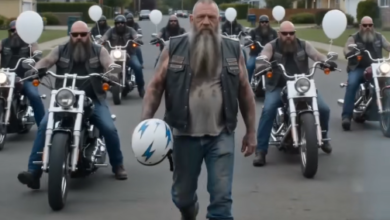
Rain hammered the windows. My black Harley waited beneath a flickering parking-lot light, dripping onto the asphalt. Eleven members of the Iron Lanterns occupied three booths near the counter, their wet leather filling the room with the smell of road dust, engine heat and cold November rain.
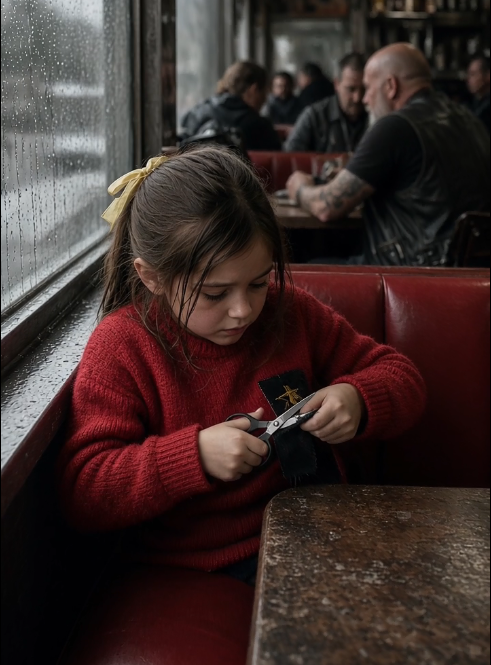
Lily sat with her mother two tables away.
I noticed her because she kept watching my back.
She was small, pale and serious, with brown hair tied by a yellow ribbon. Her mother, Mara, looked exhausted. She wore a grocery-store uniform beneath an old green coat and kept turning Lily’s face toward a plate of untouched pancakes.
The girl always looked back.
More precisely, she looked at one patch sewn below my left shoulder.
It showed a black crow flying across a broken silver compass. One wing had faded nearly gray. Beneath it was a tiny yellow star made from four crooked stitches.
The patch did not match anything else on my vest.
It had no club name. No territory. No rank.
Just the crow.
When I stood to refill my coffee, Lily slipped from her booth and took the small scissors beside the diner’s children’s craft basket. No one noticed until she stepped behind me.
I heard the blades scrape leather.
Then came the sound I had feared for seven years.
Thread snapping.
Leon Brooks, our club president, stood so quickly his coffee overturned. Boone Keller swore and moved into the aisle. A trucker near the register grabbed his phone, expecting an angry biker to turn on a child.
I turned slowly.
Lily held the patch in both hands. One corner was still attached to my vest by a strip of black thread.
Her lower lip trembled, but she did not run.
“You stole this,” she said.
The whole diner went quiet.
Her mother crossed the room and pulled Lily against her side. She apologized so quickly the words collided. She offered to pay for the vest and begged me not to frighten her daughter.
I barely heard her.
I was staring at the yellow star.
Seven years earlier, a fellow soldier and Iron Lantern named Daniel “Crow” Carter had placed that patch in my hand before mounting his Harley for the last ride of his life.
He told me his little girl had chosen the yellow thread.
Then he made me promise something I had spent seven years failing to complete.
“What’s your name?” I asked.
The mother tightened her arms around the child.
“Don’t answer him.”
But Lily raised her chin.
“Lily Carter.”
My knees stopped holding me.
I lowered myself onto the diner floor while leather creaked across my shoulders. The giant biker everyone expected to explode was suddenly kneeling in front of a frightened child, looking at four crooked stitches made by a three-year-old hand.
“You’re Crow’s little girl,” I whispered.
Lily pulled the patch free.
Hidden beneath it was a flat waterproof envelope sewn into the lining of my vest. Her scissors had cut through the first seam, revealing one corner and a name written in faded black ink.
LILY.
Her mother saw it.
So did Leon.
For seven years, even my own club had not known what I carried beneath Daniel’s patch—or why he told me never to remove it unless his daughter recognized it first.
Mara looked from the envelope to my face.
Then she said the words I had been dreading since the night Daniel died.
“You’re the man who sent him on that last ride.”
Want to know what Daniel hid beneath the crow patch and why Hammer disappeared after his death? Drop PATCH in the comments—I’ll share the rest below.
Part 2 — The Soldier Who Painted a Crow on Everything
I met Daniel Carter in Afghanistan twelve years before Lily cut his patch from my vest.
We were both Army vehicle mechanics attached to a logistics unit outside Kandahar. Daniel was thirty-one, six years younger than me and incapable of leaving any government-issued object undecorated. He painted tiny black crows on toolboxes, fuel cans and the inside panels of vehicles where officers would not notice.
That was how he earned the name.
Crow.
He claimed the bird suited him because crows remembered faces and collected useless things. His wall locker proved the second part. He kept flattened bottle caps, broken watch gears, foreign coins, bent bolts and stones picked up from places he never wanted to visit again.
I kept nothing.
At that point in my life, I believed possessions gave loss more places to hide. My first marriage had ended while I was deployed. My younger brother had died in a motorcycle crash outside Tulsa. I owned a Harley stored at my mother’s house, three Army duffel bags and an anger problem I called discipline.
Daniel saw through it.
He never tried to make me talk. He simply placed coffee near my elbow during night maintenance and worked beside me. When incoming rounds struck outside the perimeter, he whistled badly until the all-clear sounded.
One night, I asked why he always whistled the same tune.
“My daughter likes it.”
Lily was eleven months old then.
Daniel carried her photograph inside a transparent wrench package to protect it from dust. In the picture, she sat in a laundry basket wearing a yellow shirt, both fists raised as though protesting the entire arrangement.
“Mean-looking kid,” I said.
“Takes after her mother.”
He grinned every time he mentioned Mara.
Daniel had met her in an Arizona grocery store when both reached for the last frozen pizza. He let her take it, then followed her to the checkout line and asked whether she planned to share. She told him no.
He married her eighteen months later.
After deployment, Daniel and I returned to different lives but stayed in contact. I left the Army first. He completed another enlistment, then settled with Mara and Lily near Flagstaff.
Civilian life did not fit either of us immediately.
I could repair a transmission in darkness, but I could not tolerate crowded offices. Daniel became a county fleet mechanic, yet the sound of a dropped metal tray could put him beneath a workbench before he realized where he was.
Motorcycles helped because they demanded attention without asking questions.
We joined the Iron Lanterns, a veterans’ riding club with no territory and no interest in frightening local businesses. The club delivered winter supplies, escorted military funerals and transported donated medical equipment across rural Arizona.
Daniel became road captain.
He was good at it. He checked every turn, fuel stop and weather report. No rider under his supervision was left beside a highway. If someone broke down, Crow stayed until the final wrench returned to the bag.
His custom patch came from Mara.
It showed a black crow crossing a silver compass cracked down the middle. The broken compass represented the years Daniel spent believing he would never find his way home. The bird represented the people who remembered the road when he could not.
Lily added the star.
She was three and angry that the patch had no yellow. Mara gave her a needle threaded through heavy canvas and helped guide her tiny fingers. Lily made four uneven stitches near the crow’s wing.
Daniel wore the patch above his heart.
The first time I saw it, I laughed.
“A star, Crow?”
“My commanding officer ordered it.”
Lily stood beside him wearing pink rain boots. “I’m the commander.”
Daniel saluted.
That memory returned in the diner as I knelt before the same child five years later. She no longer remembered making the stitches, but she had seen the patch in photographs beside her father’s face.
To her, it belonged to him.
She was right.
What she did not know was why Daniel removed it.
The trouble began with a cough he could not shake. He blamed dust, allergies and old burn-pit exposure. Mara forced him to see a doctor after he nearly passed out in the garage.
The tests found an aggressive cancer already spreading through his lungs and liver.
Daniel was thirty-six.
Lily had just turned four.
Doctors offered treatment, but they did not offer much time. Daniel accepted chemotherapy because Mara asked. He lost weight. His beard thinned. He stopped leading rides when medication made his hands tremble.
Still, every Wednesday, he entered the clubhouse and checked the charity route maps.
The Iron Lanterns were preparing their annual Christmas run to deliver toys to children receiving long-term treatment at Phoenix Children’s Hospital. Daniel had organized it for three years.
He wanted one final ride.
Mara said no.
The doctors said no.
I should have said no.
Instead, I promised I would keep him safe.
That was why she blamed me.
And on the morning of that ride, before Daniel started his Harley, he cut the crow patch from his own vest and pressed it into my palm.
Part 3 — The Ride I Should Have Stopped
Daniel arrived at the Iron Lanterns’ clubhouse before sunrise on December 14.
The temperature was thirty-two degrees. Frost covered the motorcycle seats, and our breath drifted beneath the yellow security light. Thirty-eight riders had volunteered for the hospital run.
Daniel looked terrible.
His leather jacket hung loose from his shoulders. A knit cap covered his bare head, and his cheeks had taken on the hollow shape illness gives a man before the people who love him are willing to name it.
He carried himself like the old road captain.
That fooled some of us.
It did not fool Mara.
She followed him to the clubhouse in her car with four-year-old Lily strapped into the back seat. When Daniel reached for his helmet, Mara blocked the motorcycle.
“You told me you were coming to organize them.”
“I am.”
“You are not riding.”
“Hospital’s two hours.”
“You could barely walk to the garage.”
Daniel looked toward me.
That was his mistake.
Mara saw it.
“You already asked Hammer.”
I should have ended it there. I should have taken Daniel’s key, accepted his anger and driven him home. Instead, I explained the plan I had helped him build: Daniel would ride in the center of the formation, Leon would lead, I would stay beside him and a support truck would follow.
We would stop every thirty minutes.
Mara asked whether any of us could stop his lungs from failing on Interstate 17.
No one answered.
Daniel opened the car’s rear door and unfastened Lily. She climbed into his arms with a yellow blanket around her shoulders.
“Daddy going motorcycle?” she asked.
“One little ride.”
“Bring pancakes.”
He promised.
Then he carried her toward me.
Daniel did not often ask for physical affection from another man. That morning, he leaned close while Lily’s blanket pressed between us.
“If I turn back,” he whispered, “she remembers the cancer taking this too.”
“She’s four.”
“She’ll remember what they tell her.”
He wanted Lily’s last stories about him to include movement, not only hospital beds.
I understood.
That did not make my decision right.
Before Mara left, Daniel asked her for the small scissors in Lily’s craft bag. He removed his vest, turned his back to me and cut through the threads around the crow patch.
Mara watched from ten feet away.
“What are you doing?” she asked.
“Lightening the load.”
She knew that was a lie.
Daniel handed me the patch, then gave me a second object: a thin waterproof envelope bearing Lily’s name. He told me to place it beneath the patch and sew both onto my vest.
“Why me?”
“Because you keep promises that hurt.”
“Crow—”
“Don’t give it to her because you feel guilty. Don’t give it because Mara hates you. Give it when Lily knows what it is.”
I asked how I would know.
Daniel looked at the little yellow star.
“She’ll know first.”
He made me promise not to seek Lily out, not to appear at school or birthday parties and turn her childhood into a memorial ride. Mara needed space. Lily needed the right to remember her father without a motorcycle club controlling the story.
“If she finds you,” Daniel said, “let her decide what comes next.”
I sewed the patch onto my vest before we left. Leon watched me but asked no questions. He thought Daniel had passed me his road-captain emblem for the day.
Mara placed Lily back in the car.
She did not kiss Daniel goodbye in front of us.
She could not.
The ride began at 7:12 a.m.
Thirty-eight Harleys left Flagstaff beneath a pale winter sky, carrying stuffed animals, books and gift cards. Daniel rode in the center on his blue Road King. I stayed on his left.
For the first forty miles, he looked steady.
At the Sunset Point rest area, he removed his helmet and vomited behind the support truck. I told him the ride was over.
He wiped his mouth.
“Twenty-six miles.”
“You’re done.”
“Twenty-six.”
“I’m calling Mara.”
Daniel grabbed my wrist. There was almost no strength in his hand.
“Let me finish one thing.”
I hated him for asking.
I hated myself more for agreeing.
We reduced the formation to six bikes and put the others ahead. Daniel completed the final miles at fifty-five miles per hour with the support truck behind him.
At the hospital entrance, children watched through second-floor windows as the motorcycles arrived. Daniel lifted one gloved hand toward them.
That was his last moment on the bike.
His legs folded when he dismounted.
I caught him before he struck the pavement. Nurses ran outside with a wheelchair. Daniel tried to resist until a little boy in a knit cap appeared near the doors holding a toy motorcycle.
Daniel took the handlebars of that plastic bike and rolled it toward the child.
Then he allowed the nurses to take him inside.
Mara reached Phoenix ninety minutes later.
By then, Daniel was in intensive care.
He died the next morning.
Lily never received her pancakes.
Mara never forgave the club.
She forgave me least of all.
Part 4 — What Crow Sewed Beneath the Patch
After Daniel’s funeral, Mara asked the Iron Lanterns to stay away.
We did.
That decision looked cruel from the outside. Forty bikers had escorted Daniel’s casket, yet none appeared at Lily’s fifth birthday. No motorcycles waited outside her school. No leather vests arrived at the grocery store where Mara worked.
Mara believed we had completed our ceremony and moved on.
The truth was less clean.
Daniel had left instructions.
Leon received one letter. I received another. Alicia Grant, the club treasurer, received financial documents and the key to an account Daniel had quietly built from his military disability payments.
The Iron Lanterns were to help Mara only if the help could not be traced back to us.
Daniel knew her pride. More importantly, he knew her anger would make every gift feel like payment for his death.
So we became invisible.
When Mara fell behind on rent after funeral expenses, the veterans’ relief office received an anonymous donation matching the balance. When Lily needed glasses, a local charity found “extra funding.” When her school canceled an art program, the Iron Lanterns paid the instructor through a community foundation without attaching the club’s name.
I never saw Lily.
I saw evidence that she was alive.
A school newsletter showed her holding a clay bird. A grocery-store charity photograph showed Mara beside a Christmas food display while Lily stood in the corner wearing her yellow ribbon.
Every time I found an image, I asked whether it was enough.
Every time, I remembered Daniel’s words.
If she finds you.
The patch remained on my vest through rain, desert heat and forty thousand highway miles. I replaced the thread twice but never removed the waterproof envelope beneath it. I could feel its edge against my shoulder whenever I leaned forward over the handlebars.
Leon asked about it once.
“Crow give you something?”
“Yeah.”
“What?”
“Not mine.”
That ended the conversation.
Seven years after Daniel’s last ride, the Iron Lanterns stopped at Rosie’s Highway Diner while returning from a winter-coat delivery. I had no idea Mara worked nearby or that she and Lily ate there every Saturday after her morning shift.
Lily recognized the patch from a framed photograph in her bedroom.
The picture had been taken on the day Mara finished sewing it. Daniel stood beside his Road King, laughing, while three-year-old Lily pointed at the yellow star.
She did not see a memorial on my vest.
She saw stolen property.
That was why she took the scissors.
Back in the diner, Mara ordered her daughter to return the patch. Lily held it against her chest and refused.
“No,” she said. “It’s Daddy’s.”
Mara looked at me with seven years of grief hardened behind her eyes.
“You heard her.”
I removed my vest.
Every biker in the room watched.
A club vest is not merely clothing. It carries funerals, earned trust, lost friends and roads that changed the person wearing it. Mine had been cut by a child and now hung open along one shoulder.
I placed it on the floor between us.
“It’s hers.”
Mara stared at the waterproof envelope exposed beneath the severed patch.
“What is that?”
“Crow’s last message.”
Her expression changed from anger to suspicion.
“You said there was no message.”
“I said he didn’t leave one for the club.”
“You came to the funeral. You looked at me. You let me bury him believing he had nothing left to say.”
“He told me when to give it.”
“And you decided seven years?”
“No.”
I looked at Lily.
“She did.”
Mara slapped me.
The impact turned my face. Boone moved, but Leon blocked him with one hand. No one in the Iron Lanterns interfered.
Mara had earned that strike years earlier.
I faced her again.
“Open it.”
“I don’t want anything from you.”
“It isn’t from me.”
Lily knelt beside the vest. Her small fingers followed the seam her scissors had opened. She pulled the envelope free.
Inside were three objects.
The first was a key wrapped in waxed cloth.
The second was a memory card inside a plastic case.
The third was a folded letter with one sentence written on the outside:
For Lily—when she recognizes the crow without anyone explaining it.
Mara sat down hard on the nearest chair.
Lily looked at me.
“What does the key open?”
I could have answered.
Instead, I told her the choice Daniel had protected for seven years.
“It starts your father’s motorcycle.”
Part 5 — The Voice Recorded Before Dawn
Daniel’s blue Road King had never been sold.
After his death, Mara wanted it removed from their garage. She could not stand seeing his helmet hanging from the handlebar, but she also could not sign the title away.
Leon moved the motorcycle to the Iron Lanterns’ workshop.
We drained the fuel, lifted it onto a stand and covered it with gray canvas. Every month, someone turned the engine by hand. Every spring, we replaced fluids and checked the seals.
Nobody rode it.
Daniel’s key remained beneath the crow patch.
The memory card contained six recordings made during the final weeks of his life. Daniel had been too weak to write for long, so he sat alone inside his garage and spoke into an old camera.
Rosie closed the diner’s back room so Mara and Lily could listen privately. Mara refused to let me leave.
“You carried it,” she said. “You hear it.”
Leon brought a laptop from the clubhouse. We inserted the card.
The first video opened with Daniel sitting beside his motorcycle. His face was thin, his voice breathless and the crow patch still rested over his heart.
Lily covered her mouth.
Children remember people differently from adults. She knew her father from photographs, stories and brief flashes: the smell of soap on his jacket, pancakes shaped like birds, hands lifting her toward a motorcycle mirror.
The moving face unsettled her.
Then Daniel whistled the same crooked tune he had used during incoming fire in Afghanistan.
Lily began crying.
Not loudly.
She leaned against Mara and allowed tears to fall while her father spoke from seven years away.
“Hey, Commander.”
He explained that if she was watching, she had found the crow. He hoped she had asked politely.
Lily looked at the scissors on the table.
“I didn’t,” she whispered.
Daniel continued as if he could hear her.
“If you cut it off Hammer, don’t feel too bad. Leather can be fixed. He’s harder to damage than he looks.”
Leon laughed once, then covered it with a cough.
Daniel told Lily the patch had never represented the motorcycle club. It represented getting lost and allowing people to help guide you home. The yellow star mattered more than the crow because she had added the only direction he trusted.
Then his expression became serious.
“Ray didn’t send me on that last ride.”
Mara closed her eyes.
“I made him take me. If you’re angry, be angry with me. Your mother was right. Ray was right. I went anyway because sick children were waiting, and because I was scared your final picture of me would be a man disappearing into a hospital bed.”
Daniel paused to breathe.
“I was wrong about one thing. Your last picture of me doesn’t belong to me. You get to choose it.”
In the second recording, he spoke to Mara.
He apologized for using love as an excuse to ignore her fear. He admitted the ride was selfish as well as generous. He wanted to feel useful one final time and asked Hammer to carry the guilt because he knew Hammer would not refuse.
Mara reached across the table and touched the image on the screen.
For seven years, she had blamed the man who caught Daniel when his legs failed.
Daniel had anticipated that too.
“Don’t forgive him because I ask,” he said. “Just don’t let hating Ray become the only way you keep me.”
The final recording was shorter.
Daniel held up the motorcycle key and told Lily the Road King belonged to her. She could sell it, keep it or ask the Iron Lanterns to strip it for parts. No decision would betray him.
If she kept it, Hammer would maintain it until she was old enough to decide whether she wanted to ride.
“He’ll pretend that’s a burden,” Daniel said. “It isn’t. Give the man a wrench and a reason to stay, and he usually does.”
The screen went dark.
No one moved.
Rain clicked against the diner’s roof. Coffee cooled in untouched cups. My vest lay open across the table, one shoulder bare where the patch had been.
Lily picked up the crow.
She studied the faded silver compass and the four yellow stitches. Then she turned it over and examined the thread she had cut.
“Can you put it back?”
I asked whether she wanted it on her father’s vest.
She shook her head.
“Yours.”
Mara looked at her daughter. “Are you sure?”
“Daddy gave it to him.”
Lily pushed the patch toward me.
“But it needs something.”
She took yellow thread from the diner’s craft basket. With Rosie’s help, she added a second tiny star beside the first.
The new stitches were as crooked as the old ones.
“One is Daddy,” she said. “One is so you don’t get lost.”
My hands had remained steady beneath gunfire, broken engines and the weight of dying men.
They shook over that patch.
Mara noticed.
She reached across the table, took the needle and helped sew Daniel’s crow back onto my vest.
Part 6 — The Motorcycle Beneath the Gray Canvas
The next Saturday, Mara and Lily came to the Iron Lanterns’ workshop.
Lily wore safety glasses too large for her face. Mara carried Daniel’s letters and a list of questions she had accumulated through seven years of silence.
The blue Road King waited beneath its cover.
I let Lily remove the canvas.
Dust had not touched the paint. Daniel’s helmet remained on a shelf above the workbench, and his old gloves lay inside the left saddlebag exactly where he had placed them.
Lily walked around the motorcycle without speaking.
At the rear fender, she discovered a faded yellow handprint beneath the clear coat. Daniel had pressed her palm there when she was three, then sealed it into the paint.
Mara had forgotten.
Lily placed her hand over it.
Her fingers extended beyond the old print now.
“Did he ride fast?” she asked.
“Not with people behind him.”
“Did he fall?”
“Once.”
“Did you laugh?”
“After he stood up.”
She smiled.
That afternoon, we did not start the motorcycle. I taught Lily the names of simple parts while Mara sorted through Daniel’s belongings. Leon showed her the route maps her father had drawn. Alicia revealed the charity account he had created.
Mara learned who had paid the rent after his funeral.
She walked outside when Alicia told her.
I found her near the row of parked Harleys, arms folded against the wind.
“You should have told me,” she said.
“Crow said anonymous.”
“He always thought he knew what everyone needed.”
“Usually wrong.”
That drew the smallest smile.
Mara did not apologize for the slap. I did not ask her to. Forgiveness did not arrive as one clean moment inside that workshop.
It came in smaller pieces.
She allowed me to change a burned-out light at her house. She invited Leon to Lily’s school presentation about veterans. She stopped leaving the grocery aisle when an Iron Lantern entered the store.
Lily began visiting twice a month.
She learned to check tire pressure, identify worn cables and organize sockets by size. She made labels for every tool drawer, though Boone kept returning wrenches to the wrong places simply to hear her scold him.
The club called her Commander.
At first, I could not bring myself to wear the repaired vest. It hung beside my workbench with two yellow stars visible near Daniel’s crow.
Lily noticed.
“Why don’t you wear Daddy’s patch?”
I told her I was afraid of damaging it.
She looked offended.
“He rode in rain.”
“Yep.”
“You ride in rain.”
“Sometimes.”
“Then wear it.”
Children can turn grief into an instruction a grown man cannot argue with.
I put on the vest.
The patch settled against my shoulder. The waterproof envelope was gone, but the place beneath it no longer felt empty.
That evening, Lily helped me start Daniel’s Road King.
The engine resisted after seven years of silence. It turned twice, coughed and stopped. Boone adjusted the fuel line. Leon checked the battery.
On the fourth attempt, the V-twin caught.
The sound filled the workshop.
Mara pressed both hands against her face. Lily stood beside the motorcycle with her yellow safety glasses slipping down her nose.
I expected the noise to frighten her.
Instead, she laughed.
It was Daniel’s laugh.
For one second, every man in that garage looked toward the door as though Crow might walk through it carrying bad coffee and another impossible promise.
He did not.
The engine kept running.
That was enough.
Part 7 — Two Yellow Stars on the Last Ride
On the eighth anniversary of Daniel’s final hospital run, the Iron Lanterns rode the same route from Flagstaff to Phoenix.
We no longer called it the Christmas Ride.
Lily renamed it Crow’s Run.
The club delivered toys, books and grocery cards to families staying near the children’s hospital. We also carried fuel vouchers for parents driving hundreds of miles to treatment appointments—an idea Mara suggested after remembering the cost of Daniel’s final months.
Lily was twelve by then.
She was still too young to ride Daniel’s Road King, and Mara was not ready to place her on the back of any motorcycle for a highway run. So Lily traveled in the support truck beside her mother.
Daniel’s Harley rode secured inside a trailer behind them.
I led the formation.
The crow patch remained on my vest, now bordered by two crooked yellow stars. Wind had faded the thread, but neither stitch had broken.
At Sunset Point, the place where Daniel had become sick during his last ride, the club stopped.
Lily climbed out of the truck carrying her father’s helmet. She placed it on the seat of his motorcycle and asked everyone to give her a minute.
Thirty-eight bikers moved away.
She stood alone beside the blue Road King, one hand resting over the yellow print on its rear fender. Mara watched from the truck. I remained near my Harley, far enough to honor the moment and close enough if Lily called.
She did.
“Hammer?”
I walked over.
“Did Daddy know he was dying that day?”
“Yeah.”
“Were you scared?”
“Yeah.”
“Why didn’t you tell him?”
“He knew.”
Lily considered that. Then she touched the crow patch on my shoulder.
“You still think you should’ve stopped him?”
“Every day.”
“Mom says he would’ve gone anyway.”
“Your mom’s right.”
She looked toward the highway where trucks moved south beneath a pale winter sky.
“Then maybe your job wasn’t stopping him.”
“What was it?”
“Making sure he didn’t ride alone.”
I had carried Daniel’s guilt longer than she had been alive. An eight-year-old girl cut open the place where I hid it. Four years later, she gave it a different name.
Brotherhood.
Not the kind printed across leather.
The kind that stays beside a failing man even when staying hurts.
At the hospital, children waited behind the glass doors. The Iron Lanterns unloaded gifts while Lily carried the first stuffed crow inside.
Before leaving, she asked me to start Daniel’s motorcycle.
I rolled it down from the trailer. With Mara’s permission, Lily sat on the stationary seat wearing her father’s helmet while I held the handlebars.
She turned the key.
I pressed the starter.
The old V-twin came alive beneath her, rough and steady. Lily did not move the motorcycle. She simply listened while her mother cried quietly near the entrance and thirty-eight bikers stood without speaking.
Then Lily shut down the engine.
Silence returned.
She climbed off, removed the helmet and handed me the key.
“Keep it safe until I’m ready.”
I closed my fingers around it.
“How will I know?”
She smiled and tapped the two yellow stars on my vest.
“I’ll find you.”
Follow our page for more unforgettable biker stories about hidden promises, loyal brotherhood and the frightening-looking riders who carry someone else’s memories until the right person comes home.
TITLE
The Eight-Year-Old Girl Cut a Patch From a Biker’s Leather Vest in a Crowded Diner—Then He Recognized the Yellow Star Her Father Had Sewn Before His Final Ride
SEO DESCRIPTION
An eight-year-old cuts a patch from a biker’s vest, revealing her father’s final promise and the secret carried beneath the leather.
VIDEO PROMPT 1 — BASED ON PART 1 VERSION 1
Create a 10-second, exactly 4-scene VEO 3/Seedance teaser, real-life cinematic style, high-quality realistic footage, natural handheld camera, rainy roadside diner near Flagstaff, Arizona, no POV. Scene 1, 0–2.4s: Lily Carter, an eight-year-old white American girl with brown hair, yellow ribbon, red sweater and frightened determination, secretly uses small craft scissors to cut a black-crow patch with a tiny yellow star from a biker’s vest. Scene 2, 2.4–4.8s: Ray “Hammer” Dawson, an imposing 56-year-old white American biker, 6’4″, 285 pounds, shaved head, thick gray-streaked beard, tattooed forearms, scarred knuckles, plain black leather vest, faded shirt, jeans and boots, turns slowly as several bikers rise and the diner freezes. Lily says, “You stole this.” Scene 3, 4.8–7.3s: Mara Carter, Lily’s exhausted 34-year-old white American mother with brown ponytail, green coat and grocery uniform, shields her daughter while Hammer kneels instead of becoming angry. “What’s your name?” Scene 4, 7.3–10s: Lily pulls the final thread, exposing the corner of a sealed waterproof envelope hidden inside the leather; Hammer recognizes the yellow star and whispers, “Crow’s little girl.” Cut before explaining the father, envelope or last ride. Scissors snip, coffee cup falls, rain, leather creak, no blood, violence, weapons, text, subtitles, logos, watermarks or readable patches.
Teaser 1
An eight-year-old girl walked behind the largest biker in the diner and cut a patch from his leather vest while eleven tattooed riders watched in stunned silence.
Ray “Hammer” Dawson stood six feet four and weighed nearly 285 pounds. His shaved head, gray-streaked beard and scarred knuckles made strangers avoid his booth without being asked.
Lily Carter did the opposite.
She took a pair of scissors from the children’s craft basket, crept behind Hammer and cut through the heavy black thread beneath his shoulder. Every biker at the table stood. A trucker raised his phone. Lily’s mother ran across the diner, convinced the child had just provoked the wrong man.
Then the patch came loose.
It showed a black crow crossing a broken silver compass, with one tiny yellow star stitched beside its wing.
“You stole this from my daddy,” Lily said.
Hammer did not shout.
He dropped to one knee.
As Lily’s mother shielded her, the giant biker stared at those crooked yellow stitches as though he had been waiting years to see them again. When Lily pulled the final thread, a waterproof envelope appeared beneath the leather.
Hammer had carried that envelope across forty thousand miles.
Even his motorcycle club did not know it existed.
But why did it bear Lily’s name—and why did her mother accuse Hammer of sending the girl’s father on the last ride of his life?