The Biker Sold His Harley Three Days Before His Son’s Birthday—Then a Frightened Boy Walked Into the Pawn Shop and Revealed What the Money Had Really Bought
The biker sold his Harley three days before his son’s sixteenth birthday, and while everyone in our pawn shop whispered that he must be broke, he kept staring at a battered guitar case chained behind my counter.
I was the person who bought the motorcycle from him.
My name is Mara Quinn, and for eleven years I managed Redline Pawn & Loan on the western edge of Tulsa, Oklahoma, where Route 66 bends past used-car lots, payday lenders and a diner whose coffee could strip paint. I had watched people pawn wedding rings, carpentry tools, televisions and once a prosthetic leg they later returned for after sobering up.
Nothing surprised me much anymore.
Then Raymond Dawson rolled into our parking lot on a black Harley-Davidson Road King that half the riders in Tulsa recognized by sound alone.
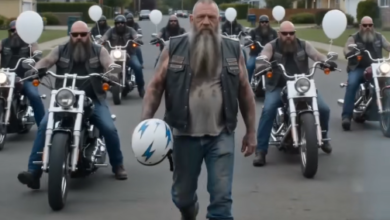
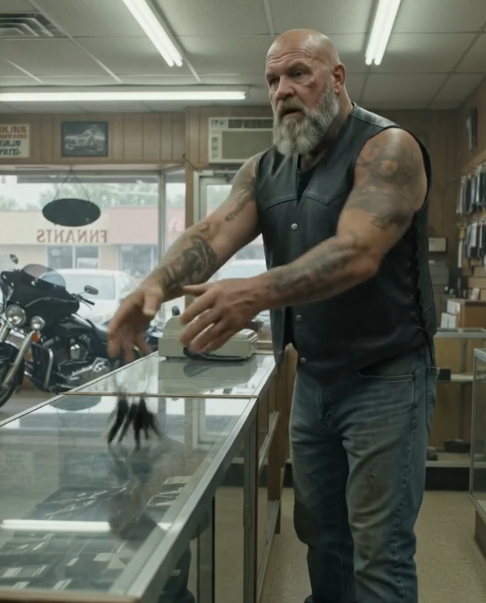
Ray was fifty-six, six-foot-four and close to 285 pounds, with a shaved head, a black-and-gray beard, tattooed forearms and hands scarred by thirty years of transmissions, chain drives and bad decisions. Men in his riding club called him Hammer, though he wore no name on the front of his plain leather cut.
The V-twin stopped.
Silence followed.
Ray came inside carrying the motorcycle title in a clear plastic folder. A silver skull ring clicked against the glass counter as he placed it in front of me.
“I need a straight sale,” he said.
Behind him, two customers turned around.
Everybody knew that Harley. Ray had rebuilt it with his son, Lucas, over four winters. Its fuel tank carried a thin blue pinstripe Lucas had painted at twelve, uneven near the seat because his hand had slipped when Ray sneezed. Three days later, when Lucas turned sixteen, father and son were supposed to take their first long ride together on Oklahoma Highway 51.
Ray had talked about it for a year.
Now he wanted cash.
My owner, Dennis Ward, came from the back office and inspected the title. “You’re not pawning it?”
“Selling.”
“You understand a sale means it doesn’t wait thirty days.”
“I understand.”
Dennis walked outside with him. Customers drifted toward the windows, pretending to examine fishing reels while watching Ray stand beside the motorcycle. The August heat smelled of hot asphalt, gasoline and exhaust. Ray kept one hand on the left grip as Dennis circled the Road King and photographed every scratch.
Someone behind me whispered, “Business must’ve finally collapsed.”
Another man said Ray probably owed back taxes.
A woman near the jewelry case asked whether his garage was being repossessed. By the time Dennis returned with an offer, strangers had already dismantled Ray’s life without asking him a single question.
“Twelve thousand eight hundred,” Dennis said.
The Harley was worth more.
Ray knew it.
He signed anyway.
Only once did his hand stop. His phone lit with a photograph of Lucas sitting on that same motorcycle, wearing an oversized helmet and holding up a cardboard sign that read THREE DAYS.
Ray turned the screen facedown.
Dennis counted the money into an envelope. Ray did not put it in his vest. He walked directly to the rear wall, where a sunburst Gibson acoustic guitar sat inside a battered brown case secured by a steel cable.
The guitar had arrived twenty-eight days earlier.
A hollow-eyed man named Wade Kell had pawned it for $6,400, using an old appraisal that valued it at almost twice that amount. He claimed it belonged to him. Two hours later, a fourteen-year-old boy came running into the shop in mismatched sneakers, begging us not to sell “his mother’s guitar.”
The boy’s name was Eli.
The loan ticket carried Wade’s signature.
Eli carried no receipt.
Legally, I could do nothing.
Ray touched the guitar case with two scarred fingers.
“How long?” he asked.
“Until it clears for sale? Two days.”
“What’s owed?”
“I can’t discuss another customer’s loan.”
He looked at me for a long moment, then slid the envelope across the counter.
“Call the father.”
Before I could answer, the front door opened. A skinny boy stood beneath the bell, breathing hard, his brown hair stuck to his forehead with sweat.
Eli.
He saw the Harley title beside Dennis. He saw the envelope beneath Ray’s hand. Then he looked at the guitar case and whispered, “My dad came back, didn’t he?”
Ray turned toward him.
At that exact moment, his phone rang.
Lucas’s name appeared on the screen.
Ray answered.
“Dad,” his son said through the speaker, bright and unaware, “you’re still picking me up on the Harley Sunday morning, right?”
Ray looked through the window.
Dennis was already pushing the Road King toward our locked storage bay.
“Yeah, son,” Ray said after a silence that lasted too long. “I’ll pick you up.”
But he had just sold the only motorcycle he owned.
And the frightened boy beside me still had no idea why.
Want to know why Ray sacrificed Lucas’s birthday ride and what Eli’s father had hidden inside the guitar case? Drop GUITAR in the comments — I’ll share more soon.
Part 2 — The Boy Who Returned Without a Pawn Ticket
I first saw Eli Kell twenty-eight days before Ray sold the Harley.
He came into Redline at 4:17 on a Tuesday afternoon, wearing a school orchestra shirt beneath a gray hoodie despite the Oklahoma heat. One shoelace had broken and been tied with blue electrical wire. He carried an empty guitar strap in both hands as if it were the only evidence of a crime nobody intended to investigate.
“Where’s the Gibson?” he asked.
I told him we had several.
“The one in the brown case. There’s a burn on the bottom and a crack by the sound hole. My mom put a blue bird sticker inside where nobody can see it.”
I knew the instrument immediately.
Wade Kell had brought it in two hours earlier. He was thirty-nine but looked older, with shaking fingers, a sweat-darkened collar and the quick, restless eyes of someone measuring everything in the room by what it might buy. The license was valid. The serial number did not appear in the stolen-property database. He knew the case combination and possessed an appraisal bearing his family name.
He said the guitar belonged to him.
Eli said it had belonged to his mother, Rachel, who died from ovarian cancer when he was ten.
“She left it to me,” he insisted. “Dad was only supposed to keep it until I was eighteen.”
“Do you have that in writing?”
His face answered first.
Rachel had made the promise in a hospital room, not a lawyer’s office. Wade had nodded beside her bed. Eli believed that should have counted for more than paperwork.
In my world, it did not.
I explained the holding period, the loan ticket and the police report he could file if he believed the property had been stolen. Eli listened without blinking, but his hands tightened around the strap.
“My concert is next month.”
“I’m sorry.”
“That’s the only guitar I can play.”
“You can play another.”
“No,” he said. “I mean that’s the only one I can play like she taught me.”
That was when Ray entered the shop.
He had come for a used torque wrench displayed near the tools. He smelled of gasoline, leather and the bitter road coffee sold at the station across from his transmission garage. His boots struck the tile twice, then stopped when he heard the boy’s voice.
Ray did not interrupt.
Eli told me his mother had played that Gibson in small churches and nursing homes around Tulsa. After she became too weak to perform, she taught him from a recliner in their apartment. She marked chord positions with tiny dots of blue nail polish because chemotherapy made her hands tremble and she sometimes forgot where her fingers belonged.
After her death, Wade lost his job.
Then he lost another.
Pills came first. Methamphetamine followed. He sold Rachel’s amplifier, the microphone she had used at their wedding and nearly everything from Eli’s room that could be carried without attracting a landlord’s attention.
The Gibson was the last thing.
Eli found the pawn receipt in a trash can.
Ray stood beside the fishing gear with the torque wrench hanging forgotten from one hand. Nothing moved in his face, but the knuckles around the wrench turned pale.
“Where’s your father?” he asked.
Eli looked up at the enormous stranger and stepped closer to my counter.
“I don’t know.”
“You safe tonight?”
The boy hesitated.
Ray placed the wrench down.
That was all.
He walked out, climbed onto the black Road King and started the engine. Eli flinched when the V-twin shook the front windows. I assumed Ray had decided the situation was none of his business.
I was wrong.
Over the next three weeks, he returned four times.
The first time, he asked whether the guitar remained on hold.
The second, he brought a photocopy of Rachel Kell’s obituary and asked if it changed anything.
It did not.
The third time, he wanted to know whether a minor could pay another person’s pawn loan.
Not without the ticket holder’s authorization.
The fourth time, he stood outside for nearly an hour without coming in. Through the glass, I watched him sit on his Harley and study the uneven blue line across the gas tank.
Later, I learned where he went between those visits.
Ray found Eli sleeping in the orchestra storage room at Booker T. Washington High School. The music teacher had been letting him stay late because home had become unpredictable. Ray brought sandwiches but left them with the janitor so Eli would not know who had paid.
He found Wade at a motel beside Interstate 44.
He also called a treatment center, a legal-aid office and a man named Isaiah Cole, president of the Iron Haven Riders. Preacher, as the club called him, had known Ray for twenty-three years and had dragged him through more than one season when Ray no longer trusted himself.
Preacher told him not to become involved.
“It ain’t just a guitar,” Ray replied.
“That’s exactly why you need to be careful.”
Ray had a history of mistaking rescue for control. When somebody vulnerable was hurt, he did not wait for permission. He moved first and considered the wreckage later.
That impulse had once sent him to prison.
Preacher knew it.
Lucas knew it too.
The night before Ray sold the motorcycle, five Iron Haven riders gathered inside Dawson Recovery & Transmission. They found him removing his registration pouch from the Road King and setting Lucas’s spare helmet on the workbench.
Crow Madden, the club’s road captain, saw the title.
“You selling?”
Ray continued packing.
“Answer me, brother.”
“Need cash.”
“For what?”
“Something that expires Friday.”
Crow looked at the blue pinstripe on the tank. “Your kid’s birthday is Sunday.”
“I know when my son was born.”
“You promised him that ride.”
Ray’s jaw tightened.
The riders offered loans. Ray refused each one. He would not use club money, would not explain the boy’s situation and would not turn Eli into the subject of a collection passed through thirty curious hands.
Preacher gave him one final warning.
“If you sell that bike without telling Lucas why, you might save one boy and cut your own loose.”
Ray folded the title into the plastic sleeve.
“Then I’ll have to find my way back to him.”
The next morning, he rode to Redline.
Part 3 — Twelve Thousand Eight Hundred Dollars and One Lie
After Lucas’s call ended, nobody in the pawn shop moved.
Ray slipped the phone into his vest. Eli stood three feet away, staring from the biker to the Harley disappearing behind our steel storage door. I expected Ray to explain.
He did not.
“Your father contact you?” he asked.
Eli shook his head.
“Anybody know where he sleeps?”
“Sometimes the Western Lodge.”
“Not anymore.”
Eli’s eyes narrowed. “How do you know?”
Ray looked toward me. “Can you hold the guitar until closing?”
“The redemption deadline is Friday.”
“It is Friday.”
“It clears at six.”
“I’ll be back before six.”
Dennis stepped between Ray and the rear wall. He had spent thirty years in the pawn business and possessed the compassion of a locked cash drawer.
“You can’t simply buy it,” he said. “Wade still owns the loan ticket until the deadline passes. If he calls and extends, it remains his.”
Ray tapped the cash envelope against his thigh. “Then we find Wade.”
Eli followed them outside. I should have stayed behind the counter, but there was something about that guitar, that sold Harley and Ray’s promise to a son who still expected a birthday ride. I told Dennis I was taking my lunch break and drove after them.
We found Wade at the Riverside Motor Inn, though “found” gave us too much credit. He was sitting on the curb beside the vending machines, bleeding lightly from one scraped cheek and trying to pry quarters from a newspaper box with a screwdriver.
When he saw Eli, he ran.
Ray caught him near the laundry room.
He did not tackle him. He simply stepped into the narrow passage, filling it with leather, beard and tattooed arms until Wade stopped on his own.
“Move,” Wade said.
“No.”
“That’s my son.”
“Then look at him.”
Wade looked everywhere else.
Eli stood behind me holding the empty guitar strap. His expression had changed from fear to something flatter. Children of addiction often learn not to hope too visibly; hope gives the next disappointment a larger target.
Wade asked whether the guitar had sold.
“Not yet,” Ray said.
“Then this ain’t your business.”
Ray’s chain wallet moved softly against his jeans as he removed a folded document. It was an intake agreement from Red Cedar Recovery, a nonprofit treatment center outside Broken Arrow. A bed had opened that morning.
Wade laughed.
“I’m not going.”
Ray held out a pen.
“Sign the guitar to the kid.”
“Pay me.”
“No cash.”
“Then go to hell.”
Ray’s scarred hand closed around the paper. For a second, I understood why Preacher had been afraid to let him handle this alone. His shoulders rose. Leather creaked across his back. Wade noticed too and smiled with the reckless confidence of a man who believed another person’s anger could excuse his own choices.
“Come on,” Wade whispered. “Hit me in front of my boy.”
Ray stepped closer.
Eli sucked in a breath.
Then Ray opened both hands.
“Not giving him that memory,” he said.
Wade’s smile faded.
Ray offered a different deal. He would pay the redemption balance, late fees and storage charges directly to Redline. Wade would sign a transfer giving Eli possession of the Gibson. The remaining Harley money would cover ninety days at a sober-living residence after treatment, but Wade would never touch a dollar.
If Wade refused, the guitar would clear at six. Dennis already had a collector interested, and once it sold, even Eli might never see it again.
Wade looked at his son.
“How much is left after the guitar?”
“Enough to keep a bed under you if you stay clean,” Ray answered.
“What’s in it for you?”
“Nothing.”
“Nobody sells a Harley for nothing.”
Ray’s eyes dropped to the guitar strap.
“Maybe somebody should.”
Wade signed at 5:42.
At 5:51 we returned to Redline, where Dennis examined the transfer as if searching for a reason to reject it. He called Wade, confirmed the authorization and calculated the final redemption amount: $7,186.40.
Ray counted the bills.
Six thousand.
Seven thousand.
One hundred.
Eighty.
Six.
He added forty cents from his pocket.
Dennis released the steel cable.
Eli did not move.
Ray carried the brown case to the counter and opened it. The sunburst finish had dulled around the edges. A crack ran beside the sound hole exactly where Eli described. Inside, beneath the strings, a tiny blue bird sticker lifted at one wing.
The boy touched it with one finger.
Then he opened the accessory compartment.
Empty.
Eli searched again, faster.
“No.”
“What?” I asked.
“My mother’s letters.”
Wade had not only pawned the guitar.
He had removed what Rachel concealed inside it.
Eli ran outside and vomited beside the curb.
Ray remained at the counter with both hands resting on the open case. The false victory collapsed around us. He had sold the Harley. He had broken a promise to Lucas. He had spent more than half the money recovering the instrument.
And the part that mattered most was gone.
Dennis shut the register. “I’m sorry.”
Ray lifted the guitar.
Something moved inside the body.
Not a musical vibration. Paper.
He tilted the instrument carefully. A folded corner appeared beyond the sound hole, too far for his fingers to reach. Eli returned as Ray removed a long mechanical grabber from our tool shelf and guided it between the strings.
A cloth pouch emerged.
Inside were eleven letters, a hospital bracelet and a small brass key.
Eli pressed the pouch to his chest.
For the first time, Ray exhaled.
We thought the crisis had ended.
Then seven Harleys entered the parking lot, followed by a rusty pickup carrying Lucas Dawson in the passenger seat.
He jumped out before the truck stopped.
His eyes went first to the empty motorcycle space near Ray.
Then to the bill of sale in Dennis’s hand.
“You sold her?” Lucas asked.
Ray’s face hardened the way men’s faces do when shame is the only protection they have left.
“Yeah.”
“Three days before my birthday?”
“Yeah.”
Lucas looked at Eli and the open guitar case. “For him?”
Ray did not answer.
He did not need to.
Lucas took off the old riding jacket his father had given him for Sunday’s trip and dropped it at Ray’s boots.
“I waited four years for that ride.”
Then he walked away.
Part 4 — The Motorcycle Named June
The riders followed Lucas outside, but Preacher stayed.
He looked at Ray, the guitar and the jacket on the floor. “You told the boy?”
“Told him enough.”
“No. You let him see the wreck and guess at the crash.”
Ray closed the guitar case. “He’s angry.”
“He’s sixteen.”
“He’s got the right.”
“That doesn’t make silence honest.”
Ray bent to retrieve the jacket. A small patch had been sewn inside the lining where nobody could see it—a crooked blue star embroidered by Lucas when he was nine.
Eli noticed.
“Was the motorcycle his?”
Ray shook his head. “His mother’s.”
That changed the room.
The Road King had belonged to June Dawson, Ray’s wife and Lucas’s mother. She was five-foot-three, a hospice nurse, and the only person in Tulsa who could stop Hammer Dawson midargument by raising one eyebrow.
June bought the Harley used after finishing chemotherapy for breast cancer. She rode it for two years, usually with Lucas seated behind Ray on another bike. When the cancer returned, she became too weak to hold the Road King upright, so Ray parked it beside her bedroom window.
She could hear the engine from her bed.
On her final good day, Ray lifted her onto the passenger seat and rode six miles to a hill overlooking Keystone Lake. Lucas followed in Preacher’s sidecar, wrapped in a blanket and laughing every time the wind flattened his cheeks.
June died eleven days later.
She left the motorcycle to Ray with one instruction: do not turn it into a shrine.
He failed.
For three years he kept it beneath a cover. He polished chrome that never saw rain and started the engine every Sunday without riding farther than the driveway. Lucas eventually pulled off the cover himself.
“Mom told us to use it,” he said.
Father and son rebuilt the neglected Harley together. Ray taught Lucas how to gap plugs, bleed brakes and listen for a loose primary chain. Lucas added the blue pinstripe, and Ray left the mistake near the seat untouched.
Sunday’s birthday ride was not merely a ride.
It was the first time Lucas would travel the route to Keystone Lake as his mother once had. He believed Ray was finally ready.
Then Ray sold the motorcycle for a stranger’s guitar without saying goodbye.
Preacher told us the rest.
Ray had once been Wade Kell.
Not literally. Close enough.
At twenty-eight, before June and before the transmission shop, Ray suffered a crushed hip in a highway collision. A doctor prescribed painkillers. When the prescription ended, Ray found pills elsewhere. He sold tools, lied to his brothers and once stole his own father’s wedding ring from a dresser.
His addiction lasted eighteen months.
During the worst week, he pawned a red electric guitar belonging to his younger sister, Danielle. Their late mother had bought it after cleaning offices for two years and hiding five-dollar bills inside a flour tin.
Danielle needed it for a scholarship audition.
Ray promised to retrieve it.
He did not.
The guitar sold before Danielle could raise the redemption money. She attended the audition using a borrowed instrument with warped frets, stumbled through the final piece and lost the scholarship.
She never blamed Ray publicly.
That made it worse.
Years later, after Ray became sober, he searched for the guitar. The serial number led nowhere. Danielle died in a winter crash before he could replace what he had taken.
When Ray heard Eli begging in Redline, he was not simply looking at a frightened stranger.
He was seeing his sister standing outside another pawn shop thirty years earlier, holding an empty case while he hid behind a lie.
The Harley’s sale bought more than the Gibson. It bought the moment back—not for Danielle, because some doors remain closed, but for a boy who had reached his own deadline before an adult finally stepped between him and it.
Ray sat on the customer bench.
His scarred fingers worked along the edge of Lucas’s jacket. “Kid thinks I chose Eli over him.”
“You did choose Eli,” Preacher said.
Ray looked up sharply.
“For one day,” Preacher continued. “Because Eli’s clock had one day left. Lucas still has a father tomorrow. But if you don’t explain that, all he’ll remember is being second.”
A Harley started outside.
Then another.
The club prepared to leave.
Crow entered and removed a narrow strip of black leather from his pocket. It had been cut from an old vest.
“We voted,” he said.
Ray’s expression did not change. “On what?”
“Whether a man who sells his bike can still lead the birthday ride.”
“And?”
Crow placed the strip on the counter. It carried Ray’s road-captain bar.
“Club says you surrendered your wheels. You surrender the road.”
Eli stared at the patch.
Ray picked it up, turned it once and placed it beside the skull ring.
“All right.”
He did not argue.
Outside, the riders departed without him.
The sound of seven V-twins faded toward Route 66. Ray stood beside the glass door holding his son’s discarded jacket, watching his brothers disappear behind the traffic lights.
He had recovered the guitar.
He had lost the Harley, his position and perhaps the one person whose disappointment he feared more than prison.
Then Eli opened the first letter from his mother.
Halfway down the page, he stopped.
“Mr. Dawson?”
Ray turned.
Eli held up the paper.
“My mother wrote about you.”
Part 5 — The Name Inside Rachel’s Letter
Rachel Kell’s handwriting leaned sharply to the right. Her letters were addressed to Eli at different ages: fourteen, sixteen, eighteen, the day he fell in love, the day he failed at something important and the day he believed Wade no longer loved him.
She had written them from hospice.
The first letter explained the blue bird sticker inside the guitar. Rachel used the symbol after meeting a nurse named June Dawson during her initial cancer treatment. June folded blue paper birds for patients who had children waiting in the hallway.
Ray closed his eyes when Eli read the name.
June and Rachel had known each other.
Not well. Enough.
During a difficult week, Rachel told June she feared Wade would relapse after her death and sell the Gibson. She had no legal money for a trust, so June helped her hide the letters inside the guitar. June also gave Rachel a small brass key and the address of Dawson Recovery & Transmission.
“If the guitar ever disappears,” Rachel wrote, “find the mechanic with the terrible coffee and the blue Harley. His wife says he understands what addiction steals, and he will not confuse your father’s sickness with your worth.”
Ray had never heard that promise.
June made it without telling him.
The key opened a narrow locker inside Ray’s garage. When we drove there that evening, he found a metal box coated in twelve years of dust. Inside were copies of Rachel’s medical directives, a photograph of June and Rachel holding blue paper birds, and a sealed envelope addressed to Wade.
June had prepared everything.
She simply died before Rachel.
After June’s funeral, Ray locked the box away without looking inside. Grief turned the whole garage into a collection of things he could not touch. The key remained hidden in the Gibson until Wade removed the cloth pouch, then pushed it accidentally through the sound hole.
The stranger’s guitar had been pointing toward Ray for twelve years.
He just had not known.
Eli read Rachel’s letter to Wade the following morning at Red Cedar Recovery. Wade sat opposite him in borrowed sweatpants, his hands trembling around a foam cup of coffee.
Rachel did not beg him to stay clean.
She knew promises made during shame rarely survived the next craving. Instead, she reminded him of one afternoon before drugs, when he sat on their kitchen floor repairing Eli’s toy train for three hours because their son refused to sleep without it circling the Christmas tree.
“You were that father once,” she had written. “If you cannot find him, ask someone to help you search.”
Wade cried.
Ray did not.
He sat against the wall with his hands open on his knees, watching another father face the damage he had caused without allowing anyone to call damage destiny.
After the letter, Wade asked Eli whether he could hug him.
Eli said no.
Wade nodded.
That was the first honest thing they did together.
Ray paid the intake balance using the money left from the Harley sale. Wade entered the twenty-eight-day program, while Eli moved temporarily into the home of his orchestra teacher, Mrs. Alvarez. The arrangement was approved by child services, with regular visits and no promise that Wade would regain custody quickly.
Recovery did not erase consequences.
Ray understood that better than most.
Lucas still refused to answer him.
For two days, Ray sent no speeches and offered no excuses. He texted only practical truths.
I should have told you.
You had a right to hear it from me.
I sold the Harley because the deadline was Friday. I did not sell what your mother meant.
On Sunday morning—Lucas’s birthday—Ray arrived at his son’s apartment carrying two helmets.
No motorcycle waited at the curb.
Lucas came outside in jeans and June’s faded denim jacket. He looked at the helmets and shook his head.
“You planning to walk to Keystone Lake?”
“If that’s what it takes.”
“You lied on the phone.”
“I did.”
“You could’ve asked me.”
“Should have.”
“I might’ve said no.”
“I know.”
Ray placed both helmets on the pavement. He did not tell Lucas that Eli needed the guitar more than Lucas needed a ride. He did not use June’s death as leverage. He stood there and allowed his son to be angry.
Lucas looked at him for nearly a minute.
Then he opened the apartment door.
Eli stepped outside holding the Gibson.
Behind him came Mrs. Alvarez, Preacher and fourteen Iron Haven riders. Several carried acoustic guitars. One carried a battered snare drum. Crow held a cardboard birthday cake that had leaned sideways inside its box.
Lucas had known about Eli before Friday.
They attended schools in the same district. Lucas had heard Eli play at a spring concert and later saw him searching dumpsters for the pawn receipt. He was the student who anonymously called Dawson Recovery and told Ray about the guitar.
Lucas never expected his father to sell June’s Harley.
But when Preacher told him the deadline, his anger collided with something harder.
He knew Ray had done exactly what June would have done.
Eli held out the guitar. “I’m sorry he sold your mom’s bike for this.”
Lucas touched the uneven blue pinstripe painted on his helmet.
“He didn’t sell her.”
Then he looked at Ray.
“Still mad at you.”
“Fair.”
“But we can ride another day.”
Ray nodded once.
That was as close as either came to crying.
A deep engine sounded at the end of the street.
Dennis Ward turned the black Road King around the corner.
Part 6 — The Club That Let Him Walk
Dennis stopped beside the curb, shut off the Harley and removed his helmet. Ray stared at the Road King, then at Preacher.
“You bought it back?”
Preacher shook his head. “Couldn’t.”
The bill of sale had already been entered. Dennis technically owned the motorcycle and could sell it for whatever the market allowed. The Iron Haven Riders offered to repay the full amount plus a reasonable profit.
Dennis refused.
For nearly one minute, I thought greed had beaten us.
Then Dennis took a folded document from his jacket and handed it to Lucas.
He had sold the Harley for one dollar.
To Lucas Dawson.
The club had quietly paid Redline the difference as a combination of birthday gifts, future garage labor and money Crow had saved for a new exhaust system. Even Dennis contributed by waiving his profit.
Ray’s face darkened. “I told you I wasn’t taking club money.”
Crow stepped closer. “We didn’t give it to you.”
He pointed at Lucas.
“We gave it to the kid whose old man forgot brothers can carry weight without stealing the reason.”
Ray looked toward Preacher. “The road-captain vote?”
“Needed to see whether you’d fight for a patch after sacrificing the bike.”
“You set me up.”
“Had to know what mattered.”
“And?”
Preacher removed Ray’s leather strip from his pocket and pressed it against his chest. “You handed it over without complaint.”
The club had tested him because Ray’s old addiction was not his only complicated history. At thirty-four, he nearly killed a dealer who sold pills to Danielle. He served five years for aggravated assault and returned believing every loss had to be answered with force.
June spent the rest of her life teaching him that protection without restraint could become another form of harm.
At the motel, Wade tried to provoke that old Ray.
He failed.
The club did not restore the road-captain strip immediately. Preacher handed Ray a needle and black thread.
“Put it back yourself.”
Ray sat on the curb and stitched the leather bar into place. His hands were made for transmissions, not sewing. The line wandered badly.
Lucas watched him struggle.
“You want help?”
“No.”
“You’re ruining it.”
“Family tradition.”
Lucas finally smiled.
The birthday ride left Tulsa at ten that morning. Lucas rode behind Ray on June’s Harley. Preacher led instead, allowing father and son to remain in the middle where the group could shelter them from impatient drivers.
Eli rode in Mrs. Alvarez’s car with the Gibson across his knees.
At Keystone Lake, they gathered on the hill where June had taken her last ride. Eli opened the guitar case. The wind moved through the dry grass, and distant engines ticked as they cooled.
He played the song Rachel taught him during chemotherapy.
The first chord buzzed.
The second came clean.
Ray sat on the ground beside the Harley, one hand resting on its blue-striped tank. Lucas sat beside him without speaking.
When the song ended, nobody applauded immediately.
The quiet belonged there.
Then Crow struck his hands together once. The others followed until the applause rolled across the hill and startled birds from the trees.
Eli closed the case.
Ray looked at Lucas. “Ride home?”
Lucas glanced at the sun lowering over the water.
“One more song first.”
So they stayed.
Part 7 — The Guitar Heard Above the Engines
Wade completed treatment.
That sentence sounds cleaner than recovery actually was.
He relapsed six weeks later, disappeared for two days and returned to Red Cedar before anyone found him. Three months after that, he missed a scheduled visit with Eli. At nine months, he moved into sober housing and began repairing chairs for a church thrift store.
Eli did not move home immediately.
He needed proof measured in seasons, not apologies.
Wade gave it.
A year after the Harley sale, he arrived at Dawson Recovery carrying the battered brown guitar case. He had repaired the torn handle, replaced the rusted latches and stitched a blue bird into the lining.
Ray inspected the work.
“Crooked.”
Wade nodded. “Yeah.”
“Strong, though.”
“I hope so.”
Ray handed the case back.
That was the entire conversation.
Lucas completed his motorcycle-safety course but did not take June’s Road King. When he turned eighteen, Ray offered him the title.
Lucas refused.
“That bike keeps finding people,” he said. “Leave it where it can.”
He bought an old Sportster with money earned sweeping the garage, then spent eight months making it run without leaking oil across every driveway in Tulsa.
Eli earned a place in the Oklahoma Summer Arts Institute. At his audition, he played Rachel’s song on the Gibson. One judge asked whether the tiny blue marks along the fretboard bothered him.
“They tell me where to put my hands when I forget,” he answered.
He received a scholarship.
Every August, on the Friday closest to Lucas’s birthday, Ray rides the Road King to Redline Pawn. He parks in the same space and enters carrying a guitar case donated by the Iron Haven Riders.
Sometimes it contains a violin.
Sometimes a trumpet.
Once, it held a child’s dented French horn that Crow complained about for forty miles because it kept knocking against his back.
The instruments go to Tulsa students whose families cannot afford rentals. Ray never gives speeches. He sets each case on my counter, drinks one cup of our terrible coffee and checks the wall where I hung a photograph from that first birthday ride.
In the picture, Eli holds the Gibson. Lucas sits on the Harley. Ray stands between them wearing the expression of a man who would rather rebuild an engine blindfolded than pose for a camera.
The crooked blue stripe is visible on the tank.
So is the crooked stitching on his road-captain bar.
Five years after the sale, Eli performed his first paid concert at a small theater near Route 66. Wade sat in the back row, sober for more than four years. Lucas came wearing grease-stained work clothes. Thirty-one bikers filled the seats around them, their leather cuts creaking whenever they shifted.
Ray remained outside.
I found him beside the Harley, listening through an open service door. His beard had gone almost entirely gray. One hand rested on June’s blue stripe.
“You paid for a ticket,” I said.
“Kid doesn’t need to look out and see this face.”
“He invited you.”
Ray stared at the pavement.
From inside, Eli stopped playing.
Then his voice came through the theater speakers.
“The man I wrote this song for is hiding beside a black Harley outside the east door.”
The audience turned.
Ray did not move.
Lucas appeared in the doorway and held it open. Behind him, Eli waited onstage with Rachel’s guitar.
“You going to make everybody wait?” Lucas asked.
Ray removed his sunglasses.
“Looks that way.”
Lucas stepped aside.
Ray entered to the sound of boots striking the floor, one pair after another, until every biker in the room was standing. Wade stood too.
No one cheered.
They simply made a path.
Ray walked down it and took the empty front-row seat between his son and the father he had once found stealing quarters outside a motel.
Eli placed his fingers over Rachel’s blue marks.
Outside, June’s Harley cooled beneath the theater light.
Then the guitar began.
Follow our page for more unforgettable biker stories about misunderstood riders, quiet sacrifices and the compassionate hearts hidden beneath leather and road-worn scars.