The Biker Smashed a School Bus Window and Carried an Unconscious Boy Away—Then a Firefighter’s Meter Revealed What the Driver Could Not Smell
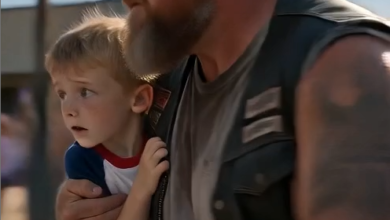
The biker shattered my school bus window, reached through the falling glass, and dragged an unconscious eight-year-old boy into his arms while I screamed that he was kidnapping one of my students.
My name is Marcus Bell. I had driven school buses around Gallup, New Mexico, for seventeen years before the afternoon I mistook the man saving a child for the greatest danger on my route.
It happened on a cold Thursday in November.
Twenty-two children had climbed aboard Bus 214 outside Red Mesa Elementary. By the time we reached the community-center stop near old Route 66, only six remained. Their parents were waiting beneath the metal awning while dust moved across the parking lot in pale ribbons.
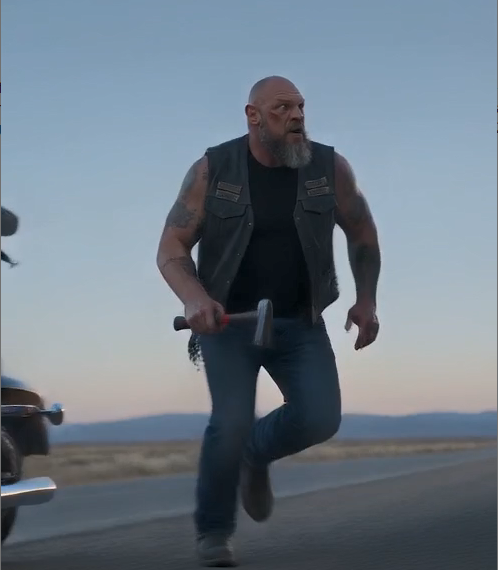
A black touring Harley had followed us for nearly three miles.
Its rider was Ray “Hammer” Dawson, though I did not know his name then. I saw a massive white biker in my mirrors: six feet four, close to 285 pounds, shaved head, thick salt-and-pepper beard and tattooed arms beneath a plain black leather vest. Heavy boots rested on the floorboards. A chain hung from his wallet. His face looked carved from old road asphalt.
He flashed his headlights.
Then he leaned on the horn.
I assumed he was impatient with a school bus stopping every few blocks. When he moved alongside us and pointed toward the rear wheels, I waved him back. He struck the side of his helmet, pointed at my bus again and made a cutting motion across his throat.
I thought he was threatening me.
My own head had begun aching. I blamed the long shift.
Two children complained that they felt sick. One girl said the bus was too warm, though the heater barely worked. Another rested her forehead against the window and closed her eyes.
I opened my driver’s window.
The biker continued following.
At the community center, I stopped and opened the front door. Parents approached, but Hammer parked his Harley across the lot, left its engine running and sprinted toward us.
That frightened everyone.
“Get away from the bus!” I shouted.
He ignored me.
Hammer ran to the rear, crouched near the exhaust pipe and pressed one scarred hand against the pavement. His expression changed. He stood, moved along the side of the bus and looked through each window.
Then he saw Eli Yazzie.
Eli was eight, small for his age and usually too curious to sit still. That afternoon, he was slumped against the final row with his backpack trapped beneath one shoulder.
Hammer pounded on the glass.
Eli did not move.
His mother, Leanne, was approaching from the parking lot when Hammer pulled a compact rescue hammer from his Harley’s roadside kit and struck the rear side window.
Glass collapsed inward.
Parents screamed.
I left my seat and stumbled down the aisle. My legs felt weak, but fear kept me moving. Hammer cleared the remaining fragments with his gloved forearm, reached through the opening and released Eli’s seat belt.
“No!” I shouted. “Put him down!”
Hammer pulled the boy through the window.
Leanne ran toward him, screaming her son’s name. Two fathers grabbed Hammer by the shoulders before he could take more than three steps. Someone knocked the rescue hammer from his hand.
Hammer did not fight.
He lowered Eli carefully onto the concrete, tore off his own leather vest and wrapped it around the child. Then he placed two fingers against Eli’s neck and looked at me.
“Get every kid off that bus.”
I thought it was a distraction.
A kidnapping attempt interrupted by parents.
I reached for Eli, but Hammer covered the boy with one tattooed arm.
“Not back inside.”
Leanne struck Hammer’s chest and demanded her son. He absorbed the blow without moving. His eyes remained fixed on Eli’s shallow breathing.
Then another child vomited near the bus door.
A second girl collapsed against her father.
Hammer shouted toward the crowd, “Kill the engine!”
I turned.
A dark pulse of exhaust was escaping beneath the middle of the bus instead of behind it. The pipe had separated near a joint below the passenger floor. The gas itself carried no warning color, and carbon monoxide could not be smelled, but soot and condensation marked the damaged seam Hammer had noticed from the road.
I shut down the engine.
Silence hit the parking lot.
Hammer looked at me and said, “Nobody goes back in.”
Firefighters arrived six minutes later. One carried a handheld gas meter through the open bus door.
The alarm began screaming before he reached the third row.
Parents stopped restraining Hammer.
Leanne dropped beside her son.
I stood beside my disabled bus, dizzy and confused, watching the frightening stranger use his leather vest as a blanket for the child I had unknowingly driven through a cabin filling with poison.
But I still did not know why Hammer recognized the broken exhaust note before my dashboard showed a warning, why he had inspected Bus 214 three days earlier, or whose name was stitched inside the vest now covering Eli.
Want to know why Hammer had been listening for that exact sound and what the torn leather vest carried from his past? Drop VEST in the comments—I’ll share the rest below.
Part 2 — The Note Beneath the Engine
I spent that night at Rehoboth McKinley Christian Health Care Services with oxygen tubes beneath my nose and guilt sitting heavier than any injury.
All six children remaining aboard Bus 214 showed signs of carbon monoxide exposure. Four improved quickly after receiving oxygen. One girl stayed for observation because she had asthma. Eli had been seated farthest toward the rear, near a floor seam above the damaged exhaust joint, and his exposure was more serious.
Doctors transferred him to Albuquerque for treatment in a hyperbaric oxygen chamber.
He remained unconscious when the helicopter left Gallup.
Leanne went with him.
I watched her disappear through the emergency doors without knowing whether I would ever be able to apologize. She had trusted me to carry her son home. I had watched him through the mirror, assumed he was sleeping and continued driving.
Hammer remained at the Gallup hospital until every child had been evaluated.
He refused treatment for several cuts along his forearm until a nurse threatened to call security. When she pointed out that security might have difficulty moving him, Hammer sat down and allowed her to remove small pieces of glass.
His leather vest went to Albuquerque with Eli.
The paramedics used it beneath a thermal blanket because Hammer had wrapped the boy in it before they arrived. When someone offered to return it, he shook his head.
“Kid’s using it.”
The Iron Lanterns Motorcycle Club reached the hospital around eight that evening. I heard their engines before I saw them. Eleven Harleys entered the lot in staggered formation, then shut down almost together.
Their silence made the hallway feel smaller.
Leon Brooks came first. He was a broad Black American man in his early fifties with a short gray beard and a plain leather vest similar to Hammer’s. Boone Keller, a red-bearded white biker, followed carrying Hammer’s helmet.
Leon looked at the bandage on Hammer’s arm.
“What happened?”
“Bus happened.”
“You broke into a school bus?”
“Window was faster.”
Leon looked toward me.
I expected accusation. Instead, he asked whether I was the driver and whether doctors had checked my blood carbon monoxide level.
I told him they had.
Then I asked why Hammer followed my bus.
Hammer did not answer immediately. He rubbed his thumb across a small crescent scar near his wrist and stared through the hospital window.
“The exhaust changed,” he said.
I had driven Bus 214 five days a week since August. I knew its rattles, door squeaks and brake hiss. The exhaust had always sounded rough, especially during acceleration, but fleet maintenance had cleared the bus at every inspection.
Hammer heard something else.
He had been riding behind us when the normal diesel rumble gained a sharp metallic pulse beneath the floor. It reminded him of an exhaust coupling working loose before the muffler. At our second stop, he saw dark moisture collecting around the middle underside rather than leaving through the tailpipe.
He tried signaling me.
I thought he was angry.
At the hospital, that misunderstanding sounded absurd. On the road, through mirrors and engine noise, every gesture from a large tattooed stranger had looked like aggression.
“Why didn’t you call police?” I asked.
“No signal where we were.”
“Why not pass me and block the bus?”
“With kids standing in the aisle?”
He had considered it.
He rejected it because forcing a sudden stop could injure them.
Hammer followed instead.
The first time he saw a child’s head fall against a window, he became certain something was wrong. By the community-center stop, Eli no longer responded to Hammer pounding on the glass.
That was why he broke it.
Not anger.
Not impulse.
A choice made after every slower option failed.
At midnight, a school district representative named Walter Grady arrived with two lawyers. They asked whether I had ignored warning lights. I had not. Bus 214 had no carbon monoxide detector and no dashboard sensor capable of identifying fumes entering the passenger cabin.
The exhaust-temperature gauge remained normal.
Walter asked when I first felt ill.
I admitted that my headache began before the final two stops.
“Why didn’t you pull over?”
“I didn’t know the bus was poisoning us.”
He wrote something on a legal pad.
Hammer stood.
The room changed when he did.
“You blaming him?” Hammer asked.
“We’re gathering facts.”
“Gather the maintenance records.”
“We will.”
“Start with Tuesday.”
Walter’s pen stopped.
Tuesday was the day Hammer had visited the district garage with a winter-coat donation from the Iron Lanterns. While unloading boxes, he heard Bus 214 idling inside a service bay.
He warned a mechanic about the exhaust note.
The mechanic told him not to touch district property.
Hammer had noticed the danger two days before it nearly killed Eli.
Someone at the garage had dismissed him for the same reason I had.
He looked like a man whose warning could safely be ignored.
Part 3 — What the Meter Found in Row Nine
Investigators sealed Bus 214 until state police, fire officials and a transportation inspector could examine it. The fire department recorded dangerous carbon monoxide levels even after the engine had been shut down and the doors opened.
The highest reading came from row nine.
Eli’s row.
A flexible exhaust coupling had separated beneath the bus floor. Two mounting brackets were cracked, allowing the pipe to shift upward whenever the bus slowed or climbed. A deteriorated rubber access seal above that area created a path into the cabin.
The defect had not appeared suddenly that afternoon.
Soot marked the metal around the joint. The damaged brackets had been vibrating for weeks, perhaps months. Mechanics should have noticed the change in sound, exhaust residue or movement during inspection.
The last maintenance form described the exhaust as secure.
The inspector’s signature belonged to a mechanic who had been home with pneumonia on the date listed.
That did not prove someone intended harm. It revealed something more ordinary and more common: a checklist had been copied without the inspection being completed.
The district suspended its fleet contractor.
All forty-three buses were removed from service until independent inspectors could examine them. Parents who had trusted the yellow buses every morning found themselves arranging carpools while rumors spread across Gallup.
A twelve-second video made everything worse.
The footage began with Hammer striking the window. It showed him lifting Eli through broken glass and running several steps away from the bus. Leanne’s scream filled the recording.
The video ended before the second child collapsed.
Someone posted it beneath a caption claiming a biker had attempted to abduct a Navajo boy from a school bus. Hammer’s face, tattoos and motorcycle were clear.
The clip traveled faster than the fire department’s explanation.
By sunrise, strangers had identified Hammer and the Iron Lanterns. Some accused the club of using charity work to approach children. Others threatened the community center for allowing bikers near the pickup area.
The district released a cautious statement confirming an “air-quality concern” but did not describe the life-threatening meter readings while its lawyers reviewed the incident.
Hammer became the visible villain.
The failed maintenance remained paperwork behind closed doors.
Leon wanted to release the entire parking-lot security recording. Hammer refused because it showed unconscious children and terrified parents.
“Blur them,” Boone said.
“No.”
“Brother, people think you grabbed that kid.”
“Kid doesn’t need his worst day watched by ten million people.”
“What about the club?”
Hammer’s eyes hardened. “We know who we are.”
The Iron Lanterns’ annual winter ride lost three sponsors within forty-eight hours. A local hardware store withdrew permission for the club to collect heaters for elderly residents. A restaurant canceled a fundraising dinner.
Hammer accepted every loss without defending himself publicly.
I did not.
I recorded a statement from my kitchen table. I described the headache, the signals I misunderstood and the meter screaming inside the bus. I told viewers Hammer had saved Eli and forced me to confront the truth that I had driven children through toxic fumes without recognizing the symptoms.
The district advised me not to post it.
I posted it anyway.
Leanne contacted me from Albuquerque two hours later.
Eli had awakened.
His first complete sentence was, “Where’s the big coat?”
He meant Hammer’s vest.
The doctors had folded it beside the hospital bed. The leather was scratched, one side stained by parking-lot mud and several seams cut where paramedics attached monitoring equipment.
Eli would recover.
Leanne asked whether Hammer could come to Albuquerque.
He rode there with Leon at dawn.
I followed in my car because I needed to see the child myself. The Interstate stretched east beneath a colorless sky. Hammer’s black Harley moved steadily ahead, but he did not ride fast.
At the hospital, Leanne met him near the elevators.
She had attacked him in the parking lot. Her fists had struck his chest while he protected Eli.
Now she stood holding his damaged vest.
“I’m sorry,” she said.
Hammer looked at the floor. “You were his mother.”
“I thought you were taking him.”
“I was.”
She stared at him.
“Out,” he added. “Just out.”
It was as close as he came to a joke.
When Hammer entered Eli’s room, the boy studied his beard and tattoos, then asked whether breaking a school bus window was illegal.
“Usually.”
“Are you going to jail?”
“Not today.”
“Can I keep your jacket?”
“It’s a vest.”
“Can I keep it?”
Hammer looked at the torn leather.
Something changed behind his eyes.
He sat beside the bed and told Eli the vest had belonged to someone before him. He did not say who. He did not explain the name stitched into the inner lining.
He only said, “Borrow it till you’re warm.”
Later, while Eli slept, Leon told me the truth.
The name inside that vest belonged to Hammer’s younger brother, Daniel Dawson.
Daniel had died from carbon monoxide poisoning in a garage twenty-eight years earlier.
Part 4 — The Garage Door That Never Opened
Daniel Dawson was twenty-one when he died.
He and Hammer had been repairing an old pickup behind their mother’s house outside Winslow. Winter rain had made the yard muddy, so they worked inside a detached garage with the main door lowered against the cold.
The truck’s engine ran while they adjusted the carburetor.
Hammer left to buy coffee.
Daniel stayed.
When Hammer returned, the garage lights were still on. Music played through a portable radio. Daniel looked as though he had fallen asleep beside the workbench.
Hammer entered and became dizzy before reaching him. He crawled back outside, shouted for a neighbor and helped drag Daniel through the side door.
The ambulance arrived.
Daniel never woke.
Hammer carried guilt more faithfully than he carried any club patch. He had been the older brother, the experienced mechanic and the one who understood engines. He should have opened the garage door. He should have shut off the truck. He should have recognized the headache Daniel mentioned before Hammer left.
Instead, he bought two coffees.
One remained unopened.
Daniel owned the black leather vest that later became Hammer’s. It was too small across Hammer’s chest, so a leatherworker added side panels. Hammer removed the old club patches but kept Daniel’s name stitched inside.
For years, he could not hear an uneven exhaust without returning to that garage.
He learned everything he could about carbon monoxide. He installed detectors for neighbors, then for elderly residents whose furnaces had not been inspected. He carried portable meters during winter charity visits. At club gatherings, he was the man who checked garage ventilation before motorcycles were started.
The others teased him.
They still opened the doors.
Hammer did not have a meter with him when he followed Bus 214. He had left it in the clubhouse after checking a family’s heater that morning. All he possessed was the change in exhaust tone, the stain beneath the bus and a memory that never softened.
That memory saved Eli.
It also explained why Hammer froze when the boy asked to keep the vest. The leather was not expensive, but it was the final thing Daniel had worn during his last motorcycle ride. Hammer had protected it through rainstorms, accidents and decades of highway miles.
Now the back panel had been scraped across broken glass.
Mud covered the lower edge.
A paramedic had cut one side seam.
Leon expected Hammer to take it home.
Hammer left it beside Eli.
“He’ll give it back,” Leon said.
Hammer watched the boy sleeping beneath the blanket. “Maybe.”
The deeper twist surfaced in the maintenance investigation.
Three days before the incident, Hammer had not merely heard Bus 214 idling in the garage. He had walked beneath its rear section and photographed the soot around the exhaust joint.
The mechanic ordered him out.
Hammer sent the photographs to the district transportation office that evening. Because the message came from an unfamiliar motorcycle-club address and used blunt language, an assistant marked it as an aggressive complaint from a trespasser.
Nobody forwarded it to the fleet supervisor.
The email remained unread until investigators searched the district server.
Hammer had warned them in writing.
Had someone opened the attachment, Bus 214 might have been removed from service before I drove it again.
Walter Grady brought a printed copy to Eli’s hospital room. He apologized on behalf of the district and asked Hammer to meet with reporters.
Hammer declined.
Walter offered to reimburse him for the damaged vest and bus window.
“Fix the buses,” Hammer said.
“We are.”
“Put detectors in them.”
“Regulations don’t require—”
“Then be better than regulations.”
Walter began explaining budgets.
Leanne stepped between them.
“My son stopped breathing in row nine,” she said. “Find the money.”
Parents raised the rest.
Within a week, a community fundraiser collected enough to install carbon monoxide alarms in every district bus while officials prepared a permanent budget. The Iron Lanterns donated the money remaining from their canceled winter ride.
They did not put the club’s name on the detectors.
Hammer asked for only one thing.
The alarms had to be loud enough for a child in the rear row to hear them before a driver lost concentration.
He knew how quietly carbon monoxide entered a room.
He wanted the warning to be impossible to ignore.
Part 5 — The Vest at the Foot of Eli’s Bed
Eli remained in Albuquerque for five days. His headaches faded, his balance returned and follow-up testing showed no obvious neurological injury. Doctors warned Leanne to monitor his concentration, sleep and mood, but his recovery was better than anyone predicted during the first hour.
I visited twice.
The first time, Eli asked whether I would still drive his bus.
I did not know.
The district had placed me on paid administrative leave. Although investigators found no evidence that I caused the mechanical failure, I had missed early symptoms among the children and myself.
That fact stayed with me.
“I should have stopped sooner,” I told him.
Eli considered it. “Hammer stopped you.”
“Yes.”
“So now you know.”
Children can make forgiveness sound like a practical instruction.
I completed additional emergency-response training before returning to work. The fire department taught drivers that carbon monoxide can cause headache, dizziness, nausea, confusion, weakness and unusual sleepiness. Those symptoms can resemble ordinary illness, motion sickness or exhaustion, especially among children.
No symptom alone proved exposure.
Several children becoming sick together demanded action.
The second time I visited, Hammer was repairing his vest near the window. Eli watched from bed while Hammer guided waxed thread through a leather seam with a curved needle.
“You said I could keep it,” Eli reminded him.
“Said you could borrow it.”
“For how long?”
“Till you’re warm.”
“I’m warm.”
Hammer stopped sewing.
Eli grinned.
The vest was far too large for him. He could disappear inside it from shoulders to ankles. Leanne had folded it at the foot of his bed each night because he refused to let nurses place it in a closet.
Hammer turned the leather over and showed him Daniel’s name inside the lining.
“My brother wore this first,” he said.
“Is he in your club?”
“Not anymore.”
“Did he quit?”
Hammer’s hands became still.
“He died.”
Eli’s smile disappeared. “Then you should keep it.”
Hammer looked at the boy for several seconds. “That what you think?”
“If my brother gave me something, I’d keep it.”
“He didn’t give it. I took it after.”
Eli touched the torn side panel. “Maybe he was done using it.”
The sentence struck Hammer hard enough that he looked toward the window.
Leon, standing near the door, lowered his head.
Hammer completed the repair but did not reclaim the vest. Instead, he removed a small inner pocket containing Daniel’s old motorcycle registration and transferred it to his shirt.
Then he left the leather with Eli for one final night.
The next morning, Leanne brought it to the parking lot. She had cleaned the mud without disturbing the worn surface. Eli had added something inside: a small square of yellow fabric from his school backpack, sewn unevenly beneath Daniel’s name.
No words.
Just color.
Hammer traced the crooked stitches.
Leanne explained that yellow was the color of the bus. Eli wanted Hammer to remember there had been children inside, not only the brother he could not save.
Hammer put the vest on.
The repaired seam pulled slightly across his side. The yellow square remained hidden against his ribs.
When the district finally held a public meeting, the room was packed. Parents demanded maintenance records, independent inspections and explanations for the ignored email.
Walter Grady accepted responsibility for the communication failure. The fleet contractor admitted that inspection forms had been copied to clear a backlog. State transportation officials opened a broader review.
Hammer attended from the back row.
He did not speak until someone blamed me.
A parent said I should have smelled the fumes.
Hammer stood.
“You can’t smell carbon monoxide.”
The room quieted.
“He had a headache. Kids looked tired. That happens on buses every day. The machine failed. The inspection failed. The warning got ignored. Don’t make one driver carry everybody’s mistake.”
I looked at him.
He did not return my gaze.
Hammer sat down and crossed his tattooed arms as if he had said nothing unusual.
The district reinstated me the following Monday.
Bus 214 never returned to service. Its repair cost exceeded its remaining value, and the board voted to retire it. Before the vehicle went to salvage, the superintendent allowed Hammer, Leanne and me to visit the yard.
The broken window remained covered with plastic.
Hammer climbed inside once.
He walked to row nine and pressed his hand against Eli’s seat.
Then he listened.
No engine. No exhaust. No children.
Just wind moving through torn plastic.
He removed the emergency-exit instruction plate from the broken window frame with district permission and carried it to his motorcycle.
“What will you do with that?” I asked.
“Make sure I remember which way was out.”
Part 6 — Forty-Three Alarms
By the start of the spring semester, all forty-three school buses carried carbon monoxide detectors. Drivers checked them during morning inspections beside lights, mirrors, brakes and emergency exits.
The alarms were tested weekly.
Children complained about the sound.
Nobody apologized.
The district replaced its fleet contractor and created a reporting system that separated safety warnings from general complaints. Photographs involving brakes, tires, steering or exhaust were automatically forwarded to both transportation supervisors and an independent inspector.
Motorcycle clubs were not given special authority.
They were finally given the same chance to be heard as anyone else.
The Iron Lanterns rebuilt their winter charity ride after the canceled sponsors returned. Two businesses never did. Leon said the club no longer needed them.
Hammer added a compact carbon monoxide meter to his saddlebag beside his first-aid kit. He checked community heaters, garages and stranded vehicles during cold weather. He never entered an enclosed space with a running engine.
Daniel’s death remained part of every inspection.
Not a speech.
A habit.
Eli returned to school on a smaller replacement bus. For the first week, he refused to sit beyond row three. Leanne rode with him on Monday, and a counselor met him at school.
Hammer waited at the community-center stop each afternoon.
He did not approach the bus. He parked his Harley where Eli could see it through the window and raised one gloved hand when the doors opened.
After three weeks, Eli moved to row five.
Then row seven.
By May, he sat in the rear seat again—not because anyone forced him, but because the back window offered the best view of Hammer following at a legal distance.
I checked the mirror more often than necessary.
This time, the biker behind my bus did not frighten me.
On the final day of school, Eli stepped off carrying a folded black cloth. He walked to Hammer and handed it over.
It was a child-sized imitation vest sewn by Leanne from heavy canvas. The back was plain. Inside, beneath the collar, she had stitched a yellow square matching the one hidden in Hammer’s leather.
“For the next kid who gets cold,” Eli said.
Hammer turned the small vest over in his hands.
“Hope nobody does.”
“Still carry it.”
Hammer opened his saddlebag.
He placed the child-sized vest beside the carbon monoxide meter.
The compartment that once held only tools now carried a blanket shaped like something he had finally learned to save.
Part 7 — The Driver Who Finally Heard It
A year after the incident, I drove a new bus along the same Route 66 stretch where Hammer first signaled me.
The children were louder. The mirrors were clearer. A carbon monoxide detector glowed near my dashboard, displaying safe levels without attracting anyone’s attention.
At the community-center stop, Eli waited until everyone else exited.
He was nine now, taller and less frightened by enclosed spaces. Before stepping down, he tapped the detector twice.
“Still working?”
“It was working when you checked ten minutes ago.”
“Check again.”
I pressed the test button.
The alarm shrieked.
Eli smiled and left.
Hammer stood outside wearing Daniel’s repaired vest. The yellow fabric remained hidden beneath it, but I knew it was there. His black Harley waited beside the curb, and the small canvas vest rode inside its saddlebag.
Leanne approached carrying the leather vest Hammer had used as Eli’s blanket in the parking lot. She had borrowed it for a school safety presentation and returned it carefully folded.
Hammer put it on.
The worn leather settled across his shoulders.
“Still smells like bus,” he muttered.
“It smells like your motorcycle,” Leanne replied.
“Motorcycle smells better.”
I completed my post-route inspection while Hammer crouched near the new bus’s exhaust system. He did not touch anything. He listened as the engine idled, then walked to the rear and watched the exhaust leave through the proper outlet.
“Sounds clean,” he said.
A year earlier, I would have heard criticism.
Now I heard relief.
The district had placed the emergency-exit plate from Bus 214 inside its training center. Hammer refused to attend the unveiling. He did not want his photograph beside it, and he rejected a plaque describing him as a hero.
He asked them to display the failed coupling instead.
Metal could teach what praise could not.
Before leaving, Eli asked Hammer whether he still thought about the brother whose vest he wore.
“Every time an engine runs indoors.”
“Does it hurt?”
“Yep.”
“Then why listen?”
Hammer looked toward the bus.
“So I hear the next one.”
He started the Harley. The V-twin settled into a heavy rhythm, but he waited until my bus pulled away before entering the road.
This time, when his headlight flashed in my mirror, I did not wave him back.
I checked the dashboard.
I listened.
Then I raised one hand in thanks.
Follow our page for more unforgettable biker stories about frightening first impressions, quiet courage and the strangers who notice danger before anyone else believes them.