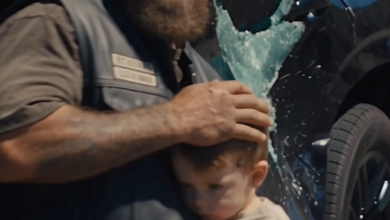
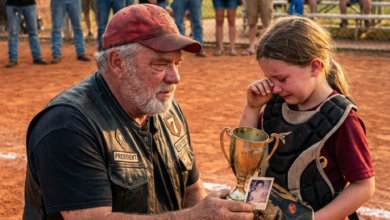
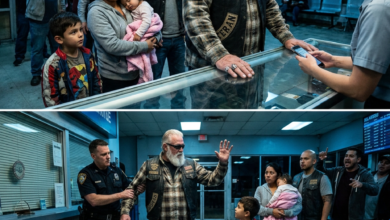
The Biker Locked a Toy Store and Refused to Let the Children Inside — Then the Ceiling Came Down Where Their Birthday Line Had Been Standing
Part 2 — The Ironworker Who Would Not Enter Toy Stores
The first time I learned Ray “Hammer” Dawson’s real name was in the ambulance bay after the collapse, although the story of why he had stopped at Tin Star Toys began long before my son’s birthday.
Fourteen years earlier, Hammer had been a union ironworker in Phoenix. He spent his days walking beams six stories above concrete and his weekends riding an old Harley north to Flagstaff, where his daughter Emma lived with her mother.
Emma was nine.
She loved windup toys, hated chocolate cake, and carried a yellow emergency whistle because Hammer believed every child should have one. He scratched her name into the plastic with the point of a roofing nail.
“Three blasts if you’re lost,” he taught her.
Emma immediately blew it inside his truck until his ears rang.
He laughed then.
That detail came from Moses Carter, the gray-braided biker I had seen leaving the parking lot. Moses had worked beside Hammer for eleven years and rode with a small veterans-and-tradesmen club called the Iron Saints. They had no territory to defend and no criminal reputation, only men carrying injuries they rarely discussed.
Hammer’s injury had no scar a doctor could photograph.
He had once understood buildings as well as some people understand voices. He knew the soft groan of a beam under ordinary strain, the ping of a fastener beginning to shear, and the difference between harmless drywall dust and the pale powder produced when concrete moved against steel.
But after Emma died, he left the trade.
She had been attending a holiday craft event inside an old department store when a decorative ceiling and part of the mezzanine failed. Maintenance workers had reported cracks. A property manager postponed repairs to keep the building open through a profitable weekend.
Hammer arrived seven minutes after the collapse.
He heard Emma’s whistle beneath the debris.
Three blasts.
Then three more.
He climbed over a barricade, fought two security guards, and tore at plaster until firefighters dragged him away because a second section was falling. Emma and another child were recovered hours later.
The whistle was in her hand.
Hammer carried it after that.
He also carried rage.
Three weeks after the funeral, he found the property manager outside a courthouse and broke the man’s jaw. The assault sent Hammer to prison for eighteen months and cost him his union card, his house, and most of the relationships that had survived Emma’s death.
Moses visited every month.
When Hammer was released, Moses placed the keys to a rebuilt Harley in his palm and said, “You can disappear, or you can ride beside somebody.”
Hammer chose the second.
The Iron Saints began repairing wheelchair ramps, escorting bullied children to school, and delivering Christmas gifts to rural shelters. Hammer went on every ride except those requiring him to enter a toy store.
He would carry boxes to the entrance.
Never across it.
That Saturday, the club was delivering handmade toys to a foster-care fundraiser in Winslow. One of the straps securing a wooden dollhouse came loose, so the riders pulled into Tin Star’s parking lot to fix it.
Hammer was tightening the strap when the rooftop unit started.
He heard a ping.
The others heard an air conditioner rattling.
Hammer heard steel surrendering.
He walked beneath the awning, saw a fresh gap in the masonry, and noticed powdered gypsum on a display behind the window. A toy train was moving in small jerks on a shelf although its switch was off.
He told Moses to call 911.
Then he entered the store.
Linda Ortega, Tin Star’s owner, recognized fear in his face before she understood its cause. Hammer asked how many people were inside, where the rear exit opened, and whether the ceiling had been inspected.
Linda’s answer was the first minor truth hidden beneath that morning’s chaos.
She had reported cracks nine days earlier.
The landlord sent a handyman who painted over them.
That morning, Linda had noticed the patch separating again, but the building manager told her the material was “only cosmetic” and reminded her that canceling two birthday parties would cost thousands of dollars.
Hammer climbed three steps onto a display platform and pressed his palm against a support column. A vibration traveled through it.
Not much.
Enough.
“Get them out the rear,” he said.
Linda hesitated. There were children arriving at the front and parents already filling the sidewalk. If she shouted that the building might collapse, they could rush inside to retrieve family members.
Hammer understood the danger.
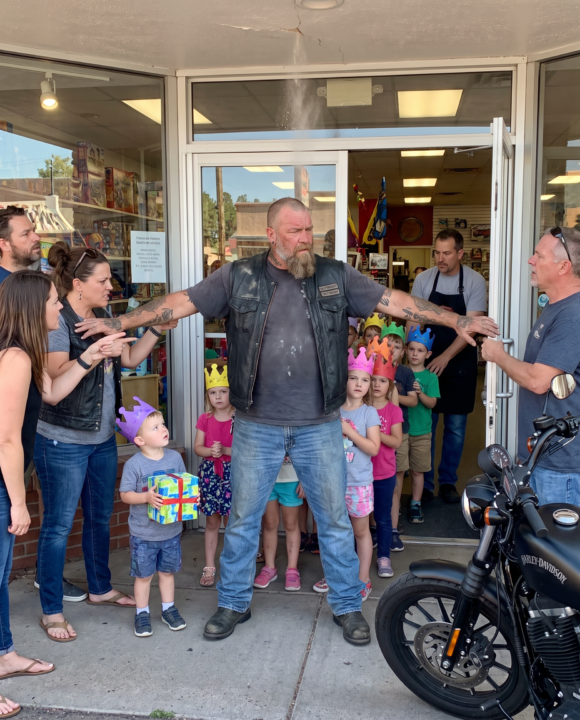
He took her keys, stepped outside, and locked the front door.
He made himself the villain because a locked door was easier to control than twenty frightened parents.
Linda led the first group toward the rear exit. Hammer’s brothers arrived after hearing Moses’s call, and he gave each man an assignment based on skills gathered over complicated lives.
Doc Mercer had been an Army medic. Moses had worked for the gas company. Colt Reyes, whose grandson Eli was inside, had managed evacuation drills at a copper mine.
Colt wanted to enter.
Hammer ordered him away.
That command almost broke the club.
“You don’t get to keep me from my blood,” Colt said.
Hammer gripped the back of Colt’s neck and pulled their foreheads close.
“If you go through that door, ten parents follow. Clear the west side. I’ll bring Eli out.”
“You swear?”
“No.”
It was the only honest answer.
Colt rode toward the adjoining businesses with tears shining in his eyes and fury stiffening his shoulders. Several parents thought he was escaping.
In reality, he was choosing to trust the one man who had already lost a child inside a failing building.
By the time the police dispatcher understood the call, Hammer had cleared the dangerous sidewalk, Linda had opened the rear route, and the Iron Saints had begun evacuating three neighboring businesses.
Only the count remained wrong.
Twenty-three children had come out.
Linda’s registration sheet listed twenty-four.
The missing child was Ruby Bell, a seven-year-old girl who had arrived with her grandmother and carried a yellow stuffed elephant everywhere. Ruby had sensory-processing difficulties. Loud voices made her hide.
When the adults began shouting, she disappeared.
Hammer looked through the glass at the bowing ceiling. Then he touched Emma’s whistle and turned the key again.
For fourteen years, he had refused to cross a toy-store entrance.
That morning, he crossed it twice.
Part 3 — Twenty-Three Children and One Crooked Song
When Hammer entered Tin Star the second time, every shelf seemed to be making a different sound.
Plastic pieces rattled inside boxes. A battery-powered pony whinnied from somewhere near the register. Above it all came the crooked melody of six music boxes chiming as the floor and display cases shifted beneath them.
I watched from behind the police tape that had finally been stretched across the parking lot. Noah clung to my waist. My niece Ava had reached the alley safely, but Ruby’s grandmother stood beside the bakery screaming the child’s name.
Hammer disappeared beyond the cardboard rocket.
Then the front section of ceiling dropped.
It did not collapse as one solid slab. First came a shower of white powder, followed by ceiling tiles, light fixtures, metal gridwork, and chunks of plaster large enough to crush the display tables beneath them.
The glass door flexed outward.
A firefighter dragged me farther back.
Hammer was still inside.
The strange part was that the roof itself had not failed. The heavy decorative ceiling beneath it had detached from corroded hangers, and one moving section was pulling against the next. To people outside, the first collapse looked like the entire danger had passed.
Parents started forward.
The fire captain stopped them.
Hammer did not reappear.
Inside, he stayed low and followed the left wall because he had seen where the first crack traveled. He called Ruby’s name once, then stopped. A frightened child who hid from shouting would not answer a huge stranger whose voice sounded like gravel.
So Hammer listened.
Ticking toys.
Breaking plaster.
A sprinkler pipe beginning to hiss.
Then something softer.
A squeak.
Not a child.
A stuffed elephant.
Ruby squeezed it when frightened, and a plastic reed inside one foot produced a weak squeal. Linda had mentioned the toy while reading names from the party list.
Hammer heard it beneath the model-train display.
He crawled toward the sound.
Outside, Colt broke from the rear alley and ran for the front entrance. Two firefighters caught him at the tape, but he fought hard enough to bring all three men to the ground.
“My grandson said she hides under tables,” he shouted. “Tell Hammer she hides under tables.”
Doc Mercer reached him first. He did not strike Colt or order him to calm down. He pressed both palms against Colt’s leather vest and waited until the man focused on him.
“Your grandson is out.”
“Ruby isn’t.”
“Hammer knows.”
“How?”
“Because he listens.”
Inside, Hammer found the yellow elephant protruding from beneath a low wooden workbench where children assembled toy kits. Ruby was curled behind it with both hands over her ears. A falling shelf had trapped one side of the table beneath a pile of boxed dolls, but the table’s thick legs had created a small pocket.
Hammer lay flat.
Ruby looked at the tattoos across his knuckles and pushed deeper beneath the bench.
He took off his vest.
The yellow whistle was gone because he had given it to me, but a square of faded purple fabric was sewn into the inside lining. Hammer tore it free and slid it toward the girl.
It was a child’s handkerchief printed with tiny silver stars.
“Emma used to hide too,” he said.
Ruby did not answer.
A metal hanger snapped above them.
Hammer looked up.
Dust struck his face.
He could not drag Ruby out without exposing her to the aisle, and the safest route to the rear had been cut off by a fallen lighting grid. He needed someone outside to create another opening.
He pulled a small two-way radio from his belt.
“Moses.”
Static answered.
The collapsing metal had disrupted the signal. Hammer shifted closer to the front window, but another section of ceiling groaned above the path.
He tried again.
“Moses, west display wall. Three feet north of the mural. Hollow partition.”
Moses heard only fragments.
“Repeat.”
Hammer glanced at Ruby.
She had unfolded the purple cloth and was rubbing one silver star between her fingers.
“Make a door.”
That message reached them.
Moses ran to the club’s support truck. The riders carried tools because they spent weekends repairing homes, and beneath the dollhouse sat a demolition saw, pry bars, sledgehammers, timber blocks, and two lifting jacks.
The same equipment parents had assumed belonged to criminals became an improvised rescue kit.
Colt joined Moses at the west wall. Firefighters initially ordered them away, but Linda confirmed that the partition beside the mural contained no electrical lines. The captain inspected the building plan and gave them ninety seconds before his crew took over.
The bikers did not waste one.
The saw screamed through stucco.
Moses cut a rectangle. Colt drove a sledgehammer through the inner board. Two firefighters pulled the opening wide enough for a body to pass.
Fresh air entered the toy store.
Ruby heard it.
Hammer pointed toward the light.
“That’s our road.”
She shook her head.
He reached under the bench, but she pressed herself against the wall. He could have seized her ankle. Instead, he removed the silver skull ring from his finger and rolled it toward her.
“My brothers are outside,” he said. “They’ll trade you this for your elephant.”
Ruby studied the ring.
Then she crawled forward.
A beam above the center aisle made a low tearing sound.
Hammer knew that sound too.
“Fast now.”
Ruby moved into his arms. He wrapped her inside the heavy leather vest, covering her head and shoulders while leaving her face open. Then he crawled toward the new hole, pushing the child ahead of him.
Colt’s hands appeared through the opening.
He caught Ruby first.
The crowd cheered.
That was the false ending.
A firefighter pulled Ruby outside. Colt carried her toward Doc Mercer. Ruby’s grandmother fell to her knees beside them, touching the child’s cheeks and repeating her name.
Hammer was still halfway through the wall.
The beam moved.
The remaining ceiling came down behind him and struck his legs, driving his chest against the broken edge of the opening. For one second, his upper body remained visible while the lower half disappeared beneath plaster and twisted gridwork.
Then the wall shifted.
Moses grabbed Hammer’s right arm. Colt seized the left. Firefighters dug beneath his shoulders while debris continued falling inside.
“Leave me,” Hammer growled.
No one did.
The Iron Saints pulled together.
Hammer came through the opening without one boot and with blood running from his scalp. His jeans were torn at the knee. His left leg dragged uselessly across the asphalt.
Yet his first question was not about himself.
“Count.”
Linda answered through tears.
“Twenty-four.”
Hammer closed his eyes.
Only then did his body begin shaking.
Ruby approached him before paramedics could place him on the stretcher. She still wore his vest, which hung to her ankles. In one hand she carried her elephant. In the other, she held his skull ring.
“You forgot this,” she whispered.
Hammer opened his palm.
Ruby placed the ring inside it, then kept hold of one of his scarred fingers.
The crowd that had called him a monster forty minutes earlier became silent.
I still held Emma’s whistle.
I thought I understood why.
I did not.
The collapse had hidden another truth beneath the ceiling, and that truth would explain why Linda recognized Hammer’s fear, why he knew her name, and why a patch of silver-starred cloth had been sewn inside his vest for fourteen years.
Part 4 — The Girl Hammer Had Already Carried Out Once
Hammer suffered a fractured ankle, three broken ribs, and a deep cut across his scalp. He refused pain medication until Ruby had been examined, which annoyed the paramedics but surprised no one who knew him.
The police wanted a statement.
The fire marshal wanted his observations.
The parents wanted to apologize.
Hammer wanted his whistle back.
I climbed into the ambulance before it departed and placed the yellow plastic object in his hand. Up close, I could see small brown marks inside the scratches of Emma’s name. Dirt, I assumed.
Hammer closed his fingers around it.
“Thank you.”
It was the first time he spoke to me without giving an order.
“I grabbed your vest,” I said. “I thought you were trapping them.”
“You were scared.”
“I called you a monster.”
“I’ve been called worse.”
He turned his face toward the open ambulance doors. Ruby was sitting on the curb wrapped in a firefighter’s coat, and Linda Ortega knelt beside her.
When Linda looked toward Hammer, she began crying.
Not from relief alone.
She stood, crossed the pavement, and climbed into the ambulance without asking permission. Hammer watched her approach with an expression I could not read.
“You remembered the count,” he said.
Linda nodded.
“Twenty-four.”
“You got them moving.”
“You taught me.”
That was the next turn.
Linda had been seventeen when the Phoenix department-store ceiling collapsed fourteen years earlier. She worked weekends at a temporary craft counter near the mezzanine and was guiding children through an ornament-making activity when the first light fixture fell.
Hammer arrived searching for Emma.
Before firefighters forced him away, he found Linda pinned beneath a display panel and carried her through a service door. She remembered his tattoos, his beard, and the yellow whistle hanging from his fist.
She also remembered what he shouted before returning toward the rubble.
“Count the kids.”
Linda counted them from the sidewalk while bleeding through her uniform. Two were missing.
One was Emma.
The other child survived after rescuers followed the sound of Emma’s whistle to the pocket where they were trapped. Emma had placed the whistle between the younger boy’s lips when he became too weak to cry.
He blew the final three blasts.
Emma was already unconscious.
The stains inside her scratched name were not dirt.
They were fourteen-year-old blood.
Hammer never told that detail. Linda did.
She had followed the investigation, attended Emma’s funeral from the back row, and later testified against the property company. Years afterward, when she opened Tin Star Toys, she designed marked evacuation routes, kept a registration list for every party, and trained employees to count children at both doors.
Those precautions saved minutes.
But Linda had also made one choice she could not forgive.
When the landlord dismissed the new cracks as cosmetic, she kept the store open.
“I knew better,” she said inside the ambulance. “I let him make me doubt what I saw.”
Hammer looked down at the whistle.
“You called.”
“He ignored me.”
“You opened the back.”
“I should have canceled everything.”
“You opened the back,” Hammer repeated.
He did not absolve her with a speech. He simply named the action that mattered when the danger became real.
The ambulance doors were about to close when another vehicle entered the lot. A silver SUV stopped beside the police cars, and a man in a pressed shirt climbed out while speaking angrily into his phone.
Linda went rigid.
“That’s him.”
The man was Grant Mercer, representative of the company that owned the strip mall. He told officers that Tin Star had operated against instructions and suggested Linda’s unauthorized decorations might have overloaded the ceiling supports.
Hammer heard him.
So did several parents.
Grant insisted the cracks had never been reported. Linda’s emails, he said, contained only complaints about flaking paint. The handyman had found no structural problem.
It sounded plausible until Noah approached the ambulance carrying a red toy truck.
He had found it beneath a bench outside. A small action camera was taped to the roof because Tin Star used the truck to film promotional races along a plastic track.
The camera had been recording that morning.
Its wide angle captured the front window, part of the ceiling, and the handyman who had visited nine days earlier. In the footage, he scraped loose material from a crack, filled it, and called someone on speakerphone.
Grant’s voice came through clearly.
“Paint it. We only need it quiet through the weekend.”
The store had not merely been neglected.
The danger had been hidden.
Police took Grant aside. Linda covered her mouth. Parents who had been shouting at Hammer now turned their anger toward the man in the pressed shirt.
Hammer did not watch.
His eyes remained on the purple cloth Ruby still carried. It had once been part of Emma’s favorite pajamas—the same pajamas she wore during weekend visits with him. After her death, he cut a square from the sleeve and stitched it inside his vest.
Ruby had rubbed the silver stars exactly as Emma once did when frightened.
That was why Hammer’s voice cracked inside the store.
He had not been rescuing a stranger in that moment.
He had been standing at the edge of the one morning he could never change.
But the greatest surprise came when Ruby’s grandmother asked Linda whether she could meet the boy Emma had saved with the whistle fourteen years earlier.
Linda looked toward Colt Reyes.
Colt was holding his grandson Eli against his chest.
Then Colt pointed at himself.
“I was that boy.”
He had been seven years old when Emma placed the whistle between his lips. Hammer had known Colt for nine years but never knew the quiet mechanic who joined the Iron Saints was the child recovered beside his daughter.
Colt had known.
He carried the secret because he could never find words large enough to give it back.
Until that day.
Part 5 — What Colt Owed a Girl Named Emma
Colt waited until Hammer returned from surgery.
The hospital allowed only two visitors at a time, but the Iron Saints filled the hallway anyway. Their leather cuts rested against plastic chairs. Coffee cooled in paper cups. Boots squeaked whenever a nurse appeared.
Moses entered first.
Colt followed alone.
Hammer lay with his left leg raised beneath a heavy brace. A line of black stitches crossed his scalp, and every breath tugged at the tape around his ribs. Emma’s whistle rested on the table beside him.
Colt closed the door.
For a while, neither man spoke.
Then Colt removed his own vest and turned it inside out. Sewn beneath the lining was a narrow strip of faded yellow ribbon and a small department-store price tag dated December 18, fourteen years earlier.
Hammer stared at it.
“My mother kept my coat,” Colt said. “That tag was in the pocket.”
Hammer’s jaw tightened.
Colt told him the memories arrived in pieces. Falling lights. Dust blocking the Christmas decorations. A girl with starry pajamas crawling toward him. Her hand pushing a whistle against his lips.
Colt remembered refusing because he was coughing.
Emma told him to blow three times.
He did.
Then she wrapped part of her pajama sleeve around a cut on his palm. That was why a section had been missing when Hammer received her belongings.
Hammer looked toward the purple cloth on the bedside chair.
Ruby had returned it.
“She kept me awake,” Colt said. “Every time I closed my eyes, she pinched me. She said her dad was coming.”
Hammer’s fingers curled against the blanket.
“I came.”
“I know.”
“Late.”
“No.”
The word landed hard.
Colt moved closer to the bed. He was nearly as large as Hammer, yet in that room he looked like the seven-year-old beneath the rubble.
“She heard you outside,” he said. “You were yelling her name. She told me, ‘That’s my dad. He always comes.’”
Hammer turned his face toward the window.
His shoulders shook once.
No tears fell.
Colt continued because stopping would have left both men inside the old debris.
“My mother tried to find you after the funeral. Then you went away. Years later, I saw Moses at a charity ride wearing the Iron Saints patch. I asked about the man named Hammer.”
“You knew when you joined?”
“First day.”
“Why didn’t you tell me?”
“Because you treated me like a brother before you knew I owed you anything.”
Hammer remained silent.
Colt had joined the club not only because motorcycles steadied his thoughts, but because he wanted to stand beside the father of the girl who saved him. He repaired Hammer’s bike. He shared holiday dinners. He sat outside the garage during nights when Hammer could not sleep.
He never mentioned Emma.
That secrecy now looked like betrayal.
“You let me talk about her,” Hammer said.
“I listened.”
“You let me say she died alone.”
Colt’s voice broke.
“She didn’t.”
That was the gift he had carried for fourteen years.
Emma had been frightened. She had been hurt. But she was not alone, and her final conscious act was not screaming for rescue. It was teaching another child how to call for help.
Hammer covered his eyes with one hand.
Colt waited.
At last, Hammer pointed toward the chair.
“Bring me my cut.”
Colt handed him the vest. Hammer turned the lining outward and placed Emma’s purple cloth beside the yellow strip Colt had saved. The torn edges matched.
Perfectly.
Hammer took the hospital sewing kit from the bedside drawer. His fingers were too swollen to guide the needle, so he passed it to Colt.
“Put it back.”
Colt stitched the two pieces together while Hammer watched.
No grand apology followed.
No speech about forgiveness.
When the last knot was tied, Hammer tapped the mattress beside him. Colt sat down. Hammer gripped the back of his neck and rested their foreheads together as he had done in the parking lot.
“Brother,” he said.
That was enough.
News of the collapse spread across Arizona. Video showed Hammer blocking the entrance while parents shouted at him. Another clip showed the ceiling striking the exact place where the children’s line had formed.
The first video made him look dangerous.
The second made the first understandable.
Parents offered interviews and fundraising pages. Hammer refused most of them. He agreed to speak once at the city hearing, where he placed Emma’s whistle on the desk and described the warning sounds in plain trade language.
He did not mention heroism.
He described failed hangers, moving joints, falling powder, and the delayed repair request. Then he looked at the council members and said six words.
“Cracks don’t care about business hours.”
The property company lost its operating license. Investigators found altered maintenance logs at three other buildings. Two were closed for immediate repairs, including a daycare center where ceiling anchors had corroded above the nap room.
That discovery meant the children at Tin Star were not the only ones saved by Hammer’s refusal to move.
Linda reopened the shop six months later in a one-story building across town. She installed exposed ceiling beams painted bright blue so every connection remained visible. A brass plaque near the rear exit bore twenty-five names.
The twenty-four children evacuated that morning.
And Emma Dawson.
Hammer objected to the plaque until Linda showed him the wording.
“She taught us to count.”
He touched the engraved letters once.
Then he walked away before anyone could see his face.
Ruby returned his skull ring during the reopening. She also gave him a new yellow stuffed elephant, small enough to fit inside a saddlebag.
Hammer accepted it carefully.
“What do I owe you?” he asked.
Ruby considered the question.
“Three whistles.”
Hammer looked at Colt.
Colt smiled.
Together, they blew three sharp blasts beneath the bright blue beams.
Part 6 — Saturdays Beneath the Blue Beams
Tin Star Toys changed after the collapse.
Every Saturday morning, one employee inspected the exposed beams while another tested both exits. Children practiced walking toward the rear alley by following a rope with colored handles. Linda kept the head-count sheet clipped to her belt.
The children treated evacuation drills like games.
The adults did not.
Hammer came on the first Saturday of every month. His damaged ankle left him with a permanent limp, especially during cold Flagstaff mornings, but the uneven beat of his motorcycle boots became as familiar inside the shop as the bells above the door.
For the first few visits, he never crossed the threshold.
He parked his Harley beside the curb, delivered wooden toys, and waited outside while Colt carried the boxes in. Ruby usually met him with two cups of cocoa—one for her, one she claimed was for his beard.
Eventually, she moved his cup farther inside.
First onto the doorway mat.
Then beside the register.
Then onto the workbench beneath the blue beams.
Hammer understood what she was doing. He complained every time.
He followed the cocoa anyway.
The first day he entered fully, the store became quiet. Parents recognized him from the videos, and several lifted phones.
Hammer turned toward them.
“No pictures of the kids.”
The phones went down.
He sat beside Ruby at the workbench and helped her assemble a wooden motorcycle. His thick fingers handled the tiny screws with the precision of the ironworker he had once been.
Above him, the beams remained still.
Colt visited too. The repaired strip from Emma’s pajamas now ran across the inside of his vest, joining the purple stars to the yellow ribbon. Hammer had asked him to carry it.
“You kept her story fourteen years,” he said. “Keep carrying it.”
The yellow whistle stayed with Hammer.
Three other whistles appeared later—one in Ruby’s backpack, one on Eli’s jacket, and one beside Tin Star’s register. Linda taught every child the signal.
Three blasts if you’re lost.
Hammer rarely talked about the day of the collapse, but he answered children honestly when they asked why he locked the door.
“Because scared people run toward who they love,” he said. “Sometimes you have to stop them long enough to bring everyone home.”
The parents understood that sentence better than the children.
I understood it most.
I had struck Hammer’s chest with both hands while my niece was evacuating safely through the rear. He had allowed me to hate him because defending himself would have cost seconds.
On Noah’s ninth birthday, we returned to Tin Star. Hammer arrived carrying the restored wooden dollhouse that had brought the Iron Saints into the original parking lot.
One corner still showed a scrape from the support truck.
Linda offered to repair it.
Hammer shook his head.
“Leave the mark.”
The dollhouse went into the front window beside a small card bearing Emma’s name. No photograph of Hammer appeared there. He had refused one.
Outside, his Harley waited beneath the Arizona sun.
Inside, children played beneath beams no longer hidden.
Part 7 — The Door He Finally Walked Through
A year after the collapse, the Iron Saints gathered outside Tin Star before opening time.
There were twenty-four motorcycles.
One for every child.
Their engines idled along the curb, the uneven V-twin rumble vibrating through the windows. Hammer sat on his bike at the front of the line with Emma’s whistle beneath his vest and Ruby’s yellow elephant tied to the saddlebag.
Linda unlocked the store.
Hammer did not move.
Ruby came through the doorway carrying two paper crowns. She placed one on her own head, then stretched on her toes and set the other crookedly above Hammer’s sunglasses.
The bikers laughed.
Hammer left it there.
“Party inside,” Ruby said.
“You know I don’t do parties.”
“You do this one.”
She took his scarred hand.
Hammer looked at the glass door—the same kind of door he had once locked against frightened parents and the same kind he had avoided since losing Emma.
Then he stepped through.
No ceiling groaned. No metal pinged. The only sound was the soft strike of his boots and the whistle of a wooden train circling its track.
Colt followed with Eli.
Moses carried the cake.
Doc Mercer checked the exits from habit.
The party was for Ruby, who had turned eight. Her grandmother had invited every child evacuated from the old store, along with the firefighters, employees, and parents who had stood in the parking lot.
Paul, the father who tried to smash the glass, approached Hammer first.
“I owe you an apology.”
Hammer adjusted the paper crown.
“You moved your daughter. We’re square.”
I offered my apology next.
He gave me the same answer.
Near noon, Ruby asked everyone to stand beneath the blue beams. She raised Emma’s whistle, borrowed for the ceremony, and blew three sharp blasts.
The room fell silent.
Colt read the names of all twenty-four children.
Linda read the twenty-fifth.
Emma Dawson.
Hammer stared at the dollhouse in the window. Sunlight caught the old scrape along its corner. His thumb rested against the repaired silver-star cloth inside Colt’s vest.
Then a toy music box began playing.
It was the same crooked melody heard before the ceiling collapsed, but now one clear tune filled a safe room. Ruby took Hammer’s hand and led him toward the cake.
Outside, the Harleys waited.
No one hurried him.
When the party ended, Hammer placed the paper crown over his handlebar, started the engine, and rode west along Route 66 with his brothers behind him.
The crown stayed on for eleven miles.
Drop HAMMER below for the next chapter, and follow the page for more powerful stories about bikers who quietly stand between danger and strangers.