The Biker Crushed a Little Girl’s Only Doll in a Crowded Route 66 Toy Store—Then Opened His Harley Saddlebag and Revealed What His Daughter Had Left Behind
The biker crushed my eight-year-old daughter’s only doll between his scarred hands while she screamed for him to stop, and I was already swinging my purse at his face when someone behind us shouted that the doll was beginning to smoke.
My name is Melissa Carter, and until that Saturday afternoon, I believed fear always announced itself honestly. I thought danger looked like a stranger following you through a dark parking lot, a car drifting across the centerline, or a doctor walking into a waiting room without meeting your eyes. I did not know it could look like a faded pink doll resting against my daughter’s chest while Christmas music played inside a crowded toy store on Route 66.
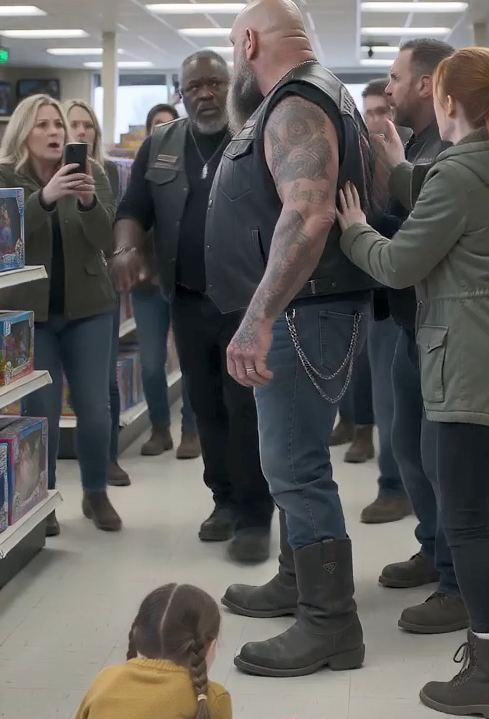
And I certainly did not expect safety to look like Ray “Hammer” Dawson.
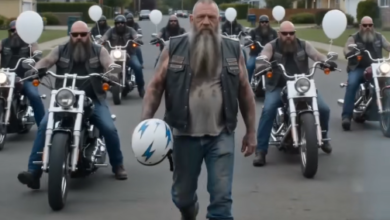
Hammer was fifty-six, six feet four, and close to 285 pounds. His head was shaved, his beard was thick with black and gray, and faded tattoos covered both forearms before disappearing beneath a plain black leather vest. A chain hung from his wallet. Heavy boots struck the tile like a warning with every step. The skin across his knuckles was scarred, and his face had the hard, sun-beaten stillness of a man who had spent more years on highways than inside rooms where people spoke softly.
He had arrived at the Flagstaff Family Toy Exchange with eleven other bikers from the Iron Lanterns Motorcycle Club. Their Harleys stood outside beneath a cold Arizona sky, engines ticking as they cooled, saddlebags packed with donated toys for children staying at the county shelter.
My daughter Lily and I were not there for the donation drive.
We had come to repair Rosie.
Rosie was a cheap talking doll with one blue eye that closed and one that never did. Her yellow yarn hair had been trimmed unevenly by Lily when she was five, and a faded marker heart covered one plastic cheek. She was not valuable to anyone else. But Lily’s father, Noah, had bought Rosie at a pharmacy on the final birthday he spent with us before a warehouse accident took him away.
After Noah died, Lily stopped asking for new toys.
She carried Rosie instead.
That morning, Rosie’s voice box had begun making a slow clicking sound. Lily had saved nine dollars and seventeen cents in a jar because she wanted to pay for the repair herself. We were standing beside the service counter when Hammer turned away from a stack of donated board games and stared directly at my daughter.
Not at Lily.
At the doll.
His expression changed so suddenly that I pulled Lily closer. He crossed the store in four long steps and asked, “How long has it been warm?”
I did not understand him.
Then Lily whispered, “Rosie feels sick.”
Hammer reached for the doll.
I slapped his hand away.
He looked at me once, not angry, just urgent. “Ma’am, give it to me.”
“No.”
A thin electronic whine rose from inside Rosie’s chest. It was quiet enough that most people kept shopping, but Hammer heard it. His eyes dropped to a slight bulge beneath the doll’s battery cover, then to a hairline discoloration spreading through the pink plastic.
He moved before I could.
Hammer took Rosie from Lily’s arms, turned his body away from her, wrapped one side of his leather vest around the doll, and squeezed. Plastic cracked between his hands. Lily screamed as loudly as I had ever heard her scream.
“Stop! That’s my daddy’s!”
I hit Hammer across the shoulder with my purse. A cashier shouted for security. Two parents lifted their phones. One man grabbed Hammer’s vest while another yelled that a grown biker was attacking a child.
Hammer did not strike back.
He crushed the doll’s torso again.
The plastic split open. A swollen silver battery pack dropped against the leather covering his palm, its metal contact glowing a dull red. Hammer kicked a display basket aside, crossed three steps, and buried the battery inside a steel sand bucket the store used for its craft workshop.
A sharp hiss followed.
Then came smoke.
Not much. Just a gray thread curling above the sand, carrying a bitter chemical smell that silenced the entire store.
Hammer stood over the bucket, breathing hard. A blister was already rising near his thumb. Behind him, Rosie lay broken across the tile, her face turned sideways, her yarn hair tangled beneath a cracked piece of plastic.
Lily dropped to her knees beside her.
“You killed her,” she whispered.
That sentence hurt Hammer more than my purse had.
I saw it.
He looked at Rosie, then at Lily, and for one strange second the enormous biker appeared unable to breathe. One of his club brothers—Leon Brooks, a broad Black man with a short gray beard—stepped toward him, but Hammer raised his uninjured hand.
“No, brother.”
He walked outside without explaining.
Through the front windows, I watched him approach a black touring Harley parked at the head of the row. He stood beside its left saddlebag for several seconds with his hand resting on the latch. The other bikers remained inside, unusually still. No one tried to defend him. No one told Lily to stop crying.
It felt as though all eleven men knew what was inside that compartment.
Hammer opened it.
He returned carrying a small doll wrapped in a child’s lavender blanket. Unlike Rosie, this doll had a cloth body, brown curls, and a hand-sewn denim dress. Its face had been repaired near one temple, and one tiny shoe was missing. The blanket had faded from years of sunlight, but Hammer held it with both hands as if it were the only unbroken thing he had left.
He knelt several feet from Lily.
“This was my daughter’s,” he said.
The store became so quiet that I heard the fluorescent lights buzzing overhead.
Lily looked up through her tears. “Where is she?”
Hammer lowered his eyes to the doll.
“She can’t carry it anymore.”
He did not offer it immediately. He only placed it on the floor between them, as if crossing that last distance required Lily’s permission.
Then Leon spoke behind me, his voice barely above a whisper.
“Ray, you don’t have to do this.”
Hammer kept looking at my daughter.
“Yes,” he said. “I do.”
That was when I noticed a hospital band tied beneath the doll’s denim sleeve and a small stain on the lavender blanket. Hammer had carried both inside his Harley for eleven years, through rain, desert heat, funerals, charity rides, and thousands of highway miles.
But I still did not know why the sound inside Rosie had frightened him before anyone else heard it, why his club brothers looked terrified when he opened that saddlebag, or what promise his daughter had made him swear beside her hospital bed.
Want to know why Hammer carried that doll for eleven years and what Lily discovered beneath its denim dress? Drop DOLL in the comments—I’ll share the rest below.
Part 2 — The Battery Beneath Rosie’s Heart
The fire department arrived twelve minutes later, although the danger had already been contained. Two firefighters carried the sand bucket outside and placed it on an empty section of pavement while a third cleared the customers away from the front windows. A store employee opened both entrance doors, allowing the chemical odor to mix with cold air and motorcycle exhaust.
The swollen battery continued hissing beneath the sand.
Lieutenant Carmen Reyes, a forty-four-year-old firefighter with dark hair pulled beneath her helmet, examined the cracked pieces of Rosie without touching them. She asked how long the doll had been charging, whether it had recently been dropped, and if the replacement battery carried a manufacturer’s label.
I could answer only the first question.
Rosie had been plugged into a secondhand charger overnight because her original cable had disappeared during our last move. The charger came from a plastic bin at a discount resale shop. Its connector fit, so I assumed it was safe.
That assumption nearly followed us home.
Carmen explained that the lithium battery had swollen against the inside of Rosie’s plastic body. The faint clicking Lily heard was not the damaged voice box. It was the battery casing shifting as heat distorted the surrounding parts. The thin whine Hammer noticed came from venting pressure. Had Lily continued holding the doll, the pack might have entered thermal runaway against her coat or inside our car.
She did not describe what that could have done to Lily.
She did not need to.
I looked at Hammer’s blistered palm and felt shame settle beneath my ribs. Twenty minutes earlier, I had thought he was the most dangerous person in the store. Now the evidence of what he had prevented was smoking inside a bucket near his boots.
The store manager, Owen Pike, apologized for calling security. Hammer shrugged as if it did not matter. When a police officer asked whether he wanted to report the man who had grabbed his vest, he shook his head.
“Folks saw half a moment,” he said. “Half a moment makes fools of all of us.”
He did not mention that I had struck him.
That made it worse.
Lily remained seated on the floor beside the broken pieces of Rosie. The crisis had passed, but children do not measure loss according to adult logic. To Lily, the doll was not an overheated battery in a plastic shell. Rosie carried the last clear recording of Noah’s voice in her memory, even though that voice had never come from the doll itself.
Rosie had sat beside him during pancakes. Rosie had ridden in the laundry basket while Noah pushed Lily through our apartment. Rosie had been tucked beneath Noah’s arm on the last night he read to her.
Now Rosie had no chest.
Hammer’s daughter’s doll remained on the tile between them.
“What’s her name?” Lily finally asked.
Hammer swallowed before answering. “Maggie.”
“Did she break?”
“No.”
“Then why is she in your motorcycle?”
Leon turned away. Another biker studied the ceiling. Hammer rubbed one thumb along the seam of Maggie’s lavender blanket, careful not to touch the hospital band beneath the doll’s sleeve.
“Because I wasn’t ready to take her out.”
Lily considered that response with the grave patience children sometimes show when adults offer them an incomplete truth.
“I’m not ready to throw Rosie away,” she said.
Hammer nodded. “Then we don’t.”
He asked Owen for a cardboard box. Instead, the manager brought a shallow wooden crate from the craft room. Hammer gathered each piece of Rosie himself—the cracked torso, the battery cover, one loose arm, the small speaker, strands of yellow yarn and the faded dress. His hands were large enough to hide the pieces, but he handled them slowly, sorting them as though every fragment mattered.
He found the marker heart from Rosie’s cheek beneath a display shelf.
That went into the crate last.
When he stood, Lily looked at Maggie again. “Are you giving her to me?”
Hammer’s jaw tightened.
“I’m asking if she can sit with you until Rosie comes back.”
“You said Rosie was broken.”
“Broken isn’t the same as gone.”
It sounded like something he had spent eleven years trying to believe.
The Iron Lanterns finished unloading their donations, though the mood had changed. Their usual jokes disappeared. Boots moved softly. Boxes were stacked without the easy shoving and laughter I had heard when they arrived.
Outside, a young man was already uploading a video of Hammer crushing Rosie. The recording began after Hammer took the doll and ended before the battery smoked. It showed Lily screaming, me hitting him, and his hands breaking the toy open.
It did not show the red metal contact.
It did not show the sand bucket.
It did not show the blister rising on his palm.
By the time Lily and I reached home, that twelve-second video had been shared more than six thousand times beneath a caption accusing an outlaw biker of destroying a dead father’s final gift to his child.
Hammer’s name was not attached yet.
But his face was clear.
And in a town where his motorcycle club spent ten months building a Christmas charity ride, twelve misleading seconds were enough to threaten everything.
Part 3 — The Video That Told Only Half the Truth
The video reached fifty thousand views before sunrise. By Sunday afternoon, local pages had copied it, shortened it, slowed it down, and circled Hammer’s hands in red. Strangers who had never met Lily called him a bully, a criminal, and worse. Some insisted he should be arrested. Others demanded the toy store identify his club.
Nobody asked what happened after the recording stopped.
I tried replying from my phone. I explained that the battery had been overheating, that Hammer protected Lily, and that the fire department confirmed the danger. My replies sank beneath hundreds of louder accusations. Several people claimed I had been pressured into defending him. One said the biker club had probably threatened me.
Lily sat at our kitchen table with Maggie beside her.
She had not hugged the doll. Not yet. She placed one hand near Maggie’s cloth fingers, then moved it away whenever she heard the refrigerator click. Rosie’s wooden crate remained on the opposite chair.
At nine that night, someone posted the Iron Lanterns’ clubhouse address.
By Monday morning, two sponsors withdrew from the Christmas ride. A supermarket canceled permission for the club to collect toys outside its entrance. The county shelter director called Leon and said she could not risk having frightened parents see Hammer near the children.
He accepted every decision without argument.
That was what angered Leon.
I learned about the club’s meeting because Carmen Reyes contacted me. Her cousin knew Leon, and Leon had told her Hammer planned to step down as road captain before the others could vote. Carmen believed my account could stop him.
I did not want to walk into a biker clubhouse with my daughter.
Then Lily asked, “If Hammer saved me, why is everybody mad at him?”
I had no answer that would let me remain home.
The Iron Lanterns met in a converted repair garage behind a closed tire shop. Old road signs hung from the rafters. The air smelled of coffee, cold metal, leather and motor oil. Twenty-three men and seven women stood around a long scarred table when Lily and I entered.
Hammer was at the far end.
His right hand was wrapped in gauze. His vest lay folded in front of him, which made him look less like the frightening man from the video and more like a tired father who had been called into a principal’s office.
Leon was speaking.
“We release the security footage,” he said. “Whole thing. Sound included.”
Hammer shook his head. “Lily’s face stays out of it.”
“We blur her.”
“No.”
“Hammer, they’re calling us predators.”
“Then let them.”
Boone Keller, a red-bearded biker who had helped organize the toy ride, struck the table with his palm. “This isn’t just you. We’ve got four hundred kids expecting those gifts.”
“I know.”
“Then stop protecting twelve seconds of pride.”
Hammer’s eyes hardened. “It isn’t pride. That girl lost her daddy. She doesn’t need ten million strangers watching her lose him again on a toy-store floor.”
The room fell silent when he noticed us.
Lily stepped behind my coat. I wanted to apologize for intruding, but Hammer was already moving away from the table, keeping his hands where she could see them.
He crouched several feet from her. “How’s Maggie?”
“She doesn’t talk.”
“She never did much talking.”
“Rosie did.”
“I know.”
Lily looked at his bandage. “Did she burn you?”
“A little.”
“Are you mad?”
“No, ma’am.”
She stared at him for a long time, then lifted Maggie from the cloth bag she carried. “I think she misses your motorcycle.”
A sound escaped Leon that might have been a laugh or a swallowed sob.
I told the club I would appear on camera. Hammer refused. I told him the story belonged to Lily and me as much as it belonged to him, and protecting us did not mean deciding whether we could speak.
That made him pause.
Carmen arranged for the fire department to release a written statement confirming that the battery posed an immediate fire hazard. Owen provided security footage beginning thirty seconds before the viral clip and ending after firefighters arrived. Lily’s face was blurred. Mine was not.
We posted it that evening.
The correction spread more slowly than the lie.
It always does.
Some sponsors returned. Some did not. A local station invited Hammer to appear on its morning broadcast, but he declined. He told Leon to send Carmen instead because she understood batteries and could keep other families safe.
The host wanted a hero.
Hammer wanted a warning label.
The Christmas ride survived, though its donation total dropped. The Iron Lanterns covered the shortage themselves, canceling upgrades, selling spare parts and putting cash into a coffee can at the clubhouse. Hammer removed a set of chrome covers from his Harley and sold them to a collector in Phoenix.
He still did not let anyone mention Maggie publicly.
That doll belonged to a different wound.
Three days after the store incident, Hammer came to our apartment carrying Rosie’s crate and a small toolbox. He asked permission before entering. Maggie was strapped carefully inside his left saddlebag, wrapped again in the lavender blanket.
“I know somebody who can rebuild Rosie’s body,” he said. “But there’s something you need to decide first.”
He placed the cracked voice module on our kitchen table. Inside it was a tiny memory chip the repair shop had overlooked.
“The battery cooked most of the board,” he said. “Maybe not this.”
“What’s on it?”
Hammer looked at Lily.
“Could be nothing. Could be whatever Rosie said before she stopped talking.”
Lily’s fingers tightened around the edge of the table.
Her father had once repaired that voice box himself.
And suddenly Rosie was no longer the only doll in our apartment carrying a dead parent’s unfinished words.
Part 4 — The Doll in the Left Saddlebag
Hammer returned the following Saturday with an electronics technician named Priya Nair, a forty-year-old Indian American woman who repaired medical monitoring equipment at Flagstaff Medical Center. She wore no club vest, but Leon called her family. Her workbench traveled inside two hard cases covered with old baggage stickers.
Priya removed the memory chip beneath a magnifying lamp.
She warned us that heat might have erased everything. Lily sat across the room holding Maggie, who had finally been allowed outside the lavender blanket. Hammer remained standing beside the window. He could have sat, but he seemed to believe sitting would make the waiting harder.
The file opened.
Static filled Priya’s small speaker. Then came several seconds of laughter.
Noah’s laughter.
Lily stopped breathing.
The recording was only eleven seconds long. Noah said, “Rosie, tell my girl breakfast is getting cold,” and Lily’s five-year-old voice answered from somewhere farther away, “She already knows!”
Then the file ended.
There was no final message. No hidden speech. Just an ordinary morning preserved by accident because Noah had been testing the repaired sound board.
Ordinary became precious after he died.
Lily pressed both hands over her face. Hammer stared through the window until the muscles in his jaw stopped moving. Priya saved the file in three places and gave me two physical copies before packing her tools.
When Lily asked Hammer whether Maggie held a recording too, he said no.
“She carries something else.”
He sat at last.
Eleven years earlier, Hammer had not been called Hammer by most people. To his daughter Emma, he was Dad or, when she wanted something, Daddy Ray. He repaired diesel engines for the city, rode on weekends, and believed every problem could be solved if a man had the correct wrench and enough patience.
Emma taught him otherwise.
She was nine when doctors diagnosed acute myeloid leukemia. For fourteen months, Hammer learned the geography of hospital corridors, the taste of vending-machine coffee at three in the morning, and the difference between a good blood count and a number that made nurses speak more quietly.
Maggie had been with Emma through every admission.
The doll wore the same denim dress because Emma refused replacements. One shoe disappeared during an ambulance transfer. The seam near Maggie’s temple opened after a hospital washing machine caught her hair, and Hammer repaired it badly with upholstery thread.
The battery lesson came during Emma’s final winter.
A volunteer brought rechargeable toys into the pediatric unit. One electronic bear began whining inside a gift bag. Hammer smelled the sweet chemical odor and saw its battery compartment bulging. He knew nothing about lithium cells then. A nurse pulled the plug and moved the toy into a metal container moments before the battery vented.
No one was hurt.
But Hammer never forgot the sound.
It was the same thin whine Rosie made.
After Emma died, Hammer completed the promise he had made beside her bed: Maggie would take one final ride through Oak Creek Canyon, where Emma loved the red cliffs. He placed the doll inside his left saddlebag, rode to the overlook, and parked.
He could not take her out.
The overlook was crowded with families. A little girl ran past wearing a denim dress similar to Maggie’s. Hammer gripped the saddlebag latch until his knuckles bled, then closed his hand and rode home.
He tried again on Emma’s birthday.
And the next.
Year after year, Maggie traveled with him while remaining hidden. The Iron Lanterns knew she was there because Leon had helped wrap her in the lavender blanket after the funeral. No one asked Hammer to remove her. Brotherhood sometimes meant pushing a man forward. Sometimes it meant riding beside the thing he could not release.
“Why keep taking her?” I asked.
Hammer’s answer came slowly. “Because leaving her in the garage felt worse.”
Lily turned Maggie over in her lap. Beneath the denim dress, sewn into the cloth body, was a narrow pocket. Hammer’s hands began to shake when she found it.
“Can I open this?”
He nodded.
Inside was a folded piece of paper written in purple pencil. The letters had faded, but Emma’s uneven handwriting remained readable.
Maggie is for the next girl who needs somebody brave.
Lily read the sentence twice.
Hammer had known about the note. Emma wrote it during her final week, then made him promise to give Maggie away after their canyon ride. That was why he kept attempting the same journey. It was not only grief holding the doll inside the Harley.
It was an unfinished promise.
“I failed her,” he said.
Lily frowned. “Because you kept Maggie safe?”
“Because I kept her too long.”
Lily looked down at the doll, then across at Rosie’s broken pieces. “Maybe Maggie was waiting.”
Hammer did not answer.
Children sometimes offer mercy so simply that adults distrust it.
Lily slid from her chair and carried Maggie to him. For a moment I thought she planned to return the doll. Instead, she placed Maggie against Hammer’s chest and wrapped his injured hand around her cloth body.
“You have to say goodbye first,” she told him.
The enormous biker closed his eyes.
He held the doll exactly once.
Not for a photograph. Not for the club. Not for the strangers who had called him a monster. He pressed his beard against Maggie’s brown curls and breathed through his nose until he could speak.
“Okay, baby girl,” he whispered. “I found her.”
Then he gave Maggie to Lily.
That should have been the end.
But Lily looked at the wooden crate containing Rosie and asked a question none of us had considered.
“Can they both come back?”
Part 5 — Two Dolls and One Unfinished Promise
The rebuilding began in Priya’s garage on a Monday evening. She warned us that Rosie could never safely use her original rechargeable system again. The casing had warped, the speaker coil was damaged, and several plastic joints had fused from heat. Repairing her exactly as she had been would be impossible.
Hammer disliked that word.
“Impossible usually means expensive,” he said.
“Sometimes it means unsafe,” Priya replied.
That ended the argument.
Lily did not need Rosie restored to factory condition. She wanted the marker heart from the cheek, the yellow yarn hair Noah had once untangled, and the sound file containing his eleven seconds of laughter. Everything else could change.
Hammer brought the club into the project carefully.
Leon carved a new interior frame from lightweight maple. Boone found a cloth-doll artist in Sedona who could sew a soft body around Rosie’s surviving pieces. A club member named Dolores “Dolly” Hart, a sixty-one-year-old Mexican American grandmother with silver hair braided beneath a red bandanna, cleaned the old dress and stitched the undamaged section onto a new skirt.
Priya installed a low-voltage removable sound module powered by replaceable alkaline cells. She added a mechanical cutoff and placed the compartment where an adult could inspect it without opening the doll’s torso.
Hammer worked on the face.
He sanded the heat-darkened edges from the surviving cheek and set the small plastic piece—with Lily’s marker heart—into a padded cloth panel. It looked imperfect. One side of Rosie remained pink plastic; the other was fabric the color of warm brown sugar.
Lily loved her immediately.
Maggie sat on the workbench throughout the repairs. She still belonged to Lily, but Lily insisted the older doll should “watch.” Hammer never touched Maggie without asking.
During those evenings, I learned what the viral video could never have shown. Hammer was not gentle because he possessed some hidden softness that contradicted his appearance. He was gentle because he had practiced restraint for years. His size, strength and anger did not vanish when a child entered the room. He chose what to do with them.
That choice had not always come easily.
After Emma’s death, he stopped working for the city and spent eighteen months moving between construction jobs. He drank too much. He slept in his garage because her empty bedroom made the house feel tilted. Leon took his motorcycle keys twice. The second time, Hammer swung at him.
Leon did not swing back.
He sat on the garage floor until sunrise and told Hammer, “You can hate me alive, brother.”
Three months later, Hammer entered treatment for alcohol dependence. He never described that period as redemption. He called it maintenance, the same word he used for checking brake lines and battery terminals.
“You don’t fix everything once,” he told me. “You keep checking what can fail.”
The Iron Lanterns’ Christmas program began during his second sober year. They delivered toys to the pediatric unit where Emma had been treated. Hammer refused to enter the first time. He remained outside beside the motorcycles until a nurse brought him a cardboard box of broken toys.
He repaired six in the parking lot.
After that, families began bringing him lamps, music boxes, wheelchairs, toy cars and anything else with a motor or loose wire. He studied battery chemistry at night. He completed safety courses through the fire department. He learned to recognize swelling, venting, melted insulation and the sharp odor of overheated electrolyte.
None of that appeared in the video.
Only his hands crushing Rosie.
The full story finally reached the public when Lieutenant Reyes persuaded Hammer to join a battery-safety workshop at the toy store. He agreed on one condition: Lily would not be used as a prop.
The event drew more reporters than parents.
Hammer ignored the cameras. He set damaged battery packs on a table, explained warning signs in plain language, and demonstrated how to isolate a hot device without touching it barehanded. He never called himself an expert. He referred technical questions to Carmen and Priya.
A reporter asked what he felt when Melissa struck him.
“Nothing worth printing.”
Another asked whether he regretted destroying the doll.
Hammer looked toward Lily, who sat beside me with Rosie and Maggie in her lap.
“I regret that she had to watch it break,” he said. “I don’t regret keeping it from burning her.”
Then the reporter asked about Maggie.
The room changed.
Hammer’s club brothers stiffened near the back wall. Leon took one step forward, but Hammer raised a hand. This time, he did not hide.
He told the room Maggie had belonged to Emma. He did not describe the hospital’s final night or the years he failed to open the saddlebag. He simply said his daughter wanted the doll to find another child.
“Did Lily replace your daughter?” the reporter asked.
Hammer’s expression became so still that even the camera operators lowered their voices.
“No child replaces a child,” he said. “That’s not how love works.”
Lily climbed down from her chair and walked to him. She carried Maggie beneath one arm and the rebuilt Rosie beneath the other.
“Maggie didn’t replace Rosie either,” she said. “Now they’re sisters.”
That sentence traveled farther online than the original accusation.
This time, the whole moment was recorded.
Part 6 — What the Club Carried Afterward
By spring, the Iron Lanterns had turned the back room of their clubhouse into a toy-inspection workshop. The walls remained rough concrete, and the shelves still held carburetors beside coffee tins of bolts, but one long bench was reserved for donated toys.
Priya trained twelve club members to identify damaged battery housings and unsafe chargers. Carmen supplied fire-resistant storage bags and helped them obtain a proper battery cabinet. Owen placed a permanent inspection station inside the toy store.
Hammer made the rules.
No unknown chargers. No swollen cells. No damaged wiring hidden beneath tape. No rechargeable toy entered the Christmas program without being checked by two people.
He painted those rules on a board in his own blocky handwriting, then hung the board where every club member had to pass it before reaching the coffee.
The viral scandal changed the club in other ways. Some businesses never returned as sponsors, even after the truth emerged. Hammer did not chase them. He said trust built under pressure was stronger than trust offered for publicity.
Several new people volunteered.
One was the man who had grabbed Hammer’s vest inside the store. His name was Craig Morton. He came to the clubhouse carrying a box of batteries and an apology. Hammer accepted the box first.
The apology took longer.
Craig eventually became one of their most careful inspectors.
Another volunteer was a woman whose kitchen had been damaged by an overheated phone battery. She taught parents not to leave charging devices beneath pillows. A high-school science teacher helped the club create simple demonstrations for children without using live damaged cells.
The workshop became known around town as Emma’s Bench.
Hammer protested the name.
Lily insisted.
She painted a small lavender stripe beneath the work surface, matching Maggie’s blanket. Hammer stood in the doorway while she worked. He pretended to complain about paint on the floor, but he never removed the stripe.
Rosie changed too. Her new cloth body made her lighter. Her mismatched face drew questions from other children, and Lily always answered the same way.
“She had an accident. They saved what mattered.”
The restored voice module played Noah’s laughter only when a small button beneath Rosie’s dress was pressed. Lily did not press it often. Knowing the recording remained available seemed more comforting than hearing it every day.
Maggie slept beside Rosie on Lily’s bed.
At first, Hammer visited only to inspect their batteries, although Maggie had none and Rosie’s compartment had already been checked repeatedly. Over time, he stopped inventing mechanical reasons. He came for coffee. He helped Lily build a wooden cradle. He fixed our loose kitchen drawer and refused payment.
He never entered Lily’s room unless she invited him.
On Emma’s birthday, Lily asked whether they could take Maggie through Oak Creek Canyon.
Hammer almost said no.
I watched the old reflex cross his face: protect the wound, close the saddlebag, ride somewhere no one could ask questions. Leon, waiting beside his Harley, did not pressure him.
Lily held Maggie against her coat. “She already found me. Now she can finish.”
Thirty-one motorcycles left Flagstaff that morning. I drove behind them with Lily in my car because Hammer would not place a child on a motorcycle without the correct equipment and training. The road descended between red cliffs washed in winter light.
At the overlook, Hammer parked in the same place he had stopped eleven years earlier.
This time, he opened the saddlebag.
It was empty.
He stood beside Lily while she held Maggie toward the canyon. No one gave a speech. No one filmed until Lily asked Leon to take one photograph for her room.
Hammer removed the old lavender blanket from the saddlebag and spread it across the stone wall. Lily placed Maggie on it for several minutes, then picked her up again.
“Was that the last ride?” she asked.
Hammer studied the road below.
“No,” he said. “Just the first one we finished.”
Part 7 — The Left Saddlebag Opens
The following Christmas, the Iron Lanterns returned to the Flagstaff Family Toy Exchange. Their Harleys filled the same row outside, engines rumbling beneath strings of plain winter lights. Inside, parents moved among tables of inspected toys while club members checked battery covers, matched chargers and attached safety instructions.
Hammer arrived last.
The chrome covers he had sold to fund the previous year’s shortage were still missing from his motorcycle. He had never replaced them. The exposed metal carried scratches from thousands of miles, and the left saddlebag opened more easily now because he no longer avoided its latch.
Lily was nine.
She stood beside Emma’s Bench wearing a denim jacket with a small lavender stripe sewn inside the collar. Maggie rested in the crook of her left arm. Rosie sat in a wooden cradle near the inspection station, her marker heart facing outward.
A frightened little boy approached the table carrying a toy fire truck that had stopped working. His mother apologized because it was dirty and missing one wheel.
Hammer crouched to the boy’s height.
“Broken isn’t the same as gone,” Lily said from beside him.
Hammer looked at her.
She smiled because she knew exactly where the sentence came from.
They opened the truck together. The problem was not dangerous—only a corroded contact and a wire pulled loose from the motor. Hammer cleaned the compartment while Lily held a flashlight. Ten minutes later, the truck rolled three feet across the table.
The boy laughed.
Hammer did not.
But the lines around his eyes softened.
Near closing time, Owen brought out the old wooden crate that had once held Rosie’s broken pieces. The club had begun using it for saved parts: wheels, buttons, fabric, speakers and safe components that could give another toy a second life.
Lily placed Rosie’s original battery cover inside. The dangerous cell was long gone, disposed of by the fire department, but the warped cover remained. She had kept it because she said people should remember what almost happened without being afraid forever.
Hammer added Maggie’s missing shoe.
Leon stared at him. “You kept that?”
“Found it under the saddlebag liner.”
“You putting it in the parts box?”
Hammer nodded. “Maggie doesn’t need it.”
The gesture was small. Most people in the store missed it.
Leon did not.
For eleven years, Hammer had carried every surviving piece of Emma’s final months as though losing one more object might erase her. Now he could place a tiny shoe in a communal box and trust that memory would remain.
When the store closed, Lily walked outside with him. Snow had begun falling across Route 66, light enough to melt against the Harley’s warm engine.
Hammer opened the left saddlebag and took out two child-sized helmets. One was lavender. The other was yellow.
Lily touched the lavender helmet but did not put it on.
“Next spring?” she asked.
“When you finish the safety class.”
“And Mom says yes.”
Hammer looked at me.
I made him wait several seconds before nodding.
He fastened both helmets inside the compartment again. Maggie stayed with Lily. Rosie stayed in the car. For the first time since I met him, the saddlebag held nothing belonging to the dead.
Only something prepared for the living.
Hammer started the Harley. The V-twin settled into its slow, uneven rhythm, and the other motorcycles answered one by one. Lily covered her ears, laughing as the sound rolled through the snowy parking lot.
Before pulling away, Hammer looked at the doll beneath her arm.
“Take care of my girl.”
Lily shook her head.
“Our girl,” she corrected.
Hammer lowered his eyes, nodded once, and rode into the falling snow with the empty saddlebag behind him.
Follow our page for more unforgettable biker stories about rough-looking strangers whose quiet choices reveal the truth everyone else judged too quickly.