Part 2: Sixty Bikers Surrounded an Elementary School Before the First Bell — Then a Motherless Little Girl Learned Why They Had Left One Narrow Road Open
Part 2 — The Promise in My Garage
Nine weeks before that first school morning, Hannah Hale walked into my motorcycle repair shop carrying a yellow legal envelope and a pink ribbon.
It was 6:40 on a Thursday evening. Rainwater ran from the roof of Mercer Cycle Works in steady ropes, and I was alone beneath a lifted Heritage Softail, trying to remove a bolt that had rusted itself into the frame. The radio was playing low. The garage smelled of hot oil, brake cleaner, and the coffee I had forgotten to drink.
When I rolled out from under the bike, Hannah stood just inside the open bay door.
She was thirty-four, thin enough that the denim jacket seemed to hang from her shoulders, with a blue scarf covering the hair chemotherapy had taken. She still wore her hospital identification badge, although she had been a patient there that day rather than a nurse.
“You look terrible,” I said.
“So do you.”
That was Hannah. No warm-up.
Eight years earlier, she had been the emergency-room nurse assigned to me after I laid a motorcycle down on County Road 9 with enough bourbon in my blood to kill someone less stubborn. I had fractured three ribs and opened my right forearm to the bone. She cleaned gravel from the wound while I cursed her, the hospital, the deputy waiting outside, and the life I had already decided was no longer worth protecting.
My seven-year-old daughter, Mara, had died of leukemia two years before that crash. My marriage followed her into the ground. I stopped riding with men who cared whether I returned home and started drinking with men who did not.
Hannah knew none of that when she entered my treatment room. She only knew I had crossed the centerline shortly before a family minivan came around the bend.
“You almost gave another parent an empty bedroom,” she told me.
I tried to sit up and leave.
She pushed me back with one hand.
“You don’t get to use your daughter’s death to take somebody else’s child.”
There was no softness in her voice. No pity.
It was exactly what I needed.
I spent eleven months without a license, fourteen months in county treatment court, and eighteen months rebuilding a life I had nearly scattered across County Road 9. The Iron Lantern Riders took me back, but not as president. Deke made me wash bikes, run coffee, and listen while younger men decided whether I deserved to wear our patch again.
Brotherhood should not mean hiding a man’s worst choices.
Sometimes it means refusing to abandon him while he answers for them.
Hannah followed my progress because that was her nature. She came to the shop when we organized blood drives. She asked the club to escort foster children to an adoption celebration. When one of our members lost his job, she quietly brought grocery-store cards and claimed the hospital had donated them.
The hospital had not.
By the time Ruby was born, Hannah had become the person who called whenever Beckford needed frightening-looking people to do something gentle.
That Thursday evening, she placed the envelope on my workbench.
“I need sixty motorcycles,” she said.
I stared at her. “For what?”
“Ruby’s first day of first grade.”
“That’s in September.”
“I know.”
The rain hammered the metal roof between us. Hannah turned toward the open bay so I would not see her face, but I already understood.
“How long?” I asked.
“Maybe four weeks. Maybe six.”
I put down the wrench in my hand.
“Does Daniel know you’re here?”
“He knows I’m making plans. He doesn’t know this plan.”
“Hannah—”
“If I tell him now, every time he looks at Ruby, he’ll see the morning I won’t be there. He already sees enough endings.”
She took the pink ribbon from her pocket. It was faded and wrinkled, the sort once tied around a child’s ponytail. Hannah laid it across the envelope.
“Ruby calls motorcycles thunder,” she said. “When she was three, we got trapped beneath the awning outside Miller’s Market during one of your charity rides. She thought the engines were applauding for her.”
I remembered a tiny child in red rain boots spinning beneath the awning while twenty wet bikers rolled past. I had not known her name.
“Hannah, sixty bikes at an elementary school will terrify people.”
“Only if you arrive like men who need to be feared.”
That landed where she intended.
She explained the formation. Two rows. A clear center path. No one approaching Ruby without permission. Engines silent until she asked for sound. No club symbols that could be mistaken for threats. No aggressive revving. No speeches about death.
“Build her walls,” Hannah said. “But leave the road open.”
She wanted Daniel to walk behind Ruby, not beside her, so the choice to enter would belong to the child. She wanted me at the beginning of the tunnel and Principal Cole at the end. Most of all, she wanted Ruby to feel that being afraid did not disqualify her from moving forward.
“Why me?” I asked.
Hannah looked at the old photograph taped inside my toolbox. Mara was sitting on the gas tank of my first Harley, her missing front teeth visible in a grin.
“Because you know what an empty place beside a child feels like.”
She slid the envelope toward me. On its front she had written: FOR BEAR—WHEN RUBY SAYS SHE CAN’T GO IN.
I did not touch it.
“What if you get better?”
“Then I’ll be furious that you made me compete with sixty motorcycles.”
For one second, we both laughed.
Then she made me promise.
Hannah died twenty-three days later.
I kept the envelope locked in the top drawer of my toolbox for nearly two months. I told myself I was waiting for the right time to speak with Daniel, but the truth was uglier.
Opening the plan would make her death final.
The Sunday before school began, Daniel called me at 1:47 in the morning. Ruby had packed and unpacked her backpack six times. She had put her mother’s photograph in the front pocket, then removed it because she was afraid the other children would ask questions.
“She says she’s not going,” he told me. “I don’t know how to do this without Hannah.”
I sat in the dark office behind my garage and looked at that legal envelope.
“You’re not doing it without her,” I said.
At 2:13, I sent one message to the Iron Lantern group:
FIRST BELL. MONDAY. A CHILD NEEDS A ROAD THROUGH. I NEED SIXTY RIDERS. NO QUESTIONS TONIGHT.
The replies began before I set down the phone.
Deke: I’m in.
Preacher: What time?
Mona: I’ll bring yellow ribbon.
Cal: My bike is down. I’ll borrow one.
Within twenty minutes, fifty-eight riders had committed.
The fifty-ninth was me.
The sixtieth place remained empty.
Part 3 — The Town Thought We Were Coming for a Fight
By sunrise Sunday, Beckford had already decided we were planning something dangerous.
A parent had seen six Iron Lantern members measuring the school parking lot and posted a photograph online. The image showed Deke holding a tape measure, Preacher pointing toward the entrance, and me standing beside a row of motorcycles with my arms crossed.
Nobody photographed the chalk marks shaped like tiny yellow stars. Nobody mentioned the child-sized ear protectors Mona had purchased in three colors so Ruby could choose a pair if the engines became too much.
The caption only said: BIKER GANG SCOUTING LINCOLN ELEMENTARY. DOES ANYONE KNOW WHY?
By noon, Principal Margaret Cole called.
“You cannot bring sixty motorcycles onto school property without approval.”
“I know.”
“Then why did your people tell the custodian you were coming at seven Monday morning?”
“Because we’re asking for approval.”
“That is not how asking works.”
She was right.
Principal Cole had known Hannah for eleven years. Hannah had worked weekends in the emergency department, but she also volunteered twice a month in Lincoln’s reading room. She helped children who came to school hungry, frightened, bruised, or carrying adult worries inside small backpacks.
Still, grief did not automatically make our plan wise.
When I explained the tunnel, Margaret remained silent for several seconds.
Then she said, “No.”
I expected resistance from strangers. I had not expected it from her.
She told me the school had autistic students sensitive to noise, a boy whose father had been injured in a motorcycle crash, and three children already afraid because their parents had seen the social-media post. The district could not permit a roaring spectacle outside the first-grade entrance.
“This is not a spectacle,” I said.
“It became one when you invited sixty motorcycles.”
The old Bear would have treated her answer as a challenge. The man Hannah helped rebuild understood that protecting one child did not give me permission to frighten fifty others.
So I asked what would make it safe.
For the next four hours, Margaret, two police officers, Daniel, and I rebuilt Hannah’s plan. Riders would arrive in groups of five with engines kept low. We would park before buses entered the lot. The bikes would remain silent while other children passed. Teachers would offer an alternate entrance. Ruby would see the formation from the road and decide whether to use it.
If she said no, we would leave.
That final condition divided the club.
“You want sixty people to ride through rain so a six-year-old can wave us off?” Cal asked during the meeting at Mercer Cycle Works.
“Yes.”
“You know what it took to get these people here?”
“Yes.”
Cal leaned against my workbench. He had ridden beside me for twenty-one years and once spent a night in a hospital chair after surgeons rebuilt my shoulder. He was not cruel. He was afraid the plan would turn Hannah’s memory into a public rejection.
“She may look at us and see exactly what everyone else sees,” he said. “A bunch of men she doesn’t know.”
“Then we let her say no.”
“What about the promise?”
“The promise was to give her a road. Not force her down it.”
The garage became still.
Deke nodded first. Then Mona. One by one, the others did the same.
Brotherhood was tested before a single engine started.
Our next problem was the missing sixtieth rider.
Several members offered to recruit friends, but Hannah had asked for people I trusted to follow her rules. Men who could remain quiet while someone insulted them. Riders who would not turn a grieving child’s morning into a performance about themselves.
At nine Sunday night, I still had fifty-nine.
Then Mack Doyle walked into the shop.
Mack was sixty-three, broad across the shoulders, with a white beard and burns covering the left side of his neck. For twenty-six years, he had ridden a red Electra Glide beside his son, Tommy.
Two summers earlier, a distracted driver crossed the centerline outside Columbus. Tommy died at the scene. Mack survived with a steel plate in his hip and a promise never to ride again.
He sold his motorcycle. He stopped attending meetings. When club members visited, he served coffee on the porch but would not enter a garage.
“What time do we leave?” he asked.
“You don’t have a bike.”
“Tommy’s is still in storage.”
I looked at him for a long moment. “You don’t owe us this.”
“It isn’t for you.”
He took a child’s yellow hair tie from his pocket. Hannah had given it to him at the hospital after Tommy’s death because Mack kept pulling at the bandages on his wrist. She told him to snap the hair tie whenever his mind returned to the highway.
He had carried it for two years.
“She sat with me until my sister arrived,” he said. “Never told me to stop crying. Never told me Tommy was in a better place. Just stayed.”
“You sure?”
“No.”
It was the most honest answer given in my garage that night.
At 4:50 Monday morning, rain ticked against my bedroom window. By five, it had become steady. Daniel sent me a message saying Ruby had slept in her school clothes because she feared she would wake and discover the first day had already happened without her.
At 5:18, Principal Cole called to say three parents had complained to the district. If one rider broke formation, blocked a bus, or deliberately frightened a child, the police would remove all of us.
At 5:31, Cal reported that Mack had not arrived at the storage unit.
At 5:45, I tied Hannah’s pink ribbon around my handlebar.
We had fifty-nine riders again.
Then, from beyond the rain, an old V-twin coughed awake.
The sound came once, stopped, then returned with a rough, uneven pulse. Mack appeared at the end of Industrial Road on Tommy’s restored Electra Glide, still wearing the highway dust it had collected two years earlier.
He pulled beside me but kept his visor down.
“Sixty,” he said.
We rode toward the school before the rain could change his mind.
Part 4 — The Road We Left Open
The first five motorcycles entered Lincoln Elementary at 6:42 a.m. The last five rolled in eleven minutes later.
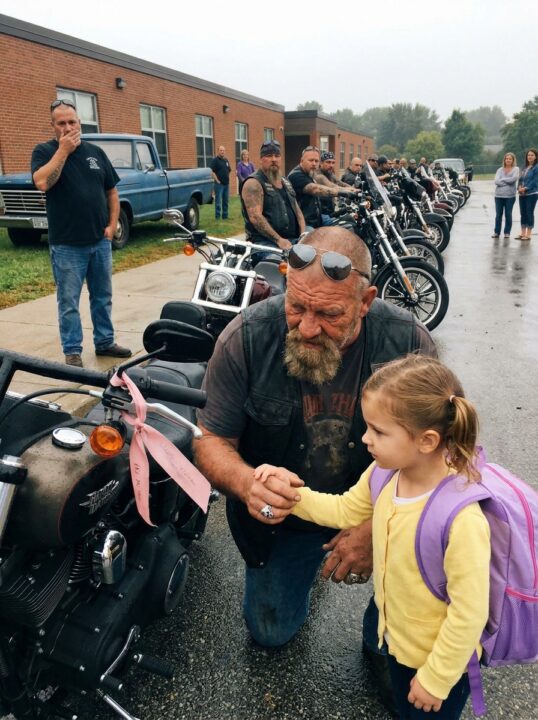
We parked in two lines, thirty motorcycles on each side, creating a corridor from the parent drop-off lane to the covered entrance. The path was eight feet wide—large enough that Ruby would not feel trapped, narrow enough that she could see every rider waiting for her.
Yellow ribbons had been tied to the handlebars. No two matched. Some were satin, some cotton, some torn from old shirts because all the stores had closed before the call went out.
Mona used chalk to draw small stars along the center of the pavement. Rain blurred their edges, leaving each one imperfect.
They were better that way.
Parents began arriving at 7:20. Some slowed to stare. Others reversed out of the lot. One father stepped from his SUV and demanded to know which of us had threatened the school.
Deke moved before I could. At six-foot-five with a braided beard and tattoos climbing both sides of his neck, he looked like the worst possible man to handle an angry parent.
Instead of approaching, he removed his sunglasses.
“Sir, the west entrance is open and quiet,” he said. “Your child doesn’t have to come near us.”
The father glanced at the police officers, perhaps disappointed that nobody had given him the confrontation his phone was recording.
“What are you doing here?”
“Keeping a promise.”
That answer spread through the crowd without explanation.
At 7:38, the school buses arrived. We shut down every motorcycle. Riders placed helmets on seats and stood on the outside of the formation, leaving the center empty.
Children passed through the alternate entrance. Some waved. A few stared at our tattoos. One boy wearing red headphones counted the motorcycles from behind his teacher and gave Mona a thumbs-up when he reached sixty.
Principal Cole remained near the main doors. She carried Hannah’s yellow envelope, still sealed. I had given it to her ten minutes earlier because I did not trust my hands to hold it when Ruby arrived.
“You haven’t read this?” she asked.
“Not all of it.”
“That seems unlike you.”
“It was written by someone who could still order me around.”
At 7:47, Daniel’s blue pickup appeared at the far end of the road.
Conversation stopped. Phones lifted. Camera lenses turned toward us.
I hated that part.
Hannah had asked for witnesses, not an audience. She wanted Ruby to see people showing up, but she had never imagined strangers broadcasting her daughter’s grief. I walked to the police sergeant and asked him to move parents farther back.
Before he could answer, the pickup stopped.
Daniel came around the hood. He wore the same white shirt he had worn at Hannah’s funeral, though it hung looser now. He opened Ruby’s door and crouched.
She would not move.
Minutes passed. The first bell was thirteen minutes away.
From my place at the head of the motorcycle tunnel, I saw Daniel reach inside. Ruby slapped his hand away, then immediately grabbed it and held on, ashamed of an anger too large for her body.
Daniel did not scold her.
He rested his forehead against hers.
I knew that posture. It was the shape a parent made when love could not fix the thing in front of them.
Principal Cole took one step toward the truck.
“Wait,” I said.
Ruby had to choose.
Eventually, one black shoe appeared below the open passenger door. Then the second. Ruby climbed down wearing her yellow cardigan, two crooked braids, and the purple backpack with fox ears.
She looked smaller than the space we had built for her.
Daniel pointed toward me. Ruby followed his hand and saw the pink ribbon fluttering on my motorcycle.
Recognition crossed her face.
She walked four steps, stopped, then walked three more. Daniel followed several feet behind as Hannah had requested.
When Ruby reached me, I lowered myself onto one knee.
Up close, I could see that she had bitten the skin around her thumbnail until it bled. A tiny photograph of Hannah was tucked into the clear pocket of her backpack, facing inward where only Ruby could see it.
“You’re Mr. Bear,” she said.
“Yes, ma’am.”
“Mom said you break chairs.”
“Only weak ones.”
She studied my face, deciding whether the joke was allowed.
“Did Mom tell you to come?”
“She asked me to help if this morning got heavy.”
Ruby looked past me at the two rows of motorcycles. Mack stood four places from the end, gripping Tommy’s handlebar hard enough to whiten his knuckles. Cal had removed every metal ring from his hands because he did not want the child to see skulls. Preacher, who could argue with anyone alive, stared respectfully at the wet pavement.
“All of them too?” she asked.
“All of them chose to come.”
The words mattered. Hannah had underlined that part in her instructions. Ruby had lost one person who had no choice about leaving. She needed to see people choosing to remain.
Ruby reached for my hand.
Her fingers disappeared inside mine.
Together, we entered the tunnel.
After three steps, she stopped.
No rider moved. No engine started. Rain tapped helmets and leather shoulders while the school entrance waited sixty yards ahead.
Ruby turned toward the motorcycles. Confusion replaced fear.
“Why are they quiet?”
“So they don’t scare you.”
She frowned.
“My mom said motorcycles clap like thunder.”
I looked toward Principal Cole.
The principal looked at the police sergeant. He looked at the children watching through the windows, including the boy wearing red headphones. His teacher had already guided him deeper into the building.
Margaret gave one small nod.
I turned back to Ruby.
“Would you like them to clap?”
She looked down the line. Sixty riders waited, each right hand close to a starter switch but touching nothing.
“All the way?” she asked.
“All the way to the door.”
Ruby took a breath, then raised her little fist the way she had seen me do.
I lowered mine.
Sixty starters answered.
The sound did not explode at once. It traveled down the corridor in a rolling wave: the heavy first thump of my Road King, then Deke’s bike, Mona’s, Cal’s, and onward until Mack pressed Tommy’s starter at the far end.
The pavement trembled beneath Ruby’s polished shoes.
She squeezed my fingers.
Then she smiled.
We began walking.
Riders kept their throttles gentle, sending a low rolling rumble along the path. Nobody shouted over it. They simply nodded as Ruby passed.
One by one.
Mechanics. Veterans. Nurses. Grandmothers. Men with criminal records and men who had once worn badges. People with names stitched inside their vests because those names no longer belonged to anyone living.
Ruby’s shoulders slowly lifted. Halfway through, she released my hand.
She continued alone.
Daniel stopped behind us, his face folded around the effort of remaining upright. Principal Cole covered her mouth. Parents lowered their phones, perhaps realizing the moment did not belong entirely to them.
Ruby walked between sixty motorcycles as if the sound were holding up the sky.
Not like a queen.
Like a champion who was still afraid.
At the final motorcycle, Mack removed one glove and extended his hand. Ruby gave him a high five. His scarred fingers shook after she passed.
Then she reached the school entrance.
Everyone believed that was the end.
It was not.
Principal Cole still held Hannah’s sealed envelope.
And Ruby had not yet heard her mother’s voice.
Part 5 — The Message Hannah Left Inside My Vest
The engines went silent as soon as Ruby reached the covered entrance.
For several seconds, nobody moved. The quiet that followed felt different from the quiet before. It was no longer an absence.
It was room.
Principal Cole crouched beside Ruby and welcomed her to first grade. Daniel joined them, wiping rain from his face with both hands even though he had been standing beneath the awning.
I remained at the end of the motorcycle tunnel.
My right hand had begun to tremble.
The morning had returned me to a school entrance I had spent twenty-two years avoiding. Mara had been seven when she last crossed one. She wore red sneakers and carried a lunchbox with a broken latch. Three weeks later, a fever sent us to the hospital.
She never went back.
Hannah knew that. It was why she had put the envelope in my hands rather than Daniel’s. She understood that keeping the promise would not only help Ruby cross a parking lot.
It would force me to cross one too.
Principal Cole broke the seal.
Inside were three sheets of paper, a photograph, and a smaller envelope labeled RUBY—AFTER SHE REACHES THE DOOR.
Margaret read the first page silently. Her expression changed halfway down. She sat on a wooden bench beneath the awning as though her knees had stopped cooperating.
“What does it say?” Daniel asked.
She handed the page to him.
Hannah had written it six days after doctors told her treatment was no longer working. The first paragraph was practical: permission for Ruby to participate, permission for the motorcycles to be present, a request that any child sensitive to noise be protected.
The second paragraph explained the tunnel.
Ruby had been three when she first heard the Iron Lantern Riders pass Miller’s Market. She had hidden behind Hannah’s legs until the bikers raised their hands to wave. Then she stepped into the rain and waved back.
For years afterward, when thunder frightened her at night, Hannah said it was only motorcycles riding above the clouds, applauding every child who had managed to do one hard thing that day.
That was why silence frightened Ruby more than sound.
But the third paragraph was for me.
Bear once told me he no longer remembered the last time he walked his daughter to school. I think he remembers every second and wishes he did not. If he agrees to stand at the beginning of Ruby’s road, please understand that he is not only keeping my promise. Ruby will be helping him keep one he broke with himself many years ago—the promise to remain where children still need adults to show up.
I turned away before Daniel finished reading.
Deke placed one hand on the back of my vest. He did not speak. That was one of the reasons he was my brother.
Then Principal Cole opened the smaller envelope.
Inside was a small silver voice recorder and one sentence:
LET RUBY PRESS PLAY.
I knew about the recorder because Hannah had shown it to me at the garage, but I had never listened to the message. She told me it belonged to Ruby. Not to Daniel, not to the club, and not to a grieving man afraid he would hear too much of himself inside another family’s goodbye.
Margaret gave it to Ruby.
“Is Mom in there?” the child asked.
Daniel knelt beside her. “I think so.”
Ruby’s thumb hovered over the button.
Every biker remained where they stood. Parents had stopped talking. Even those who could not hear the recording seemed to understand that another voice was about to enter the morning.
Ruby pressed Play.
The speaker crackled.
Hannah’s voice came through thin but unmistakable.
“Hello, my brave little fox.”
Ruby shut her eyes.
“If you’re hearing this, you made it to the door. I wish my hand had been the one holding yours, but look behind you. Look at every person who came because you were worth showing up for.”
Ruby turned.
Sixty bikers stood between her and the road.
“You may feel scared again tomorrow,” Hannah continued. “That doesn’t erase what you did today. Champions aren’t people who never feel afraid. Champions are people who carry the fear with them and keep walking.”
There was a pause in the recording. In the background, we could hear Hannah cough, drink water, and steady her breath.
Then her tone brightened.
“And Mr. Bear, if you’re pretending not to cry, everyone can see you.”
A sound moved through the riders—not laughter exactly, but something warm enough to loosen our shoulders.
I wiped my face with the back of my wrist.
Hannah’s message continued.
“Ruby, when school ends, Dad will be waiting. Mr. Bear will probably still be talking even though he claims bikers are men of few words. And I will be wherever you keep the people you love after you can’t see them.”
The final line was softer.
“Walk in, little fox. Your mother is proud of you.”
The recorder clicked off.
Ruby held it against her chest.
Daniel bowed his head. Principal Cole looked toward the windows, where first-graders had gathered behind the glass. Several teachers were crying openly.
Ruby did not.
She walked back to me.
For a nervous second, I thought she wanted to leave. Instead, she reached into her backpack and removed a folded sheet of purple construction paper.
It was a drawing of a little girl between two lines of motorcycles. Above them floated a woman with yellow hair and enormous white wings. The motorcycles were purple, blue, red, and green, and each rider had arms far too long for his body.
At the bottom, in Hannah’s handwriting, were the words:
WHO WOULD YOU ASK TO HELP YOU DO SOMETHING HARD?
Ruby had drawn the picture weeks before her mother died.
She pointed to the largest biker.
“That’s you.”
The figure had a gray beard, black boots, and tears the size of raindrops.
“You made me cry in the picture,” I said.
“Mom said you would.”
Hannah had planted the entire morning months before any of us understood what she was doing. She had used a child’s drawing to ask Ruby what courage should look like, then built the answer around her.
The motorcycle tunnel had never been our gift alone.
Hannah had designed it.
Ruby had imagined it.
We had merely shown up.
She placed the drawing inside my vest, over the old photograph of Mara. Then she wrapped both arms around my neck.
I had been embraced by grown men after funerals, wrecks, prison releases, and combat homecomings. None of them held on with the unquestioning strength of that six-year-old child.
“Thank you for bringing the clapping,” she whispered.
Behind us, an engine started unexpectedly.
Everyone turned.
It was Mack.
He sat on Tommy’s old Electra Glide with tears caught in his white beard. For one uneasy second, I thought the morning had broken him.
Then Ruby raised her fist again.
Mack smiled and touched two fingers to his helmet.
He shut off the engine.
“I think my boy heard that one,” he said.
Ruby walked into school.
Only then did I understand the reverse side of Hannah’s plan. We had believed sixty bikers were carrying one child through the hardest sixty yards of her young life.
But Ruby had carried Mack back onto his son’s motorcycle.
She had carried Daniel past the morning he feared most.
And she had carried me through a school door I had been standing outside for twenty-two years.
Part 6 — What Happened After the First Bell
The photographs spread across Beckford before Ruby finished morning reading.
The earliest posts called us a gang. Later ones called us heroes. Neither description fit.
We were sixty people who followed the instructions of a dying mother and had enough sense not to improve them.
Principal Cole asked parents to remove videos showing Ruby’s face. Most complied. The school published one approved photograph taken from behind: a small girl in a yellow cardigan walking between two rows of motorcycles, her purple backpack centered on the open path.
No face. No spectacle.
Just the road.
At 2:30 that afternoon, all sixty riders returned.
We did not form the tunnel again. Hannah’s plan had been for arrival, not departure. After school, Ruby needed something ordinary: her father waiting beside the blue pickup with an apple juice and one of her mother’s old hair ties around his wrist.
Still, she ran toward us when she came outside.
“My teacher has a turtle,” she announced.
Sixty bikers received a detailed report on a box turtle named Franklin, a broken green crayon, macaroni at lunch, and a boy who had cried because he forgot where the bathroom was.
Nobody interrupted.
When Ruby finished, she looked at Mack. “Did your motorcycle belong to your kid?”
Mack glanced at me. I had not told her.
“The name on the side,” Ruby explained. “It says Tommy.”
Mack crouched carefully because of the steel plate in his hip.
“Yes, ma’am. He was my son.”
“Is he with my mom?”
“I don’t know.”
Ruby considered that answer. Adults often lie to children because uncertainty makes us uncomfortable. Mack respected her enough not to.
“If he is,” she said, “Mom can tell him you rode it good.”
Mack sat on the curb after she left and remained there until the buses were gone.
Two weeks later, he asked me to help service Tommy’s motorcycle. He never became a weekly rider again, but he joined every school escort the Iron Lanterns organized after that.
Cal also changed. He had been the loudest voice against allowing Ruby to reject the tunnel. The following month, when his teenage grandson refused to attend a grief-support meeting, Cal drove him there and waited outside without demanding that the boy enter.
“Give him the road,” he told me afterward. “Don’t force him down it.”
Principal Cole framed Ruby’s drawing and hung it in her office beside Hannah’s letter. She placed the pink ribbon in a small wooden box beneath the frame, but Ruby asked that it not be sealed behind glass.
“Someone might need it,” she said.
That became true sooner than expected.
In November, a second-grade boy named Marcus lost his father to a construction accident. He stopped entering through the front doors because the last time his father had used them was during parent night.
Ruby asked Principal Cole for the ribbon.
The next morning, she stood beside Marcus at the curb. No motorcycles came. No crowd watched. Ruby simply tied the ribbon around the strap of his backpack and walked beside him.
He made it to class.
By spring, the school had created what students called the First Road. Any child facing a frightening return—a death in the family, a long illness, foster placement, or months away from school—could choose people to line the walkway.
Sometimes teachers stood there. Sometimes firefighters, grandparents, former students, or neighbors came. Most mornings, the road was silent.
The child always chose.
The Iron Lantern Riders attended only when invited.
Ruby invited us again on the final day of first grade. This time, she did not need sixty motorcycles. She asked for six riders, one for every year of her life, and told us the engines had to remain off because her class planned to release painted paper butterflies.
Mack came on Tommy’s motorcycle.
Daniel brought coffee. Principal Cole brought Hannah’s ribbon. I brought the purple drawing, now protected inside a plastic sleeve but still carried over my heart.
Ruby had grown taller. Her braids were even. The yellow cardigan no longer reached her wrists.
“Are you scared today?” I asked.
“No.”
“Then why are we here?”
She looked at me as though the answer should have been obvious.
“People can come when you’re not scared too.”
That may have been the smartest thing anyone ever said in a school parking lot.
When the paper butterflies lifted into the June wind, one landed on Mack’s handlebar. Another caught in Deke’s beard. Ruby’s landed on the wet pavement, but she picked it up, smoothed the wing, and tried again.
The second time, it flew.
Part 7 — The Sixty-First Motorcycle
One year later, on Ruby’s first day of second grade, I arrived at Lincoln Elementary alone.
That was the plan.
Ruby had called me the night before and said she did not need the tunnel. She wanted Daniel to walk beside her until the chalk stars, then she would continue by herself.
I parked across the street with Hannah’s pink ribbon tied to my handlebar. The morning was clear, and the school lot sounded ordinary—bus brakes, car doors, children calling to one another, a custodian dragging a trash bin across the sidewalk.
Daniel’s pickup arrived at 7:44.
Ruby climbed out without waiting for him to open the door. Her purple fox backpack had been replaced by a plain blue one, but the old recorder hung from a cord inside its front pocket.
She saw me and waved.
Daniel walked with her to the first faded chalk star. There, he kissed the top of her head and stopped.
Ruby continued.
No motorcycles lined the road. No engines applauded. She passed the place where Mack had extended his hand and the spot where she had first released mine.
Near the entrance, she turned and raised one fist.
I started my Road King.
The single engine rolled across the parking lot, low and steady. Ruby smiled, lowered her fist, and entered the school.
I thought that would become our ritual: one motorcycle, one ribbon, one child learning that courage could grow quieter without becoming smaller.
Then another engine sounded behind me.
Mack pulled to the curb on Tommy’s red Electra Glide. Deke arrived next, followed by Mona and Preacher. Within five minutes, riders had filled both sides of the road—not in formation, not summoned, and not there to make Ruby walk a path she no longer needed.
They had come because it was Hannah’s morning too.
We counted fifty-nine motorcycles.
The space beside mine remained open.
Daniel crossed the street carrying a helmet.
For the year since Hannah’s death, he had kept her old Sportster beneath a cover in his garage. She had learned to ride before Ruby was born but stopped after motherhood turned every risk into a negotiation.
Daniel had never ridden it.
That summer, Mack taught him.
He pulled Hannah’s motorcycle into the empty space and shut off the engine. Her pink gloves were tucked beneath the strap behind him.
“Sixty,” Mack said.
Daniel looked toward the school doors.
“She would’ve called this excessive.”
“She asked Bear,” Deke replied. “She knew what she was getting.”
At 8:05, the bell rang. We started to leave in pairs, quietly, without revving the engines. There were no cameras and no crowd. Just leather creaking, boots lifting from pavement, and sixty motorcycles turning toward County Road 9.
I went last.
Before pulling away, I looked at the school entrance and remembered Hannah standing in my garage, thinner than the jacket around her, telling me to build walls but leave the road open.
The ribbon on my handlebar moved in the wind.
For years, I believed a promise was something one person carried until it was fulfilled. Hannah understood better. Some promises are too heavy for one pair of hands, so they pass through a community—from a dying mother to an old biker, from sixty riders to a frightened child, and from that child to the next person waiting at the curb.
We did not replace Ruby’s mother.
We never tried.
We only made enough thunder for Ruby to hear Hannah’s love inside the silence—and left enough space for the little girl to choose her own way forward.
I eased onto County Road 9. Hannah’s motorcycle followed behind Daniel, surrounded by riders on both sides.
Sixty engines carried one promise home.
Follow our page for more true-to-life biker stories about rough hands, quiet promises, and the people carried safely through life’s hardest miles.