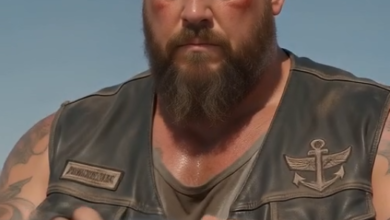
A PARK OFFICIAL CALLED THE BIKER A THUG—THEN A LITTLE GIRL POINTED AT THE PAVEMENT AND SAID, “LOOK UNDER HIM!”
VIDEO CAPTION A
A biker pulled a 90-year-old man out of his wheelchair.
A stranger rushed him. A little girl pointed at the bricks.
Three seconds later, the empty spot collapsed.
Why had he been watching those wheels?
Read the full story below 👇
VIDEO CAPTION B
She thought the biker had just attacked her grandfather.
Then her daughter shouted, “Look under him!”
The wheelchair was on the grass when the path dropped away.
The man blaming him suddenly stopped talking.
What happened next is below 👇
Part 1
THE BIKER PULLED A NINETY-YEAR-OLD OUT OF HIS WHEELCHAIR, AND CLAIRE RAN TOWARD HIM BEFORE SHE NOTICED WHAT HIS BOOTS WERE DOING.
At eleven on a bright April Saturday, Claire Bennett had taken her grandfather to Founders Park in Briar Glen, Ohio. Walter Bennett, ninety, wore his navy cardigan despite the sunshine. Eight-year-old Lucy carried a yellow sketchbook and the crackers he always pretended were for the ducks. His wheelchair faced the old bandstand. He asked for that spot every visit.
Claire had turned toward the drinking fountain when the stranger moved.
He was enormous, with a shaved head, a long gray beard, and tattoos running down both arms. His black leather vest bore a broken bridge stitched over a rising sun. One second Walter sat upright. The next, the biker had swept him sideways onto the grass.
“Get your hands off him!”
Claire heard her own voice before she recognized it.
The stranger stayed low, one arm behind Walter’s shoulders, the other beneath his knees. His muddy boots dug backward. Walter’s shoes dragged through clover.
Grant Mercer, the city’s parks project manager, came running from the bandstand.
“That’s what happens when we let these people take over,” he said.
The biker did not answer.
His old cruiser stood near the parking entrance, chrome catching the sunlight. Claire smelled warm leather when she reached him. One worn glove had come off. His bare hand cradled the back of Walter’s head, carefully keeping it above the ground.
That gentleness made no sense.
Neither did the way he kept watching the empty wheelchair.
“Move away from my grandfather,” Claire said.
Grant stepped in front of her.
“I saw everything. He yanked him right out.”
Several people lifted their phones. A jogger caught Lucy by the shoulder of her cardigan before she could follow Claire onto the path. Lucy pulled free and stayed on the grass.
Grant raised his hands toward the growing audience.
“I’m trying to keep this park safe.”
A man in a red running shirt charged toward the biker, fists clenched.
The biker shifted Walter another foot backward. Then he reached for the wheelchair’s rear frame.
“Not there,” he said.
The runner thought the warning was meant for him.
He planted one shoe on the paving stones.
Lucy pointed.
“Look under him!”
Claire followed her daughter’s finger.
A dark seam curved around the runner’s heel. It had not been there a breath earlier. A thin thread of water pushed up between two bricks.
The biker pulled.
The empty wheelchair lurched onto the lawn, one front caster folded sideways. He braced it with his boot and turned his shoulder over Walter.
Claire remembered the folded work order tucked beneath the cruiser’s windshield. Earlier, she had heard Walter call the stranger Hank. She had assumed they had met while she was parking.
Now she realized Hank had been watching the ground before anyone screamed.
The runner stepped back.
Three seconds after Walter left his chair, the place where his wheels had rested dropped away. Brick after brick slid into a dark opening. Claire caught Lucy against her hip.
Across the hole, Grant opened his mouth.
Nothing came out.
Part 2
Then another row of bricks slipped into the opening.
“Everybody back,” Hank said.
He did not shout. He pointed toward the parking lot, away from the path, and the man in the red shirt began repeating the instruction loudly enough for the people behind him.
Claire held Lucy so tightly that the corner of the yellow sketchbook pressed into her ribs.
“Grandpa?”
“I’m here.”
Walter’s voice sounded offended, which frightened her less than silence would have.
Hank looked at her.
“Call emergency services. Tell them ground collapse. We need the whole walkway cleared.”
Claire’s fingers missed the numbers twice.
Grant finally found his voice.
“Everyone remain calm. This is an isolated paving failure.”
A wet grinding sound came from below the broken edge.
Hank looked at him.
“You don’t know that.”
It was the first thing he had said directly to Grant.
Claire gave the dispatcher the parking entrance and described Walter on the grass. When she mentioned his age, the dispatcher asked whether he was conscious, breathing normally, bleeding.
“Yes. Yes. I don’t see any.”
“Don’t try to stand him up.”
Claire repeated that instruction before Grant could offer to help Walter back into the chair.
Hank stayed beside him.
“Anything hurt?”
“My dignity.”
“Anything else?”
Walter considered the question.
“Ask me when my heart slows down.”
A woman brought a picnic blanket. Hank folded it beneath Walter’s head without lifting him more than necessary. His missing glove lay in the grass, palm up, with a pale thread hanging from its thumb.
Claire stared at it because looking at the hole made her stomach roll.
“I thought—”
“Later,” Hank said.
Not sharply.
Simply because Walter was still on the ground.
The runner backed away from the path. His name, Claire learned when the dispatcher requested witnesses, was Ben Carter. His hands were shaking.
“I almost grabbed you.”
Hank nodded once.
“Good thing you didn’t.”
Behind them, Grant spoke into his phone.
“We had an individual interfere with a wheelchair user before the surface failure.”
Claire turned.
“Interfere?”
“I’m documenting the sequence.”
“You said he attacked him.”
“I said what I observed.”
Hank did not answer. He was watching a shallow wet depression farther along the path, beyond the bandstand.
A fire engine arrived first. Responders established a wide perimeter, guided people out through the parking lot, and brought equipment across the lawn rather than the bricks.
Only when a paramedic took Hank’s place did he move his hand from Walter’s shoulder.
The skin beneath his glove was red where a seam had rubbed.
Claire stepped close enough to smell leather and the faint oily odor of work clothes.
“How did you know?”
“The caster dropped.”
“The wheel?”
“Front one. Went down into the joint. Then the joints started opening around it.”
“Why didn’t you roll him backward?”
“Wheel was trapped.”
He pointed to the bent caster on the grass.
“Chair wouldn’t move. Ground was moving.”
Claire looked from the wheel to the place where her grandfather had been sitting.
Grant approached the police officer at the parking entrance.
“I should mention,” he said, “this man has a history with our department.”
Part 3
The officer asked Grant to wait while the paramedics worked.
That small refusal steadied Claire more than she expected.
Hank stood beside his cruiser, hands visible, answering questions. He gave his name as Henry Ellis.
“People call me Hank.”
“And Anchor?” the officer asked, reading the small name tag clipped inside his open vest.
“Road name.”
“Occupation?”
“Construction foreman. Utility work.”
Grant shifted beside the parking curb.
“He no longer works on city projects.”
The officer looked up.
“Was he asked to leave this park today?”
“No.”
“Then we’ll come back to that.”
Claire had lived in Briar Glen long enough to recognize Grant’s expression. He wore it at neighborhood meetings when someone asked about a delayed repair: patient, slightly injured, certain the room would eventually appreciate how difficult his job was.
She had appreciated it herself.
He had helped arrange an accessible parking space for Walter during the previous summer’s concert series.
That mattered. It made changing her mind harder.
A paramedic called her over.
Walter had normal observations, no obvious injury, and enough energy to complain about missing lunch. Given his age and the sudden movement, they recommended a hospital evaluation.
Claire agreed.
Walter looked toward Hank.
“What about my chair?”
“We’ll sort it out,” Claire said.
“The left brake was what he came for.”
She stopped.
“What?”
Walter lifted his chin toward the motorcycle.
“Fellow at the repair shop gave me his number. Said he helps with small fixes.”
Claire remembered the folded paper beneath the windshield.
It was not a city inspection notice.
It was a handwritten list: left brake, footrest bolt, cushion strap.
For months, Walter had refused to let Claire handle every minor inconvenience. He could still use a phone. He could still arrange his own appointments.
She had mistaken that independence for secrecy.
“You should have told me.”
“I was going to. You were parking.”
Hank had arrived early, parked where Walter could see him, and walked over carrying a small tool roll.
He had not come looking for Grant.
He had come to tighten a brake.
At the hospital, Lucy sat beside Claire with a packet of crackers balanced on her knees. Walter underwent an examination while Claire called her husband and explained what had happened without finding a version that sounded believable.
“No, he didn’t fall in.”
“No, the biker didn’t hit him.”
“Yes. I thought he was hurting him.”
Across the waiting area, Lucy opened her sketchbook.
“Great-Grandpa knew him before today.”
“Only on the phone, sweetheart.”
“No. The bridge man.”
Claire looked down.
Lucy had drawn a crooked bridge above a bright orange sun.
“His jacket,” she said.
“What about it?”
“Great-Grandpa said that picture means they fix things.”
Claire had not heard that conversation.
She had been answering a work message while Walter spoke to Hank.
Her phone vibrated.
A neighbor had sent a screenshot from a local discussion group.
The headline above a short video read: BIKER DRAGS ELDERLY MAN FROM CHAIR BEFORE PARK COLLAPSE.
The post quoted Grant.
And the video ended before the ground gave way.
Part 4
Claire watched it once.
Then again, with the sound off.
The clip began with Walter already halfway out of his wheelchair. It showed Hank’s size, Walter’s startled face, Claire running.
It did not show the trapped front caster.
It did not show Hank placing his hand behind Walter’s head.
It ended with Grant saying, “I saw everything.”
Below it, strangers were deciding what kind of man Hank was.
Some wanted his name.
Others had already supplied photographs of motorcycles parked outside a diner, as though one leather vest explained every other leather vest in town.
Claire’s first impulse was to throw the phone into her bag.
Her second was to write something furious.
Lucy touched her sleeve.
“Can I show you mine?”
“Your what?”
“The movie.”
Lucy’s tablet was an old family device with a cracked protective case. Claire allowed her to use its camera at the park, mostly to record ducks making what Lucy called “terrible decisions.”
That morning, Walter had asked her to film the bandstand so he could send it to his sister in Arizona.
The camera had stayed running when everyone shouted.
Claire pressed play.
There was Walter in his chair.
Hank stood beside him, tool roll tucked beneath one arm. He bent slightly and looked down.
On the recording, his expression changed before he touched Walter.
“Sir. Hold on.”
The front caster dipped.
Hank dropped the tools.
The next seconds were crooked grass, Claire’s voice, Lucy breathing hard.
Then the camera caught the path opening.
Claire could hear Grant’s earlier words clearly.
“That’s what happens when we let these people take over.”
She stopped the playback.
“Did you send this to anyone?”
“No.”
“Good. We’re going to give the original to the officer.”
“Is Hank in trouble?”
“I don’t know.”
The honest answer hurt.
A nurse came out to say Walter could go home after the physician reviewed the final results. Claire called the officer whose card she had been given and explained that they had a longer recording.
He told her how to preserve and submit it.
Only afterward did she write beneath the misleading post.
She identified herself as Walter’s granddaughter. She stated that Hank had moved him away from collapsing ground, that Walter was being evaluated, and that a full recording had been provided to police.
She attached no accusation she could not support.
Grant replied within minutes.
No one is disputing that Mr. Ellis may have believed he was helping. The question is whether prior unauthorized activity contributed to the hazard.
Claire read it three times.
Prior activity.
At the hospital exit, Hank waited beside a borrowed replacement wheelchair. A local mobility shop had loaned it after he explained the damaged caster.
He did not mention the post.
Claire showed him Grant’s reply.
Hank’s jaw tightened.
“Did you work under that path?” she asked.
“No.”
“Then what is he talking about?”
Hank took a folded sheet from his vest pocket.
“I think he means this.”
Part 5
The paper was a copy of a field observation report.
Claire recognized the park’s service entrance in the attached photograph. A shallow depression crossed the paving near a utility access cover.
The date was five weeks earlier.
Hank’s name appeared under the observations.
“Your crew was there?”
“Repairing a delivery entrance. Different section.”
“Then why were you looking at the path?”
“Wet in dry weather. Sand washing through a joint.”
He had reported possible loss of support beneath the paving and requested that the walkway be restricted pending assessment by the city’s utility staff and an engineer.
He had not diagnosed a sinkhole.
He had identified something that required checking.
Claire read the distribution line.
Grant’s office had received a copy.
“Was it checked?”
“Don’t know.”
“Did you ask?”
“Twice.”
Hank showed her the follow-up messages. The first had received a brief acknowledgment. The second had been forwarded to a general maintenance address.
Two weeks later, his employer moved his crew to another job.
Grant’s office had called the report an unnecessary escalation.
Claire leaned against the hospital’s brick wall.
She had been grateful for the accessible parking space. She had watched Grant hold a door for Walter. Those things had happened.
So had this.
“I’m sorry,” she said.
Hank glanced toward the entrance, where Walter was arguing with a nurse about whether a discharge wheelchair counted as “extra transportation.”
“Tell him,” Hank said.
“Tell him what?”
“You’re scared. He thinks you’re mad.”
Claire had been.
At Walter for arranging repairs without her. At Lucy for wandering with a camera. At Hank for looking like the person she had expected to fear.
It embarrassed her how much anger fear could borrow.
That evening, the city closed Founders Park entirely.
A preliminary notice stated that a broken buried water line had been isolated and that engineers would assess the surrounding ground. The next morning, investigators measured the original opening at roughly six feet across and more than ten feet deep.
Claire read those measurements at the kitchen table while Walter buttered toast.
He had been medically cleared, with instructions to watch for delayed pain or other symptoms.
“Don’t tell me the numbers,” he said.
“Okay.”
“Bad?”
“Yes.”
He put down the knife.
“Then don’t tell Lucy either.”
Lucy was already listening from the doorway.
“Was anybody else sitting there?”
“No,” Claire said.
“But could somebody have been?”
Claire could not answer quickly enough.
Two days later, the engineering team announced that testing had identified four additional areas of underground erosion beneath other sections of walkway.
The leaking line had washed soil away over time.
The original hole was only the first place the surface had failed.
Claire called Hank.
He listened without interrupting.
Then he said, “Ask for the routing record.”
“For your report?”
“Yes.”
“Why?”
“Because the copy they sent my boss didn’t have my recommendation on it.”
Part 6
Claire did not know how to request a routing record.
She asked.
The city clerk explained which records could be requested, what might require review, and why a response would take time. Claire wrote down the instructions instead of trying to sound as though she already understood them.
She requested the original field report, revised versions, related messages, and the maintenance referral.
Grant called that afternoon.
“I understand you’re upset.”
Claire stood at the kitchen counter, watching Walter teach Lucy to peel an orange in one long strip.
“Yes.”
“I’d hate for misinformation to complicate your grandfather’s claim.”
“What misinformation?”
“Suggestions that staff knowingly allowed a dangerous condition.”
“Did you receive Hank’s report?”
“We receive hundreds of observations.”
“That wasn’t my question.”
Grant paused.
“His employer had concerns about his approach.”
Claire wrote the sentence down.
She asked him to put any further explanation in writing.
After the call, her certainty weakened for about ten minutes.
Perhaps Hank had left something out. Perhaps the warning had been less clear than it sounded. Perhaps she was trying to repay a rescue by choosing his version too quickly.
She called him.
“Did your employer discipline you?”
“No.”
“Did they tell you to stop arguing with Grant?”
“Yes.”
“What did you do?”
“Sent the pictures again.”
It was not a polished answer.
That helped.
A week later, Claire received the first records release. The original report recommended temporary restriction of the affected walkway and further assessment.
The copy sent to routine maintenance described minor surface settlement.
The recommendation had vanished.
An email from a coordinator named Nora Price accompanied the revised document: Updated per your direction. Please confirm whether temporary barriers are still required.
Grant’s reply was attached.
No barriers at this stage. Maintain normal access until after the spring event. Further review can follow.
Claire read it at the table twice before calling the city manager’s office.
By then, the city’s internal review had begun.
Nora contacted Claire only after being interviewed through that process. She did not arrive with a secret envelope. She gave Claire the same explanation she had provided to investigators.
“I should have asked again.”
“Why didn’t you?”
“I asked once in writing. When he said it had been handled, I believed him.”
“Did you know about the leak?”
“No. Neither did he, as far as I know.”
That distinction mattered.
They had not known the size of the void beneath Walter’s chair.
They had known a worker had identified warning signs and requested a restriction.
The spring reopening ceremony had been Grant’s project. A regional facilities position was becoming vacant, and his application highlighted an on-time, uninterrupted park improvement program.
Closing the walkway would have complicated that claim.
It was a smaller motive than Claire had imagined.
That made it worse.
On Friday, the city manager announced an open meeting to discuss the closure and preliminary findings.
Grant was scheduled to speak.
So was Hank.
Walter asked Claire to get his good cardigan.
Part 7
“The navy one is your good cardigan.”
“The other navy one.”
Claire found it hanging behind a suit he had not worn since his wife’s funeral.
A small paper envelope fell from the pocket.
Walter held out his hand before she could pick it up.
“Please.”
She gave it to him.
Inside was a photograph with rounded corners. A young woman in a light summer dress stood beside the old bandstand, squinting toward whoever held the camera.
On the back, in faded blue ink, someone had written: Evelyn. July 1953.
Claire sat on the edge of his bed.
“Was this your first date?”
“First one she agreed was a date.”
“You never told me that.”
“You never asked why I wanted that spot.”
She had asked whether he needed shade.
Whether the pavement was smooth.
Whether they should sit nearer the restroom.
She had not asked why.
Walter ran his thumb along the photograph’s edge.
“I was seventeen. Worked afternoons at the hardware store. She came in for window hooks.”
“And you asked her out?”
“Asked if she needed help carrying them.”
“Window hooks?”
“Wasn’t my strongest opening.”
Claire laughed, then covered her mouth because the laugh had broken somewhere in the middle.
They had met at the bandstand the following Sunday. Evelyn had brought sandwiches wrapped in waxed paper. Walter had brought two bottles of warm orange soda and a terrible amount of confidence.
For twenty years, after retirement, they returned to the same section of path.
At first they sat on a nearby bench.
Later, when Walter needed a wheelchair, Evelyn brought a folding chair and sat beside him.
She died three years earlier.
“I know it’s pavement,” he said.
Claire waited.
“But it’s where I can still remember her before hospitals.”
At the meeting, she had planned to describe a hazardous walkway and a false accusation.
Now she understood that Walter had nearly lost the place where his wife was still sixteen.
Hank came by that evening to adjust the loaner chair’s footrests.
Lucy sat on the porch steps watching his hands.
“What does Anchor mean?”
“Means my friends think I slow them down.”
“Do you?”
“Usually for lunch.”
Walter snorted.
Lucy pointed to the bridge patch.
“Why is it broken?”
“Old bridge outside town. First job our riding group helped with was fixing the footpath around it.”
“Do you have to ride a motorcycle to help?”
“No.”
She considered that.
“Good. Mom says I can’t have one.”
“Your mom’s got sense.”
When he finished, Walter handed him the glove Claire had retrieved from the lawn.
The pale thread still hung from the thumb.
“You need that mended,” Walter said.
“Been meaning to.”
“Evelyn used to do mine.”
Hank turned the glove over but did not put it on.
Claire told him about the photograph.
He listened, eyes on Walter rather than the picture.
Then Walter said, “I want you beside me when they ask what happened.”
Part 8
The meeting room smelled of burnt coffee and rain-soaked coats.
Claire sat between Walter and Lucy. Hank took the aisle seat, his leather vest drawing the same quick looks it had drawn in the park.
This time Claire watched people look.
Grant stood at the front in a jacket and tie.
The city manager began with the engineering findings. The water line had leaked for months, eroding supporting soil. Five affected areas had been identified. Repair work would include pipe replacement, removal of compromised material, ground stabilization, and assessment before reopening.
No one promised a quick patch.
Then Grant spoke.
“The original observation concerned a limited surface defect. There was no confirmed subsurface emergency at that time.”
That much was true.
Claire felt the distinction settle over the room like a cover being pulled into place.
“Mr. Ellis’s later actions,” Grant continued, “were dramatic, and fortunately the gentleman was unharmed. But we should avoid rewriting incomplete information as certainty.”
Hank did not move.
The city manager asked the clerk to display the original report.
Then the revised version.
The missing recommendation filled the screen between them.
A council member leaned forward.
“Who authorized that removal?”
Grant adjusted the microphone.
“The language was unnecessarily alarming.”
“Was an engineer consulted before it was removed?”
“No formal consultation at that stage.”
“Was the requested restriction put in place?”
“No.”
Nora’s email appeared next.
Then Grant’s instruction to maintain access until after the event.
Nobody gasped.
Several people simply stopped writing.
Claire found that more convincing than any dramatic reaction could have been.
The city manager explained that the internal review had also examined Grant’s public statements following the collapse. His assertion that Hank had performed unauthorized work beneath the path had no supporting record.
Hank’s employer had confirmed that his crew’s work occurred elsewhere.
The officer’s completed incident report found no evidence of an assault by Hank. The available recordings showed a protective removal immediately before collapse.
Grant looked toward the audience.
“My priority was preventing panic.”
Ben, the runner, stood when public remarks opened.
“I nearly put my hands on the man who saved him.”
He looked at Hank.
“I’m sorry.”
Hank nodded.
Ben turned back to the front.
“I got that idea from what Mr. Mercer was saying. He sounded like he knew.”
Claire spoke next.
She had brought notes about measurements and documents.
Instead, she began with the thing she could not excuse in herself.
“I believed him because he looked official.”
She looked at Hank.
“And I doubted you because you didn’t.”
Lucy raised her hand beside her.
The chairperson hesitated, then nodded.
“Can the people who saw the little movie see the whole one?”
Claire put a hand on her daughter’s back.
“That’s a fair request,” the city manager said.
Walter spoke last.
“Hank hurt my pride for three seconds.”
He placed Evelyn’s photograph on the table.
“You nearly took the rest.”
Grant lowered his eyes.
The city manager announced that the disciplinary findings would be released the next morning.
Part 9
Grant’s employment ended after the review.
The written findings described his removal of a safety recommendation, failure to escalate the observation appropriately, and unsupported statements about Hank after the incident. The city issued a correction through the same public channels that had carried its original account.
Claire read it before showing Walter.
It named Henry Ellis.
It stated that his actions had removed Walter from the area immediately before the collapse.
It did not call the incident a misunderstanding and leave responsibility floating between everyone involved.
Nora received disciplinary action for processing the revision without obtaining the required technical review. The city changed the reporting process so that safety recommendations could not be removed through an informal administrative edit.
Claire did not understand every part of the new procedure.
She understood that the person who noticed a problem would receive a documented response.
That seemed like a beginning.
The park stayed closed for three months.
Walter complained every week.
He complained about the temporary walking route, the missing shade, and the way everyone now asked whether he felt safe before asking whether he wanted coffee.
Hank visited when his work schedule allowed.
Sometimes he brought a bolt or a strap for the wheelchair. Sometimes he brought nothing.
Lucy learned that he drank coffee without sugar and could draw a motorcycle badly enough to make her laugh.
She drew him a better one.
He tucked it behind the clear pocket inside his saddlebag.
In July, the city invited Walter to inspect the accessible route before the public reopening.
Claire expected fresh paving and a short apology.
There was also a bench.
It stood beside the old bandstand, on a reinforced pad adjoining the restored path, with enough room for a wheelchair beside it. A small plaque bore two names.
Walter and Evelyn Bennett.
The family had approved the wording. Claire had kept the installation date quiet.
Hank arrived in a borrowed accessible van, with his cruiser left at home.
Walter noticed immediately.
“You miss your bike?”
“Not today.”
They crossed the park slowly.
No crowd surrounded them. The larger reopening event was scheduled for the afternoon. Claire had asked for a quiet hour first, and for once a request had reached the right person without getting smaller on the way.
Walter read the plaque.
Then he looked toward the bandstand.
“Wrong side,” he said.
Claire’s heart dropped.
“What?”
He pointed beside the bench.
“She sat on my left.”
Hank checked the clear space, released the wheelchair brakes, and asked Walter before moving him.
They settled him on the other side.
Walter nodded.
“There.”
Lucy climbed onto the bench, leaving the space nearest him empty.
“Is this Evelyn’s spot?”
Walter looked at the small gap between them.
“It can be yours today.”
Claire sat at the far end. Hank remained standing until Walter tapped the wood.
“Plenty of room, Anchor.”
He sat carefully, leather creaking.
Claire had trusted clean clothes and an official title before she trusted the man whose hands were holding her grandfather’s head off the ground. She would remember that the next time appearances offered her an easy answer.
If this family’s story stayed with you, follow the page for more stories of kindness people almost failed to recognize.
Walter rested his hand on the bench.
“Same time next week?”
Hank nodded.
“I’ll bring coffee.”