A Biker Flipped the Table Before I Could Mortgage My House to Save My Daughter—and Then Asked Why the Loan Officer Knew Her Bedtime Name
Evan Mercer didn’t look at Ray.
He looked at me.
“You told me,” he said. “While we were discussing the application. You were upset.”
For a moment, I believed him.
That was the worst part.
I had been awake since four, working the opening shift at the bakery. Since noon, I had listened to a stranger tell me how easily a child could disappear. I couldn’t remember whether I’d eaten breakfast, much less every word I’d said inside that bank.
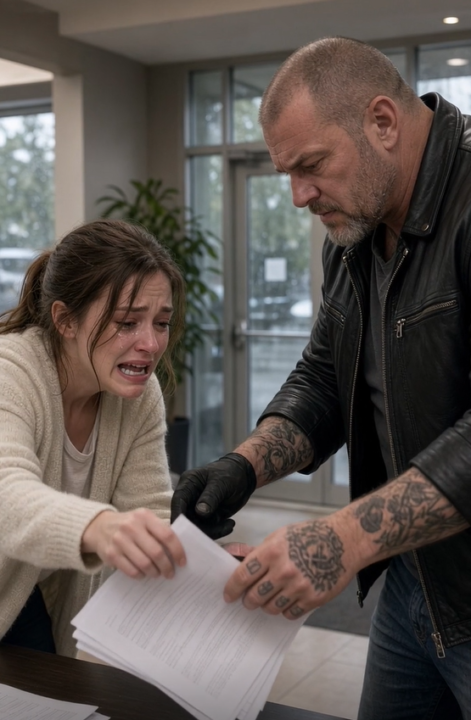
Maybe I had told him.
Maybe Ray was turning fear into something he could fight.
Evan moved the pen toward my hand.
Ray caught the edge of the small signing table and tipped it hard onto its side, away from our chairs. The sound cracked through the glass-walled office.
Nobody was struck.
Everyone moved.
Evan stumbled backward. His elbow hit the cabinet, and something black slid from inside his jacket.
A phone.
Not the silver one beside his keyboard.
This one landed faceup near my shoe. On its screen, Lucy sat on a mattress with her elephant pressed against her stomach.
A little speaker hissed.
Then I heard her cough.
I dropped to my knees.
“Lucy?”
Evan reached down.
Ray stepped between us.
“Don’t touch it.”
The security guard arrived with one hand raised. Ray backed away immediately, both palms open.
“My sister’s child is missing,” he said. “Call police. Keep that phone on.”
Evan’s voice became sharp.
“That’s a security feed. Her aunt sent it to me.”
I heard only one word.
Aunt.
My sister-in-law, Beth, was Lucy’s emergency contact at school. She had offered to collect her that morning because Lucy’s teacher had scheduled an early dismissal.
Beth had also told me which bank employee to ask for.
My stomach tightened until I thought I would be sick.
The branch manager, Denise Holloway, pulled the office door open and moved the waiting customers away. She called 911 herself.
I kept saying Lucy’s name.
On the screen, Lucy lifted her head.
She couldn’t hear me.
There was no answering voice, no movement toward a camera. Just the same low fluorescent buzz and the edge of a brown door.
Evan stood perfectly still.
“That’s delayed,” he said. “It isn’t what you think.”
Ray looked at him.
“How delayed?”
Evan didn’t answer.
The guard asked Ray to sit. He did, slowly, beside the overturned table. A paper cup rolled against his boot.
I wanted to thank him.
Instead, I said, “If you scared them into hurting her—”
He nodded once, as if he had already thought of that.
Two officers reached the bank while Denise was still on the phone. One separated us. The other crouched beside the black device without picking it up.
He asked me when I had last seen my daughter.
“Seven forty this morning.”
Then he asked who had permission to take her from school.
I gave him Beth’s name.
Across the office, Evan finally exhaled.
Why did he look relieved?
Before my husband died, Sundays belonged to our kitchen.
Daniel made pancakes badly. Lucy stirred batter with both hands around the spoon. Ray arrived on his Harley carrying groceries in a backpack because Daniel always forgot something.
One rainy Sunday, Lucy tore her elephant’s ear on a drawer handle.
I repaired it with yellow thread. She insisted I leave a little opening because she needed somewhere to hide her treasure: a red coat button she called her emergency penny.
Daniel put the button inside the left ear.
Ray watched from the sink.
Later, Daniel noticed our kitchen clock was seven minutes fast.
“Leave it,” I told him. “For once, we’ll be early.”
He laughed and wrote a small seven on the battery cover.
That was our whole life then.
A crooked seam.
A fast clock.
People who knew where things belonged.
At the bank, Detective Marisol Vega asked me to repeat the morning without guessing.
Lucy’s teacher had emailed about the early dismissal. Beth had offered to collect her at eleven fifteen and keep her until my shift ended.
At twelve twenty-three, an unknown number called.
The man knew Lucy’s name, her school, my address, and the balance I still owed on the house.
He played six seconds of her crying.
Then he told me to raise eighty thousand dollars.
“If you contact police, we’ll know.”
I had called Beth first.
No answer.
Then her voicemail filled.
Evan had called ten minutes later about an old home-equity inquiry I’d abandoned months earlier. When I started crying, he told me to come in.
He could help.
Now those words sounded rehearsed.
Vega asked how Ray had found me.
“Beth called him,” I said.
Ray looked up.
“She texted. Said Claire needed somebody at the bank. Then she stopped answering.”
He handed over his phone.
The message was plain: YOUR SISTER NEEDS YOU. MERCER’S OFFICE. PLEASE GO NOW.
Beneath it was a second message.
DON’T TELL HIM I SENT YOU.
I stared at the screen.
Ray hadn’t come to reclaim money or start another argument. He had come because somebody who knew our history had decided I needed him anyway.
Vega photographed the messages.
Then she asked why we hadn’t spoken in six years.
I looked at Ray’s hands.
He saved me from answering.
“I forged our father’s name on a loan application,” he said. “Did eighteen months. Claire found out after Dad died.”
It was the version I knew.
The version he had never argued against.
Vega wrote it down without changing her expression.
Another officer returned from speaking with Evan. The black phone belonged to him. He had admitted that much.
But its camera account, he said, belonged to Beth.
Then Vega’s phone rang.
Beth had been found at an urgent-care clinic, disoriented and alone.
Lucy wasn’t with her.
What had happened between the school and that clinic?
Beth was wearing one of Lucy’s hair ties around her wrist.
That was the first thing I saw when Vega brought me into the clinic’s small consultation room.
A yellow elastic with a plastic lemon.
Lucy had chosen it that morning.
Beth looked at me and started crying before I spoke.
“Where is she?”
“I don’t know.”
I slapped my palm against the examination table so hard the paper cover jumped.
“Don’t say that.”
A nurse stepped toward us. Vega asked me to move back. I did, but only because Ray touched the doorframe instead of touching me.
He knew I would have pulled away.
Beth said she had collected Lucy, driven toward her apartment, and stopped at a pharmacy. A man she recognized as Evan’s brother had approached her car.
Dale Mercer.
He said Evan needed her to sign something connected to an overdue loan.
She had let him sit in the passenger seat.
After that, her account became broken pieces: a bitter drink, a parking lot, waking in her car without Lucy.
The clinic staff had already requested a medical assessment. Vega didn’t tell us what they suspected. She asked about times, locations, receipts.
Beth handed over a pharmacy bag.
Inside was children’s allergy medicine and a receipt stamped eleven forty-one.
Evan had been on a recorded customer call at eleven forty-one.
Bank cameras showed him entering the branch shortly after eight and remaining there until Ray overturned the table.
He had never left.
I sat down.
It felt like my body had become heavier than the chair.
Maybe Evan was exactly what he claimed: a worried bank employee whose brother and acquaintance had dragged him into something terrible.
Maybe I had helped Ray accuse an innocent man.
Then Vega asked Beth about the camera.
Beth’s mouth opened.
Nothing came out.
“The room on his phone,” Vega said. “He says you gave him access.”
“I did. Months ago.”
Beth rented a small room behind a closed appliance-repair shop on the east side of Dayton. She kept supplies there for the cleaning jobs she did on weekends.
Evan had helped install a cheap indoor camera after a break-in.
His brother owned the building.
Everything had an explanation.
Every explanation led back to the same two men.
Vega left to direct officers toward the shop. She told us to remain at the clinic.
I watched the minute hand move on a wall clock.
Ray stood beside the door, holding his helmet against his stomach.
“Sit down,” I said.
“I’m okay.”
“I wasn’t asking if you were okay.”
He sat.
For a few seconds, he looked like my older brother again instead of the man I had reduced to the worst thing he’d done.
Then Beth whispered something.
“Evan said nobody would need to know.”
Vega had just returned.
She stopped inside the doorway.
“Know what?”
Beth looked at the floor.
“The loan wasn’t supposed to be in my name.”
Whose name had she used?
Mine.
Beth had used my name.
Not on the eighty-thousand-dollar papers at the bank. On an earlier loan, six months before Lucy disappeared.
She had copied my information from documents Daniel left in a filing cabinet. She still had a key to our house then. I had given it to her after the funeral because I couldn’t manage a child, a job, and the rooms full of his clothes alone.
She borrowed fourteen thousand dollars.
She said Evan arranged it through a private company after the bank turned her down.
“I was going to pay it back before you found out.”
I stared at the lemon hair tie.
“Take that off.”
Beth blinked.
“Claire—”
“That belongs to my daughter.”
She removed it and laid it on the examination table.
Vega let the silence stay.
Then Beth explained the payments. The fees. The new balance that grew even when she paid. Evan saying there were irregularities that could become a criminal complaint.
Dale saying he knew ways to settle things.
Three weeks earlier, they had asked about my house.
“No mortgage,” Beth said. “Not much left, anyway. Daniel’s insurance paid most of it.”
I stood.
Ray moved his chair out of my way without saying anything.
Vega asked whether Beth had told them about Lucy’s school.
“Yes.”
Her emergency contacts?
“Yes.”
Our daily schedule?
Beth covered her mouth.
I went into the hall before I heard the answer.
A little boy in a dinosaur sweatshirt sat beside the water fountain, holding a warm compress against his ear. His mother was peeling the label from a juice bottle.
The world had continued making ordinary children.
I couldn’t understand it.
Denise called Vega while we were in the hall. The bank had preserved Evan’s work messages and stopped the private-lender packet from going anywhere.
The proposed loan wasn’t something the branch itself could fund that afternoon.
It was a referral.
The company on the papers was an LLC connected to Dale.
The papers included a substantial origination charge and a broad authorization over where the proceeds would be sent. Evan had placed the signature tabs.
My house was supposed to secure money controlled by the same family demanding it.
The loan and the ransom were parts of one machine.
Vega said this carefully. She called it a developing picture. She didn’t promise an arrest would bring Lucy back.
Then the officers at the appliance shop reported in.
The rear room was empty.
A mattress remained.
So did a blue plastic cup and the charging cable for a camera.
Lucy’s elephant was gone.
The camera feed on Evan’s phone had been a recording from earlier that afternoon. The image had kept me kneeling beside the desk while somebody moved my child.
Vega asked the officers to hold the scene.
I gripped the wall.
My phone vibrated in my pocket.
A message from the ransom number.
YOU BROUGHT POLICE.
Below it was a new photograph.
Lucy sat in a car, her cheek pressed against a dark window.
Where were they taking her now?
They moved us out of the clinic through a side door.
No sirens.
No promises.
An officer drove Beth separately. Ray followed us to the police building in his truck; he had left his motorcycle at his garage when Beth’s message arrived because he thought I might need a ride.
I remembered how I had told him to leave.
At the station, Vega asked me not to respond to the new message until she could sit beside me.
Then my phone rang.
Same number.
I answered on speaker.
The voice sounded different from the first call. Less muffled. Tired, almost annoyed.
“You made this complicated, Claire.”
I couldn’t speak.
Vega wrote two words on a pad.
KEEP TALKING.
“Let me hear her.”
A pause.
Fabric scraping.
Then Lucy said, “Mom?”
I bent over the phone.
“Hi, baby.”
“Did I do something bad?”
“No.”
The word came out too loud.
I tried again.
“No. You didn’t do anything bad.”
The man took the phone back.
“Money first. She goes home.”
Vega pointed to another note.
ASK FOR TIME.
I told him the papers weren’t finished. I told him the bank couldn’t release the money that fast.
He said I had forty minutes.
Then he added, “Your brother knows what happens when people don’t pay.”
Ray had been standing behind the glass.
I looked up at him.
The caller laughed once.
“Ask him about your father.”
The line went dead.
Vega stepped outside with another detective. Ray came in only after she waved him through.
“Did you know these men?”
He set his helmet on the chair.
“I knew Dale.”
The room seemed to shrink.
“When?”
“Before prison. He arranged loans for people who couldn’t get them anywhere else.”
“And you never thought to tell anybody?”
“I gave the detective his name at the bank.”
I had been too busy watching Evan to hear it.
Ray rubbed his palms together.
“Dale wasn’t on the paperwork then. Somebody else always was.”
The detective returned with a printed document. It was a scan of the old loan bearing our father’s signature.
I recognized the shape immediately.
I had watched Ray sign birthday cards. He made a heavy slash through the R.
This signature had a careful loop at the bottom.
My loop.
I looked away before he could see.
Vega asked whether the caller’s reference meant anything to me.
“No,” I said.
Ray closed his eyes.
It was a tiny movement.
But I understood that he had seen me recognize it.
The danger hadn’t only come from my phone. It had followed us into a room where I was still lying to the people trying to find my child.
Vega waited.
Ray said, “Tell her, Claire.”
What would finding Lucy cost if I finally told the truth?
I had signed our father’s name.
Six years earlier, Daniel had been recovering from a back injury. We were behind on bills, and I needed money quickly enough that I stopped asking the right questions.
Dale arranged the loan.
I used Dad’s name because his credit was better.
Ray found out when the collection letters came.
He paid what he could. When that wasn’t enough and the fraud investigation began, he told them he had submitted the application.
He had handled the money afterward. He had dealt with Dale. There was enough around his confession to make it believable.
I let him.
That was the part I could never soften.
I let my brother stand in a courtroom and become the explanation for something I had done.
When he came home, I told myself he was angry, unstable, dangerous around Lucy. It was easier than letting him sit at our table.
Vega listened without interruption.
Then she said, “Your daughter still needs us. We deal with what you’ve told me, and we keep looking.”
She didn’t forgive me.
She didn’t need to.
Ray looked down at the scratched helmet between his boots.
“Daniel knew,” I said.
He nodded.
My husband had found the old papers while sorting our finances. He had wanted me to correct the record. Then came the wet highway, the hospital call, the three days when I kept believing he might wake up.
Afterward, Beth became the person who handled things.
Mail.
Bills.
Lucy’s pickups.
She had seen the old loan documents, including Dale’s contact information.
My lie had stayed in the house like an unlocked door.
Vega went to speak with Beth again. When she returned, she brought a new account.
Beth had not been unexpectedly approached at the pharmacy.
She had agreed to meet Dale.
Evan had told her they would stage a brief scare, pressure me into signing a loan, and return Lucy before dinner. He said nobody would hurt her. Beth would receive debt relief and a share of the fees.
Then Dale refused to give Lucy back.
Beth panicked.
She sent Ray to the bank because she knew I wouldn’t listen to her if she admitted what she’d done. Dale took her phone, threatened her, and left her near the clinic.
The story about losing consciousness had been hers.
Another lie offered as shelter.
I pressed my hands flat on the table until the trembling stopped.
“Where would she meet him again?”
“She gave us an address,” Vega said. “We’re checking it.”
Minutes stretched.
A detective examined the new photograph beside an older property listing connected to Dale. The car window reflected a narrow row of windows in a block wall.
A former transmission shop.
One of the addresses Beth had supplied.
Vega stood before the comparison finished loading.
She left us with another officer.
Ray sat across from me, silent.
I wanted to ask why he had carried my sentence.
Instead, I asked whether Lucy would still want her elephant.
He looked at me as if I had finally asked something he could answer.
“She’ll want you.”
Then Vega called.
They had found the car.
Was Lucy still inside?
She wasn’t in the car.
For three seconds, that was all Vega said.
Then she told me officers had found Lucy inside the shop’s small office. Dale was in custody. A paramedic was checking her.
“She’s asking for you.”
I made a sound I had never heard come out of my body.
Ray stood so fast his chair struck the wall.
Vega told us where to go and who would take us. She kept speaking until I could repeat the instructions back.
At the hospital, Lucy’s socks didn’t match.
One was pink.
The other had gray stars.
I noticed that before I noticed anything else. My mind had room for socks because it couldn’t yet hold the whole child sitting alive on the examination bed.
She held out both arms.
I went to her carefully.
Every part of me wanted to grab.
Instead, I asked, “Can I?”
She nodded.
Her hair smelled like an unfamiliar room.
I held her until she said my necklace was poking her chin.
Then I loosened my arms.
A nurse asked me to sit beside the bed while she finished checking Lucy. Ray waited near the doorway with his helmet tucked under one arm.
Lucy studied him.
“You’re the motorcycle uncle.”
His mouth moved before any sound came out.
“Yeah.”
“Mom said you lived far away.”
He looked at me.
“Not that far.”
Lucy held up the elephant. Its left ear hung open, yellow thread pulled loose.
“They took my penny.”
Vega, standing behind the nurse, became still.
“What penny, sweetheart?”
“My red one.”
“Can you tell me who took it?”
“The nice man. Before the other man drove.”
I felt the bed rail beneath my hand.
“What nice man?”
“The bank man.”
Evan had been at the branch on camera.
But Lucy said he had come to the first room with sandwiches before she was moved. His lunch break hadn’t happened outside the bank. He had used a side office with a separate exterior door, outside the lobby camera’s view.
That gap had been missed in the first hurried review.
Later, investigators found an exit recorded by the door-access system and a return twenty-six minutes later. The appliance shop was a short drive away.
Lucy said he had searched her elephant.
“He thought my penny was a tracker.”
Vega asked a few careful questions, then stopped. A specialist would speak with Lucy when she was ready.
That night, Evan was arrested.
Finding Lucy didn’t finish the story. It changed its shape.
There were interviews. Search warrants. Devices taken for examination. Beth’s lawyer called mine before I had even found a lawyer.
Ray gave investigators everything he still had about the old loan.
I corrected my statement.
Months later, I signed a fuller one.
The prosecutor warned me that honesty didn’t come with a guarantee about what would happen next.
I signed anyway.
Evan pleaded not guilty.
He claimed Beth and Dale had used him. The phone, the referral, the camera access—all innocent things arranged into an ugly picture.
At trial, he chose to testify.
Would the man who had almost taken my house convince a jury he had been helping us?
The courtroom was smaller than the one in my nightmares.
There were no rows of reporters shouting questions. A ceiling vent clicked. Somebody behind me opened a cough drop with painful slowness.
Ray sat beside my attorney.
He wore a clean dark shirt. His leather vest lay folded across his knees because he hadn’t known whether wearing it would make things harder for me.
I hated that he had needed to ask.
Beth had accepted a plea agreement and testified. Dale had taken a separate plea. Neither became innocent by telling the truth.
The prosecutor had already shown the loan referral, messages recovered from Evan’s devices, the camera account, and records tying him to Dale’s company.
The financial evidence mattered more than his smile.
Still, he had an answer for each piece.
His brother borrowed his accounts.
Beth exaggerated to save herself.
He had visited the room because he believed Lucy was simply waiting for her aunt.
On the stand, he spoke the way he had spoken in his office.
Patiently.
As if the rest of us were being unreasonable.
The prosecutor asked about the sandwiches.
“I brought food to a child,” he said. “That’s what I did.”
“Did you search her belongings?”
“No.”
“Did you open her stuffed elephant?”
“No.”
“Did you remove anything from it?”
“Absolutely not.”
A photograph appeared on the courtroom screen.
The elephant.
The torn yellow seam.
I looked at the actual toy in the clear evidence bag on the table and remembered Daniel’s fingers pushing that red button through the little opening.
The prosecutor asked Evan whether he knew why the seam had been opened.
“I couldn’t tell you.”
She paused.
“Lucy described a small object being taken from the toy. Did you see that object?”
“No.”
“Her mother calls it a penny.”
Evan gave the faintest smile.
“It wasn’t a penny.”
The room changed without anybody moving.
The prosecutor waited.
Evan looked toward his attorney.
Then he said, “I mean, that’s what I understood from—”
“From whom?”
He swallowed.
“The police reports.”
The prosecutor lifted a thin folder.
“The report disclosed to your attorney describes a small red object. It does not identify what it was.”
His attorney stood.
There was an objection. The judge heard it. The lawyers approached the bench, and for several minutes we listened to the vent.
Nobody declared victory.
Nobody needed to.
When questioning resumed, the prosecutor returned to his earlier answer.
“You testified that you never handled the toy.”
“That’s correct.”
“Then how did you know the object wasn’t a penny?”
Evan gripped the edge of the witness box.
He tried to retreat into possibilities. Maybe Beth had mentioned it. Maybe he had heard it during an interview. Maybe he had seen a photograph.
The prosecutor took him through the dates.
Then she introduced a photograph recovered during the search of his car.
A red coat button lay inside a small envelope in his center console.
It had been photographed where investigators found it.
Evan stared at it.
For the first time since I had met him, he let a question remain unanswered.
Ray’s hand rested on his folded vest.
I wanted to take it.
Why was that harder than signing my name in court?
I took his hand before the jury came back.
He looked down.
Then he shifted his fingers so I wouldn’t have to hold them awkwardly.
That was all.
The verdict came late in the afternoon.
Guilty.
Not because of one wrong word.
Because of the messages, the money trail, Lucy’s account, the devices, the rooms, and the ordinary little object he had carried away because he thought it might expose him.
His mistake on the stand had opened something the other evidence already supported.
At sentencing, I read a statement with both feet flat on the floor.
I talked about Lucy asking permission before she used the bathroom now. About how she checked the back seat before getting into a car. About the first time she asked whether our house belonged to us.
I didn’t ask Evan to look at me.
I had spent enough time needing something from him.
Beth received a prison sentence under her agreement. I sent her one letter, through the lawyers, telling her Lucy was safe and that I wasn’t ready for contact.
I didn’t promise I ever would be.
The bank covered the damage to the signing table at first, then Ray insisted on paying the amount they requested. He said stopping a crime didn’t mean he hadn’t broken their furniture.
Denise sent the receipt in an envelope.
Inside was another note.
Thank you for refusing to leave.
My own old fraud didn’t disappear.
With an attorney, I gave a formal statement and records. The case took time. I accepted responsibility, paid restitution under the agreement reached, and did the work required of me.
Ray’s lawyer began the separate process of challenging what had happened to him.
There was no single hearing that returned eighteen months.
There was no document that made my father alive to hear the truth.
I told Lucy, with help from her counselor, that adults in our family had made serious mistakes. I told her none of them had been her fault.
She asked whether Uncle Ray had made one.
“Yes,” I said. “He lied to protect me.”
“Was that good?”
I sat with the question.
“No. He loved me. But it wasn’t good.”
Spring came slowly.
Ray started having dinner with us on Thursdays. At first, he brought food and stayed near the door. Then Lucy began leaving his place set even on Mondays.
One evening, he took the kitchen clock down to change its battery.
He turned it over.
The little seven Daniel had written was still there.
“You want it right?” he asked.
Lucy stood on a chair beside me, holding the elephant while I repaired its ear again. We had put the red button back inside.
I looked at Ray.
“For once,” I said.
He set the clock to the right time.
After dinner, Lucy brought him the elephant and asked him to check my stitches. He pressed one rough fingertip along the seam.
“Looks strong.”
She climbed onto the couch beside him.
“Are you staying?”
Ray glanced at me before answering.
“I’m here.”
And if she asked again tomorrow, could we both keep making that true?