Part 2: Police Told a Biker to Leave a Rich Neighborhood — Then the Family Inside the Mansion Ran Outside Crying
PART 2
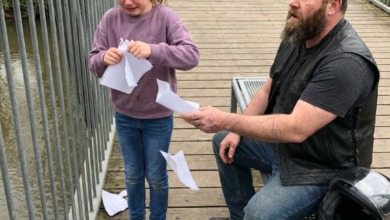
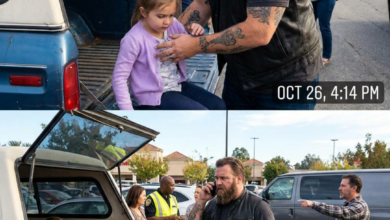
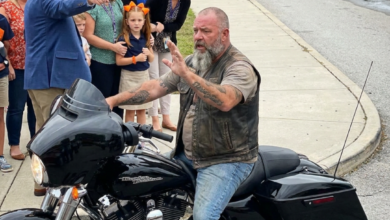
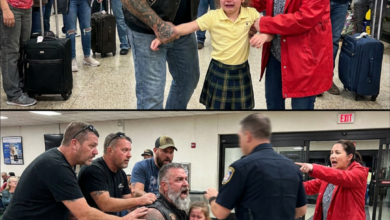
His name was Elias “Roadhouse” Mercer, though the police did not know that when they pulled in behind his motorcycle. To them, he was one more call shaped by a neighbor’s suspicion: unknown male, biker, loitering near residence, possibly casing property. The kind of phrase that sounds official enough to hide how much of it began with someone looking out a window and deciding fear was evidence.
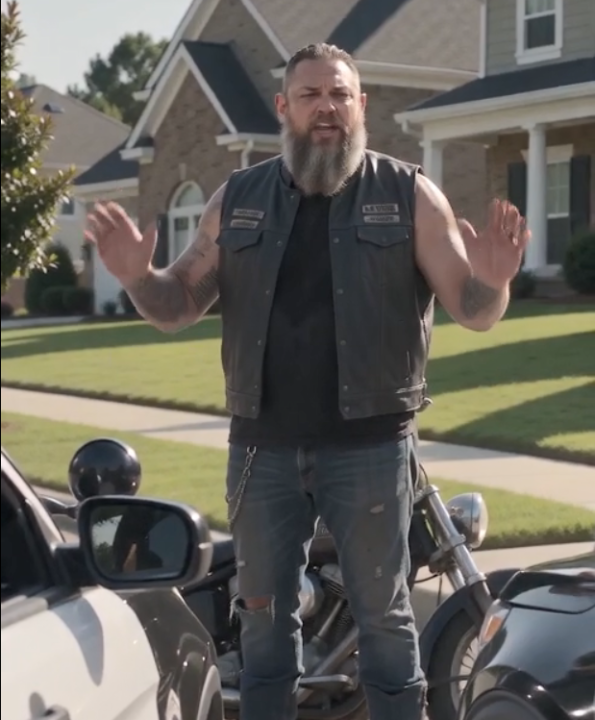
Elias had heard worse.
That was the first small thing nobody noticed.
He did not rage when the officers questioned him. He did not puff up or make a show of disrespect. He turned slowly, kept his hands visible, and answered every question in a voice low enough to make the neighbors lean closer.
“Name?”
“Elias Mercer.”
“Address?”
“Memphis.”
“Reason for being here?”
He looked toward the mansion again.
That was where silence entered the story.
The house belonged to the Whitmore family, though even people who had lived in Harrington Oaks for years knew them more by glimpses than closeness. White stone exterior. Tall black-framed windows. A circular driveway. Two Range Rovers. A seasonal wreath that probably cost more than some people’s weekly groceries.
The father, Grant Whitmore, ran a private equity office in Nashville. The mother, Claire Whitmore, chaired charity lunches and wrote perfect thank-you notes. Their son, Miles, was eight years old and had been seen by neighbors only in fragments for nearly two years: a pale face behind glass, a small hand lifting a curtain, a child in a medical mask being carried into the house after hospital stays.
Nobody talked about it directly.
Rich neighborhoods are skilled at privacy when privacy belongs to the rich.
But they were less generous with Elias.
He stood on the curb with his dusty boots and road-worn face, and the neighbors filled in the blanks with whatever made them comfortable. The woman in tennis clothes whispered that she had seen him “watching the house.” The retired man said his bike had been idling too long. Another neighbor claimed he had been there before, though later it turned out she meant she had seen a motorcycle once at a gas station two miles away.
Fear edits memory.
Officer Daniel Reyes, Latino American, late thirties, kept his tone professional but guarded. His partner, Officer Melissa Hart, white, early forties, watched Elias’s hands. Not cruelly. Carefully. The kind of careful that can become kindness or force depending on the next second.
“Mr. Mercer,” Reyes said, “do you know anyone in this house?”
Elias opened his mouth.
Then stopped.
His eyes moved again to the upstairs window.
The boy was still there.
Miles Whitmore stood behind the glass in a gray hoodie, small for his age, one hand pressed flat against the windowpane. His head was covered in soft new hair, the uneven kind that grows back after the body has been asked to survive more than childhood should ask. He looked down at Elias with recognition so pure it made the biker’s face change before he could hide it.
That was Reveal One.
The child was not afraid of him.
The officers saw the child too, but not the recognition. Not yet.
“Sir,” Officer Hart said, “why are you looking at that boy?”
The neighbors shifted at that question. Phones angled higher. Someone muttered, “See?”
Elias heard it.
Of course he did.
He swallowed once and looked at the envelope in his hand. It was wrinkled from travel, folded at the edge, with a child’s sticker on the back. A small dinosaur. Green. Half peeled from heat and mileage.
“I was told not to come up the drive,” he said.
“By who?” Reyes asked.
Elias did not answer fast enough.
That made the scene worse.
The retired neighbor stepped off his porch and called across the street, “He’s been standing there watching that child for fifteen minutes!”
Officer Hart turned. “Sir, stay on your property.”
The neighbor looked offended by boundaries arriving late.
Elias let out a breath, almost a laugh but with no humor in it. “Funny how everybody’s got instructions for me today.”
Reyes stepped closer. “Mr. Mercer, we’re trying to resolve this calmly. Do you have business with the family?”
“I used to.”
Used to.
That answer made the street colder.
Claire Whitmore opened the front door at that exact moment.
She was white, forty-one, thin in the way long fear can make a person thin, wearing a cream sweater and jeans that looked expensive but slept in. Her blond hair was pulled back, not neatly. Her face had the stunned, hollow brightness of someone who has heard a voice from a life she thought had ended.
She stood in the doorway, one hand gripping the frame.
Then she screamed, “Elias?”
Not fear.
Recognition.
The neighbors did not know what to do with that.
Grant Whitmore appeared behind her, taller, polished, white, mid-forties, in a blue dress shirt with the sleeves rolled up. He looked first at the police, then at Elias, then at the envelope in the biker’s hand. His face did not soften the way Claire’s had.
In fact, it hardened.
That was Reveal Two.
The family knew him.
But not everyone was happy he had come.
“Claire,” Grant said quietly, “go inside.”
She did not move.
Miles appeared at the top of the stairs behind them, breathing hard from the effort of getting there too fast. He wore blue socks and held the railing with both hands. When he saw Elias fully, his mouth opened.
No sound came out.
Then the little boy lifted one trembling hand and touched the center of his own chest.
Elias’s face broke for half a second.
Just half.
Enough for Officer Hart to lower her hand from her belt.
“Mr. Whitmore,” Reyes called, “can you confirm this man is known to your family?”
Grant walked down the front steps but stopped halfway, keeping distance like distance itself could preserve whatever story he preferred.
“He was asked not to come here,” Grant said.
Claire turned toward him sharply. “Grant.”
“He was asked,” Grant repeated.
Elias nodded once.
“That’s true.”
And just like that, every neighbor who had already judged him felt confirmed again.
The biker had been told not to come.
He came anyway.
That was all they needed.
But Miles, still on the stairs, began crying silently.
And the envelope in Elias’s hand trembled for the first time.
PART 3
The truth came out badly at first, the way truths often do when too many people have worked too hard to keep them contained.
Grant did not want the street to hear. Claire could not bear the street not hearing. Elias looked like he would rather be arrested than explain himself in front of polished driveways and camera phones. The officers stood in the middle of it all, trying to figure out whether they had a trespass call, a family dispute, or something much older than either.
Then Miles stepped onto the porch.
That changed everything.
“Miles, go inside,” Grant said.
The boy ignored him.
Children who have survived hospitals learn early that adults are not always right just because they are louder.
Miles was white, eight years old, thin, pale, wearing a gray hoodie and pajama pants, with soft brown hair growing back unevenly across his scalp. He moved slowly, one hand on the railing, but his eyes never left Elias.
Claire rushed toward him, afraid he would fall.
He whispered something.
Nobody heard.
Claire bent close.
Miles said it again.
“Tell him I kept it.”
Claire covered her mouth.
Elias looked down.
That was Redemption One before anyone understood it. A child had kept something from the biker every neighbor wanted removed.
“What did he keep?” Officer Hart asked gently.
Claire looked at Grant, then at Elias, then at her son.
Grant said nothing.
So Claire answered.
“A medal,” she said. “From the hospital.”
Elias closed his eyes.
The envelope in his hand bent slightly under his grip.
Officer Reyes looked between them. “Mr. Mercer, what is your connection to Miles?”
Grant began, “This is private.”
But Claire turned on him then with the quiet fury of a mother who had spent too long making pain presentable for people who had not carried it.
“No,” she said. “He can stand in front of our house and be treated like a criminal, but the truth is private?”
That sentence moved through the street harder than any siren.
Phones lowered.
Not all. Enough.
Claire walked down the steps, slowly, like she was approaching not a stranger but a wound. She stopped a few feet from Elias and looked at the envelope.
“You came for his birthday?”
Elias nodded.
“Dropped it here,” he said. “Wasn’t going to knock.”
Grant’s jaw tightened. “You were told—”
“I know what I was told.”
Elias’s voice was low.
Not angry.
Spent.
That was the strange thing about him. He looked built for confrontation, but every word came out like he had been practicing how not to become one.
Claire turned to the officers.
“Two years ago,” she said, “our son had leukemia.”
The street went completely still.
There are words that wealth cannot soften. Leukemia is one of them.
Miles stood on the porch beside his father, one hand pressed to his chest again, as if the memory lived there physically.
Claire continued, voice shaking now. “He needed a bone marrow transplant. We had no family match. No registry match at first. Then there was one.”
She looked at Elias.
“He was the match.”
Officer Hart’s face changed first.
Then Reyes.
Then, slowly and miserably, the neighbors.
That was Redemption Two.
The suspicious biker outside the mansion had once let doctors drill into his body so the child inside it could live.
Elias did not look proud.
That mattered.
He looked embarrassed by the attention, almost irritated that the thing he had given quietly had been dragged out under porch lights and suspicion. He stared at the pavement near his boots while Claire spoke, as if the concrete deserved more eye contact than he did.
“I was on the registry because of my sister,” he said.
The officers turned to him.
He shrugged once, too small for a man that size. “She needed a donor. Didn’t get one in time. I stayed on the list after.”
That was Redemption Three.
He had not become a donor because he was noble in the shiny way people like to post about. He had become one because grief had left him with nowhere useful to put his hands.
When the call came, he was in Arkansas fixing a truck transmission. The match coordinator told him the patient was a child, nothing more. Elias drove through the night for testing. He took unpaid days. He stayed in a cheap motel near the hospital. He signed forms, listened to risks, and told nobody except his older riding buddy because someone had to feed his dog.
The donation hurt more than he admitted.
Not in the dramatic way movies show, but in the deep-bone soreness of a body loaned out to hope. He went home with bruises, instructions, and no name. Anonymous donor rules meant he could not know Miles for the first year. He was fine with that. He had not done it to be thanked.
Then the year passed.
Claire wrote first.
A letter through the registry. Careful. Grateful. Full of phrases that looked like they had been rewritten a hundred times because “thank you for helping save my son’s life” is both too much and not enough. Elias replied with three sentences and a photo of a dog sleeping under his motorcycle lift because he did not know how to receive gratitude without making it awkward.
Eventually, with consent on both sides, names were exchanged.
Claire wanted to meet.
Grant resisted.
That was the part everyone on Wrenfield Lane had never seen. Grant loved his son. That was true. He had slept in hospital chairs, argued with insurance, searched medical journals at three in the morning, and aged five years in one winter. But he could not bear what Elias represented.
A stranger had done what all of Grant’s money, control, and influence could not do.
That kind of helplessness humiliates certain men.
So when Miles began asking about “the motorcycle man with my matching blood,” Grant tightened the gate around the family. Too much stress, he said. Too soon. Too confusing. Then after one awkward hospital-organized meeting, where Miles had hugged Elias and refused to let go, Grant asked him not to come to the house again.
Elias respected it.
Mostly.
He sent birthday cards through Claire’s charity office. He mailed a model motorcycle one Christmas. He stayed away from the street, the gate, the mansion, the boy whose immune system had once carried something of him and whose father could not forgive him for surviving the boundary.
But this year, the card came back unopened.
Return to sender.
That was why Elias rode to Harrington Oaks.
Not to trespass.
Not to intrude.
To leave one envelope by a mailbox and go.
Inside it was a photograph of his sister, the one who never found a match, and a small note for Miles’s tenth birthday.
Claire knew before she opened it.
She had known Elias long enough through letters to understand how little he said when something mattered.
Grant looked at the envelope like it accused him.
Maybe it did.
Miles came down the steps then, slow and determined. Claire hovered beside him, but did not stop him. Grant started to, then couldn’t. The boy crossed the driveway in socks while the entire rich street watched the child they had protected from strangers walk straight to the man they had treated like danger.
Elias knelt before Miles reached him.
That single movement broke something in the scene.
He was still huge. Still tattooed. Still in leather. But kneeling made him look less like a threat and more like a man making himself small enough for a child’s courage.
Miles touched the envelope.
“You came,” he whispered.
Elias’s mouth trembled once.
“Mailbox only.”
“You were leaving?”
“Yeah.”
Miles looked confused, hurt in the clean way children are when adult rules make no emotional sense.
“Why?”
Elias looked at Grant.
Then back at Miles.
“Because sometimes grown folks get scared of what they can’t repay.”
Grant flinched.
No one spoke.
Miles reached into the neck of his hoodie and pulled out a ribbon with a small plastic hospital medal attached. It was cheap, blue, stamped with the words BRAVE PATIENT. The kind of thing hospitals give children because bravery needs objects when the pain is too big.
He held it toward Elias.
“I kept it,” Miles said.
Elias stared at the medal like it was a relic.
Then he touched it with two tattooed fingers.
“Good,” he said, voice rough. “I kept breathing too.”
Claire began crying.
Officer Hart wiped one eye quickly and pretended she hadn’t.
The neighbors, for once, had nothing useful to say.
PART 4 – ENDING
Officer Reyes cleared the call without drama.
That was probably the kindest thing he could do. No warning made theatrical. No apology performed for the neighbors. He simply confirmed that the homeowner knew Elias, that there was no criminal issue, and that no one needed to be removed from the neighborhood unless the family requested it.
Then he looked at Grant.
Grant looked at Claire.
Claire did not look away.
“No,” Grant said finally. “He can stay for a minute.”
A minute.
It was not enough.
It was still a door.
The police left first. Then the neighbors retreated into their beautiful houses in the embarrassed choreography of people who had watched the wrong thing too confidently. Curtains moved. Phones disappeared. The woman in tennis clothes stood by her SUV for a long second, then walked across the street with her arms folded tightly.
“I’m sorry,” she said to Elias.
He looked at her.
Not cruelly.
Not warmly either.
“Next time call hello before 911.”
She nodded, cheeks burning, and went home with that sentence following her up the driveway.
Elias did not enter the mansion that day.
That mattered too.
He sat on the bottom porch step because Miles asked him to, and because Grant was not ready for more than the step. Claire brought a blanket for Miles and coffee for Elias in a white mug with a gold rim. He held it awkwardly, as if fine things might accuse him of mishandling them.
Miles sat beside him, close enough that their shoulders touched.
Nobody said much at first.
The boy opened the envelope carefully. Inside was the photograph of Elias’s sister, Maggie, smiling in a red winter hat, holding a paper sign that said JOIN THE REGISTRY. On the back, Elias had written one line:
She didn’t get her match, so I stayed ready for yours.
Miles read it three times.
Grant stood near the doorway, one hand in his pocket, face turned slightly away.
Sometimes guilt looks like anger until it runs out of places to stand.
Over the next few months, the story changed Harrington Oaks in small ways, not because everyone became better overnight, but because embarrassment can become useful if it survives long enough. The neighborhood association invited a local marrow registry group to its spring fundraiser. Claire insisted Elias be invited. Grant did not object, which was not the same as welcoming him, but it was not nothing.
Elias came in a clean shirt under the same leather vest.
No readable patches.
Boots polished badly.
Miles greeted him at the door before anyone else could decide how formal the moment should be. He wore a navy blazer, a medical mask hanging loose under his chin because old habits fade slowly. Around his neck was the hospital medal.
At the fundraiser, people asked Elias questions with the nervous politeness of folks trying not to reveal what they had once assumed. He answered plainly. Registry swab. Phone call. Testing. Donation. Recovery. No sermon. No hero pose. When one man called him a lifesaver, Elias shook his head.
“No,” he said. “I was a match.”
That was how he always made the story smaller.
Miles always made it big again.
By summer, Elias visited once a month. Never without asking. Never up the driveway until Grant opened the gate himself. At first, he sat on the porch. Later, the kitchen. By fall, he helped Miles build a model motorcycle at the marble island while Grant watched from across the room, trying to pretend he wasn’t interested in how carefully Elias taught patience.
One Saturday, Grant finally asked about Maggie.
Elias told him.
Not all of it. Enough.
He told him about hospital rooms where hope got thinner each week. About learning that matches are not guaranteed. About grief so useless it needed a task. About keeping his phone loud for years because somewhere, someday, a stranger might need what his sister never got.
Grant listened without interrupting.
At the end, he said, “I hated that I couldn’t save him.”
Elias did not soften the sentence.
“Yeah,” he said. “That’ll eat a man.”
Grant looked toward the backyard, where Miles was showing Claire how the model motorcycle’s tiny kickstand worked.
“I think I hated you for being able to.”
Elias nodded once.
“Figured.”
That was the first honest conversation they had.
Not forgiveness.
Not yet.
Honesty.
A year after the police call, Harrington Oaks held a registry drive at the clubhouse. Not a gala. Not a performative charity luncheon with ice sculptures and speeches. Just folding tables, cheek swabs, clipboards, coffee, and volunteers explaining how bone marrow donation actually worked.
Elias sat at the end table with Miles beside him.
Miles told people, “It doesn’t hurt to sign up.”
Elias added, “It might hurt later.”
Miles elbowed him.
“You’re supposed to make them not scared.”
“I’m supposed to tell the truth.”
They worked well together.
By noon, more than eighty people had joined the registry, including the retired neighbor who had called police that first day. He stood in line quietly, avoiding Elias’s eyes until the very end.
When his swab was sealed, he walked over.
“I was wrong about you.”
Elias looked at him for a long moment.
Then he said, “You were loud about it.”
The man swallowed.
“Yes.”
Elias nodded toward the registry table. “Be loud about that too.”
And the man was.
The final image stayed with Claire long after the day ended. Elias at the curb again, beside the same old dark motorcycle, getting ready to leave as the evening settled gold over the clean lawns. Miles stood barefoot in the grass, stronger now, hair thicker, cheeks fuller, holding the hospital medal in one hand and Elias’s envelope in the other.
Grant walked down the driveway.
He stopped beside Elias, not too close.
Then he held out his hand.
Elias looked at it.
For one second, everything that had happened lived in that pause: the police lights, the neighbor’s call, the returned envelope, the child at the window, the marrow pulled from one body and accepted by another, the strange debt no family can ever pay and no donor should ever ask to collect.
Then Elias shook his hand.
No speech.
No clean ending.
Just two men standing in a rich neighborhood neither of them fully understood anymore.
Miles ran forward and wrapped both arms around Elias’s waist. The biker looked startled, then rested one huge tattooed hand on the boy’s back with the careful pressure of someone touching proof that grief had not taken everything.
Across the street, curtains moved.
This time, nobody called.
Elias looked down at Miles and said the simple line Claire would remember years later, long after the registry drive, long after the neighborhood stopped whispering, long after Miles grew tall enough to look the biker in the eye.
“Keep growing, kid.”
Then he put on his helmet, started the motorcycle, and rode away slow enough for the boy to wave until the sound disappeared past the gate.
Follow the page for more emotional, cinematic stories about misjudged people, quiet courage, and the hidden kindness we almost miss when we judge too fast.