Everyone Laughed When a Tattooed Mechanic Bought Lace and Pearls — Until They Saw the Bride Waiting in a Hospital Bed
The 290-pound biker with oil-black tattoos and hands like busted tools sat in my sewing shop at midnight, learning how to stitch pearls onto a child-sized wedding dress.
That was not the strange part.
The strange part was how quiet he was.
His name was Caleb “Anvil” Mercer, and in Amarillo, Texas, people knew him before they knew him. They knew the sound first. The deep V-twin rumble of his Harley-Davidson touring bike rolling past the old Route 66 diner just after sunrise. The heavy boots on the sidewalk. The leather cut creaking over shoulders wide enough to block my entire shop doorway.
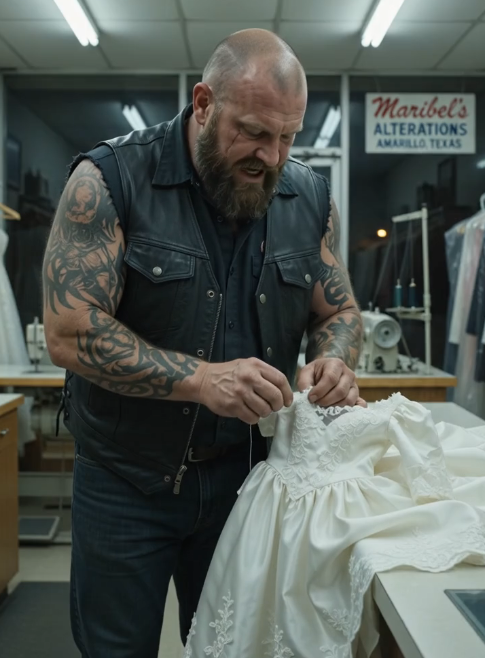
He was forty-one years old, white, six-foot-two, nearly 290 pounds, with a shaved head, a thick brown beard, a scar down one cheek, and tattoo sleeves that disappeared under a black leather vest with unreadable patches. He wore dark jeans, steel-toe boots, and a chain wallet that clicked against the stool whenever he shifted his weight.
People moved around Caleb like he was weather.
They did not see what I saw the first night he came into my shop.
I saw a man holding a folded piece of notebook paper with measurements written in crayon.
Chest. Waist. Shoulder. “Twirl room.”
That last one made me look up.
“Twirl room?” I asked.
Caleb cleared his throat.
“My daughter said a dress ain’t a dress if it can’t spin.”
He said it like he was reporting a mechanical problem, not carrying the softest sentence in the world.
I owned Maribel’s Alterations, a narrow little shop between a pawn store and a closed barber college off Sixth Avenue. I hemmed jeans, altered bridesmaid dresses, fixed busted zippers, and once replaced the lining of a biker vest after a man’s pit bull mistook it for a chew toy.
But I had never had a biker ask me to teach him how to sew a wedding dress.
Not buy one.
Not commission one.
Teach him.
“Why don’t I make it for you?” I asked.
He shook his head before I finished.
“Her daddy’s making it.”
That was the first seed.
Her daddy.
Not a seamstress. Not a store. Not some charity group. Him.
For the next six months, Caleb came after his shift at a diesel repair shop near I-40. He smelled like gasoline, metal dust, black coffee, and cold night air. He washed his hands in my utility sink until the water ran gray, then sat at the back table with lace, satin, pearls, and a needle that looked ridiculous between his scarred fingers.
He stabbed himself often.
Never cursed around the dress.
Not once.
If the thread tangled, he breathed hard through his nose. If the seam crooked, he pulled it out and started again. If a pearl rolled off the table, he dropped to one knee and searched the floor like a man looking for a lost wedding ring.
The other women in the shop laughed at first.
Not cruelly.
Just because the sight made no sense.
A giant biker bending over white satin under fluorescent lights, tongue pressed against his teeth, trying to make a sleeve small enough for a six-year-old girl.
Then one evening, a group of young men from the barber college walked by the window and saw him. They filmed through the glass.
“Big man making princess clothes,” one of them said.
Caleb heard.
His shoulders tightened.
I thought he would stand.
He did not.
He kept sewing.
Then he said, without looking up, “She asked for lace.”
One of the boys laughed harder.
Caleb’s hand shook once.
The pearl slipped.
When he reached for it, I saw a tiny hospital bracelet folded inside his vest pocket, tucked beside a pink ribbon patch sewn on the inside lining.
That was when I stopped laughing forever.
Because the dress was not for a school play.
Not for pretend.
Not exactly.
It was for a little girl named Lily Mercer, who had spent more nights at Northwest Texas Children’s Hospital than in her own bed, and who had asked her father one question no six-year-old should ever have to ask.
“Daddy, can I be a bride before I go?”
Caleb put the needle through the satin again.
Outside, the boys kept filming.
Inside, the biggest man in the room lowered his head over a tiny wedding dress and whispered, “Not crooked. Not for her.”
The video would go around town by morning.
But nobody knew what he was really making.
Not yet.
Part 2
My name is Maribel Reyes, and I have spent thirty-two years measuring strangers while they pretend clothes are the problem.
Men come in for suit alterations and talk about funerals without saying the word death. Brides come in with mothers who cry over hemlines because daughters are easier to hold when they are standing still. Bikers come in with torn cuts and say, “Just patch it,” when the leather smells like rain, gas, road dust, and history.
Caleb Mercer was not my first biker.
He was the first one who asked for a thimble.
He hated that thimble.
It barely fit the end of his finger, and the first week he called it “that little chrome hat.” He tried to work without it, stabbed himself three times in one night, then accepted it like a man signing a treaty with an enemy.
Caleb had not always been gentle. He never pretended otherwise.
When he was young, he fought too much and listened too little. He did six months in county jail after a bar fight that left another man with a broken jaw. He got sober at thirty after waking up beside his Harley in a ditch outside Vega, Texas, with no memory of the last twenty miles and Lily’s baby sock in his pocket.
That was the story he told me.
Not for sympathy.
More like inventory.
“I was wasting the only daddy she had,” he said.
After that, he stayed sober. He worked at a diesel repair shop near I-40. He rode with the Iron Shepherd Riders, a motorcycle club made mostly of mechanics, veterans, roofers, drivers, and one retired Black hospice nurse everyone called Preacher, though his real name was Samuel Boyd.
They were rough men and women.
But they had rules.
No engines near Caleb’s house after Lily fell asleep. No smoking around the porch. No hospital visits without washing hands first. No pity talk in front of the kid. If Lily asked for something ridiculous, every brother treated it like a work order.
A purple birdhouse.
A moon-shaped nightlight.
A stuffed bear wearing a tiny leather vest with no readable patch.
Then came the wedding dress.
Lily asked for it after watching a wedding scene in a cartoon from her hospital bed. Not a husband. Not romance. She was six. She wanted the dress, the flowers, the twirl, the aisle, the music, the moment everyone looked at her and did not look sad.
She told Caleb she would marry Mr. Buttons, her stuffed bear.
Caleb said yes before he understood what yes would cost.
When he told the Iron Shepherd Riders, Cruz laughed first because he thought Caleb was joking. Cruz was Latino, forty-three, a welder with tattooed hands and a soft belly laugh.
Caleb stared at him.
Cruz stopped.
Then Cruz said, “Brother, I can weld an arch.”
Miller, a white retired firefighter, offered folding chairs. Denise, a Black nurse with braids and a hard stare, offered medical supervision. Preacher offered to officiate, as long as nobody expected him to say “dearly beloved” without choking on it.
They did not understand sewing.
Neither did Caleb.
That was why he came to me.
Every night, he learned one small thing. How to cut a pattern. How to leave seam allowance. How to gather the skirt. How to make room for a port under the bodice without letting Lily feel medical underneath magic.
That was the first hidden detail.
The dress had to be beautiful.
It also had to be kind to a sick body.
Part 3
The false climax happened because of a video.
Three young men filmed Caleb through my shop window while he was sewing pearl beads onto the bodice. They were old enough to know better and young enough to think cruelty was humor if it came with a caption.
The first clip showed only what they wanted people to see.
A huge tattooed biker hunched over a tiny wedding dress. Skull tattoo on his wrist. leather cut hanging on the chair. thimble on one finger. pearls under fluorescent lights.
They did not film the hospital bracelet pinned to the pattern board.
They did not film the oxygen tank by the back door.
They did not film Lily’s crayon drawing taped above the sewing machine.
The caption said, “Route 66 biker making his dream dress.”
By morning, it had been shared all over Amarillo.
People laughed.
Some wrote jokes about his manhood. Some called him names. Some edited music over the clip. One local page reposted it with a laughing headline before taking it down after Denise called them and used the kind of nurse voice that can make a grown man apologize to a thermometer.
Caleb saw it at the repair shop.
He did not smash his phone.
That would have been easier.
He folded it, screen down, on the workbench and kept working on a transmission until his hands shook so badly the foreman sent him home.
He came to my shop at 5:40 p.m., earlier than usual, still in oil-stained work clothes. His Harley coughed once outside and went silent. The bell over my door rang. Boots crossed the floor.
He did not look angry.
He looked empty.
That scared me more.
“The dress here?” he asked.
“Yes.”
“Good.”
He sat down at the machine.
His leather cut creaked when he bent forward. The shop smelled like steam, chalk, coffee, and the faint gasoline that followed him everywhere. He picked up the bodice, threaded the needle, and missed the eye three times.
“Caleb,” I said.
He did not look up.
“Take a breath.”
“Got no time.”
“We have two weeks.”
He shook his head.
“Doctors moved it.”
My mouth went dry.
He kept trying to thread the needle.
“When?”
“Saturday.”
The wedding was supposed to be in two weeks.
Saturday was in four days.
That was the second hidden detail.
The countdown had changed, and nobody online knew they were laughing at a man racing a clock that would not slow down.
The Iron Shepherd Riders arrived twenty minutes later. Not roaring. Not making a scene. Their Harleys rolled in low and parked along the curb, engines dying one by one under the pink Texas evening. Leather creaked. Boots hit concrete. Men and women came inside carrying coffee, sandwiches, thread, flowers, and silence.
Preacher stood beside Caleb.
“You eat today?”
“No.”
“Wrong answer.”
“Not hungry.”
“Wasn’t a question.”
Caleb’s eyes lifted.
For a second, the whole room tightened. These were the moments people misunderstood about brotherhood. It was not all backslaps and road names. Sometimes it was an old man telling a younger one he was not allowed to destroy himself just because grief had a schedule.
Caleb’s jaw worked.
Then he took the sandwich.
The next three nights were not sewing lessons.
They were a vigil.
I adjusted the bodice. Caleb hand-stitched pearls. Denise lined the inside with soft cotton where the satin might rub Lily’s skin. Cruz built a small arch from scrap metal and painted it white in my alley. Miller ironed chair covers badly until I took the iron away from him. Preacher sat by the door, checking the street every few minutes like he expected trouble to come back wearing a human face.
It did.
On Friday afternoon, one of the boys who filmed the video walked in.
He was eighteen, white, skinny, with a cap in his hands and shame barely holding him upright. His name was Jordan. He looked at Caleb, then at the dress, then at the floor.
“I didn’t know,” he said.
Caleb did not answer.
Jordan swallowed. “I can take it down.”
Preacher’s voice came from the door.
“You can do better than down.”
Jordan looked confused.
Caleb finally spoke.
“No cameras Saturday.”
Jordan nodded fast. “Yeah. Yeah, of course.”
“No,” Caleb said. “You heard me wrong.”
He picked up a pearl with two fingers, placed it against the bodice, and pushed the needle through.
“You want to fix it, you hold a chair.”
The boy blinked.
“What?”
“Saturday. You hold a chair for my daughter. You look at what you laughed at.”
That was the false ending.
We thought the apology mattered.
It did.
But the dress still was not finished.
And when Lily tried it on the next morning, the zipper would not close.
Part 4
The zipper failed at 8:17 a.m.
I remember the time because the clock above my cutting table had stopped at 8:17 two years earlier, and I never fixed it. That morning, it felt less like laziness and more like accusation.
Lily stood on the fitting stool in the back of my shop, small as a bird under all that white satin. She wore a pink knit cap with tiny fabric roses, white socks, and glitter shoes Preacher had bought because he said no bride should walk in hospital socks unless she chose to.
Caleb stood behind her, both hands out, afraid to touch.
The dress was almost perfect.
Almost can be brutal.
The bodice had been adjusted for her port. The seams were soft. The skirt had twirl room. Pearls circled the neckline like little moons. The veil clipped gently to her cap. For a second, Lily looked at herself in the mirror and forgot to be tired.
Then we tried to zip it.
The zipper caught halfway.
Not because Caleb measured wrong. Not because I cut wrong. Lily’s little body had changed again. Swelling from medication. Fluid. The kind of cruel shift illness makes overnight, as if even joy needs permission.
Rebecca, Lily’s mother, would have cried if she had been there.
But Rebecca was not there.
That was one of the twists people in town never understood.
She had not left because she stopped loving Lily.
She left because she broke.
There are exits that look like abandonment from the road and collapse from inside the house. Rebecca had developed a pill addiction during Lily’s early treatment, disappeared into rehab twice, relapsed once, and signed temporary custody to Caleb because she knew he would stay when she could not trust herself to.
Caleb never explained that to gossiping neighbors.
He let them blame her.
He let them praise him.
Both hurt him.
The zipper caught again.
Lily’s lower lip trembled.
“Daddy,” she whispered, “am I too big for my wedding?”
Caleb turned his face away.
His eyes went wet.
No tears fell.
Bikers like Caleb learn early how to keep water behind the dam. Sometimes that is strength. Sometimes it is just habit. That morning, it was both.
He crouched in front of Lily.
“No, baby.”
“But it won’t close.”
“Then the dress is wrong.”
She looked down at the satin.
“Can dresses be wrong?”
“All the time.”
He stood and looked at me.
“Fix it.”
That was not an order.
It was a plea wearing boots.
We had six hours.
I opened the back seam. Denise drove to three stores for matching ribbon. Cruz stripped white satin from a thrift-store flower girl dress. Miller sat outside with Lily and told her stories about fire trucks so she would not hear the panic inside. Jordan, the boy who made the video, arrived with folding chairs and saw Caleb kneeling on the shop floor pinning fabric with hands that could rebuild a diesel engine but trembled near his daughter’s waistline.
He did not say anything.
Good.
Some moments do not need teenage commentary.
By noon, we had turned the zipper back into a lace-up panel. It gave Lily room. It looked intentional. It looked delicate. It looked, somehow, more like her.
When Caleb saw it, his face changed.
He touched the ribbon with one scarred finger.
“Better?”
“Better,” I said.
Lily came back inside, tired but smiling.
The dress closed.
The room exhaled.
That was when Preacher walked in carrying something wrapped in brown paper. He handed it to Caleb without a word.
Inside was a tiny leather patch.
No club name.
No symbol anyone could read.
Just white thread stitched into the shape of a small dress.
Caleb stared.
Preacher said, “Inside the cut, brother. Not for show.”
That was the patch.
The one strangers would never see.
The one that said this rough man had spent 200 hours making something the world thought he had no business touching.
Caleb pinned it inside his leather vest, over his heart.
Then Lily asked to see.
He opened the vest.
She touched the little patch and smiled.
“Now you have a wedding dress too.”
Caleb looked down at her.
“Ride or die,” he said softly.
She frowned. “What does that mean?”
He swallowed hard.
“It means I’m here.”
Part 5
The princess wedding happened at sunset behind Ruby’s Diner, where Route 66 bends past an old gas station and the sky turns copper if the day has been hot enough.
Ruby closed early without charging a dime.
The Iron Shepherd Riders moved like men building a chapel from diner furniture. Cruz set the white metal arch near the back fence. Miller lined the aisle with folding chairs. Denise kept Lily’s medicine bag beside her own purse. Preacher stood under the arch with a children’s book in one hand because Lily said real weddings needed words.
There were no cameras except one old Polaroid Caleb approved.
No live stream.
No viral clip.
No strangers.
Just twenty-seven people who understood that some days are too sacred for the internet to chew.
Lily arrived in Caleb’s arms.
Not because she could not walk at all.
Because the gravel behind the diner was uneven, and he refused to let her waste strength before the aisle. He carried her carefully, one huge arm under her knees, the other behind her back, the tiny wedding dress spread over his black shirt like white water.
The dress fit.
It spun.
It had pearls Caleb had sewn one by one, some crooked, all perfect. The lace brushed her wrists. The veil trembled in the wind. The lace-up back gave her room to breathe. Under the hem, where only Caleb and I knew to look, he had stitched six tiny blue stars.
One for each birthday.
That was the revelation of the first seed.
The crayon note had said twirl room, but the dress held more than movement. It held time. Six years of it. Six years that would never become sixteen, twenty-six, or thirty. Caleb knew that. He stitched anyway.
Lily’s groom was Mr. Buttons, a stuffed bear with one missing eye and a tiny bow tie Miller had made from a strip of black ribbon. Jordan, the boy who filmed the sewing clip, held the chair at the front like Caleb had told him. He kept his eyes on the ground until Lily smiled at him.
Then he cried.
Quietly.
No one mocked him.
Preacher began the ceremony.
“We are gathered,” he said, then stopped.
His voice cracked.
He looked at Caleb.
Caleb nodded once.
Preacher started again.
“We are gathered because Miss Lily Mercer has decided Mr. Buttons is reliable, well-dressed, and unlikely to leave socks on the floor.”
Lily giggled.
That sound moved through the yard like something everyone had been waiting to breathe.
When Preacher asked if she took Mr. Buttons to be her bear, Lily said, “I do, but only if Daddy can still keep him sometimes.”
Caleb pressed his fist to his mouth.
Denise looked away.
I watched the man everyone feared bend down so his daughter could place a plastic ring on a stuffed bear’s paw. His tattoos showed under the evening light. His boots were dusty. His leather cut hung open, and inside it, hidden over his heart, the tiny dress patch rested against the lining.
After the ceremony, Caleb offered his hand.
“Dance?”
Lily looked at the gravel.
“I’m tired.”
“Then I’ll do the walking.”
He lifted her onto his boots.
She stood on them like a little bride standing on a father’s strength. He held her hands and moved slowly, one step, then another, while the jukebox inside Ruby’s played something old and scratchy through the open back door.
The biker did not cry.
Not where people could see.
But his beard moved once, and his eyes shone hard under the string lights.
Lily looked up at him.
“Am I a real bride?”
Caleb’s voice came out rough.
“Prettiest one that ever stood on my boots.”
She accepted that.
Children know truth when it is spoken simply.
The second revelation came after the cake.
Lily asked to ride the Harley.
Everyone froze.
Caleb shook his head. “No engine tonight.”
“Just sit?”
That he allowed.
He carried her to the parking lot. The Harley waited under the Route 66 sign, black and still, chrome holding the last light. Caleb sat sideways on the seat and placed Lily in front of him, dress gathered carefully, veil floating behind her.
No revving.
No posing.
Just a father and daughter on a quiet motorcycle that had taken him to hospitals, sewing lessons, repair shifts, and every hard place love required him to go.
Lily touched the gas tank.
“Does it know I got married?”
Caleb looked at the bike.
Then at the sky.
“Yeah,” he said. “She knows.”
Part 6
Lily died nine weeks later, on a Thursday morning when the whole world outside her hospital window looked ordinary enough to be insulting.
No storm.
No dramatic sky.
Just pale sun over Amarillo, nurses changing shifts, coffee cooling in paper cups, and Caleb sitting beside her bed with his leather cut folded under his hands.
The dress hung in the room.
Not on her.
She had already worn it on the day she wanted. Caleb would not let sickness steal that memory and turn it into a costume for grief.
It hung near the window, cleaned, repaired, and bright, with six blue stars hidden under the hem and the lace-up back soft from where his hands had tied it.
After the funeral, people expected Caleb to disappear.
Some men do.
Pain makes caves out of garages.
For three weeks, his Harley stayed under its cover. The Iron Shepherd Riders kept showing up anyway. Engines low. Boots soft on the porch. Food left in coolers. Coffee left on the steps. Nobody knocked unless invited.
Then one night, Caleb came back to my shop.
He looked older.
Not by years.
By weight.
He carried the wedding dress in both arms.
I stood behind the counter and could not speak.
He placed it on the table.
For a long time, the only sound was the fluorescent light buzzing and his chain wallet tapping once against the chair.
“I need the pattern,” he said.
I stared at him.
“What?”
“The pattern. For the dress.”
“Caleb…”
He shook his head.
“Not hers.”
He touched the satin with two fingers.
“Like hers.”
That was the final twist.
He did not want to preserve the dress behind glass. He did not want it sealed away as proof that one perfect day had happened. He wanted it turned into a map.
Over the next year, Caleb made fifty dresses.
Not alone.
Never again alone.
The Iron Shepherd Riders became the strangest sewing circle Amarillo had ever seen. Cruz cut pattern pieces with the focus of a bomb technician. Denise handled soft linings and medical comfort details. Miller ironed under supervision. Preacher delivered finished dresses in garment bags and told every family, “No cameras unless the bride says so.”
Jordan came too.
The boy who had filmed the first video learned to sew buttons.
He was terrible at first.
Caleb made him redo every crooked one.
Good.
Each dress was different. Some white. Some pink. Some blue. Some with room for ports. Some with Velcro closures for tired hands. Some with sleeves to cover bruises. Some with open backs for medical equipment. Every one had twirl room.
Every one had a hidden star under the hem.
Not six.
One.
For Lily.
Caleb never made speeches when he delivered them. He would stand in a hospital doorway, huge and uncomfortable, leather cut creaking, boots quiet against polished floors, holding a garment bag like it contained a sleeping bird.
If the child smiled, he nodded.
If the mother cried, he looked at the floor.
If a father tried to thank him too much, Caleb usually said, “Dress needed making.”
That was all.
Part 7
The first dress still hangs in Caleb’s house.
Not in a shrine.
That would have made him angry.
It hangs in a glass-front cabinet beside the hallway, where morning light touches the satin for about six minutes if the blinds are open. Under it sits Lily’s glitter shoes, Mr. Buttons, and one Polaroid from behind Ruby’s Diner.
In the photo, Lily is standing on Caleb’s boots.
The dress is caught mid-sway.
Caleb’s head is bowed over her like he is listening to the only sound that matters.
Every year, on Lily’s birthday, the Iron Shepherd Riders meet at Ruby’s before sunrise. Their Harleys line the curb along old Route 66, engines low, then silent. No speeches. No fundraiser. No banner. Just coffee, black for Caleb, too much sugar for Cruz, and one empty chair with a white ribbon tied around it.
After breakfast, they ride to the children’s hospital with garment bags across their backs.
People still stare.
Of course they do.
A 290-pound biker carrying a wedding dress will always confuse the world for a second.
Maybe that second matters.
Maybe it is where judgment cracks.
Last spring, I watched Caleb deliver dress number fifty. It was pale yellow, with soft sleeves, pearl buttons, a lace-up back, and one hidden blue star under the hem. The little girl who received it was seven and shy. She touched the skirt, then looked up at Caleb’s beard, tattoos, and heavy leather cut.
“Did a princess make this?” she asked.
Caleb’s hands closed around the helmet he was holding.
He looked toward the hallway window, where his Harley waited in the parking lot under a flat Texas sky.
“No,” he said.
Then he touched the inside of his vest, right over the tiny dress patch no stranger could see.
“A bride did.”
Outside, the V-twin started low.
The garment bag was empty.
The blue star stayed hidden.
Follow the page for more stories about the people we judge too quickly, and the love they carry where no one looks.