A Biker Roared Across a Schoolyard During the Pledge of Allegiance—Everyone Wanted Him Arrested Until a Leaking Truck Stopped Behind the Playground and the Principal’s Signature Turned Up on the Wrong Piece of Paper
Part 2
The first person to ask whether I had lost my mind was my daughter.
Not a deputy.
Not the principal.
My daughter, Kelly, standing in the church parking lot with my granddaughter pressed against her legs.
Kelly had received the school’s emergency message while working at a physical-therapy clinic. She arrived expecting a chemical spill and found a video already circulating that showed her father riding a Harley onto school grounds.
“Tell me you didn’t ride through the children.”
“I didn’t.”
“Tell me that again.”
“I stayed on the outside maintenance strip. Nobody was in my path.”
She watched my face before looking down at Mia.
My granddaughter had not spoken since I approached.
She wore two orange ribbons because she had decided school colors should be considered formal clothing. One ribbon had come loose and hung beside her cheek.
“You scared Mrs. Bell,” she said.
“I know.”
“You scared me too.”
There was no answer that could make that disappear.
I knelt, and my knees made their usual complaint.
“I’m sorry for that part.”
She studied me. “Were you chasing somebody?”
“A truck.”
“Did it do something bad?”
“I saw something wrong. Other people are checking what it means.”
That was the most honest explanation I could give.
I knew trucks.
I did not know the material inside that one, the reason it had come to the school, or how many people had decided it belonged there.
For most of my working life, I maintained commercial vehicles at industrial sites. I had inspected corroded fittings, repaired hydraulic lines, and stood through more safety meetings than any man can remember without developing a twitch.
The useful part was not learning chemical names.
It was learning that a leak is information.
Something is not where it belongs.
Until someone qualified identifies it, you do not get to call it safe because you are busy.
I learned that lesson after an accident at a plating plant when I was thirty-one. A coworker named Luis walked through what appeared to be wash water beneath a loading line. He suffered burns that kept him off work for months.
I had seen the wet patch earlier.
I assumed someone else knew about it.
Luis recovered. We remained friends.
But I never forgot how easily someone else becomes nobody.
My motorcycle club, the Mill Creek Riders, knew that story. They also knew I could be stubborn enough to make ordinary conversations feel like equipment inspections.
We were a community riding club, not an outlaw organization. Our most serious recurring dispute involved whether a charity breakfast should serve biscuits or pancakes.
Still, when I called our president from the church parking lot, he did not immediately tell me I had done the right thing.
“Everybody safe?” he asked.
“As far as I know.”
“You touch the truck?”
“No.”
“You try to stop it with the bike?”
“No.”
“You call emergency services?”
“Before I entered the grounds.”
He exhaled.
“Good. Now stop talking to cameras.”
A parent had begun recording me beside the fence.
Another wanted a statement.
A third asked whether I had seen green smoke.
There was no green smoke.
There was a leaking load, an odor, several children with irritation, and a situation requiring trained responders.
I repeated only what I had observed.
The fire captain, Elise Warren, eventually crossed the road and asked me to describe the truck’s route. She carried a small notebook, and she made me begin before the moment I thought mattered.
Which direction was I traveling?
Where was the first wet mark?
How far behind the truck had I been?
When did I call 911?
Had I seen a discharge before it turned onto school property?
I answered.
Then she asked whether I knew the contractor.
The name on the cab had been Caldwell Site Services.
I did know them.
Their owner had brought fleet vehicles to my garage for years. His company accounted for nearly a fifth of my commercial work.
Captain Warren watched my expression.
“Does that change anything you told me?”
“No.”
It changed plenty about what the truth might cost.
It did not change the truth.
Across the parking lot, a mother was holding a spacer mask against her son’s face while paramedics assessed him. He was alert, annoyed, and asking whether he still had to take a spelling test.
Captain Warren followed my eyes.
“We’re checking everyone who needs it.”
“Good.”
Then she turned back to the school.
The principal stood near a patrol vehicle, speaking rapidly to a district administrator.
He kept pointing at my motorcycle.
The truck driver kept pointing at his clipboard.
Neither seemed interested in the dark streak continuing toward the drain.
Part 3
I had first seen the hauler at the intersection of County Road 18 and the school service lane.
It was not speeding. That mattered later.
The driver stopped at the sign, signaled, and made a careful turn.
If he had been swerving or racing, people might have noticed sooner.
Instead, he looked like an ordinary contractor beginning an ordinary workday.
The covered roll-off container sat unevenly on the chassis. Near its lower rear seam, liquid dripped onto the road. Every few yards, the wheels carried it into a wider mark.
I stayed back.
At the next safe pull-off, I stopped and called emergency services.
I could see the school through a chain-link fence. Children were gathering around the flagpole. A microphone squealed, followed by the principal asking everyone to settle.
The truck continued toward the rear gate.
I sounded my horn.
Its brake lights flashed once.
The driver did not stop.
The dispatcher asked whether I could remain in a safe location and provide the plate.
I read it from where I stood.
Then I told her about the school.
She repeated the address and said fire and law-enforcement units were being sent.
That should have been the point where I waited.
Instead, I saw a worker unlock the rear gate.
The truck had not wandered onto the wrong property.
Someone expected it.
I called the school’s main number. It rang while the assembly microphone carried the beginning of a welcome speech.
I tried again.
Still nothing.
The front maintenance entrance remained open because a district van had just driven inside. Beyond it, the paved perimeter strip provided a clear route to the adults.
I knew the strip. I knew where it ended.
I also knew what I did not know.
I did not know whether the truck carried a flammable material. I did not know whether the odor posed an immediate threat. I did not know whether I was about to make a frightening situation worse.
So I did not follow the leaking vehicle into the rear service area.
I rode toward the people who could move the children.
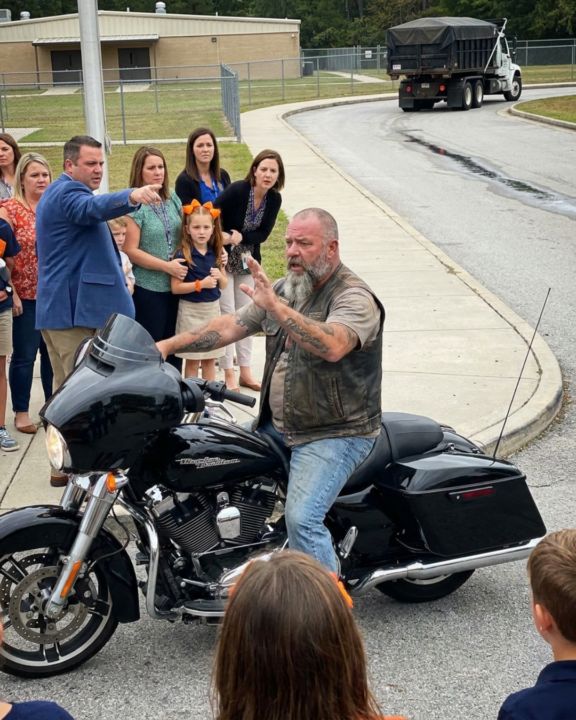
My speed was low enough to stop quickly, but the engine was loud. A Harley under a school’s brick walls does not sound restrained, regardless of what the speedometer says.
Heads turned.
Teachers spread their arms.
The children closest to the pavement stepped back, though I remained far outside their rows.
I sounded the horn again and shouted for someone to stop the assembly.
A father ran toward me.
“Get out of here!”
I braked and planted both boots.
“There’s a leaking load behind the school!”
Principal Whitlock crossed from the microphone.
He was a narrow man in a blue blazer, with a silver school pin and the exhausted expression of somebody who had already handled three problems before breakfast.
He recognized me.
“Frank, what are you doing?”
“Call the fire department.”
“You cannot ride a motorcycle through a school ceremony.”
“I called 911. Your rear contractor is leaking.”
“That delivery is authorized.”
“Authorized to deliver what?”
He hesitated.
“Drainage material.”
I looked toward the rear fence.
A boy in the back row rubbed his eyes.
Behind him, Mrs. Bell had turned her face into the breeze.
She did not need to identify the material.
She only needed to connect it to the smell she had already reported.
“Third grade, with me,” she said.
Whitlock raised his hand.
“Nora, wait for instructions.”
She took her class west.
That was the moment I stopped being the only adult interrupting the morning.
Two teachers followed her.
The security officer, Ben Carver, heard my explanation and checked the service-lane camera on his radio-linked phone. He saw the truck, saw the liquid, and called the district emergency line.
He did not announce a dramatic evacuation into the microphone.
He helped staff begin a controlled relocation toward the designated alternate area away from the rear grounds, while dispatch supplied further instructions.
The flag remained halfway through its rise.
The pledge never began.
One younger child started crying because he believed the motorcycle meant somebody was coming to hurt them. His teacher knelt beside him before guiding him with the others.
I heard him ask whether they were practicing.
She answered, “We’re taking care of each other.”
That sentence steadied more than the child.
A deputy arrived first.
He told me to step away from the motorcycle and keep my hands visible.
I did.
Whitlock began describing my entrance.
The deputy listened, then looked toward the school staff moving children across the western road.
“Sir,” he said, “tell me about the truck.”
For the first time, Whitlock stopped speaking.
Fire crews established control of the incident. They assessed conditions, expanded the restricted area, and directed the school’s movement and accountability process.
I gave my statement from outside their boundary.
The driver stood beside his cab, insisting he had done nothing wrong.
Then he said something I could not forget.
“This is where they always tell us to unload.”
Always.
Not today.
Not once.
Captain Warren asked for his delivery records.
He reached into the cab.
Principal Whitlock stepped forward before the clipboard cleared the window.
Part 4
Captain Warren did not let Whitlock take the clipboard.
She asked the driver to hand it directly to the responding officer documenting the scene.
The first sheet listed the school, the rear access lane, and permission to enter during designated delivery windows. Principal Whitlock had signed it.
That alone did not prove he authorized illegal dumping.
Schools sign access forms for contractors every day.
The second sheet mattered more.
It described placement of “reclaimed stabilization material” in the drainage depression beyond the athletic field. A map marked an unloading location behind the playground.
There was no environmental authorization attached.
No laboratory clearance.
No district facilities approval.
Captain Warren asked whether the school had an environmental consultant overseeing the work.
Whitlock said the contractor had assured him the material was suitable.
The driver looked confused.
“My dispatch sheet says recovered industrial material.”
The officer asked him not to speculate and to preserve every document.
That was when I understood we were no longer discussing a loose fitting or one leaking truck.
We were discussing what had already gone into the ground.
The hazardous-materials team examined the current load and arranged sampling. Environmental investigators were notified. They did not identify the contents by smell, color, or a dramatic test performed in front of us.
They collected evidence.
They traced its origin.
They compared transport records with the material on the truck and the soil behind the school.
The initial school closure was precautionary. Classes moved temporarily to other district buildings while specialists evaluated the site and ventilation systems.
Six children and two adults were transported for further medical assessment after reporting respiratory or eye irritation. Others were checked at the scene.
Mia was not among those transported.
I felt guilty about the relief that gave me.
Other grandparents did not receive the same immediate answer.
At the church parking lot, parents waited behind a reunification table while staff checked identification and matched children to authorized adults. The ordinary delay of finding a name on a sheet became unbearable.
A father demanded to enter the school.
A mother wanted every child sent directly to a hospital.
Teachers answered questions they did not yet have facts to resolve.
Mrs. Bell held a clipboard so tightly its plastic clip broke.
I offered her a bottle of water.
She took it without drinking.
“I sent them outside,” she said.
“What?”
“After I reported the smell. I let them keep playing back there.”
“You reported it.”
“I accepted the answer.”
There was nothing I could say that would make those two facts cancel each other.
Later that afternoon, she forwarded her emails to the district investigator using the official reporting channel. She preserved the originals.
Her first message was five weeks old.
She had described an unfamiliar odor near the eastern swings after a delivery.
The reply came from the front office: the contractor had confirmed that the material was safe.
Her second message described two students with eye irritation after recess.
Whitlock answered personally.
Please avoid alarming families about an approved maintenance project.
The third email asked whether she could see the approval.
There was no response.
The documents did not prove which substance caused which symptom. Investigators were careful about that distinction.
They did prove that concerns had reached the principal.
He could not honestly say nobody warned him.
Three days after the incident, my garage received a call from Caldwell Site Services.
Not the owner.
His operations manager.
He said they were moving fleet maintenance elsewhere.
I asked whether this concerned the school.
He said the company preferred vendors who understood professional relationships.
I looked through the office window at two employees replacing brake lines beneath a delivery van.
One had a mortgage.
The other had a daughter starting college.
“Send your final account request in writing,” I said.
Then I called my accountant.
The loss would hurt.
I could not pretend otherwise.
Our club president offered to organize a boycott against Caldwell. I told him no. Investigators needed records, not a convoy of angry men making threats outside a contractor’s gate.
He was quiet for a moment.
Then he said, “All right. We’ll find you customers.”
That was a harder form of brotherhood.
No confrontation.
No engines outside somebody’s house.
Just men calling local businesses and asking whether they needed honest repair work.
A week later, environmental investigators confirmed that the material was not ordinary clean fill. It included solvent-contaminated soil and industrial processing sludge requiring controlled handling and disposal.
The truck had come from a cleanup operation at a shuttered manufacturing property.
Disposing of that material properly cost money.
Placing it behind a school had been cheaper.
Whitlock claimed he had been deceived.
For several days, that explanation remained possible.
Then investigators recovered the earlier email he had not supplied.
Attached was a waste-characterization report.
The message above it asked him to confirm that he still wanted deliveries after reading the restrictions.
His reply was three sentences.
The last one mentioned the morning assembly.
Part 5
I learned about that email at a public school-board meeting six weeks after the incident.
By then, a criminal investigation was underway, and the district’s attorney released only documents approved for disclosure. There were matters she would not discuss.
Parents hated hearing that.
I understood why.
Their children had been moved between buildings, some families had missed work, and everyone wanted a clean answer to a question that refused to be simple.
What had our children been exposed to?
The public-health team could explain the identified materials, known hazards, testing plan, and recommended follow-up.
They could not honestly promise that every future cough was unrelated.
They could not diagnose harm from fear alone.
They also could not rewind the five weeks during which nobody treated Mrs. Bell’s questions as urgent.
Whitlock appeared with an attorney.
He had been placed on administrative leave immediately after the document review began.
At first, his statement sounded familiar.
The school was underfunded.
The district delayed repairs.
The drainage area remained unusable after heavy rain.
He believed he was obtaining a practical solution.
Then the board’s attorney displayed the recovered exchange.
The contractor had offered free grading and a contribution toward replacing the gym roof in return for allowing specified material to be placed on the grounds.
The contribution was not recorded through the district’s normal procurement and donation procedures.
Whitlock negotiated directly.
When he received the report showing the material was unsuitable for unrestricted placement, he did not forward it to the district facilities office.
Instead, he asked that the contractor keep unloading beyond the tree line.
The final sentence of his reply read:
Use the morning assembly window. Students will be at the front.
I looked toward the parents.
Nobody spoke.
The sentence did not mean he wanted children harmed.
It meant he knew enough about the activity to arrange their absence from its immediate location.
That distinction did not save him.
It made the decision more deliberate.
Whitlock’s attorney said his client misunderstood technical terminology and believed the material could be contained safely.
A mother in the second row stood.
“Then why didn’t you send it to somebody who understood?”
The board chair asked her to sit.
She remained standing.
Her son was one of the children evaluated after the assembly.
She did not shout.
That made the question harder to escape.
Whitlock looked down.
The evidence showed no payment to his personal account. That disappointed people who wanted an easy villain with a new boat or a hidden vacation home.
His motive was uglier in a different way.
He wanted to be the principal who fixed what the district could not afford.
He wanted the roof repaired.
He wanted the flooded area usable.
He wanted the praise that followed solving expensive problems without asking families for another fundraiser.
So he treated an expert warning as an obstacle to a result he had already decided was good.
He traded scrutiny for gratitude.
The contractor treated his willingness as an opportunity.
Their savings were measurable.
The children’s risk was something they expected not to become visible.
A custodian named Harold Finch spoke after the attorney finished.
He had worked at the school for twenty-two years and unlocked the rear gate for several deliveries.
“I thought it was dirt,” he said.
His voice shook.
“He told me it was dirt.”
Harold had also kept a gate log. He recorded truck arrivals because he needed to know when children could safely use the rear grounds.
Those entries matched the delivery receipts.
Two arrivals occurred before the first odor complaint.
Four followed it.
His notebook became evidence.
The people who had appeared powerless—a teacher asking questions and a custodian writing down times—had preserved the records that made denial difficult.
Months later, the contractor’s owner pleaded guilty to offenses arising from unlawful waste disposal and false transport records. Whitlock faced separate charges connected to his role, including misconduct and falsifying school records, and eventually entered a plea agreement.
The precise legal terms mattered to the court.
To the parents, the central fact was simpler.
He had known the material required scrutiny.
He had hidden the decision from the people responsible for providing it.
He lost his position.
The contractor became responsible under the settlement for substantial cleanup costs, with insurers, district funds, and state assistance bridging work that could not wait for every dollar to be recovered.
I did not celebrate the outcome.
A prison sentence would not remove contaminated soil.
A guilty plea would not restore trust by itself.
The school still needed to be made safe.
And some children were still afraid of motorcycles.
Part 6
The first time I returned to Bellwether Elementary, Mia asked me to leave the Harley at home.
That hurt.
I agreed immediately.
The school remained closed, but the district held a family meeting in the cafeteria of the temporary host campus. Specialists explained the remediation plan while counselors worked with students in another room.
I arrived in my pickup wearing a clean work shirt.
A boy near the entrance recognized me from the video and moved behind his mother.
I stepped back.
Saving somebody from one danger does not prevent you from becoming part of the memory that frightened them.
Mrs. Bell understood that better than I did.
She asked me to visit the third-grade class with a school counselor present. Not as a hero. As a man who could explain the noise, acknowledge that he scared them, and answer questions without replaying the emergency.
One child asked why I did not wait outside.
I told him I had been afraid the adults would not receive the warning quickly enough.
Another asked whether motorcycles were allowed on playgrounds.
“No.”
“Then you broke a rule.”
“Yes.”
“Did you get in trouble?”
“I had to explain everything to police and school officials. They reviewed the emergency before deciding what action to take.”
That was the answer.
Not that rules disappeared because I meant well.
Not that a loud motorcycle was a good way to solve school problems.
Just that an unusual emergency required people to examine what happened.
Mia asked the last question.
“Could you use a quieter warning next time?”
The room laughed softly.
“So would I,” I said.
Outside the classroom, my daughter hugged me.
She had been angry since the assembly.
Not because she believed I should have ignored the truck.
Because the video made her imagine two dangers reaching her daughter at once.
“You know you don’t get another granddaughter,” she said.
“I know.”
“You don’t get another dad either.”
I had not considered that side of her fear.
The cleanup took longer than the first estimates. Soil was removed in controlled stages. The drainage system was assessed and repaired. Air, soil, and building evaluations proceeded through independent specialists, with results released to families in language they could understand.
School reopened only after the responsible agencies and independent consultants cleared its use.
No volunteer bikers shoveled contaminated dirt.
We repaired desks at the temporary campus, drove donated supplies, and helped families move classroom materials.
When the contractor’s departure left my shop short of work, the club found enough new fleet customers to keep both employees.
The help was not glamorous.
It arrived as oil changes, brake jobs, and invoices paid on time.
Mrs. Bell remained a teacher.
Harold remained a custodian.
Both had offers to speak publicly.
They declined most of them.
They wanted a school where a question did not require a disaster before somebody answered it.
Part 7
A year after the interrupted ceremony, Bellwether held another outdoor flag assembly.
This time, I received a printed visitor pass.
I parked the Harley in the designated lot, shut it off, removed my helmet, and walked through the front office like everybody else.
Mia waited near the door.
She had new orange ribbons.
The old ones were tied around a drawer handle in my garage beside a photograph of her first day of third grade.
She inspected my pass.
“You’re official.”
“Finally.”
The new principal, Dr. Lena Ortiz, had asked whether I wanted to address the students.
I declined.
Mrs. Bell had suggested something else.
Before the pledge, the school would explain its new safety-reporting process in a way children understood. Every concern received a record number. Every report had an assigned person responsible for responding. Environmental and contractor approvals required district review rather than one administrator’s signature.
Students were not told that every strange smell meant danger.
They were told that noticing something and asking an adult was never a reason to feel embarrassed.
Harold stood beside the maintenance entrance with the grounds team. The gate was closed to vehicles while children assembled.
A small detail.
The kind that disappears when people write dramatic stories about emergencies.
He caught my eye and raised one hand.
I raised mine back.
At the microphone, Dr. Ortiz thanked the staff members who had moved their classes promptly and the responders who had handled the incident. She named the teacher and custodian whose records had helped explain what happened.
Then she said something I wished every institution would learn before needing to.
“A warning is not disloyalty.”
Mrs. Bell looked down at her class.
Several parents nodded.
No one applauded wildly.
The sentence did not need that.
Afterward, Mia walked me toward the parking lot. Beyond the east fence, the restored area remained subject to monitoring. There were no swings in that location anymore.
The replacement playground stood on the western side of the school.
Children argued over whose turn came next.
That ordinary noise sounded better than any thank-you speech.
Mia reached into her pocket and handed me a laminated drawing.
It showed my Harley beside a school.
The wheels were enormous.
My beard covered most of the motorcycle.
Above the bike, she had drawn a speech bubble.
Not a horn.
A speech bubble.
It said, PLEASE LISTEN.
I looked at her.
“You made me polite.”
“Mrs. Bell said you were already trying.”
I put the drawing inside my vest.
As I fastened my helmet, Mia touched the handlebar.
“You can ride now.”
“You sure?”
She nodded.
Then she stepped back behind the painted pedestrian line, where her mother waited.
I started the engine.
This time, nobody ran.
The flag rose. The children kept singing.
Follow the page for more biker stories about misunderstood choices, quiet courage, and the people willing to interrupt an ordinary morning before silence becomes somebody else’s tragedy.