A TRANSIT SUPERVISOR CALLED THE BIKER A DANGEROUS VANDAL—THEN HE LIFTED A LITTLE GIRL THROUGH THE ROOF AND SHE CRIED, “MOMMY!”
PART 1
A BIKER WAS KICKING THROUGH HER DAUGHTER’S BUS ROOF WHILE A MAN IN A TRANSIT JACKET TOLD EVERYONE TO KEEP FILMING.
At 3:42 on a Thursday afternoon in Dayton, Ohio, Maren Brooks stood outside a corner pharmacy with a grocery sack cutting into her fingers. Her six-year-old daughter, Lily, was coming home from an after-school reading program. Maren had already spotted her yellow cardigan through the bus window when a delivery van clipped the bus’s rear corner in the intersection.
The impact sounded small.
What followed did not.
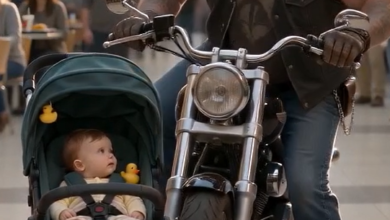
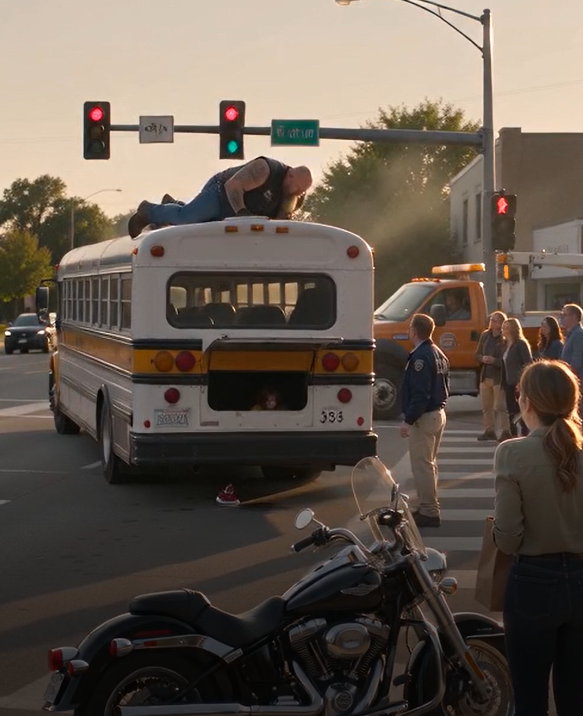
The bus stopped crooked across the crosswalk. A broad man left an old V-twin cruiser beside a utility truck and ran toward the front doors. He wore a black sleeveless leather vest, faded jeans, and muddy boots. Tattoos reached his knuckles. When the doors refused to move, he struck their frame with his palm.
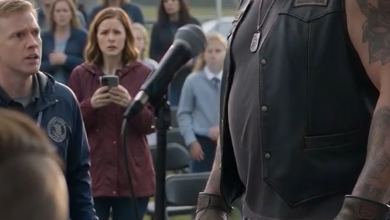
“Get away from that vehicle!” shouted Grant Mercer, the transit supervisor who had pulled over behind it.
Maren knew Grant from neighborhood meetings. He wore clean shoes and answered parents’ emails.
The biker looked like somebody she would cross a parking lot to avoid.
“That man doesn’t work for us,” Grant announced, lifting his phone. “He’s been trouble before.”
The biker did not defend himself.
He pressed his face toward the glass, trying to see past the reflections. His beard brushed the door seal. Maren could hear the trapped engine laboring, then a sharp change in its sound.
A gray ribbon curled from the rear compartment.
The man reached for the door again.
“Lily!” Maren shouted.
A small palm appeared against a window.
Grant raised one hand toward her. “Stay back. We have procedures.”
Then the biker moved away from the doors.
For one terrible second, Maren thought he was leaving.
Instead, he pointed toward the utility truck. Its driver, Luis Alvarez, had already stepped down with his phone against his ear. The biker said something Maren could not catch. Luis looked at the smoke, opened his equipment rack, and began moving a ladder.
“Don’t help him damage city property!” Grant yelled.
Someone nearby said, “Is that guy drunk?”
Phones tilted upward.
The biker climbed.
His vest creaked as he crawled toward the roof hatch. On its back, a stitched lantern sat inside a broken circle. Maren saw his gloved hand work at the handle.
Nothing opened.
He planted one boot beside the hatch and struck it with the other.
Passengers flinched beneath the glass. Grant kept filming.
The fifth impact made Maren close her eyes.
The sixth made her open them.
The hatch jerked free.
The biker dropped flat on his stomach, one arm disappearing into the opening. His other hand spread against the roof. His mouth moved, but the traffic horns swallowed his words.
Maren stepped forward until Luis caught her sleeve.
“Let him reach,” he said.
A red sneaker emerged.
Then Lily’s yellow cardigan.
The biker lifted her clear and gathered her safely against his chest.
Lily clung to him.
Part 2
Her arms tightened around his neck, and Maren heard the word she had been waiting for.
“Mommy!”
The sound nearly folded her knees.
“I’m here, baby!”
The biker turned just enough for Lily to see the curb. He pointed toward Maren, then toward Luis, who had steadied the ladder beside the bus.
“Your mom’s there,” he said. “Stay with me.”
His voice surprised Maren. Low. Almost ordinary.
A man from the sidewalk climbed partway up to help Luis. Between them, they brought Lily down carefully while the biker returned to the hatch.
Maren caught her daughter at the bottom.
Lily smelled like hot vinyl.
One red sneaker had lost its lace. Her cardigan was stretched at the shoulder, and she had a cracker crushed into her palm.
“I couldn’t open it,” Lily said.
“You don’t have to open anything.”
“The door wouldn’t—”
“I’ve got you.”
Maren wanted to carry her across the street and keep walking until the bus disappeared behind buildings. Instead, she stood with Lily against her hip and looked up.
Another child appeared through the hatch.
Then a teenage girl.
The biker was lying flat again, his beard almost brushing the opening. An older passenger inside was helping people reach him.
Grant moved closer.
“Everyone needs to stop improvising,” he called. “Emergency personnel are on their way.”
Luis glanced down from the ladder.
“Then help us until they get here.”
Grant looked at his phone.
Maren had seen that look before, though never clearly enough to name it: a man choosing the safest position for himself while describing it as responsibility.
She pushed the thought away.
Grant had arranged the reading program’s discounted bus passes. He had stood beneath a paper banner and told parents he understood what it meant to trust a driver with a child.
Maren had thanked him.
Now he was filming the man lifting children out.
A police cruiser stopped beyond the intersection. The officer who emerged was dark-haired, square-faced, and already speaking into his radio.
“Keep this lane clear!”
He helped move the crowd back, then looked toward the ladder.
“How many?”
Luis held up a hand without looking away from the next passenger.
“Still counting.”
The officer turned toward Maren.
“Was your daughter on that bus?”
She nodded.
“Did she see a boy? Blue sweatshirt. About nine?”
Lily lifted her face from Maren’s shoulder.
“Eli?”
The officer stopped moving.
Maren felt her daughter’s fingers tighten against her blouse.
“He was sitting behind me,” Lily said. “He gave me his crackers.”
“Where was he when you came out?”
Lily looked toward the bus.
Her mouth opened, but no answer came.
Above them, the biker helped another child through the hatch. The officer took one step toward the ladder, and Maren saw that his right hand had begun to shake.
“My son can’t hear you call him,” he said.
Part 3
The officer’s name was David Reed.
Maren learned it because he said it twice into his radio, the second time more slowly, as though his own name had become difficult to pronounce.
“My son is on that bus. I need somebody else coordinating this side.”
Another officer moved beside him.
“David. Look at me.”
“I’m looking.”
“You’re with the families.”
“My kid’s in there.”
“I know.”
The exchange lasted only seconds. To Maren, it seemed to stretch across the entire intersection.
Above them, the biker kept working.
A woman in a gray coat emerged, coughing into her sleeve. Then a boy carrying one shoe. An older man stayed near the hatch on the roof, bracing himself and helping the biker guide the next passenger toward the ladder.
Maren counted each person reaching the pavement.
She lost track at eleven.
Lily did not.
“Twelve,” she whispered against Maren’s neck.
“Baby, you don’t need to—”
“Thirteen.”
David heard her.
He crouched in front of them, taking care not to crowd Lily.
“Did Eli have his backpack?”
“The blue one.”
“Was he wearing his hearing aids?”
Lily shook her head.
“He put them in the little box. The bus was making a squealing noise.”
David closed his eyes briefly.
He had been trying to meet the bus at its next stop. His shift had run late, and his sister, who usually collected Eli, had called from a stalled checkout line.
That was why his cruiser had been nearby.
That was why he had arrived first.
Maren would understand those details later. Right then, she understood only that another parent had been standing within a few blocks of his child and still had almost missed him.
Grant approached David.
“The man on the roof is Ray Cole,” he said. “Former maintenance employee. There’s a history you should know about.”
David looked past him.
“Can you tell me where my son is?”
“I’m explaining that this individual may have worsened—”
“Can you tell me?”
Grant stopped.
On the roof, Ray lifted a small boy in a striped shirt. His left arm trembled as he passed him toward the older passenger.
For the first time, Maren saw the effort behind his size.
He was not lifting people as if they weighed nothing.
Every person cost him something.
The seventeenth evacuee reached the ladder as the first fire engine turned into the intersection.
Then nobody else appeared.
Ray leaned into the hatch.
“Two more,” he called.
David stepped forward.
“Eli! His name is Eli!”
Ray looked down.
David pointed toward his own ears, shook his head, and then held up nine fingers.
The change in Ray’s expression was small but unmistakable.
He understood.
A firefighter was approaching with equipment. Someone shouted for Ray to stay where he was.
Ray pointed into the opening.
“Boy and driver.”
Then he disappeared below the roof.
Maren’s stomach tightened.
Lily raised her head.
“The driver fell,” she said.
Grant, standing close enough to hear, went still.
“He fell before the man started kicking,” Lily added.
Part 4
Maren looked at Grant.
He had told the crowd to record Ray damaging the bus. He had warned them about a troublesome former employee.
He had not mentioned an unconscious driver.
“Did you know?” she asked.
Grant’s eyes stayed on the roof.
“Know what?”
“That the driver was hurt.”
“I couldn’t see the entire interior.”
“Did you try?”
A firefighter directed them farther back before he could answer.
Maren went because Lily was in her arms.
Behind the bus, the smoke had thickened. The rear windows looked strangely flat, as though somebody had hung dark curtains inside.
David stood beside the second officer, hands open at his sides.
“Come on,” he said.
He was not speaking to anyone near him.
A small blue sleeve appeared at the hatch.
The older passenger on the roof reached down as a firefighter climbed toward him. Together, they brought a boy into the afternoon light.
Eli.
He was conscious.
That was the first thing Maren saw.
The second was his expression. He looked angry and confused, pushing at the air until David stepped where he could see him.
David raised both hands.
Eli stopped struggling.
Maren did not know the signs David made. She understood their effect.
The boy’s shoulders dropped.
Once he reached the pavement, David knelt and held him so tightly that the second officer turned away.
Ray did not emerge.
A firefighter leaned into the hatch, speaking to somebody below. Another was working at an exterior exit farther along the bus.
For several seconds, Maren saw only hands.
Then the driver’s head appeared.
Ray was beneath him, helping raise his shoulders while the firefighter and the older passenger took his weight from above.
The driver moved.
A tiny movement. Enough.
Ray came out last, one forearm over the rim, his face darkened by soot. He paused halfway through as if his body had forgotten the next motion.
The firefighter gripped his arm.
Ray let him.
Later, investigators would reconstruct the timing from several recordings. Forty seconds separated Ray’s final exit from the moment fire spread forward into the cabin.
Maren never needed the number.
She remembered the sound.
A deep change inside the bus, followed by the firefighter ordering everyone farther away.
By then, Ray was on the sidewalk with an oxygen mask against his face.
A medic reached for his vest.
He caught her wrist lightly, then released it immediately.
“Sorry.”
“We need to check you.”
He nodded.
Across the intersection, David held Eli between his knees while another medic examined the boy.
Nineteen people had been aboard: eighteen passengers and the driver.
All nineteen were out.
Maren stood watching Ray while her daughter rested against her shoulder.
She wanted to thank him.
Then she heard Grant speaking behind the ambulance.
“Get the footage showing him kicking it,” he told someone on his phone. “We need that before the other version spreads.”
Part 5
Maren turned so sharply that Lily startled.
Grant stepped away from the ambulance.
“That isn’t what it sounded like,” he said.
“You asked for the kicking.”
“We need to document property damage.”
“Children were inside.”
“And there will be a full investigation.”
His voice had changed. He was no longer shouting at a stranger on a roof. He was speaking softly to a mother who might become a problem.
“Maren, you know me.”
That was what made her hesitate.
She did know him. Or she knew the man who remembered Lily’s name at meetings and had helped her replace a lost transit pass without charging another fee.
Ray Cole was still a stranger.
Grant saw her uncertainty.
“He was dismissed from maintenance,” he continued. “He’s made accusations about this department before.”
“What accusations?”
“Personnel matters.”
“Then why tell me?”
He glanced toward her daughter.
“Because you’re upset, and people sometimes attach themselves to a crisis.”
Maren looked across the open ambulance doors.
Ray was sitting on the step, enormous knees apart, oxygen mask clouding with each breath. His gloves lay beside him. Without them, his hands looked older than his face.
Lily followed her gaze.
“He came back,” she said.
Grant stopped talking.
“After he got me,” Lily continued. “He kept coming back.”
A medic approached Maren with a clipboard, and the conversation ended.
At the hospital, Lily needed observation and clean clothes. Maren called her manager from a hallway that smelled of floor cleaner and burnt coffee.
“I can’t come in.”
“Is she all right?”
“They’re checking.”
“Stay with her.”
It was the first uncomplicated kindness Maren had received since the collision.
By early evening, the clip was everywhere.
Ray on the roof.
Three kicks.
A frightened voice saying, “Somebody arrest him.”
The video ended before the hatch opened.
The account sharing it described a disgruntled former employee interfering with an emergency.
Maren watched it twice, unable to reconcile the neat little story with the hot smell still trapped in Lily’s hair.
Luis called while Lily slept.
He had gotten Maren’s number from an officer after asking permission to send his recording.
“My truck camera runs whenever the work lights are on,” he said.
“You filmed it?”
“Before he climbed. Before any of that.”
“Does it show the doors?”
“It shows more than the doors.”
Maren stepped into the hallway.
At the far end, Ray sat alone outside an examination room, wearing a hospital blanket over his leather vest.
Her phone vibrated.
Luis had sent a video.
In its first seconds, Grant Mercer walked directly toward Ray and said his name.
Not as a warning.
As recognition.
“Cole,” he said. “Don’t start this again.”
Part 6
Maren watched the recording with the volume low.
Ray was beside the front doors.
“The driver’s down,” he said.
Grant came closer.
“Step away.”
“Get your emergency crew moving.”
“They’re being called.”
“Those doors aren’t releasing.”
“You’re not employed here.”
Ray tried the frame again. Behind the windshield, the driver’s head was visible at an unnatural angle.
Then came the words Maren replayed three times.
“I reported this unit.”
Grant moved between Ray and the camera.
“Not here.”
Ray looked toward the rear smoke.
“Where, then?”
The clip continued. It showed Luis on the phone with dispatch. It showed Ray looking toward the utility truck, then up at the roof.
It showed Grant watching all of it.
Maren walked down the hallway.
Ray raised his head as she approached.
“Lily?” he asked immediately.
“Sleeping. They say she’s doing well.”
He nodded and looked at his hands.
She held out the phone.
“Luis sent me this.”
Ray did not reach for it.
“You worked on that bus?”
“Used to.”
“You reported it?”
He rubbed the edge of the blanket between his fingers.
“Reported more than one.”
Maren sat two chairs away.
For a while, neither spoke.
An ice machine rattled somewhere beyond the nurses’ station. Ray’s boots left pale gray dust beneath his chair.
“Grant said you were fired.”
“I was.”
“Why?”
“Wouldn’t sign something.”
She waited.
Ray looked toward the examination-room door.
“An inspection sheet. It said the exits had been checked.”
“Had they?”
“Not by me.”
“Was that why you were following the bus?”
He shook his head.
“Wasn’t following.”
From inside his vest, he took a folded receipt, damp and soft at the corners.
A grocery pickup.
Bread. Apples. Chocolate pudding.
“Thursday dinner,” he said.
“For your family?”
“Three older fellows at an apartment building off my route. We take turns.”
“We?”
He turned his shoulder enough to show the lantern patch.
“Lantern Bridge Riders.”
Maren looked at the broken circle around it.
She had thought it was a warning.
Ray touched the edge.
“Leave a place open,” he said. “For somebody who needs it.”
He put the receipt away.
There was no secret mission. No plan to confront Grant. Ray had been carrying dinner through an intersection when he saw a bus he recognized.
That ordinary explanation made Maren feel worse.
She had needed him to become extraordinary before she could trust what she had seen.
A woman in work pants appeared at the hallway entrance, holding a thick envelope against her chest.
“Ray?”
His face changed.
“Denise.”
The woman looked at Maren, then back at him.
“I kept the copies,” she said.
Part 7
Denise Walker had worked in maintenance scheduling.
Maren learned that after they moved into a small family room, where a nurse brought water and asked them to keep the doorway clear.
Denise put the envelope on the table.
“I’m not leaving originals with anybody tonight,” she said.
Ray nodded.
“Good.”
She had seen the shortened video after her shift. Then she had recognized Ray’s vest in a hospital photograph and called until someone agreed to pass along her number.
Ray had told her where he was.
“What copies?” Maren asked.
Denise took out several sheets.
“His reports. My routing records. The acknowledgments.”
Maren did not understand most of the maintenance language. She understood dates. She understood a warning marked received.
She understood Ray’s name beside a refusal to certify work he had not inspected.
“Nolan Pike supervised the outside repair shop,” Denise said. “Grant wanted vehicles back in service. Pike supplied the completion sheets.”
“Were the repairs done?”
“Some were. Some weren’t done correctly. That’s what needs an independent inspection.”
Denise chose her words carefully.
She was frightened.
Maren could see it in the way she aligned the pages whenever her hands had nothing else to do.
“Why didn’t you give these to somebody?”
“I did. Internally.”
“What happened?”
“My concerns were marked resolved.”
Ray watched her without accusation.
That seemed to make it harder.
“I should have gone farther,” Denise said.
“You’re here.”
She pressed her lips together.
Then she drew out a photograph of a maintenance sheet with handwritten notes along the bottom.
Ray recognized it before Maren did.
His hand stopped moving.
“That’s the one.”
The note referred to the bus involved in the collision.
An exit mechanism sticking during a prior check.
A request for further inspection.
A return-to-service authorization.
Grant’s name.
Maren leaned back in the plastic chair.
She could still hear him at the transportation meeting.
Your children are our priority.
Denise gathered the pages again.
“I called the investigator assigned to the fire,” she said. “He’s coming.”
Across the hall, a boy laughed.
David had brought Eli out of his room to stretch his legs. The boy wore hospital socks and carried the blue backpack Lily had described.
He stopped when he saw Ray.
For several seconds, he studied him.
Then he raised his hands.
Ray looked helplessly toward David.
“He’s saying you scared him,” David translated.
Ray’s face tightened.
“Tell him I’m sorry.”
David signed.
Eli shook his head hard and signed again.
David listened with his eyes.
“He says not when you came in.”
A pause.
“When you went away with the driver.”
Ray lowered his gaze.
Eli opened his backpack and took out a little plastic hearing-aid case.
Beside it lay a folded sheet of paper.
The boy held it out.
It was the seating chart from the reading program, and one place had been circled in pencil.
His own seat.
Part 8
Eli had circled it while waiting for the bus that afternoon.
His teacher had asked the children to mark their seats so a substitute chaperone could learn their names on the following week’s trip.
Maren learned that from David.
The paper had survived inside a folder.
Eli pointed at his mark, then at the front of the bus printed on the sheet. He signed quickly.
David followed.
“He left his seat when the smoke started. Somebody dropped a bag in the aisle. He went down to get past it.”
Eli pointed beneath the printed row.
“He got stuck behind the seat?”
David shook his head.
“He hid there. Everything was moving. He couldn’t hear what people wanted.”
Maren looked at Ray.
“How did you find him?”
Ray rested his forearms on his knees.
“Saw the backpack first.”
“Did he know you were helping?”
“Not right away.”
Eli made another sign.
David’s voice softened.
“You showed him the ladder?”
Ray nodded.
“Through the hatch. Wanted him to see where we were going.”
There had been no perfect shared language inside the bus.
Only a man taking enough time to make a frightened boy look up.
The investigation took longer than the rescue.
Maren learned to separate those two clocks.
There was the afternoon clock: impacts, smoke, hands, nineteen people reaching daylight.
Then there was the other one: interviews postponed, records requested, explanations revised.
Grant was placed on administrative leave. His attorney disputed the allegation that he had tried to mislead anyone.
Pike’s shop stopped receiving fleet work while inspectors examined its repairs.
The driver, Walter Finch, recovered from his head injury. He remembered trying the door controls and then the impact that threw him forward.
He did not remember Ray.
That bothered him more than Maren expected.
“I’d like to know the man who carried my weight,” he told her.
Weeks later, an independent inspection found thirty-one buses with emergency roof exits immobilized by improper repair work.
Some had been welded shut beneath replacement fittings.
The bus from the intersection was not one of those thirty-one. Its hatch had been binding, but it had still been possible to force it open.
Maren read that distinction twice.
Thirty-one buses where a man on the roof might have found nothing that would move.
At the public oversight meeting, Grant arrived in a suit.
Maren sat with Lily’s small red sneaker in her bag. She had brought it without knowing whether she would show anyone.
Ray sat near the back with Denise and two riders wearing the same lantern patch.
Grant’s representative described confusion at the scene.
He questioned whether the former employee’s actions had created additional danger.
Then Luis stood to submit his complete recording.
An investigator placed the maintenance sheet beside the video transcript.
For the first time, the two versions occupied the same table.
The chairwoman looked toward Grant.
“You were aware of the earlier report?”
His representative leaned toward him.
But Grant was already looking at the signature.
Part 9
Grant did not answer immediately.
The room waited.
Maren could hear the air moving through the ceiling vents and the small click of Denise closing her pen.
Finally, Grant said, “I received a great many reports.”
The chairwoman slid the page closer.
“This one required your authorization.”
He looked toward his representative again.
The meeting did not become a courtroom. Nobody announced a sentence. The chairwoman stopped several speakers from making claims beyond what the documents established.
That restraint made the facts harder to dismiss.
Grant had received the warning.
The vehicle had returned to service.
He had recognized Ray at the intersection.
His public account had omitted the unconscious driver and the trapped passengers while emphasizing damage to the hatch.
Luis’s complete recording contradicted him.
Denise’s records showed how the warning had been closed.
The shortened clip could no longer carry the story alone.
Over the following months, Grant was dismissed. Pike’s repair contract was terminated, and the findings were referred for further investigation. The fleet’s emergency exits were independently checked before affected vehicles returned to service.
Ray received a letter correcting the stated grounds for his dismissal and an offer to discuss compensation.
He folded it and put it in the kitchen drawer.
He had already found work at a smaller garage.
Maren knew because she took her car there.
At the public meeting, though, she had asked for one minute.
She stood with the sneaker in her hand.
“I believed him because he looked like the person who should know,” she said, glancing toward Grant. “And I doubted Ray because I didn’t like how he looked.”
Her voice caught.
She waited until it steadied.
“My daughter didn’t need me to guess which man was respectable. She needed me to see which one was helping.”
Ray stared at the floor.
Afterward, Lily approached him with a paper lantern she had made at the reading program.
Its yellow panels were crooked. A loop of string passed through the top.
“For your jacket,” she said.
“Bit big.”
“For your garage, then.”
“That’ll work.”
David and Eli waited nearby.
David had asked his son to help him prepare something. He knew how to thank people in sign language; he had been doing it since Eli was a toddler.
This time, he wanted to say more than the usual two words.
Eli had made him practice.
David faced Ray and signed slowly.
Then he spoke.
“Thank you for going back for my son.”
Eli watched his father’s hands, corrected one movement, and nodded.
Ray swallowed.
“You’re welcome.”
A week later, Maren saw the paper lantern hanging inside his garage, above a shelf of clean shop towels.
Under it sat a little plastic box.
Lily had sent replacement crackers for Eli.
The boy had left half for Ray.
Follow this page for more stories about the people worth looking at twice.
The lantern stayed over the open door.