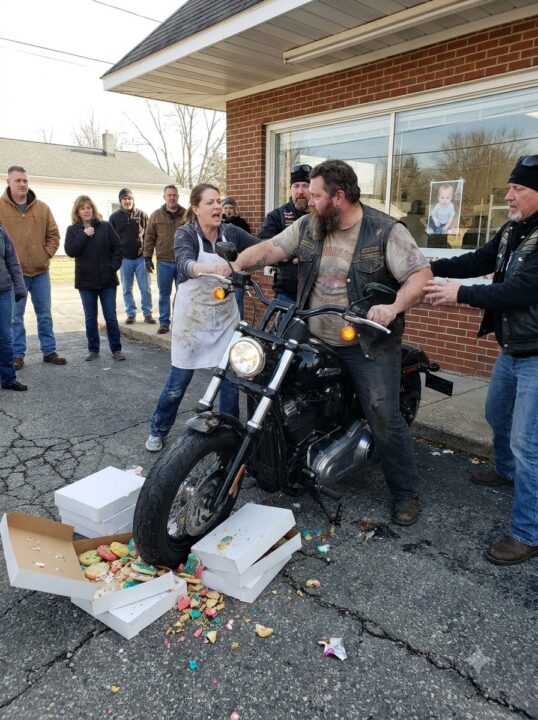
A Biker Bought All 300 Birthday Cookies and Crushed Them Beneath His Harley Outside the Bakery — Then the Owner Learned Which Little Girl Was Supposed to Eat One
Part 2 — The Call from Mile Marker 118
Forty-three minutes before Silas entered our bakery, Levon Price was unloading restaurant supplies at a distributor outside Springfield when a forklift blade punctured one of the blue ingredient drums.
Levon rode with the Black River Riders, but his weekday life was less dramatic. He was a fifty-two-year-old warehouse safety officer who wore steel-toed shoes, carried three pens in his shirt pocket, and corrected anybody who failed to log a damaged pallet.
The ruptured drum was labeled SUNFLOWER BAKING SHORTENING.
What leaked onto the concrete smelled wrong.
Levon had spent fourteen years around commercial food products. Sunflower shortening carried almost no aroma. The paste spreading beneath the pallet smelled toasted and slightly sweet.
A forklift operator touched it with a gloved finger.
Levon stopped him before he tasted it.
Beneath the loose sunflower label, they found part of an older manufacturer’s sticker. The visible code belonged to a cashew-praline filling made on equipment that also processed almonds and pistachios.
The drums had been relabeled after a trucking subcontractor damaged their outer packaging. Somewhere between Arkansas and Missouri, two pallets were switched.
One had already left the warehouse.
Levon checked the manifest.
Six drums had gone to bakeries across southern Missouri. One was delivered to Mabel’s Oven in Cedar Ridge three days earlier.
He called the bakery.
No answer.
He called the county health office. Saturday staffing transferred him twice, then placed him on hold. He called the distributor’s manager, who told him not to contact customers until corporate counsel confirmed the lot number.
Levon called Silas.
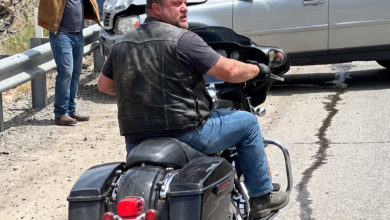
The Black River Riders were gathered at a gas station near Mile Marker 118, preparing to escort a veteran’s remains from Springfield to Cedar Ridge. Silas listened while fuel pumps clicked around him and eighteen Harley engines warmed in the morning air.
“What bakery?”
Levon told him.
Silas shut off his motorcycle.
Boone noticed the change immediately. “What happened?”
Silas asked whether the shipment sheet listed a product date. It did.
He knew Mabel’s weekend production schedule because the club had ordered six hundred rolls for a tornado-relief fundraiser the previous month. Saturday mornings were when Claire made her school-event and birthday batches.
He called the bakery seven times.
Claire rejected his number twice.
Boone offered to call me, but my phone was locked in my car. Silas sent three riders to the other bakeries while he and Boone headed for Cedar Ridge.
The funeral escort could wait.
That decision angered several brothers. The deceased veteran had been a friend of the club, and his widow expected Silas at the front of the procession. One rider accused him of allowing old grief to control club business.
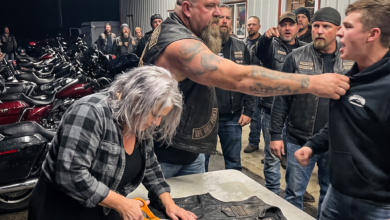
Silas removed the folded flag from his saddlebag and handed it to the man.
“Lead clean,” he said.
Then he rode.
The trip normally required forty-five minutes. Silas made it in twenty-nine without weaving through traffic or crossing the center line. Boone later told me the frightening part was not their speed.
It was Silas’s silence.
At a red light outside Cedar Ridge, Boone pulled beside him and asked whether he was thinking about Annie.
Silas stared ahead.
“I’m thinking about the trash can.”
Boone understood.
I did not learn what that meant until much later.
When they reached Main Street, Silas saw balloons tied outside the American Legion hall. A hand-painted rabbit pointed visitors toward Mae’s birthday party.
He knew about Mae’s allergy because her mother, Rachel Calder, worked as an emergency dispatcher. Months earlier, she had given a first-aid demonstration at the Black River Riders’ clubhouse after one of the prospects suffered a bee sting.
Mae had attended.
The small girl corrected Silas when he called her injector “an EpiPen.”
“It’s epinephrine,” she told him. “The medicine has a name even if the pen has a brand.”
Silas had nodded gravely. “Yes, ma’am.”
She taught twenty-three bikers where her mother kept the injectors and made each man practice with an orange trainer.
Silas practiced twice.
Afterward, Mae asked about the faded bracelet beneath his glove. He said it belonged to someone who had also needed people to read labels carefully.
Mae did not ask more.
On the morning of her party, Silas carried two emergency injectors because the club planned to stop at the hall after the funeral escort. Mae had invited them to eat cake and show her friends the motorcycles.
That was why Boone had one inside his vest.
It was also why Silas knew the three hundred cookies on Claire’s table were not ordinary inventory.
He entered the bakery intending to stop the order without explaining Annie in front of strangers. He asked for the ingredient container.
Claire refused.
He asked to buy everything.
She accepted.
Then he destroyed every cookie because experience had taught him that removing dangerous food from a counter was not enough.
Twelve years earlier, he had trusted a sealed trash bag.
His daughter paid for that trust.
Part 3 — The Missing Rabbit Cookie
When Evan said one sample cookie was missing, Silas ran across Main Street before anybody could stop him.
Boone followed with the preserved cookie. I followed Boone. Claire came behind us, still wearing her flour-covered apron, while two police cruisers turned into the bakery lot and found nobody willing to explain the battlefield of frosting.
The American Legion hall smelled of paper decorations, fruit punch, and floor wax. Thirty children crowded around folding tables while parents taped balloons to the walls.
On the dessert table stood eleven rabbit cookies.
The twelfth wrapper lay empty.
Silas did not shout. He moved from child to child, searching hands, plates, and mouths. His size frightened several parents, and one father stepped between him and the tables.
“Back away from the kids.”
Silas held up both hands. “Who ate the white rabbit?”
Nobody answered.
Mae sat beneath a banner wearing a gold paper crown. Her plate held a slice of cake but no cookie. Rachel Calder stood beside her, confused by the sudden arrival of four adults and a biker breathing like he had run through fire.
Claire reached the table first.
“Don’t let anyone eat these.”
Rachel looked at her. “Why?”
“We may have received the wrong ingredient.”
That was all it took.
Rachel swept the cookies into an empty cake box. She asked the children to raise their hands if they had eaten one. No hands rose.
Silas found a smear of white icing on a napkin beside Mae.
His voice changed. “Did you taste it?”
Mae shook her head. “I gave mine away.”
“To who?”
She pointed toward a curtained side room where the hall stored coats.
A six-year-old boy named Oliver had begun crying because his mother arrived late. Mae gave him the rabbit cookie to make him feel better. Oliver was hiding behind the coats, eating it.
He had no diagnosed nut allergy.
For one second, everybody relaxed.
Silas did not.
“Take it.”
Rachel removed the remaining half-cookie from Oliver’s hand, rinsed his mouth, and called his mother. The boy complained but showed no symptoms.
Then Mae coughed.
One small cough.
Rachel turned.
Mae rubbed her lower lip. A pink patch had appeared along her chin.
She had not eaten the cookie, but she had handled it before touching her mouth.
Rachel opened her bag.
The first injector was missing.
She had used it two weeks earlier during a restaurant exposure and forgotten to replace it. The backup pen was locked in her car across the parking lot.
Silas already had his in his hand.
He knelt in front of Mae and asked permission before touching her leg. That detail matters. Even while the room closed around him and Mae’s breathing changed, he waited until she nodded.
He removed the safety cap.
Pressed the injector against her outer thigh.
Held it.
Boone counted aloud.
Mae began wheezing before the count reached ten.
Rachel called emergency dispatch from her own phone. I cleared chairs from the central aisle. Claire stood frozen beside the dessert table, staring at the green allergen-safe stickers she had placed on every wrapper.
Silas laid Mae on the floor and checked her breathing. The children were moved into the kitchen, but several watched through the serving hatch.
The hall became brutally quiet.
No engines.
No music.
Only Mae dragging air past a tightening throat.
Paramedics arrived in four minutes. It felt like forty. They administered oxygen and prepared another dose while Silas remained kneeling beside her.
One medic recognized Annie’s bracelet.
His name was Paul Henson. Twelve years earlier, he had been the youngest paramedic at the scene when Silas’s daughter collapsed.
Paul looked at Silas, then at Mae.
“Not again,” he whispered.
Silas’s right hand began shaking.
Mae saw it. She reached from beneath the oxygen mask and closed her fingers around his smallest one.
“I’m okay,” she rasped.
Silas did not tell her she was wrong.
He said, “Stay mad.”
It was something he used to tell Annie during hospital procedures. Anger kept her alert when fear made her quiet.
Mae squeezed harder.
The ambulance left with Rachel beside her. Silas stood in the doorway until its siren disappeared. Then Cedar Ridge police officers arrived and asked him to place his hands where they could see them.
Claire had reported the property destruction before understanding why he did it. Although Silas owned the cookies, the crushed boxes blocked a public sidewalk, frosting had entered a storm drain, and witnesses claimed he had threatened her with his motorcycle.
He did not argue.
Officer Dalton handcuffed him.
Boone stepped forward, but Silas stopped him with one look. “Hospital first.”
“We’re not leaving you.”
“That girl has no escort.”
Those six words divided the club again.
Half the riders had just reached town after abandoning the funeral route. Some wanted to remain with their president. Others believed Mae’s ambulance should never travel alone after what had happened.
Boone made the choice.
He sent twelve motorcycles after the ambulance and stayed with Silas.
Claire watched the police place Grinder Cade in a cruiser while yellow icing dried on his boots.
She could have corrected the threat allegation.
She did not.
Not yet.
She still believed the contamination might have been accidental but Silas’s public destruction had been personal. She believed he could have warned her calmly, preserved the evidence, and waited for authorities.
Then Levon arrived holding the supplier records.
The document showed that Claire had received the warning three days earlier.
Someone at Mabel’s Oven had signed for it.
The signature looked like hers.
Part 4 — The Signature That Wasn’t Claire’s
The supplier’s system showed a digital acknowledgment beside the contaminated lot number.
CLAIRE HOLT.
A recall notice had been emailed Thursday afternoon and marked opened eight minutes later. A second notification went to the bakery’s ordering portal on Friday morning.
Claire denied seeing either.
Officer Dalton heard her denial and looked toward Silas in the cruiser. From his perspective, the situation had changed. A bakery owner appeared to have ignored a recall, sold the products anyway, and then accused the man who stopped her.
Claire demanded to see the signature.
The digital mark was hers.
I recognized it because she wrote the H in Holt with a long backward loop. Evan knew that too.
My nephew was sixteen, clever with computers, and terrified of losing the bakery. He handled supplier invoices after school and watched his mother cry over bills she thought nobody saw.
Three weeks earlier, their normal shortening increased in price. Evan found a discounted “sunflower blend” through a broker using the same distributor portal. When the recall appeared, he believed it concerned damaged packaging rather than the contents.
He dismissed the notice.
Then he copied Claire’s electronic signature because he feared the entire shipment would be destroyed and the bakery could not afford a replacement.
He never opened the attached allergen bulletin.
Claire sat on the bakery floor when he admitted it.
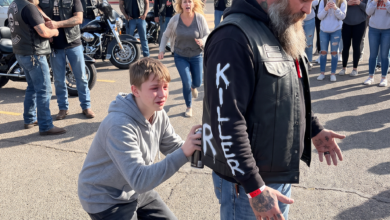
“I was trying to save us,” Evan said.
“You used my name.”
“I was going to tell you after the weekend.”
“You let us bake for a child with an allergy.”
His face collapsed. “The front label said sunflower.”
Silas heard the confession through the open cruiser window.
He did not curse the boy.
He leaned his head against the seat and closed his eyes.
That restraint surprised me more than anger would have. Evan had made a reckless choice with consequences Silas understood better than anyone, yet the biker refused to turn a frightened teenager into a substitute for the people who had failed Annie.
Officer Dalton released him from the cruiser while the county prosecutor reviewed whether any charge applied to destroying his own purchase. Claire withdrew her claim that Silas had threatened her.
She did not apologize.
Silas did not ask.
He walked back into the bakery, removed a roll of industrial trash bags from beneath the sink, and began cleaning the parking lot. Boone joined him. Then Levon. Then the riders returning from the hospital.
Mae had stabilized.
The emergency dose had worked quickly, and physicians expected her to go home that evening. Twelve riders had remained outside County General until Rachel called and told them the noise from their idling motorcycles was disturbing patients.
They shut off the engines and stayed.
At the bakery, Claire watched Silas scrape crushed cookies from the pavement with a steel shovel. She finally asked the question that had been waiting for twelve years.
“Why destroy all of them?”
Silas continued working. “So nobody could pull one back out.”
“Out of what?”
“The trash.”
The old story was not what our town believed.
Annie Cade had attended a school carnival when she was seven. Claire’s father supplied pastries from his bakery. One tray was labeled free of tree nuts, but almond paste had been used on the same preparation table.
Annie took one bite and complained that her tongue felt strange.
Silas recognized the symptoms because his wife had trained him. He used Annie’s injector and called for help. The reaction appeared to ease.
Claire’s father immediately threw the tray away.
Everyone believed the danger was over.
Then a volunteer saw dozens of untouched pastries inside the clean liner. She assumed they had been discarded because the carnival was ending, removed them, rearranged them on a different plate, and carried them to the children waiting near the buses.
Annie’s friend picked up one.
Annie knocked it from her hand.
The pastry broke against the pavement, and paste transferred to Annie’s fingers. Minutes later, she rubbed her eye.
Her second reaction was worse.
The ambulance crew had one pediatric dose. Annie’s backup injector had been left in Silas’s truck because another volunteer moved the vehicle to clear the fire lane.
She survived the afternoon but suffered oxygen deprivation during cardiac arrest. She remained in intensive care for nine days.
Then she died.
Silas had not blamed Claire’s father for the original cross-contact alone. He blamed him for refusing to tell investigators that the discarded pastries had been recovered and served again.
The owner feared lawsuits. He convinced the volunteer to say Annie had taken a second pastry herself.
That lie became the official account.
Silas’s wife believed it.
She accused him of failing to watch their daughter and left Cedar Ridge three months later. Their marriage ended without either of them learning the truth.
Silas carried Annie’s bracelet because it was cut from her wrist during the resuscitation.
He carried stainless-steel tongs because after her death he began teaching food-allergy safety at club fundraisers, schools, and roadside events. He never advertised the work. His leather cut made administrators nervous, so Rachel Calder usually placed his supplies and spoke for him.
Grinder Cade was not merely a grieving father who happened to recognize an unsafe batch.
For eleven years, he had been certified to train community groups in anaphylaxis response.
Mae had practiced with him.
That was why she stayed conscious while he held the injector. She recognized his voice.
The feared biker had been preparing strangers to save children because he had never forgiven himself for failing to save one.
But the deepest twist was still inside our father’s old office.
Claire found it after Evan surrendered his computer password.
A hidden email folder contained twelve years of messages.
Our father had known the volunteer’s statement was false.
And Silas’s former wife had been asking for proof.
Part 5 — Annie’s Mother Came Back for the Truth
The messages began six months after Annie died.
Her mother, Rebecca Cade, had written from Tulsa asking our father to provide the original disposal log, staff names, and insurance photographs from the carnival. She believed Silas had told the truth about the discarded tray.
Our father never answered.
He saved every message.
The last one arrived two weeks before his death.
Rebecca wrote that she was ill and wanted to speak with Silas before it became too late. She had remarried, changed her surname, and spent years believing their daughter’s second exposure happened because Silas failed to supervise her.
A retired carnival volunteer had recently confessed.
The volunteer was Claire’s mother-in-law, Donna Holt.
Donna had removed the pastries from the trash. She also gave the false statement after our father promised the bakery’s insurer would protect her from prosecution.
She carried that secret for twelve years.
After learning she had late-stage cancer, Donna contacted Rebecca and admitted everything. Rebecca then wrote to our father demanding that he correct the record.
He did not.
Claire stared at the messages until the screen blurred.
Our father had died with the truth inside his office and Silas’s name in a locked folder.
There was one more unsent document: a signed statement acknowledging the mislabeled tray, the recovered pastries, and the pressure placed on Donna. The document had never been delivered to investigators.
Claire printed it.
Then she walked to County General.
Silas was outside Mae’s room, still wearing boots stained with purple frosting. Hospital security would not allow the entire club upstairs, so twenty-two bikers occupied the far end of the parking lot with their engines off.
Claire handed him the confession.
He read the first page standing.
He read the second sitting on a concrete planter.
When he finished, he folded the pages along their existing lines and placed them behind Annie’s bracelet in his vest.
Claire waited for him to accuse her family.
He asked one question.
“Rebecca’s number in there?”
She showed him the final email.
Silas copied the number onto his palm with Boone’s pen. His phone remained in police evidence because officers had retained the contamination photograph and call history.
Claire offered hers.
He refused.
“Not beside a child’s room.”
That evening, Mae came home. Her party had no cookies, the cake was thrown away as a precaution, and half the balloons had deflated.
She said it was still her best birthday because twenty-two motorcycles followed her mother’s car from the hospital to their house.
Silas did not ride at the front.
He stopped behind the bakery and called Rebecca.
I did not hear the conversation. Boone waited near the alley entrance but kept everyone else away. Silas stood beside the Harley for thirty-seven minutes without sitting.
He spoke fewer than twenty words.
Rebecca did most of the talking.
At the end, Silas lowered his head until his forehead rested against the handlebar. The leather across his shoulders moved once, sharply.
Then he called her name.
Just Rebecca.
Nothing more.
She came to Cedar Ridge three days later.
She was fifty-six, thin from treatment, and carried Annie’s yellow backpack. Silas met her outside the closed bakery. Claire offered to let them use the office, but Rebecca wanted to stand where the cookies had been destroyed.
She removed a small plastic container from the backpack.
Inside was a crushed pastry sealed in resin.
Annie’s friend had retrieved it from the pavement after the carnival. Rebecca kept it because she thought it was the last thing Annie touched. Years later, testing found traces of almond protein on the surface and beneath the broken edge.
It proved Annie had knocked the pastry away rather than eaten it.
The evidence could no longer produce a criminal case against a dead bakery owner, but it corrected the medical record. More importantly, it corrected the story Rebecca and Silas had told themselves about each other.
Rebecca had believed he left Annie’s backup injector in the truck.
Silas had not.
He placed it in Annie’s yellow backpack.
Donna moved the backpack when she cleared the children’s table, then forgot where she put it during the emergency. Silas searched the truck because someone shouted that the bag was inside.
The failure did not belong to one parent.
It belonged to a chain of small decisions, hurried assumptions, missing labels, moved objects, and adults protecting themselves after a child could no longer contradict them.
Silas did not ask Rebecca to forgive him.
She did not ask him either.
They sat on the bakery curb until dark, Annie’s backpack between them.
The following morning, Claire closed Mabel’s Oven voluntarily. She discarded every ingredient, replaced the preparation tables, and enrolled the entire staff in allergen-control training.
Silas led the first session.
Evan attended from the front row.
When the boy tried to apologize, Silas placed a damaged sunflower label beside him.
“Don’t apologize to me.”
“What should I do?”
“Read past the first layer.”
Evan nodded.
Silas gave him the stainless-steel tongs.
“Start with the trash.”
For eight hours, Evan opened every disposal bag, recorded batch codes, and helped the health department account for every item baked with the contaminated product.
No other customers became ill.
The club brothers who had accused Silas of abandoning the funeral escort returned to the clubhouse expecting discipline. Silas gave none.
He asked whether the veteran had reached the cemetery with honor.
They said yes.
“Then the club did its job.”
Boone challenged him. “And if Mae had died while half of us were arguing about formation?”
Silas looked around the room. “Then we’d have failed ours.”
No one argued again.
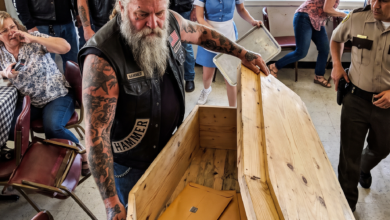
The veteran’s widow later learned why Silas left. She mailed the folded flag back to the club with a note saying her husband would have chosen the child too.
Silas kept the flag in his saddlebag beside Annie’s bracelet.
Not as proof.
As instruction.
Part 6 — Three Hundred Green Stickers
Mabel’s Oven reopened six weeks later under a different system.
No product was called “allergen-safe.” Claire said those two words promised more than any shared commercial kitchen could guarantee. Each label now listed the exact ingredients, supplier lot, preparation surface, and potential cross-contact.
Green stickers disappeared.
Evan designed the new labels as part of the community service agreement approved after the health department investigation. He also spent Saturdays speaking to culinary students about the recall he dismissed.
He never used the phrase “I was only trying to help.”
Silas would have stopped him.
Mae visited the bakery on reopening day. She wore the same paper crown from her interrupted birthday and carried an orange injector trainer.
She asked Silas whether he would eat the first cookie.
He examined the ingredient sheet, checked the sealed container, and looked toward Rachel.
Then he broke the cookie in half.
Mae ate one half.
Silas ate the other.
Claire turned away long enough to wipe her face with the corner of her apron.
The bakery placed a clear box beside the register containing three hundred blank ingredient cards, one for each cookie Silas destroyed. Customers could take a card and write the name of someone whose allergy, medication, or medical condition others needed to respect.
Silas refused to write Annie’s name.
For months, I assumed grief made it impossible.
On the anniversary of Mae’s party, he arrived before opening with Rebecca riding behind him. Her treatment had slowed the cancer, though it had not cured it.
Together, they filled out one card.
They wrote:
ANNIE CADE — SHE KNOCKED IT AWAY.
Claire framed the card inside the kitchen, not the dining room. Silas did not want his daughter turned into decoration or advertising.
Every Saturday at 10:17, the time he entered the bakery, Evan stopped production for sixty seconds. Staff checked active batches, supplier notices, and emergency injectors.
No speeches.
No memorial bell.
Only verification.
Outside, faint purple stains remained in the asphalt cracks where the frosting had dried. Claire tried pressure-washing them away, but Silas asked her to leave one.
“Why?” she said.
He pointed toward the loading door.
“So people remember trash can come back.”
That became the sentence printed above the disposal log.
Part 7 — The Birthday Ride
Mae turned nine the following spring.
This time, her party was held in the Black River Riders’ clubhouse. Rachel chose the location because every rider had completed Silas’s emergency-response course and three injectors were mounted in unlocked cabinets.
Claire baked the cookies.
Evan checked the labels.
Levon verified the supplier lots.
Rebecca placed the first tray on the table.
There were three hundred cookies again—yellow stars, purple balloons, and white rabbits—but none carried a green sticker.
Each package listed exactly what it contained.
Before the children entered, Silas inspected every box. Mae stood beside him with her hands on her hips, pretending impatience.
“You trust us yet?” Claire asked.
Silas examined the final seal.
“I trust checking.”
That was the closest he came to forgiveness in public.
During the party, Mae gave him a rabbit cookie and ordered him to sit at the children’s table. The enormous biker lowered himself into a folding chair between two eight-year-olds while his club brothers watched from the wall.
One child asked why purple frosting stained the grooves of his motorcycle tire.
Silas looked at Mae.
She answered for him.
“He stopped my first birthday from being my last one.”
The room went quiet.
Silas tapped the table twice. “Eat before it gets stale.”
After sunset, Rebecca asked him to take her past the old school carnival grounds. They rode slowly, Annie’s yellow backpack secured inside the saddlebag.
I watched them leave from the bakery doorway.
His Harley’s V-twin rolled through Cedar Ridge, low and uneven. At the corner, Rebecca lifted one hand toward Mae. Silas did not look back.
The purple stain outside Mabel’s Oven remained beneath the streetlight.
Three hundred cookies had disappeared there.
One little girl had not.
Follow the page for more unforgettable biker stories, and leave GRINDER below if you want the next full story from this brotherhood.