Part 2: A Biker Left a Trapped Driver Beside a Fuel-Leaking Car and Roared Away — What He Carried Back Revealed Why He Had Abandoned Another Wreck Twenty-Eight Years Earlier
Part 2 — The Man Who Always Counted the Curves
I met Ray “Hammer” Dawson four months before the crash.
He entered my diner at 5:40 every Thursday morning, ordered black coffee, two eggs, wheat toast, and an extra cup he never drank. He always sat in the booth facing Route 89.
Ray owned Dawson Iron & Cycle, a small welding and motorcycle repair shop south of Flagstaff. He had been a member of the Cinder Ridge Riders for twenty-six years, though the plain raven patch on his cut had faded until the bird looked more like a shadow.
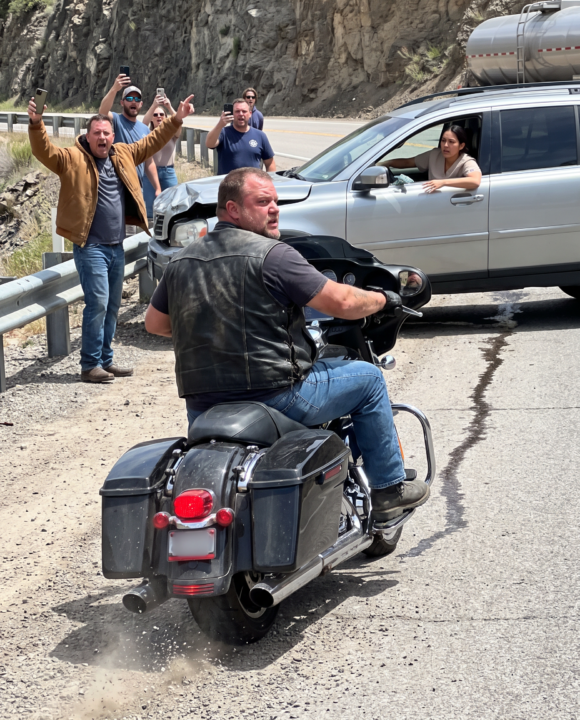
Most customers gave him space.
He was a massive white American man with weathered skin, a shaved head, a long beard, tattoos around his neck and forearms, and hands scarred by steel, fire, tools, and more than a few fights he did not discuss.
His voice was quiet.
That made people listen harder.
The second cup of coffee remained untouched across from him until exactly 6:15. Then Ray poured it into a paper cup, left two dollars beneath the saucer, and carried it outside.
For weeks, I assumed it belonged to another biker.
It did not.
Ray placed the coffee beside a small roadside cross north of the diner. The cross carried no photograph, only a rusted motorcycle chain and a metal plate stamped with one name.
MICAH.
I once asked Ray who Micah was.
“My brother.”
“How long ago?”
Ray looked at the highway.
“Long enough for people to stop asking. Not long enough for me.”
That was all.
The Cinder Ridge Riders met behind Dawson’s shop on Wednesday nights. Their president was Malcolm “Preacher” Boone, a sixty-one-year-old Black veteran with silver braids, deep cheek scars, and the patient manner of a man who had spent years preventing large men from making small decisions.
Preacher told me Ray had not always been quiet.
At twenty-seven, Ray drank hard, rode angry, and treated every disagreement like an invitation. He had broken another biker’s jaw in Albuquerque, spent eight months in county jail after a bar fight, and lost his first welding job because he arrived drunk beside industrial machinery.
Micah was younger by seven years.
He followed Ray everywhere.
“He thought Hammer hung the moon,” Preacher said. “Problem was, Hammer believed him.”
Micah joined the Riders before he understood what membership required. He loved the engines, the patches, the attention at fuel stops, and the way strangers moved aside when six Harleys entered a parking lot.
He did not love rules.
Ray did not enforce them.
That failure followed him.
One rainy night in 1998, Ray and Micah left a bar near Page after an argument. Ray rode ahead. Micah followed on an old Harley with a weak headlight and a rear tire Ray had promised to replace.
At a downhill curve, a pickup lost control.
Micah struck the truck’s rear quarter panel and went beneath the guardrail. The fuel line tore open.
Ray heard the impact.
He returned within a minute.
Several motorists had stopped, but nobody controlled the road. Cars squeezed past the wreck. One driver lit a cigarette twenty yards away. Another tried dragging Micah by the shoulders while his boot remained trapped beneath the motorcycle.
Ray attacked the wrong problem first.
He fought the man touching Micah.
Then he screamed at the cigarette smoker.
Then he tried lifting the motorcycle alone.
A second vehicle entered the blind curve too fast. It swerved, struck the pickup, and pushed the wreckage deeper against the guardrail.
Fuel ignited.
Micah died before firefighters reached him.
Ray survived with burns across his left shoulder and both hands.
He spent thirteen months in prison after pleading guilty to assaulting two bystanders during the chaos. Preacher visited every month. The club did not abandon him, but they stopped pretending grief excused what he had done.
When Ray was released, he did three things.
He quit drinking.
He repaired the rear tire on Micah’s motorcycle.
Then he joined the Coconino County volunteer fire program.
Ray never became a career firefighter. He struggled with classroom tests, distrusted authority, and froze during his first vehicle-fire simulation when an instructor ignited a gasoline pan.
He returned the next week.
And the week after that.
He learned traffic control, fuel hazards, basic extrication support, hypothermia prevention, scene assessment, and the hardest rule for any frightened witness: saving one person sometimes begins by stopping twenty others from creating new victims.
Ray volunteered for seven years.
Then his wife, Ellen, became ill.
She had pulmonary fibrosis and needed oxygen by thirty-nine. Ray left the program to care for her, converted their bedroom into something resembling a medical supply room, and learned to sleep through the soft cycling of an oxygen concentrator.
Ellen died two winters later.
Afterward, Ray stopped wearing his volunteer-fire patch where others could see it. He sewed it inside his cut, beneath Micah’s name.
“He said he wasn’t a firefighter anymore,” Preacher told me. “I told him training doesn’t vanish because the shirt comes off.”
Ray answered, “Neither does failure.”
Years passed.
He repaired bikes. He sponsored men leaving jail. He carried an extinguisher in his shop truck, trauma supplies in his saddlebag, and wool blankets on every winter ride.
That explained the empty red bracket I noticed at Elena’s wreck.
Normally, the extinguisher would have been there.
Three days earlier, Ray had used it when a tourist’s overheated camper began smoking at a fuel station. He had placed the empty cylinder beside his shop door to be refilled.
He had planned to collect it Thursday.
The crash happened Wednesday.
There was one more detail.
Ray’s phone had been destroyed that morning when a transmission housing slipped from a workbench. His club brothers offered him replacements. He said he would buy one after payday.
So when he reached Elena’s wreck, he carried no working phone, no extinguisher, and no blankets.
He had only his training.
And a highway full of people certain that standing beside the victim was the same as helping her.
Part 3 — Forty-Seven Seconds of the Wrong Story
The full accident began twelve minutes before Ray arrived.
Elena Ruiz had finished a double shift at Flagstaff Medical Center. She was driving home toward Prescott when a deer stepped from the scrub beside Route 89.
She swerved.
The SUV struck the guardrail, spun halfway around, and stopped with its driver’s side pressed against steel. The front wheel folded beneath the body. A suspension bracket punched through the floor and trapped Elena’s lower leg without cutting it.
She could not see the fuel leak.
We could.
The first people at the scene behaved like people usually do when fear arrives before knowledge. We moved quickly, spoke loudly, and assumed action mattered more than direction.
One man pulled the door.
Two tried rocking the SUV.
Someone opened the rear hatch, hoping Elena could crawl through, without realizing the movement twisted the damaged frame around her pinned leg.
Elena screamed.
Then Ray arrived.
He saw several risks at once: gasoline leaving the damaged tank, vehicles idling downhill from the spill, traffic approaching from a blind curve, an injured driver who could not be removed without tools, and a crowd compressing around the only safe path rescuers would have.
He shut off the SUV’s ignition.
He checked Elena’s breathing and circulation.
He warned us not to move the frame.
Then he heard the tanker horn.
Ray recognized it because tanker driver Samuel Price used the same descending three-note blast whenever he approached blind sections of Route 89. Ray repaired the man’s Harley and had heard him complain about motorists stopping near the curve.
The tanker was coming south.
The wreck filled most of its lane.
Ray could not know whether Samuel had received any warning. There was no signal, no officer, no flares, and no person positioned far enough beyond the curve to be seen.
So Ray left.
He accelerated north, leaning the Harley around the rock wall. The tanker appeared almost immediately, descending faster than Ray expected.
Ray did not try to outrun it.
He turned across the lane.
The Harley stopped sideways roughly two hundred yards ahead of the tanker. Ray dismounted, left the engine running, and stepped into the road while waving both arms.
Samuel saw him.
The tanker’s air horn exploded through the canyon.
Brakes screamed.
The trailer moved sideways by several feet before its tires found grip. It stopped less than forty yards from Ray’s motorcycle.
Samuel climbed down furious.
“You trying to die?”
“Wreck around the bend,” Ray said. “Fuel leak. Woman trapped.”
The driver’s anger disappeared.
Samuel positioned the tanker across both southbound lanes, activated its emergency flashers, and radioed his dispatcher. The dispatcher contacted highway patrol and rescue services with an exact location.
That solved the first danger.
Ray still needed equipment.
He rode farther north to a road-maintenance yard. The gate was locked, but a county worker inside recognized the Cinder Ridge patch and came running.
“Need an extinguisher,” Ray said. “Blankets too.”
The worker asked questions.
Ray did not wait through all of them.
He took a twenty-pound dry-chemical extinguisher, two wool emergency blankets, wheel chocks, and a trauma bag. The worker followed in a pickup carrying traffic cones.
By then, four minutes and nineteen seconds had passed.
At the wreck, those minutes felt much longer.
Elena kept asking whether the biker had left because the car might explode. Nobody knew how to answer without terrifying her.
The man in the hunting jacket became angrier.
“He knew something,” he said. “He saw that leak and ran.”
The college student continued recording.
I knelt outside the window, holding Ray’s leather gloves because Elena had begun squeezing them whenever pain surged through her leg.
“Tell me about your family,” I said.
“My son is sixteen.”
“What’s his name?”
“Mateo.”
“What does Mateo complain about?”
The smallest smile crossed her face. “Everything.”
Gasoline spread farther along the shoulder.
Someone suggested pouring sand over it. Someone else wanted to disconnect the battery. A third man approached with a tire iron, intending to force the door.
I remembered Ray’s words.
“Don’t touch the frame.”
The man ignored me.
I stood between him and the vehicle.
That was the first useful thing I did.
“Move,” he said.
“No.”
“We can pry it open.”
“Her leg is caught in it.”
“You trust the guy who ran?”
I looked at the gloves in my hands.
“Yes.”
I was not certain.
But Elena heard me.
The crowd argued while the recording continued. Every sentence made Ray look worse. People described him as cold, suspicious, possibly drunk, and eager to escape responsibility.
Then we heard another V-twin.
The sound came from the north.
Ray rounded the bend with the extinguisher strapped across the passenger seat, blankets tied behind it, and the red trauma bag hanging from his shoulder. The county pickup followed with amber lights flashing.
Behind them, the tanker blocked the road.
Nobody cheered.
We were too ashamed.
Ray parked uphill from the spill, carried the extinguisher to the guardrail, and placed it within reach without discharging it. Then he returned to Elena’s window.
“You came back,” she whispered.
Ray took one glove from my hand and slid it beneath hers.
“Said I would.”
“You didn’t.”
“I should’ve.”
That was the only apology he offered.
He unfolded one blanket and passed it through the rear window so I could cover Elena’s upper body without shifting her. He wrapped the second around her shoulders from outside, tucking it carefully behind her neck.
Elena stared at his burned hands.
“What happened to you?”
“Old road.”
Ray checked her foot again. It remained warm. He marked the time on a strip of medical tape from the trauma bag and wrote it on the blanket.
Then sirens arrived.
The fire crew established a safety zone, absorbed the fuel, stabilized the SUV, and began controlled extrication. Paramedics started an IV through the broken window.
Ray stepped back.
He did not interfere.
For forty-six minutes, firefighters cut away the door and separated the dashboard from Elena’s leg. Ray held the extinguisher beside the spill until a captain relieved him.
When Elena was finally carried to the ambulance, the crowd applauded.
She raised one hand.
Not toward the firefighters.
Toward Ray.
He lifted two scarred fingers in return.
Then the college student approached him with the phone still recording.
“Why didn’t you tell anyone what you were doing?”
Ray looked at the screen.
“Would you have stopped filming long enough to listen?”
The young man lowered it.
But the first video was already online.
And by sunset, nearly half a million people had watched Ray Dawson ride away.
Part 4 — The Name Beneath the Leather
The video spread faster than the correction.
Its caption said an unidentified biker had inspected an injured driver, shoved a man trying to help, and fled after noticing leaking gasoline. The final frame froze on Ray’s taillight disappearing around the curve.
People filled the missing minutes themselves.
They called him a coward.
They claimed he caused the crash.
Some said his club had ordered him to leave. Others decided the object beneath his vest must have been a weapon.
The Cinder Ridge Riders recognized Ray immediately.
By seven that night, twelve motorcycles stood outside Dawson Iron & Cycle. Engines shut down one after another until the shop filled with cooling metal clicks and the smell of oil, wet denim, and highway dust.
Preacher entered first.
Ray sat at his workbench cleaning road grit from the borrowed extinguisher. His leather cut hung from a welding hook.
“You seen it?” Preacher asked.
“No.”
“Everybody else has.”
Ray continued wiping the cylinder.
Luis “Crow” Ramirez placed his phone on the bench. Comments moved too quickly to read.
“We post the tanker footage,” Crow said. “County worker caught you coming back. Diner cameras show the equipment. We put all of it out tonight.”
Ray shook his head.
“Why not?”
“Woman’s still in surgery.”
“This isn’t about her.”
“It should be.”
The brothers argued.
A younger member wanted to identify the men who had accused Ray. Another proposed riding to the college student’s house. Preacher stopped that idea with one look.
Nobody threatened witnesses.
Nobody touched the young man.
Still, the club was being tested by something they understood poorly: a public lie that could be challenged immediately, but only by turning Elena’s worst hour into more content.
Ray refused.
“Wait until she speaks,” he said.
“What if she doesn’t?” Crow asked.
Ray’s hand stopped on the extinguisher.
“Then she doesn’t.”
Preacher studied him. “You willing to carry this?”
“Carried worse.”
That answer brought every eye toward the leather cut.
Micah’s name was stitched inside it.
The younger brothers had seen the lettering, but most did not know the story. They believed Micah died in an ordinary motorcycle accident.
Preacher removed the cut from the hook.
Ray stood.
“Leave it.”
“No.”
“Malcolm.”
“You’re letting a dead boy punish a living man.”
The room changed.
Ray’s scarred hands closed into fists. For a second, I saw the man he had been before prison, volunteer training, Ellen, sobriety, and twenty-eight years of choosing not to strike first.
Preacher saw him too.
He did not step back.
“Tell them,” he said.
Ray’s voice went flat. “Not yours.”
“Then tell me I’m wrong.”
Silence.
The shop clock clicked above the parts shelves.
Finally, Ray opened the leather cut. Beneath the outer raven patch was a smaller piece of fire-damaged cloth sewn against the lining. It had once been yellow.
A volunteer-fire insignia remained barely visible.
Below it sat Micah’s name.
And beneath the name, concealed by a narrow seam, was a strip of burned blue denim.
Ray had cut it from his brother’s jeans after the funeral home returned Micah’s belongings.
He carried it on every ride.
Not as a charm.
As a warning.
Ray told the club what happened on the 1998 curve. He described the leaking fuel, the crowd, the second vehicle, the cigarette, his rage, and the moment the scene became more dangerous because nobody controlled the road.
Then he admitted the part even Preacher had never heard.
Ray had ridden away that night too.
After realizing no one had called rescue, he started toward a ranger station two miles south. But Micah screamed his name, and Ray turned back before reaching it.
He chose to remain visible to his brother.
Nobody blocked traffic.
Nobody completed the call.
The second vehicle arrived three minutes later.
“For twenty-eight years,” Ray said, “I told myself staying meant I didn’t leave him.”
Preacher waited.
Ray stared at the floor.
“Staying killed him.”
Nobody answered that.
There are sentences too heavy for comfort.
Ray explained that when Elena’s hand closed around his wrist, he heard Micah again. Every part of him wanted to remain beside her so she would not believe she had been abandoned.
Then the tanker horn sounded.
This time, he chose the road.
He rode away from the person asking him to stay because the person could not see the danger approaching from beyond the curve.
Crow sat on an overturned bucket.
“So Elena wasn’t the first person you left at a wreck.”
“No.”
“She was the first one you went back for.”
Ray shook his head.
“First one I went far enough to help.”
Preacher looked at the video again.
The internet saw a biker fleeing an injured woman.
The club now saw a man completing a ride he had turned back from twenty-eight years earlier.
Before anyone could respond, my diner phone rang.
Elena had awakened after surgery.
Her son Mateo had one question.
He wanted to meet the biker whose gloves his mother was still holding.
Part 5 — What the Camera Missed
Elena remained hospitalized for nine days.
Her leg was fractured in three places, but circulation returned after surgeons repaired a damaged artery. Doctors expected months of rehabilitation. They also expected her to walk again.
Ray did not visit immediately.
He delivered the borrowed extinguisher to the maintenance yard, paid for its refill, replaced both blankets, and repaired a broken hinge on the worker’s gate without being asked.
Then he returned to his shop.
Elena sent Mateo on the third day.
The sixteen-year-old arrived with his aunt and carried Ray’s gloves inside a clear hospital-property bag. He was tall, thin, and trying hard to look older than fear had allowed him to feel.
Ray was welding a trailer bracket.
Mateo waited until the torch went dark.
“These are yours.”
Ray removed his helmet.
“She can keep them.”
“She said you’d say that.”
Ray looked toward the bag.
Mateo opened it. One glove had deep crescent marks where Elena’s fingernails had pressed through the leather.
“She wants you to see what she did.”
“Held on.”
“She says she held on because you left them.”
Ray did not understand.
Mateo explained that the gloves carried the smell of motor oil, leather, smoke, and cold highway air. They gave Elena something physical to grip while the crowd argued. When pain rose, Jenna reminded her that the biker had left his gloves and therefore intended to return for them.
Ray looked at me.
I had not realized my small lie mattered.
“You knew?” he asked.
“No.”
“Then why say it?”
“Because she needed to believe somebody had a plan.”
Ray touched the marks in the leather.
Mateo handed him a folded page.
It was not a thank-you letter.
Elena had written a timeline.
2:14 p.m. — Biker arrived.
2:16 — Biker heard truck horn.
2:17 — Biker left.
2:20 — Traffic stopped beyond curve.
2:21 — Biker returned with supplies.
2:24 — First emergency unit arrived.
Below the times, she had written one sentence:
He did not abandon me. He expanded the place where he was helping me.
Ray read it twice.
Then he folded the page and placed it behind Micah’s name inside his cut.
Elena agreed to let the county release the maintenance-yard footage and tanker driver’s statement. The college student who posted the original video uploaded a correction, but he did something Ray did not expect.
He came to the shop.
His name was Caleb Warren. He was twenty-one, studying communications at Northern Arizona University, and had gained nearly forty thousand followers from the wreck footage.
He entered without a camera.
“I made you look like something you weren’t,” Caleb said.
Ray adjusted a carburetor on the bench.
“You filmed what happened.”
“I filmed part of what happened.”
“Most people do.”
Caleb waited for anger. Ray gave him none.
That made the apology harder.
“I can delete it.”
“Won’t delete copies.”
“I can post everything.”
“Post the road.”
Caleb frowned.
Ray showed him a map of the curve. He marked the wreck, the tanker’s stopping point, the maintenance yard, and the route emergency vehicles used.
“People keep looking at me,” Ray said. “Make them look at where it happened.”
The corrected video did exactly that.
It began with the original forty-seven seconds. Then the frame widened to show the blind curve, tanker footage, the blocked lane, the county pickup, Ray’s return, and the fire crew’s response.
Elena recorded a short statement from her hospital bed.
“The man everyone thought was leaving me,” she said, “was the only person who understood that rescuing me required walking away from me first.”
Ray refused an interview.
He refused television appearances.
He refused a motorcycle safety company offering him money to reenact the scene.
He did accept one request.
Elena wanted to see the inside of his vest.
When Ray visited the hospital, he carried no flowers. He brought a stainless-steel travel mug from my diner because she complained the hospital coffee tasted like warm cardboard.
Elena sat with her injured leg elevated.
Mateo stood by the window.
Ray placed his leather cut across the bed. He showed her the faded volunteer-fire cloth, Micah’s name, the strip of burned denim, and her folded timeline.
Elena touched the stitching.
“You ran because of him.”
Ray looked at Micah’s name.
“I ran because of you.”
“No,” she said. “You knew what to do because of him.”
Ray did not answer.
Elena turned the vest over. On the outside, the raven patch looked ordinary. Inside, it held fire damage, a dead brother, a prison term, a volunteer’s training, a widow’s memory, and four minutes the internet had erased.
“People think this tells them who you are,” she said, touching the outer patch.
Ray nodded toward the lining.
“Wrong side.”
Before leaving, he placed the gloves on Elena’s bed.
She pushed them back.
“I don’t need them anymore.”
Ray studied the nail marks.
“Neither do I.”
Mateo suggested framing them. Ray shook his head.
Tools belonged where they could be used.
He cut the damaged palms away, sewed them onto two small traffic flags, and placed the flags inside his saddlebag.
One carried Elena’s marks.
The other carried Micah’s denim.
From then on, whenever Ray stopped at a road emergency, he did not have to choose between remaining beside the injured and warning approaching traffic.
He could leave something from each person in both places.
Part 6 — The Red Bags on Every Harley
The Cinder Ridge Riders changed after Elena’s crash.
Not dramatically.
Bikers distrust dramatic change.
Preacher called a Saturday meeting and placed a red emergency bag on every table. Each bag contained reflective markers, compact blankets, a trauma kit, a glass-breaking tool, a small extinguisher, and a laminated card listing the first details dispatchers needed.
Ray taught the first session.
He spoke for eleven minutes.
“Don’t become the second wreck,” he began.
He showed the brothers how quickly a crowd could block emergency access, how damaged vehicles shifted when pulled, and why somebody had to move far enough beyond a blind bend to warn traffic.
A prospect asked whether they were supposed to act like firefighters.
“No.”
“Then what are we?”
“Useful until they arrive.”
The club began offering the training at diners, veterans’ halls, repair shops, and county fairs. Ray never put his name on it. The course was called Micah’s Curve.
Elena attended the first public session on crutches.
When she entered, Ray stopped speaking.
The room waited for a reunion worthy of cameras.
Elena held out his gloves.
Ray looked confused. “Thought we settled that.”
“You forgot something.”
Inside one glove was a small embroidered strip reading:
HE CAME BACK.
Ray examined it.
“Too many words.”
Elena smiled. “Then don’t sew it outside.”
He stitched it behind Micah’s name.
Caleb recorded the training only after everyone agreed. His final project focused not on Ray’s heroism, but on how incomplete images create complete judgments.
The video received fewer views than the accusation.
Ray preferred it.
Every November, Elena, Mateo, Ray, and several Riders met at the curve. They cleaned litter, checked the roadside emergency marker, and placed a fresh cup of coffee beside Micah’s cross.
The first year, Elena asked why Ray still brought two cups.
“One for him,” Ray said.
“And the other?”
Ray looked down the road toward the place where her SUV had rested.
“Whoever’s still coming.”
Then they stood quietly while cold wind moved through the grass and trucks sounded their horns beyond the bend.
Part 7 — Four Minutes Beyond the Frame
Five years after the crash, Ray still rides Route 89 every Thursday morning.
His beard is whiter now. His knees complain when he lowers the Harley from its stand, and his scarred fingers take longer to close around the grips.
The red emergency bag remains in his right saddlebag.
Two wool blankets fill the left.
The extinguisher rides behind him where a passenger might sit.
Elena walks with a slight limp, but she returned to emergency nursing. Mateo became a volunteer firefighter and later joined the county rescue service. On his first call near a blind curve, he remembered Ray’s opening instruction.
Do not become the second wreck.
Caleb became a local reporter. He keeps the original forty-seven-second video on his phone, though he never posts it without the remaining four minutes attached.
The diner still has Ray’s booth.
At 5:40, I bring black coffee, eggs, wheat toast, and a second cup. He rarely says more than necessary.
Sometimes tourists recognize him.
They ask whether he is the biker who abandoned the trapped nurse.
Ray usually answers, “For four minutes.”
If they wait, he explains.
If they only want a photograph, he returns to breakfast.
One November morning, a young rider entered wearing a new leather cut and carrying a red emergency bag. He told Ray that the Cinder Ridge training had helped him control traffic after a pickup rolled outside Kingman.
“No fire,” the rider said. “No second collision. Everyone got home.”
Ray nodded.
That was enough.
After breakfast, he carried the second coffee to Micah’s cross. Elena was already there, tightening a faded strip of reflective cloth around its base.
A tanker horn rolled through the canyon.
Ray counted the seconds.
Then another sound rose behind us—twelve Harleys approaching slowly, each carrying a red bag, a blanket, and an extinguisher.
They stopped before the curve.
Engines died one at a time.
Ray placed one gloved hand on Micah’s name. Elena stood beside him. Beyond them, traffic moved safely through the bend where strangers once mistook leaving for abandonment.
Four minutes were missing from the first story.
Ray spent the rest of his life filling them.
Follow our page for more biker stories about misunderstood riders, quiet courage, and the unseen miles where ordinary men choose to return.