A Biker Lifted a Seven-Year-Old Girl Into His Pickup and Slammed the Tailgate—Three Witnesses Called Police, but He Never Started the Engine or Stopped Watching the Gray Van Thirty Yards Away
Part 2
I knew Sarah because she worked the front desk at a tire shop that sent us alignment work. I owned a small motorcycle and light-truck repair garage outside the fictional town of Ashford, Ohio.
Sarah had been there eleven months.
She remembered customers’ names, found parts nobody else could locate, and kept a jar of wrapped peppermints beside the card reader. She never placed photographs of Ruby on the counter.
I thought she was private.
Later, I understood she was careful.
Ruby came to the shop after school when her grandmother could not collect her. She was seven, liked purple pencils, and believed every motorcycle should have a basket.
“For groceries,” she explained once.
“What about saddlebags?”
“Baskets are prettier.”
We were not family. I was simply one of the adults she recognized from the place her mother worked. She called me Mr. Jack and asked whether my beard became hot in summer.
It did.
That Saturday, Sarah and I were meeting at the grocery store to transfer donated bedding for a family-support charity. Several members of my riding club, the Mill Creek Riders, collected household supplies each month.
I brought the pickup rather than the Harley because mattresses and canned food travel badly on two wheels.
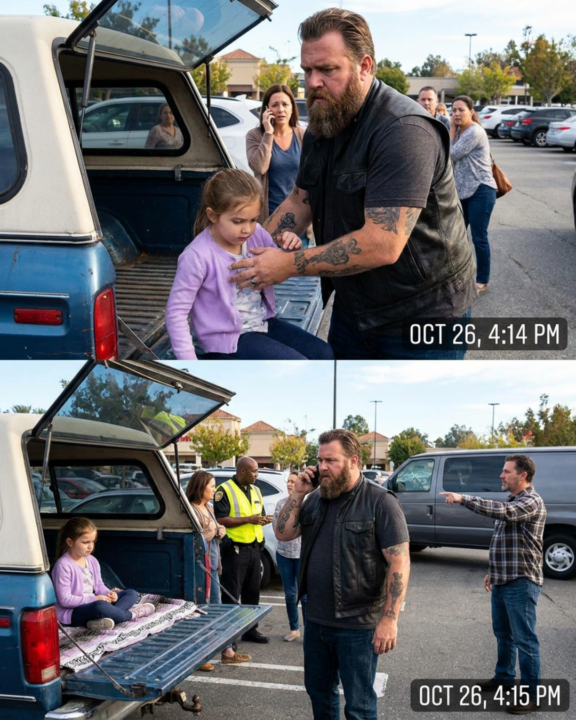
The bed was empty except for folded moving blankets, a secured tool case near the cab, and two bags of donated bedding. A fiberglass camper shell covered it. The rear glass hatch opened upward, independently of the tailgate.
Those details became important later.
At the time, they were ordinary things I barely noticed.
Sarah parked three spaces away. She needed to collect an order from the customer-service desk, so I went inside to buy supplies while she finished shopping with Ruby.
Nothing about the morning felt dangerous.
I remember comparing the price of two brands of paper towels. I remember a man arguing with a self-checkout machine. I remember buying Ruby a pack of purple mechanical pencils because she had complained that sharpeners “eat the good ones.”
Ordinary mornings do not announce what they are about to become.
The gray van appeared in the background of my memory only afterward. I saw it near the outer row when I arrived. I saw it again closer to Sarah’s vehicle when I returned.
I did not watch it for twenty minutes.
The cameras did.
Investigators later reconstructed its movements from the store lot and adjoining businesses. The van had entered before Sarah finished shopping, changed positions twice, and remained where the occupants could see the pedestrian exit.
A vehicle moving around a parking lot proves very little by itself.
People wait for relatives.
Drivers search for shade.
Workers eat lunch between jobs.
It was the later behavior that gave those movements meaning.
I was standing beside my open tailgate when Sarah and Ruby reached their car. Sarah placed two grocery bags inside and turned to move the cart.
Ruby stood between her mother’s rear bumper and my pickup, close enough to ask about the bedding.
“What happens if the people don’t like the blankets?”
“They get to choose other ones.”
“Even after you give them?”
“Especially after.”
She considered that.
Then a man approached from the next row.
He wore a ball cap and a gray work jacket. I did not recognize him, and Ruby did not behave as though she did.
He spoke quietly.
Sarah looked up.
Her whole body changed.
She moved toward Ruby, placing the cart between the child and the approaching man.
“No,” she said.
The man kept coming.
Another man remained near the van.
Sarah raised her voice.
“You need to leave.”
The first man said something about collecting Ruby for her father.
I could not hear every word.
I heard enough to know Sarah had not agreed.
I stepped away from the tailgate.
“Everything all right?”
The man looked at me.
“Private business.”
Sarah said, “It isn’t. Call police.”
That was the point at which ambiguity narrowed.
The man moved the shopping cart aside. Its front wheel caught against Sarah’s ankle, forcing her to step backward.
Ruby backed toward my truck.
He reached for her wrist.
She pulled away.
There was no time for me to interview anyone, inspect court documents, or find out whether the man beside the van had another explanation.
I had a child within reach, an adult trying to take hold of her, and her mother asking for police.
I moved.
Part 3
People remember the tailgate because it was loud.
They do not remember the small sound Ruby made when the man reached for her.
I do.
It was not a scream.
It was a sharp intake of breath, followed by “Mom,” said once in a voice too small for the space around us.
I placed myself between her and the man.
He stepped around me.
I turned with him.
“Back up.”
He told me to get out of the way.
Sarah tried to come around the cart, but another vehicle had stopped in the lane, and the cart sat diagonally between its bumper and her open car door.
For a few seconds, everything narrowed into obstacles.
The store doors were too far away.
The cab of my pickup was locked.
The man was already moving.
The open bed was at my shoulder.
I lifted Ruby beneath her arms, set her near the rear edge on a blanket, and brought the tailgate up.
The rear hatch remained raised.
I never pulled it closed over her.
I braced one hand against its frame, keeping the opening clear, and stood where the man could not reach her without coming through me.
I wanted distance, not a hiding place that became another danger.
Ruby crouched instinctively.
“I want Mom.”
“She’s right there.”
“I can’t see.”
“I know. Just a moment.”
I wanted to say something better.
There was nothing better available.
The approaching man looked over my shoulder.
“You just put a kid in a truck.”
“Yes. Police are coming.”
“You’re going to regret that.”
“Stand back.”
I did not hit him.
I did not reach for the tools secured near the front of the bed.
I had spent enough years around angry men to know how quickly one raised hand could change everyone’s attention. If I started fighting, Ruby would be behind a truck beside a fight.
That was not protection.
I called 911.
Behind me, somebody shouted that I was abducting a child.
I turned far enough to see a woman near the cart corral holding her phone. She looked terrified.
Good.
A terrified witness who calls police is useful.
A terrified witness who decides to attack can become another problem.
“Tell them blue pickup,” I called. “Tell them I’m staying here.”
She repeated it.
The man in the gray jacket backed several steps.
Near the van, the driver had come partly into view, but its open door and another parked vehicle blocked most of his face.
He called, “Bring her over.”
Sarah heard him.
She stopped struggling with the cart for a second, then began shouting louder.
“No. No, you do not get to do this.”
A customer approached my truck, angry enough that I expected him to grab my arm.
“Open it.”
“The hatch is open. Come here.”
He moved to the rear and saw Ruby.
Then he saw my phone.
Then he heard Sarah calling her daughter’s name.
“Help her get here,” I told him.
He did.
He pulled the cart clear and guided Sarah around the stopped car. I watched the gray-jacketed man shift toward them.
The customer noticed too.
He planted himself in the lane.
“Stay there,” he said.
A security employee named Denise Harper arrived at a fast walk. She had heard two conflicting reports over her radio: a biker taking a child, and a mother asking for help because two men were trying to take the same child.
She did not pretend the first loud account settled the matter.
“Everybody stop moving,” she said.
Sarah reached the truck.
I lowered the tailgate.
Ruby scrambled toward her so quickly that I had to steady her at the waist to prevent a fall. Sarah took her, stepped back, and pressed her face against the child’s hair.
The time between placing Ruby in the bed and helping her out was less than thirty seconds, according to the video.
I would not have guessed that.
Inside the moment, it had felt long enough for an entire life to become different.
Denise positioned Sarah and Ruby behind the delivery customer, away from the two men. She radioed for another employee and asked dispatch to direct police to the rear of our row.
The men returned toward the van.
I gave Denise the plate number aloud.
The driver shouted that it was a family disagreement.
Sarah said, “There is a court order.”
The man in the gray jacket reached for the passenger door.
Denise told him officers needed to speak with everyone.
He ignored her.
I did not chase him.
I remained beside Sarah because one stopped child did not mean the danger was finished.
The first patrol vehicle entered the lot about four minutes after the earliest emergency call. Another arrived from the opposite entrance.
An officer approached me with his hand near his equipment.
I raised both hands.
“The child is with her mother. I put her in the open bed for a few seconds. The two men are at the gray van.”
He told me to step away from the truck.
I did.
For several minutes, police treated all of us as people whose claims required checking.
That included me.
An officer inspected the pickup, spoke to Ruby with her mother present, and asked whether the camper hatch had been closed.
“No,” Ruby said. “But I thought it might.”
Those words were the first consequence I had not anticipated.
I had prevented a hand from reaching her.
I had also given her something new to fear.
Then the driver stepped out of the van.
Sarah saw him clearly.
She looked at the officer beside her.
“That’s Nathan,” she said. “That’s her father.”
Part 4
I had expected Sarah to say the driver was a stranger she recognized from somewhere else.
A customer.
A neighbor.
A man who had followed her before.
When she said he was Ruby’s father, several witnesses visibly reconsidered everything.
One lowered his phone.
Another asked whether this was “just custody.”
That word—just—made Sarah close her eyes.
The officer beside her did not dismiss the concern.
He asked for the order.
Sarah’s copy was stored on her phone. She also kept a folded paper version in the glove compartment, worn soft along the creases.
Nathan Cole had once been married to her.
The marriage ended two years earlier after incidents that led to criminal proceedings and a protective order. Ruby remained with Sarah. Nathan’s contact was restricted under separate family-court orders.
There was no scheduled pickup that afternoon.
There was no agreement allowing another man to collect Ruby.
Nathan nevertheless told police he had come to exercise his rights as a father.
The officer listened, checked identification, and contacted dispatch to verify the orders.
Nathan pointed at me.
“That man put my daughter in a box.”
The pickup was behind the officer, its hatch raised and tailgate down.
I said nothing.
My explanation had already been recorded.
Repeating it louder would not make it more reliable.
Sarah held Ruby against her and told the officer Nathan had not been authorized to approach them.
The man in the gray jacket claimed he had been asked to provide a ride.
That was his first version.
Later, he said he believed he was assisting with a legal pickup.
Later still, his attorney negotiated around evidence that made both descriptions difficult to maintain.
At the scene, police did not know all of that.
They had a verified order, Sarah’s account, my observations, multiple emergency calls, and the beginning of a camera review.
That was enough to separate the men and investigate further.
Officers also found a tarp covering part of the van’s rear floor.
The tarp became the detail everybody repeated.
I wish it hadn’t.
A tarp in a work van is ordinary. So are ropes, gloves, blankets, and tools. None of those things independently tells you what a person intends.
The tarp did not prove the case.
The communications did.
So did the coordinated movements caught on camera, the attempt to take hold of Ruby despite her mother’s refusal, and the false explanations that changed as officers verified them.
I learned those details later.
I did not stand beside the van while police conducted searches, and I did not see evidence appear in a magical instant that settled everything.
Sarah and Ruby went with an officer to a quieter room inside the store. I remained outside until another officer finished taking my initial account.
A paramedic checked Ruby.
She had no serious physical injury.
Her mother kept asking whether that meant she was all right.
The paramedic answered carefully.
“It means we aren’t finding a medical emergency right now.”
Not every injury can be identified in a parking lot.
I drove to the station later that afternoon to provide a formal statement. Sarah was there with a victim advocate. Ruby sat beside her grandmother, drawing on a sheet of paper that had a cartoon police car printed in one corner.
When she saw me, she pulled her knees onto the chair.
I stopped at the doorway.
I had expected gratitude because I was still thinking like an adult who knew what I intended.
Ruby remembered being lifted.
She remembered metal closing behind her.
She remembered not seeing her mother.
Her response made sense.
I sat down far away and waited until the officer called me.
The interview took nearly two hours.
They asked which man spoke first, where Sarah stood, whether I heard the father’s voice, how the tailgate moved, whether Ruby resisted being lifted, and why I had not simply taken her toward the store.
I answered without improving my choices.
The truth was not that I found a perfect solution.
I found a temporary barrier in a frightening second.
The officer explained that my conduct would be reviewed along with everyone else’s. Immediate protective intent mattered, but so did what witnesses and video showed.
I signed the statement.
Outside, our club president was waiting beside his motorcycle.
He asked whether I needed a ride.
I said I had my pickup.
He looked toward it.
“You want to drive that right now?”
I didn’t.
For the first time since the parking lot, I realized my hands were still shaking.
Part 5
Nathan had hired the second man, Curtis Webb, to help him take Ruby.
That fact did not become public until investigators had recovered and examined communications through proper legal process.
There was no need for me to invent his intentions.
His own messages supplied them.
He discussed collecting Ruby without Sarah’s consent, keeping her away from Sarah, and leaving before anyone could intervene. Curtis knew there was a dispute and knew Sarah would refuse.
He participated anyway.
Store footage showed Curtis approaching Ruby while Nathan remained near the van. It showed Sarah objecting, the shopping cart moving across her path, and Curtis continuing after Ruby pulled away.
The recordings from three witnesses showed the next part.
My pickup.
The closing tailgate.
The open hatch visible from another angle.
The calls for police.
Taken together, the videos told a more complete story than any single clip.
That did not stop a partial version from reaching social media first.
For two days, strangers circulated twelve seconds of me lifting Ruby into the truck and standing beside it. The caption called me a child abductor.
Some people identified my repair shop.
Others shared photographs of our club’s charity rides as if leather vests explained a criminal motive.
I wanted to publish the rest.
Our lawyer told me not to.
The family’s advocate asked the same.
A complete defense of me would require exposing details about Ruby, Sarah, the court order, and an active investigation. Winning an argument online could make their lives harder.
The Mill Creek Riders held a meeting that Sunday.
Some members wanted a public response.
One wanted to ride past Nathan’s house.
Our president, Ruth, stopped that idea before I had to.
“We are not adding another threat to a child’s week.”
There was an angry silence.
Then somebody asked what we could do.
Sarah’s advocate had a list.
Meals.
Transportation.
Help with work shifts.
Contributions to professional support through an established organization.
No photographs.
No surprise visits.
No posts identifying the family’s location.
Brotherhood became restraint.
That was harder for some of us than offering to fight.
Sarah accepted grocery deliveries arranged through the advocate. She declined an offer to have club members watch her apartment.
She had already spent years being watched by someone who claimed it was for her own good.
I understood.
Police and the family court handled safety planning. With professional assistance, Sarah and Ruby moved, adjusted routines, and protected their new address where applicable.
I did not learn the location.
I did not need to.
The criminal case lasted months.
Nathan’s status as Ruby’s biological father did not excuse violating the orders or planning to take her through force and deception. Curtis’s claim that he had misunderstood the arrangement weakened when investigators matched his communications to the store footage.
Both cases proceeded.
Nathan was eventually convicted of offenses connected to the attempted abduction and violation of the protective order. Curtis also faced consequences for his participation.
I testified about what I saw.
Not about what I imagined might have happened inside the van.
The prosecutor did not ask the jury to decide the case from the tarp.
She used verified orders, recordings, communications, and conduct.
That distinction mattered to me.
Fear can make almost any ordinary object look sinister. Evidence is what tells a court which fear is supported.
When the proceedings ended, reporters wanted a reunion photograph.
The huge biker.
The little girl.
The mother.
A neat ending.
Sarah said no.
I said no too.
Ruby had already been looked at by too many strangers.
A week later, Sarah called me.
For a moment, I thought she wanted to tell me the case was over.
Instead, she said Ruby had stopped riding in elevators, refused to enter the school’s small reading tent, and cried whenever a car door closed before her mother finished fastening the seat belt.
“She knows you were trying to help,” Sarah said.
I sat in my office looking at the pickup through the window.
“That doesn’t make it stop feeling bad.”
“No.”
“Does she want me to stay away?”
“For now.”
The words hurt.
I thanked her for saying them plainly.
Then I kept my distance.
That was the first thing I could do for Ruby that did not involve deciding for her.
Part 6
For almost a year, I knew about Ruby only through updates Sarah chose to share.
She was working with a qualified child therapist. Her school coordinated with her mother. People around her learned not to force cheerful explanations onto frightening memories.
Nobody told her she should be grateful enough to stop being afraid.
Nobody used my intentions as evidence against her feelings.
At the garage, I removed the camper shell from the pickup.
I told myself it was because the seals leaked.
They did.
That was not the whole reason.
The space beneath it had become impossible for me to see as ordinary storage. Every time I opened the rear hatch, I heard Ruby say, “I thought it might.”
I put the shell in a locked storage building, away from visiting children, and continued using the truck with its bed open.
A few club members suggested building Ruby a decorated version of the compartment—a little clubhouse with cushions, lights, and toys—to help her reclaim the memory.
I understood the kindness behind the idea.
Sarah declined.
Her therapist had explained that recovery should not be turned into a surprise challenge designed by adults. Ruby did not need to climb back into anything to prove she was improving.
We stopped planning.
Months later, Sarah called again.
Ruby had begun drawing places with no doors.
Gardens.
Porches.
Open shops.
A library where every shelf was shorter than she was.
She wanted a place for her books and art supplies.
Not a secret room.
Not a hiding box.
A place she could leave without asking.
Sarah asked whether the club knew anyone who built children’s furniture.
Ruth looked around our workshop when I repeated the question.
Six woodworkers.
Two cabinetmakers.
An upholsterer.
A retired elementary-school librarian.
“We may have somebody,” she said.
This time, we did not build first.
We sent drawings through Sarah.
Ruby returned them with corrections.
Lower shelves.
No curtain.
No lid.
Purple cushion.
A lamp she could reach.
She crossed out one decorative arch because it made the entrance “look like a mouth.”
We removed it.
The finished piece was not a vehicle compartment. It was a low, open-front reading bench with side shelves, a secured reading light, and a wide cushion. There was no closing panel and no space intended to contain a child.
Some sound pine from an old storage unit went into it. Nothing from the pickup’s enclosure did.
Ruby had not asked for the object that frightened her.
She had asked us to listen to the object she wanted.
Delivery was arranged through Sarah, without a convoy or a camera.
I did not attend.
Ruth and another member left it where Sarah directed, assembled the wall anchors, and went away before Ruby returned from school.
That evening, a photograph arrived.
It showed the furniture, books lined along the lower shelf, and a purple pencil resting on the cushion.
No child.
No address.
No details a stranger could use.
Sarah’s message said:
She put her backpack beside it, not inside it.
I stared at those words for a long time.
The next week, Ruby sent a note.
It was written in uneven capitals on paper decorated with three stars.
THANK YOU FOR NOT MAKING A DOOR.
I kept it in the drawer where I used to store spare keys.
Part 7
Ruby saw me again fourteen months after the parking lot.
It happened at a small family picnic organized through the charity Sarah volunteered with. Attendance was limited, photographs were prohibited without permission, and the venue was not publicly posted.
Sarah told me beforehand that Ruby knew I would be there.
She also told me not to approach.
So I sat beneath an oak tree with a paper plate of food cooling on my knee.
I wore a plain work shirt instead of my leather vest.
That was not an attempt to disguise myself.
I wanted the afternoon to belong to the families, not to the man everybody remembered from a video.
Ruby arrived with her mother and grandmother. She had grown taller. Her hair was shorter. She carried a purple sketchbook against her chest.
She saw me.
Then she looked away.
I kept eating.
Several minutes later, she walked toward the tree with Sarah beside her.
I put down the plate.
“Hi, Ruby.”
“Hi, Mr. Jack.”
No hug.
No dramatic forgiveness.
She asked whether my pickup still had a roof over the back.
“No.”
“Did you take it off?”
“Yes.”
“Because of me?”
“Because I didn’t need it anymore.”
She studied me with the seriousness children reserve for answers they suspect are partly true.
Then she opened her sketchbook.
Inside was a drawing of her reading bench.
She had added plants, two cats she did not actually own, and a sign over the shelves.
RUBY’S PLACE.
“It isn’t a hiding place,” she said.
“I can see that.”
“People can see me.”
“Yes.”
“And I can go.”
“Whenever you want.”
She closed the book.
For a moment, I thought she was finished.
Then she asked the question I had carried since the station.
“Were you scared too?”
“Yes.”
“Of those men?”
“Yes.”
“Were you scared of the police?”
“A little. They needed to find out what happened.”
She nodded.
“I was scared of everybody.”
I could not fix that sentence.
I did not try.
“I’m sorry you had to be.”
Sarah placed a hand lightly against Ruby’s shoulder, then let it fall when the girl moved.
Ruby pointed toward a table where other children were painting flowerpots.
“I’m going over there.”
“All right.”
She took three steps, stopped, and turned.
“Can you watch my book?”
I looked at the purple sketchbook in my hands.
“Of course.”
Then she left.
That was the closest thing to forgiveness I needed.
Not permission to hold her.
Not proof that she no longer remembered the parking lot.
A small thing entrusted to me while she went somewhere she wanted to go.
Later, Sarah sat beneath the tree.
“She still has bad days,” she said.
“I figured.”
“She might have them for a long time.”
“I know.”
Across the lawn, Ruby laughed because somebody painted a flowerpot completely purple and claimed it was a rare species of plant.
I had once thought the story ended when police arrived.
Then I thought it ended when Nathan was convicted.
Then I thought a handmade gift might supply an ending kind enough to live with.
I was wrong each time.
Ruby was not an ending.
She was a child whose life kept going.
Sometimes that meant fear.
Sometimes counseling.
Sometimes a reading bench with no door.
And sometimes it meant leaving a sketchbook with a big man under a tree because she wanted both hands free to paint.
When she returned, she did not ask whether I had kept it safe.
She already knew.
She took it, tucked it beneath her arm, and ran back toward her mother.
This time, she chose where to go.
Follow the page for more biker stories about difficult choices, quiet loyalty, and the kind of protection that keeps listening after the immediate danger has passed.