Part 2: A Little Girl Was Kicked Out of Her Friend’s Birthday Party — Then a Biker Walked Her Outside
Part 2
My name is Rachel Monroe, and before that afternoon, I would have told you birthday parties were harmless things. Loud, expensive, exhausting, maybe full of too much sugar and too many adults pretending not to compete, but harmless.
I do not believe that anymore.
Sometimes a birthday party is where a child first learns whether the world thinks she belongs.
Mia had arrived alone because her grandmother’s bus ran late and the house was only three blocks from their apartment. Her grandmother had called Mrs. Whitman that morning, explaining she would walk over as soon as she could, but Mia had begged not to be late because she had spent two nights making the gift.
That detail mattered later.
At the time, nobody cared.
The children were already running between a bounce house and a folding table covered in pink plates. The cake had three tiers. The gift table looked like a small department store, stacked with shiny bags, ribbon curls, and boxes big enough to make a seven-year-old feel poor before she even sat down.
Mia stood there with her grocery bag held in both hands.
The birthday girl, Sophie Whitman, saw her first.
“Mia!” she shouted, running toward her in a blue party dress with glitter on the skirt.
That should have ended any confusion.
But Mrs. Whitman moved faster.
She placed one manicured hand on Sophie’s shoulder and said, “Honey, go play. Mommy will handle this.”
Handle this.
Those words still bother me.
As if Mia were a spill on the patio.
The biker near the fence was named Wade Mercer, though his leather patch said Preacher. He was Sophie’s great-uncle by marriage, the kind of relative invited out of obligation and then placed near the edge of the yard because nobody knew what to do with him.
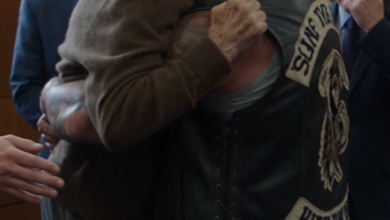
He looked out of place among the balloon arch and pastel cupcakes. His black Harley sat at the curb like a storm cloud beside a row of SUVs. His vest was worn, his beard was gray, and his hands looked too rough for paper plates.
Most parents avoided him.
Children did not.
Children are often better at reading the room than adults who think manners are the same as goodness.
Earlier, I had seen Preacher kneel to tie a little boy’s shoe near the sidewalk. The boy’s mother looked nervous until Preacher stood and backed away without expecting thanks.
That small moment should have told us something.
Still, when he guided Mia out of the yard, suspicion moved through the parents like wind through dry leaves.
“Who is that man?” someone whispered.
“Is he with her?”
“Should we stop him?”
Nobody stopped Mrs. Whitman when she hurt the child.
That is another thing I remember.
But the second a biker tried to spare Mia from being humiliated in front of thirty people, everyone suddenly discovered concern.
Part 3
The false climax happened on the sidewalk, where Mia stood under the shade of a live oak tree, crying so quietly it was worse than sobbing.
Preacher stayed a few feet away from her, hands open, careful not to crowd her. For a man that large, he knew how to make himself smaller. That is not something people learn by accident.
“You got somebody coming?” he asked.
Mia nodded.
“My Nana.”
“She know you’re here?”
Another nod.
“She said Mrs. Whitman knew.”
Preacher looked back toward the yard.
Mrs. Whitman had returned to the patio, laughing too brightly with two other mothers. Sophie stood near the cake table, confused and upset, watching Mia through the fence.
The party music kept playing.
That felt cruel somehow.
Mia wiped her face with the back of her hand and looked down at the grocery bag.
“I made her a present,” she said.
Preacher lowered himself onto one knee, slow enough that she could step away if she wanted.
“What kind?”
Mia opened the bag.
Inside was not a cheap toy.
It was a handmade storybook, folded from construction paper and tied with purple yarn. The cover said Sophie and the Moon Garden in careful child handwriting. Each page had drawings of two girls planting flowers on the moon, sharing sandwiches with stars, and finding a lost dog made of clouds.
On the last page, Mia had drawn herself and Sophie holding hands under a yellow moon.
Underneath, she had written: Best friends are invited everywhere.
Preacher looked at the page for a long time.
His face did not soften the way people expect in movies. It tightened first, like tenderness had to pass through anger before it reached the surface.
“That’s a fine gift,” he said.
Mia whispered, “She said I’m not invited.”
“She was wrong.”
“She’s the mom.”
Preacher looked at the house again.
“Adults can be wrong louder than kids.”
That was when Mr. Whitman came down the driveway.
He was a white American man around forty-two, wearing a polo shirt and holding barbecue tongs, trying to look calm but embarrassed by the scene spreading toward the street.
“Sir,” he said, “I’m going to need you to step away from the child.”
Preacher stood slowly.
Every parent in the yard looked over.
Mia stepped behind him without thinking.
That made everything worse.
Mr. Whitman’s face changed.
Mrs. Whitman came to the gate, voice sharp now.
“Is he bothering you, Mia?”
The little girl clutched the storybook to her chest.
Nobody waited for her answer.
That was how adults had treated her all afternoon.
Preacher did not move toward anyone.
He simply said, “Maybe ask your daughter who invited her.”
Sophie heard that.
And Sophie ran.
Part 4
The twist arrived in the form of a crumpled invitation tucked inside Mia’s grocery bag.
Sophie pushed past her mother at the gate and ran straight to Mia.
“She is invited,” Sophie cried. “I gave it to her at school.”
Mrs. Whitman’s smile vanished completely now.
“Sophie, we talked about this.”
That sentence changed everything.
Not for the children.
For the adults.
Because it told us this was not a misunderstanding.
It had been decided before Mia ever arrived.
Sophie’s face flushed red.
“You said she could come if her grandma brought her.”
Mrs. Whitman glanced at the parents watching from the patio, then lowered her voice too late.
“I said maybe.”
Mia’s hands shook as she reached into the grocery bag and pulled out a folded pink invitation. It had Sophie’s name printed at the top, the date, the address, and a crooked heart drawn beside Mia’s name.
Sophie had written it herself.
Best friend seat saved.
The words sat there on the paper like evidence.
Mr. Whitman looked at his wife.
“Claire.”
She stiffened.
“Don’t start with me in front of everyone.”
Preacher looked down at Mia.
“You want to stay?”
That question mattered.
He did not say, “You’re staying.”
He did not force justice on a child who had already been forced into humiliation.
Mia looked at the backyard.
The cake.
The balloons.
The children staring.
Then she looked at Sophie, whose eyes were full of tears and apology.
“I don’t want to go in if her mom doesn’t want me,” Mia said.
The sentence was soft, but it hit the yard harder than shouting.
Mrs. Whitman looked away.
That was when a woman’s voice came from the sidewalk behind us.
“She was wanted when she was helping your daughter read.”
Everyone turned.
Mia’s grandmother had arrived, breathing hard from walking too fast. Her name was Gloria Carter, a Black American woman around sixty-five, wearing a dark raincoat though the sky was clear, with silver hair tucked under a scarf and grocery bags in one hand.
She looked at Mrs. Whitman with a steadiness that made every polished decoration feel foolish.
“Your daughter has been sitting with my Mia at lunch for three months,” Gloria said. “My granddaughter sounded out words with her every Tuesday because Sophie was afraid the other children would laugh.”
Sophie looked down.
Mrs. Whitman’s face went pale.
That was the second twist.
Mia was not the charity guest.
She was the friend who had been quietly helping the birthday girl feel less alone.
Part 5
Once Gloria arrived, the party stopped pretending it was a party.
The bounce house still hummed. The balloons still moved in the breeze. Somewhere near the patio, a speaker kept playing a cheerful song about sunshine, which made the whole scene feel even more uncomfortable.
Mrs. Whitman tried to recover her authority.
“I didn’t know that,” she said.
Gloria did not blink.
“You didn’t ask.”
Those three words did more than any speech could have done.
Mr. Whitman stepped through the gate and crouched near Mia.
“I’m sorry,” he said. “You were invited. You should have been welcomed.”
Mia held the storybook tight.
She did not answer.
That was fair.
Adults love apologies because they want the wound to close on their schedule. Children do not owe us that.
Preacher stood beside Gloria now, not in front of her. That detail stayed with me. He knew when to shield and when to step aside.
Mrs. Whitman finally looked at Mia.
“I thought—”
Preacher’s voice cut in, low but not loud.
“No.”
Everyone turned toward him.
He did not insult her. He did not threaten her. He did not do the thing people expected a man like him to do.
He simply looked at Mia’s small hands around the handmade book and said, “Don’t make that child carry what you thought.”
Mrs. Whitman’s mouth closed.
Sophie walked to Mia and held out her hand.
“You can sit by me if you want,” she whispered. “Or we can go somewhere else.”
That was the best thing anyone had said all afternoon.
Mia looked at her grandmother.
Gloria nodded.
“Your choice, baby.”
Mia looked at Preacher.
He nodded too.
“Your road,” he said.
For some reason, that made Mia smile a little.
She did not go back into the backyard right away.
Instead, Sophie dragged two folding chairs to the front yard under the live oak tree. Gloria sat in one. Mia sat in the other. Sophie sat on the grass between them and opened the handmade storybook like it was treasure.
One by one, other children came over.
Not because adults told them to.
Because children know when something real is happening.
They gathered around Mia, asking to see the moon garden, the cloud dog, the stars with sandwiches. The birthday party slowly moved from the perfect backyard to the imperfect front lawn.
Mrs. Whitman watched from the gate.
Not angry anymore.
Lost.
Sometimes shame looks like someone realizing the room kept living after they lost control of it.
Preacher walked to his Harley parked at the curb and took something from the saddlebag.
A small wrapped box.
He handed it to Sophie.
“Almost forgot,” he said.
Sophie opened it carefully.
Inside was an old silver bookmark shaped like a feather.
“It was my wife’s,” Preacher said. “She liked books better than people most days.”
Sophie looked up.
“Can Mia use it first?”
Preacher’s face changed.
Barely.
“That’d be right.”
And just like that, the real birthday began.
Part 6
Later, I learned why Preacher had moved so quickly when Mia started crying.
His wife, Ellen, had been a school librarian for thirty-one years. She kept extra snacks in her desk, extra socks in winter, and a drawer full of birthday cards for children whose parents forgot or could not afford to remember.
Preacher told Gloria this while the children read under the tree.
He did not say it like a confession.
He said it like a fact that still hurt to touch.
“Ellen used to say kids know exclusion before they know spelling,” he said.
Gloria looked toward Mia.
“She was right.”
Preacher’s jaw tightened.
“She usually was.”
Ellen had died three years earlier, and since then Preacher had still carried small things she once believed mattered: bookmarks, pencils, granola bars, and little notebooks he gave away when a child looked like they needed somewhere to put their thoughts.
That was the third twist.
The biker at the edge of the party had not been some random intimidating relative.
He was a widower still carrying his wife’s quiet mission in the pockets of a leather vest.
When Mrs. Whitman finally walked to the front yard, she did not bring a speech. That was good. A speech would have made it about her.
She brought a slice of cake on a paper plate and placed it on the grass near Mia.
“I was wrong,” she said.
Mia looked at the cake.
Then at Sophie.
Then at Gloria.
Finally, she looked at Mrs. Whitman.
“You hurt my feelings.”
Mrs. Whitman nodded.
“I did.”
No excuse.
No “but.”
Just the truth.
That was the first useful thing she had offered.
Mia accepted the plate, but she did not smile for her. That was also fair.
A little later, the children sang happy birthday in the front yard instead of the backyard. Sophie sat beside Mia, holding the handmade book open on her lap. When she blew out the candles, she wished out loud, even though every adult told her not to.
“I wish nobody gets uninvited after they come.”
Nobody laughed.
Even Mrs. Whitman lowered her head.
Preacher stood by his Harley, arms folded, looking too rough for the sweetness of the moment. But when the children clapped, he clapped too, slowly, with tattooed hands that sounded heavy and careful.
Before Gloria took Mia home, Preacher walked over and handed the little girl a small blank notebook.
“For the next moon garden,” he said.
Mia hugged it to her chest.
“Are you a writer?”
Preacher almost smiled.
“No. I just know one when I see one.”
That line stayed with me longer than anything else.
Because he did not tell her she was brave.
He told her she was something.
There is a difference.
Part 7
Two weeks later, Sophie brought the handmade book to school for show-and-tell.
According to my niece, she stood in front of the class and said, “My best friend made this, and my mom made a mistake, but we fixed the party.”
Children are honest in a way adults spend years trying to survive.
Mia and Sophie still eat lunch together.
Gloria told me Mia writes stories now in the notebook Preacher gave her. Most of them have moon gardens, lost dogs, brave grandmothers, and one giant man on a motorcycle who never says much but always knows where to stand.
Mrs. Whitman changed too, though not in a dramatic way. She began volunteering in the school library once a month, badly at first, then better. Gloria says she still has much to learn, but learning is better than performing kindness for other parents.
As for Preacher, he still rides that old Harley through the Dallas suburbs with Ellen’s silver bookmark tucked inside his vest. He looks like trouble at every stoplight. Children wave anyway.
The last time I saw him, Mia ran across the school sidewalk and held up a new drawing.
It showed a biker standing outside a fence, not blocking the gate, just opening it.
Preacher studied it for a long moment, then tapped two fingers to his heart.
Mia smiled like she had been understood.
That day, a little girl was led out of a birthday party.
But she was not taken away from belonging.
She was led back to it.
Follow the page for more stories about the people we almost judged before we finally saw them.