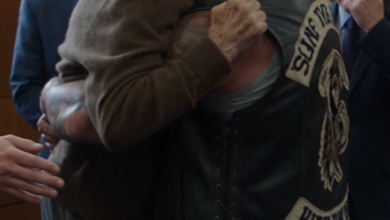
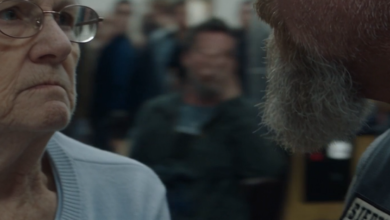
Part 2: A Biker Grabbed His Grandmother’s Walker and Threw It Down the Nursing-Home Stairs — Then the Broken Metal Exposed Why Dozens of Residents Had Been Falling
Part 2 — The Man Behind the Leather
My name is Mara Bell, and before the day Eli Mercer broke that walker, I had learned to distrust two kinds of silence.
The first came from residents who were too frightened to complain.
The second came from employees who understood exactly what a complaint would cost them.
I had taken the job at Cedar Glen because the schedule allowed me to raise Sophie without leaving her alone every evening. The building looked respectable from Valley Pike: red brick, white columns, trimmed hedges, and a flag that was replaced before its edges began to fray.
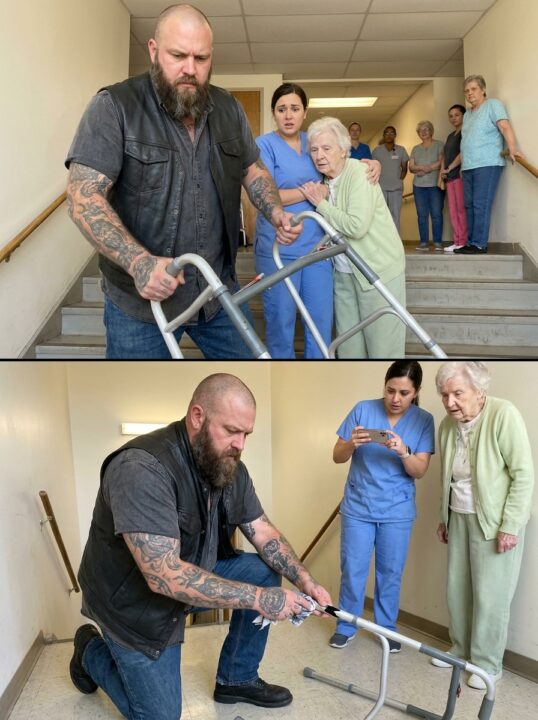
Inside, fresh flowers stood on the reception desk.
Behind the locked service door, we reused disposable gait belts.
My orientation lasted four shifts. Linda Carver showed me how to chart meals, medications, skin checks, transfers, and falls. She also taught me an unwritten rule.
“If you describe every uncertainty,” she said, “you create liability where none exists.”
At the time, I thought she meant that nervous new nurses wrote too much.
Later, I understood she meant the truth could be made inconvenient simply by recording it.
Ruth Mercer lived in Room 214. She was eighty-two, widowed, and small enough that her green cardigan seemed to hang from her shoulders. Her white hair curled naturally around her ears, and she wore pale pink lipstick even on mornings when arthritis kept her from fastening her own shoes.
She had spent forty-one years keeping payroll for a tool-and-die company.
Numbers stayed with her.
So did sounds.
She knew which medicine cart had a loose wheel, which elevator door closed half a second too fast, and which aide wore rubber soles instead of foam ones. When Ruth said the rear leg of her walker clicked, I believed she had heard something.
I simply did not know what to do with that belief.
Eli did.
He had been eleven when Ruth took him in. His father—Ruth’s only son—had disappeared into methamphetamine, short jail sentences, and promises that always arrived before another absence. Eli’s mother left Ohio when he was six and sent two postcards in thirty years.
Ruth gave him a bed in the sewing room and three rules: attend school, tell the truth before she had to drag it out of him, and never use size to frighten someone smaller.
He broke the first rule often.
The second took years.
The third became the center of him.
At sixteen, Eli stole a pickup and drove it into a drainage ditch. At nineteen, he served eight months for aggravated assault after a bar fight. He did not hide either fact.
“Some scars are warnings,” he once told me. “Some are receipts.”
Ruth visited him every Thursday during those eight months. She rode two buses and walked three blocks in winter because she refused to own a car after her husband died.
Eli never returned to jail.
He learned welding at a vocational shop, then worked twelve years repairing agricultural machinery. By forty, he owned Mercer Frame & Machine in a cinder-block garage beside an abandoned feed store. He repaired motorcycle frames, trailer hitches, mower decks, and anything else made of metal that working people could not afford to replace.
His club, the Black River Riders, met there on Wednesday nights.
They were not outlaws. They were roofers, electricians, truck drivers, a paramedic, two veterans, and one middle-school custodian. Their cuts, engines, tattoos, and rough voices made strangers decide the rest.
Eli did not correct them.
He rode a black Harley Road King with a dented fuel tank he refused to repaint. Ruth had made the first payment on that motorcycle after Eli remained sober for five years.
“You need one thing worth coming home on,” she had told him.
Every Sunday, its V-twin announced his arrival at Cedar Glen before the front desk saw him. He would enter carrying a paper sack from Harlow’s Bakery and a canvas tool roll.
He fixed small things no one had written a work order for.
A loose footrest on Walter Greene’s wheelchair.
A rattling tray beside Lottie Ames’s bed.
The battery cover on Ruth’s radio.
Once, he spent forty minutes smoothing a sharp edge on a metal drawer pull because a resident with poor vision kept cutting her sleeve against it.
Denise Calder disliked those repairs.
She told him unapproved maintenance violated policy.
Eli began asking permission.
The requests were rarely approved.
His club brothers teased him about the butterscotch candies in his saddlebag, but the teasing ended the afternoon they saw him opening each wrapper with a razor blade, then folding it closed so Ruth could reach the candy without pain.
Cal Dorsey—road name Hawk—was Eli’s closest brother. Cal had ridden beside him for seventeen years and worked as a delivery driver for Mid-State Senior Supply, the company that delivered wheelchairs, shower chairs, walkers, mattresses, and transfer equipment to facilities across southwestern Ohio.
That connection meant nothing to me at first.
Later, it meant almost everything.
Cal had delivered equipment to Cedar Glen. His signature appeared on dozens of manifests. Eli trusted him enough to leave his shop keys in Cal’s pocket whenever he went out of town.
Yet on the morning after Ruth’s second fall, Eli called Cal and asked whether Mid-State repaired cracked aluminum walkers.
“Never,” Cal said. “Liability’s too high. Cracked frame gets scrapped.”
“Cedar Glen says hers passed inspection.”
“Then it should be fine.”
Eli heard the answer, but something in Cal’s voice made him ask another question.
“Did you deliver silver two-button walkers there this year?”
Cal paused.
“I deliver hundreds of them, brother.”
It was not a lie.
It was not an answer either.
That evening, Eli visited Ruth and photographed the serial number stamped beneath her walker’s crossbar. He also photographed a cloudy ring around the left rear leg, though the overhead light made the mark difficult to see.
The next morning, that walker disappeared.
Staff told him it had been replaced for routine cleaning. By afternoon, it returned with new rubber tips, wiped handgrips, and a fresh green inspection sticker covering an older yellow one.
Ruth fell again less than twenty-four hours later.
That was the bruise Eli touched on Thursday.
That was why he carried an inspection mirror into Cedar Glen.
And that was why, before he walked through our front door, he sent Cal a photograph of the serial number with six words beneath it.
Tell me where this came from.
Cal did not reply.
Part 3 — The Crash on the Stairs
At 3:08 p.m., the Harley stopped outside Cedar Glen.
At 3:11, Eli found the painted weld.
At 3:14, Denise ordered him to leave.
Three minutes later, the walker went down the stairs.
The crash brought people from both wings. Residents leaned through doorways. A physical therapist ran from the rehabilitation room. Two aides abandoned a linen cart in the corridor.
Security guard Neal Pritchard reached Eli first.
Neal was twenty-six, thin, and frightened enough to mistake instruction for defiance. He grabbed Eli’s right wrist while Eli crouched beside the broken walker.
Eli did not pull away.
“Don’t touch the pieces,” he said.
“You’re coming upstairs.”
“After she photographs this.”
He looked at me.
My phone was already in my hand. I had taken six close-ups before he dropped the walker: the cloudy paint, the fracture line, the inspection stickers, the metal dust on the napkin, Ruth’s bruised wrist, and the serial number.
Now I photographed the broken tube.
The fracture surface told its own story even to someone without mechanical training. A narrow section gleamed where the final strip of metal had separated on impact. Most of the interior was dark gray and rough, with a thin line of white residue near the edge.
Eli pointed without touching.
“Oxidation. That crack’s been open awhile.”
Denise descended three steps, then stopped as if proximity might make her responsible.
“You deliberately destroyed facility property,” she said. “Any damage you see was caused by your actions.”
“Then explain the black metal.”
“I am not discussing this with you.”
“Explain the new sticker.”
Her face changed for less than a second.
I saw it.
So did Ruth.
Denise told Neal to remove Eli from the building. She ordered Linda to take Ruth to her room and instructed me to surrender my phone.
I refused.
It was the smallest word I had spoken all week.
“No.”
Linda stared at me. “Mara, that device may contain protected resident information.”
“It contains evidence of a fall hazard.”
“It contains photographs taken without authorization.”
“Ruth authorized them.”
Ruth’s voice came from the upper landing.
“I still know my own name.”
The hallway went quiet.
Then Walter Greene rolled forward in his wheelchair. Walter had spent thirty-two years driving a city bus and still wore a transit-company cap with the logo faded nearly white. He pointed toward the broken walker.
“My right brake slips,” he said. “Told them twice.”
Lottie Ames raised one hand from her recliner.
“My shower chair rocks.”
Another voice came from behind the linen cart.
“My wheels don’t lock.”
The complaints arrived one at a time, then together.
Denise turned on the residents.
“This is precisely why equipment concerns must be evaluated by qualified personnel, not encouraged through agitation.”
Eli stood.
The leather of his vest creaked. Neal stepped back.
Eli’s hands remained open at his sides.
“They’re not agitated,” he said. “They’re answering.”
Sirens approached from Valley Pike.
Denise seemed relieved until two vehicles entered the driveway: a county sheriff’s cruiser and a gray sedan belonging to the regional long-term-care ombudsman.
Eli had called both before coming inside.
He had not expected the walker to be taken seriously based on his word alone. That was why he wanted witnesses. It was why he asked me to photograph the crack. It was why he chose the concrete service stairwell instead of striking the frame with a tool from his shop.
The drop was crude.
It was also public.
Denise could not carry the pieces away while forty people pretended nothing had happened.
Deputy Sheriff Elena Ruiz came through the stairwell door with her body camera running. Behind her was Samuel Price, the ombudsman, a gray-haired former social worker with a canvas briefcase and the tired eyes of a man who had heard too many families apologize for asking questions.
Neal released Eli.
Denise began speaking first. She described an aggressive visitor, threatened residents, destroyed property, and a staff member who had violated privacy policy.
Ruiz listened.
Then she asked Ruth whether she felt threatened by her grandson.
“No.”
“Did he take the walker without permission?”
“He took it because I asked him to find out why I kept falling.”
Ruth had not spoken those exact words earlier. Yet there was no uncertainty in her voice.
Ruiz looked at the bruises.
“When did these happen?”
“Monday, Tuesday, and this morning.”
Denise interrupted. “Mrs. Mercer has intermittent confusion.”
Ruth turned toward her.
“Your birthday is March ninth. Your office carpet was replaced on May seventeenth. You owe me four dollars from the Christmas raffle.”
Walter laughed once.
Denise did not.
Samuel Price inspected my photographs and asked that no one move the broken frame. Then he requested Ruth’s fall reports, equipment inspection logs, care-plan revisions, and incident-camera footage.
Denise said the security system did not cover resident hallways.
It covered the stairwell.
She claimed the camera had been offline for maintenance.
Deputy Ruiz looked up.
A small red light blinked above us.
Denise said blinking did not mean recording.
The first lie had become visible.
The second arrived in Ruth’s chart.
Her three falls were documented, but only one report mentioned the walker. That entry had been amended fifteen minutes after Eli entered the building. The original note, written by a night aide named Tessa, stated:
Resident reported rear leg collapsed during transfer. Visible movement observed at left support. Supervisor notified.
The amended version read:
Resident demonstrated poor safety awareness and failed to follow transfer instructions. Equipment checked; no defect found.
Tessa was not scheduled that day.
Linda’s login had made the change.
When Samuel asked Linda who had inspected the walker, she pointed to the green sticker and read the initials aloud.
J.B.
Jim Barlow, Cedar Glen’s maintenance director.
Jim had called in sick.
Denise said he was recovering from influenza.
Ruiz called him.
A phone began ringing behind the locked basement door.
Nobody moved.
It rang again.
Then stopped.
Neal admitted Jim had arrived at work before dawn and gone downstairs shortly after Eli called about Ruth’s third fall.
Denise ordered Neal to be quiet.
That order made him talk faster.
Jim was still in the building.
Deputy Ruiz requested the basement key. Denise said only maintenance possessed one.
Eli reached into his vest and removed neither a weapon nor a lock pick, as two aides later claimed.
He removed the broken walker’s plastic identification clip.
Inside it was a tiny inventory label with a storage designation.
B-17.
Ruth’s walker had come from the basement.
Samuel Price told Denise to open the door.
She refused.
Ruiz called for a warrant and additional deputies. In the meantime, she sealed the stairwell, collected my phone as evidence with my consent, and asked Eli whether he intended to file charges.
“Against who?”
“That’s what we’re determining.”
Eli looked upstairs at Ruth.
“I want her falls recorded right.”
It was an unexpectedly small demand.
Denise mistook it for weakness.
She told him Cedar Glen would correct the records as a courtesy if he withdrew his allegations, accepted a replacement walker, and left the property without further disruption.
Samuel Price stared at her.
Deputy Ruiz stopped writing.
Eli’s jaw tightened, but his voice remained level.
“Three falls aren’t a typo.”
Denise lowered her voice.
“Your grandmother could lose her placement if her family creates an unsafe environment.”
That was the threat Ruth had feared. If classified as behaviorally difficult or cognitively unstable, she could be transferred upstairs, where doors remained locked and residents had less freedom.
Eli took one step toward Denise.
Neal reached for his radio again.
Then twelve Harley engines entered the driveway.
The glass doors trembled. Conversations stopped. Denise looked toward the lobby and went pale as black motorcycles formed a line beside the visitor parking spaces.
The Black River Riders had arrived.
Eli had not called them.
Cal had.
Part 4 — The Basement
For a few seconds, everyone believed the bikers had come to fight.
I did too.
The men entering Cedar Glen looked like a fear assembled from familiar pieces: leather cuts, broad shoulders, gray beards, tattooed arms, heavy boots, chains against denim, and expressions that did not ask permission.
At their center walked Cal “Hawk” Dorsey.
He was fifty-four, leaner than Eli, with a braided beard and a faded burn scar along his neck. He carried a cardboard document box against his chest.
No one raised a voice.
No one surrounded Denise.
The riders stopped inside the lobby and removed their hats and sunglasses. Cal walked directly to Deputy Ruiz.
“I may have delivered the equipment downstairs,” he said.
Eli stared at him.
Cal set the box on the reception counter. Inside were photocopied manifests, route sheets, photographs, and three small dash-camera memory cards from his Mid-State delivery truck.
He had spent the previous hour gathering them.
His hands shook as he opened the first folder.
In February, Mid-State Senior Supply had delivered twenty-four new walkers, eight wheelchairs, six shower chairs, and four transfer benches to Cedar Glen. Cal had driven the truck.
The facility administrator’s signature confirmed delivery.
So did Cal’s.
But the serial numbers in Cedar Glen’s current inventory did not match the delivered equipment.
Ruth’s walker was thirteen years old.
Its manufacturer had issued a safety notice after several frames developed fatigue cracks near the rear adjustment holes. Facilities were instructed to remove affected units from service rather than repair them.
Mid-State’s records showed Ruth’s model had been collected from another nursing home for recycling.
Cal had transported fourteen of those condemned walkers to a metal recycler the previous autumn.
At least, that was what his route sheet said.
The truck’s dash camera showed something else.
On the day of disposal, Cal stopped at Mid-State’s rear yard. Jim Barlow met him beside the loading dock with a company supervisor named Aaron Pike. The condemned walkers were transferred into an unmarked Cedar Glen maintenance van.
Cal did not remember questioning the transfer. Aaron told him the equipment would be used for parts, and Cal signed the disposal manifest at the end of a fourteen-hour shift.
“I put my name on it,” he told Ruiz. “I should’ve looked.”
Eli’s face hardened.
“You knew she had one.”
“I knew it looked old. I didn’t know it was from that load.”
“I sent you the number.”
“I checked after your message.”
“After she fell the third time.”
Cal accepted the words without defending himself.
Brotherhood did not make the moment easier. It made it worse.
For seventeen years, Cal had been the man Eli called when a midnight engine failure stranded him beside Interstate 75. Cal had sat outside Ruth’s hospital room during her hip surgery. He had helped carry Eli’s father’s coffin after an overdose finally ended thirty years of leaving.
Now Cal’s signature sat beneath the chain that put broken equipment beneath Ruth’s hands.
“I’m sorry” would have been too small.
Cal did not say it.
He handed Ruiz the memory cards.
“Use all of it.”
The additional deputies arrived with a county prosecutor on the phone. Based on the altered medical note, the concealed staff member, the equipment records, and concern that evidence might be destroyed, Denise finally surrendered the basement key while the warrant application continued.
Jim Barlow was found in a small maintenance office behind shelves of cleaning supplies. His phone lay on the desk. A portable label printer sat beside it.
So did a roll of green inspection stickers.
The basement storage room held forty-one mobility devices.
Eleven walkers had visible repairs near structural joints. Four had mixed legs from different manufacturers. Three wheelchairs had brake assemblies secured with hardware-store bolts. A shower chair had a cracked seat reinforced underneath with a strip of plywood.
Every device carried a current inspection sticker.
Most bore Jim’s initials.
The oldest equipment stood behind the new items, but even the supposedly new walkers raised questions. Their serial numbers had been ground away or covered with Cedar Glen inventory labels.
Samuel Price ordered an immediate facility-wide equipment quarantine.
That created a different danger.
Residents still needed to walk, bathe, transfer, and reach the dining room. Removing unsafe equipment without replacements could trap people in bed.
Eli turned to his riders.
“Shop.”
One word.
They understood.
Four bikers rode to Mercer Frame & Machine and returned with calipers, inspection mirrors, flashlights, clean tags, and toolboxes. Another two went to a medical-supply rental warehouse. Cal called Mid-State’s corporate compliance line and reported his employer’s involvement.
No rider repaired a cracked frame.
That mattered to Eli.
They inspected removable hardware, photographed every defect, recorded serial numbers, and placed red tags on anything unsafe. The county emergency-management office delivered loaner walkers before dinner.
Residents watched tattooed men kneel on the floor and test brakes.
Walter Greene rolled toward Cal and tapped his right wheel.
“Told them twice.”
Cal squeezed the brake lever. The chair moved four inches.
The brake pad was worn almost smooth.
Walter had reported it twenty-three days earlier. The maintenance log claimed Jim replaced it the following morning.
No replacement had occurred.
Lottie’s shower chair rocked because one leg belonged to a different model and was half an inch shorter. A folded piece of plastic had been shoved beneath the rubber foot to level it.
Another resident, Mrs. Baines, had fallen beside her bed two months earlier. Her chart blamed low blood pressure. Her walker now stood in basement position B-09 with a cracked crossbar and an inspection sticker dated five days after the fall.
Mrs. Baines had died in the hospital.
Her death certificate listed complications from a hip fracture.
Eli found her name on the plastic clip.
That was the moment his control nearly broke.
His shoulders rose once. His tattooed hand closed around the walker until the knuckles blanched beneath the ink.
Cal approached.
Eli stepped away.
“Don’t,” he said.
Cal stopped.
Deputy Ruiz placed the walker in an evidence area.
The walker Eli had thrown was no longer an isolated maintenance failure. It was a fragment of a system built from substitutions, false inspections, altered reports, and elderly people whose memories were easier to question than financial records.
But money still had to explain the system.
It did.
Cedar Glen’s books showed payments for new mobility equipment every quarter. The invoices carried Mid-State Senior Supply branding and valid product codes. Yet the payment destination belonged to a shell company named Valley Patient Resources.
Its registered address was a postal box.
Its authorized representatives were Aaron Pike and Denise Calder’s brother.
New equipment had been billed to residents and insurers. Condemned or damaged equipment had been moved into Cedar Glen, patched, relabeled, and placed into service.
The actual new devices were resold through small care facilities and online liquidation auctions.
Jim performed the repairs.
Linda altered fall reports that mentioned equipment failure.
Denise kept family complaints inside Cedar Glen’s internal review process.
Residents paid twice.
Some paid with money.
Others paid with bone.
The investigators would need months to trace every invoice, but before sunset, they had enough to suspend Denise and remove Jim from the building for questioning. Linda was placed on administrative leave.
Aaron Pike stopped answering his phone.
Mid-State compliance claimed it knew nothing about the scheme.
Cal’s route records suggested at least four employees knew enough to avoid asking questions.
Eli listened without satisfaction.
He stood beside Ruth while a county therapist fitted her with a loaner walker. He checked every pin, brake, grip, and joint before allowing her to place weight on it.
Ruth took three steps.
Then four.
No click came from the rear leg.
She looked at Eli.
“You made a scene.”
“Yes, ma’am.”
“A large one.”
“Yes, ma’am.”
Her hand rose to his beard.
“Good.”
Part 5 — What the Records Had Buried
The state moved Ruth and fourteen other residents to a nearby rehabilitation facility that evening. Cedar Glen remained open under emergency management because closing it immediately would have displaced sixty-three people, but the administrator’s office was sealed and all mobility equipment was inventoried.
I expected to lose my job.
Instead, investigators asked me to remain.
They needed someone who knew the medication system, fall logs, resident routines, and which employees had access to electronic records. More importantly, residents needed familiar faces while strangers searched their rooms and asked them to repeat stories they had already told.
For two days, Cedar Glen sounded different.
No music played in the lobby.
No administrator’s heels crossed the tile.
Loaner equipment squeaked through the hallways while deputies carried boxes toward the exit.
Eli stayed with Ruth at the rehabilitation facility until she fell asleep. Then he returned to Cedar Glen wearing the same oil-stained shirt beneath his cut.
He did not come for revenge.
He came with a list.
Ruth’s first fall had occurred beside her bed at 6:42 a.m. An aide named Tessa found her on the floor and documented the clicking walker leg. Linda changed the note before the morning management meeting.
The second happened near the dining room. Security footage showed the walker tilting left before Ruth fell, but the video clip attached to the incident report began seventeen seconds later, after two aides had moved the walker against a wall.
The third happened in the bathroom. There was no camera, but another resident heard a metallic snap through the shared wall.
Each complaint had existed.
Each had been reduced.
Tessa arrived voluntarily on Saturday morning carrying a spiral notebook. She had started copying concerning incidents after noticing entries changed beneath her login.
Her notebook listed nine residents, fourteen falls, two unsafe transfers, a wheelchair brake failure, and a shower chair collapse.
She had reported the pattern to Linda.
Linda warned her that incomplete charting could cost her license.
Fear had kept Tessa silent for six weeks.
Guilt brought her back.
When she saw Eli in the lobby, she stopped walking.
“I’m sorry about your grandmother.”
Eli studied her face.
“Did you pick her up?”
“Yes.”
“Were you gentle?”
Tessa began crying.
“Yes.”
He nodded once.
“Then help them fix the record.”
That was all.
The new inspection of Ruth’s walker produced a formal metallurgical finding. The left rear support contained a fatigue crack that had developed over months. Someone had attempted to bridge it with a low-temperature repair unsuitable for the aluminum alloy, ground the surface, and painted over it.
Only about twelve percent of the original metal remained intact before Eli dropped it.
The final impact separated that narrow strip.
His act had not created the failure.
It revealed its age.
The white residue inside the fracture was polishing compound used before the paint was applied. A laboratory matched the paint to a can found in Jim’s basement office.
The fresh green sticker also contained a fingerprint.
It belonged to Linda.
She had placed the label over the old one after Ruth’s second fall.
Jim eventually admitted repairing condemned equipment, but he claimed Denise ordered it as a temporary cost-saving measure. He said he never intended anyone to be injured.
Investigators showed him photographs of Mrs. Baines’s walker.
His lawyer ended the interview.
Linda said Denise pressured her to protect Cedar Glen’s safety rating. She had been told that a pattern of equipment-related falls could trigger fines, insurance problems, and a loss of referrals.
She insisted she changed reports only when resident confusion seemed plausible.
That phrase stayed with me.
Seemed plausible.
At Cedar Glen, age had become a tool. If an eighty-two-year-old woman contradicted a thirty-eight-year-old supervisor, management did not need to prove she was wrong.
They only needed her to look old while saying it.
Ruth understood that better than any of us.
During her state interview, she described the clicking leg, each fall, the threats about memory care, and the exact time Denise entered her room after the second incident.
Then she asked the investigator for a copy of her statement.
“Why?” he asked.
“Because people become careless when they think you won’t compare versions.”
The investigator smiled.
Eli did not.
He had heard Ruth say the same thing when he was thirteen and tried to hide three failing grades behind one altered report card.
Another record carried a deeper wound.
My mother, Elaine Bell, had spent six weeks at Cedar Glen three years earlier after knee-replacement surgery. She fell during a nighttime bathroom transfer and suffered a fractured pelvis.
I had believed the explanation: weakness, medication, and disorientation.
Her chart said the wheelchair brakes were engaged.
Tessa’s notebook could not reach back three years, but basement records did.
A discarded maintenance ledger showed my mother’s wheelchair had been reported for a slipping right brake eleven days before her fall. Jim marked the repair complete.
No replacement part had been ordered.
My mother never fully recovered. She died eighteen months later after infections, immobility, and a decline that began with that fracture.
I sat in the empty family lounge holding the copied ledger until the words blurred.
Eli found me there.
He placed a paper cup of coffee beside my elbow and sat across from me. Leather creaked against the vinyl chair. Machine oil still lived in the lines of his hands.
“I told her to go there,” I said.
He waited.
“I toured Cedar Glen. I liked the flowers and the dining room. I told her it was safe.”
Still he waited.
“I left her here.”
Eli pushed the coffee closer.
“They built the lie,” he said. “You believed your mother’s chart.”
“I should have asked more.”
“Ask now.”
It was not comfort.
It was something better.
Direction.
I gave investigators permission to reopen my mother’s incident file. Three other former Cedar Glen families did the same. Then nine. Eventually, twenty-seven.
Not every fall involved defective equipment. Elderly people do fall. Bodies lose strength. Balance changes. Medication carries risks.
That truth had protected Cedar Glen’s larger lie.
Because some falls were natural, management treated every fall as inevitable.
Because some residents had memory loss, management treated every contradiction as confusion.
Because families wanted reassurance, Cedar Glen sold it to them in clean hallways and polished language.
The broken walker interrupted that language.
It gave the residents something management could not soften with a revised note.
A fracture.
A painted weld.
A dark interior.
Metal did not forget.
Part 6 — The People Who Returned
Six months later, Cedar Glen no longer carried that name.
The court appointed a receiver, the owners lost their license, and the building was sold to a nonprofit elder-care network. Denise Calder, Jim Barlow, and Aaron Pike faced charges connected to fraud, evidence tampering, elder neglect, and falsification of records.
Linda accepted a plea agreement and testified.
Mid-State Senior Supply paid a civil settlement and replaced several managers. Cal kept his commercial license but left the company before the investigation ended.
He did not return immediately to the Black River Riders.
No one expelled him.
Eli did not ask him to stay.
For three months, Cal’s chair remained empty at Wednesday meetings. His coffee mug stayed on the shelf above Eli’s workbench, gathering a gray ring of dust.
Brotherhood did not erase what his signature had enabled.
It also did not pretend he had known everything.
Cal spent those months helping investigators trace deliveries. He visited families whose relatives had been injured and answered their questions without asking forgiveness.
On Saturdays, he volunteered at a medical-equipment recycling nonprofit in Dayton. He removed unsafe frames from service, cut them into unmistakable sections, and logged every serial number before the metal left the building.
No cracked walker went back into circulation.
One cold Wednesday in February, Cal entered Mercer Frame & Machine during the club meeting. Snow melted from his boots. He carried no cut.
Conversation stopped.
He placed a bent walker joint on Eli’s workbench. It had been sawn cleanly through the defective area and stamped in red:
SCRAP — NOT FOR REUSE.
“I look now,” Cal said.
Eli examined the stamp.
Then he took Cal’s old coffee mug from the shelf, washed it in the utility sink, and set it beside the pot.
No speech followed.
Cal returned the next Wednesday wearing his cut.
Ruth moved into a small assisted-living apartment ten minutes from Eli’s shop. The first floor had wide doors, low shelves, and an administrator who encouraged families to inspect anything they wanted.
Eli inspected everything anyway.
He checked Ruth’s walker every Sunday. He cleaned the tubing, tested the adjustment pins, examined each joint beneath a white shop light, and wrote the date in a small notebook she kept beside her medication organizer.
Ruth teased him about it.
“You planning to marry that walker?”
“Background check isn’t done.”
She laughed whenever he said it, even after hearing it twenty times.
My daughter Sophie began visiting Ruth with me. The first time Eli arrived on his Harley, Sophie no longer moved behind my chair.
She asked him why his motorcycle was so loud.
“So cars know I’m there.”
“Did the walker know?”
Eli glanced at Ruth.
“That was the problem. Nobody listened.”
The new facility eventually invited the Black River Riders to hold a mobility-equipment safety day. Families brought walkers, wheelchairs, rollators, canes, transfer benches, and shower chairs into the parking lot.
The bikers did not certify medical equipment. Licensed technicians handled that work.
The riders cleaned parts, checked visible hardware, recorded model numbers, and helped families locate manufacturer notices. Anything questionable went to professionals.
Eli stood beneath a folding canopy with inspection mirrors and a flashlight. His vest, beard, tattoos, and scarred hands still made some visitors hesitate.
Then Ruth sat beside him with a handwritten sign:
MY GRANDSON IS LESS DANGEROUS THAN A LOOSE SCREW.
It was the only time I saw Eli blush.
By noon, technicians had removed seven unsafe devices from use. One walker contained a crack beginning at the same rear adjustment hole as Ruth’s.
The owner was a seventy-nine-year-old man named George. His daughter stared at the thin line and said he had complained about wobbling for months.
George looked toward Eli.
“They said it was my balance.”
Eli placed a red tag around the frame.
“Not this time.”
Part 7 — The Sound That Remained
A year after the walker went down Cedar Glen’s stairs, the county held a hearing for families affected by the equipment scheme.
Ruth attended in her green cardigan.
She walked into the room using a properly fitted blue rollator with bright reflectors Eli had added near the wheels. He checked it in the parking lot before letting her enter.
The prosecutor displayed photographs of the broken walker. My original image showed the hairline crack before the drop. Another showed the darkened fracture afterward.
Denise’s attorney described Eli’s action as reckless destruction.
Ruth asked to speak.
She stood slowly and placed both hands on the rollator.
“My grandson did something loud,” she said. “That is true.”
She looked toward Denise.
“But I had already tried being quiet.”
Nobody interrupted her.
She described the falls, the reports, and the threat of being moved into memory care. Then she repeated the sentence that newspapers later printed beneath photographs of Eli.
“My grandson did not make the walker dangerous. He made the danger impossible to put back in my room.”
Eli sat behind her in a clean black shirt with his leather cut folded across his knees. He never looked toward the cameras.
When the hearing ended, reporters surrounded him on the courthouse steps.
One asked whether he regretted throwing the walker.
Eli studied the microphones.
“My grandmother fell three times, and they said she was confused,” he answered. “I threw it down those stairs so it couldn’t lie for them anymore.”
Then he left.
Ruth waited beside the Harley in a helmet decorated with a small yellow sunflower. Eli helped her into the sidecar he had restored during the winter, secured the lap belt, and tucked a blanket around her knees.
Cal started his motorcycle behind them.
One by one, the Black River Riders’ engines came alive. The low V-twin rumble rolled across the courthouse windows, not like a threat, but like an answer that had taken too long to arrive.
Ruth lifted one gloved hand.
Eli eased the Harley onto Main Street.
The red taillight grew smaller beneath the bare Ohio trees until traffic folded around it.
But the sound remained.
Follow our page for more biker stories about rough hands, quiet courage, and the people who finally refused to look away.