MY HUSBAND STRAPPED OUR DAUGHTER’S GOLDFISH BOWL TO HIS MOTORCYCLE AND RODE 2,000 MILES WHILE SHE WAS IN THE HOSPITAL—THEN A STRANGER FILMED HIM AND CALLED HIM AN ANIMAL ABUSER.
A WOMAN RIPPED THE COVER OFF A GOLDFISH BOWL STRAPPED TO A BIKER’S MOTORCYCLE AND SCREAMED, “THIS MAN IS TORTURING A FISH!”
It was 2:40 on a scorching Tuesday afternoon in July at a highway rest stop outside Kingman, Arizona.
Tourists were stretching their legs. Families sat at picnic tables under metal shade roofs. The desert shimmered in the heat, and the asphalt smelled like hot tar.
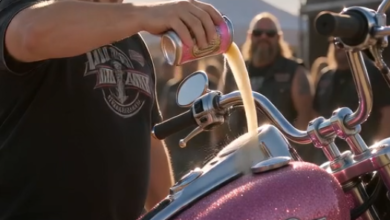
At the end of the parking lot sat a black V-twin motorcycle covered in road dust.
Bolted behind the seat was something nobody had ever seen before.
It was a round, padded frame wrapped in a silver insulated cover, with a small black box and a coiled wire running to the battery.
A young woman in a sun hat and oversized sunglasses walked past it with her phone out. She stopped. She leaned in and peeked under the edge of the cover.
Then she gasped.
“Oh my God.”
She grabbed the silver cover and ripped it off.
Underneath, held in a padded cradle, was a clear plastic sphere full of water. Inside it, a single orange goldfish swam in slow circles.
“You guys,” the woman said into her phone, her voice rising. “Somebody has strapped a goldfish to a motorcycle. In the desert. In a hundred and eight degrees.”
Her name was Tessa Vaughn. She ran a pet rescue page with a hundred thousand followers.
A crowd started to gather.
“That’s sick,” a man said.
“Who would do that?” a mother whispered, pulling her kids closer.
Then the owner walked out of the rest stop building carrying a bottle of water.
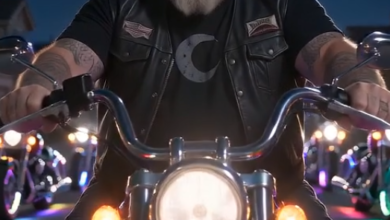
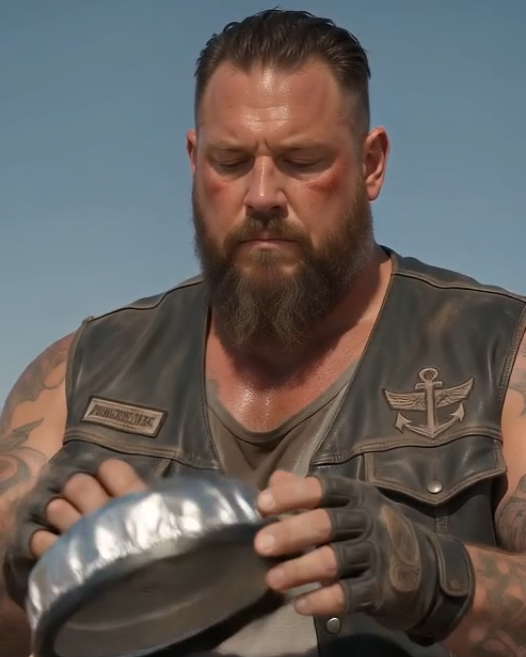
He was huge, maybe six-foot-four, with a dark beard, a sunburned neck, and both arms covered in tattoos. He wore a black short-sleeved leather jacket gray with road dust.
Tessa pointed her phone straight at him.
“Is this yours? Are you seriously torturing a fish for some kind of stunt?”
The biker didn’t answer.
He walked to his motorcycle, picked up the silver cover from the pavement, and gently laid it back over the bowl. His knuckles were cracked and his gloves were worn through at the fingertips.
He didn’t look at Tessa or at the crowd.
“Don’t you dare walk away from me,” Tessa said. “I’ve already called animal control.”
She turned to the people watching.
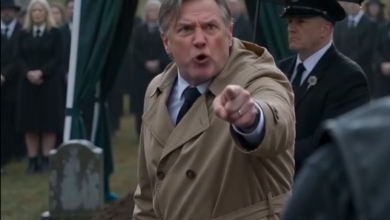
“Everybody, please, film this. This man drove a living animal across the desert strapped to an engine. That’s abuse. That’s a crime.”
Phones went up all around the parking lot.
“Get the fish out of there,” someone yelled.
“Arrest him,” said another.
A woman near the picnic tables started crying. “That poor little thing.”
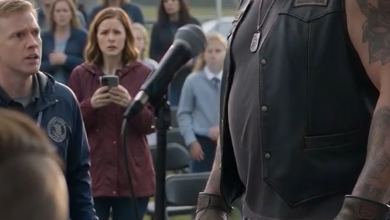
The biker stood beside his motorcycle in the heat, a hundred people staring at him. Sweat ran down his face into his beard.
He still didn’t argue.
Instead, he reached into his jacket pocket and pulled out his phone. He tapped the screen twice and waited.
Tessa laughed. “Oh, you’re calling a lawyer? Good. You’ll need one.”
He didn’t respond.
He just turned the phone around and held it out toward the crowd.
On the screen was a hospital bed.
A little girl was sitting in it. She was very small and very pale, with no hair, wearing a blue paper mask over her nose and mouth. Her eyes lit up when she saw the goldfish bowl behind her father.
The crowd fell silent.
Then her small voice came through the phone’s speaker, thin and tired and puzzled.
“Daddy,” she said, “who’s that lady yelling at Bubbles?”
Part 2
Reid Bishop looked down at his phone and smiled at his daughter.
“Nobody, bug,” he said quietly. “Just a lady who’s worried about Bubbles. Say hi to everybody.”
Nora waved at the screen with one tiny hand. An IV line was taped to the back of it.
“Hi, everybody,” she said. “That’s my fish. He’s on a world tour.”
Nobody in the parking lot said a word.
A woman by the picnic tables put her hand over her mouth. The man who’d yelled “Arrest him” slowly lowered his phone.
Tessa Vaughn recovered first.
“Oh, come on,” she said, turning back to her own phone. “Seriously? You guys see what he’s doing? He’s using a sick kid as a prop. That’s the oldest trick there is.” She pointed at the motorcycle. “It doesn’t matter whose fish it is. That fish has been strapped to a vibrating engine in hundred-degree heat. That is cruelty.”
A few people in the crowd murmured. It sounded reasonable. It was a hundred and eight degrees, after all.
Reid didn’t answer her. He kept his eyes on his phone.
“Bug, I’ve got to go for a few minutes,” he said gently. “I’ll call you right back, okay?”
“Is Bubbles okay?” Nora asked.
“Bubbles is fine. I promise.”
He ended the call.
A white county pickup with a cage in the back pulled into the parking lot, and a woman in a tan uniform climbed out. She was in her forties, with her dark hair in a braid under a ball cap. Her badge read MOHAVE COUNTY ANIMAL CONTROL. Her name tag said GARZA.
Tessa practically ran to her.
“Officer, thank God. I’m the one who called. This man has a goldfish strapped to his motorcycle in the desert. I have it all on video. I want it seized.”
Officer Lupe Garza walked slowly to the motorcycle. She lifted the silver cover and crouched down beside the acrylic sphere. She looked at it for a long time without saying anything.
Then she looked at the little black box wired to the battery.
“Sir,” she said to Reid, “I’m going to have to take the fish.”
Part 3
Reid didn’t argue. He just nodded.
But his chest felt like it was caving in.
Seven-year-old Nora had been diagnosed with leukemia when she was four. She fought it for two years and won. Then, last spring, it came back.
Three weeks ago, she’d had a bone marrow transplant at St. Brendan’s Children’s Hospital in Denver. After a transplant, a child’s immune system is close to zero. For six weeks, Nora had to stay in a sealed isolation room. Every visitor wore a gown, gloves, and a mask. No flowers. No toys from home. No pets.
Not even a goldfish.
Bubbles had lived on Nora’s dresser for two years. She’d won him at the Adams County Fair by tossing a ping-pong ball into a cup. It was the day before her first diagnosis, so he was the last thing she remembered before everything changed.
She talked to him every night.
In the hospital, she worried about him constantly.
“He’s never been anywhere,” she told Reid one night over video. “He doesn’t even know there’s an ocean. Can you take Bubbles somewhere for me? Since I can’t go?”
Most dads would have laughed.
But Reid Bishop wasn’t most dads.
For eleven years, he had been the head of life support systems at the Front Range Aquarium in Denver. He was the guy who kept a two-hundred-thousand-gallon shark tank running at exactly the right temperature, oxygen, and salt. He’d moved sea turtles across three states in custom transport tanks. He knew more about keeping fish alive than almost anyone in Colorado.
So he went to the garage.
For four nights, he built the rig. It was a sealed acrylic sphere, set in a padded cradle on rubber shock mounts that absorbed every vibration from the engine. There was a battery-powered aerator to keep the water full of oxygen. A temperature sensor logged readings every five minutes to an app on his phone. He added a cooling sleeve and a silver insulated cover to keep the sun off.
He took it to the aquarium’s veterinarian, Dr. Priya Shah, before he left. She checked Bubbles over, ran water tests, and signed off on it.
“That fish,” she told him, “is going to be living better than some of our fish here.”
Then Reid’s wife, Jess, moved into the hospital with Nora, and Reid hit the road.
He rode two thousand miles through Colorado, Utah, Arizona, California, Nevada, and Wyoming. Every night, Nora got a new video of Bubbles looking at the mountains, red rock arches, the Grand Canyon, or the Pacific Ocean.
Now, in the parking lot outside Kingman, Officer Garza unclamped the sphere from his motorcycle and carried it carefully to her truck.
Reid’s phone buzzed. It was a video call from Nora.
He couldn’t make himself answer.
Part 4
By that night, Tessa Vaughn’s video had two million views.
She’d posted it on her page, Rescue With Tessa, with the caption Biker straps goldfish to his motorcycle in 108-degree desert. Animal control seized it. Share so this never happens again.
The video was sixty seconds long. It showed Tessa ripping off the cover, the goldfish swimming in the sphere, and the crowd shouting. Then it showed animal control carrying the fish away.
It didn’t show the phone call. It didn’t show the sensor box. It didn’t show the cooling sleeve.
The comments were brutal.
Disgusting. Find this man.
He should lose his license.
Using a sick kid for sympathy. Sick.
Reid sat on the edge of a motel bed in Kingman and read them for an hour. He felt like he was going to throw up.
At ten o’clock, Jess called him from the hospital.
“Reid,” she said, her voice shaking. “A hospital social worker came by. She said two TV stations called asking about ‘the goldfish dad.’ Someone found out where Nora is.” She paused. “And one of the nurses showed her the video by accident. Nora saw the comments.”
Reid closed his eyes.
“She keeps asking if Bubbles is in jail,” Jess whispered. “She thinks it’s her fault, because she asked you to take him.”
Reid sat very still.
He thought about coming home. He thought about giving up the tour, saying sorry, and letting the internet call him whatever it wanted. He could get the fish back somehow and just make it all go away.
Maybe Tessa was right. Maybe it had been a stupid idea. Maybe a grown man shouldn’t strap his daughter’s goldfish to a motorcycle and ride across the desert.
Then his phone rang again.
It was an Arizona number.
“Mr. Bishop? This is Officer Lupe Garza, Mohave County Animal Control.” She paused. “I need you to come down to the shelter. Tonight, if you can. And bring your sensor data.”
Part 5
The Mohave County Animal Shelter was a low concrete building at the edge of Kingman. At eleven p.m., it was dark except for one lit office at the end of a hallway.
Officer Garza was waiting for him there.
On her desk was the acrylic sphere with Bubbles inside, swimming happily in slow circles. Beside it sat a water testing kit and a thermometer.
“Sit down,” she said.
Reid sat.
“I keep a three-hundred-gallon reef tank at home,” Officer Garza said. “Twelve years. I know a little about fish.” She tapped the sphere. “The second I saw that rig at the rest stop, I knew whoever built it knew what they were doing. Shock mounts. Aerator. Cooling sleeve. Sensor logging. That’s professional-grade life support.”
Reid let out a long breath.
“Then why’d you take him?”
“Because I had a complainant, a hundred witnesses, and a camera in my face,” she said. “If I’d walked away, I’d have been the next video.” She leaned back in her chair. “So I brought him here and tested him myself. Water temperature seventy-two degrees. Dissolved oxygen better than most home aquariums. No signs of stress. That fish is in perfect health.”
Reid pulled out his phone and showed her the sensor app. It had two thousand miles of data, a reading every five minutes for eleven days. The water temperature never went above seventy-four degrees, and the oxygen was always steady.
Officer Garza scrolled through it. Then she slid the sphere across the desk to him.
“He’s released,” she said. “No charges. No citation.”
Reid put both hands on the sphere and lowered his head.
“There’s something else,” Officer Garza said quietly. “When I filed my report, I ran the complainant’s name. Tessa Vaughn.” She raised an eyebrow. “She’s filed eleven animal cruelty complaints in four states this year. Every one of them on camera. Every one turned into a video. And every video ends with a donation link to her rescue fund.”
“How many were real?”
“Two,” Officer Garza said.
Reid’s phone buzzed.
It was a direct message from a stranger on social media. The profile picture was a young man with a camera around his neck.
Mr. Bishop, my name is Jordan. I’m Tessa’s camera guy. I was at the rest stop today. I have the raw footage. All of it. I can’t keep doing this.
Part 6
Reid met Jordan Pierce at a 24-hour diner on Route 66 at one o’clock in the morning.
He was twenty-four, skinny, with a camera bag on his shoulder and dark circles under his eyes. He couldn’t look Reid in the face.
“I’ve worked for Tessa for eight months,” Jordan said. “I thought I was helping animals.” He opened his laptop. “Watch this.”
It was the unedited footage from the rest stop, shot from Jordan’s camera before Tessa ever pulled out her phone.
Tessa walked past the motorcycle and lifted the edge of the silver cover. She looked underneath at the goldfish, the aerator, the sensor box, and the cooling sleeve.
She looked for a long time.
Then she turned to Jordan.
“Oh, this is perfect,” she said on the recording. “Okay. When I pull the cover, stay tight on the fish. Don’t get the box or the wires in the shot. We want it to look like he just stuck it in a bowl. And get the crowd reacting.”
Jordan stopped the video.
Reid stared at the screen.
“She saw it,” he said slowly. “She knew the whole time.”
“She always knows,” Jordan said quietly. “She does this every month. Finds something that looks bad on camera. A dog left in a car with the AC running. A horse that’s supposed to be thin because it’s old. She films it, cuts it a certain way, and posts it with a donation link.” He swallowed. “Her rescue fund took in three hundred eighty thousand dollars this year. Maybe twenty thousand of it went to animals. The rest went into her account. She bought a house in Scottsdale.”
He turned the laptop toward Reid again and showed him a spreadsheet of donation totals by video.
The goldfish video had raised forty-one thousand dollars in seven hours.
“She’s going live tomorrow night,” Jordan said. “She’s calling it Justice for Bubbles. She’s going to ask people to donate to help her ‘fight for animals like this.'” He looked up at Reid. “Using your daughter’s fish.”
Reid closed the laptop very gently.
“Jordan,” he said. “Will you send me all of this?”
Jordan nodded.
“There’s one more thing you should know,” he said. “When you turned your phone around, and your little girl said, ‘Who’s that lady yelling at Bubbles?’…” He swallowed hard. “Tessa told me to cut that part out first.”
Part 7
Reid didn’t make an angry video. He didn’t call Tessa a liar or put her address online. He didn’t even say her name.
At six o’clock the next morning, he sat at a picnic table outside his motel in Kingman with Bubbles’ sphere beside him. He posted every single video from the World Tour, all eleven days of them, completely unedited.
There was Bubbles in front of Longs Peak, Bubbles at Arches National Park, and Bubbles at the Grand Canyon at sunrise. There was Bubbles on the beach in Santa Monica, with the Pacific Ocean behind him and a little girl’s voice coming through the phone, squealing, “He’s seeing the ocean! He’s seeing the ocean!”
He posted a screenshot of eleven days of sensor data.
He posted Dr. Shah’s veterinary sign-off from the Front Range Aquarium.
Then he wrote one short paragraph.
My daughter Nora is seven. She’s in an isolation room after a bone marrow transplant and can’t leave for six weeks. She asked me to take her goldfish somewhere, because she couldn’t go. I’m an aquarium life support engineer. I built him the safest ride I could. This is his trip. Tonight we’re heading for Las Vegas. Nora wants him to see the lights.
He didn’t mention Tessa at all.
By noon, it had three million views.
By three o’clock, the Front Range Aquarium had posted a statement confirming that Reid Bishop was its head of life support systems. It said the World Tour rig was “a remarkable piece of engineering.”
By five, Jordan Pierce had posted forty seconds of raw footage from the rest stop. It included Tessa’s own voice. Don’t get the box or the wires in the shot.
At seven o’clock, Tessa Vaughn went live anyway.
She lasted four minutes. The comments were scrolling so fast nobody could read them. Liar. Fraud. Where did the money go? Justice for Bubbles. She ended the stream mid-sentence.
That night, Reid rode into Las Vegas and held Bubbles’ sphere up in front of the Bellagio fountains while Nora watched on video, laughing.
At eleven p.m., his phone rang. It was Jess, and she was crying.
“Reid,” she said. “Her counts came up. The new marrow is working.”
Part 8
Reid finished the World Tour five days later.
He rode north through Nevada and Utah. Bubbles saw Bryce Canyon, and the Great Salt Lake at sunset, and a herd of bison in Wyoming. Every night, Nora watched, and every night her voice on the phone sounded a little stronger.
On the last morning, Reid rode south down I-25 toward Denver.
He wasn’t alone.
His motorcycle club from Denver met him at the Wyoming state line, thirty bikes. In Fort Collins, a group from the aquarium joined in on their own motorcycles. By the time Reid crossed into Denver, sixty-two motorcycles were riding behind him in a long, rumbling line.
Officer Lupe Garza rode with them. She had taken two days off and driven up from Kingman with her husband on his bike. “Had to see how it ended,” she said.
They rolled into the parking lot of St. Brendan’s Children’s Hospital at noon.
Nora’s room was on the fourth floor, on the side facing the lot. She wasn’t allowed out of isolation yet.
But she was allowed at the window.
Reid climbed off his motorcycle in the parking lot, unclamped Bubbles’ sphere, and held it high over his head in both hands.
Four stories up, a tiny bald girl in a blue mask pressed both palms against the glass.
Sixty-two bikers revved their engines at once. Nurses crowded the windows of every floor. Patients in wheelchairs rolled to the glass. Jess stood behind Nora with both hands on her shoulders, sobbing.
Reid’s phone rang. He put it on speaker.
“Daddy!” Nora shouted. “You brought him home!”
“Bubbles saw the whole world, bug,” Reid said, his voice cracking. “Mountains, desert, ocean. Everything.”
“I’m going to go see it all,” Nora said. “When I’m better. I’m going to ride the same road. Every single place.”
Reid had to put his sunglasses on.
That same afternoon, the Arizona Attorney General’s Office announced it had frozen Tessa Vaughn’s rescue fund. They were opening an investigation into charitable fraud. Her page was suspended by the platform for “deceptive fundraising.”
Nora’s oncologist came to the window an hour later and pressed a note against the glass for Reid to read. He couldn’t read it from four stories down, so Jess called him.
“Dr. Morales says she can go home Friday,” Jess said. “Friday, Reid.”
Part 9
Here’s how the rest of it went.
Tessa Vaughn was charged with charitable fraud and filing false reports with animal control agencies in three states. She pleaded guilty eight months later. She was ordered to repay more than three hundred thousand dollars to donors and sentenced to two years of probation. Her house in Scottsdale was sold to cover the restitution. Jordan Pierce testified against her. He works for an actual animal shelter in Phoenix now.
The forty-one thousand dollars people had donated “for Bubbles” was returned to every donor. More than half of them sent it right back to St. Brendan’s Children’s Hospital instead.
Nora went home on a Friday in August. The first thing she did when she walked into her bedroom was put her face against Bubbles’ bowl on the dresser and whisper, “Tell me everything.”
She stayed in remission.
The following July, one year to the day after the World Tour began, Nora Bishop climbed onto the back of her father’s motorcycle in a little purple helmet. Her hair was growing back in soft brown curls. Bubbles rode in his sphere in a new sidecar Reid had built, with a bigger window so he could see better.
They rode the same road, every single place.
There were the Rocky Mountains, the red arches in Utah, and the Grand Canyon at sunrise. In Kingman, Arizona, they stopped at the same rest stop, where Officer Lupe Garza was waiting at a picnic table with a cake shaped like a goldfish.
In Santa Monica, Nora took off her shoes and stood in the Pacific Ocean for the very first time, holding Bubbles’ sphere up so he could see her do it.
But the World Tour didn’t end with Bubbles.
After the story went viral, kids from the oncology floor at St. Brendan’s started asking Reid for something. They wanted him to take their stuffed animals on rides, or their action figures, or their drawings, since they couldn’t go anywhere either.
So he did.
Today, his motorcycle club runs a program called the World Tour. Every month, bikers from Denver carry small toys and keepsakes from hospitalized kids on their rides. They send back photos and videos from mountains and deserts and oceans. So far, more than four hundred stuffed animals have seen the Grand Canyon.
Nora is the program’s official mascot.
Bubbles is the honorary president.
People see a huge, tattooed biker with a goldfish bowl strapped to his motorcycle in the desert heat, and they decide he must be cruel or crazy before he says a word. A woman with a hundred thousand followers called him an abuser. A crowd demanded his arrest. Tessa Vaughn was the one using a little girl’s goldfish to fill her own bank account. Sometimes the strangest thing you see on the side of the road is a father keeping a promise to a child who can’t go anywhere.
If this story stayed with you, follow our page. We share stories like this one every week, about the people who carry our dreams for us until we’re strong enough to carry them ourselves.