A 7-YEAR-OLD GAVE HER DUCK UMBRELLA TO A CRYING BIKER AT A CEMETERY—TEN YEARS LATER, 200 MOTORCYCLES ROLLED INTO HER FATHER’S FUNERAL AND HER UNCLE SCREAMED AT THEM TO LEAVE.
IT WAS POURING RAIN AT HER FATHER’S FUNERAL, AND THERE WEREN’T ENOUGH UMBRELLAS. THEN 200 BIKERS WALKED THROUGH THE CEMETERY GATES.
It was a gray Saturday morning in late October at Oak Hill Cemetery in Ashby, Pennsylvania.
Ben Shaw had been a mail carrier for twenty-six years. He died of cancer at fifty-one and left behind one daughter, seventeen-year-old Hannah.
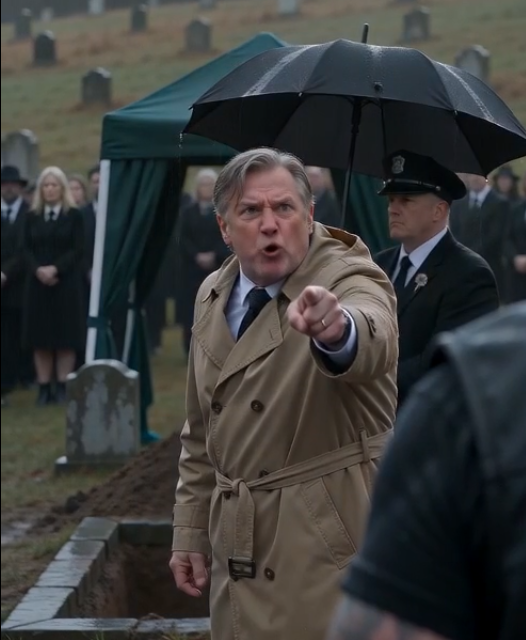
The rain had started at dawn and never stopped.
Maybe sixty people stood around the open grave in Section C. There were neighbors, coworkers from the post office, and Hannah’s high school friends. The funeral home had brought eight umbrellas.
Most people were soaked.
Hannah stood at the front in a black dress that was too big for her, her hair plastered to her face. She hadn’t brought an umbrella. She hadn’t thought about it.
Then the rumble started.
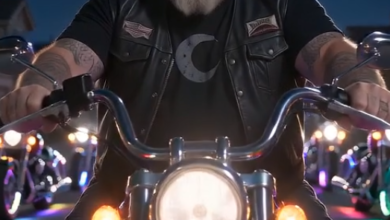
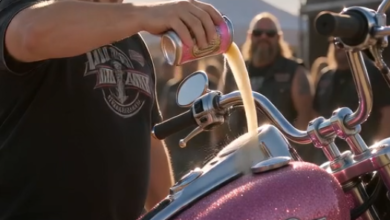
It began low and far away and grew until people turned around. Motorcycles were pouring through the cemetery gates, one after another. They parked in long, neat rows along the gravel road.
Engines cut off one by one.
There were two hundred of them.
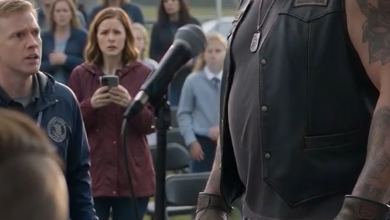
Hannah’s uncle, Dennis Shaw, Ben’s older brother, spun around in his expensive raincoat.
“Oh, you’ve got to be kidding me,” he said loudly. “Who invited a biker gang to my brother’s funeral?”
The bikers were climbing off their motorcycles and walking toward the grave in silence. They were big, bearded men in leather.
Dennis marched toward them.
“This is a family service,” he snapped. “Not a biker bar. Turn around and leave. Now.”
The man in front didn’t answer.
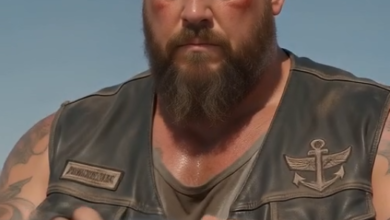
He was enormous, maybe sixty, with a gray beard that reached his chest and a black short-sleeved leather jacket. Rain ran down his face and dripped off his beard. He just looked at Dennis with tired, steady eyes.
He didn’t argue. He didn’t move.
Behind him, two hundred men stood silently in the rain.
Dennis turned to the funeral director.
“Call the police,” he said. “Right now. I don’t know what these people want, but my niece has been through enough.”
He put his arm around Hannah’s shoulders.
“Don’t worry, sweetheart. I’ll handle this.”
Some of the mourners nodded nervously. A mother pulled her kids closer. Hannah’s best friend, Kenzie, grabbed her hand.
Hannah didn’t know what to think. She was too tired and too cold to be scared.
Then the big biker raised one hand.
All two hundred bikers moved at once.
They split into two long lines facing each other, stretching from the gravel road all the way to Ben Shaw’s grave. Then, with a sound like a flock of birds taking off, they opened their umbrellas.
Two hundred umbrellas.
Every one of them was bright yellow.
They lifted them high and close together until they formed a solid golden roof over the path to the grave. Underneath it, the rain stopped falling.
Nobody spoke.
Dennis’s mouth hung open. The funeral director lowered his phone. Mourners stepped under the yellow canopy one by one, staring up.
Hannah stood frozen at the head of the path.
Yellow umbrellas.
Something deep in her memory stirred.
Ten years earlier, in this same cemetery, in another storm, a seven-year-old girl had run across the wet grass. She gave her little yellow umbrella to a giant stranger who was kneeling in front of a tiny grave and crying.
He never learned her name.
The big biker walked slowly down the yellow aisle toward Hannah.
He stopped in front of her, unzipped his leather jacket, and pulled out something small and faded.
It was an old yellow children’s umbrella with a duck’s head for a handle.
He held it out to her.
Part 2
Hannah didn’t take it at first.
She just stared at the little umbrella in the big man’s hand. The yellow had faded almost to cream. One of the plastic duck’s painted eyes had worn off. The fabric was patched in two places with black electrical tape.
But she knew it.
She knew it the way you know your own handwriting.
“That’s mine,” she whispered.
“Yes, ma’am,” the biker said. His voice was low and rough. Rain dripped off the yellow umbrellas over their heads. “You gave it to me. Ten years ago. Right over there in Section C.” He nodded toward the far side of the cemetery. “You told me, ‘You can have it. I have a hood.’ Then you ran back to your daddy.”
Hannah’s knees nearly gave out.
She remembered.
She remembered the rain and her yellow raincoat. Her father had been holding her hand on the way to visit Grandpa Walt’s grave. A huge man was kneeling in the mud in front of a tiny white headstone, with no umbrella, his shoulders shaking. She’d let go of her dad’s hand and run to him before anyone could stop her.
“It was you,” she said.
“It was me.”
She reached out and took the umbrella with both hands. It was lighter than she remembered. Her hands were shaking.
“You kept it,” she said. “Ten years.”
“Every day,” he said simply. “Rode with it in my saddlebag.”
“Hannah.” Her uncle Dennis pushed his way through the yellow canopy, his face red. “Don’t touch that. Give it back to him.” He grabbed her elbow. “You don’t know who these people are.”
The big biker looked at Dennis but didn’t say anything.
Down at the gravel road, a sheriff’s cruiser had pulled up, lights flashing silently in the rain. A deputy was walking toward them.
“What’s going on here?” the deputy asked.
“These men crashed my brother’s funeral,” Dennis said quickly. “I want them removed.”
The deputy looked at the two hundred yellow umbrellas held over a crowd of mourners. He looked at the soaked teenage girl clutching a faded child’s umbrella.
“Sir,” he said slowly, “it looks to me like they’re keeping everybody dry.”
Dennis opened his mouth and closed it.
The big biker turned back to Hannah.
“My name is Raymond Vance,” he said. “Folks call me Rook.” He hesitated. “I saw your daddy’s obituary in the paper on Wednesday. The picture.”
Part 3
Hannah had chosen that picture herself.
Her father had kept it on the refrigerator for ten years, held up by a magnet shaped like a mailbox. It showed seven-year-old Hannah in her yellow raincoat, gap-toothed and grinning, holding a yellow duck umbrella. Her dad took it the morning of that cemetery visit, before they left the house.
Ben Shaw had been a mail carrier in Ashby for twenty-six years. Hannah’s mother died of an aneurysm when Hannah was three. After that, it was just the two of them. Ben braided her hair badly every morning for years before he finally watched enough videos to get it right.
Eighteen months ago, he got a stomachache that wouldn’t go away.
It was pancreatic cancer, stage four.
Hannah spent her junior year of high school driving him to chemotherapy. In the end, it was just the two of them in a hospice room with the TV on low. He died on a Tuesday morning, holding her hand.
When the funeral home asked for an obituary photo, she didn’t even have to think.
“He told that story all the time,” Hannah said to Rook. Her voice cracked. “Every Thanksgiving. Every time he met someone new. ‘My daughter gave her umbrella away to a stranger who was crying.’ He said it was the proudest he’d ever been of me.”
Rook closed his eyes for a moment.
“He always wondered who you were,” Hannah whispered. “Every time he told it, he’d say, ‘I hope that man’s okay.'”
“I wasn’t,” Rook said quietly. “Not for a long time.”
Dennis stepped between them.
“All right, that’s enough,” he said. “Hannah, I’m sorry, but you need to hear this.” He lowered his voice, but not enough. “Your father had debts. A lot of debts. Medical bills, credit cards, things you don’t know about.” He glared at Rook. “And I’d bet anything some of those debts were to people like this. You think two hundred bikers show up at a funeral out of the goodness of their hearts? They’re here for money.”
Hannah stared at him.
She knew her father had debts. She’d seen the bills piled on the kitchen table. She’d heard him on the phone with the insurance company, his voice tight.
She looked at Rook. She looked at the two hundred strangers holding umbrellas.
Was Dennis right? Was any of this real?
Rook didn’t defend himself.
Dennis reached into his raincoat and pulled out a folded stack of papers in a plastic sleeve.
“After the service,” he told Hannah, “you’re going to sign these. Today. Or we lose your father’s house.”
Part 4
The service went on under the yellow canopy.
The pastor read from Psalms. Ben’s supervisor from the post office talked about how Ben once walked a lost dog four miles home on his route. Kenzie read a poem she’d written in study hall.
Hannah stood at the front holding the little duck umbrella and heard almost none of it.
Two hundred bikers stood silently in two lines the whole time, their arms raised, holding their umbrellas over strangers. Nobody’s arms came down.
When it was over, the casket was lowered. Hannah dropped a handful of wet dirt on top of it and couldn’t breathe for a minute.
Then Dennis was beside her again with the papers.
“Let’s go sit in my car,” he said. “Get this done.”
“What is it?” Hannah asked.
“Just formalities. You’re seventeen, honey. Until your birthday in March, you need a guardian. I’m family. This makes it official.” He flipped to the second page. “And this one lets me handle the house and your dad’s life insurance until you’re eighteen. To pay off his debts before they take everything.”
Rook was standing a few feet away. He spoke for the first time in half an hour.
“Don’t sign anything today, Hannah.”
Dennis whirled on him. “Excuse me? This is none of your business.”
“Nobody signs legal papers at their daddy’s grave,” Rook said quietly. “Not on the day they bury him. Whatever it is, it’ll keep till Monday.”
“Who the hell do you think you are?”
Behind Dennis, a young woman in a black coat was standing very still. She was twenty-two, with dark hair and red eyes. It was Natalie Shaw, Dennis’s daughter and Hannah’s cousin.
She was staring at the papers in her father’s hand. She looked sick.
Hannah noticed. She didn’t know what it meant.
Rook took a slow breath. Then he turned and looked across the cemetery, toward the far hillside of Section C.
“I’ll tell you who I am,” he said. “You want to know why I was crying in this cemetery ten years ago?”
Nobody answered.
“Come with me,” Rook said to Hannah. “I want to show you something.”
Part 5
They walked across the wet grass together, Hannah and Rook. A dozen bikers walked behind them, holding umbrellas over their heads.
Dennis followed, scowling. Natalie followed too.
Section C was on the far side of the hill, where the children were buried. The headstones were smaller there. Some had pinwheels or stuffed animals.
Rook stopped in front of a small white stone near the end of the third row.
LUCY ANNE VANCE. There were two dates, seven years apart.
“My daughter,” Rook said.
Hannah put her hand over her mouth.
“She was riding her bike home from a friend’s house,” Rook said. “Two blocks from our house. Drunk driver ran a stop sign.” He looked down at the stone. “She was seven.”
The rain pattered on the umbrellas above them.
“Her mother and I split up a year later. We couldn’t look at each other anymore,” he went on. “That day you saw me, it was the first time I’d come back here since the funeral. Three weeks. I hadn’t been able to make myself come. I got here and fell apart. Couldn’t even stand up.”
“I remember,” Hannah whispered.
“And this little girl in a yellow raincoat came running across the grass and held out her umbrella,” Rook said. His voice broke. “Same age as Lucy. And she said, ‘You can have it. I have a hood.'” He shook his head. “Then she was gone before I could ask her name. I didn’t even say thank you.”
He pushed up the short sleeve of his leather jacket. On the inside of his forearm was a small tattoo of a yellow umbrella with a duck’s-head handle.
“I kept it with me every day for ten years,” he said. “I didn’t know why. I just couldn’t let it go.”
Hannah was crying now.
She looked down at the little white headstone. Then she noticed something at its base, half-hidden in the wet grass.
There were rubber ducks, a whole row of small yellow rubber ducks. Some were faded almost white, some were newer, and one looked like it had been left just a few weeks earlier.
Hannah’s breath stopped.
“Oh my God,” she whispered. “This is her. This is the grave.”
Rook looked at her. “What?”
“We came back,” Hannah said. “Dad and I. Every year. On the same day in October.” She was shaking. “Dad said anyone who cried like that must have lost someone very small. So every year, we bought a rubber duck and left it here. On the grave where you were kneeling. We never knew whose grave it was. We never read the name. Dad said it felt like spying.”
Rook stared at the row of ducks.
Then the huge man sank down onto one knee in the wet grass.
“Ten years,” he whispered. “I find a new duck here every October. I never knew who was leaving them.”
Behind them, Natalie Shaw suddenly spoke.
“Hannah,” she said, her voice shaking. “There’s something you need to know. About my dad.”
Part 6
Dennis spun around. “Natalie. Not now.”
Natalie didn’t look at him. She looked at Hannah.
“Don’t sign those papers,” she said. “Please. He’s lying to you.”
“Natalie,” Dennis said, his voice low and dangerous. “That’s enough.”
“No, Dad. It’s not.” Natalie’s hands were trembling. “I heard you on the phone last week. With the real estate agent.”
The rain drummed on the umbrellas. Two hundred bikers and sixty mourners had drifted across the hill and were standing silently around Section C.
“My dad’s in trouble,” Natalie said to Hannah. “Real trouble. His business failed last year. He owes the bank almost three hundred thousand dollars. He’s going to lose his house.”
Dennis’s face went white.
“When Uncle Ben got sick, Dad started coming around,” Natalie went on. “Taking care of things. He became the executor. And he found out Uncle Ben had a life insurance policy. Two hundred fifty thousand dollars. For you.”
Hannah stared at her uncle.
“Those papers make him your guardian until March,” Natalie said. “And they give him control of the insurance money and the right to sell your house. He already has a buyer. A developer wants the lot. He was going to sell your home and use your money to pay his debts before you turned eighteen.” She was crying now. “He told me you’d never know the difference.”
The whole hillside was silent.
“That’s a lie,” Dennis said hoarsely. “She’s upset. She doesn’t know what she’s saying.”
“And there’s a will,” Natalie said. “Uncle Ben made a will. I saw it in Dad’s briefcase. It names Aunt Julie as your guardian. Your mom’s sister. And it puts the house and the money in a trust for you.” She looked at her father with tears running down her face. “He told everybody there wasn’t a will. He hid it.”
Hannah turned slowly to look at Dennis.
“You told me Dad never got around to making a will,” she said. “You told me I had nobody else.”
Dennis didn’t answer.
At that moment, a silver sedan pulled up on the gravel road below. A woman in her sixties with short gray hair and a black raincoat climbed out and hurried up the hill under an umbrella, holding a leather folder.
Natalie wiped her eyes. “I texted her during the service,” she said. “Uncle Ben’s lawyer.”
Part 7
The lawyer’s name was Patricia Gaines. She’d been Ben Shaw’s attorney for fifteen years, ever since he’d bought the little house on Elm Street.
She was out of breath when she reached Section C, and she looked furious.
“Mr. Shaw,” she said to Dennis. “I’ve been trying to reach you for nine days. Ben’s will was filed with the county two weeks before he died. You’ve been named in it as nothing more than a beneficiary of his fishing tackle.”
A few of the bikers laughed quietly. Dennis’s face turned from white to red.
Patricia turned to Hannah. Her expression softened.
“Hannah, honey, I’m so sorry about your father.” She opened her folder. “Your dad named your Aunt Julie as your guardian until your birthday. The house and the life insurance are in a trust in your name. Nobody can sell that house. Nobody can touch that money. Not until you’re old enough to decide for yourself.”
Hannah’s Aunt Julie, her mother’s younger sister, was standing in the crowd of mourners. She’d driven in from Pittsburgh that morning. She pushed her way forward and wrapped Hannah in her arms.
“I didn’t know,” Julie whispered. “Dennis told me there was no will. He told me he had everything handled.”
“And the debts,” Hannah said, pulling back. “Dennis said Dad had debts. That these men were here for money.”
Patricia shook her head.
“Your father’s medical bills were covered by his federal employee insurance,” she said. “There are a few small credit card balances. The estate will handle them easily.” She looked at the two hundred bikers on the hillside. “And he certainly didn’t owe anything to these gentlemen.”
Every head turned toward Dennis Shaw.
He stood alone in his expensive raincoat in the middle of the children’s section, rain dripping off the end of his nose. He had nobody beside him, not even his daughter.
The deputy who had been standing quietly at the back of the crowd stepped forward.
“Mr. Shaw,” he said. “Those papers in your hand. I’m going to need to take a look at those.”
Dennis handed them over without a word.
Then Patricia reached into her folder again. She pulled out a small white envelope, sealed and slightly worn at the corners.
“Hannah,” she said gently. “There’s one more thing. Your father gave me this in August. He said if anyone ever found the man with the umbrella, you should open it together.”
On the front, in her father’s handwriting, it said:
For Hannah, and for the umbrella man. If he ever turns up.
Part 8
Hannah’s hands shook so badly that Rook had to help her open it.
Inside was a single sheet of lined notebook paper, folded twice. It was her father’s handwriting, shaky from the chemotherapy but still his.
She read it out loud, standing in Section C, with the rain on the umbrellas and Lucy Vance’s small white headstone at her feet.
Hannah,
If you’re reading this with him, then I guess miracles happen. I always hoped they did.
I’ve told the umbrella story a thousand times. You were seven. You saw a grown man crying in the rain, and you didn’t think about it. You just ran to him and gave him the only thing you had. Of all the things I’ve ever seen you do, that’s the one I’m proudest of. That’s who you are.
To the man with the umbrella: I don’t know your name. I don’t know who you lost. But I wanted you to know that a little girl and her dad have been thinking about you every October for ten years. We left you a duck every time, so you’d know somebody remembered.
I hope you’re okay. I hope you found your way back.
And if you’re standing next to my daughter right now, please look after her for me. She’s going to try to take care of everyone else. Somebody needs to take care of her.
Ben
Hannah’s voice gave out on the last line.
Nobody on that hillside said a word.
Rook Vance, the biggest, toughest-looking man in the cemetery, stood with his face in his hands. His shoulders shook, just like they had ten years earlier, on that same patch of grass.
This time, Hannah didn’t run away.
She stepped forward, opened the little faded duck umbrella, and held it up over his head.
It was far too small. It barely covered half of him.
Rook laughed through his tears. He put his arm around her shoulders and pulled her against his leather jacket. Hannah held onto him and sobbed for her father.
Two hundred bikers stood around them in the rain, holding their yellow umbrellas, not one of them moving.
Dennis Shaw walked down the hill alone, got into his car, and drove away.
When Hannah finally let go, a stocky, gray-haired biker stepped forward from the crowd. He was the president of the Hollow Creek Riders, Rook’s club.
“Miss Shaw,” he said. “We passed a hat around this morning before we rode over here.” He held out an envelope. “And we’d like to talk to you about college.”
Part 9
Here’s how the rest of it went.
The probate court removed Dennis Shaw as executor of Ben’s estate within the month. The judge referred the forged guardianship papers and the concealed will to the county prosecutor. Dennis eventually pleaded guilty to attempted fraud and was ordered to pay restitution and serve probation. He lost his house to the bank the following spring.
Natalie moved out of her father’s house that winter. She and Hannah have dinner together every Sunday.
Hannah lived with her Aunt Julie in Pittsburgh until she graduated from high school in June. Two hundred Hollow Creek Riders sat in the bleachers at her graduation. When her name was called, they all stood up and opened yellow umbrellas indoors. The principal didn’t say a word about it.
The envelope the club handed her that day at Oak Hill had eighteen thousand dollars in it. By the time she started college, the Hollow Creek Riders had turned it into a scholarship fund. They added to it at every charity ride. It paid for all four years.
Hannah enrolled at Penn State and studied psychology. Today, she volunteers with a children’s grief support program. She works with kids who have lost a parent, a brother, or a sister. She named her group The Yellow Umbrella.
Ben Shaw’s birthday and Lucy Vance’s birthday are exactly one week apart in October.
Every year since that rainy Saturday, Rook rides to Oak Hill Cemetery on Ben’s birthday. Hannah meets him at the gate. They walk together to Ben’s grave, and Hannah leaves a stamped envelope on the headstone, because her dad was a mail carrier. They stand there for a while without saying much.
One week later, they come back for Lucy.
They bring two rubber ducks now. One is from Hannah, the way her father used to do it. The other is from Rook.
And every year, Hannah brings the little faded duck umbrella. She doesn’t need it. She just holds it over the two of them, even when it isn’t raining.
Rook gave it back to her for good on the day of the funeral. She keeps it on her desk at college, next to the photo from her father’s refrigerator, still held up by the little mailbox magnet.
People see two hundred bikers ride through the gates of a cemetery in black leather, and they decide what kind of men they are before a single one of them speaks. An uncle in an expensive raincoat called them a gang and called the police. Dennis Shaw was the one trying to steal a grieving girl’s home on the day she buried her father. Sometimes the strangers who look the most frightening are the ones carrying a promise they’ve kept for ten years.
If this story stayed with you, follow our page. We share stories like this one every week, about small kindnesses that find their way back to us.