Part 2: A Biker Was Dragged Off a Bus for Holding a Crying Little Girl — Then Her Mother Heard What She Called Him
Part 2
Raymond Collins had not boarded Bus 27 with anyone.
He had arrived at the Phoenix terminal alone, carrying one duffel bag, one helmet, and a return ticket to Tucson after visiting his older sister in the hospital. He had planned to sit near the front because his knees hurt after long rides, close his eyes, and ignore the world until the driver called his stop.
Then he saw the little girl by the vending machines.
At first, he thought she belonged to the woman buying chips nearby. Then the woman walked away. The child stayed. She stood under the harsh fluorescent lights with her small hands twisted in the skirt of her yellow dress, looking from one face to another as if the whole station had become too large to survive.
Raymond slowed down.
He did not approach too closely.
He had raised three daughters and knew that a frightened child did not need a stranger’s shadow falling over her too fast. So he crouched several feet away, held his phone where she could see it, and said gently, “Are you lost, sweetheart?”
She stared at him with wet eyes.
No answer.
Raymond tried again, softer.
“Name?”
The child whispered something he could not understand.
He opened a translation app, set it to Spanish, and typed with one thick finger.
Are you lost? Where is your mother?
The phone spoke in Spanish.
The girl’s face changed.
She nodded so hard her braids bounced, then began talking quickly through tears. Raymond caught only one word clearly.
Mamá.
He looked around immediately and waved toward a terminal employee, but the man was busy arguing with a passenger about luggage fees. Raymond stood, keeping his body angled away from the girl so she would not feel trapped, and called out that a child was lost near the vending machines.
Several people turned.
That was when the first mistake happened.
A woman hurried toward the child with good intentions and open arms.
The little girl screamed.
She backed into Raymond’s leg, grabbed the edge of his leather vest, and hid behind him as if he were the only solid thing in the station. Raymond froze, both hands lifted, not touching her.
“Okay,” he said. “Okay, nobody’s grabbing you.”
He typed again.
Do you want me to stay here?
The phone spoke.
The child nodded and held his vest tighter.
From that moment on, Raymond became the safest-looking unsafe man in the room.
And that is what confused everyone.
Part 3
The bus began boarding before anyone solved the problem.
That detail mattered later, though several people would pretend it did not. Bus 27 to Tucson was loading near Gate C, and passengers were being rushed forward because the schedule was already late. The station staff member Raymond had tried to flag down told him to “bring her to the desk,” but the moment Raymond gently gestured toward the counter, the child panicked again.
She screamed, shook her head, and pressed both fists into his vest.
Raymond typed another question.
Do you need to find your mother?
She nodded.
Can I ask for help?
She nodded again, but only when he stayed close.
The staff member looked irritated.
“Sir, you can’t just stand here blocking boarding.”
“I’m not blocking anything,” Raymond said. “She’s lost.”
“Then bring her to security.”
“She won’t move with you reaching for her.”
That was true, but it sounded like refusal.
A few passengers nearby began watching him differently.
One white American man in his forties whispered to his wife that something was off. A young college student stared at Raymond’s tattooed arms and then at the little girl’s fingers locked in the leather vest. An elderly woman asked the child where her parents were, but when the girl did not answer in English, the woman looked at Raymond as if silence itself had accused him.
Raymond made a decision that would look terrible to people who had missed the first twenty minutes.
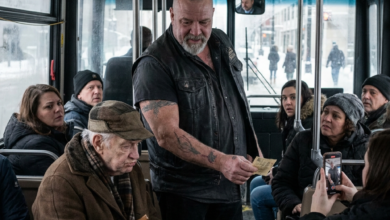
The bus driver agreed to let him sit in the front row while the terminal paged security and searched for the mother. Raymond kept the girl beside him near the aisle, not hidden, not covered, not rushed. He placed his phone in her lap with the translation app open and typed slowly.
My name is Raymond. People call me Bear. I will sit here until we find your mother.
The child read the Spanish translation and sniffed.
“Bear,” she repeated quietly.
Then she leaned against his side and cried into his vest.
That was the image the passengers saw.
Not the translation app.
Not the staff member failing to respond quickly.
Not the small girl choosing the only adult who had asked before touching her.
Just a biker holding a child who did not look like his.
Part 4
The police were called by a passenger before the mother was found.
Officer Melissa Grant, a thirty-four-year-old white American woman, entered first with her partner, Officer Luis Ramirez, a forty-one-year-old Latino American man who immediately noticed the child’s Spanish words beneath the crying. By then, the bus had become a room full of guesses, and every guess pointed at Raymond.
“Sir,” Officer Grant said, voice firm but controlled, “take your hands off the child.”
Raymond looked up.
His face had gone pale beneath the sunburn.
“I’m not holding her against her will.”
The little girl clutched him harder.
“Please release her.”
“She’s going to panic.”
Officer Ramirez heard the child whispering in Spanish.
He stepped closer, slower than his partner.
“¿Cómo te llamas, mija?”
The girl buried her face deeper into Raymond’s vest and shook violently.
Raymond looked at him.
“She’ll answer through the phone sometimes. Not when people crowd her.”
That sentence should have helped.
Instead, several passengers murmured at once.
Officer Grant reached for Raymond’s arm.
He did not resist.
But the moment his shoulder shifted away from the girl, she screamed with a raw terror that silenced the entire bus. It was not the cry of a child being saved from danger. It was the cry of a child losing the one thing that had made the danger pause.
Raymond’s vest button tore as officers guided him into the aisle.
He kept both hands open.
“Her name might be Lucía,” he said quickly. “Her mother has a red suitcase, I think. She said red, maybe rojo, and gate bathroom, maybe baño. I wrote it down in the app. My phone is on the seat.”
Officer Ramirez picked up the phone.
On the screen were the translated questions from the last twenty minutes.
Where is your mother?
What color is her suitcase?
Did you come on a bus?
Do you want me to call someone?
Are you scared when people touch you?
Officer Ramirez’s expression changed.
“Melissa,” he said quietly.
Officer Grant looked at the screen.
Then the terminal doors burst open.
A Latina woman in her thirties, dark hair loose from a ponytail, face streaked with tears, ran toward the bus steps shouting, “Lucía! Mi niña!”
The child stopped screaming mid-breath.
And the whole bus finally understood that the story had begun long before they started watching.
Part 5
Lucía’s mother was named Marisol Vega.
She was thirty-two, Mexican American, wearing a blue blouse, black work pants, and the expression of a woman who had lost her child in a public place and aged ten years in twenty minutes. Her red suitcase rolled crookedly behind her, one wheel broken from the way she had dragged it through the terminal while searching every gate.
She reached the bus stairs and stopped only because Officer Ramirez gently lifted one hand.
“Señora, slowly,” he said in Spanish. “She is safe.”
Marisol saw Lucía pressed against the seat, saw Raymond standing in the aisle with both hands still visible, saw the torn button hanging from his vest, and for one terrible second looked like she might misunderstand too.
Then Lucía spoke.
“El oso,” she whispered.
Marisol froze.
Lucía pointed at Raymond.
“El oso me mantuvo a salvo.”
The words moved through Officer Ramirez first. His face softened, then tightened with emotion.
Officer Grant asked, “What did she say?”
Raymond answered before Ramirez could.
“She said the bear kept her safe.”
His voice broke slightly on the last word.
Marisol climbed the last step and knelt in front of her daughter. Lucía hesitated, then released Raymond’s vest for the first time since the vending machines. She fell into her mother’s arms and sobbed with her whole body, the way children do after they finally believe they no longer have to stay brave.
Marisol held her so tightly both officers looked away.
When she could speak, she explained in English broken by panic that Lucía had slipped away while Marisol was in the restroom with their suitcase outside the stall. A crowd had moved between them. An announcement had covered her voice. By the time she came out, Lucía was gone.
“I thought someone took her,” Marisol said.
Nobody on the bus moved.
Everyone had thought the same thing about the wrong person.
Marisol turned to Raymond.
“You stayed with her?”
He nodded.
“She was scared of being touched. I just asked questions on the phone.”
“You held her?”
Raymond swallowed.
“She held me first.”
That was the truth nobody had seen clearly.
Marisol looked at the torn leather button in Lucía’s fist, then at Raymond’s careful hands.
“Gracias,” she whispered.
Raymond lowered his head.
“Yes, ma’am.”
It was the most helpless answer a good man could give to a mother whose child had been returned.
Part 6
The apology did not come all at once.
People like to imagine that once the truth appears, shame makes everyone brave. It does not. Most people looked away first. The college student who had stood up to challenge Raymond sat down with his jaw tight. The woman who had whispered across the aisle wiped at her eyes and pretended to search her purse. The bus driver gripped the steering wheel and stared out the windshield.
Officer Grant was the first to say it properly.
“Mr. Collins,” she said, “I’m sorry.”
Raymond looked surprised, as if he had expected paperwork but not humility.
“You were doing your job.”
“I was,” she said. “But you were doing the right thing before we got here.”
Officer Ramirez returned Raymond’s phone.
“You had everything written down,” he said. “Her name, the suitcase, the restroom, the language.”
Raymond shrugged.
“My daughters used to get scared in crowds.”
Marisol heard that.
“You have daughters?”
“Three. Grown now.”
Lucía, still wrapped around her mother’s neck, looked back at him through wet lashes.
“Bear,” she said again.
Raymond smiled a little.
“Yes, ma’am.”
Marisol reached for the torn button in Lucía’s hand and offered it back, but Raymond shook his head.
“She can keep it.”
Lucía curled her fingers around it.
The terminal manager finally arrived, sweating and apologizing, promising reports, policy reviews, and security checks. Marisol listened, exhausted. Raymond listened too, but his eyes stayed on the child, making sure loud voices did not send her back into panic.
A passenger near the middle of the bus stood slowly.
“I called the police,” he admitted.
Raymond turned.
The man was in his forties, white American, wearing a polo shirt and guilt all over his face.
“I thought…”
Raymond nodded before he finished.
“I know what you thought.”
“I’m sorry.”
Raymond looked down at his torn vest, then back at Lucía.
“You saw a big ugly man with a little girl who didn’t look like him,” he said. “Next time, look for the phone in her lap too.”
The man nodded, eyes wet.
That sentence traveled quietly through every row.
Not as an insult.
As a lesson nobody had earned gently.
Part 7
Bus 27 left Phoenix forty-eight minutes late.
Nobody complained.
Raymond did not take that bus. He changed his ticket because Marisol asked if he could stay until her sister arrived to help them. He said yes before she finished the sentence, then stood near a quieter corner of the terminal while Lucía sat on her suitcase with the torn leather button in one hand and her mother’s fingers in the other.
Officer Ramirez brought Lucía a bottle of water and spoke to her softly in Spanish. Officer Grant printed a report number for Marisol and wrote down instructions for filing a complaint about the terminal’s delayed response, not because blame could fix the terror, but because systems do not improve unless someone writes down where they failed.
Raymond waited through all of it.
He never tried to become the center of the story.
That mattered to Marisol.
Before her sister arrived, she asked if she could take a photo of Raymond’s vest button in Lucía’s hand, not his face, not her daughter’s tear-streaked face, just the small torn button resting in a child’s palm.
Raymond nodded.
Later, Marisol posted the photo with a few careful lines.
“My daughter got lost today at the Phoenix bus terminal. A biker everyone judged stayed with her, used translation to understand her, and let her hold his vest until I found her. She calls him El Oso. The Bear. I will never forget him.”
The post traveled farther than Raymond wanted.
People asked for interviews. He refused most of them. When one local reporter finally reached him outside his sister’s apartment in Tucson, he gave only one sentence worth printing.
“She wasn’t mine, but for twenty minutes she needed someone to act like she mattered.”
Months later, a small envelope arrived at his house.
Inside was a photograph of Lucía smiling in a yellow dress, holding the torn vest button on a string like a charm. Behind it, Marisol had written in English and Spanish:
She still calls you The Bear.
Raymond pinned the note inside his vest, near the place the button used to be.
He never replaced the missing button.
Some empty spaces are not damage.
Sometimes they are proof that someone held on when the world felt too loud.