A Biker Wore a GoPro on His Chest and Whispered to It Every Night Beside the Highway — Three Years Later, His Daughter Opened the Folder Containing 1,000 Goodnights
Part 2 — The Man Who Measured Distance in Goodnights
Ray did not begin as a long-haul driver. He began as a diesel mechanic in Springfield, Missouri, working six days a week at a fleet garage where the radio never played loudly enough to cover impact wrenches, dropped steel, and foremen shouting over engines.
He met Sarah Benton when she brought in a bakery van with a cracked radiator hose. Ray repaired the hose without charging her, then discovered she had left two cinnamon rolls on his toolbox. He returned the following Saturday claiming the van needed another inspection.
Sarah knew better.
They married eleven months later. Ellie arrived when Ray was forty-four, old enough to be frightened by how small her fingers looked around one of his.
Sarah took the first photograph of Ray holding their daughter. He was still wearing his work shirt, his beard was shorter, and Ellie’s head fit beneath his palm. Ray later told me that was the first moment he understood a man could be terrified without anyone threatening him.
He joined the Iron Lanterns before Ellie was born. The club was not a gang, though some members had histories that made strangers cross streets. They were welders, nurses, mechanics, veterans, roofers, and two retired police officers who rode Harley touring bikes because long days together required fewer explanations than long conversations.
Ray earned the name Bear because of his size.
Sarah called him Raymond.
Ellie called him Dad until she was three, then Bug decided he needed a nickname too.
For a while, their life was ordinary. Ray repaired trucks, Sarah baked wedding cakes, and Ellie slept in a room with glow-in-the-dark stars above her bed. Sunday mornings belonged to pancakes, while Sunday afternoons belonged to short rides on the Harley with Ellie seated in front of Ray inside the driveway, never moving faster than walking pace.
Then Sarah developed bacterial meningitis.
She was thirty-eight.
The illness moved faster than anyone understood. On a Tuesday she complained of a headache. On Thursday, Ray sat beside a hospital bed while machines breathed for her. By Saturday morning, he was a widower with a five-year-old daughter and medical bills larger than the value of their house.
Ellie stopped sleeping.
Every night she asked whether Ray would still be there when she opened her eyes. He dragged a chair into her bedroom and stayed until morning, sleeping upright with his boots beside the door.
He missed work.
Then more work.
The garage owner gave him every chance possible, but diesel shops survive by finishing trucks, not by waiting for grief to become convenient. Ray sold Sarah’s bakery van, two motorcycles, his tools, and nearly everything that did not contain a memory.
He kept the Road King.
“Why that?” I asked years later.
“Sarah rode on it.”
That was enough.
Long-haul trucking offered the money he needed. It also demanded the one thing Ellie feared most: nights without him.
Ray’s sister, Dana, agreed to live in their house and care for Ellie during the week. Ray promised he would be home every Friday. Dispatch promised regular routes.
Both promises failed within a month.
A broken refrigeration unit stranded him in Kansas. A receiver in Denver held his trailer for sixteen hours. A tornado warning shut down Oklahoma highways while Ellie sat beside the front window wearing her pajamas.
The first night he missed bedtime, Ray called from his truck.
The signal froze halfway through “goodnight.”
Ellie stared at her father’s motionless face on the phone, then screamed when the screen went black. Dana needed two hours to calm her.
The second missed bedtime, Ray called early.
Ellie refused to answer.
The third, he recorded a short video with his phone from a rest area outside Tulsa. He showed her the trucks, the moon, and his boots on wet pavement. Dana played it after bath time.
Ellie slept.
That changed everything.
Ray bought a used GoPro because it survived rain, cold, grease, and drops that would destroy a phone. More importantly, it showed the world from the center of his chest. When Ellie watched, she saw Ray’s hands, his boots, the road ahead, and whatever he would have seen if she had been walking beside him.
He created rules.
Every video had to be recorded the same day it was watched. Each needed one detail from the road, one question for Ellie, one reminder about home, and the same closing sentence.
Goodnight, Ellie. Dad loves you past every mile.
No reruns.
No missing nights.
Ray stored the files by date. Dana downloaded each one onto a hard drive, and the Iron Lanterns kept a second copy at their clubhouse after Hawk Mercer warned that hard drives failed.
The ritual began as a solution.
Then it became a road between them.
Ray recorded from forty-one states. He showed Ellie snow clinging to fences in Wyoming, red dirt in New Mexico, lightning over Nebraska, and a plastic grocery bag that followed his boots across an Arkansas parking lot like a stubborn dog.
He never showed wrecks.
He never complained about dispatch.
He never let her see him afraid.
That last rule would eventually break.
Part 3 — The Nights the Road Refused to Cooperate
The first serious test came on night 184, when Ray’s truck lost an alternator belt outside Tucumcari. His batteries were dying, his phone showed one percent, and the nearest service truck was two hours away.
Ray recorded the message before turning on his hazard lights.
The GoPro had power.
The internet did not.
He walked a mile toward a roadside motel where the manager refused to share the Wi-Fi password without a paid room. Ray offered cash. The manager saw the leather vest, tattoos, and chain wallet and locked the office door.
Ray sat on the curb.
At 8:31, an Iron Lantern named Calvin “Hawk” Mercer answered his call. Hawk was sixty-one then, with a white beard, a rebuilt left knee, and the patience to hear what Ray did not say.
“Card’s recorded,” Ray told him.
“Signal?”
“None.”
“Bedtime?”
“Twenty-nine minutes.”
Hawk called a retired club brother living in Santa Rosa. The man drove forty miles, collected the memory card, and uploaded it from a gas station at 8:58.
Ellie watched at 9:02.
Ray counted it.
After that, the Iron Lanterns created what they called the Goodnight Chain. A brother along Ray’s route could collect a card, find a signal, or record the upload confirmation over the phone. They treated the ritual like a roadside rescue.
Some laughed at first.
A younger member named Travis “Rook” Nolan called the videos bedtime television. Ray said nothing, but Hawk removed Rook’s club keys and handed him a destination.
“Video 213. Get it to Joplin.”
Rook rode 107 miles through rain with the memory card sealed inside a sandwich bag. When he arrived, he found Ellie awake beside Dana, holding the previous night’s drawing.
She asked whether her father was safe.
Rook stopped laughing.
By night 300, the entire club knew the closing sentence. By night 365, they gathered outside Ray’s truck and said it with him. None looked directly at the camera afterward.
The videos were not always tender.
Ray corrected homework. He explained why lying about a broken lamp was worse than breaking it. He reminded Ellie to apologize to Dana after slamming a door, and once spent six minutes describing how to clean a goldfish tank because Captain’s water had turned green.
He parented through delays.
On night 427, Ellie asked why he had chosen trucking if it kept him away. Ray did not answer during the next recording. He showed her a bridge over the Mississippi and talked about river barges.
Dana accused him of avoiding the question.
He was.
Ray could describe an engine failure in exact order, but guilt made his sentences disappear. That Friday, he arrived home before dawn and found Ellie sleeping on the couch beside a packed backpack.
She had planned to hide in his truck.
Ray sat on the floor until she woke. He did not promise to stop driving because stopping would cost the house, her health insurance, and the stability Sarah had wanted for them.
He told her something harder.
“I leave because the bills stay when I don’t.”
Ellie asked whether she was one of the bills.
Ray went silent.
The question wounded him because a child could make money and love sound like enemies.
He took her to the garage where his Harley waited. Beneath the workbench sat a metal ammunition box containing duplicate memory cards. Ray opened it and showed her hundreds of tiny numbered cases.
“These are the nights I couldn’t be here.”
Ellie touched the rows.
“Do you watch them?”
“Sometimes.”
“Why?”
“So I remember where I was.”
She thought about that, then asked whether he remembered where she was.
Ray had no answer.
The following Monday, Dana began helping Ellie record replies. One minute each. She showed her father a loose tooth, a spelling test, Captain’s bowl, Sarah’s old recipe book, and the empty chair beside her bed.
Dana stored the replies without telling Ray.
Ellie wanted to surprise him at video 1,000.
She calculated the date on a calendar and circled it in purple.
Ray continued driving.
Night 512 came from a Nevada loading dock. Night 600 came beside a cotton field in Mississippi. Night 700 came from a repair bay while two mechanics argued behind him.
Night 731 came from my supply closet.
After the confrontation at our playground, Ray stopped using open areas near families. He recorded behind the diner, between dumpsters and a humming refrigeration unit, even when the sunset was better on the other side of the building.
I apologized.
Ray shrugged.
“You were watching the kids.”
“So were you.”
“Watching the sky.”
The distinction mattered to him.
It mattered to me too.
I began keeping a booth near our router empty at 8:47. When his route crossed Amarillo, a mug of black coffee waited beside the password card. Ray never thanked me in long sentences, but he repaired our broken freezer latch and refused payment.
By night 900, the Goodnight Chain had become bigger than the club. Truck-stop workers, mechanics, dispatchers, and small-town librarians recognized Ray’s uploads. They provided light, quiet, or internet without asking what the files contained.
Then Ellie collapsed at school.
She had inherited a cardiac rhythm disorder from Sarah’s side of the family. Doctors said it was manageable, but the first episode required tests in a Springfield hospital.
Ray was in northern Texas.
He asked dispatch to send him home. A winter storm was approaching, and the company refused to release the loaded trailer without a replacement driver.
Ray nearly abandoned the truck.
Dana stopped him.
“Ellie is stable. Finish the load. Come safely.”
Ray recorded night 999 outside Dalhart with frost covering the GoPro mount. He told Ellie he would be home for number 1,000.
For the first time, he promised a date.
The storm arrived before morning.
Part 4 — The Thousandth Camera Light
Snow erased Interstate 40.
By noon, visibility east of Amarillo had dropped below fifty feet. A tanker jackknifed across two lanes, cars slid into the median, and state police closed the highway.
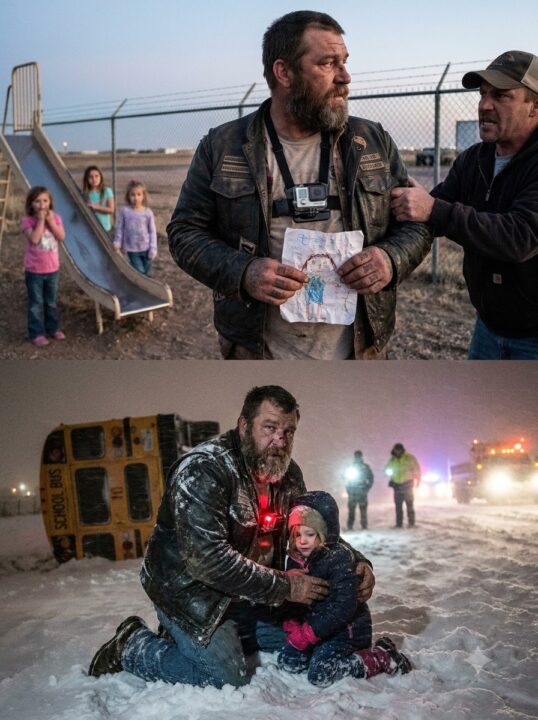
Ray’s Peterbilt sat six miles west of a school bus carrying twelve members of a middle-school robotics team. The bus driver lost control while avoiding a stalled pickup. The vehicle crossed the guardrail, dropped onto its side, and came to rest against a drainage culvert.
The students were alive.
Their heater was not.
Ray heard the emergency traffic through his CB. Responders approaching from the east were delayed by the tanker. A county unit from the west stopped behind dozens of stranded vehicles.
Ray removed three thermal blankets from his sleeper, packed road flares, a flashlight, bottled water, and a tow chain into a canvas bag, then strapped the GoPro over his leather vest.
Another driver told him not to go.
Ray stepped into the storm.
The wind drove snow beneath his collar. His beard froze against the zipper of his jacket, and each breath left ice around his mustache.
He followed guardrail posts because the road itself had disappeared.
The GoPro recorded everything.
Ray reached the bus at 2:17 p.m. He broke the rear emergency window, crawled inside, and found a driver with a dislocated shoulder and twelve frightened children wrapped in coats.
One boy had cut his forehead. A girl with asthma could not find her inhaler. Ray located it beneath a seat and held the child steady while she breathed.
He did not speak like a hero.
He assigned tasks.
“Count heads.”
“Share coats.”
“Keep her awake.”
The bus was sliding.
Each gust shifted the rear of the vehicle closer to the culvert. Ray attached the tow chain to the frame and carried its other end uphill to a utility truck stopped on the highway.
The utility driver tightened the line.
For twenty minutes, it held.
Ray led the children out one at a time and guided them uphill, his GoPro capturing little more than boots, snow, gloved hands, and the sound of his voice telling each student where to step.
Eleven reached the road.
The twelfth child, nine-year-old Sophie Dale, had crawled beneath a seat after the bus rolled. Her coat snagged on exposed metal, and panic made her fight anyone who approached.
Ray returned.
A truck trailer above them shifted when its brakes released on the ice. The utility driver shouted. The tow chain snapped tight, then dragged sideways across the road.
Ray covered Sophie.
The trailer struck the guardrail.
Steel folded.
The GoPro image went black.
For thirty-seven minutes, nobody heard Ray’s voice.
I was at the Red Lantern when the emergency call reached us. Someone identified the stranded Peterbilt by unit number, and one of my fuel-desk clerks knew it belonged to Bear.
Hawk called Ray’s phone.
No answer.
Dana called me from Springfield. Ellie was sitting upright in a hospital bed with monitoring wires beneath her gown, asking when her father would arrive.
I lied.
I said the weather had slowed him down.
At 6:22, rescuers found Ray beneath a section of aluminum trailer skirting. His left shoulder was dislocated, two ribs were fractured, and blood had frozen along his temple.
Sophie was beneath him.
Alive.
The GoPro remained fastened to Ray’s chest, its outer case cracked but intact. The camera had stopped after the impact, yet the memory card survived.
An ambulance carried Ray toward Amarillo. The closed highway turned a thirty-minute trip into nearly three hours.
At 8:11, Ray woke.
His first question was not about Sophie.
“What time?”
The paramedic told him.
Ray tried to sit up.
“Camera.”
The paramedic found it inside an evidence bag. Ray’s right hand shook too badly to open the case, so she removed the memory card for him.
“No signal,” she said.
“Need one.”
“Sir, you need to stay still.”
“Number thousand.”
She thought he was confused.
Ray explained in eleven words: “My daughter has heard me every night for three years.”
The ambulance radioed our travel center because we had the nearest functioning broadband connection west of the closure. A county snowplow brought the memory card to our service road.
It arrived at 8:36.
I inserted it into the diner computer.
The file was damaged.
The last playable image showed Ray covering Sophie as metal crossed the lens. If Ellie watched it, she would see her father disappear beneath the wreckage.
Ray had never shown her fear.
Now video 1,000 contained almost nothing else.
At 8:42, Hawk called.
“Don’t upload it.”
“It’s the only recording.”
“Then we make another.”
Ray was still in the ambulance, injured and drifting in and out. The Iron Lanterns were spread across Missouri, Oklahoma, Kansas, New Mexico, and Texas.
Hawk sent one instruction.
“Start where Bear stopped.”
Rook stood beside his motorcycle in Joplin and recorded the first sentence.
“Hey, Bug. Your dad found some bad road tonight.”
He sent the file to the next brother.
A rider in Tulsa added, “He also found twelve kids who needed him.”
A retired club member in Oklahoma City spoke next. Then a mechanic in Elk City. Then two bikers stranded near Shamrock.
Each recorded a few seconds.
No speeches.
No pretending Ray was unhurt.
At 8:54, the final file reached me. I joined the clips, added the first safe minutes from Ray’s GoPro, and sent the completed message to Dana.
The upload finished at 8:59.
In Springfield, Ellie pressed play.
She saw the storm from her father’s chest. She watched his boots move through snow. She heard him tell frightened children to count one another.
The image then faded before the trailer moved.
Hawk appeared.
One by one, the Iron Lanterns carried Ray’s message across the closed highway until the final brother looked into his phone and said, “Truck’s pointed east tonight. That means he’s pointed home.”
Then every rider spoke the closing line together.
“Goodnight, Ellie. Dad loves you past every mile.”
It was video 1,000.
Ray did not record most of it.
His road did.
Part 5 — The Goodnights Ray Had Never Seen
Ray reached the Amarillo hospital shortly after eleven. Doctors reset his shoulder, treated his ribs, and placed twelve stitches above his left eyebrow.
Sophie’s mother arrived before dawn.
She walked into Ray’s room carrying the damaged GoPro. Someone had cleaned the blood from the case but left the crack across its corner.
Ray tried to sit.
She stopped him.
“My daughter said you covered her.”
Ray looked toward the window.
“Trailer moved.”
“She said you told her to close her eyes.”
“Kids listen better with one job.”
Sophie’s mother began to cry. Ray reached for the water cup because he did not know what else to do with his hand.
She placed the GoPro on his blanket.
“My daughter wants you to keep this.”
Ray turned the camera over. The mount had bent inward against his vest, leaving a bruise directly above his heart.
“Still works,” he said.
He tested it before breakfast.
The Iron Lanterns arrived that afternoon in pickups because the roads remained too dangerous for motorcycles. Hawk carried a laptop, three hard drives, and the metal ammunition box from Ray’s garage.
Ray assumed they had brought his archive.
They had.
They had also brought Ellie’s.
Dana appeared on the laptop through a hospital call. Ellie sat beside her wearing a heart monitor and Sarah’s old blue robe.
“Dad,” she said, “you missed something.”
Hawk connected the first drive.
A five-year-old Ellie appeared on-screen. She wore pajamas covered in yellow stars and held Captain’s fishbowl with both hands.
“Goodnight, Dad,” she said. “Drive safe.”
The recording lasted fourteen seconds.
Then another began.
Ellie had lost a tooth. Ellie had learned to spell “Mississippi.” Ellie had burned pancakes. Ellie had cried after a nightmare and admitted she wanted Ray home.
Every night Ray recorded, Ellie answered.
Dana had stored the files by matching number. Video 184 showed Ellie waiting while the Goodnight Chain carried his memory card from Tucumcari. Video 427 contained the question he had avoided.
“Do you leave because of me?”
The next clip showed Ellie apologizing for asking.
Ray stopped the playback.
His hand remained on the space bar.
“You recorded all these?”
“One thousand,” Ellie said.
“Why didn’t you send them?”
“Your internet was bad.”
Ray almost smiled.
Ellie lowered her voice.
“I wanted to give them to you when you came home for number 1,000.”
Ray looked at Hawk. The road captain turned toward the hospital window, giving him privacy without leaving.
Ellie asked him to play the final reply.
The screen showed her hospital room at 9:07 the previous night. Video 1,000 from the Iron Lanterns had just ended. Ellie’s eyes were swollen, but her voice stayed steady.
“Goodnight, Dad. I know you’re not home. I know you tried.”
She held up the purple crayon drawing Ray had shown in my supply closet years earlier. The paper was soft along every fold.
“You always say you love me past every mile. I love you through every one.”
Ray looked down.
His beard hid most of his mouth, but his shoulders moved once.
No one spoke.
Then Ellie leaned closer to the camera.
“And Dad? You don’t have to make the road look safe anymore. Just come back from it.”
Ray replayed that sentence.
He had believed the videos protected Ellie from his absence. In truth, they had sometimes protected him from admitting what the absence cost.
The GoPro was never merely a gift to his daughter.
It was the way a father convinced himself that distance could be controlled if he numbered it carefully enough.
Ray watched all one thousand replies during the next six weeks.
He did not skip the angry ones.
He did not skip the nights Ellie cried.
He did not skip the recording where she placed an empty chair beside her bed and said nothing for fifty-three seconds.
When he reached the last file, he removed the GoPro from its chest harness and set it beside Sarah’s photograph.
Then he called dispatch.
Part 6 — A Different Route Home
Ray did not quit trucking immediately. Medical bills did not disappear because a man finally understood his daughter.
He changed routes.
The company offered him a regional position hauling parts between Springfield, Tulsa, Kansas City, and St. Louis. The pay was lower. Ray sold a set of custom wheels, gave up his rented garage in Amarillo, and brought the Road King home.
He still traveled.
He stopped missing entire weeks.
The recordings continued, but the rules changed. Ray no longer hid storms, fear, or exhaustion behind descriptions of sunsets. If a delivery had gone badly, he said so. If he was lonely, he used the word.
Ellie answered the same night.
Sometimes they watched each other’s messages together on weekends, correcting details and arguing about whose camera angle was worse.
The Iron Lanterns kept the Goodnight Chain active. They used it for deployed parents, traveling nurses, divorced fathers working offshore, and one club brother serving six months in county jail.
No child received a recycled recording.
That rule belonged to Ray.
Sophie visited Springfield the following summer. She brought the torn strip of her red winter coat, the piece that had snagged beneath the bus seat.
Ray placed it inside his leather vest beside Ellie’s purple drawing.
Sophie touched the cracked GoPro.
“Does it still record?”
Ray pressed the button.
A red light appeared.
The camera had survived.
On the third anniversary of the first video, Ray parked his Harley outside the Red Lantern Travel Center. Ellie climbed off the passenger seat wearing a properly fitted helmet and a denim jacket Dana had covered with small road patches.
Ray walked her to the playground.
I expected the place to bother him.
Instead, he asked me to take a photograph.
He stood where the angry father had grabbed his vest years earlier. Ellie pressed one hand against the GoPro mount over his heart.
The father who had confronted Ray happened to be inside the diner. He recognized him, approached slowly, and apologized.
Ray shook his hand.
“You watched your kid.”
“So did you.”
“Watched my sky.”
This time, both men understood.
At 8:47, Ray recorded another message. Ellie stood beside him rather than hundreds of miles away.
“Hey, Bug,” he said. “Mile zero tonight.”
She rolled her eyes.
“We drove six hundred miles.”
“Home starts where you are.”
That line embarrassed Ray enough that he nearly deleted the recording.
Ellie saved it.
Part 7 — Goodnight Number 1,001
Years later, the original GoPro sat inside a glass cabinet at the Iron Lanterns’ clubhouse. Beneath it were two hard drives, the bent chest mount, Sophie’s strip of red coat, and the first purple drawing.
There was no plaque explaining why they mattered.
The brothers knew.
Ray eventually left commercial trucking and became a safety instructor for new drivers. He taught winter recovery, load checks, and one lesson no company manual included: never promise a child the exact hour you will return from a road you cannot control.
Ellie grew tall. At sixteen, she edited short sections from the two thousand recordings—one thousand from Ray and one thousand from herself—into a private film for his sixtieth birthday.
It lasted twenty-seven minutes.
Ray watched it once in front of the club.
Nobody teased him when he stepped outside afterward.
Hawk found him beside the Harley, staring at the road while evening settled across Springfield.
“You all right, brother?”
Ray nodded.
“Too many miles?”
“Every one.”
Ellie came outside carrying the old GoPro. She fastened it to Ray’s chest, climbed onto the Road King behind him, and tapped his shoulder.
“Record one more.”
Ray started the Harley. The V-twin rumble filled the lot, shook the cabinet glass, and rolled beneath the open clubhouse door.
He pressed the red button.
“Hey, Bug. Number one thousand and one.”
“You’re supposed to say where you are.”
Ray looked into the mirror. Ellie’s helmet was directly behind his.
“Home.”
They rode through Springfield at dusk, past Sarah’s old bakery, the diesel shop, Ellie’s school, and the house where a frightened five-year-old once waited beside a window.
The camera saw Ray’s hands on the bars.
It saw Ellie’s arms around his waist.
When they returned, he left the engine running long enough to finish the message.
“Goodnight, Ellie. Dad loves you past every mile.”
Ellie leaned near the camera.
“He’s home tonight.”
Ray stopped recording.
The red light disappeared.
The Harley did not.
Follow the page and leave BEAR below for more full stories about quiet bikers carrying promises no one else can see.