He Was Kicked Off the School Bus for Not Having a Ticket — Then a Biker Started Running After It
The bus doors slammed shut behind the boy while other students stared, and the driver didn’t look back as the engine pulled away.
It was just after dawn in a small working-class town in Ohio, the kind of morning where breath shows in the air and backpacks look too big on narrow shoulders. The yellow school bus idled at the curb, diesel fumes curling into the cold.
Ethan was ten years old.
He stood on the sidewalk clutching his backpack straps, shoes scuffed, jacket zipped all the way up even though the zipper was broken and wouldn’t stay closed. In his pocket was a crumpled note from his mother—I’ll pay Friday—but the driver had already waved him off.
“No pass, no ride,” the driver said flatly. “Rules.”
Ethan tried again.
“My mom said—”
“Step off the bus.”
A few kids stared. One looked down at his phone. Another watched with open curiosity, like this was just another delay before school started.
The doors hissed closed.
The bus rolled forward.
Ethan didn’t cry. Not yet. He just stood there, stunned, watching the bus disappear around the corner. The school was too far to walk safely. The road had no sidewalk. Cars sped past, tires hissing over damp asphalt.
He checked his phone. No signal.
Being left behind is quieter than people think.
That was when the sound cut through the morning.
An engine.
Not the bus.
A motorcycle slowed near the curb. The rider wore a sleeveless shirt under a worn leather vest, tattoos visible despite the cold. He braked hard, boots scraping pavement, and turned his head toward the boy.
The biker looked from the empty road to Ethan’s shaking hands.
“Hey,” he called out. “Why aren’t you on that bus?”
Ethan hesitated.
Then he answered.
“They said I couldn’t ride.”
The biker looked up the road.
And without another word, he kicked the bike back into gear.
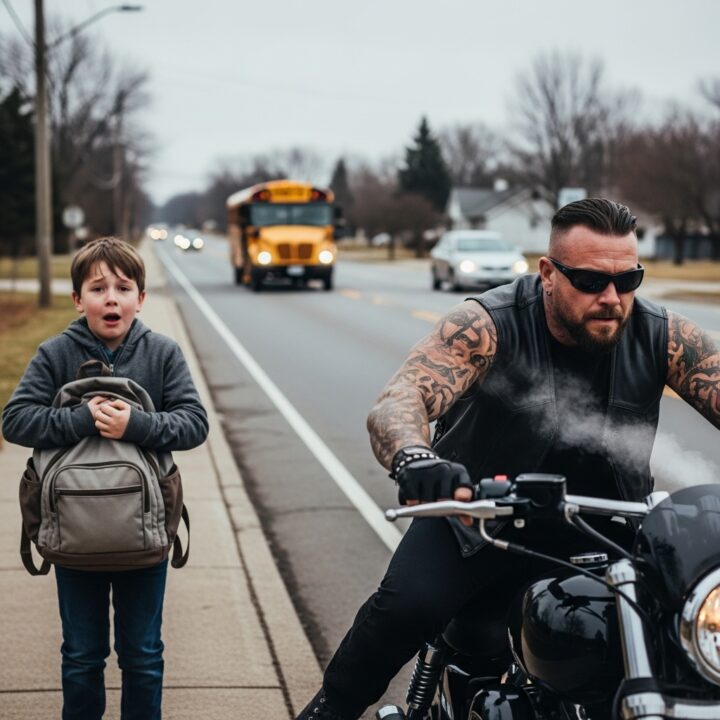
The motorcycle surged forward, engine roaring as it chased the bus down the street.
To anyone watching from a distance, it looked bad.
A biker accelerating after a school bus.
A grown man closing the distance on a vehicle full of children.
A woman waiting at the corner gasped.
“Is he chasing the bus?”
Another pulled out her phone.
“Someone call the police.”
The bus driver noticed the motorcycle in the side mirror and stiffened. He tapped the radio, voice sharp.
“Dispatch, I’ve got a biker following me. This doesn’t feel right.”
Inside the bus, kids pressed their faces to the windows.
“What’s he doing?”
“Is he mad?”
“Is he going to hit the bus?”
The biker didn’t swerve. Didn’t signal. He stayed behind the bus, close enough to be seen, far enough to keep control. At the next stoplight, the bus slowed.
The biker pulled alongside, raised one hand—not in anger, but to get attention.
The driver slammed the brakes.
“Stay back!” he shouted through the glass.
The biker cut the engine and stepped off, helmet under his arm, hands clearly visible.
“I’m not here to cause trouble,” he said. “You left a kid behind.”
Parents in nearby cars leaned forward. Someone honked impatiently. A man rolled down his window.
“Hey! Get away from that bus!”
The biker ignored him and looked at the driver.
“He doesn’t have a pass,” the driver snapped. “That’s policy.”
“He’s ten,” the biker replied. “And it’s freezing.”
The driver shook his head.
“Not my problem.”
Phones were recording now. Whispers spread fast.
Why is a biker arguing with a school bus driver?
This is getting dangerous.
The biker took a breath, jaw tight, and stepped back.
“Fine,” he said. “Call whoever you need to call.”
That didn’t calm anyone.
It made things worse.
Police sirens wailed in the distance, faint but unmistakable.
The bus idled at the light, children silent now, sensing the weight in the air. The biker stood beside his motorcycle, posture straight, eyes on the bus but body angled away—non-threatening, deliberate.
A patrol car pulled up behind him, lights flashing.
“Sir,” the officer called out, hand resting near his belt. “Step away from the vehicle.”
The biker complied immediately, taking two slow steps back.
“I just want the kid to get to school,” he said.
“Why were you following the bus?” the officer asked.
The biker reached into his vest pocket.
Gasps rippled through the onlookers.
“Hey!” someone shouted.
The biker stopped, then raised his other hand first, palm open.
“It’s my phone,” he said calmly.
He pulled it out, unlocked it, and showed the screen to the officer.
A text thread.
A name.
A photo.
“I saw him get kicked off,” the biker said. “I called his mom.”
The officer glanced toward the bus, then back at the phone.
“She’s on her way,” the biker continued. “But that road isn’t safe for him to walk.”
The driver crossed his arms.
“Still doesn’t change the rules.”
The biker looked past him, through the bus windows, to where Ethan now stood on the sidewalk again, smaller than ever.
Then the biker did something unexpected.
He typed one short message.
Hit send.
And said a single sentence, low and certain.
“Give me five minutes.”
The officer frowned.
“Five minutes for what?”
The biker didn’t answer.
From the far end of the street, a new sound began to rise—deep, steady, unmistakable.
Engines.
More than one.
Parents turned their heads. The officer looked over his shoulder.
The bus driver swallowed.
And suddenly, the balance of the moment began to shift—
not toward violence,
but toward something no one had anticipated.
The engines arrived without urgency.
They didn’t scream down the street. They rolled in—one after another—steady, controlled, respectful of the flashing lights already painting the morning. Motorcycles lined the curb in a clean arc, riders dismounting calmly, helmets tucked under arms, hands visible.
No one rushed the bus.
The biker who had chased it didn’t turn around to greet them. He stayed where he was, rain-dark asphalt beneath his boots, eyes on the boy across the street.
A second patrol car pulled in. The first officer raised a hand—not in alarm, but to pause everyone at once.
“Alright,” the officer said, voice even. “Let’s keep this calm.”
One of the riders—an older man with gray at his temples—stepped forward just enough to be heard. “Morning, officer,” he said. “We’re here because a child was left on an unsafe road.”
The bus driver scoffed. “He didn’t have a pass.”
The older rider nodded. “We heard.”
He didn’t argue. He didn’t threaten. He simply turned his head toward Ethan, who stood hugging his backpack, breath fogging the air.
“Son,” the rider said gently. “You alright?”
Ethan nodded once. Didn’t trust his voice.
A woman’s car skidded to a stop nearby. A door flew open.
“Ethan!”
His mother ran to him, hair pulled back hastily, jacket half-zipped, fear still catching up to her legs. She dropped to a knee and pulled him close, whispering apologies into his hair.
The officer checked the biker’s phone again. Then the text time-stamp. Then the road—no sidewalk, narrow shoulder, traffic already picking up.
He exhaled. “Driver,” he said, turning back to the bus, “you’re authorized to let him on.”
The driver hesitated. “Policy—”
“—doesn’t override safety,” the officer finished. “Open the door.”
The bus doors hissed open.
Silence spread—not triumphant, not loud. Just relieved.
Ethan climbed aboard. He didn’t look back until he reached the steps. When he did, he met the biker’s eyes.
The biker gave him a small nod.
Nothing more.
The truth didn’t need a speech.
It settled into place the way things do when they finally make sense.
The biker wasn’t reckless. He was a volunteer safety marshal for a local riders’ association—men and women who escorted charity rides, directed traffic at events, and responded when someone called because waiting felt like the most dangerous option.
The riders who arrived weren’t there to intimidate. They were there because the message said a child was standing on a road no child should be standing on.
The driver stared at the curb for a long moment after the bus pulled away. His arms dropped from their crossed position. He didn’t apologize. He didn’t argue.
He just watched the road again.
Ethan’s mother thanked the officer, voice shaking. She turned to the biker who had run after the bus and held out her hand.
“I didn’t know what would’ve happened,” she said. “Thank you.”
He shook his head. “Anyone would’ve done it.”
She looked at the bikes. At the riders quietly remounting, engines still off, waiting for the light to change.
“Not everyone,” she said.
The biker didn’t respond. He zipped his vest, swung a leg over the seat, and started the engine only after the last rider was ready.
They left the way they came—measured, disciplined, unremarkable to anyone who wasn’t paying attention.
Later that morning, kids would talk about a biker chasing a bus. Some would say it was scary. Others would exaggerate the sound, the speed, the tension.
But Ethan would remember something else.
He would remember standing alone and cold, and then the moment someone stopped—really stopped—and chose to act without asking for permission.
And every time he saw a yellow bus door close after that, he would also remember this:
Being protected doesn’t always look gentle at first—but it always leaves you safer than before.