Part 2: A Veteran Biker Took His Five-Year-Old Son on a Ten-Mile-an-Hour Ride Around an Empty Parking Lot — Then the Boy Refused to Let Go Because He Could Hear His Father’s Heartbeat
PART 2
Mason had not planned to let Caleb ride that morning.
He had promised “someday” for almost a year, which is the kind of promise a five-year-old treats like a debt and a traumatized father treats like a mountain.
Caleb loved the Harley the way some children love dragons. He did not understand horsepower, chrome, weight, or danger. He understood only that when the engine started, his father’s eyes changed. Not happier exactly. Quieter. Focused. Present in a way Mason struggled to be at crowded restaurants, grocery stores, or birthday parties where balloons popped without warning.
Emily noticed that too.
The motorcycle did not make Mason reckless. It made him careful.
He inspected everything with almost sacred attention. Tire pressure. Brakes. Mirrors. Fuel line. Helmet straps. Boot laces. Weather. Distance. Exit points. He did not ride fast anymore, not since returning home. Speed no longer felt like freedom. Control did.
His therapist had once asked him what the Harley gave him that other places did not.
Mason had answered, “Predictability.”
The engine vibrated, but it did not sneak up on him. The wind pressed against his chest, but it did not grab him. The road came toward him from the front, where he could see it.
Touch was different.
Touch had become complicated after Afghanistan, though Mason rarely explained the details. His body responded to surprise before his mind could name the person. Emily could stand in their kitchen and brush past his arm, and he might jerk away so violently that guilt arrived in his eyes before either of them said a word.
He hated that most.
Not the nightmares.
Not the silence.
That.
The way love sometimes reached for him and his body treated it like danger.
Caleb did not understand PTSD. He only knew Daddy sometimes needed people to say his name before they hugged him. He knew Mommy asked, “Can I touch your hand?” when Daddy looked far away. He knew thunder made Daddy go quiet.
But children learn maps adults never draw.
Caleb had discovered that leaning against Mason during bedtime stories was okay if Mason saw him coming. Holding Daddy’s sleeve was okay. Sleeping with one small foot pressed against Mason’s leg during movie night was okay.
The back of the Harley became different because everything about it was arranged.
Mason knew Caleb would be there.
He chose it.
He prepared for it.
And for once, the weight behind him did not feel like a threat.
It felt like trust.
PART 3
Emily almost said no.
Not because she doubted Mason’s love for Caleb, but because she knew how easily love and fear could crash into each other.
The lot behind the feed store belonged to Mason’s friend, Luis Ortega, a forty-five-year-old Latino American mechanic with tan skin, short black hair, a thick mustache, and the calm confidence of a man who believed safety was not boring if it kept people alive.
Luis had offered the private lot after Caleb spent three months asking whether he could “ride with Daddy just a tiny bit.”
“No public roads,” Luis said.
“No turns near traffic,” Emily added.
“No showing off,” Mason said, offended she thought he needed the reminder.
Emily gave him a look.
Mason softened.
“No showing off,” he repeated.
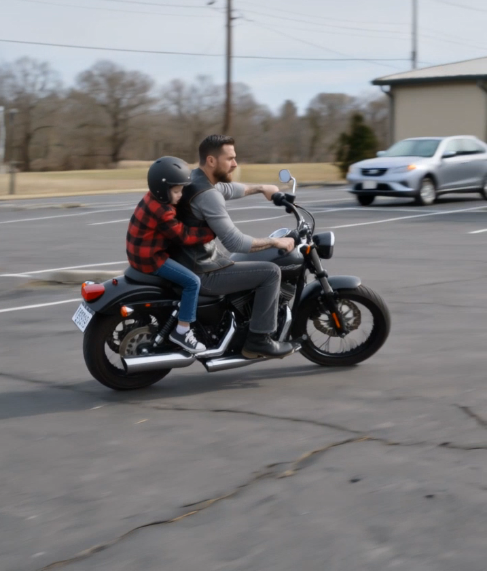
They made the ride almost absurdly careful. Caleb wore a properly fitted child helmet, gloves, long pants, boots, and a padded jacket that made him look like a very serious red marshmallow. Mason practiced with him while the bike was off: how to climb on, where to put his feet, how to hold the belt loops on Mason’s vest, what to do if he felt scared.
Caleb listened with unusual seriousness.
“Can I hug you instead?” he asked.
Mason froze for half a second.
Emily saw it.
Caleb saw it too, though he did not understand why.
Mason swallowed.
“You can hold around my waist if you keep your hands still.”
“Like bedtime?”
The question was innocent.
Mason looked toward Emily.
Her eyes had filled already, and the ride had not even started.
“Yeah,” he said quietly. “Like bedtime.”
When Caleb climbed on, his tiny arms wrapped around Mason’s stomach with awkward concentration. The helmet tapped the back of Mason’s vest. The boy’s knees pressed against his sides. It was the kind of contact that would have sent Mason’s nervous system into panic on any ordinary day.
But the engine was off.
The parking lot was empty.
Emily was visible in the window.
Luis stood twenty feet away with a first-aid kit he knew they would not need but kept anyway.
Mason took one breath.
Then another.
His hands stayed steady on the handlebars.
Emily whispered, “Oh my God.”
Not because the bike had moved.
Because Mason had not.
PART 4
The first circle lasted less than a minute.
To anyone else, it would have looked almost boring. A big Harley rolling slowly across an empty parking lot. A careful father. A tiny boy in an oversized-looking helmet. A wife watching from behind glass. A mechanic pretending not to wipe his eyes.
But inside Mason’s body, something enormous was happening quietly.
Caleb’s weight rested against his back. The boy’s hands stayed still around his stomach. The small helmet bumped softly when they turned. Mason could feel each breath his son took, and somehow none of it turned into panic.
The engine gave him rhythm.
The open lot gave him space.
The child gave him trust without demand.
Mason did not feel cured. He did not feel like the war had loosened its grip in some dramatic way. He simply felt one clear, impossible thing.
This touch was safe.
He rode one circle, then another half circle, then slowed near the feed-store window because Emily was crying openly now.
Caleb laughed once when the bike hummed beneath him.
It was a small laugh, muffled by the helmet, but Mason felt it against his back.
He almost had to stop right then.
When he finally killed the engine, silence settled over the parking lot.
Luis clapped softly, then stopped because the moment felt too private for applause.
Emily stepped outside.
Caleb still held on.
Mason waited.
“Buddy?”
No answer.
“You ready to get down?”
Caleb shook his helmet against Mason’s back.
Mason smiled faintly.
“Why not?”
That was when Caleb said it.
“Because on the bike I can hear your heart, Daddy.”
Emily stopped walking.
Caleb continued, as if explaining something obvious.
“It sounds like when you hold me while I sleep.”
Mason closed his eyes.
The child had found the heartbeat through leather, engine quiet, and his own cheek pressed against the safest wall he knew.
For three years, Mason had thought touch came with danger attached.
His son had just described it as a sound.
PART 5
Emily did not run to them.
That mattered.
There had been years when she would have rushed forward, overcome by relief, and then hated herself when Mason flinched from her joy. She had learned that love sometimes had to approach slowly, with open hands and permission.
So she stopped several feet away.
“Can I come closer?”
Mason opened his eyes.
His voice was rough.
“Yeah.”
She walked to the side of the bike, not behind him. Caleb still clung to his father’s back with the stubbornness only small children and barnacles understand.
Emily touched Caleb’s helmet first.
“You okay, baby?”
Caleb nodded.
“Daddy’s heart is loud.”
Emily laughed through tears.
“It always was.”
Mason looked at her then.
The sentence had layers.
Before deployment, Emily used to fall asleep with her head on his chest. After he came home, even that became hard. Not because he did not want her there, but because the closeness sometimes trapped him inside memories where weight against his body meant injury, chaos, hands pulling, noise, helplessness.
Emily never blamed him.
That almost made it worse.
Her patience was a kindness he feared he did not deserve.
Caleb finally loosened one arm but did not climb down.
“Can Mommy hear it too?”
The question floated between them like something fragile.
Mason’s first instinct was fear.
Then shame for feeling fear.
Then the old pattern of trying to hide both.
Emily immediately shook her head.
“Not today if Daddy isn’t ready.”
Caleb accepted that easily.
Children can be gentler than adults because they do not always need a moment to become everything at once.
Mason looked at his wife.
“Maybe not from behind.”
Emily nodded.
“That’s okay.”
He took one hand from the handlebar and placed it over Caleb’s arm.
Then, after several breaths, he held his other hand out toward Emily.
She stared at it as if he had handed her a miracle.
She took it carefully.
Mason flinched.
A little.
But he did not pull away.
Emily cried harder then, silently, because healing was not the absence of trembling.
Sometimes healing was trembling and staying.
PART 6
They told Mason’s therapist about the ride the following Tuesday.
Dr. Alan Reed was a sixty-year-old Black American trauma therapist with dark skin, close-cropped gray hair, and the kind of quiet voice that made silence feel usable instead of empty.
Mason described the parking lot as if giving a mechanical report.
Speed.
Distance.
Helmet fit.
Hand position.
Weather conditions.
Dr. Reed let him speak that way because some men enter emotion through details.
Then he asked, “What did you feel when Caleb held on?”
Mason looked at the floor.
“Weight.”
“Dangerous weight?”
“No.”
“What kind?”
Mason struggled for the word.
“Anchor.”
Emily began crying again, but softly this time.
Dr. Reed nodded.
“Predictable touch can sometimes reach places surprise cannot.”
Mason did not like the word breakthrough. It sounded too clean, too final, too much like a movie scene where pain politely exits after the right sentence. Nothing exited. He still startled that week when a grocery cart slammed behind him. He still woke sweating when a helicopter crossed low over the house. He still asked Emily to say his name before touching his shoulder.
But something had changed.
There was now one kind of touch his body had accepted.
That mattered.
Caleb, meanwhile, became convinced he was a motorcycle expert after one parking-lot ride. He told his preschool teacher that Harley engines “make daddies calm” and that helmets were “heavy hats for brave heads.”
Mason wrote that down on a receipt and kept it in his vest.
They did not ride again immediately. Mason did not want to turn the moment into a test he could fail. Instead, they practiced sitting on the parked bike. Caleb behind him. Emily beside them. Engine off. Then engine on. Then one tiny roll forward. Then stop.
Slow.
Careful.
Repetitive.
That was how Mason rebuilt trust with his own nervous system.
Not through force.
Not through shame.
Through choosing the same safe moment again and again until his body began believing him.
One evening, Caleb climbed into bed during a thunderstorm and pressed his small hand against Mason’s chest.
“Your heart is fast.”
Mason kissed his hair.
“Thunder does that sometimes.”
“Want me to be your motorcycle?”
Mason laughed for the first time during a storm in years.
“Yeah, buddy. Maybe just stay right there.”
Caleb curled against him.
Emily watched from the doorway.
No window between them this time.
PART 7
The photograph from that first ride stayed on the refrigerator for years.
Emily had taken it through the feed-store window without knowing whether the image would be too painful or too precious to keep. In it, Mason sat on the Harley with both boots flat on the ground. Caleb was behind him, arms wrapped tightly around his middle, helmet pressed against his back. Mason’s head was slightly bowed, as if listening to something only he could hear.
The picture did not show the war.
It did not show the nights Emily slept on the edge of the mattress because Mason could not bear unexpected contact. It did not show the apologies whispered after flinches, the therapy bills, the guilt, the loneliness of loving someone whose body sometimes mistook tenderness for danger.
It showed one small boy holding on.
That was enough.
Years passed.
Caleb grew too tall for the tiny red jacket, then too tall for the passenger pegs, then old enough to understand that the first ride had not been about motorcycles at all.
At twelve, he found Mason in the garage polishing the Harley before a veterans’ charity ride.
“Did I really say I could hear your heart?”
Mason looked up.
“Yep.”
“That’s embarrassing.”
“Only if you hate poetry.”
“I was five.”
“Best poets usually are.”
Caleb rolled his eyes, but he smiled.
Then he asked, “Did it help?”
Mason stopped polishing.
The honest answer was complicated.
It did not erase PTSD.
It did not make him easy to touch overnight.
It did not give Emily back every ordinary hug she had lost.
But it had given him a place to begin.
“Yes,” Mason said. “It helped.”
Caleb nodded, suddenly serious.
“Because you couldn’t see my hands?”
Mason considered lying, then chose not to.
“Partly. I knew where you were. I knew why you were holding on. I knew you trusted me.”
Caleb leaned against the workbench.
“And because I was little?”
Mason smiled.
“You were very little.”
“Am I still safe?”
The question landed gently and deeply.
Mason set down the rag.
“You have always been safe to me.”
Caleb looked away, pretending the sentence had not affected him.
A month later, at a family barbecue, Caleb hugged Mason from behind without thinking. He was twelve now, taller, stronger, no helmet, no engine, no carefully controlled parking lot.
Mason startled.
His shoulders tightened.
But before Caleb could pull away in guilt, Mason put one hand over his son’s arm.
“Stay,” he whispered.
Emily saw it from across the yard.
She did not cry dramatically this time.
She simply closed her eyes and breathed.
That was how healing had entered their family.
Not as thunder.
Not as a miracle.
As a five-year-old boy on a Harley, holding his father around the waist and refusing to get down because he had found a heartbeat through leather.
As a wife learning that hope could return without demanding too much too fast.
As a man discovering that the body can remember fear, but it can also learn safety in small, repeated acts of trust.
Mason eventually spoke at a veterans’ family event, not as a hero and not as someone cured, but as a father who learned that love sometimes has to find the one doorway trauma forgot to guard.
“My son did not fix me,” he told the room. “That was never his job. But he reminded me that my body could still recognize safe weight, safe warmth, safe love. And once you recognize one safe thing, you can start looking for the next.”
Emily sat in the front row with Caleb beside her.
The boy, now nearly grown, leaned toward his mother and whispered, “He still has a loud heart.”
Emily smiled.
“Yes,” she whispered back. “He always did.”
Follow this page for more unforgettable biker stories about fatherhood, healing, and the quiet moments that help wounded people find their way back to the people who love them.