Part 2: A Blind Little Girl Touched a Harley for the First Time Inside a Biker’s Garage — Then Her Description of the Motorcycle Made His Wife Break Down Crying
PART 2
Hannah Whitfield had spent five years teaching her daughter that blindness did not make the world smaller.
It simply changed the doors through which the world entered.
Nora could identify people by the way their footsteps paused near thresholds. She knew when rain was coming because air softened against her cheeks. She could tell whether her mother had cried at night by the careful brightness in Hannah’s voice the next morning.
But motorcycles had remained a mystery.
Not the sound. Nora loved the sound. She could hear one three blocks away and name whether it was small, sharp, heavy, deep, smooth, angry, or happy. She did not know brands or engines, but she knew feelings.
Harleys, to her, sounded like thunder trying not to scare anyone.
Her father had once owned a motorcycle, or so Hannah had told her before realizing the memory hurt more than it helped. He had left shortly after Nora turned two, overwhelmed by doctor visits, bills, grief, and the cruel disappointment of a child who would never look back at him the way he expected a daughter to look.
Hannah never told Nora the ugliest version.
She simply said, “He was not ready to be the father you deserved.”
That sentence became a room in Nora’s heart with the door half open.
Michael Donovan did not know that when he first met Nora.
He knew only that she sat beside her mother at a community support picnic, smiling every time the motorcycles arrived, tilting her head toward the engines as if listening to a language nobody else heard.
Michael belonged to a child-protection motorcycle club inspired by the principles of groups like BACA, though his chapter was careful, trained, and supervised by family advocates. They were not vigilantes. They did not replace parents, therapists, courts, or police. They simply helped children who had reason to fear adults remember that some adults could be steady.
Nora had not been abused.
But she had been abandoned.
That counted too, in quieter ways.
When Hannah mentioned that Nora wished she knew what a Harley looked like, Michael offered his garage.
Only if Hannah came.
Only with Caroline present.
Only with every part of the bike checked first.
Hannah agreed because careful kindness feels different from attention-seeking heroism.
And on Saturday morning, Nora arrived holding her mother’s hand.
She had no idea she was about to change Michael’s life.
PART 3
Michael’s garage was cleaner than Hannah expected.
She had imagined oil stains, sharp tools, heavy smells, and the kind of masculine clutter that made children unsafe. Instead, every tool hung neatly on the wall. The concrete floor was swept. The Harley sat centered beneath soft overhead lights, polished but not showy.
Caroline Donovan stood near the workbench with coffee, warm muffins, and a folded fleece blanket in case Nora wanted to sit.
Caroline was a forty-seven-year-old white American woman with fair skin, shoulder-length auburn hair, green eyes, a cream sweater, jeans, and the gentle caution of a woman who had learned that kindness toward children must always include boundaries.
She greeted Nora before touching her.
“I’m Caroline. I’m Michael’s wife. I’m standing to your left, near the table, and I have blueberry muffins if your mom says yes.”
Nora smiled immediately.
“You smell like cinnamon.”
Caroline laughed.
“That is the best introduction I have ever received.”
Michael did not rush the Harley.
He began by asking Nora what she wanted to know.
“What color is it?” she asked.
“Black,” he said, then paused because color meant little without comparison. “Black like the quiet behind closed eyes, but shiny enough that light slides across it.”
Nora touched her own eyelids.
“Is black scary?”
“Not always. Sometimes black is peaceful.”
She nodded.
Then Michael guided her toward the handlebar.
“May I place your hand on it?”
“Yes.”
The chrome was cold. Nora gasped, then laughed.
“It feels like winter pretending to be silver.”
Michael froze for half a second.
Most adults tried to explain the world to Nora.
Nora explained it back better.
She traced the mirror, the brake lever, the curve of the fuel tank. Michael described each part simply, using function instead of jargon.
“This helps steer.”
“This holds fuel.”
“This is where I sit.”
“This rubber touches the road.”
Nora asked whether the bike was dangerous.
Michael answered honestly.
“It can be. So can a kitchen knife, a stove, a swimming pool, or a road. Dangerous things are not always bad. They just demand respect.”
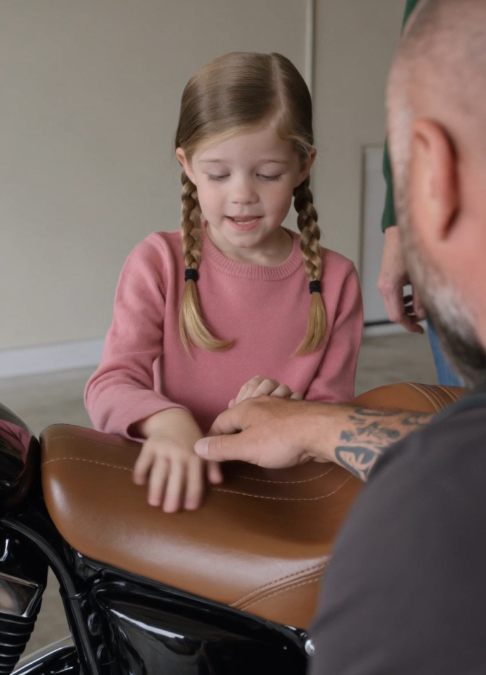
Nora placed her palm flat on the leather seat.
“This part feels kind.”
Caroline’s eyes softened.
Michael looked at the old saddle and said, “That may be the first time anyone has called my Harley kind.”
PART 4
The exhaust pipe was the only part Hannah feared.
Michael understood before she said anything.
He turned toward Nora and spoke clearly.
“This part can get very hot when the engine has been running. Today the bike is off and cooled, and I’m covering the pipe with a thick shop towel. You may touch the towel over it for one second if your mom agrees.”
Hannah appreciated the precision.
Nora appreciated being included.
“Mom?”
“One second,” Hannah said.
Michael placed his own bare hand near the pipe first, then added the towel and guided Nora’s fingers to the covered surface.
Warmth passed through the cloth.
Nora inhaled.
“That part feels like anger after it calms down.”
Michael looked at Caroline.
Caroline whispered, “She’s incredible.”
Nora moved next to the tire.
She pressed both palms against the thick rubber grooves and followed them around the wheel as far as she could reach.
“This is the shoe.”
Michael laughed.
“Yes. A very expensive shoe.”
“Does it walk?”
“It rolls.”
“Like a brave ball?”
“Exactly like a brave ball.”
For nearly an hour, Nora built the Harley inside her mind. She assembled it from cold handlebar, smooth tank, warm seat, thick tire, oily smell, garage echo, and Michael’s voice patiently naming whatever her fingers found.
She did not ask what it looked like in the way sighted people meant.
She asked what it was for.
Who sat there.
Where the feet went.
Whether rain hurt it.
Whether it got lonely in the garage.
Michael answered everything.
Eventually, Nora found his hand resting near the seat. She touched his knuckles, felt the scars, the heavy fingers, the rough palm.
“You feel like the bike.”
Michael smiled.
“Old and loud?”
“No.”
She placed one hand on the seat and one hand on his hand.
“Hard outside. Soft where people sit. Warm when it matters.”
Hannah looked down quickly.
Caroline stopped wiping the already clean workbench.
Michael’s smile faded into something unguarded.
Nora tilted her head.
“I know what it looks like now.”
“What does it look like?” he asked.
She said it without drama, without knowing the room was about to change.
“It looks like a dad.”
The word struck every adult differently.
Hannah felt guilt.
Caroline felt grief.
Michael felt a door open inside him that he had kept locked for years.
PART 5
Michael and Caroline had tried to have children.
For eight years, they built hope and lost it. They endured appointments, explanations, quiet drives home, and well-meaning people telling them they could always adopt, as if adoption were a consolation prize instead of its own sacred calling.
Eventually, they stopped trying because hope had become a room filled with sharp furniture.
Michael joined the child-protection motorcycle group afterward. At first, Caroline worried he was using other people’s children to avoid grieving the ones they never had. Then she saw the way he showed up.
He never pushed for affection.
Never asked children to call him uncle.
Never posed as a savior.
He stood near courthouse doors when families requested support. He attended supervised events. He helped repair bikes for charity rides. He let frightened children choose whether to approach him.
He became very good at being present without taking ownership.
That was why Nora’s words shook him so deeply.
“It looks like a dad.”
She had not said he was her father.
She had not even known enough about fathers to compare him to one through memory.
She had compared the idea of a father to the safest adult male standing within reach.
Michael stepped back slightly.
Not because he rejected it.
Because he respected it.
Hannah knelt beside Nora.
“Sweetheart, what do you mean?”
Nora looked confused by the adults’ sudden quiet.
“The motorcycle,” she said. “It’s hard because it has to be strong. It’s soft where somebody needs to sit. And it’s warm inside, even when the outside is cold.”
Caroline turned away, crying fully now.
Nora heard it.
“Did I say something wrong?”
Michael crouched immediately.
“No, ma’am. You said something very beautiful.”
“Why is she crying?”
Caroline wiped her cheeks and came closer.
“Because sometimes beautiful things find a sore place and touch it gently.”
Nora considered that.
“Like when Mom brushes my hair and finds a tangle?”
Caroline laughed through tears.
“Yes. Exactly like that.”
Nora reached toward Caroline’s voice. Caroline offered her hand.
“I never saw my dad,” Nora said.
Hannah closed her eyes.
Michael kept still.
Nora added, “But if dads feel like this bike, I think I would have liked one.”
The garage went silent again.
Michael looked at Hannah, asking without words whether he could answer.
Hannah nodded.
He said softly, “Then any man who gets to be a dad should try very hard to feel that safe.”
PART 6
After that day, Michael did not become Nora’s father.
He became something quieter and more careful.
He became the man who let her touch tools only after naming the sharp ends. The man who described sunrise as warmth arriving before light. The man who taught her how to recognize a motorcycle by engine rhythm and how to tell whether a person was smiling by the shape of their breathing.
Caroline became part of it too.
She taught Nora how to bake muffins by smell, touch, and timing. Hannah sometimes stood in the kitchen doorway watching her daughter laugh with a woman who had once believed motherhood had passed her by forever.
The adults kept boundaries.
Michael never picked Nora up without Hannah’s permission. He never corrected her as if he were a parent. He never allowed others in the club to turn her into a mascot or inspirational story for social media.
When the club held a charity ride for children’s advocacy, Nora attended with ear protection, seated safely beside Hannah in a parked support van. Michael let her touch the bikes before they started, one at a time, while riders introduced themselves by name and asked permission before offering a hand.
Nora became famous among them for describing motorcycles in ways that made grown men suddenly inspect their own hearts.
One bike felt like “a big dog pretending not to wag.”
Another felt like “rain wearing boots.”
Michael’s Harley remained “the dad bike.”
He pretended to hate the nickname.
He polished it more after that.
One evening, Hannah found Nora sitting at the kitchen table, running her fingers over a raised-line drawing Caroline had made of the Harley.
“What are you thinking about?” Hannah asked.
“About dads.”
Hannah sat carefully.
“What about them?”
“If mine left, does that mean I did not feel right?”
The question nearly broke her.
“No, baby. It means he did not know how to stay.”
Nora traced the motorcycle’s seat.
“Michael knows how to stay.”
Hannah swallowed.
“Yes.”
“Does staying make somebody family?”
Hannah thought about legal words, biological words, cautious words, and all the ways adults protect themselves from hope.
Then she answered as honestly as she could.
“Sometimes staying is how family begins.”
Nora smiled.
“I thought so.”
That night, Hannah called Caroline and told her what Nora had asked.
Caroline cried again.
Michael, overhearing from the garage, sat beside his Harley long after the call ended.
He placed one hand on the warm leather seat.
For the first time in years, the empty space inside him did not feel like failure.
It felt like room.
PART 7
The folded paper appeared inside Michael’s saddlebag three months later.
He found it after a support ride, tucked beneath a clean rag and secured with one of Caroline’s hair clips. At first, he assumed it was a receipt.
Then he opened it.
The paper was thick, and the lines were raised with glue so Nora could feel them. Caroline had clearly helped, but the shapes were Nora’s: uneven, careful, full of meaning rather than visual accuracy.
It showed a motorcycle.
At least, Michael believed it did.
The handlebars were too tall. The wheels were different sizes. The seat looked like a cloud. Beside it stood three figures holding hands: a small girl, a woman with long hair, and a very large man with square shoulders.
At the bottom, Caroline had written Nora’s words exactly as dictated:
This is the bike that taught me what a safe man feels like.
Michael sat down on the garage floor.
Caroline found him there ten minutes later, still holding the paper.
“She asked me not to tell you until you found it,” she said.
Michael’s voice was rough.
“I don’t know what to do with this.”
Caroline sat beside him.
“Yes, you do.”
He looked at her.
“How?”
“You keep being worthy of it.”
That became the promise.
Michael framed the drawing and placed it not in the club office, not online, not above the Harley where visitors could praise him, but inside the garage where only family and close friends could see it.
Nora grew older.
At ten, she learned to identify Michael’s bike before it turned onto her street. At twelve, she asked whether she could help polish the chrome. At fifteen, she gave a speech at a school event about accessibility, chosen family, and how touch can carry truth sight sometimes misses.
Michael and Caroline sat beside Hannah in the audience.
Nora stood at the microphone with her cane folded against the podium.
“People think I learned what a motorcycle looks like,” she said. “But that day, I learned something bigger. I learned that strong things can be gentle if the person guiding you respects your hands.”
Michael stared at the floor.
Caroline took his hand.
Nora continued.
“My father left when I was little. For a long time, I thought maybe I was too hard to love because I could not see him. Then a biker let me see his world carefully, one piece at a time, and I realized love is not about being looked at. It is about being guided safely.”
The room stood.
Michael did not.
He could not move.
Afterward, Nora found him by sound.
“You’re crying,” she said.
“Garage dust.”
“We are in a school auditorium.”
“Traveling garage dust.”
She laughed and hugged him.
Not as a child clinging to a replacement father.
As a young woman who had learned that absence does not get the final word when someone else chooses to stay.
Years later, Nora would still describe Michael’s Harley the same way.
Half hard.
Half soft.
Warm inside.
But when people asked whether she had been describing the motorcycle or the man beside it, she always smiled.
“Yes.”
Because some people enter a child’s life like thunder, all noise and leather and engine heat, only to become the gentlest shape her hands ever learned.
Follow this page for more unforgettable biker stories about chosen family, misunderstood tenderness, and the people who help children feel the world safely, one careful touch at a time.