Fourteen Bikers Arrived at a Children’s Home Carrying No Gifts — Then One Teenager Held Their Letter Over a Trash Can, and the Biggest Rider Told Me Not to Stop Him
When fourteen bikers arrived at our children’s home carrying no presents, I nearly sent them away—until the biggest man unfolded a list and asked which teenager hated having her name shortened.
I had cleared two tables for donation boxes. They stayed empty.
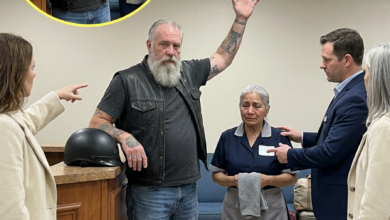
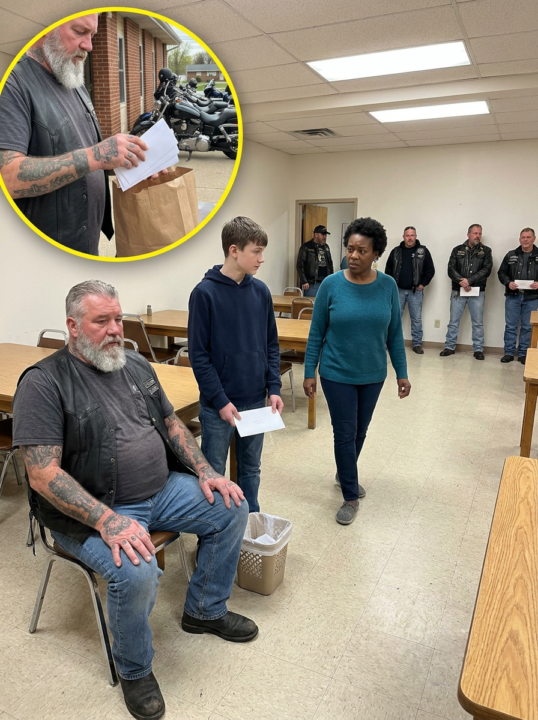
Outside, the last Harley ticked as its engine cooled. Inside, twelve teenagers watched a man built like a refrigerator remove his riding gloves with the concentration of somebody preparing to handle broken glass. His beard reached the collar of his black leather vest. Tattoos covered both forearms, and one thick finger had healed crooked.
He carried a grocery bag full of envelopes.
My name is Leah, and I worked evening shifts at a small residential home in Dayton, Ohio. We housed teenagers whose circumstances were different enough that any sentence beginning with “these kids all” was usually wrong. Some had families they loved. Some hoped to return home. Others changed the subject whenever anyone mentioned next year.
They did share one talent: spotting a visitor who needed them to look grateful.
Our director had arranged this visit after several supervised conversations with the motorcycle club. I knew there would be letters. I had assumed there would also be the usual sacks of donations, a group photograph, and someone asking everybody to squeeze together beneath our bulletin board.
Instead, the man asked where he could put his phone away.
“Ray Maddox,” he said. “And it’s Juniper, right? Not June?”
Across the room, Juniper stopped working the loose thread on her sleeve. She was sixteen, sharp enough to find the weak spot in any explanation, and tired of strangers deciding her full name was too much trouble.
“Depends who’s asking,” she said.
Ray nodded as if that were a perfectly reasonable answer. He checked the envelope again.
Behind him, a broad woman in riding boots held three letters against her stomach. Another rider had brought reading glasses in a hard case. One man kept smoothing an envelope over his knee, although the paper was already flat. Nobody unpacked toys. Nobody raised a camera.
Ellis, seventeen, looked toward the empty tables.
“That’s it?”
The room tightened. I had heard that tone before, usually after an adult announced a wonderful surprise that turned out to require the children to sing.
Ray glanced at the envelopes. “Today, yes.”
Ellis laughed without smiling. “You rode all that way with homework?”
A couple of the others laughed, too. Ray didn’t ask them to be respectful. He pulled out a chair, checked that it wasn’t blocking the doorway, and sat. His knees barely fit beneath the table.
“Nothing you have to do,” he said.
That made Ellis more suspicious.
I noticed something when Ray opened his vest to put away his glasses. Inside the pocket was one yellowed envelope, much older than the others, its edges reinforced with clear tape. He touched it once, almost absentmindedly, then left it where it was.
The fresh envelopes all had names. The old one was turned inward.
Juniper leaned forward. “Did somebody tell you what to write?”
“Some things,” Ray said. “Only what you said staff could share.”
“Like what?”
“That you draw buildings.”
“Everybody knows that.”
He looked down at her envelope. “And you hate it when people call every drawing a dream house.”
Her hands went still.
That detail had come from a conversation she had almost refused to join. I remembered because she’d spent most of it looking at the clock. Apparently, somebody on the other end had been listening.
Ray placed her letter on the table, within reach but not in her hands.
She didn’t touch it.
Then Ellis asked the question I should have asked before setting out the chairs: “What happens when you get bored with us?”
Ray stopped arranging the envelopes. Around him, fourteen people in leather suddenly looked less like a visiting club and more like people facing a test.
Then he reached inside his vest for the battered envelope, and I understood that Ellis had just asked the one question this man had come prepared to answer.
Part 2 — The Names on the Envelopes
The name on the old envelope was Raymond. Beneath it was an address Ray said had been a group home.
Ray laid it facedown again. “Before we get into mine,” he said, “you ought to know what you agreed to.” He looked at Ellis, then at the rest of the room. “You agreed to meet us. You didn’t agree to perform.”
Our director, Della, stepped forward before I could. She explained that anyone could take a letter upstairs, ask a staff member to hold it, read it there, or leave it alone. Nobody had to stay for the visit. The kitchen remained open, and the basketball game outside could continue without an audience.
Omar immediately asked whether leaving meant losing his share of the brownies. Della pointed toward the tray. “Those are still brownies, Omar.” He took two and sat down.
A little air came back into the room.
I wish I could say I had understood the afternoon from the beginning. I hadn’t. I had spent six years helping young people manage the space between what an adult intended and what actually happened. By then, I sometimes distrusted a good intention before it had finished introducing itself.
Three months earlier, a local company had brought headphones, pizza, and a photographer. Several residents enjoyed the visit. Juniper did not, especially after someone moved her chair to improve the photograph and called her “sweetie” instead of asking her name. The headphones were useful. Both things could be true.
I had also watched Ellis wait through an entire Saturday for a visitor who never came. He claimed he had forgotten the appointment. He stayed in his shoes until dinner.
So when Della first mentioned a motorcycle club, I pictured noise, a speech about choices, and somebody asking our teenagers to pose beside expensive bikes. I offered to work the kitchen. Della told me I could make coffee, but I couldn’t decide what people would be like before meeting them.
The first meeting had surprised me. Ray brought two club members and a notebook. He asked what the home actually needed. Della named practical things: transportation help arranged through staff, grocery support, dependable volunteers. He wrote those down instead of explaining what he preferred to donate.
Then she said something else.
“Some of our older residents have a drawer full of gifts from people whose names they don’t know.”
Ray’s pen stopped.
That led to the supervised conversations, offered only to residents who wanted them. They weren’t interviews. People folded laundry together, played cards badly, and disagreed about whether a hot dog counted as a sandwich. Ray lost at checkers to Ellis twice. The second time, Ellis accused him of losing on purpose.
“First time, maybe,” Ray admitted. “Second time, you got me.”
I remembered that now as he struggled to fit his glasses over one ear. He hadn’t arrived knowing these children. He had asked permission to begin knowing them, then returned.
The woman with silver braids was Denise, a bus mechanic who carried peppermint candies but remembered to ask before offering any. Her letter was for Omar. He had told her he wanted to learn to cook something that didn’t come with microwave instructions.
He turned the envelope over. “Is this a recipe?”
“Partly.”
“Does it have onions?”
“Not a single one.”
Omar looked genuinely impressed. Adults had forgotten bigger things about him, but onions were a good place to start.
At the far end of the table, a rider named Luis sat with a teenager who had asked for help understanding a job application. He didn’t reach for the pen. He waited while the boy finished reading. The room grew ordinary, which was a better sign than any sudden round of applause.
Ray stayed across from Juniper and Ellis. He had written their letters himself, although he made clear that anyone could choose a different correspondent or none at all. Juniper slid one fingernail beneath her envelope’s flap. Ellis watched her rather than his own.
Inside was a single sheet, written in blue ink. Not calligraphy. Some words leaned downhill. A sentence near the bottom had been crossed out neatly and rewritten in the margin.
Juniper frowned.
“What?” I asked.
“He crossed something out.”
Ray nodded. “Got it wrong.”
“Why didn’t you use a new piece?”
“I did. Twice. Kept getting things wrong.”
She studied the page again. “You could’ve typed it.”
“Could’ve.”
There was no clever answer afterward. He simply waited, hands on his knees.
Juniper read the first paragraph, then the second. Her eyes slowed over something in the middle. I couldn’t see the words, and I didn’t lean over her shoulder.
Across from her, Ellis finally broke the seal on his envelope. He used a spoon handle rather than his fingers, taking absurd care not to tear anything after threatening to throw it away.
I pretended not to notice.
Ray pretended better than I did. He turned to ask Omar whether the brownies contained walnuts, and Ellis unfolded the paper in the brief privacy that an ordinary conversation can give somebody.
Then he read one line twice.
His chair scraped backward.
“Who told you that?”
Part 3 — The Promise Nobody Could Make
Ray turned toward him, but he didn’t stand.
Ellis held the page at arm’s length. His face had gone flat in the way it did when a feeling arrived before he had somewhere to put it. I set down the coffee pitcher. Della moved closer, leaving space between them.
“Which part?” Ray asked.
Ellis jabbed the paper. “This.”
He didn’t read it aloud. Ray waited until Ellis pushed the sheet across the table, then looked where the boy was pointing. I could see only the edge of the paragraph.
“You told me,” Ray said.
“No, I didn’t.”
“At the checkers table. You said you were fixing that cabinet in the art room. Asked whether pine splits easier near the end.”
Ellis blinked. “That was just talking.”
“Yeah.”
“You put it in here?”
Ray nodded once.
The anger didn’t disappear. It changed direction. Ellis looked around, suddenly aware that several people had stopped talking, and folded the letter hard along its original crease.
I asked if he wanted to step into the smaller sitting room. He said no, then yes, then grabbed his soda before anyone could mistake the move for a punishment. Ray looked at Della. She asked Ellis whether he wanted Ray there.
“Whatever.”
“That’s not a yes,” she said gently.
Ellis stared at the floor. “He can come.”
I went with them. Through the open doorway, I could still hear Omar asking Denise why every recipe described an onion as small when onions came in suspiciously different sizes.
In the sitting room, Ellis chose the chair nearest the exit. Ray took the low couch and set the old envelope on his thigh. I perched on the radiator cover, a habit Della had told me to stop approximately a thousand times.
Ellis opened his letter again.
The paragraph that had startled him was about the cabinet. Ray had written that Ellis had noticed a door dragging before anyone else did, and had checked the hinge before sanding the edge. He called that paying attention, not a miracle, not hidden genius.
Below it, he had asked whether the repair held.
That was what Ellis couldn’t get past.
“You actually want to know?”
“Yes.”
“It’s a cabinet.”
“I fix things for a living. Cabinets qualify.”
For a second, Ellis almost smiled. Then he saw the next paragraph again, and the smile vanished.
It said Ray would return on the second Saturday of the following month, between two and four, if Ellis wanted another visit. Della would have the details. If anything changed, staff would tell him before that afternoon.
“You can’t know you’ll come,” Ellis said.
“It’s on my calendar.”
“People have calendars.”
Ray accepted that without defending calendars or people.
Ellis started picking at a loose seam on his jeans. “There was a guy who said he’d teach me guitar. He came twice. Then he got busy.” He looked toward the doorway. “I still had to give back the guitar.”
I remembered the guitar. I also remembered telling him the man probably had a lot going on.
Sitting there, I wished I could take back the explanation I had offered instead of an apology.
Ray rubbed his thumb over his crooked finger. “That shouldn’t have been put on you.”
“Are you going to say you’re different?”
“No.”
The answer surprised all three of us.
“I can tell you what I plan to do,” he continued. “Then you get to see whether I do it.”
Ellis studied him, searching for the part that usually came next: the demand to trust, the complaint about ingratitude, the reminder that these people had given up their Saturday.
None came.
A broad rider named Cal appeared in the doorway carrying coffee. He’d heard the last exchange and wanted to help. I could see it in the way he bent toward Ellis, eager to make something difficult feel simple.
“Brother, you got fourteen of us now. We’re not going anywhere.”
Ray lifted a hand.
“Cal.”
“What?”
“We need to talk about that.”
Cal’s smile faltered. Ellis looked from one man to the other.
For the first time, the club stopped looking unanimous.
Cal set the coffee on a side table. “I’m saying we’re here for him.”
“I know what you’re saying.”
“Then what’s the problem?”
Ray’s voice stayed low. “All fourteen of us haven’t promised next Saturday. Don’t make him count on fourteen.”
The room went quiet enough that I could hear a dryer turning down the hall. Cal looked embarrassed, then irritated. I braced for Ellis to make a cutting joke and end the whole thing.
Instead, he asked Cal, “Are you coming next month?”
Cal opened his mouth, closed it, and checked his phone.
“My daughter’s moving that weekend.”
Ellis gave one small nod. It was not triumphant. That made it worse.
Cal put the phone away. “I should’ve checked before I said that.”
“Yes,” Ellis said.
Nobody rescued Cal from the answer.
After a moment, Cal asked if he could leave his letter with Della for the teenager he’d met. He would explain what days he could actually offer before arranging another visit.
When he left, Ray didn’t call him a bad man. He picked up the coffee Cal had brought and took a sip.
Ellis leaned back. “He’s mad at you.”
“He’ll survive.”
“You’ll get in trouble with your club?”
“Wouldn’t be the first time.”
Something in that answer loosened the boy’s shoulders. Not much, but enough for him to look at the envelope resting against Ray’s jeans.
“Is that why you keep that thing?” he asked. “Somebody promised you something?”
Ray looked down.
The tape along the edge had gone cloudy. He ran one finger over it before answering.
“Somebody came back.”
Then he opened the envelope, and the man I had spent the afternoon trying to understand handed me a piece of paper older than I was.
Part 4 — The Man Who Missed Tuesday
The paper was lined, the kind sold in school supply packs. At the top, in firm handwriting, someone had written, “Raymond, I owe you an apology about Tuesday.”
I glanced at Ray. He nodded permission to keep reading.
There was nothing grand about the letter. A man named Walt had missed a visit because his truck wouldn’t start. He should have called the home earlier, he wrote. Raymond had done nothing wrong by being angry. Below that was a question about a model bridge, a reminder that Walt still had the paintbrush he’d borrowed, and a new visiting time.
At the bottom, three sentences stood apart.
“You are not forgotten. You don’t have to be easy company for me to remember you. I will see you Saturday.”
I read them once. Then I read them again.
Ray watched Ellis, not me. “He worked maintenance at the place I lived,” he said. “Wasn’t a counselor. Wasn’t trying to take me home.”
“How old were you?”
“Fourteen when he started writing. Fifteen when he wrote that one.”
Ellis looked at Ray’s beard, evidently trying to fit a teenage boy inside that enormous body.
“What’d you do?”
Ray understood the question beneath the question. “To end up there? Nothing a kid should have had to fix.” He let that answer stand. “Later, I did plenty that was mine.”
Walt had known him first as the boy who helped sort screws into coffee cans. Ray liked the workshop because broken things stayed broken for reasons somebody could explain. Walt gave him small jobs and corrected his work without making every mistake sound like a prediction.
When Ray moved to another home across town, Walt asked whether he wanted letters. Ray said he didn’t care. Walt checked with the adults responsible for him, then wrote anyway, with permission and no demand for an answer.
At first, Ray stuffed the envelopes under his mattress. He read them after lights-out. There were questions about school, complaints about Walt’s tomatoes, and descriptions of repair jobs that had gone wrong.
“One time he sent three pages about a squirrel in the attic,” Ray said. “Didn’t learn a damn thing about the squirrel. Learned he thought of me while it was happening.”
Ellis lowered his eyes to his own letter.
Ray told us there had been donated bicycles, winter coats, and toys in those years. He needed the coats. He loved one of the bicycles until somebody stole it. He wasn’t going to pretend paper could keep a kid warm or put dinner on a plate.
“But by fifteen, another package didn’t tell me whether anybody remembered which kid I was.”
He touched the lined page.
“This did.”
Outside the sitting room, a chair scraped and somebody laughed. The afternoon kept going. I was grateful for that; it kept the conversation from turning into a stage.
Walt had missed that Tuesday visit, Ray explained, and Ray had decided the whole friendship was finished. He refused to come downstairs when the apology arrived. On Saturday, Walt sat in the common room for forty minutes.
“Then he left?” Ellis asked.
“Visiting hours ended.”
“Did you see him?”
“No.”
“What happened after?”
“He wrote about his truck. Said the starter was bad.”
Ellis shook his head. “He wasn’t mad?”
“Probably. Didn’t turn it into my job.”
The next visit, Ray came downstairs. They argued about whether his bridge needed another support. Walt had brought the borrowed paintbrush.
Ray’s voice roughened at that detail. He took a drink of coffee and found it had gone cold.
Walt did not save him from every bad decision. Ray wanted us to know that. At twenty-three, he went to prison after taking part in a warehouse burglary. He had known what he was doing. A worker lost his job in the aftermath, and Ray couldn’t explain that away with his childhood.
Walt wrote to him there, too.
“Didn’t say it was fine,” Ray told Ellis. “Said I owed people better. Asked what I was reading.”
There was room for both things in the letters: accountability and the stubborn fact that somebody still expected an answer about an ordinary Tuesday. After his release, Ray found steady repair work, got help with his drinking, and spent years becoming somebody his friends could rely on.
He bought his first used Harley long after that. Walt, by then walking with a cane, refused a ride but insisted on inspecting the seat.
“Said it looked uncomfortable.”
“Was it?” Ellis asked.
“Terrible.”
They both smiled.
Walt died when Ray was forty-six. Ray kept the letters in a metal box, except for this one. This one traveled in his vest, inside a waterproof sleeve when rain threatened.
I handed it back carefully.
“Why this one?”
Ray looked toward the dining room, where fourteen adults had arrived believing they knew something about showing up.
“Because he missed Tuesday,” he said. “Then he did the next thing right.”
I finally understood the taped edges, the crossed-out sentences, and his refusal to let Cal promise an entire club’s future. Ray wasn’t protecting the afternoon from disappointment. He knew disappointment would happen.
He was trying to make sure it didn’t become another child’s evidence that they weren’t worth the trouble.
Ellis looked at the last line of his new letter. With his permission, I read it later.
“You have not been forgotten, Ellis. If you don’t feel like talking next time, I can still lose at checkers.”
He didn’t cry. He didn’t hug Ray. He folded the paper carefully and put it in the pocket of his hoodie, then asked whether Ray really thought the cabinet needed a different hinge.
Ray said he’d have to see it.
They stood up together. The old letter returned to the vest; the new one stayed against the boy’s chest.
In the hallway, Juniper was waiting with her envelope.
“Mine says you’ll look at my floor plans,” she told Ray. “You know anything about floor plans?”
“Some.”
“Then I have questions.”
For the first time all afternoon, he looked properly outnumbered.
Part 5 — The Saturday Ray Couldn’t Come
Juniper spread three drawings across the dining table and moved Ray’s coffee to a place she considered less dangerous. She didn’t ask whether he liked the pictures. She asked why the hallway in her latest design felt wrong.
Ray studied it with his reading glasses halfway down his nose. “Where do you put your shoes?”
“By the door.”
“Which door?”
She pointed, then frowned at the space she’d left. He waited while she picked up a pencil.
That was the afternoon I remembered afterward: not fourteen motorcycles, not a speech, but a man taking a teenage girl’s question seriously. Juniper changed the hallway. Ray admitted he didn’t know whether one wall needed to carry a load and offered to ask a qualified friend, through Della, if Juniper wanted.
“Don’t guess,” she said.
“Wasn’t planning to.”
At the other table, Denise and Omar had reached a disagreement about measuring flour. Omar believed every recipe should include what happened if you only had a coffee mug. Denise said they could find out during a future cooking afternoon if staff approved it.
Luis was listening to someone complain about a school assignment. Cal had returned from the parking lot and was quietly correcting the visit dates he’d given Della. Nobody held up a child and called the day a success.
Before leaving, Ray asked whether the unused donation tables were usually needed for something else. I told him we played table tennis on them when the proper table broke.
He looked at the uneven legs. “Explains the score.”
It was a small joke. I laughed harder than it deserved, partly because my guard was finally coming down.
Then the riders left. The engines started one at a time, and several residents watched from the porch because they liked motorcycles. Others stayed inside. Ray did not treat either choice as a review of his afternoon.
There were no group pictures. I had nothing to post.
I did have twelve used cups, crumbs in the couch, and seven empty envelopes in the recycling bin. The letters themselves were elsewhere. Juniper had tucked hers behind a drawing. Omar put his beside the kitchen’s recipe folder.
Ellis took his upstairs.
For three weeks, that seemed like the whole story.
Then Ray called on a Thursday morning.
His younger sister had fallen ill, and he needed to drive to Indiana to help after she left the hospital. He couldn’t make Saturday. He sounded exhausted, irritated with the situation, and more frightened of one phone call to our home than I would have expected.
“I need to tell Ellis,” he said.
We arranged a call with me present, at a time Ellis chose. Ray explained what had changed without burying him in medical details. He wouldn’t be there Saturday. Denise and Luis still planned to visit, but they weren’t a substitute he had chosen for Ellis.
Ellis listened with his arms folded.
“Knew it.”
“I understand.”
“No, you don’t. You said you’d come.”
“I did. I’m sorry.”
Ray didn’t ask the boy to reassure him about his sister. That mattered. He gave a day when he would call Della with an update, rather than inventing a return date he couldn’t keep.
Ellis ended the conversation early. Afterward, he took the letter from his pocket, flattened it on the table, and slid it toward me.
“Keep it.”
“Do you want me to throw it away?”
He shook his head.
I put it in a plain folder in my desk, where he knew he could ask for it. Not returned. Not destroyed. For that afternoon, that was as far as he could go.
Saturday, Denise came in a station wagon because it was raining. Luis arrived with wet socks and a complaint about a leaking boot. No engines announced them. Omar was disappointed about that until Denise produced the coffee mug he had insisted on using as a measuring cup.
Ellis stayed upstairs.
They didn’t send me to fetch him. They cooked with the teenagers who wanted to cook. The first batch came out flat. Omar wrote a warning beside the recipe and underlined it twice.
On Monday, Ray called Della exactly when he’d said he would. His sister needed more help than expected. He still couldn’t give a visiting date.
But he had written another letter.
Ellis refused it the first time I offered. Two days later, he asked whether Ray had mentioned the cabinet. I told him I hadn’t read his letter.
He stood in my doorway for a full minute.
“Fine. Give it here.”
That evening, he asked to use the art room.
Meanwhile, the club had its own trouble. I heard about it from Ray later, not from a dramatic confrontation in front of the children. A few members wanted another big ride, something people would notice. Several were stretched thin with work and family. Cal worried that they were promising a program they couldn’t sustain.
He was right to worry.
So they got specific. Fewer visitors at a time. Commitments people could actually make. Letters through the home, with staff helping manage changes. Material support handled separately, because being remembered didn’t replace needing groceries.
Four riders chose not to continue visiting. Nobody called them traitors. They helped in other ways, and the adults explained changes instead of leaving children to guess.
Ray returned five weeks after the missed Saturday. He came alone, helmet under one arm, and waited in the dining room while Ellis decided whether to join him.
It took twenty minutes.
Then Ellis walked in carrying the cabinet hinge and both letters.
“Your first suggestion didn’t work,” he said.
Ray pulled out a chair.
“Show me.”
There was no applause that time, either.
Part 6 — The Letters That Kept Coming
After that, I stopped measuring the visits by how many motorcycles arrived.
Some Saturdays brought three riders. Some brought one tired woman with grocery-store flowers for the kitchen table and a request for strong coffee. Once, snow kept everybody home, and the teenagers who wanted to joined a supervised video call that spent ten minutes failing to unmute Luis.
Omar declared it the best meeting yet.
The letters continued at a pace people could keep. They didn’t all arrive on the same day. They weren’t always beautiful. Denise wrote about a cake that collapsed. Cal described trying to assemble his daughter’s bookshelf with one piece backward, then admitted she had been the one to fix it.
The adults became people, which gave the teenagers something safer to work with than heroes.
Some residents never wanted a correspondent. One preferred help practicing for job interviews. Another wanted to join the cooking afternoons but keep his personal life entirely his own. Della made room for both without turning the letter project into a test of belonging.
Juniper started answering Ray in the margins of photocopied floor plans. Her first response contained no greeting, just a circle around a doorway and the words, “You were right about this.”
Ray told me he kept it on his refrigerator.
She still had difficult weeks. A disappointing family call could leave her furious at everybody who happened to be in the room. Ray didn’t receive a better version of Juniper as a reward for caring. Sometimes she told him she didn’t want company, and he spent the visit helping Omar measure something instead.
Next time, he asked again.
In late summer, she invited him to a school exhibition. He went through the same visitor arrangements as everyone else and arrived wearing a clean shirt beneath his vest. Juniper had displayed a design for a small apartment building with shared laundry on every floor.
I asked about the laundry rooms.
“People shouldn’t have to drag everything down three flights,” she said.
Ray stood beside her model for almost an hour. He asked questions, listened to the answers, and never once called it a dream house.
Ellis watched all of this with the caution of somebody checking a repaired tire before trusting it. He still teased Ray. He still sometimes declined a visit. But he began asking Della for the schedule instead of pretending the calendar didn’t matter.
One afternoon, I found him explaining a loose hinge to a younger resident. He had the cabinet door balanced against his knee, and he was letting the other boy hold the screwdriver.
“No, feel where it catches,” he said.
I heard Ray’s patience in it, but Ellis’s voice remained his own.
That fall, the club helped replace our failing washing machine through an ordinary donation to the home. No procession. No ceremony. The invoice went to Della, and Omar celebrated by announcing he could finally stop timing the spin cycle with a calendar.
The letters didn’t make us stop needing money, trained staff, or families working through complicated things. They took their place beside those needs, small enough to be dismissed and personal enough that their absence could be felt.
Ray’s sister recovered slowly. Sometimes he talked about visiting her. Ellis began asking how she was doing, not because anyone suggested gratitude, but because her life had become part of the man’s ordinary conversation.
Near winter, Ellis asked for an envelope.
I handed him three, assuming he needed them for paperwork. He returned two.
“Just one.”
A week later, Ray arrived with that envelope tucked beside Walt’s old letter. He didn’t tell me what Ellis had written. He only asked whether the boy was around and whether he had brought the right kind of hinge this time.
I pointed toward the art room.
Before he went, he stopped beside my desk. The huge hand holding his helmet tightened for a moment.
“Thanks for keeping that first letter,” he said.
I knew which one he meant: the one Ellis had pushed away after the canceled visit.
“He asked me not to throw it out.”
Ray nodded.
Then he went down the hall, boots sounding on the worn floor, carrying a small paper bag from the hardware store. Ellis had asked him to bring it.
Part 7 — The Address Around Back
Ellis turned eighteen in February. Leaving the home took longer than he’d expected, which frustrated him until the actual moving date arrived and suddenly seemed much too soon.
He moved into supported housing across town. There were appointments, forms, and a bus route he practiced twice with a staff member. He had a part-time job that wasn’t glamorous and a training course he hoped would lead somewhere. The club didn’t hand him a perfect future.
Ray helped carry boxes.
He asked where Ellis wanted the desk rather than choosing a spot. Ellis changed his mind three times. Ray moved it three times, then suggested they sit down before either of them discovered a fourth corner.
I brought sandwiches and remembered not to add onions. Omar had supervised that part.
On the desk, Ellis placed a small stack of letters tied with a shoelace. Not a ribbon. A shoelace from a pair of sneakers he’d worn until the soles separated.
He caught me looking.
“Don’t.”
“I didn’t say anything.”
“You were about to.”
I put the sandwiches down.
That evening, after the boxes were empty and Ray had gone to get his motorcycle from the lot, Ellis stood beside me in the little kitchen. The refrigerator hummed. Somebody upstairs dropped something heavy and swore.
“It’s loud,” he said.
“Different loud.”
He nodded.
For a moment, I could see the boy who used to stay in his shoes waiting for a visitor. I could also see the young man checking whether his cabinet doors opened all the way. Neither canceled the other.
Ray knocked on the open doorway before coming back in.
“You want me to write here?” he asked.
Ellis glanced toward the letters on the desk. Now he was an adult, and the choice of whether to share his new address was his.
“You planning on stopping?”
“No. Asking where.”
Ellis took a scrap of paper and wrote down the address, although Ray was standing inside the apartment. He added the unit number carefully.
“Mailboxes are around back,” he said.
Ray folded the paper and put it in his pocket.
A month later, Ellis visited the home for dinner. He complained that living on his own involved an unreasonable number of dishes. Omar offered to sell him a recipe. Juniper asked whether the apartment had decent windows.
Before leaving, Ellis gave Della an envelope for a younger resident who had agreed to hear from him. He didn’t ask us to make the boy read it. He left his old monster movie collection for the common room and kept the letters Ray had sent.
He knew what he wanted to carry forward.
By spring, I had new residents to learn about and new mistakes to avoid. The empty donation tables were tables again, covered with homework, toast crumbs, and whatever project somebody had spread across them. Sometimes there were toys, too. Being older didn’t mean anybody had to stop enjoying them.
But when a visitor asked what to bring, I no longer answered before asking the people who lived there.
Ray still came. Not every Saturday, not with fourteen motorcycles, and never with a promise that nothing would interfere. His beard grew a little whiter. His reading glasses acquired a strip of tape that Juniper found unacceptable.
One rainy afternoon, he sat at our dining table with a postcard from Ellis beside his coffee. Ellis had said he could show it to me.
There were only a few lines. His course was going all right. The upstairs neighbor still dropped things. He had finally bought a proper dish rack.
At the bottom, beneath a small drawing, he’d added: “Cabinet’s holding. Got room for you Sunday if you’re free.”
Ray checked his calendar before answering.
Then he took out a pen.
He wrote slowly, one scarred hand holding the card steady while rain tapped against the windows and the coffee cooled beside his elbow.
This time, he was the one invited.
Follow our page for more biker stories about quiet kindness, difficult promises, and the people who find a reason to show up again.