Fifty Bikers Surrounded a Locked Missouri House and Pounded the Door—Then a Child’s Small Hand Appeared Behind the Upstairs Curtain
Fifty Harleys boxed in the little blue house while fifty leather-clad bikers hammered the front door, and from my porch it looked less like a rescue than the opening minute of a gang attack.
I was forty-eight then, a night-shift emergency dispatcher named Claire Donnelly, living across Juniper Street in Springfield, Missouri. I had heard doors slam after midnight and watched the little boy abandon his red bicycle whenever his father’s truck appeared, but I had never seen anything like what arrived at 6:17 that Thursday evening.
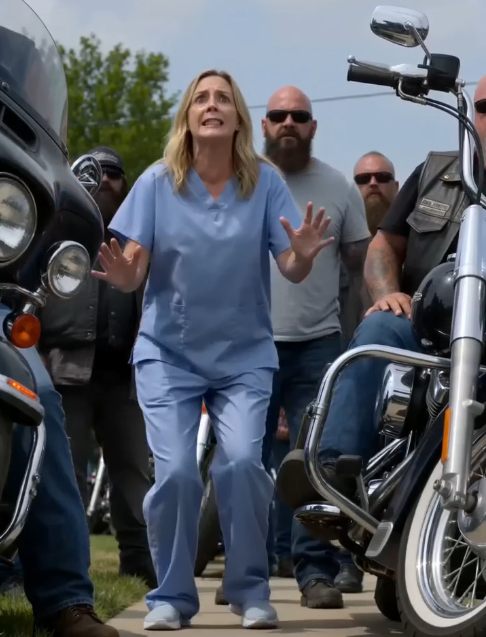
The first engine came low and hard. Then another answered it. Within ninety seconds, the street shook beneath fifty V-twins, chrome headlights filled both curbs, and men and women in weathered leather cuts stepped into the smell of gasoline and summer rain.
Their leader was impossible to miss.
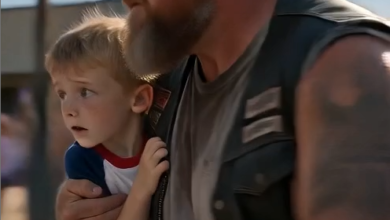
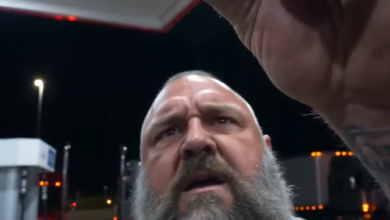
Marcus “Bear” Callahan was fifty-five, six-foot-five, and close to three hundred pounds, with a shaved head, braided gray beard, tattooed arms and neck, and a pale scar crossing one eyebrow. His heavy boots struck the porch boards like a judge’s gavel.
Then he pounded on the door.
“Daniel!” he shouted. “Open it.”
No answer came. The curtains downstairs had been pulled tight, the family SUV blocked the garage, and every exterior door appeared locked. Bear knocked again—three blows hard enough to rattle the porch light—while the other riders spread around the yard.
To anyone watching, they looked as though they were sealing the house for an attack.
Mrs. Alvarez dragged her grandchildren inside. Two teenagers began recording while someone behind me yelled that the bikers had weapons.
They did not.
Bear had ordered every rider to leave anything that might be mistaken for a weapon inside the saddlebags. I learned that later. At the time, I saw tattooed arms, clenched jaws, and fifty strangers refusing to leave.
I called 911.
While I gave the address, a sharp crack came from inside the house. Bear froze with his fist inches from the door. The rage left his face so quickly that what replaced it frightened me more.
Fear.
He pressed one ear against the wood. Beside him, a short Latina rider named Rosa removed her leather glove and held up a phone with a shattered corner. On the screen was a message only four words long, sent seventeen minutes earlier.
HE LOCKED US IN.
Below it sat an unfinished second message and a blurry photograph of a child’s blue sock beside a bathroom vent.
“Police are coming!” I shouted, partly as a warning and partly because I still believed the bikers might be the danger.
Bear turned toward me. His scarred hands were open.
“Good,” he said. “Tell them there’s a woman and a boy inside.”
Before I could ask how he knew, a man appeared behind the upstairs curtain. He grabbed the fabric, saw the motorcycles, and vanished. Seconds later, a child’s hand pressed against the glass—small, trembling, there for only a heartbeat.
Bear stepped off the porch and spoke to all fifty riders.
“Nobody enters angry. Nobody touches him unless he makes us. We open the way, get them out, and hold the ground until uniforms arrive.”
That did not sound like a gang leader preparing an assault. It sounded rehearsed.
Rosa began circling toward the back fence. Two riders moved parked motorcycles away from the driveway so an ambulance could enter. Another biker, a broad Black woman in her sixties, unfolded a child’s blanket from her saddlebag as though she had known exactly what they might find.
Then something heavy struck the upstairs wall.
The little hand disappeared.
Bear looked once at Rosa’s phone, once at the window, and then drove his shoulder into the front door. The frame cracked, neighbors screamed, cameras rose, and three police cruisers turned onto Juniper Street just as fifty bikers closed ranks around the porch.
But the strangest part was not why Bear broke that door.
It was how he knew which locked room to reach—and what seven-year-old Noah had hidden inside the bathroom vent.
Part 2
The first police cruiser stopped sideways across Juniper Street. Officer Aaron Bell stepped out with one hand near his holster and ordered everyone away from the house.
For half a second, nobody moved.
Fifty bikers stood in the rain around a splintered front door. Their engines ticked as they cooled, leather creaked when shoulders turned, and every phone held by every neighbor pointed toward the same enormous man on the porch.
Bear lifted both hands.
“Woman and child upstairs,” he said. “Possible confinement. Possible assault. Man inside.”
Officer Bell shouted for Bear to get on the ground.
Bear obeyed.
That surprised me more than the motorcycles had. He lowered himself slowly because his left knee did not bend well, placed his scarred palms on the wet porch boards, and let a younger officer secure his wrists without arguing.
“Upstairs bathroom,” Bear said as the cuffs closed. “Blue tile. Linen cabinet on the west wall. There’s a service opening behind it.”
The officer paused.
“How do you know that?”
Bear looked toward the window where the child’s hand had disappeared.
“Because I built it.”
Two officers entered through the broken doorway. A third moved along the side of the house. The fifty riders backed toward the curb without complaint, though one of them—a broad man called Diesel with a red beard and fists the size of hammers—kept staring at the upstairs window.
Rosa caught his sleeve.
“Hold the line,” she said.
“There’s a kid in there.”
“And Bear gave an order.”
Diesel’s jaw tightened. He stepped back.
The officers had been inside perhaps twenty seconds when a man’s voice shouted from the second floor.
“They’re attacking my family! Those people came to kill us!”
It was Daniel Walsh.
I had lived across from Daniel for three years. He worked as a security supervisor at the county courthouse, coached Little League twice a month, and waved whenever he saw me carrying groceries. His lawn stayed trimmed. His trash cans were brought in before sunset. At Christmas, he hung white lights in perfect straight rows.
That was the version Juniper Street knew.
Another version existed behind the curtains.
We had heard pieces of it without admitting what they meant: an argument cut short when someone noticed a porch light, a plate breaking after midnight, Emily wearing long sleeves during a Missouri heat wave. Once, Noah had come to my porch asking whether he could keep his bicycle in my garage “until Dad was done being mad.”
I had let him.
Then I had accepted Emily’s explanation the next morning—that Daniel had been tired, that Noah exaggerated, that everything was fine.
Good intentions had made me polite.
Politeness had made me useless.
A second crash came from upstairs. Officer Bell pulled Bear to his feet and moved him away from the entrance.
Bear did not resist, but he looked at the officer with an urgency so controlled it sounded almost cold.
“The bathroom door opens inward. He’ll block it with the laundry chest. Go through the linen panel.”
“You said you built it?”
“Eight years ago.”
“For this family?”
Bear looked toward Rosa.
“No. For my sister.”
That was the first crack in the story I thought I understood.
Eight years earlier, the blue house had belonged to Bear’s younger sister, Anna Callahan. She had bought it after leaving a marriage nobody in the Black River Brotherhood liked to discuss. Bear had spent six months repairing the place: new porch boards, stronger locks, a secondhand furnace, and blue tile in the upstairs bathroom because Anna said it reminded her of the swimming pool where she worked as a teenager.
She had asked for one unusual thing.
A way out.
Bear built a narrow service opening behind the linen cabinet. It connected to a maintenance space above the garage and descended by a folding ladder to a side door. It was not elegant. It was barely wide enough for an adult, but it meant a person trapped upstairs would not have to pass through the hallway.
Anna never used it.
She died in a highway collision the following winter, struck by a driver who crossed the center line. Bear sold the house to cover the medical bills left from her final week. The next buyer replaced the side door, and Bear assumed the hidden opening had been sealed.
Five years later, Daniel and Emily Walsh moved in.
Bear had never met them.
At least, that was what he believed until Rosa received Emily’s message.
Rosa Martinez had worked beside Emily at a medical billing office before Daniel pressured Emily to resign. Months earlier, Emily had quietly asked Rosa whether the riders she saw in Rosa’s photographs were as dangerous as they looked.
“Some are,” Rosa had answered. “Mostly to buffet breakfasts.”
Emily had laughed. Then she asked a question that stopped Rosa from laughing.
“If somebody needed fifty witnesses, could you get fifty?”
Rosa told Bear. Bear gave Emily a number that rang to a prepaid phone kept in the club garage. He also gave her a simple instruction: if speaking was unsafe, send a picture of the room and one sentence saying where she was.
Emily never contacted them.
Until Thursday.
The first photo showed a blue tile floor, the edge of a child’s sock, and a rusted vent cover Bear recognized because his own hands had installed it. The unfinished second message contained only six visible words:
NOAH PUT IT IN THE VENT—
Whatever “it” was, Bear did not know.
But he knew the room.
More importantly, he knew the hidden way out.
Officer Bell’s radio snapped to life. An officer inside reported that the staircase was blocked by overturned furniture. Daniel was refusing commands. A woman had called out once, then gone silent.
Bear turned his cuffed hands toward Rosa.
“Show him the picture.”
She held the cracked phone out to Bell.
The officer studied the blue floor, the sock, and the dark vent cover. Then he looked at the enormous man whose knees were bleeding through wet denim because he had gone to the ground without a fight.
“Can you show us the outside entrance?”
Bear nodded.
“If it’s still there.”
Officer Bell removed the cuffs.
Fifty bikers watched the steel bracelets come away. None cheered. None moved closer.
Bear rubbed his wrists once.
Then he led the police toward the side of the house.
Part 3
The old entrance was hidden behind a plywood panel inside the garage, but the garage door was locked and Daniel’s SUV sat against it from the inside. Bear walked the officers to the narrow space between the house and the fence, knelt beside a row of overgrown hydrangeas, and began scraping mud away from the foundation.
“What are we looking for?” Officer Bell asked.
“Two brass screws.”
Bear found the first beneath a layer of blue paint. The second had rusted almost smooth.
Diesel appeared at the fence with a screwdriver from his saddlebag. Bell raised a hand, and Diesel stopped immediately.
“Set it down and step away.”
Diesel placed the tool on the grass.
Bear picked it up only after Bell nodded.
The small panel opened into darkness. Damp air came out carrying the smell of insulation, wood dust, and something electrical burning.
Bear leaned close.
“Emily?” he called. “My name is Marcus. Rosa sent me.”
No answer.
Then came three faint taps.
Pause.
Three more.
Bear closed his eyes for a second. Not relief. Calculation.
“That’s the cabinet,” he said. “Somebody’s hitting the other side.”
Officer Bell called for the fire department and another unit. Bear measured the opening with his shoulders and shook his head.
“I won’t fit.”
A thin Asian American rider named Minh Tran stepped forward. He was forty-two, a motorcycle mechanic with silver at his temples and a leather cut hanging from a frame much smaller than Bear’s.
“I will.”
Bell refused at first. The passage was unstable, the house had not been cleared, and no civilian was going inside while an aggressive suspect remained upstairs.
Then a child screamed.
Every rider heard it.
Diesel took one step toward the house.
Bear caught him by the chest with one forearm.
“No.”
“He touched that boy.”
“We don’t know that.”
“I heard him.”
“So did the police.”
Diesel’s eyes shone with something older than that evening. His younger sister had lived for two years with a man who broke furniture near her face, then apologized by replacing it. Diesel had carried that history into the yard like gasoline in an open jar.
Bear lowered his voice.
“You go in angry, you make yourself the story. The mother and boy are the story.”
Diesel looked away first.
He returned to the curb and began moving spectators behind the motorcycles, creating a wide corridor for the ambulance. It was the hardest useful thing he could do, and Bear knew it.
Inside the house, Daniel continued shouting that armed bikers were breaking in. He claimed Emily was unstable. He claimed Noah had been injured because she had panicked. He said everybody outside was being manipulated by a woman who needed treatment.
The sentences came too quickly.
I knew the pattern from emergency calls. Not the exact words, but the structure: a person describing everyone else’s supposed instability while making sure his own behavior remained outside the frame.
Officer Bell listened without arguing. Another officer reached the landing but could not see past the overturned dresser and dining chairs Daniel had dragged upstairs.
The side passage remained the safest route.
The fire department arrived. A compact firefighter named Lila Grant crawled through the foundation opening with a helmet light, radio, and small pry bar. Bear stayed outside, one hand pressed against the siding, following her progress from the sounds beneath his palm.
Eight feet.
Turn left.
Past the old copper pipe.
Up the folding ladder—if it still held.
Lila’s radio crackled.
“Ladder’s been removed.”
Bear looked toward the upstairs wall. The maintenance shaft rose twelve feet from the garage ceiling to the linen cabinet. Without the folding ladder, Lila could not climb it safely.
“Can she reach the conduit?” Bear asked.
Officer Bell repeated the question.
Lila found a steel electrical conduit secured along the studs, but it was too narrow to support her weight.
Bear stared at the riders along the curb.
“Minh.”
The mechanic approached again.
“You still have the climbing straps from Flagstaff?”
Minh pointed toward his touring bike.
“Left saddlebag.”
The straps were intended for securing motorcycles on transport trailers. Minh and Lila fed one through the opening and around a structural brace. The firefighter tested it, then pulled herself slowly into the shaft.
Nobody spoke.
The only sounds were rain dripping from the gutter, police radios muttering, and the soft metallic knock of Lila’s equipment against the wall.
She reached the cabinet.
“Something’s blocking the panel.”
“The laundry chest,” Bear said.
“No. Smaller.”
A whisper came through her radio.
“It’s a child.”
Bear moved closer.
Officer Bell crouched beside the opening. “Can you speak to him?”
Lila’s voice softened.
“Hey, buddy. My name’s Lila. I’m on the other side of this cabinet.”
Noah answered so quietly the radio barely carried it.
“Are you with the motorcycles?”
Lila looked back through the dark shaft toward Bear.
“Yes.”
“My mom said the big one would know the blue room.”
Bear’s scarred fingers tightened against the siding.
“What did your mom tell you to do?” Lila asked.
“Hide the phone. Then block the door.”
“Is your mother with you?”
A pause.
“She fell down.”
Bear turned his face away. His beard hid most of it, but his right hand began to tremble. He curled it into a fist until the shaking stopped.
Lila instructed Noah to move aside. The cabinet shifted an inch, then caught against something heavy. She pushed again. Wood scraped tile.
Inside the house, Daniel heard it.
His shouting stopped.
Bootsteps crossed the upstairs floor.
Officer Bell raised his radio and warned the officers at the staircase that Daniel was moving toward the bathroom. Bear was already heading for the front door.
Bell grabbed his arm.
“You stay here.”
“He knows about the panel now.”
“My officers know too.”
“Your officers are behind a dresser.”
“And you’re unarmed.”
Bear looked down at Bell’s hand on his vest, then at the upstairs window.
“So is the boy.”
Daniel reached the bathroom first.
The crack that followed was not a gunshot. It was the bathroom door striking the laundry chest from the hallway side.
Noah cried out.
Lila shoved through the linen opening, climbed over the cabinet, and entered the bathroom. She found Emily unconscious but breathing beside the bathtub and Noah wedged between the toilet and wall, clutching a red prepaid phone against his chest.
Daniel hit the door again.
The laundry chest slid six inches.
Lila braced it with both boots and called for immediate entry.
Bear did not wait for permission.
He ran through the broken front door.
Part 4
Fifty bikers did not storm the house.
One did.
Even then, Bear did not run toward Daniel. He went to the foot of the staircase and put his shoulder under the overturned dresser blocking the officers. Two police officers were pushing from above, but the dresser legs had wedged between the banister posts.
Bear lifted.
His damaged knee buckled. Wood groaned. The pale scar above his eye turned white as every muscle in his neck tightened.
“Again,” he said.
Diesel appeared behind him.
Officer Bell shouted for Diesel to stay outside, but Bear shook his head once.
“Help me move it. Nothing else.”
Diesel gripped the opposite corner.
Together, the two men raised the dresser high enough for an officer to kick one chair free. The barricade collapsed sideways, and the police reached the landing.
Daniel stood outside the bathroom door holding a short metal flashlight. He was not covered in blood. He did not look like the monster the street would later imagine. He wore khaki pants, a courthouse polo, and one house slipper because the other had come off on the stairs.
That made the scene worse.
Monsters are easy when they look like monsters.
Daniel looked like a man neighbors trusted with spare keys.
Officer Bell ordered him to drop the flashlight. Daniel turned toward the bathroom as if measuring whether he could reach the door before the officers reached him.
Diesel saw the movement.
He started up the stairs.
Bear caught the back of his leather cut and pulled him down hard enough to stop him, not hurt him.
“Hold.”
Daniel swung the flashlight once toward the closest officer. It struck the banister. Two officers brought him to the floor, removed the flashlight, and secured his hands.
Diesel stood at the bottom step, chest heaving.
“He deserves—”
“Doesn’t matter,” Bear said.
Bear’s voice stayed low.
“Kid sees what we do next.”
That sentence held Diesel more firmly than any hand could have.
Lila opened the bathroom door after police confirmed Daniel was restrained. Paramedics climbed over the damaged furniture with a stretcher and medical bags.
Noah came out first.
He wore blue pajamas with one sock missing. His brown hair had been cut unevenly above one ear, and both hands were wrapped around the red prepaid phone. He looked past the uniforms, past the paramedics, and directly toward Bear.
The boy froze.
Bear was bigger indoors. His tattoos climbed from his wrists beneath his sleeves and disappeared into his collar. Rain darkened his beard. Blood from his scraped knees stained his jeans.
He looked exactly like the man Daniel had told Noah to fear.
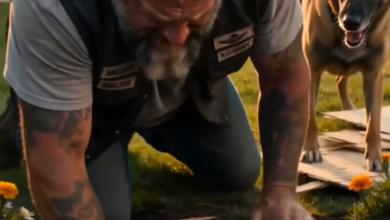
Bear lowered himself onto one knee.
The bad one.
The joint shook beneath him, but he remained there until his face was below the child’s.
“You Noah?”
The boy nodded.
“I’m Bear.”
Another nod.
“Your mama sent us.”
Noah stared at the leather vest.
“Are you the big one?”
“So they tell me.”
“My mom said you’d know where the wall opened.”
Bear looked toward the bathroom.
“She remembered.”
Noah held out the phone.
“I put it in the vent like she told me.”
Bear did not take it. He turned toward Officer Bell.
“Evidence.”
That single word mattered.
The officer pulled on gloves and accepted the phone directly from the child. When he asked Noah whether anyone had told him what was on it, Noah shook his head.
“Mom just said it remembers things when people don’t.”
The phone contained eleven audio recordings, fourteen photographs, and a list of dates written in Emily’s notes application. Some recordings captured threats. Others captured long silences broken by Daniel demanding passwords, money, or explanations for ordinary errands.
There was also a video Noah had accidentally started while hiding the device.
It showed very little: blue floor tile, the dark mouth of the vent, his small fingers, and Emily standing between him and the bathroom door. Daniel’s voice came from the hallway, telling her nobody would believe a woman who invited a motorcycle gang to attack her own home.
The recording had continued after the screen went dark.
That was what Noah had hidden.
Not a weapon.
Not stolen money.
Memory.
Emily had bought the prepaid phone two months earlier with cash saved from grocery change. She kept it switched off behind the vent because Daniel checked her regular phone every night. Noah knew about it only because he had once watched her remove the screws with a dime.
The emergency plan was simple. If Daniel locked them upstairs again, Noah would take the red phone, start recording, and push it into the vent. Emily would send Rosa a picture of the blue floor before Daniel took her regular phone.
They had practiced once while Daniel was at work.
They had never expected the plan to involve fifty motorcycles.
Paramedics carried Emily down on a stretcher. She had a concussion, bruising along one shoulder, and an injured wrist, but she was conscious by the time they reached the porch. Her eyes opened when the stretcher wheels struck the threshold.
She saw Bear.
For a moment, panic crossed her face.
Then she noticed Rosa standing beside him.
“You came,” Emily whispered.
Rosa bent close. “You asked.”
Emily looked past her toward the riders occupying both sides of Juniper Street.
“I asked you.”
“You asked one of us,” Rosa said.
Bear stepped back so the paramedics could pass. He did not touch Emily or ask her to explain anything in front of the neighbors. He simply removed his leather cut, folded it over the broken edge of the doorway so the stretcher would not scrape against splintered wood, and held the frame steady.
As the ambulance doors opened, Daniel was led outside in handcuffs.
The crowd changed instantly.
People who had been filming the bikers shifted their phones toward Daniel. Neighbors who had called Bear a criminal began shouting questions at the man from the blue house. One teenager moved close enough to record Daniel’s face.
Bear blocked the camera with his body.
The teenager protested.
Bear pointed toward Noah, who was wrapped in the blue blanket beside the ambulance.
“Kid doesn’t need his worst night online.”
The phone lowered.
Daniel looked at Bear.
“You think you saved them?”
Bear did not answer.
Daniel smiled through a split lip caused when he struck the floor during his arrest.
“She’ll come back. They always come back.”
Diesel moved.
One boot. One step.
Bear placed a scarred hand against his chest.
Again, Diesel stopped.
Officer Bell put Daniel into the cruiser. The door closed between him and the street.
Everyone seemed to exhale at once.
We thought the crisis was over.
Then Emily grabbed Rosa’s wrist from inside the ambulance.
“The envelope,” she said.
Rosa leaned closer.
“What envelope?”
Emily’s eyes moved toward the house.
“Anna’s envelope. He found it.”
Bear went still.
He had never told Emily about Anna.
Part 5
Police searched the house after obtaining Emily’s consent and later a warrant. I stayed across the street until nearly midnight, first because officers might need my statement and then because leaving felt like repeating every earlier moment when I had decided the sounds from that house were none of my business.
Bear sat on the curb with his cut folded beside him. Without it, he looked older. The black T-shirt stretched across his shoulders, but the years showed in the stiffness of his hands and the way he straightened his left leg.
Rosa stood over him.
“You never told me about an envelope.”
“Didn’t know there was one.”
“Emily said Anna’s name.”
“I heard her.”
Bear stared at the upstairs bathroom window.
After Anna died, he had cleared her belongings from the house alone. Clothes went to a church closet. Furniture went to neighbors. He kept one coffee mug, an old swimming medal, and the yellow toolbox she had given him when he began carpentry work after leaving county jail at twenty-six.
He believed that was everything.
Anna had left something behind.
Detective Nina Harper brought the first bag from the house at 10:41 p.m. Inside it was a white envelope darkened by age, the edges stained with rust. It had been found beneath the bathroom vent cover, behind the prepaid phone.
Across the front, Anna had written one word.
MARCUS.
Bear did not reach for it.
Detective Harper explained that because the envelope had been recovered during a criminal investigation, it would be photographed and examined before it could be released. She asked whether Bear recognized the handwriting.
“Yeah.”
“Did your sister ever mention hiding documents?”
“No.”
“Was she afraid of someone?”
Bear looked at the pavement.
“All the time.”
Anna’s first husband, Wade, had controlled her bank account, isolated her from friends, and broken things close enough to her body that he could claim he had never hit her. When Bear discovered what was happening, he drove to their apartment after drinking and attacked Wade in the parking lot.
Bear went to jail for eleven months.
Wade used the incident as proof that Anna’s family was dangerous. He convinced her to stop calling them. By the time she finally left, she had learned not to ask Bear for help because she feared he would solve every problem with his fists and become another man deciding what happened to her.
That was the past Bear carried beneath his vest.
Not the pride of having hurt Wade.
The shame of making Anna’s escape harder.
After his release, Bear stopped drinking. He joined a riding club through a mechanic who offered him work, learned carpentry, and spent years accepting that protection without restraint could become another form of control.
When Anna bought the blue house, she allowed him to repair it under one condition.
“No breaking doors,” she told him. “Build me one I can open myself.”
That was why he created the passage behind the linen cabinet.
It was not intended for a dramatic rescue. It was meant to give Anna a choice she controlled.
The letter explained the rest.
Detective Harper returned three days later and handed Bear a photocopy. The original remained with the case because Daniel’s fingerprints had been found on it.
Bear read the letter alone in the Black River Brotherhood garage. Rosa waited by the workbench. Diesel pretended to adjust a carburetor on a motorcycle that did not need adjusting.
Anna had written it eight years earlier.
She said she knew Bear blamed himself for not arriving soon enough, but she had not needed him to arrive angry. She had needed a brother who would believe her, sit beside her, and wait while she chose the next door.
The hidden passage had given her that.
During her first month in the house, Anna sometimes slept in the bathroom because it was the only room where she believed she could escape from two directions. She had placed the letter inside the vent on the night Bear finished the cabinet, intending to give it to him when she felt strong enough to speak about the marriage.
Then the highway collision happened.
The letter stayed in the wall.
Years later, Emily found it while cleaning rust from the vent. She read the first line before realizing it belonged to someone else and returned it to the envelope. She searched property records, learned Anna had owned the house, and eventually found Bear through Rosa’s motorcycle photographs.
That was why Emily had asked whether Rosa could bring fifty witnesses.
It was not a random number.
Anna’s letter contained a line about Bear’s club:
Your forty-nine loud friends waited outside while you built me a quiet way out. With you, that made fifty people who believed me before I could believe myself.
At the time, the Black River Brotherhood had fifty active members.
The same number arrived for Emily.
Daniel discovered the envelope two weeks before the rescue. He assumed Emily had been communicating secretly with Bear. He began checking her routes, her receipts, and her phone more aggressively. When he found Rosa’s number on a scrap of paper, he accused Emily of planning to leave with a biker gang.
Thursday’s confinement began because Emily refused to tell him where the red phone was hidden.
She did not know Noah had watched her place it in the vent.
Noah knew.
When Daniel took Emily’s regular phone, Noah crawled into the bathroom, started the prepaid recording, and pushed the device behind Anna’s letter. Then he dragged the laundry chest against the door just as they had practiced.
A dead woman’s escape plan had waited eight years inside a wall.
A child finished it.
Bear reached the last paragraph of Anna’s letter and stopped reading. His thumb covered one sentence while the paper trembled between his hands.
Rosa sat beside him.
“What did she say?”
Bear handed her the page.
The final paragraph was short.
Anna wrote that Bear would always look frightening when he was scared because fear sat badly on a man his size. She asked him not to waste the rest of his life proving he could break doors.
Find people who need one built, Marcus. Then wait outside until they choose to use it.
Rosa read the sentence twice.
Across the garage, Diesel switched off his wrench.
Bear folded the photocopy along the old lines.
That night, he removed a small iron door charm from a drawer beneath his workbench and fastened it inside his leather cut. Anna had worn it on a bracelet after moving into the blue house.
Nobody made a speech.
The next morning, the club changed its rules.
Part 6
The Black River Brotherhood had always helped quietly: a tank of gas for a stranded family, a motel room after a house fire, a ride to court for someone whose car would not start. But help had depended on knowing the right person at the right moment.
Bear wanted something more disciplined.
They partnered with a Springfield domestic violence organization and called the program Open Door. The name was Anna’s, though the public never knew that.
Every participating rider completed training on de-escalation, confidentiality, evidence preservation, and how to support a survivor without making decisions for them. They learned that fifty motorcycles could create safety, but they could also create panic. They learned to stand where they were asked, leave when professionals took over, and never post photographs of the people they helped.
Diesel nearly quit during the second training session.
The instructor asked him to role-play listening without offering a solution. He lasted forty seconds before telling the imaginary survivor exactly what she should do.
The instructor stopped him.
“You just replaced one person controlling her with another.”
Diesel walked outside.
Bear found him sitting on the curb beside his Harley.
“She was talking about my sister,” Diesel said.
“No,” Bear replied. “She was talking about you.”
Diesel stared at him.
Bear sat beside him, bad leg stretched into the parking lot.
“Took me eleven months in jail and eight years after that to hear it.”
Diesel returned to the classroom.
Emily and Noah moved first to a confidential shelter and later to a small apartment on the north side of Springfield. The criminal case took months. Daniel pleaded guilty to charges that included unlawful restraint, domestic assault, and interference with emergency communication. The recordings from the vent mattered, but Emily’s testimony mattered more.
Bear attended no hearings unless she asked.
For the first one, she did.
He sat in the rear row wearing a plain gray shirt instead of his leather cut. Rosa sat beside him. Diesel waited outside with the motorcycles because the courthouse security staff did not appreciate fifty riders gathering at the entrance.
Afterward, Emily approached Bear near the elevators.
“You didn’t have to break the door,” she said.
Bear studied her face, unsure whether she was angry.
“The police were there.”
“I know.”
“I should’ve waited.”
Emily shook her head.
“Not that door.”
She handed him an estimate from a carpenter. The blue house required a new front frame, staircase repairs, and replacement cabinets. Insurance disputes had delayed everything.
Bear looked at the total.
“I can fix it.”
“I don’t want to live there.”
“Then don’t.”
“I want the next woman who lives there to have the passage.”
Bear understood.
For three weekends, members of the club repaired the house under police-approved access arrangements. They widened the maintenance opening, installed a code-compliant emergency window, and rebuilt the linen cabinet so it opened with one push from inside.
No weapons. No engines. No crowd.
Just sawdust, coffee, and the steady knock of hammers.
Noah visited once with Emily and a caseworker. He walked through every room except the upstairs hallway. When Bear showed him the repaired passage from the garage side, the boy placed one hand against the new panel.
“Can a big person fit now?”
Bear measured the opening.
“Not me.”
Noah considered this.
“You should make it bigger.”
So Bear did.
Part 7
One year after the evening fifty bikers surrounded the blue house, Juniper Street heard engines again.
This time, nobody called 911.
The Black River Brotherhood rode in two slow lines and parked along one curb, leaving every driveway clear. There were still fifty motorcycles, though three riders had changed and one old Harley arrived on a trailer because its owner refused to let heart surgery erase his place in the count.
The blue house belonged to a new family. They knew nothing about the people who had lived there before, only that one upstairs cabinet opened into an unusually wide maintenance passage.
Emily did not attend.
That was her choice.
She and Noah had moved to Kansas City, where Emily worked in a pediatric clinic and Noah had joined a youth baseball team. He no longer abandoned his bicycle when trucks entered the parking lot, though loud knocking still made him stop whatever he was doing.
Bear never asked him to forget.
At 6:17 p.m., Rosa placed a blue porch light on a folding table in the club garage. Beside it lay Anna’s letter inside a plain wooden frame.
The riders did not hold a memorial parade. They did not tell strangers they had saved anyone. They spent the evening assembling emergency bags for the shelter: documents folders, prepaid chargers, children’s socks, bus cards, toiletries, and small notebooks with no club logo printed on them.
Around eight, a package arrived.
Inside was a red toy motorcycle and a photograph of Noah standing beside his new bicycle. On the back, Emily had written:
He still remembers the sound of all fifty engines. Now he knows they were outside, not coming in.
Bear read it once and passed it to Rosa.
Then he found a screwdriver and fastened the toy motorcycle above the workbench, directly beneath Anna’s iron door charm.
The Open Door riders have answered eleven calls since that night. Sometimes twenty motorcycles arrive. Sometimes two people come in an old pickup because engines would attract the wrong attention. Sometimes the safest thing the brotherhood can do is pay for a motel room and remain invisible.
Bear still looks like the man most people cross a parking lot to avoid. His beard has gone almost white, his left knee bends even less, and his scar still makes his resting face appear angry.
But before every call, he gives the same order.
“No heroes. No revenge. We make room.”
Last summer, I visited the garage with Noah’s old red bicycle, which had remained behind my house after Emily moved. Bear repaired the chain, straightened one wheel, and shipped it to Kansas City.
Before sealing the box, he placed a small brass screw inside the package.
It came from the original bathroom vent.
Noah keeps it in his desk now.
Every July, at exactly 6:17, fifty riders turn their engines off outside the Black River garage. For one full minute, there is no V-twin thunder, no chain rattle, and no heavy boots crossing concrete.
Only silence.
Then Bear opens the garage door.
Follow our page for more biker stories about intimidating riders, quiet courage, and the brotherhood that knows saving someone begins by believing the voice behind a locked door.