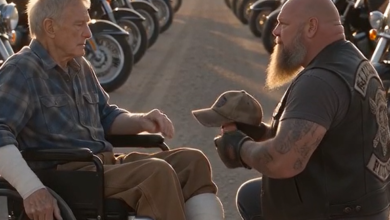
THE WEDDING COORDINATOR ROPED OFF THE CHURCH STEPS TO STOP A BIKER—THEN HE LIFTED A COVER AND THE GROOM RECOGNIZED THE BLUE BICYCLE.
THE COORDINATOR PULLED A VELVET ROPE ACROSS THE CHURCH STEPS, BUT THE BIKER STAYED RIGHT WHERE HE WAS AND UNCOVERED A CHILD’S BICYCLE.
Frank Maddox had parked his cruiser at the far end of the church walk in Mill Creek, Ohio, on a Saturday in October. He’d left his helmet on the seat and wheeled a small, covered bicycle toward the steps. Ben Carter came out just then with his new wife, Leah, still holding her hand because they’d spent the whole ceremony being told where to put theirs. Somebody behind them was looking for the bag of dried petals.
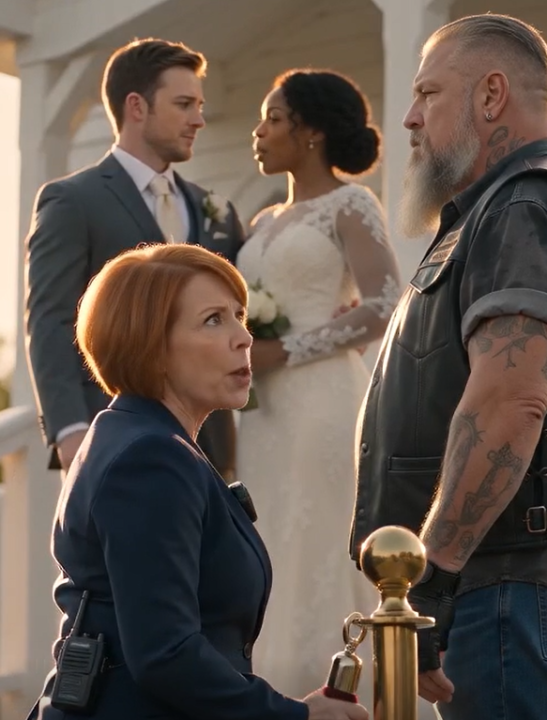
Denise Walsh, the wedding coordinator, stepped between Frank and the bottom stair. She pulled a burgundy velvet rope across the walk and clipped it to a brass post. The clasp rang loud enough to turn several heads.
“Deliveries go around back,” she said.
“I’m here for Ben.”
“Everyone says they know somebody. This is a wedding. Take your club out of the pictures.”
Someone gave a short laugh and looked down. Ben knew the man’s face from the grocery store. He’d never seen him find a reason to stare so hard at his own shoes.
Frank stood six foot four, about 285 pounds, with close-cropped silver hair, a long gray beard, and tattoos down both forearms and across his knuckles. A stitched lantern covered the back of his short-sleeved black leather jacket. He held the bicycle still with one gloved hand. Ben could smell warm gasoline from the curb and hear a cooling engine tick behind the guests.
Denise touched the radio at her waist. “I’ve got an uninvited group at the front. They won’t move.”
Frank hadn’t been asked to move until she told him to go around back. Still, Ben looked down the walk and saw all those jackets. He imagined one bike starting, then another, the sound carrying into the church where his mother was still gathering her purse. For a second he nearly asked Frank to wait until the photographs were done.
Then Frank pulled off his right glove, working each finger loose before tucking it into his jacket pocket. He lifted the gray cover slowly enough to keep it from snagging. Blue paint caught the sun. The bike had white grips, a white bow at the handlebars, and the same awkward loop of brake cable Ben used to catch with his thumb.
Behind it, fifty motorcycles stood in two rows. Nobody on either side moved.
Leah’s bouquet dropped a few inches. The guest with the phone lowered it. Ben stepped down one stair and rested his hand on the brass post. He knew how small the bicycle was. He’d spent years remembering it bigger.
“Mara said you’d be coming out this way,” Frank said.
Mara was their florist. She’d asked Ben about the old folded note he wanted displayed at the reception, then listened while he told her about the bike. He’d thought she was figuring out how much room to leave beside the flowers. Now she stood near the church door, looking straight at Frank.
Ben saw a photograph tucked face down beneath the bow. Frank put his bare hand on the corner before the breeze could lift it. The rope still ran between them. Ben looked from the small white grips to the man’s face. Frank met his eyes.
“I found you.”
Part 2
Ben’s hand slipped on the brass post.
“Where were you looking?”
The man glanced down at the bike. “Started with the houses behind the old feed store.”
Ben let go of the post. The feed store had been empty for years. You could still see where the windows had been painted around the lettering, but the loading dock was gone and there was a pharmacy where he used to cut through on his way home.
“You were sitting on the curb,” Ben said.
“Standing when you came by.”
“You sat down first. You had your phone open on your knee.”
The man gave a little nod. “That’s right.”
Ben had remembered a black beard. He’d remembered a man he thought could have picked up the motorcycle if he felt like it, which, at twelve, had seemed like the obvious thing to do when a machine refused to move. The beard was gray now, and the man’s hand, still resting on the photograph, looked older than a hand had any right to look when you remembered it as clearly as Ben remembered that one.
Denise leaned toward him. “Ben, do you know this person?”
“I think I do.”
“Because we’ve got an agreement about outside groups.”
“Give me a minute, Denise.”
She looked past him toward the guests. “I’m going to get the caretaker.”
Leah moved her bouquet to her other hand. “I’ll be here,” she told Ben.
He understood she meant it in the ordinary sense. She would stay on the step with him until he knew what he wanted to do. At the rehearsal he’d been worrying about where to put his mother in the procession, whether he should leave the seat beside her empty, and how many people would read a meaning into an empty chair. Leah had asked him where his mother wanted to sit. He’d called her and found out she wanted the aisle because her right knee hurt when she had to climb over people.
His mother came out of the church now, purse hooked over one elbow.
“Ben, did they already do the picture with my sisters?”
“Mom,” he said. “Look at the bike.”
Linda Carter looked past him to the little blue frame. She stopped short of the bottom step.
“Where did you get that?”
Frank slipped his bare hand away from the ribbon. “I’m Frank Maddox.”
It didn’t mean anything to Ben at first. Then he remembered a man in a leather jacket bent over a curb with an open flip phone, asking somebody to tell his wife he was coming.
Frank held out his hand.
Ben took it. He felt the same ridges on two knuckles that he’d felt when they’d passed the handlebars between them. Or he thought he did. Twenty years could make a person very sure about something he had no way of checking.
“My mother said you might sell my bike,” he said.
Linda looked down. “I said he could have.”
“I left it at the hospital,” Frank said. “I went back with tape and a piece of paper.”
Ben had told Leah that part before they were married. He’d never had anybody else there who could say where the paper came from.
Frank glanced at the photograph under the bow.
“Did you ever wonder if I got upstairs?”
Part 3
“Every time I went back,” Ben said.
He could remember the day in pieces that had nothing to do with one another until he put them in order. There had been a split in the left sole of his sneaker. A crushed paper cup had rolled under the stalled motorcycle and stuck there. His mother had asked him to be home in time to bring the wash in, and he’d had every intention of making it.
Frank was on the shoulder of the county road, holding an open phone. The motorcycle had gone dead a little over three miles from the hospital. Ben heard enough of the call to know there was somebody on the other end waiting for Frank to say what he planned to do.
“Can she hear you?” Frank asked. Then, “Put the phone by her if you can.”
Ben rode a few yards past him. He squeezed his brakes and put one sneaker on the ground.
“You got a flat?”
Frank shook his head. He’d been trying to get a ride, he told Ben. His sister was already at the hospital with his wife. He had a cousin heading out to get him, but his cousin was coming from the far side of town. There hadn’t been a car on that stretch of road since Ben pulled up.
“How far?” Ben asked.
“Hospital.”
“You can take this.”
Frank looked down at the bicycle. “How are you getting home?”
“Behind the feed store. I know the way.”
“Your folks know where you are?”
“My mom knows I’m on this road.”
What Ben had meant was that she knew which road he usually took. He had been twelve. The distinction mattered a great deal to him when he got home.
Frank asked if there was a number he could call. Ben knew his mother’s number but she kept the phone at home when she worked, so he said he could find the bike at the hospital later. Frank looked toward the empty road once more. Then he took the handlebars.
Ben had watched him get on. The seat was already as high as Ben’s dad had been willing to raise it. On Frank it looked ridiculous. His knees came up nearly to his wrists. Ben called out, “The back brake sticks,” and Frank raised two fingers off the grip to show he’d heard.
That was the last Ben saw of him until the wedding.
“Did you have to walk it up the hill?” Ben asked now.
“Bottom half. Got back on where it leveled off.”
“I used to get off there, too.”
“You were twelve.”
“Still get off there.”
Frank looked like he might laugh. He took a breath through his nose and pressed his lips together instead.
Linda rested her purse on the railing. “You could have called me from the feed store, Ben.”
“It was closed.”
“I know. I went back through all of it after you went to bed. There wasn’t a single place open between there and the house.”
Ben looked at her. He’d spent twenty years remembering how angry she was about the bicycle. He’d never pictured her sitting up afterward and counting the places where he might have asked for help.
Frank took a step nearer the rope. Denise had gone inside, and nobody had unclipped it yet.
“The hospital had stopped letting visitors use the front entrance by then,” he said. “I rode right past the door I needed.”
“You found it?”
“A custodian came out to empty a trash can. He held the side door for me and pointed me to the stairs.”
“Then what?”
Frank looked down at his gloves, one still on and one tucked in his pocket.
“Then Ellen asked me why my pants were wet.”
Part 4
Ben remembered the rain because it had started while he was walking home. It came down hard enough that he ducked under the feed store awning. There he pulled his sweatshirt sleeves over his hands and thought about how he was going to explain where the bike was.
Frank had ridden through it. He told Ben there’d been water in his boots by the time he got upstairs.
“What did you tell her?” Leah asked.
“Told her I’d borrowed a bike.”
“Did she believe you?”
“She asked what kind of man lends a bike in the rain.”
Ben felt Leah’s fingers touch the back of his wrist.
“I said a kid did,” Frank went on. “She wanted to know your name. I said I’d forgotten to ask.”
Frank’s sister had stepped into the hall when he got there. Somebody found him a chair, but he spent most of the time on the edge of the bed because that was where Ellen could reach his hand. He said this plainly, looking at Ben as though he were answering a question about the route he’d taken. Ben could see him working to keep the next sentence just as plain.
“I got forty minutes with her.”
Ben looked at the bike and tried to make that amount of time fit inside an ordinary afternoon. Forty minutes was the length of the break he took on the late shift if he ate in the car. It was how long Leah had left him alone with the wedding invitations before coming back and finding he’d addressed three. He’d have given Frank the bike if Frank had said he needed to get there for one minute.
Ellen asked him to tell her about the ride again. Frank thought she wanted something to picture while he held her hand, so he told her about his knees and the noise the back brake made when he forgot and squeezed it.
“I left out the part where I almost dropped your bike in the ditch,” he said.
“That’s okay,” Ben told him. “I dropped it there plenty.”
Later, after Ellen died, Frank went outside and found the bicycle leaning where he’d left it near the gate. A hospital attendant offered to wheel it into a locked storage room. Frank asked if it could stay where a boy looking from the sidewalk would see it. The attendant let him leave it inside the gate where staff could watch it and gave him tape for a note.
“I wrote, ‘Thank you, kid. I’ll find you.’ Figured I’d be back there with a better plan by morning.”
“Were you?”
“By afternoon. My sister was helping me pick out clothes for Ellen. I waited an hour. Then I went back the next day.”
Ben nodded. “I went three days.”
“You saw it all three?”
“First day I was across the street. Second day I went up to the gate, but I couldn’t figure out how to tell them it was mine without somebody calling my mom. Third day she came with me.”
Linda gave him a sideways look. “Third day you asked.”
Ben had remembered her making him go. He could see now how convenient that version had been.
“I kept the note,” he said.
“I know,” Frank said.
“How?”
Frank looked up toward the woman by the church door. Mara had her florist’s apron folded over one arm. She started down the steps with a phone in her hand.
“Before I tell you that,” she said, “there’s a message somebody here ought to read.”
Part 5
Denise came back through the door with Mr. Pike, the church caretaker. Ben had known him since he was small enough to believe there was a room behind every locked door in the church. Mr. Pike wore the same brown cardigan he used to wear while unlocking the building before Sunday school.
“Where are they blocking it?” he asked.
Denise indicated the driveway. “The group I called about.”
Mr. Pike stood on the top step and looked. The cruisers were along the curb where the church had agreed to let them park. The access lane was empty. A rider near the end of the first row had stepped off the sidewalk so two guests could pass arm in arm.
“I asked where they were blocking it,” he said.
Mara held the phone out to Ben. On the screen was an email thread with a photograph of the church approach. She’d marked where the motorcycles would go and left the driveway clear. There was a note about keeping engines off while the couple came out. Ben recognized Leah’s email at the bottom, giving permission for a surprise from Mara as long as Ben could decide when to open it.
Above that, Denise had replied that she would bring the gift up the front walk herself if Mara had her hands full.
Ben turned the phone so Denise could see.
“You told him deliveries went around back.”
“I thought I’d approved a gift,” she said. “I didn’t know what it would look like when they all showed up.”
Mara scrolled up. “You had the number.”
“I had a lot coming through my inbox.”
“You told me last night you were moving the photo shoot earlier,” Leah said. “You never said the plans for the gift had changed.”
Denise put a hand on the brass post. Her name was on the portfolio cards by the guest book. She’d asked the photographer for a short video of the church exit for her business, and Ben had heard her give him instructions about keeping the driveway and the curb in frame. He could see now how fifty unexpected jackets in that frame might have felt like a problem to her. He also knew who’d paid for the pictures.
“Your videographer was already set up,” Denise told Leah. “I had ninety seconds before he lost that light. I thought I could move them and explain afterward.”
“You said they wouldn’t move,” Mr. Pike said. “You made it sound like I needed to call somebody.”
“I needed you to come out.”
“I’d have come if you asked.”
Ben looked at Frank. During the whole exchange Frank had shifted the bicycle about an inch to keep its pedal from scratching the brass base. The riders behind him had done what Mara’s email asked. The only thing Ben could hear from them was a cough and the click of somebody closing a helmet buckle.
He unhooked the velvet rope himself.
“Mr. Pike, can you stay until we get everybody inside?”
“Sure.”
“Denise, give Leah your timing sheet. We’ll take it from here.”
Denise folded the sheet once before handing it over. She looked as if she wanted to say something to Frank, but her eyes went to the phones and she lost her nerve.
Mara stepped over to the bicycle.
“You want to know how I knew?” she asked Ben.
He nodded.
“Tell me again what the note said. The whole thing.”
Part 6
Ben knew it without looking. “Thank you, kid. I’ll find you.”
“Right,” Mara said. “You said ‘kid.’ Most people tell it with ‘son.’”
Frank glanced at her. “I don’t tell it with ‘son.’”
“You don’t. People remember it that way.”
Mara put her phone away. She rode with Frank’s club and had known him for eleven years. Ben had spent two appointments talking to her about table arrangements and never asked what she did on a Sunday when she didn’t have a wedding. The Saturday nearest the anniversary of Ellen’s death, the club went out for breakfast. At some point, someone would ask Frank about the ride to the hospital. Even when the diner was busy he’d set his coffee down to tell it.
“What changes every year?” Ben asked.
“Which part gets him,” Mara said. “Some years it’s how far you had to walk.”
“Some years it’s the hill,” Frank said.
“The hill makes you mad. Different thing.”
Ben smiled. He could imagine her saying that over breakfast. He could imagine Frank pushing the sugar toward her and letting her finish.
Two months before the wedding, Mara had asked what he wanted on a small table at the reception. Leah had a photograph of her grandparents. Ben brought the note in an envelope because he didn’t want it getting lost between fabric samples. He told Mara where he’d been when he handed over the bicycle, how tall the man was, and how he used to wonder whether he’d made it in time.
“You asked which side of the feed store,” Ben said.
“Frank always said the houses were behind it. I wanted to make sure.”
“What did you say when you called him?”
“I asked whether he was sitting down.”
Frank grunted. “She called at eleven forty.”
“I was cleaning buckets. It took me that long to be sure I remembered every word you’d said.”
Frank had been looking for a boy with a blue bicycle for years. At first he’d gone back to the hospital gate and waited. Then he’d asked around the feed store, where everybody knew somebody with a boy about that age. He’d talked to two families whose sons had blue bikes and one whose son had lent a green one to a man who turned out to be his uncle.
“After a while I felt like I was telling people somebody else’s business,” Frank said. “I’d bring Ellen into it and they’d want to know everything. So I quit asking strangers.”
“You still told them at breakfast,” Ben said.
“Those were my people.”
That made more sense to Ben than a man searching every day for twenty years. There were stretches when Ben himself didn’t think about the note. He moved apartments twice without opening the envelope it was in. Then a stranger at work would ask for a jump, or he’d see a father walking a kid home with both bicycles, and he’d remember that man crouched beside a motorcycle with his phone open.
Mara said she had asked Frank whether he wanted her to arrange a meeting before the wedding. He asked if he could have a little time first. The next morning he called her to ask about the shape of the handlebars and whether Ben had mentioned the kind of brakes.
Ben leaned closer to the blue bike. The left grip was spotless.
“I cut a groove in mine right there,” he said. “I kept thinking if I saw it close enough I’d find it.”
“You won’t,” Frank said. “Let me tell you where I got this one.”
Part 7
Frank found it in a garage outside Dayton. The man selling it had bought two matching bicycles for his sons, one red and one blue. The red one had been ridden until the wheels went crooked. The blue one had sat behind a broken lawn mower for years because its chain came off the first summer and nobody in the house knew how to put it back on.
“Did he know what you wanted it for?” Ben asked.
“He knew I needed the blue one.”
“What’d he charge you?”
“Less once he saw I’d driven all that way.”
Frank and his friends spent two months getting it ready. He did most of the work in the evenings at his repair shop. One rider knew a retired sign painter who could match the blue from a patch of original paint under the seat clamp. Another found white grips with the same raised rings. Mara showed up with ribbon before the tires were mounted and got told to put it somewhere safe, which she did, in a cookie tin Frank kept opening when he thought she’d brought cookies.
The old bike had been a birthday gift from Ben’s father. He’d presented it in the driveway and told Ben it was big enough to grow into. He left before Ben grew into it. For months afterward Ben would look at the bicycle in the garage and think his father would have to come back sometime, if only to see whether the seat needed raising.
“When you came home without it,” Linda said, “I thought you’d given away the last thing you had from him.”
“That’s what you were mad about?”
“I was mad you’d walked home in the rain. Then I got mad at the bike because the bike was something I could be mad at without scaring you more.”
“You did scare me.”
“I know.”
The third day at the hospital she’d spoken to the attendant while Ben waited by the gate. She’d asked if anybody had been back looking for the bicycle. The attendant on duty didn’t know. Then Linda helped Ben lift it into the back of her car, careful to turn the handlebars so they wouldn’t catch. She left the note taped to the grip.
Ben had ridden it for two more years. Eventually his knees came up too high, and Linda asked whether he wanted it to go to a neighbor whose daughter had just learned to balance on two wheels. He said yes. He’d been able to say it by then without checking the street for his father’s truck.
“I can still picture her riding it,” he told Frank. “She used to coast down her driveway with her feet sticking straight out.”
“Front brake work by then?”
“Mom paid somebody to fix both.”
“That somebody charged me eighteen dollars,” Linda said. “I remember because he told me I could buy a different bike for twenty-five.”
Ben looked at her, and she shrugged as if the difference were still obvious.
At the curb, somebody checked the time. A few of the riders had come from two counties away. They’d ridden in with Frank because they knew what day it was for him and wanted to see him deliver the bicycle. Nobody had asked for a toast or a seat. Ben wondered how many times they’d heard the story without getting to see the boy at the end of it.
Leah held out her hand to Frank. “Will you come in with us?”
Frank looked down at the ribbon. “There’s one more thing first.”
He eased the photograph out from under the bow and handed it to Ben, still face down.
“Your hands are cleaner,” he said. “You turn it over.”
Part 8
The woman in the picture had a yellow cardigan pulled up around her shoulders. Somebody had combed her hair back on one side. Her smile was small and slightly crooked, as if the person holding the camera had said something she was trying to decide whether to laugh at.
“Ellen,” Ben said.
Frank nodded. “My sister took that earlier that day. Ellen wanted to show me she’d finally got warm. I didn’t see it till afterward.”
Ben turned the photograph over again. On the back, beneath a date he’d spent most of his adult life thinking of as the day he lent his bike to a stranger, Frank had written 40 minutes.
“I had a whole speech,” Frank said. “Mara heard it. She said it was too long.”
“I said you didn’t have to say all of it,” Mara told him.
Frank looked at Ben. “Those forty minutes were yours. I got to spend them with her.”
Ben lowered his head. He was trying to make the photograph stay level, which became difficult when he started to cry. Leah put her bouquet on the step and took it from him with both hands. When Ben could look up again, Frank was still standing there. His beard was moving a little at the chin. Ben reached for him and felt Frank’s arms come around him, stiff for a second and then certain.
Somebody picked up Leah’s bouquet. Somebody else held the door.
Ben asked the riders to come inside. A number had to leave, but enough stayed that Mr. Pike found himself unfolding chairs along the wall. Ben brought the blue bicycle into the reception room and parked it beside the table with the note. He put Ellen’s picture where people could see her face. Linda fetched a glass of water for Frank and pointed to the empty chair beside hers at the family table.
Denise came to the side door before dinner. She gave Leah the original schedule and the photographer’s contact information. Then she crossed the room to Frank.
“I called you a gate-crasher,” she said. “You had permission. I’m sorry I did that in front of everybody.”
Frank set his glass down. “Tell the caretaker, too. He came out here expecting trouble.”
“I already did.”
The venue manager took Denise off the event that afternoon. The following week Leah received a refund for the coordination fee and a written correction from Denise, copied to the church. Ben was glad she’d said it to Frank first. He’d heard the first accusation from halfway up the steps. He wanted Frank to hear the correction from close enough that nobody could mistake who it was for.
Months later, Ben took his car to Frank’s shop for a rattle he could have lived with. Frank found a loose heat shield and told him to come back Sunday if he wanted to learn how to fix it. Ben went back Sunday. Afterward they ate eggs at a counter and argued over who’d ordered the extra toast.
When Ben and Leah’s daughter started walking, Frank sent a message asking if it was too early to bring over a bike bell. When she started school, he wore a button-down shirt to her first winter concert and kept his leather jacket on his lap. Ben had learned how quickly a room could decide what kind of man had walked into it. His daughter knew Frank by the way he held his hands out to catch whatever she was about to drop.
At her first school play, Ben saved him the aisle seat next to Linda. Frank arrived just before the lights went down.
“You didn’t have to save the front,” he whispered.
Ben moved his coat. “I wanted you where she could see you.”
If stories like Ben and Frank’s stay with you, follow this page for the next one.
When the curtain opened, Frank was already leaning forward.