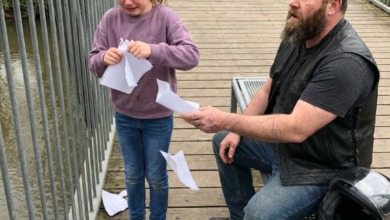
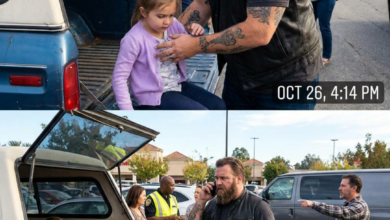
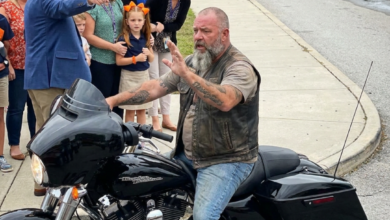
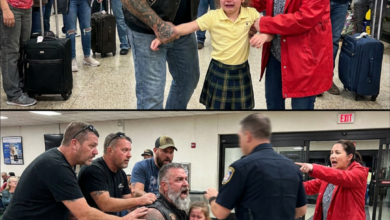
Part 2: Every Halloween, 30 Bikers Dressed Like Princesses and Superheroes — Then They Rode Into the Poor Neighborhood With Candy
Part 2
My name is Angela Morris, and I had lived on Maple Street for eleven years before I understood that Halloween can hurt a child in ways adults do not always admit. People think poor kids are only sad about big things: rent, food, heat, school clothes, broken cars, and overdue bills folded beneath refrigerator magnets.
But children also grieve the small doors they are not allowed to open.
A Halloween costume in a store window.
A porch light glowing on another block.
A plastic pumpkin bucket that stays empty because every house nearby is just as tired as yours.
East Glen was not a dangerous place the way outsiders liked to describe it. It was a worn-down place. That is different. Most families there were not careless. They were working, stretching, borrowing, deciding whether candy mattered more than gas, and hoping children would not notice when childhood became another expense.
They noticed.
They always noticed.
My daughter’s name was Tasha. She was seven years old, Black American, small and serious, with two puff ponytails tied in orange ribbons and a paper princess crown she had made from a cereal box. She had colored it yellow with a broken marker, then taped it carefully because she said “real crowns get fixed, not thrown away.”
That sentence still follows me.
I had promised her we would do something for Halloween, but my paycheck had gone to the electric bill, her asthma inhaler, and groceries that looked smaller once they were in the kitchen. I bought a bag of mixed candy at the dollar store, then put half of it back because I needed bus fare for Monday.
By sunset, our porch light stayed off.
Not because I hated Halloween.
Because turning it on meant children would knock and I would have to disappoint them too.
That was the kind of shame no one puts in speeches.
The Iron Saints had started coming to East Glen five years earlier, but I did not know the full story then. I only knew that every Halloween, right around dusk, people heard motorcycles before they saw costumes. The sound came first: deep Harley thunder rolling through the narrow streets, not fast, not threatening, but steady enough to pull children to windows and grandparents to screen doors.
The first year, some people were scared.
The second year, they were curious.
By the fifth year, children waited for them.
But that night was the first time I saw what they were really doing.
They were not bringing candy.
They were bringing permission for poor children to feel included.
Part 3
The false climax came when a patrol car turned onto Maple Street behind the bikers.
It had happened before, someone told me later. Thirty motorcycles in costume, rolling through a poor neighborhood after dark, can look strange to people who measure safety by silence. This time, a new homeowner from the edge of East Glen had called and reported a “biker gang blocking the street.”
By then, the Iron Saints had formed a slow parade.
Children walked along the sidewalk in mismatched costumes: a little Spider-Man with no mask, a princess in sneakers, a ghost made from an old sheet, a football player with cardboard shoulder pads, and my Tasha holding Bear’s gloved hand like she had known him forever.
Every few houses, a biker would stop, knock on a door, and hand the adult inside a small bowl of candy.
“Your house is part of the route now,” the bunny-eared rider said gently to a grandmother who looked embarrassed.
The grandmother laughed through tears.
Then she turned on her porch light.
That was how it worked.
The bikers did not simply hand candy to children from motorcycles. They stocked the neighborhood first, quietly giving candy to families who could not afford it, so the children could knock and receive it from their own neighbors.
No one had to stand in line for charity.
No child had to feel like a project.
No parent had to say, “We couldn’t.”
When the police cruiser stopped, several adults stiffened.
East Glen knew that feeling too well, the sudden tightening when lights flash and everyone wonders whose night is about to become a story told wrong.
Officer Daniel Price stepped out, a white American man around forty, careful but stern, his eyes moving over the Harleys, costumes, children, and candy bags.
Bear turned around in his princess dress.
That image alone would have made another man laugh.
Officer Price did not.
“Who’s in charge here?” he asked.
Bear raised one large hand.
“That’d be me, officer.”
“You have a permit for this?”
Bear looked down at his glittery skirt, then back at the children.
“For being Cinderella? No, sir. I took my chances.”
Some parents chuckled nervously.
Officer Price did not smile yet.
“We got a call that you’re blocking traffic.”
Bear nodded toward the street.
“We’re moving at kid speed.”
“That’s not a legal answer.”
“No,” Bear said calmly. “But it’s an honest one.”
The officer looked at the children’s buckets.
Then at the porch lights coming on one by one.
Then he noticed something none of us had noticed yet.
Every biker was carrying not just candy, but a laminated list of house numbers.
A route.
A plan.
A promise.
Part 4
The twist began when Officer Price asked why they were doing it.
Bear did not answer right away. He looked toward the far end of Maple Street, where the old brick apartment building sat with half its windows dark. His pink plastic crown had slipped sideways, and one sleeve of the princess dress had torn near his leather vest, but somehow that made him look more serious, not less.
“Because a kid died waiting for Halloween,” he said.
The laughter on the street faded.
The officer’s posture changed.
Bear explained that five years earlier, a boy named Devon Harris lived in East Glen. He was eight years old, Black American, small, funny, and obsessed with Batman. His mother worked nights at a nursing home. His grandmother watched him after school. That October, Devon made a Batman mask from a black paper plate and told everyone he was going to fill a pillowcase with candy.
But Halloween week, most houses on his block kept their porch lights off.
Not because people did not care.
Because they had nothing to give.
Devon walked three blocks with his grandmother and came home with eleven pieces of candy, two pencils, and one orange. His grandmother felt so ashamed that she cried after he went to bed.
Devon did not complain.
He put three pieces of candy in his mother’s lunch bag the next morning.
Two weeks later, he died from complications of an asthma attack after a cold turned bad too quickly.
His mother, Sheila Harris, was Bear’s niece.
That was the secret.
Bear had not started this because he thought poor neighborhoods needed saving by bikers. He started because one child in his own family had once tried to protect adults from his disappointment.
The first Halloween after Devon died, Bear and five riders came to East Glen with candy. They dressed up because Devon had once told Bear that bikers were “too scary for Halloween unless they became cartoons.”
So they became cartoons.
The next year, twelve riders came.
Then eighteen.
Now thirty.
Each rider sponsored a block. Each saddlebag carried candy bought all year during clearance sales. Each costume was ridiculous on purpose, because children should not have to decide whether a stranger looks safe before accepting joy.
Officer Price listened without interrupting.
When Bear finished, the officer looked at the children gathered around him.
Then he looked at the porch lights.
Finally, he removed his radio from his shoulder.
“Dispatch,” he said, voice quieter now, “no disturbance here. Community event in progress.”
He paused.
Then added, “I’ll be assisting with traffic.”
The children cheered.
Bear adjusted his crown and said, “Officer, you want a cape?”
Officer Price looked like he might refuse.
Then the bunny-eared rider pulled a purple superhero cape from her saddlebag.
Five minutes later, a police officer was directing traffic in a purple cape while thirty bikers dressed like storybook characters made sure every child in East Glen had a Halloween.
Part 5
Once the police joined instead of stopped them, the night became something I still cannot describe without smiling.
It was not pretty in the way wealthy neighborhoods do Halloween. No fog machines. No inflatable dragons taller than the roof. No families posting coordinated costume photos under perfect porch lights. East Glen’s Halloween was crooked, loud, patched together, and alive.
One biker dressed as a giant rabbit gave glow sticks to children whose costumes were too dark for traffic. A Latino American rider in a pirate hat helped a little boy tie his superhero towel-cape tighter around his neck. A white American biker with a gray beard and fairy wings carried a folding step stool so toddlers could reach doorbells.
Bear walked beside Tasha like royal security.
Every time she knocked on a door, the adult inside acted surprised on purpose.
“Well, who do we have here?”
Tasha stood taller.
“Princess Tasha of Maple Street.”
Then they placed candy in her bucket like it was treasure.
The trick was simple.
The kindness was complicated.
Because the bikers had understood something many charities miss: children do not just need things. They need the experience of receiving those things without feeling reduced by them.
At one house, a father opened the door wearing his work uniform, eyes red with exhaustion. A biker had given him a bowl of candy twenty minutes earlier. When children shouted “trick or treat,” he held the bowl out with pride, as if he had planned it all along.
His little son stood beside him watching.
That mattered.
A boy saw his father give.
Not fail.
Not apologize.
Give.
At another porch, an elderly white American woman who lived alone handed out candy with trembling hands. She had told the bikers earlier she did not want to participate because she could not afford enough for everyone. They gave her three bags and a little pumpkin basket. By the end of the night, she was laughing harder than any child.
The teenage boy who had shouted “Y’all lost a bet?” ended up helping carry candy refills from the Harleys.
His name was Malik. He was fifteen, Black American, tall, thin, and too practiced at pretending nothing impressed him. By the third block, he was walking beside a biker dressed as a dinosaur, asking questions about motorcycles, jobs, and whether people really could join a club without being related to someone.
Bear noticed.
Bear always noticed.
“You got plans after high school?” he asked.
Malik shrugged.
“That means nobody asked right,” Bear said.
By the end of the night, Malik was wearing a spare firefighter helmet over his hoodie and helping younger kids cross the street.
Sometimes dignity arrives disguised as responsibility.
Part 6
Near the final block, the bikers stopped in front of the old brick apartment building where Devon had lived.
The children did not know why at first.
The adults did.
Sheila Harris stepped out of the front entrance wearing a black coat and a Batman pin on the collar. She was a Black American woman in her late thirties, with tired eyes, short natural hair, and the kind of face grief gives to people who have learned how to keep breathing in public.
Bear removed his princess crown.
So did every biker remove whatever silly thing sat on their head: tiaras, rabbit ears, superhero masks, pirate hats, foam animal hoods.
The street quieted.
Sheila carried a small plastic pumpkin bucket. It was old now, faded orange, with a crack near the handle.
Devon’s bucket.
She placed it on the front step.
For one minute, nobody spoke.
Even the children seemed to understand that joy sometimes pauses to honor the reason it exists.
Then Sheila reached into the bucket and pulled out a single piece of candy.
She handed it to Tasha.
My daughter looked confused.
Sheila knelt.
“My boy loved Halloween,” she said. “So you take one for him, alright?”
Tasha nodded solemnly.
Then she reached into her own bucket, chose her biggest chocolate bar, and placed it inside Devon’s pumpkin.
“For him too,” she said.
Sheila covered her mouth.
Bear looked away.
A few bikers turned toward their motorcycles, not because they were bored, but because grown men with tattoos and fairy wings sometimes need somewhere else to put their tears.
That became the tradition after that night.
Every child placed one piece of candy in Devon’s bucket, not because they were asked, but because children understand giving back when adults do not make it a lesson.
By the time the last child passed, the bucket was full.
Sheila lifted it with both hands and cried quietly.
Officer Price stood beside his cruiser in the purple cape, hat held against his chest.
“I didn’t know,” he said to Bear.
Bear put the princess crown back on, crooked and glittering under the streetlight.
“Most folks don’t,” he replied. “That’s why we keep showing up.”
The ride ended at the community center parking lot, where the bikers handed out hot chocolate, socks, toothbrush kits, and small flashlights. They did it gently, without speeches. They called everything “Halloween gear,” because that sounded better than aid.
When Tasha climbed into my lap later with her bucket heavy against her knees, she whispered, “Mama, we had the best house.”
I looked at our dark porch.
Then at the street full of children.
“Yes,” I said.
“We did.”
Part 7
Every Halloween after that, East Glen glows.
Not perfectly.
Not everywhere.
But more than before.
Porch lights come on earlier now. Families start saving candy in September. The community center keeps a costume bin. The local grocery store donates unsold Halloween bags after Bear convinced the manager that joy was better inventory than waste.
Officer Price still comes.
He wears the purple cape.
No one lets him forget it.
Malik, the teenager who once laughed at the bikers, is nineteen now and studying automotive repair at the community college. He comes back every Halloween to help decorate bikes with orange lights and reflective tape. He says he is not joining the Iron Saints yet because he wants to earn his own ride first.
Bear says that is the right answer.
Tasha still has the paper crown, though it is taped so many times it barely counts as paper anymore. She keeps it in a shoebox with photographs from that first night: bikers in ridiculous costumes, children holding heavy buckets, a police officer in a cape, and one picture of Bear bowing before her like she truly was royalty.
Every year, the ride ends at Devon’s old apartment building.
Every year, his cracked pumpkin bucket fills again.
And every year, before the bikers leave, Bear stands in the middle of Maple Street in whatever ridiculous costume he has chosen that season and reminds the children of one rule.
“Nobody trick-or-treats alone in East Glen.”
That rule has become bigger than Halloween.
Now neighbors check on each other before storms. Parents trade costumes. Teenagers walk younger children across busy corners. A woman who once kept her porch dark now runs the candy table at the community center. Men who used to avoid speaking to each other compare who got the best decorations for the least money.
People still call East Glen poor.
Maybe they are right.
But they should be careful.
Poor does not mean empty.
Every Halloween, thirty bikers dress like princesses, superheroes, rabbits, pirates, and cartoon animals, then ride Harley-Davidsons into a neighborhood most people forgot. They do not come to look tough. They do not come for cameras. They come because one child once came home with eleven pieces of candy and still tried to share.
And because no child on Maple Street should ever have to wonder whether Halloween belongs to them too.
Follow the page for more stories about the people we almost judged before we finally saw them.