A Biker Smashed Through a Teenage Girl’s Locked Door With a Hammer—What He Heard Inside Changed Every Apartment on Route 66
The first time I saw Hammer Dawson raise a framing hammer outside sixteen-year-old Mia Torres’s locked bedroom, I thought I was watching a debt collector lose control—until the black device clipped to his vest began screaming.
I managed the Desert Star Apartments, a sun-faded two-story complex sitting three blocks off Route 66 in Tucumcari, New Mexico, where everyone knew which marriages were failing, whose car payment was late, and which families kept their porch lights off because they could not afford another electric bill. Privacy was something we claimed to respect while listening through walls thin enough to hear a spoon dropped in the next apartment.
That January evening, half the building stood in the hallway outside 3B.
Mrs. Alvarez from downstairs held up her phone and recorded. Old Mr. Keene had already called the police. Two construction workers from 3A blocked the staircase, whispering that the biker was drunk and that somebody needed to stop him before he hurt the girl.
I believed them.
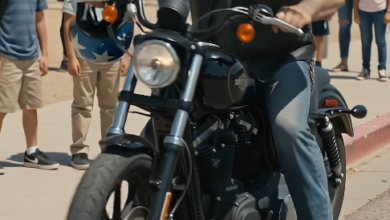
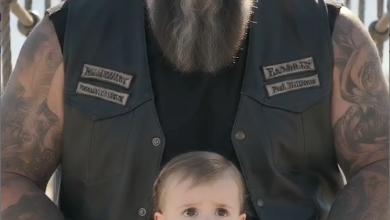
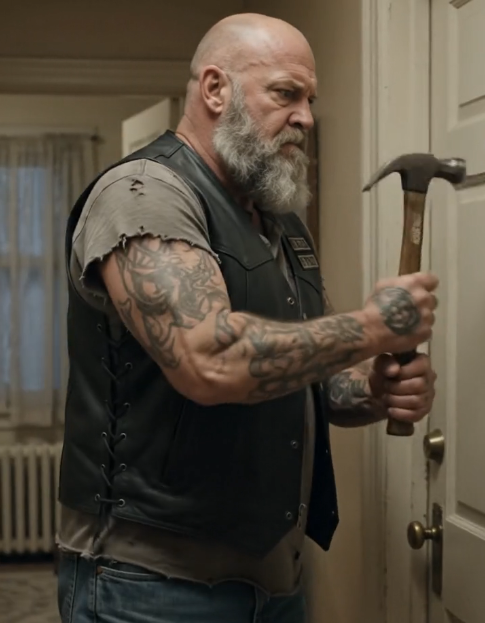
Ray Dawson—everyone called him Hammer—stood six feet four and weighed close to 280 pounds. His shaved head shone beneath the hallway light. A gray beard covered half his chest, and black tattoos crawled from his scarred knuckles beneath a plain leather cut whose patches had no words anyone could read from a distance. His boots left wet marks on the linoleum. Snowmelt dripped from his jeans. Behind the building, his Harley’s cooling engine ticked in the cold like an old clock.
He looked exactly like the kind of man people blame before asking questions.
And Mia’s dead father had owed his motorcycle shop money.
Everybody knew that part.
Javier Torres had repaired cars, motorcycles, lawn equipment, and anything else that could keep food in the refrigerator for one more week. Before he died the previous winter, he had borrowed money from Hammer’s garage. At least, that was the version passed from balcony to balcony. Hammer had visited Mia’s mother twice since the funeral, always carrying a brown ledger envelope, always leaving without being invited inside.
So when he appeared at 3B asking for Mia, the hallway formed its own verdict.
“She’s not coming out,” Mrs. Alvarez snapped. “Her mother is working.”
Hammer ignored her and pressed his ear against Mia’s bedroom door.
I grabbed his forearm. It felt like grabbing a fence post.
“You need to leave,” I told him.
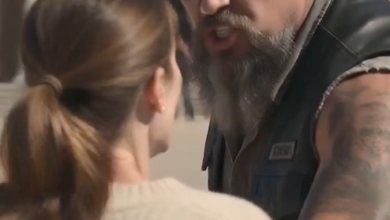
He looked down at my hand, then at my face. His expression was tight, but there was no cruelty in it. There was fear.
“Manager,” he said, “when did you last hear her answer?”
“Ten minutes ago. Maybe fifteen.”
“What did she say?”
I hesitated. Mia had called through the door that she had a headache and wanted everyone to go away. Her words had sounded thick, almost lazy. At the time, I assumed she was crying.
Hammer pulled a black instrument from inside his cut. It was smaller than a phone, scratched around the edges, with a strip of faded yellow tape across the back.
The moment he held it near the doorframe, its alarm sharpened.
Mrs. Alvarez lowered her phone.
Hammer pounded once with his fist. “Mia. Open up.”
Nothing.
He tried the knob. Locked.
I pushed my master key into the old cylinder, but Mia had turned the interior privacy latch. Hammer stepped back and lifted the framing hammer from the tool loop at his belt.
That was when people started shouting.
Mr. Keene called him a thug. One of the construction workers moved forward. I planted myself between Hammer and the door, certain I was protecting a frightened teenager from a man who had come to collect a dead father’s debt.
Hammer did not shove me.
He only held the screaming detector where I could see its numbers climbing.
Then he said six words I still hear in my sleep.
“You’re guarding the wrong side, Claire.”
He swung.
The first strike split the frame. The second tore the latch free. When the door collapsed inward, Hammer dropped the tool, covered his mouth, and vanished into a room that looked perfectly ordinary.
No smoke.
No fire.
No visible danger at all.
Three seconds later, he came back carrying Mia’s limp body, and the brown envelope everyone believed contained her father’s debt slid from inside his vest onto the hallway floor.
It had one word stamped across the front.
PAID.
But that was not the strangest thing inside it, and it did not explain why Hammer recognized a danger none of us could see—or whose name had been written beneath Mia’s on the final page.
Want to know what was hidden in Javier’s ledger and why Hammer carried that battered detector everywhere? Drop ALARM in the comments — I’ll share more soon.
Part 2 — The Girl Behind the Locked Door
Mia Torres was not the kind of girl who created scenes. She was sixteen, small for her age, and so careful with other people’s space that she apologized when someone else bumped into her. On school mornings, I watched her cross the parking lot with a thrift-store backpack held together by blue thread and a travel mug filled with coffee she was too young to need.
Her mother, Rosa, worked nights in the laundry department at Dr. Dan C. Trigg Memorial Hospital. Since Javier’s death, Rosa accepted every shift she could get. She cleaned sheets, folded gowns, and came home smelling of bleach with red marks around her wrists from industrial gloves.
Mia had become the adult who was home.
She paid rent at my office with money orders. She argued with the electric company. She knew which burner on their stove needed a match and which bathroom pipe had to be kicked before it stopped rattling. Whenever I offered to help, she smiled in a way that meant no without making me feel rejected.
The Torres family had lived in 3B for nine years. Javier used to sit on the balcony after work with black grease caught in the creases of his hands, waving at every motorcycle that passed along Tucumcari Boulevard. He had never owned a Harley. He said feeding a family came before feeding a machine.
Then Hammer gave him an old Road King to rebuild.
That was how their friendship started, though none of us understood it at the time. We saw Hammer’s motorcycles lined outside the complex and assumed Javier had gotten involved with dangerous men. We saw leather cuts, tattooed arms, chain wallets, and the heavy boots that made our stairwell shake. We never saw what happened inside Hammer’s garage: Javier teaching young club prospects how to rebuild carburetors, bringing leftover burritos for men too proud to admit they were hungry, and keeping the shop books because Hammer claimed numbers gave him headaches.
After Javier died, those motorcycles stopped coming.
Rosa did not explain why.
The story that replaced the truth was simpler. Javier had borrowed $3,800. Hammer wanted it back. Rosa could not pay. Twice, neighbors saw him carry that brown envelope upstairs. Twice, they saw Rosa shut the door in his face.
By the third visit, everyone had decided Hammer was collecting.
That third visit came on the coldest evening of the year. Wind drove dry snow against the windows, and our ancient gas furnace ran so hard that the metal vents popped in the walls. I was in the basement laundry room when Mrs. Alvarez called to say Mia had come home early from school, stumbled on the stairs, and locked herself in her bedroom.
I went up immediately.
Mia answered my first knock. Barely.
She said she felt sick. I offered to call her mother, but she told me Rosa could not leave work without losing the overtime. When I asked whether she needed an ambulance, Mia laughed once and said she only needed sleep.
Then she stopped answering.
I called Rosa. No response. I called the hospital switchboard and spent four minutes on hold while Mrs. Alvarez gathered neighbors in the hall. Someone remembered seeing Hammer’s Harley near the gas station. Someone else said Javier’s debt had finally caught up with them.
Rumors always arrive before help.
Hammer arrived seven minutes later because Rosa had called him, not me. Her message had been short: Mia was slurring her words, the apartment felt unusually warm, and the furnace had made a metallic bang before she left for work. Rosa knew Hammer had spent years repairing heaters and generators as well as motorcycles.
She also knew about the detector.
He entered 3B without greeting anyone, crossed the living room, and crouched near the wall vent. The portable meter clipped inside his vest chirped once. He removed it, watched the display, then stood so fast his shoulder struck a framed school photograph.
“Everybody outside,” he said.
Nobody moved.
Mrs. Alvarez demanded to know what he wanted from Mia. Mr. Keene asked about Javier’s debt. One of the construction workers told Hammer the police were coming.
Hammer looked at me. “How many gas appliances?”
“Furnace and water heater.”
“Where’s the furnace?”
“Utility closet downstairs.”
“Shared flue?”
I nodded, although I was no longer certain.
The detector alarm changed from intermittent chirps to a continuous shriek. Hammer opened the balcony door and told us again to evacuate, but Mia was still behind the locked bedroom door. My master key turned the outer lock, yet the old privacy latch held from inside.
She had not been hiding from Hammer.
She had locked the door because she was sixteen, frightened, sick, and alone.
Hammer pressed his cheek to the gap beneath the door. Then he said her name in a voice so gentle that the hallway became quiet.
“Mia, kid. Knock once if you hear me.”
Nothing answered.
Not a footstep. Not a cough. Not even the bedsprings.
Only that alarm.
Hammer reached for the framing hammer he carried for removing bent body panels at the garage. I caught his arm because I still believed the ugliest explanation. He could have thrown me aside. Instead, he turned the detector toward me and made me read the rising number.
I had never seen a carbon monoxide meter before, but I understood the red light.
“Call 911,” he said. “Tell them suspected CO exposure. Get everyone into open air.”
Then he broke the door.
What I did not understand was why the sound of splintering wood changed his face. His jaw locked. His eyes went somewhere far beyond Apartment 3B, somewhere colder than that hallway.
He had heard that sound before.
And the first time, he had been too late.
Part 3 — The Room With No Smoke
The door gave way on the second blow. Hammer dropped the tool before it hit the carpet and went inside without waiting for permission.
The room looked safe.
That was the horror of it.
Mia’s desk lamp glowed beside an unfinished algebra worksheet. A hoodie hung over the back of her chair. Her phone lay facedown beside the bed, still playing music through one white earbud. There were no flames, no smoke stains, no overturned pills, no broken glass—nothing dramatic enough to warn an ordinary person that the room had become deadly.
Mia was on the floor between the bed and the wall.
Hammer found her by the heel of one sneaker.
He crouched, touched two fingers to her neck, and called her name. She did not respond. He lifted her with one arm under her knees and the other supporting her shoulders, holding her head against his chest as though she were much younger than sixteen.
“Move,” he growled.
We moved.
The neighbors who had blocked the hallway flattened themselves against the walls. Mrs. Alvarez’s phone remained raised, but she was no longer recording Hammer. She was recording herself trembling.
He carried Mia across the living room and out onto the balcony. The January wind hit us hard. Hammer lowered her onto his folded leather jacket, checked her airway, and told me to repeat every word the dispatcher said.
“Is she breathing?” I asked.
“Shallow.”
The dispatcher instructed us to keep her outside and not reenter the apartment. Hammer tilted Mia’s head, watched her chest, and kept one scarred hand against the side of her face.
Then Mia stopped taking those shallow breaths.
Everything happened at once.
Mrs. Alvarez screamed. Mr. Keene began praying. A little boy from 2A started crying because his mother had left without shoes. The detector inside 3B continued its mechanical shriek, indifferent to all of us.
Hammer began rescue breaths and chest compressions.
He did not perform them like a man guessing from something he had seen on television. His elbows locked. His count was steady. He gave short instructions without looking up: clear the staircase, send someone to the curb, keep the apartment doors open only as people exited, do not let anyone go back for pets or phones.
The two construction workers obeyed him.
So did I.
A woman from 3C tried to return for her cat. One of Hammer’s club brothers arrived just then—a broad Black man named Leon “Preacher” Brooks on a blue Electra Glide—and intercepted her at the bottom of the stairs. He handed his helmet to her son, wrapped the woman in his riding coat, and asked which window belonged to her apartment so firefighters could locate the animal safely.
More Harleys came.
Their V-twins rolled into the parking lot one after another, deep and uneven, then cut off until the only sounds were boots on pavement and the approaching sirens. The bikers did not crowd Hammer. They created space. One guided residents toward the sidewalk. Another used a flashlight to mark the furnace room for firefighters. A third moved parked motorcycles and cars so the ambulance could pull close to the stairs.
Nobody had to explain the system.
Brotherhood had become choreography.
Mia gasped on Hammer’s twenty-third compression. It was a thin, wet sound, but it stopped every voice around us. He rolled her slightly, kept her airway open, and told her not to fight for words.
Her eyelids fluttered.
“Mom?” she whispered.
“She’s coming,” Hammer said.
That was the first lie he told that night. He had no idea whether Rosa had received my messages or whether she could get away from the hospital.
The paramedics reached the balcony less than a minute later. They fitted Mia with an oxygen mask, attached monitors, and asked what she had been exposed to. Hammer held up the portable detector, gave the highest reading he had seen near her door, and described the shared gas furnace.
One paramedic looked at him. “You carry a CO meter?”
Hammer did not answer.
Firefighters evacuated the rest of the building. Their professional monitors alarmed before they reached the second floor. The highest concentration was in Mia’s bedroom because a damaged return-air channel had been pulling contaminated air through a gap in the wall cavity. The room’s closed door had reduced circulation with the rest of the apartment, allowing the concentration to climb while Mia slept.
Our building had smoke alarms.
We had no carbon monoxide alarms.
At the curb, residents wrapped themselves in blankets and watched paramedics load Mia into the ambulance. Her oxygen mask fogged with every breath. Hammer stood beside the rear doors wearing only a faded gray T-shirt, his tattooed arms bare in the freezing wind.
Rosa’s car skidded into the lot before the ambulance left.
She ran past the police officer, past me, and straight toward Hammer. For one sharp second, I thought she might hit him. Instead, she grabbed the front of his shirt with both fists.
“You found her?”
Hammer nodded.
“You got her out?”
Another nod.
Rosa pressed her forehead against his chest, and the sound that came from her was lower than crying. Hammer lifted one hand, held it above her back, then let it fall without touching her. Guilt seemed to make even comfort feel like something he had not earned.
The ambulance doors closed.
The crowd turned toward the building, toward firefighters opening the utility room, toward the landlord who had finally arrived in a clean pickup and an expensive coat. People wanted somebody to blame. Some chose him. Some chose me.
Hammer chose neither.
He walked back upstairs after firefighters declared the immediate path safe for a brief supervised retrieval. He picked up his leather jacket, his framing hammer, and the brown envelope that had fallen outside Mia’s room.
I followed him.
On the torn carpet, I saw the red PAID stamp. Beneath it was Javier Torres’s name and the amount everyone had repeated for months: $3,800.
“You came to erase the debt?” I asked.
Hammer stared through the shattered doorway. “Debt was erased before the funeral.”
“Then why did Rosa keep shutting you out?”
He opened the envelope and removed a grease-stained ledger page, a cashier’s check, and a photograph of two men beside a gasoline generator. One was Hammer. The other was Javier.
On the back, written in Javier’s blocky handwriting, were six words:
If the alarm sounds, believe it.
Hammer folded the photograph before I could ask more.
Then a firefighter called from the utility room. They had found the source, but not the cause.
Someone had worked on the flue recently.
And the repair tag carried my signature.
Part 4 — The Name Under the Debt
The furnace inspection happened under portable lights while the building stood empty. Our landlord, Gerald Pike, protested every photograph the fire marshal took. He insisted the system had passed service in October. I remembered signing the access form, but I had never watched the contractor complete the repair.
A sheet-metal flue joint had separated behind the furnace. A bracket meant to support it was missing. Exhaust had leaked into the utility chase and traveled upward through gaps around old ductwork. The furnace itself had kept running, quietly distributing warmth and poison together.
Gerald kept saying it was an accident.
Hammer said nothing.
He stood at the edge of the parking lot with his leather jacket back on, the brown envelope tucked beneath his arm. Five club members waited near their motorcycles. Their faces were hard. Leon wanted the contractor’s name. A younger biker called Boone said they should pay the landlord a visit before the man had time to hide his records.
Hammer turned on him.
“No.”
One word.
Boone argued that Javier had warned them about cheap furnace repairs months earlier. Leon reminded Hammer that a girl had nearly died. Another rider said the police would protect the landlord before they protected the tenants.
Hammer listened until they finished.
“Alarms first,” he said. “Anger later.”
Boone kicked gravel. “He could’ve killed that kid.”
“And you knocking his teeth out puts oxygen in her blood?”
The younger man looked away.
That was the test no one outside a club understands. Brotherhood is easy when everyone agrees on an enemy. It is harder when the man you follow orders you to swallow rage, carry boxes, and spend your Saturday drilling plastic detectors into ceilings.
Hammer’s men obeyed.
Near midnight, I drove to the hospital. Mia remained on high-flow oxygen, but the doctor expected her to recover. Rosa sat beside the bed with one hand wrapped around her daughter’s ankle beneath the blanket, as though any looser grip might allow the room to take her again.
Hammer waited in the corridor.
He had cleaned the blood from a split knuckle caused by the doorframe. A paper cup of coffee rested untouched between his boots. The detector lay on the chair beside him.
I sat across from him and placed the repair tag on my knee.
“I signed this,” I said.
“You signed that the worker entered.”
“I should have checked.”
“Could you inspect a flue?”
“No.”
“Then stop stealing blame that belongs somewhere else.”
It was the longest sentence he had spoken to me.
I asked about Javier.
Hammer rubbed his thumb across the yellow tape on the detector. Under the tape was a name written so many years earlier that only the first letter remained visible.
The story came slowly because Hammer did not tell stories in clean paragraphs. He gave me pieces. Rosa supplied others later. Leon filled the gaps Hammer refused to touch.
Three winters earlier, an ice storm had knocked out power to Hammer’s garage. Orders were late, pipes were freezing, and several club members had brought generators from home. One gasoline generator sat outside the rear service door, but an improvised exhaust extension ran loose beneath the half-open bay.
Javier complained of a headache.
He stumbled once. Hammer smelled alcohol on his jacket from a solvent they had used and made the cruelest assumption available. Javier had been sober for eight years, but Hammer knew about the years before that. He thought his friend had relapsed.
“Go sleep it off,” Hammer told him.
Javier went into the office.
Hammer rode to a twenty-four-hour gas station for fuel. On the way, cold air cleared the dizziness he had not admitted feeling. He realized his own headache was fading. He turned back.
By then, Javier was unconscious.
Hammer broke the office door with the same framing hammer he later used at Apartment 3B. He pulled Javier outside and performed CPR until paramedics arrived. Javier lived long enough to reach the hospital, but not long enough to come home.
The official finding was carbon monoxide poisoning.
Hammer bought the portable detector the day after the funeral. The yellow tape came from Javier’s toolbox. Hammer wrote Javier’s name beneath it, then wore the device every winter, in every garage, diner back room, rental cabin, and apartment with a gas appliance.
He had heard people laugh.
He kept wearing it.
The $3,800 was real, but the story around it was backward. Javier had not borrowed money for himself. Hammer’s shop had advanced the cost of parts for a custom motorcycle commissioned by a wealthy rancher. Javier spent six months rebuilding the engine and fabricating brackets after regular hours. The customer paid late, two weeks after Javier died.
Hammer cleared the parts charge and calculated Javier’s remaining labor share.
The shop owed Rosa $6,240.
The cashier’s check in the envelope was for that amount. Hammer had tried twice to deliver it, but Rosa refused to accept money connected to the garage where her husband died. She did not believe Hammer had murdered Javier. Her anger was more complicated.
Hammer had doubted a sober man.
Rosa could not forgive that.
The final ledger page showed Javier’s handwriting beside the $3,800 parts advance. Lower on the sheet, another line recorded his labor hours. Beneath Mia’s name—where Javier listed the reason he kept accepting extra work—he had written a second name.
Ray Dawson.
Beside both names was a note: People I’m trying to get home.
Hammer had not merely failed to recognize Javier’s symptoms. Javier had recognized Hammer’s. Before entering the office, he had pushed the portable shop fan toward Hammer’s workbench and opened the side door. That extra air may have kept Hammer conscious long enough to ride outside and realize something was wrong.
Javier had saved him while dying from the same exposure.
That was the true debt.
When Hammer reached 3B and heard Mia’s thick voice behind the door, he did not see a debtor’s daughter. He heard Javier stumbling across the garage. When the meter alarmed, he was not brave.
He was being given a second chance.
Rosa stepped into the corridor while we spoke. She had heard enough. Hammer stood, picked up the envelope, and held it toward her.
She did not take it.
“Money won’t change what happened,” she said.
“No.”
“It won’t bring Javier back.”
“No.”
“You thought he was drinking.”
Hammer’s beard moved as his jaw tightened. “I did.”
Rosa looked through the glass panel at Mia. “And tonight?”
“I believed the alarm.”
She stared at him for a long time. Then she took the envelope, removed the check, and placed the photograph back in his hand.
“This stays with you,” she said.
Hammer looked at Javier’s face.
Rosa touched the battered detector on the chair. “That stays with you too.”
For the first time that night, Hammer’s eyes filled. He did not let the tears fall. He folded the photograph once and slipped it behind the inner lining of his vest.
Then he asked Rosa a practical question because men like him often survive emotion by finding work.
“How many apartments in that building?”
“Twenty-four,” I answered.
He looked at Leon, who had just arrived with food and a fresh shirt.
“How many alarms can we buy by morning?”
Leon took out his phone.
“All of them, brother.”
Part 5 — Alarms First, Anger Later
By sunrise, the Desert Star parking lot looked like a motorcycle rally organized by a hardware store.
Twelve Harleys stood in a row along the curb, chrome clouded by road salt and cold. Beside them sat three pickup trucks loaded with sealed carbon monoxide detectors, extension ladders, batteries, screws, anchors, and cases of bottled water. Hammer’s club had purchased every approved detector available at two local stores, then sent riders to Clovis for more.
They did not install anything immediately.
That mattered.
Hammer contacted the fire marshal and asked what models met current standards. Leon called a licensed electrician who rode with the club on weekends. Another member, Martin “Fuse” Delaney, held an HVAC contractor’s license and inspected the placement plan. They obtained written permission for each occupied unit and documented serial numbers and test dates.
No one trusted Gerald Pike to manage it alone.
The residents spent the night in a church fellowship hall provided by Reverend Brooks, Leon’s older brother. Families slept on folding cots while children wore donated sweatshirts over pajamas. Mrs. Alvarez’s cat was recovered safely by firefighters and spent the night inside a cardboard carrier, expressing her opinion of the entire emergency every thirty seconds.
Mia remained at the hospital.
Rosa called me shortly after seven. Her daughter was awake, embarrassed by the attention, and asking whether her school backpack had survived. The doctor wanted to monitor her through the afternoon, but neurological tests looked normal.
I passed the update through the church hall.
People cheered.
Hammer stood outside by himself.
He had been awake all night, yet he refused coffee until every family had received breakfast. When I told him Mia was speaking clearly, he nodded and turned toward his motorcycle. His shoulders dropped by less than an inch.
That was all.
At eight thirty, the fire marshal cleared portions of the building for supervised entry while the gas supply remained shut off. The damaged heating system could not operate until licensed repairs passed inspection. Gerald complained about the expense until Mrs. Alvarez raised her phone and asked him to repeat himself for the local news station.
He stopped complaining.
The bikers entered in pairs. Their boots shook dust from the stair treads. Leather creaked in narrow doorways. Their tattoos and heavy tool belts frightened a few residents who had not witnessed the rescue, especially after social media clips showed only Hammer striking Mia’s door.
The first video posted online had a caption accusing a motorcycle gang of attacking a teenage girl.
The clip ended before Hammer carried her out.
By noon, thousands of strangers had called him a criminal.
Hammer refused to respond.
“Finish the work,” he told us.
In Apartment 1A, Leon knelt so a five-year-old boy could press the test button. The alarm emitted four sharp beeps. The child jumped, then laughed and pressed it again until his mother took his hand away.
In 2C, Fuse explained to an elderly couple that carbon monoxide cannot be seen or smelled. He wrote the replacement date on a card in large letters and placed it inside their kitchen cabinet. In 3A, the two construction workers who had nearly confronted Hammer helped anchor units outside the sleeping areas.
Mrs. Alvarez stopped Hammer in the hallway.
“I recorded you,” she said.
“I know.”
“I thought you were hurting her.”
“I know.”
“I posted part of it.”
He looked at her phone. “Post the rest.”
She did.
The full video showed the detector in Hammer’s hand, his repeated order to evacuate, the door breaking, and Mia’s limp body emerging from a room with no smoke. It showed him lowering her onto his own jacket. It showed his hands beginning compressions.
Public opinion reversed with the same speed it had condemned him.
Hammer disliked that too.
“They don’t know me any better now,” he said. “They just picked a nicer guess.”
The line stayed with me.
By late afternoon, all twenty-four apartments had detectors near their sleeping areas and on each level where required. Extra units went into the laundry room, maintenance space, and office. The club also left sealed replacements with the fire department for families who could not afford them elsewhere in town.
Gerald eventually produced the contractor’s paperwork. The worker who had serviced our furnace was not licensed for gas systems. Gerald had hired him because his bid was $900 lower.
The fire marshal forwarded the matter to code enforcement. Our residents organized. Legal aid became involved. Gerald was ordered to pay for temporary lodging, certified repairs, and an independent inspection of every fuel-burning appliance on the property.
Some club members wanted more.
Boone found Hammer near the shattered bedroom door and asked whether they were really going to let paperwork handle the man responsible.
Hammer pointed at the detector above the hallway.
“That little box beat him already.”
Boone frowned.
“Twenty-four families know what he skipped,” Hammer continued. “Fire marshal knows. City knows. Insurance knows. You hit him, story becomes you.”
The younger biker stared at his boots, then picked up a broom and began sweeping splintered wood.
Later, I found Hammer measuring Mia’s broken doorframe. He had already purchased new lumber and a solid replacement door. I told him the landlord should pay.
“He will,” Hammer said.
“Then why are you doing it?”
He fitted a new piece of trim against the frame. “Kid needs a door tonight. Court can reimburse me next year.”
That evening, Rosa drove Mia home.
The entire parking lot went quiet when the car appeared. Mia stepped out slowly, wrapped in a hospital blanket over borrowed clothes. She saw the motorcycles, the ladders, and the bikers standing beside freshly emptied boxes.
Then she saw Hammer.
He remained near the staircase, leaving her room to choose the distance between them.
Mia crossed the lot.
She stopped in front of his vest and looked at the scratched detector clipped beneath his left shoulder.
“Mom told me about my dad,” she said.
Hammer’s face hardened against whatever he expected next.
Mia pointed toward the new alarm visible through their living-room window. “Can you show me how to test it?”
Hammer exhaled.
“Yeah, kid.”
They climbed the stairs together.
Part 6 — Four Beeps in Every Hallway
The club returned the following Saturday, though the original work was finished.
This time they brought coffee, breakfast burritos, and a printed safety checklist reviewed by the fire department. The forms contained no club emblem and no request for donations. Hammer said a family should not have to advertise gratitude in exchange for staying alive.
They called the effort Javier’s Run only among themselves.
Once a month through the rest of winter, teams visited older apartment buildings, trailer parks, and rented houses along Route 66. Fuse handled technical questions. Leon spoke with churches and neighborhood groups. Boone became unexpectedly good at calming children during alarm tests; he let them cover their ears, count to three, and press the button themselves.
Hammer carried boxes.
He never stood for photographs.
When local television requested an interview, he sent Rosa. She spoke about working families who delayed replacing detectors because food, medication, and rent came first. She explained that landlords and tenants both needed clear responsibilities. She never called Hammer a hero.
That was how he wanted it.
The cashier’s check paid Javier’s old medical bills, replaced Mia’s failing laptop, and covered several months of rent while Rosa reduced her night shifts. She set aside the remainder for Mia’s education. Hammer did not ask how she spent a dollar.
I resigned as property manager three months later, but I did not leave the residents. I testified during the code-enforcement hearing and gave legal aid every maintenance request I had kept. Gerald sold the Desert Star before summer. The new owner replaced the furnace system, sealed the utility chase, and hired a certified contractor.
The broken doorframe remained in Hammer’s garage.
He had taken the splintered pieces after asking Rosa’s permission. They hung above his workbench beside Javier’s old yellow toolbox, not as a trophy but as a measurement. Underneath, Hammer mounted two detectors: one old, one new.
Every Monday, he tested both.
Mia started visiting the garage after school. At first, she sat in the office and finished homework while Rosa worked. Later, Fuse taught her how combustion appliances vent, how sensors age, and why a detector’s expiration date matters.
Hammer taught her engines.
Their conversations were short. Mia supplied enough words for both of them. Hammer answered with grunts, nods, or the occasional sentence that sounded expensive because he spent so few.
One afternoon, she asked why the club called him Hammer.
He glanced at the tool above the workbench.
“Used to fix things the loud way.”
“And now?”
He handed her a screwdriver.
“Learning.”
The old debt rumor disappeared slowly. Some people still believed Hammer had forgiven money Javier owed. Others insisted the club had paid Rosa to keep quiet about the garage accident. Truth could not travel as quickly as suspicion, but it lasted longer once it arrived.
Rosa eventually allowed Hammer into her apartment for coffee.
The first time, he stood beside the door as though expecting her to change her mind. She poured two cups, placed Javier’s ledger between them, and asked Hammer to tell Mia the parts her father had never shared.
He did.
He told her Javier sang badly while working. He hid candy bars inside empty oil-filter boxes. He once rebuilt a veteran’s truck without charging labor, then told everyone the man had paid in cash. He disliked motorcycles with ape-hanger bars and loved an ugly green pickup no one else could keep running.
Mia laughed until she cried.
Hammer looked toward the window.
Rosa did not forgive him with a speech. She simply refilled his coffee.
Sometimes that is the only kind of forgiveness a person can carry.
Part 7 — The Sound That Replaced the Hammer
One year after the night at Apartment 3B, the first hard freeze returned to Tucumcari.
I drove past the Desert Star just after sunset and heard motorcycles before I saw them. Eight Harley engines rolled beneath the old Route 66 sign, their exhaust notes bouncing between the stucco buildings. Residents stepped onto balconies, but nobody raised a phone in fear.
Hammer parked beside the staircase.
He looked almost unchanged—same shaved head, same gray beard, same weathered cut, same detector clipped beneath his shoulder. The only difference was a small yellow stitch Mia had added to the vest’s inner lining, securing Javier’s photograph behind Hammer’s heart.
Mia opened the apartment door before he knocked.
She was seventeen now, taller, wearing a community-college EMT program sweatshirt and holding a folding stepladder. Rosa followed with coffee for the riders. Mrs. Alvarez appeared downstairs carrying her cat, who had grown no more forgiving.
Nobody mentioned the hammer.
They began at 1A and moved from apartment to apartment, checking manufacture dates, battery condition, placement, and response. Children took turns pressing test buttons. Four sharp beeps sounded in bedrooms, halls, and living rooms.
Beep. Beep. Beep. Beep.
At 3B, Mia climbed the ladder herself. Hammer steadied it with both hands. She pressed the button, waited for the alarm sequence, and wrote the date on a card.
“Working,” she said.
Hammer nodded. “Good.”
She climbed down and noticed him looking at the new bedroom door. Its paint was slightly lighter than the surrounding trim. Most visitors would never know why.
“You still keep the old frame?” she asked.
“Above my bench.”
“My dad’s toolbox too?”
“Yeah.”
“And the photo?”
Hammer touched the inside of his vest.
“Right here.”
Mia looked toward the parking lot, where the other bikers waited beside their machines. “Mom says you were trying to pay a debt.”
Hammer considered that.
“Still am.”
“You know you can’t finish, right?”
His eyes moved to the detector above her door. “Doesn’t mean I stop.”
Outside, the riders mounted their Harleys. Engines caught one after another, heavy and uneven in the winter air. Hammer was the last to leave. Before putting on his helmet, he looked up at the third-floor window.
Mia stood behind the glass and pressed the test button once more.
Four beeps answered.
Hammer raised two fingers, started his engine, and followed his brothers beneath the Route 66 lights.
The hammer was gone.
The alarm remained.
Follow the page for more powerful biker stories about misunderstood riders, tested brotherhood, and the quiet acts of courage that rarely make the evening news.