A Biker Tore a Stroller From a Mother’s Hands and Sent Her Baby Down a Hill—Then Three Leather Jackets Revealed What Had Fallen Into the Canopy
The biker tore my daughter’s stroller from my hands, aimed it toward the steep service lane behind Prescott’s courthouse plaza, and shoved my seven-month-old baby downhill before I understood why three men below were stripping off their leather vests.
For one frozen second, nobody moved.
Then I screamed.
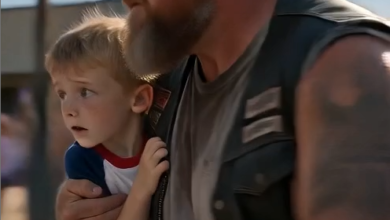
The stroller gathered speed almost immediately. Its front wheels bounced over a seam in the pavement while the pink blanket hanging from the side snapped in the wind. My daughter, Mia, was strapped beneath the raised canopy, hidden from me as the stroller rolled farther away.
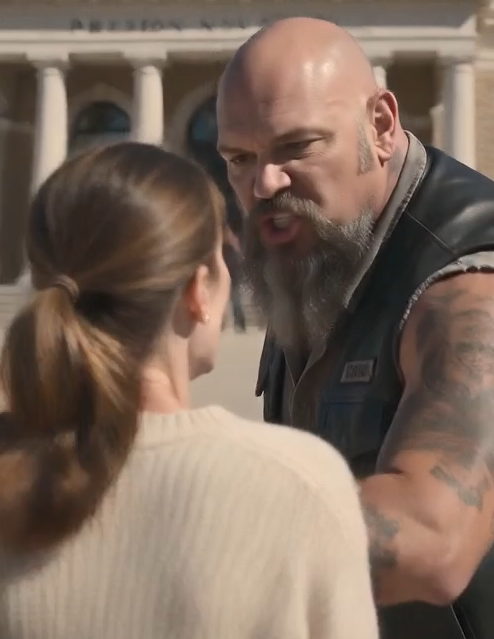
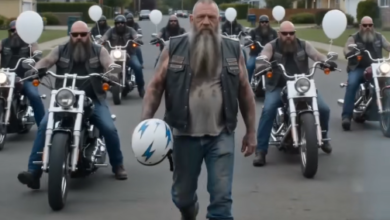
Ray “Hammer” Dawson stood between me and the hill.
He was fifty-six, six-foot-four, nearly 285 pounds, with a shaved head, a long black-and-gray beard, tattooed forearms, and scarred knuckles wrapped around the air where the stroller handle had been. His plain black leather vest had no readable patches, but he looked like every warning my mother had ever given me about strange men near children.
I struck his chest with both hands.
“What did you do?”
Hammer barely moved.
“Don’t follow the stroller,” he said.
That made no sense.
Parents were already running downhill. A woman dropped her phone. Two fathers pushed past folding tables and chased the stroller while someone shouted for police. Behind us, thirty Harleys stood in two shining rows, their cooling engines ticking beneath the noise.
Hammer raised one hand above his head.
Three fingers.
At the bottom of the lane, Leon Brooks, Boone Mercer, and Rosa Martinez reacted before anyone else understood the signal. They pulled off their heavy leather vests, grabbed the corners, and stretched them between their bodies like a black hammock.
The stroller kept coming.
So did the crowd.
I tried to run, but Hammer caught my shoulders and turned me away from the hill.
“Let me go!”
“Cover your face.”
“My baby is down there!”
“I know.”
Then I heard it.
Not crying.
Buzzing.
The sound came from the empty space where the stroller had been—hundreds of wings vibrating around the overturned refreshment table and the branches above it. A gray paper nest, ripped open along one side, hung from a broken piece of canopy fabric on the ground.
Except part of the nest was missing.
That part had fallen into Mia’s stroller.
Hammer had seen it drop from the cottonwood tree seconds before I reached beneath the canopy to lift my daughter. He had seen dark shapes pouring from the torn paper shell. He had also seen the three bikers stationed at the bottom of the closed service lane, beside a flat patch of grass with no traffic behind them.
He had made a choice.
A brutal-looking choice.
The stroller reached Leon, Boone, and Rosa. Their leather stretched, bowed, and absorbed the impact before the front wheels could strike the stone barrier. Leon caught the handle. Rosa locked the brake. Boone pulled the canopy away with his vest wrapped around both arms.
A black cloud rose from the fabric.
I could not see Mia.
People screamed again. Someone tackled Hammer from behind. Another man grabbed his beard. Police officers ran across the plaza while the bikers moved forward, and for a few terrible seconds it looked as if the entire charity event would become a street fight.
Hammer never swung back.
He kept pointing downhill.
“Get the child inside!”
Rosa lifted Mia from the stroller beneath a second leather vest. Leon held the cloth around them while Boone dragged the contaminated stroller toward an empty gravel area. Mia’s crying finally reached me.
That sound broke my legs.
I fell to my knees.
When Rosa carried my daughter uphill, Mia had no visible stings. She was frightened, red-faced, and alive. I held her against my chest while paramedics examined every inch of her skin.
Only then did I notice Hammer staring at the torn nest.
His right hand was shaking.
Inside his vest, beneath the rough leather and old road dust, he carried two epinephrine injectors and a faded photograph of a woman who had died after a hornet sting twenty-one years earlier.
Yet that was not the secret that silenced the three bikers who had caught Mia.
The real secret was why Hammer had taught them the three-finger signal—and whose empty stroller they had failed to catch the first time.
Want to know whose stroller created Hammer’s rescue signal and why he refused to let anyone call him a hero? Drop CRADLE in the comments—I’ll share more soon.
Part 2 — The Man Who Checked Every Tree
My name is Claire Bennett. I was thirty-four when the incident happened, living in Prescott, Arizona, and raising Mia alone after her father decided parenthood looked better in photographs than it felt at two in the morning.
The charity gathering at the courthouse plaza was supposed to be easy. Local businesses had donated diapers, canned food, and winter coats. The Iron Lanterns Motorcycle Club had transported boxes from three surrounding towns, and their riders were offering free safety checks for older residents’ cars in the parking lot.
I almost stayed home.
Mia had slept badly the night before, and I was running on cold coffee and the kind of exhaustion that makes every decision feel personal. But the community center had reserved a month’s supply of formula for us, so I strapped her into the stroller and walked six blocks downtown.
The Iron Lanterns arrived just after noon.
Thirty V-twin engines rolled along Montezuma Street, low and disciplined, then cut off one after another beside the courthouse lawn. The sudden silence felt like a held breath. Bikers dismounted wearing leather, denim, heavy boots, and expressions that sent several parents instinctively toward their children.
Hammer rode at the front.
He parked his black Harley away from the stroller area, checked that the pipes faced the curb, and placed a small orange cone beside the motorcycle so children would not brush against the hot metal. That should have told me something about him.
I noticed only the tattoos.
Mia noticed his beard.
When Hammer walked past us carrying two boxes of diapers, she reached toward him and laughed. He stopped. His weathered face softened, though the change was so slight I might have imagined it.
“Careful,” I said, drawing the stroller closer.
Hammer stepped back immediately.
“Ma’am.”
His politeness embarrassed me because it exposed my fear without challenging it. He carried the boxes inside, returned ten minutes later, and began inspecting the old cottonwood trees around the plaza.
He looked upward repeatedly.
Once, he asked a city worker whether the branches had been checked after the previous night’s windstorm. The worker shrugged and said parks maintenance would return Monday.
Hammer did not like that answer.
He spoke to Leon, who relayed something to the other riders. Three bikers moved to the bottom of the service lane. At the time, I assumed they were blocking access to their motorcycles.
They were creating an emergency receiving point.
Hammer had noticed children chasing balloons near the slope. He had seen loose branches above the refreshment tables and a delivery truck entering the alley beyond the stone barrier. None of those dangers became emergencies, but he prepared for them anyway.
That was Hammer’s habit.
He checked exits in restaurants. He counted children near traffic. He examined overhead wires before charity rides and watched people’s hands whenever tempers rose. The club teased him for carrying more first-aid equipment than spare tools.
They still followed his instructions.
Leon Brooks was a fifty-two-year-old Black American former firefighter with broad shoulders, a short gray beard, and a quiet voice that rarely needed volume. Boone Mercer, thirty-two and white, had a red beard, tattooed arms, and the impatient loyalty of a younger brother who believed Hammer could not make mistakes. Rosa Martinez was a forty-six-year-old Latina Army veteran, lean and disciplined, with silver threaded through her dark braid.
Those were the three people stationed downhill.
They were not chosen randomly.
During Iron Lantern charity events, Hammer used several hand signals when engines or crowds made voices useless. A closed fist meant stop. Two fingers meant clear a lane. Three fingers spread downward meant cradle—prepare to receive weight that could not stop itself.
The signal had been practiced with boxes, injured riders, wheelchairs, and once with a runaway shopping cart carrying a toddler.
No one outside the club knew it existed.
I saw Hammer test the direction of the wind by holding a damp finger above his shoulder. I saw him walk around the cottonwood tree. I saw him stare at a high branch where something gray swayed beneath the leaves.
Then Mia began fussing.
I pushed the stroller under the tree because the canopy needed shade. Hammer crossed the plaza toward me, but a volunteer stopped him to ask about a broken car battery. By the time he looked back, a gust of wind had bent the branch above us.
There was a tearing sound.
Not wood.
Paper.
A heavy gray mass dropped into the stroller canopy and disappeared between the folded layers. I saw the fabric sag, but I assumed a small branch had fallen.
I reached beneath the canopy.
Hammer saw the hornets emerge first.
“Claire, stop!”
I had never told him my name.
He had read it from the volunteer tag pinned to my sweater.
I turned toward him, one hand still on the stroller handle. A dark insect crawled from the canopy seam. Another followed. Then five.
Hammer’s face emptied.
He glanced downhill. Leon, Boone, and Rosa were already watching him.
Three fingers.
The decision was made before I understood the danger.
Part 3 — Six Seconds on the Service Lane
Hammer covered the distance in three strides.
He knocked my reaching hand away from the canopy, seized the stroller handle, and pulled it toward the slope. The sudden movement felt like an attack because I could not see what he saw.
“What are you doing?”
“Back.”
He positioned the stroller on the center of the service lane, looked downhill, and waited until Leon’s hands were on Rosa’s vest. Boone tore off his own leather cut and doubled it over the first layer.
The stroller canopy twitched.
Hornets crawled along the fabric.
Hammer pushed.
The stroller rolled beyond his reach.
Six seconds separated his hand from the bikers at the bottom. Inside those seconds, the entire world rearranged itself.
First, I believed a stranger had stolen my child.
Then I believed he had tried to kill her.
Only later did I understand that Hammer had calculated the slope, the distance, the receiving team, and the greater danger of opening a canopy already filling with hornets.
The crowd understood none of it.
A father named Miles Carter tackled Hammer from behind. They struck the pavement together. Miles wrapped one arm around Hammer’s neck while another man kicked at his side.
Hammer did not retaliate.
He tucked his chin, covered his head, and kept watching the stroller.
“Catch left!” he shouted.
Downhill, one front wheel hit a shallow drainage groove. The stroller turned slightly toward the stone barrier. Leon shifted left. Rosa followed. Boone moved backward across the grass while maintaining tension on the leather.
The stroller struck their makeshift cradle.
The vest folded around the front frame. Leon caught the handle before it rebounded. Rosa activated the brake. Boone wrapped his own vest around his forearms and reached toward the canopy.
“Don’t open it toward her,” Rosa warned.
Boone rotated the stroller so the wind carried the insects away from Mia. He lifted one edge of the canopy while Leon draped a leather jacket over the opposite side. Rosa reached beneath the cover, found the harness release, and pulled my daughter free against her chest.
Hornets rose around them.
Boone dragged the stroller away.
Leon covered Rosa and Mia with leather while they moved toward the community center doors. The jackets were not designed as protective gear against swarming insects, but their weight gave the group a few seconds of separation.
Several hornets followed Boone instead.
He was stung twice on the neck and once near his wrist. Leon took a sting above his eyebrow. Rosa escaped without one because she kept Mia enclosed until they reached the building.
By then, police had pulled Miles off Hammer.
Officer Nina Alvarez ordered everyone to the ground. Iron Lantern riders formed a line, but Leon shouted from below for them to stand down.
“Hammer’s clear! The baby’s clear!”
The phrase did not stop the chaos. People had seen a stroller rolling downhill. Phones were everywhere. A woman kept yelling that the biker had thrown a baby off a hill.
I ran toward Rosa.
She handed Mia to me inside the community center. My daughter was crying so hard her body trembled, but she had no visible punctures, swelling, or difficulty breathing. Paramedics arrived and checked her immediately.
“Was she stung?” I asked.
“We don’t see one.”
“Check again.”
They did.
Mia’s pink blanket had remained caught outside the canopy, drawing several insects away from the seat. The closed fabric and harness had kept her lower in the stroller while the nest fragment lodged near the upper fold.
Chance mattered.
So did timing.
Hammer appeared at the doorway with a split lip and dirt ground into one cheek. Officer Alvarez held his arm, though he was not handcuffed. Miles stood behind another officer, still shouting that Hammer should be arrested.
I looked at Hammer and felt two emotions fighting for the same space.
My daughter was alive because he had acted.
My daughter had also disappeared downhill because he had acted.
“You could have told me,” I said.
“There wasn’t time.”
“You could have lifted her out.”
“Your hand was under the nest.”
“You pushed her away from me.”
“I pushed the nest away from everyone.”
The words landed hard.
Outside, firefighters sealed off the tree. A pest-control specialist later found the remains of a large aerial nest torn open by the wind. Part of it had fallen into the stroller canopy while the rest broke across the refreshment table.
If I had raised the canopy, the disturbed insects would have emerged beside my face and Mia’s exposed head.
Hammer had seen it.
He had also seen something I had not: a smear of spilled fruit punch across the table and stroller handle, attracting already-agitated insects toward us.
Still, people argued that the stroller could have overturned. It could have struck the barrier. The leather could have failed. One biker might have tripped.
All true.
Hammer had not chosen between danger and safety.
He had chosen between two dangers in less than a breath.
Officer Alvarez reviewed the first phone video. It showed Hammer wrenching the stroller away and releasing it downhill. It did not show the nest. She asked whether I wanted him charged.
I looked at Mia.
Then I looked at Boone receiving treatment for the stings on his neck. Leon’s eye was swelling. Rosa’s arms were still wrapped around the leather vest that had caught my daughter.
“No,” I said.
Miles protested. Several parents accused me of being intimidated.
Hammer said nothing.
He reached inside his vest and removed two epinephrine injectors. Both were unexpired. Both had labels written in a woman’s handwriting.
Officer Alvarez noticed his trembling hand.
“Who are those for?”
“Anybody who needs them.”
“Why do you carry two?”
Hammer looked toward the torn nest.
“One wasn’t enough last time.”
Part 4 — The Empty Stroller Twenty-One Years Earlier
Her name was Evelyn Dawson.
Hammer met her when he was twenty-three and working nights at a tire shop outside Tucson. She was a veterinary technician with dark hair, sharp humor, and a severe allergy to wasp and hornet venom.
She carried an epinephrine injector.
So did Hammer.
At least, that was the rule.
Over the years, rules softened into habits, and habits became assumptions. One summer afternoon, Evelyn placed the injector in the diaper bag before taking their three-year-old daughter, Abigail, to a roadside picnic near Payson.
Hammer forgot to move the bag from the truck.
A hornet flew into Evelyn’s soda can.
The sting landed inside her mouth.
By the time Hammer realized what had happened, swelling had already begun. He ran to the truck, but the vehicle was parked on the other side of a crowded rest area. The first injector misfired after years of heat exposure. An off-duty nurse attempted to help while someone called emergency services.
Evelyn died before the helicopter arrived.
Abigail sat strapped in her stroller throughout the emergency.
The stroller rolled when Hammer released the handle to catch his collapsing wife.
It traveled only twelve feet before striking a curb and tipping onto its side. Abigail was not seriously injured, but the sound of that empty handle snapping backward stayed inside Hammer for decades.
He lost Evelyn.
Then he saw his daughter’s stroller on its side.
That was the first time the Iron Lanterns failed to catch one.
Leon had been at the picnic. He was still a firefighter then and not yet a member of the club. He remembered Hammer screaming two names at once—Evelyn and Abigail—while trying to decide whom to reach first.
No one should have to divide a body that way.
After Evelyn’s death, Hammer became obsessed with preparation. He stored emergency injectors correctly, tracked expiration dates, and took first-aid courses. He taught the Iron Lanterns hand signals for emergencies when engine noise, crowds, or panic made speech useless.
The three-finger cradle signal came from Abigail’s overturned stroller.
That was the secret behind Leon, Boone, and Rosa moving before they knew why.
Hammer had taught every member that when he raised three fingers toward the ground, they did not ask what was falling. They created a safe place for it to land.
For fourteen years, the signal was used only in practice. Then a rider fainted near a gas pump outside Kingman, and six club members caught him before his head reached the concrete. Two years later, they used it when a woman lost control of her wheelchair on a sloped parade route.
At Prescott, it carried a baby.
Leon told me the history two days after the incident. Boone remained under observation because swelling from his stings worsened overnight, though he recovered. I visited him at the hospital with Mia.
Boone looked embarrassed to be seen in a gown.
“You caught her,” I said.
“Leather caught her.”
“You held the leather.”
“Rosa did the hard part.”
Every rider redirected credit toward another rider. Leon said Hammer saw the danger. Hammer said Leon adjusted for the wheel. Rosa said Boone drew away the hornets. Boone said the stroller manufacturer had built a good harness.
Nobody claimed the rescue.
That made the online version worse.
The first video reached millions of views with the title “Biker Pushes Baby Down Hill.” The footage ended before the catch. Some viewers believed Hammer had tried to harm Mia. Others celebrated him as though he had performed an impossible stunt for applause.
Both versions disturbed him.
“We almost lost the stroller,” he told Leon.
“But we didn’t.”
“Almost counts when there’s a kid in it.”
The Iron Lanterns held an emergency meeting at Dawson Cycles. Several members argued that Hammer’s decision had placed too much responsibility on Leon, Boone, and Rosa without explaining the danger. Others insisted that explaining would have wasted the seconds they needed.
The discussion became heated.
A younger member named Travis said Hammer had acted like the club would obey any command without question. Hammer removed the road-captain key from his belt and placed it on the workbench.
“Then don’t,” he said.
The room went quiet.
Brotherhood was being tested not by enemies or police, but by the question nobody wanted to ask: When does trust become recklessness?
Rosa answered.
“Trust is why we caught the child,” she said. “Training is why it wasn’t blind.”
She explained that Hammer had checked the lane before the emergency. He knew it was closed to traffic. He had stationed them on the level grass. He gave the correct signal and waited until their hands were ready.
He had not simply thrown a stroller into hope.
Still, Hammer accepted that the plan could have failed.
That part mattered to me.
He never told me there had been no risk. He never tried to turn terror into something clean. He simply admitted that the danger inside the canopy was closer than the danger below the hill.
Then he handed me Evelyn’s second injector.
“I replace them in pairs,” he said. “Keep one in Mia’s bag until your doctor says you don’t need it.”
“I can’t accept this.”
“You can return it when she’s twenty.”
That was Hammer’s version of a joke.
I placed the injector inside Mia’s diaper bag.
For the first time since the stroller left my hands, Hammer’s shoulders lowered.
Part 5 — What the Long Video Showed
The courthouse security camera changed the story.
Its angle captured the cottonwood branch bending, the nest falling, and Hammer looking downhill before touching the stroller. It showed Leon, Boone, and Rosa removing their vests before the wheels began moving.
Most important, it showed Hammer waiting.
Only half a second.
But he waited until the three bikers had stretched the leather.
The video also showed me reaching beneath the canopy moments before insects emerged from the fold. Hammer’s hand knocked mine away just as the first hornet crawled toward my wrist.
Officer Alvarez released a written account after the investigation closed. No charges were filed against Hammer or the men who attacked him, though Miles apologized privately and paid for Hammer’s damaged prescription glasses.
The internet reversed itself.
News vans appeared outside Dawson Cycles. Reporters called Hammer a hero. A motorcycle company offered to replace the three leather vests if the club posed for an advertisement.
Hammer refused.
“The kid isn’t a sales pitch.”
Leon convinced him to accept three unbranded replacement jackets because the original leather had been damaged by pesticide and emergency cleaning. The vests that caught Mia were sealed inside clear display boxes at the community center—not as trophies, but as training objects.
Each showed a different mark.
Leon’s had a torn shoulder seam. Boone’s had a crushed zipper where the stroller frame struck it. Rosa’s had a small pink thread from Mia’s blanket caught beneath one snap.
Rosa left the thread there.
I attended the next Iron Lantern safety meeting. Mia slept against my chest while riders practiced the cradle signal using weighted training bags on a gentle ramp. They repeated the drill until their hands moved without confusion.
Hammer stood at the side, watching every angle.
When one practice bag rolled too far right, he stopped the exercise and repositioned the entire receiving line. Boone joked that Hammer would inspect gravity if given enough time.
Hammer did not laugh.
“Gravity’s undefeated,” he said.
The club added new rules. No uncontrolled wheeled object would be released unless the path was clear, the receiving team visible, and no safer immediate option existed. During public events, one rider would carry a whistle and another would maintain a clear evacuation lane.
They transformed a desperate choice into something that did not depend on desperation.
I returned to work three days after the incident, but I could not push Mia’s stroller downhill. Even gentle ramps tightened my chest. My hands locked around the handle until my fingers hurt.
Hammer noticed during a follow-up event.
He walked beside us without speaking.
At the top of a short accessibility ramp, I stopped. Families passed while I stared at the slope. The new stroller brakes were locked, yet my mind saw the old one rolling away.
Hammer placed one hand near the frame but did not touch it.
“You hold,” he said. “I walk.”
We moved down together.
At the bottom, Leon, Boone, and Rosa waited—not with stretched leather, but with coffee and a pink stuffed rabbit. Mia reached toward Rosa, who lifted her after asking permission.
That detail seemed small.
It was not.
The last time those riders had held my daughter, I had no choice. This time, Rosa waited until I nodded.
Hammer understood the difference between rescue and control. He had learned it because he knew what it felt like to lose both at once.
Later, I asked if Abigail knew about the stroller signal created after her childhood accident.
“She knows.”
“Does she ride?”
“Not anymore.”
The answer carried weight.
Abigail had ridden with the Iron Lanterns through her twenties. Then she left Arizona after a conflict with Hammer over how he handled Evelyn’s memory. Hammer treated preparation like penance. Abigail experienced it as a reminder that her mother’s death remained in every room.
They had not spoken in eight years.
The viral video changed that.
Abigail watched the full footage from Oregon. She saw her father push another child’s stroller toward the signal born from hers.
Two weeks later, she arrived at Dawson Cycles.
She was forty-four, wearing no leather, carrying no helmet, and holding a photograph of the overturned stroller from twenty-one years earlier.
Hammer stood behind the workbench.
Neither moved.
Abigail placed the photograph face down.
“You caught this one,” she said.
Hammer’s beard shifted as his jaw tightened.
“Club caught her.”
“You taught them.”
He stared at the floor.
Abigail crossed the garage and wrapped both arms around him.
Hammer did not cry.
He held his daughter with one scarred hand behind her head and the other pressed against her back as though checking that she was real.
The garage remained silent except for cooling metal.
Part 6 — The Pink Thread Inside the Vest
Abigail stayed in Prescott for four days.
She met Mia, thanked Leon, Boone, and Rosa, and asked to see the vests. When she noticed the pink thread trapped beneath Rosa’s snap, she touched it with one finger.
“My stroller was green,” she said.
Hammer looked at her. “Ugly green.”
“You bought it.”
“Your mother chose it.”
“That explains it.”
The exchange sounded ordinary. That was why everyone nearby looked away.
For years, father and daughter had communicated through old pain, every sentence carrying the weight of Evelyn’s death. Now they argued about stroller colors. Sometimes reconciliation begins with the smallest safe subject available.
Abigail eventually asked Hammer why he had released Mia’s stroller rather than pulling the baby out.
“Couldn’t reach under the nest,” he said.
“Were you certain they would catch it?”
“No.”
She nodded.
“Thank you for saying that.”
Hammer had expected judgment.
Instead, Abigail gave him the truth he had avoided for twenty-one years: He had not caused Evelyn’s allergy. He had made mistakes with the injector and the truck, but he had spent decades punishing himself as though perfect preparation could travel backward.
“You can prepare for tomorrow,” she said. “You can’t repair yesterday by bleeding into it.”
Hammer did not answer.
The next morning, he removed an old strip of green stroller fabric from a locked drawer at Dawson Cycles. He had kept it since Abigail’s accident. He placed it beside the photograph, then asked whether she wanted either item.
Abigail took the photograph.
Hammer kept the fabric.
Rosa added Mia’s pink thread to the inside of Hammer’s vest beside the green strip. Neither could be seen when he wore it. They were not patches for strangers to admire.
They were reminders carried close to the ribs.
The Iron Lanterns began inspecting trees and overhead structures before outdoor charity events. They also partnered with the fire department for crowd-response training, though Hammer refused to let anyone call it the “stroller drill.”
Boone called it that anyway.
Mia grew familiar with the club. At eleven months, she began walking by holding the edge of Hammer’s workbench. At fourteen months, she called every motorcycle “boom.”
Hammer became “Ham.”
He pretended to dislike the name.
No one believed him.
Part 7 — The Hill We Walked Down Together
On the first anniversary of the incident, the charity returned to Prescott’s courthouse plaza.
The damaged cottonwood branch had been removed. A new barrier protected the service lane, and volunteers kept strollers away from the trees. Leon, Boone, and Rosa stood at the bottom of the hill in the same positions captured by the security camera.
This time, they wore new vests.
Mia was nineteen months old and refused to stay in her stroller. She walked beside me with one hand wrapped around my finger and the other holding the faded pink rabbit Rosa had given her.
Hammer waited at the top of the lane.
Abigail stood beside him.
The club had planned no ceremony, but local families gathered anyway. Some recognized Hammer. Others knew only that a large tattooed biker was standing near a toddler while three riders waited downhill.
Mia released my hand and walked toward him.
Hammer crouched.
She touched his beard, laughed, and said, “Ham.”
He lifted her only after looking at me.
I nodded.
Together, we walked down the service lane. Hammer carried Mia against his chest. I held the empty stroller. Abigail walked on his other side while the three bikers waited below.
No leather was stretched.
No one ran.
At the bottom, Hammer placed Mia’s feet on the grass. She toddled toward Leon, Boone, and Rosa as if the hill had never frightened anyone.
Hammer looked back at the slope.
“You okay?” I asked.
“No.”
It was the most honest answer he could have given.
I stood beside him until the engines started across the plaza. Thirty Harleys settled into a low rumble, and Mia pressed both palms against her chest to feel the vibration.
Hammer opened his vest.
Inside, the green cloth and pink thread rested together.
Then he closed the leather, lifted two fingers toward the waiting riders, and walked back toward his motorcycle with Abigail beside him.
The hill remained behind us.
This time, nobody had to catch anything.
Follow our page for more unforgettable biker stories about misunderstood choices, quiet courage, tested brotherhood, and the humanity hidden beneath leather, scars, and roaring engines.