A Biker Dumped a Bucket of Filthy Water Over a Bride’s White Gown—Then the Guests Smelled What Had Been Leaking Beside the Candlelit Aisle That Freezing Night
The biker lifted a gray mop bucket above my head and poured filthy water down the front of my white wedding gown while 112 guests watched me waiting for my first dance.
For one second, nobody made a sound.
Brown water spread across the lace bodice, ran beneath the satin belt, and turned the skirt around my legs the color of roadside slush. A crushed paper cup slid from the bucket and landed beside my silver shoe.
Then my husband hit him.
Daniel crossed the reception floor before I could breathe. His shoulder drove into Ray “Hammer” Dawson’s chest, but Hammer barely moved. He was fifty-six years old, six-foot-four, nearly 285 pounds, with a shaved head, a long salt-and-pepper beard, tattooed forearms, and scarred knuckles that remained open at his sides.
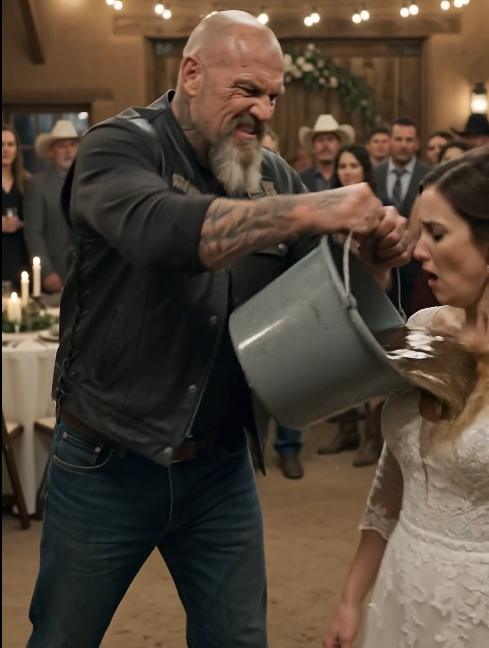
He did not strike back.
That was the only reason the room did not become a fight.
Three of Daniel’s cousins grabbed Hammer’s vest. Guests shouted. Someone called police. My mother pulled me away while staring at the ruined dress she had spent fourteen months helping me pay for.
“What is wrong with you?” Daniel yelled.
Hammer looked at my skirt.
“Get her outside.”
“You just destroyed her wedding.”
“Outside. Now.”
His voice was not loud.
It was terrified.
The reception was being held inside a restored adobe barn outside Santa Fe, New Mexico. November wind rattled the old windows, so the venue staff had positioned portable bioethanol heaters near the walls. Rows of candles lined the aisle and surrounded the dance floor.
One heater stood six feet behind me.
Its reservoir had split along a hairline seam. Clear fuel had dripped across the concrete, soaked into the trailing hem of my dress, and climbed through several layers of dry fabric without changing the color.
Nobody saw it.
Hammer smelled it.
He had been crossing the room with a glass of water when he noticed the sharp, sweet chemical odor beneath the flowers, food, perfume, and candle wax. Then he saw a drop fall from my train and leave a clear mark near an open flame.
The mop bucket was beside him.
He had no time to explain.
So he poured.
Daniel’s cousins still held Hammer when Leon Brooks—a broad Black biker with a short gray beard—kicked the nearest candle stand away from my skirt. Rosa Martinez shut down the leaking heater. Boone Mercer grabbed a fire blanket from the kitchen and wrapped it around my lower body.
Only then did the smell rise.
The dirty water had diluted the clear alcohol-based fuel and saturated the cloth before my train reached the candles. When Boone lifted the soaked hem, a faint chemical sheen moved through the puddle.
Daniel released Hammer.
Every face changed.
The fire alarm sounded. Venue staff evacuated the barn while firefighters inspected the heater, the floor, and my gown. Our first dance never happened. The cake remained inside. The band packed up. By midnight, my wedding dress had been sealed inside a hazardous-material bag.
Hammer stood alone beside his Harley while sleet gathered on his leather shoulders.
I walked toward him wearing a borrowed sweatshirt, leggings, and hotel slippers.
“You saved me,” I said.
“I ruined the dress.”
“Both can be true.”
He looked at the chrome exhaust system beneath his motorcycle—the one my late father had fabricated with him sixteen years earlier.
The next morning, that exhaust disappeared.
Hammer told the Iron Lanterns it needed repairs. He lied.
He sold it to a collector, used the money to replace my dress, rent another hall, rebook the minister, and rebuild the wedding he believed his bucket had destroyed.
But none of us understood what the exhaust meant until Boone found my father’s initials welded inside the metal—and realized Hammer had sold the last thing the two men ever built together.
Want to know why Hammer recognized the leaking fuel and what my father had hidden inside that Harley exhaust? Drop BUCKET in the comments—I’ll share more soon.
Part 2 — The Biker My Mother Did Not Want Invited
My name is Emily Hart. I was thirty-one when Daniel and I married, though “married” became a complicated word after the ceremony and reception were separated by three weeks, one ruined gown, a fire investigation, and a motorcycle part no one was supposed to know had been sold.
The first ceremony happened at San Marcos Ridge Barn, a converted agricultural building twenty miles south of Santa Fe. Daniel and I chose it because it was beautiful in photographs and barely within our budget during the off-season.
We paid for nearly everything ourselves.
Daniel worked as a high-school history teacher. I managed appointments at a pediatric dental clinic. We had postponed the wedding twice—once when my mother needed surgery and once when our apartment flooded after a pipe burst above the kitchen.
By the time November arrived, we wanted simple.
Simple lasted until we discussed Hammer.
Ray Dawson had been my father’s closest friend. My father, Thomas Hart, owned a muffler and fabrication shop near Cerrillos Road. He met Hammer in 2002, shortly after Hammer left prison and began rebuilding a life damaged by alcohol, anger, and four years behind concrete walls.
Dad offered him work when other shop owners would not.
Hammer arrived before sunrise, swept floors, and accepted every unpleasant task without complaint. My father eventually trusted him with welding, engine work, and the keys to the building.
My mother never did.
She believed Hammer brought trouble close to our family. The tattoos, motorcycles, and prison record mattered more to her than the years he spent proving he had changed.
When Dad died from pancreatic cancer, Hammer stood outside the church rather than enter. He wore his plain black leather vest, jeans, and heavy boots while snow settled in his beard.
I asked him why he remained on the steps.
“Your mother’s day,” he said.
“You loved him too.”
“Doesn’t mean she has to look at me.”
That was Hammer. He could occupy an entire doorway and still try to make himself smaller for someone else’s grief.
I invited him to the wedding.
Mom objected.
Daniel supported me because he knew Hammer had helped pay one semester of my community-college tuition after Dad became sick. Hammer had never mentioned the money. I discovered it years later while sorting my father’s receipts.
Hammer accepted the invitation under one condition.
“No club procession.”
He did not want thirty engines arriving before the bride.
The Iron Lanterns came quietly in trucks and a few motorcycles, parking behind the barn. Hammer arrived alone on his black Harley. The chrome exhaust beneath it had been designed and welded with my father during one long winter in the fabrication shop.
Dad called it the Hartline system.
It was not commercially produced. The bends were uneven in places, and one weld had been ground smooth three times because Hammer hated the way it looked. Inside the left pipe, my father had stamped three letters:
T.H.H.
Thomas. Hammer. Hartline.
The exhaust was the last project Dad completed before illness weakened his hands.
Hammer polished it every Saturday.
He refused offers from collectors, including one worth more than the motorcycle itself.
I knew the exhaust mattered.
I did not know how much.
At the barn, Hammer checked the temporary heater near the entrance before taking his seat. He asked a staff member what fuel the units used and whether the reservoirs had been inspected.
The employee told him the heaters were new.
Hammer frowned.
Later, he noticed a clear damp spot near the wall. He touched it with one finger, smelled it, and called for the venue manager. She said a guest had probably spilled water.
Hammer remained unconvinced.
The spot dried before anyone investigated.
An hour later, the same heater was moved closer to the dance floor because older guests complained about the cold. Its reservoir rocked slightly when a server carried it, widening a fracture too small to see beneath the decorative metal housing.
Clear fuel began dripping.
My train passed across it as Daniel and I entered the reception.
The fabric absorbed everything.
I felt only coldness near my ankles and assumed melting sleet had entered beneath the door.
Hammer saw me touch the skirt.
Then he smelled the air.
The expression on his face changed before he reached for the bucket.
Part 3 — The Dress, the Candles, and Five Seconds
Our wedding photographer captured the exact moment Hammer made his decision.
In the first image, Daniel and I stood beneath strings of warm lights. My dress was still white. Guests surrounded the dance floor while the band prepared our song.
Hammer appeared at the edge of the frame.
He was looking down.
The second image showed him bending toward the mop bucket. His glass had fallen from his hand, spilling clear water across the floor.
In the third, he was running.
The photographer stopped shooting after that.
I remember the bucket rising. I remember Hammer’s beard moving across his chest as he crossed the floor. I remember thinking he had lost his mind.
Then the water hit.
It was cold enough to steal my breath. The weight of it dragged the gown against my legs while dirt, flower stems, and gray soap spread across the fabric.
My mother screamed Hammer’s name.
Daniel struck him.
Guests surged forward.
Hammer never looked at any of them. He kept watching the train of my dress as though something beneath it might wake.
“Candles,” he said.
Leon moved first.
He had spent twenty-seven years with the Albuquerque Fire Department before retiring. Hammer’s tone told him the danger was not social. Leon kicked the nearest candle stand across the floor and smothered the flames beneath his vest.
Rosa reached the heater.
She found clear liquid running from the base. When she touched the shutdown control, fuel coated her glove.
“Leak!” she shouted.
That word changed the room.
Boone grabbed the fire blanket. Another biker unplugged the decorative lighting near the puddle. The venue manager ordered an evacuation while guests who had been ready to attack Hammer began moving chairs and helping elderly relatives toward the exits.
Daniel released him.
I stood soaked and shaking while Hammer crouched near my skirt without touching it.
“Emily, step out of the shoes.”
“Why?”
“Don’t drag the hem.”
I obeyed.
Boone wrapped the fire blanket around the gown. Rosa and Leon guided me away from the contaminated area while Hammer remained beside the candles until every flame had been extinguished.
Outside, sleet struck my face.
I wore no coat. My dress weighed nearly forty pounds from the water. Daniel wrapped his tuxedo jacket around my shoulders while firefighters entered the barn.
The incident had lasted less than a minute.
The consequences lasted months.
The fire marshal found that a weld along the heater’s bioethanol reservoir had failed. The clear fuel spread across approximately twelve feet of concrete. My dress absorbed enough that the investigator would not return it until the material had been treated and deemed safe.
One candle had stood less than two feet from the soaked train.
No one promised the dress would have ignited. Investigators deal in evidence, not dramatic certainty. The gown might have passed the flame without catching. The fuel might have evaporated. A guest might have noticed the smell.
Or none of those things might have happened.
Hammer had seen a clear liquid, smelled fuel, and noticed open flames.
He chose the bucket.
The firefighters ventilated the barn, but the venue remained closed pending inspection. Our caterer discarded exposed food. The cake absorbed smoke and chemical odor. The musicians had another event the following weekend and could not return soon.
Our reception was over.
My mother stood beside the ambulance looking at Hammer as though gratitude and fury were different languages she had been forced to speak at once.
“You ruined her gown,” she said.
Hammer nodded.
“You might have saved her.”
He nodded again.
“Say something.”
“Wish I’d smelled it sooner.”
That answer broke something inside her anger.
Daniel approached Hammer next. His right hand had swollen from striking the biker’s vest.
“I hit you.”
“Poor technique.”
“I’m sorry.”
Hammer looked toward me.
“You were the groom.”
“That doesn’t excuse it.”
“No.”
He never accepted easy pardons, including his own.
Police took statements. The photographer provided her images. The venue manager admitted Hammer had raised concerns about moisture near the heater earlier.
Mom heard that.
“You warned them?”
“Asked a question.”
“They ignored you.”
“So did I. Should’ve shut it down myself.”
“You weren’t responsible for the heater.”
Hammer rubbed one thumb across his scarred knuckles.
“Responsibility’s what’s left when blame gets tired.”
He walked toward his Harley before anyone could answer.
The chrome exhaust reflected the emergency lights. For years, that sound had been the first thing I recognized when Hammer approached our house—the low, uneven note Dad had helped create.
Hammer started the engine.
The exhaust filled the cold parking lot with a deep metal pulse.
My father’s last machine spoke once beneath the sleet.
Then Hammer rode away.
Part 4 — The Fire Hammer Had Smelled Before
Hammer recognized the fuel because he had smelled it on the worst night of his life.
Not my wedding.
Years before he met my father, Hammer worked maintenance at a small roadside motel outside Gallup. He was twenty-eight, recently separated from his wife, drinking heavily, and sleeping in a room beside the boiler shed.
One January night, a portable alcohol heater leaked inside a guest room. Hammer smelled the sharp odor in the hallway but assumed a cleaner had spilled solvent.
He kept walking.
Minutes later, a cigarette lighter ignited vapor near the carpet. The fire spread through curtains and plastic furniture before alarms activated.
Hammer helped evacuate six rooms. He carried an elderly man down the stairs and broke a window to reach a woman who had locked herself inside a bathroom.
A teenage employee suffered serious burns.
The motel survived.
Hammer did not escape the guilt.
He had smelled the warning and dismissed it.
His drinking worsened. Anger became easier than shame. Two years later, the pool-hall assault sent him to prison.
My father learned the entire history during Hammer’s first week at Hart Fabrication. Hammer spilled cleaning alcohol near a welding station, smelled it, and froze so completely that Dad shut down every tool in the shop.
Instead of firing him, Dad made coffee.
They sat on overturned buckets until Hammer explained.
“Smells travel,” Dad told him. “Use the memory. Don’t live inside it.”
After that, Hammer became obsessive about fuel, ventilation, and ignition sources. He checked hoses twice. He stored rags in sealed containers. He trained the Iron Lanterns to recognize the difference between gasoline, kerosene, alcohol, coolant, and ordinary water.
Some club members called him paranoid.
They still listened.
At my wedding, the smell reached a part of him that never forgot the motel hallway. He did not see a bride first. He saw absorbent fabric carrying clear fuel toward flame.
The mop water looked ugly.
Fire looked worse.
The next morning, Hammer returned to Dawson Cycles at five. Leon found him removing the Hartline exhaust from his Harley.
“What are you doing?”
“Selling it.”
“No.”
Hammer kept loosening the mounting hardware.
Leon blocked the tool chest. Boone arrived fifteen minutes later and joined him. Rosa called three other club members.
The argument lasted an hour.
The Iron Lanterns had an emergency fund, but recent medical expenses for a member’s child had nearly emptied it. Several riders offered personal savings. Hammer refused.
“The venue owes them,” Boone said.
“Insurance will pay.”
“Eventually,” Hammer answered.
“You didn’t cause the leak.”
“I poured the bucket.”
“That saved her.”
“And ended the wedding.”
Leon looked at the exhaust.
“Thomas built that with you.”
Hammer’s hand stopped for one second.
Then the wrench turned again.
“Thomas built a lot of things.”
“That’s the last one.”
Hammer removed the first pipe.
“You think he’d rather hear it idle in my garage or hear his daughter finish her vows?”
“We already finished the vows,” I said from the doorway.
Every man turned.
I had come to return Hammer’s vest, which Daniel had accidentally carried from the venue. Instead, I found half my father’s final project lying on a shop blanket.
Hammer rose.
“You shouldn’t be here.”
“You shouldn’t be selling that.”
“Already have a buyer.”
“I don’t want another wedding.”
“That’s shock talking.”
“I’m married.”
“You didn’t get the dance.”
“My dress is gone.”
“Then we find another.”
“Dad built that exhaust.”
Hammer looked at the pipe.
“Your dad built it for motion. Not a shrine.”
I stepped closer.
“Does the buyer know about the initials?”
“Yes.”
“He’ll own them.”
“Yes.”
The word cost him.
I heard it.
Hammer continued removing the system.
He did not ask permission because he knew I would refuse. He sold the exhaust to a custom motorcycle collector in Phoenix for $6,800.
The money paid for a simple replacement dress, a community hall, food, flowers, the band’s travel costs, and a second reception.
Hammer kept none of it.
He installed an inexpensive used exhaust on his Harley. The engine sounded different afterward—cleaner, quieter, ordinary.
The first time he started it, every Iron Lantern looked toward the empty place where my father’s voice had been.
Nobody commented.
Some losses deserve silence.
Part 5 — The Wedding Built Inside a Motorcycle Shop
We discovered the second wedding after Hammer had already organized half of it.
The Iron Lanterns transformed a veterans’ community hall near Route 14. Leon handled the fire inspection. Rosa arranged the kitchen. Boone built candleless centerpieces from motorcycle gears, white flowers, and battery-powered lights.
My replacement dress came from a consignment shop.
It was simpler than the first—no long train, no elaborate lace, no months of payments. The shop owner altered it after hearing only that our original reception had been evacuated.
Hammer prohibited anyone from explaining more.
“No pity discounts,” he said.
The owner ignored him and charged one dollar for the alterations.
Daniel’s students created paper flowers. My clinic coworkers baked desserts. The band returned for half its normal rate, while the Iron Lanterns quietly paid the rest.
The venue had no portable fuel heaters.
Leon checked anyway.
My mother arrived early and found Hammer sweeping the entrance. He wore a clean black shirt beneath his vest and had trimmed his beard.
She stood beside him for nearly a minute.
“I judged you for years,” she said.
Hammer continued sweeping.
“Probably had material.”
“Thomas trusted you.”
“He trusted people past good sense.”
“He trusted you with Emily.”
Hammer stopped.
My mother held out her hand.
He looked at it as though he did not understand the gesture.
Then he accepted.
At the first wedding, Dad’s absence had felt like an empty chair. At the second, pieces of him appeared everywhere: in Hammer’s hands, in the club members he had once fed at our kitchen table, and in the old welding helmet Boone placed near the guest book.
The ceremony itself lasted ten minutes.
We did not repeat the vows. Instead, the minister asked Daniel and me whether we still chose each other after the plan had changed.
We did.
The answer felt heavier.
At the reception, Hammer stayed near the exit. When the band began our delayed first-dance song, Daniel led me to the center of the floor.
The replacement dress moved lightly around my ankles.
No train.
No open candles.
No smell of fuel.
Halfway through the song, I saw Hammer walking toward the doors. I released Daniel’s hand, crossed the floor, and stopped him.
“You paid for this.”
“Club did.”
“You sold Dad’s exhaust.”
Hammer looked at Leon.
Leon became fascinated with a centerpiece.
“You were never going to tell me?”
“Would’ve started an argument.”
“We’re having one now.”
“Dance first.”
I took Hammer’s wrist and brought him to the floor. He resisted until my mother placed one hand against his back and pushed.
Guests formed a loose circle.
Hammer looked enormous and uncomfortable beneath the white paper flowers. I rested one hand on his leather shoulder while he held the other as if afraid his scarred fingers might damage it.
“You should be dancing with Daniel,” he said.
“I did.”
“Your father would laugh.”
“He’d say your timing is terrible.”
“That too.”
The band continued.
Hammer did not cry.
But when the song ended, he placed his forehead briefly against mine.
“Your dad heard it,” he whispered.
Outside, Boone started Hammer’s Harley to move it away from the catering truck.
The replacement exhaust produced a thin, unfamiliar note.
Hammer closed his eyes.
Only for a second.
Then he went outside to help.
Part 6 — The Pipe That Did Not Come Home
Daniel and I tried to recover the Hartline exhaust.
The collector refused to sell it.
He knew its history and had purchased it for a private display of handmade American motorcycle components. We offered payments. The Iron Lanterns offered labor. Even my mother called him.
His answer remained no.
I expected Hammer to be angry.
He was not.
“Sold means sold,” he said.
“You regret it.”
“Yes.”
“You still would’ve done it?”
“Yes.”
Both truths fit inside the same answer.
Hammer kept the used exhaust on his Harley. He never tried to recreate my father’s system because copying the bends and welds would have turned memory into imitation.
Instead, he mounted a small section of leftover Hartline tubing above his workbench. Dad had discarded it during fabrication because the angle was wrong. Hammer had saved it for sixteen years.
He stamped new initials beside the old test marks:
E.D.H.
Emily. Daniel. Hammer.
Below them, he added the date of our second reception.
The dirty bucket also survived.
Rosa cleaned it, painted the outside white, and asked wedding guests to fill it with handwritten notes. Some thanked Hammer. Others apologized for attacking him. My mother wrote only six words:
I finally saw what Thomas saw.
The bucket remained near the entrance to Dawson Cycles, filled with paper rather than water.
Hammer never read the notes in front of anyone.
But they changed positions.
We knew he read them at night.
Part 7 — The First Dance We Kept
Five years later, Daniel and I returned to the community hall for our anniversary.
We brought our three-year-old daughter, Grace, who believed Hammer’s beard existed for her to braid. He permitted one yellow ribbon and rejected every pink one.
The Iron Lanterns had just finished another charity ride. Harleys lined the building, their engines ticking in the evening cold.
Hammer’s motorcycle stood among them.
The cheap exhaust had rusted near one clamp. Its sound remained ordinary. The Hartline system had never returned.
Inside the hall, Boone played our first-dance song through an old speaker. Daniel offered his hand, and Grace stepped between us.
We danced as three.
Hammer watched from the doorway.
My mother joined him. Age had softened both of them. She handed him a paper cup of coffee, and he accepted without checking what was inside.
When the song ended, Grace ran toward Hammer. He lifted her carefully and carried her to the white bucket near the entrance.
She dropped in a folded note covered with purple crayon.
“What does it say?” Hammer asked.
“She can’t write yet,” I told him.
He opened it anyway.
The page held three crooked figures: a woman in a white triangle, a small child, and an enormous man beside a black motorcycle.
Above them floated a gray square.
“The bucket,” Grace explained.
Hammer folded the picture along the same lines and placed it inside his vest rather than returning it to the container.
Outside, the Iron Lanterns started their motorcycles. The building filled with low mechanical thunder, but Hammer’s Harley no longer carried my father’s distinctive note.
It did not need to.
Dad remained in the stamped metal above the workbench, in the second wedding, and in the man he had once trusted before anyone else did.
Hammer carried Grace outside.
The white bucket stayed by the door.
Follow our page for more unforgettable biker stories about misunderstood actions, hidden sacrifices, second chances, and the quiet humanity carried beneath leather and roaring engines.