An 82-Year-Old Woman Was Left On A Bus Stop Bench In An Erie Snowstorm With One Small Suitcase. A Tattooed Biker Wrapped Her In His Jacket, And She Wept At The Name On His Arm. Her Own Daughter Had Brought Her There, The Day After Learning That Name Existed.
Part 2 — Kissed by the Moon
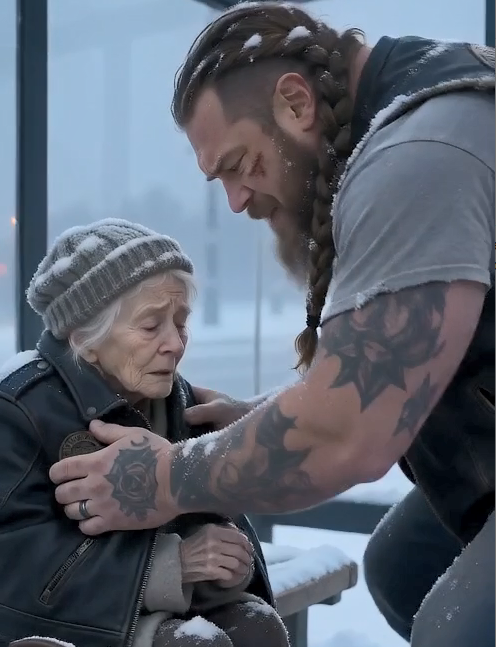
The Presque Isle Riders came down Pittsburgh Avenue through the snow, eleven bikes and Dutch Kaminski’s old F-250 with the plow on the front. They didn’t ask questions. They lifted the old woman into the warm cab like she was made of glass.
Tom rode behind them to UPMC Hamot, on the bayfront, with his hands numb on the grips and his mind somewhere else entirely.
Tomasz.
He’d had the name on his wrist for six years. His adoptive mother, Ruth Reilly, gave it to him on her deathbed in 2020. It was a slip of paper from St. Joseph’s Home for Children, folded so many times it was soft as cloth.
Birth name: Tomasz. Born March 17, 1981, Hamot Hospital. Birthmark on left wrist, “kissed by the moon,” per nurse.
That was all. No mother’s name.
He’d gotten the tattoo the week of Ruth’s funeral, wrapping the letters around the little crescent mark. In 2024, he finally registered with the Pennsylvania Adoption Information Registry. Last month, a letter came back. A match has been found. The birth parent has consented to contact.
He’d read it in the break room at Donjon Shipbuilding, where he worked as a welder on Great Lakes barges. Then he’d put it in his locker and never answered it.
For forty-five years, his adoptive parents had told him the same thing, kindly. Your birth mother wasn’t able to keep you. He’d always heard didn’t want to. A forty-five-year-old welder with a braided beard and a 2006 bar fight on his record wasn’t anybody’s prayer answered.
And now an old woman in a snowstorm had touched his wrist and known a phrase only his adoptive mother had ever said out loud.
It could be a coincidence. Lots of babies have birthmarks. Lots of nurses say sweet things. Maybe she was confused, and he was a lonely man who wanted it to be true so badly he’d believe anything.
The nurse at Hamot said mild hypothermia. Peg Dombrowski held Tom’s hand the whole time they warmed her. She wouldn’t let them take the leather jacket.
At 4:40, the emergency room doors slid open.
A woman in a camel wool coat and expensive snow boots hurried in. She was forty-five, with sharp cheekbones and blonde highlights, and her phone was in her hand. Behind her came the young man in the Penn State parka, red-eyed.
“Mom. Oh my God, Mom.” She dropped to her knees by the bed. “You wandered off again. I’ve been searching everywhere.”
Peg didn’t answer. She was staring at her daughter.
Then the woman stood up and saw Tom.
She took in the braided beard, the tattoos, and her mother’s hand in his.
“I’m Christine Haller. Her daughter,” she said coolly. “And you are?”
“Tom Reilly.”
She held out her hand to shake his. It was a reflex, a real estate agent’s handshake.
Then she saw his wrist. The tattoo. The tiny crescent mark.
She snatched her hand back like she’d touched a stove.
Her coat sleeve had slid up when she reached out. On the inside of her own left wrist was a tiny crescent-shaped birthmark.
The same size. The same shape. The same place.
Why did a stranger in a leather vest have the same mark as the woman who’d left her mother in the snow?
Part 3 — Two Kittens
March 17, 1981. Hamot Hospital, Erie.
They came four minutes apart, just after dawn on St. Patrick’s Day. A girl first, then a boy. Twins. Nobody had known. Peg Dombrowski was thirty-seven, and the doctor only heard one heartbeat.
They each had the same tiny crescent birthmark on the inside of the left wrist. The night nurse, an Irish woman named Bridget, held them up to the window.
“Look at that. Kissed by the moon, the both of them.”
Peg named them Krystyna and Tomasz.
For two nights, she held one in each arm and sang them the lullaby her own mother had sung in Polish, in the old house on the East Side. It was Aaa, kotki dwa. Two little gray kittens. She sang it until the nurses came to take them back to the nursery.
Every time she reached the line about the two kittens, she touched each baby’s crescent, one and then the other.
Her husband, Stan, had been laid off from the GE locomotive plant in Lawrence Park since November. There were two other children at home already. His mother, Babcia Halina, sat in the corner of the hospital room with her rosary and her arithmetic.
On the third morning, Father Novak from St. Stanislaus came with a woman from Catholic Charities, a clipboard and a good Catholic couple in Pittsburgh who couldn’t have children.
Babcia Halina said one baby was a blessing and two was a burden. Stan didn’t look at Peg.
Before they came for him, Peg cut the tiny paper bracelet off her son’s ankle. Baby Boy Dombrowski. She sewed it into the lining of her red sewing box, behind the pincushion, where she kept the needles nobody else was allowed to touch.
Then she kissed his crescent one last time.
Part 4 — The Text
Christine was ready the next morning.
She met Tom in a small family conference room at Hamot with two coffees from Tim Hortons and a leather folder. Her son Ryan, twenty-two, sat beside her, staring at the table.
“I owe you a thank-you,” Christine said. “And an explanation. Because I know how this looks.”
She opened her phone and turned it toward him. It was a text thread labeled Mom.
12:14 PM: Christine drop me at the 26th St stop. I’ll take the #2 to St Stans for Mass. Don’t fuss.
“She takes the bus to afternoon Mass every Wednesday,” Christine said. “She insists on it. Fifty years at St. Stanislaus. I dropped her off at noon. I had a closing at one.” Her eyes filled. “The #2 runs every twenty minutes. I never imagined the buses would stop for the snow.”
She slid a stack of papers across the table. They were Peg’s bills: property taxes on the house on West Sixth Street, the gas bill, a pharmacy statement. All of them were paid from Christine’s account.
“I’ve been taking care of her alone for six years, Mr. Reilly. My two older brothers are in Florida and Arizona and don’t call.” Her voice hardened slightly. “So whatever she told you in that bus shelter, please understand. She mixes things up now. She tells stories.”
“And the memory care paperwork in her suitcase?”
Christine’s face tightened. She turned, slowly, to look at her son.
Ryan wouldn’t meet her eyes.
“Ryan set up Mom’s phone,” she said quietly. “He’s the only one who knows her passcode. He’s the one who filled out that Lakeview form. I didn’t even know he’d put it in her suitcase until the hospital told me.” She shook her head. “He thinks she’s not safe at home. He’s been pushing me to place her for months. I told him not yet.”
Ryan’s face had gone red. His mouth opened and closed.
“Ry,” Christine said gently. “Tell him.”
The young man looked at Tom, then at his mother, then down at the table.
“I filled out the form,” he said hoarsely.
He didn’t say anything else.
Tom walked out of the conference room with his head spinning. The text came from Peg’s own phone. The paperwork was in the grandson’s handwriting. And there was a daughter with six years of bills, two absent brothers and an exhausted face.
Maybe Christine had made a terrible mistake on a snowy day. Maybe the person who really wanted Peg gone was a twenty-two-year-old boy who knew her passcode.
Down the hall, the old woman was sitting up in bed, waiting for him.
“Did she show you a text from my phone?” Peg asked.
“She did.”
Peg held up her hands. They were thin and spotted, the knuckles swollen from fifty years of sewing.
“Tomasz,” she said softly. “I can’t work a phone keyboard. My fingers won’t do it. Ryan set it up so I just press the green button to call. I have never sent a text message in my life.”
Then who had sent one from her phone, sitting in a car while she sat in the snow?
Part 5 — Route 2
Dutch Kaminski drove a bus for the Erie Metropolitan Transit Authority for thirty years before he retired and bought a Harley. He still knew everybody in the dispatch office on 14th Street.
By two that afternoon, he was standing in Tom’s kitchen with a thumb drive.
“Every EMTA bus has four cameras,” he said. “One faces the curb. The #2 passed the 26th Street shelter at 12:11 and again at 12:31. Driver didn’t stop either time because nobody waved.”
They watched it on Tom’s laptop.
12:11 p.m. Snow blowing sideways. A black Audi SUV at the curb. A woman in a camel coat got out, walked around, and helped an old woman onto the bench. She set down a brown suitcase. Then, before she got back into the car, she held out her hand.
The old woman put something small and dark into it.
A phone.
The Audi stayed at the curb for three more minutes. Through the windshield, you could see the driver bent over her lap, her thumbs moving.
At 12:14 the Audi pulled away. The old woman sat alone on the bench, her hands empty.
“She took her phone,” Tom said quietly. “She sent the text to herself. From her mother’s phone. Sitting right there.”
At 12:31, the second bus went by. Peg was still on the bench, white with snow.
The bus didn’t stop. Nobody had told her to wave.
Ryan came to Tom’s apartment that night, alone. He stood in the doorway in his Penn State parka with snow on his shoulders, looking like he hadn’t slept.
“She told me to fill out the form,” he said. “Mom did. She dictated it to me at the kitchen table on Monday night. She said if her own handwriting was on it, people would think she was trying to get rid of Grandma.” His voice broke. “I didn’t know she’d leave her at a bus stop. I swear to God. I thought it was for after Christmas.”
He held out a folder.
“I took these from her office. She’s going to kill me.”
The first page was a printout from the Erie multiple listing service. It was a pocket listing, coming soon, not yet public. 1914 Georgian Revival, West Sixth Street. Original woodwork, five bedrooms, Lake Erie views. Listing agent: Christine Haller, Haller Realty Group. The list price was $895,000. It was dated two weeks before the bus stop.
The second page was a durable power of attorney, signed by Margaret Dombrowski last December, when she was in Hamot with pneumonia. It named Christine as her agent.
The third page was a photocopy of Peg’s will from 1999. Christine had highlighted one line in yellow.
I leave my house and all my property in equal shares to my children.
Above it, in Christine’s handwriting, she had written: Tomasz counts???
The last page was a letter from the Pennsylvania Adoption Information Registry, addressed to Margaret Dombrowski and dated last week. We are pleased to inform you that a match has been confirmed with your son, born March 17, 1981.
It had been opened.
“Grandma’s had that will since I was born,” Ryan whispered. “Mom always figured ‘my children’ meant her and my uncles. Then that letter came Monday. Mom read it in the car outside Grandma’s house and screamed. I was in the passenger seat.”
Tom stared at the papers. There was a house worth nearly a million dollars and a pocket listing that wasn’t public yet. There was a will that said children, and a birth son who could walk into any courtroom in Erie County and claim a share of everything.
Unless the woman who’d written the will was declared incompetent and moved out of state before he showed up.
Tom’s phone rang. It was the nurse from Hamot.
“Mr. Reilly? Mrs. Dombrowski was discharged an hour ago. Her daughter has power of attorney. She signed her out to a private transport.” A pause. “To Ohio.”
How far could Christine get Peg before anybody stopped her?
Part 6 — Across the Line
By midnight, Christine had made sure nobody would.
Her post went up on Facebook at 10:15 p.m. There was a photo of her mother smiling at a Christmas party, and a paragraph that would be shared eleven thousand times by morning.
My mother has advanced dementia. Yesterday she wandered away from home in a snowstorm, and when we found her, a biker gang had convinced her that one of them was a long-lost son. They are now harassing our family. She is safe at a memory care facility. Please respect our privacy and pray for us.
Somebody in the comments posted a photo of Tom from a Toys for Tots ride, circled in red.
At seven the next morning, his supervisor at Donjon Shipbuilding called him into the office. Some of their barge contracts were with federal agencies, and somebody had called corporate.
“Take a week, Tom,” his boss said. “Paid. Until this blows over.”
At ten, an Erie police officer served him with a temporary protection order. Christine had filed it on behalf of her mother, as her agent. He was not to contact Margaret Dombrowski or come within five hundred feet of her.
Tom drove to Ashtabula anyway, forty miles west on Interstate 90, in a whiteout. He didn’t go inside. He parked across the road from Lakeview Memory Care, more than five hundred feet away, and stared at the low brick building with its coded door and the windows that didn’t open.
A Lakeview staff member came out to the parking lot after twenty minutes.
“Sir, we’ve been told about you. Please leave, or we’ll call the Ashtabula County sheriff.”
He left.
On the drive back, the lake-effect bands came off the water so thick he couldn’t see the hood of his truck. He crawled along at fifteen miles an hour for an hour behind a salt truck’s orange light, with nothing to do but think.
Peg was in a locked ward in another state. Ohio courts, Ohio judges. Christine had power of attorney and a closing on the house, and it would take him weeks to get a Pennsylvania judge to do anything across the line.
At his apartment, Ryan was waiting in a car out front, with the engine running.
“They’re giving her lorazepam,” Ryan said. “For ‘agitation.’ Because she keeps asking for you. A nurse’s aide told me. Grandma keeps saying your name and spitting the pills into her napkin.” He wiped his eyes. “Mom’s closing on the house is Friday. A doctor from Cleveland bought it, cash. Mom told me last night she’s using her share to pay off her office lease.”
“Her share?”
“She thinks it’s all hers. If Grandma’s declared incompetent before you’re legally recognized, Mom says the will gets frozen and she controls everything until Grandma dies.” Ryan’s voice cracked. “She says that won’t be long. In a place like that.”
Then he reached into the back seat and lifted out something heavy.
It was a red metal sewing box, scratched and old, with a pincushion on the lid shaped like a tomato.
“Grandma made me promise,” Ryan said. “Before they took her. She grabbed my sleeve in the hospital and whispered. ‘Ry. The red box. Give it to Tomasz. Not your mother. Tomasz.'”
What had Peg Dombrowski been keeping in a sewing box for forty-five years?
Part 7 — The Red Box
Tom opened it at his kitchen table at midnight, while Ryan sat across from him.
There were spools of thread, a tin of buttons and a tomato pincushion stuck full of needles. Under the top tray was a layer of tissue paper.
Under the tissue paper were letters.
They were tied in bundles with sewing thread. Each envelope said Tomasz in careful, old-fashioned script, with a year underneath. 1982. 1983. 1984. All the way to 2026. There were forty-five of them, one every March 17th. None had ever been mailed.
At the very bottom, sewn flat into the lining behind the pincushion, was a scrap of yellowed hospital paper no bigger than a stick of gum.
Baby Boy Dombrowski. 3/17/81.
And on top of everything was one more envelope, newer than the rest, addressed to Tomasz, if you ever find this.
He read it with his hands shaking.
Tomasz,
They will tell you I was forced. That is partly true. Your father and his mother and the priest decided we could not keep two babies. But they did not take you from me.
They told me I could keep one.
I chose.
I chose your sister because she was crying and you were sleeping. That is the only reason. She was crying, and I picked her up, and that was the choice. I have spent forty-five years knowing that if you had been the one crying, I would have kept you instead.
I never told Krystyna the whole truth. When she was ten, I told her she had a twin brother who went to a family in Pittsburgh. I told her she was the one God wanted me to keep. I thought it would make her feel loved. I think instead it made her afraid that I could unchoose her. Everything she has done since, she has done like a girl who was told she was chosen and has spent her whole life waiting to be returned.
Last year I signed up with the registry. I asked my lawyer to change nothing in the will, because “my children” already meant you. I did not tell her. I was a coward with both of you.
I am not a victim in this story, Tomasz. I am the woman who picked up the crying baby.
Kocham cię. I love you. I always did.
Mama
Tom put the letter down on the table.
He didn’t know what he felt. He was grateful and furious at once. For forty-five years he’d believed nobody had wanted him. The truth was worse and better. She had wanted them both, and she’d had to choose, and she’d chosen in about two seconds because of who was crying.
Ryan was crying quietly across the table.
“She told Mom she was the chosen one,” Ryan whispered. “That’s why Mom’s like this. Everything is a competition with her. Me, my dad, her brothers. She can’t lose anything.”
Tom thought about a forty-five-year-old woman screaming in a parked car over a letter from a registry. It wasn’t only greed. It was a ten-year-old girl who’d been told she was picked, finding out she could be replaced.
It didn’t excuse a bus stop in a snowstorm.
But it explained it.
“Ryan,” Tom said. “Where’s your mom going to be before Friday?”
Ryan wiped his face. “Sunday night is Wigilia. Christmas Eve supper at the St. Stanislaus parish hall. Two hundred people. Mom’s on the parish council. She’s bringing Grandma from Ohio for it. She’s already got a photographer. She wants the whole East Side to see what a good daughter she is.” He swallowed. “The parish livestreams it.”
Tom looked at the forty-five letters and the little hospital bracelet.
Would a sewing box full of letters be enough to stand up to a power of attorney in front of a whole parish?
Part 8 — Wigilia
The St. Stanislaus parish hall on East 13th Street smelled like pierogi, mushroom soup and fried carp. Long tables were covered in white cloth, with hay tucked under each tablecloth the old way, for the manger. Two hundred people from Erie’s Polish East Side sat in their Christmas best. An empty place was set at the end of each table for the unexpected guest, the way it always was at Wigilia. A parish volunteer filmed from the stage with a phone on a tripod.
Christine stood near the front in a red dress. Her mother sat beside her in a wheelchair, in a lace collar, her eyes glassy and slow.
Father Michalski raised the plate of opłatek, the thin white Christmas wafers that families break and share, asking forgiveness for the year.
“Before we share the wafer,” he said, “Christine Haller has asked to say a few words about her mother.”
Christine took the microphone and laid a hand on Peg’s shoulder.
“Most of you have known my mother for fifty years,” she said, her voice catching beautifully. “This has been a hard year. Mom’s mind has been slipping. Last week, she wandered off in the snow. Strangers took advantage of her confusion. Bikers. One of them actually convinced her he was a son she gave up decades ago.”
Murmurs went around the hall. A few people shook their heads.
The back doors opened.
Tom Reilly walked in from the snow. His beard was braided and he wore a clean flannel shirt, and he carried a red metal sewing box in his arms. Behind him, the Presque Isle Riders filed in quietly and stood along the back wall, still in their jackets. Dutch Kaminski held a laptop. Ryan walked beside Tom, pale.
The room went silent.
Christine’s face hardened. “This is the man. There’s a protection order. Somebody call—”
“The protection order was filed under your power of attorney,” Ryan said. His voice shook, but it carried. “And Grandma’s lawyer revoked your power of attorney yesterday afternoon. He drove to Ashtabula himself. She signed it in front of a notary and two nurses. She was perfectly clear.”
“She has dementia—”
“Then how did she tell him exactly where her will was and what it says?” Ryan asked.
Dutch opened the laptop on the nearest table and turned it toward the room. It showed EMTA bus camera footage. The black Audi. The woman in the camel coat holding out her hand. The old woman giving up her phone. Three minutes of a woman bent over a screen. Then the Audi driving away, and the old woman alone in the snow.
The hall had gone so quiet you could hear the soup simmering in the kitchen.
“That was for Mass,” Christine said, too fast. “She takes the bus to Mass—”
“She can’t text,” Tom said quietly. “Her fingers can’t work the keys. You took her phone and texted yourself so you’d have a record.”
Christine turned to the crowd, her voice rising.
“This is insane. My mother has been confused for years. She’s always made up stories. When I was little, she used to sing me that Polish lullaby about the two kittens, and every time she’d cry and tell me I was one of two kittens and the other one ran away—”
She stopped.
Two hundred people heard it.
Tom set the red sewing box down on the white tablecloth and opened the lid.
“You knew,” he said softly. “You’ve known since you were ten years old.”
Christine’s mouth opened. Nothing came out.
In the wheelchair, Peg Dombrowski lifted her head. Her eyes weren’t glassy anymore. They were wet and clear.
She began to sing.
It was barely more than a whisper, in Polish, in the voice of a much younger woman in a hospital bed.
“Aaa, kotki dwa…”
Two little gray kittens.
She reached out with one hand and took her daughter’s wrist. With the other, she took her son’s. She turned both wrists over in the light so the whole room could see.
Two identical crescent birthmarks.
Christine stared down at her own arm. Then at her brother’s.
Her face crumpled.
What would the girl who’d been chosen do now that the other kitten had come home?
Part 9 — The Wafer
She sat down on the floor of the parish hall in her red dress and cried.
Nobody moved for a long time. Then Father Michalski came down off the stage, knelt beside her, and put a hand on her shoulder. He didn’t say anything.
In January, the Erie County district attorney charged Christine Haller with neglect of a care-dependent person and with attempting to exploit her mother financially. The pocket listing on West Sixth Street was withdrawn. The doctor from Cleveland got his deposit back. In March, Christine pleaded guilty and was sentenced to two years of probation and three hundred hours of community service at a senior center on the East Side. She did every hour. The director said she was the best volunteer they’d ever had.
Peg went home to the house on West Sixth Street on the second day of January. Ryan moved into the spare room to help. Tom came every evening after his shift at Donjon, which had taken him back with an apology from corporate. He fixed the porch steps and the furnace and the sticking back door.
On March 17th, Peg turned eighty-three, and her twins turned forty-six.
Tom read the letters one at a time, a year at a time, at her kitchen table. He was up to 1993. She’d said he could only read one a day.
Christine came on Sundays. At first she sat in her car in the driveway for twenty minutes before she could come in. Then ten minutes. Then she just came in.
She and Tom didn’t talk much at first. There was too much between them, and none of it was simple. She’d left their mother in the snow. He’d been the baby that wasn’t picked. Neither of them had chosen any of it.
But one Sunday in April, Tom found her in the back hallway, staring at his coat on the hook, and at the leather jacket he’d put on their mother’s shoulders that night at the bus stop.
“I’m sorry,” she said, without turning around. “I’m so sorry.”
“I know,” he said.
That December, on Christmas Eve, the family gathered around the long dining room table on West Sixth Street for Wigilia. There was hay under the tablecloth and an empty place set at the end. Ryan was there, and Tom, and Christine. Peg’s two older sons had flown in from Florida and Arizona for the first time in years. Dutch Kaminski and his wife came too, because Peg said a man who could get bus camera footage on a Saturday was family now.
Peg stood at the head of the table, holding a single white wafer.
The tradition is simple. You break the opłatek with each person at the table. You wish them well for the year. You ask forgiveness for the last one.
She turned to her daughter first. Christine’s hands were shaking. Peg broke a piece of the wafer and held it out.
“Forgive me, Krysia,” she said. “For telling you that you were chosen. You were never chosen. You were loved. It’s different.”
Christine took the piece and put her arms around her mother and didn’t let go for a long time.
Then Peg turned to her son.
She broke the last piece of wafer and held it out to him with both hands. He took it with his left hand, and the little crescent on his wrist caught the candlelight.
Across the table, Christine slowly put her own left hand on the white cloth next to his. Two crescents, side by side.
Peg looked at them, and her eyes filled. She began to hum, very softly.
“Aaa, kotki dwa.”
Two little gray kittens.
“Both of you,” she whispered. “Home.”