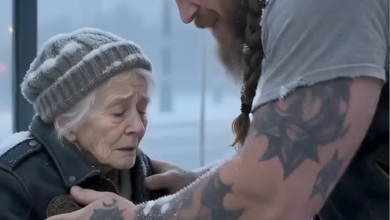
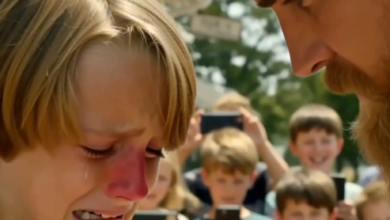
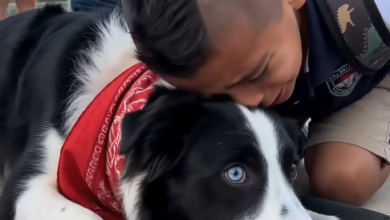
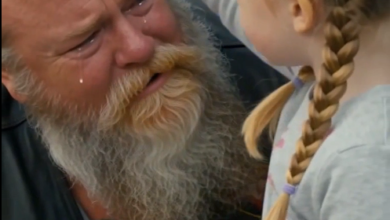
A Tattooed Biker Slapped A Bag Of Food Out Of A Homeless Boy’s Hands In Front Of A Crowd That Called Him A Monster. He Had Seen What Was Hidden Inside, And Who Had Been Handing It To The Boy Every Night.
Part 2 — Wandered Off
The Dayton police cruiser pulled in four minutes later.
Officer Marisol Vega was thirty-four and had worked third shift in Old North Dayton for nine years. She took one look at the giant in the leather vest and the crying boy and put her hand on her belt.
Then Wyatt held up the pliers.
She saw the needle, and her face changed.
“Don’t anybody touch that.” She pulled on gloves, bagged the syringe and the sandwich, and crouched down in front of the kids. “Hey, buddy. What’s your name?”
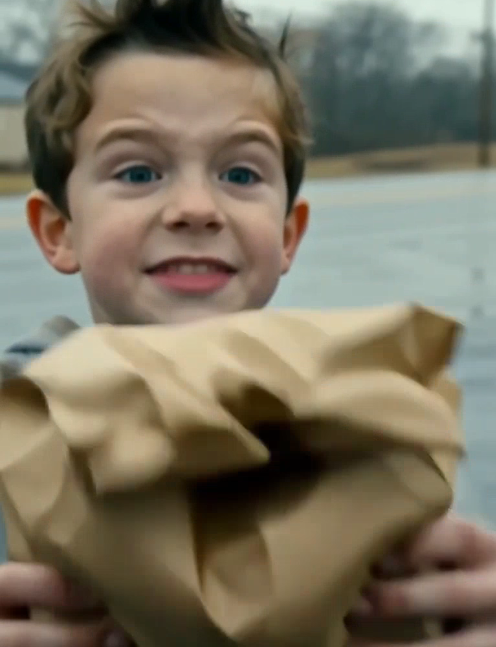
“Owen.” He had his arm around his sister. “This is Lucy. We didn’t do anything.”
“I know you didn’t, sweetheart. Who takes care of you?”
Owen’s eyes went to Wyatt, then to the ground.
“Pastor Gary Whitcomb,” he said. “From Bread of Life. He’s our foster dad.”
Vega made a call. Eleven minutes later, a white passenger van with BREAD OF LIFE MISSION on the side swung into the Speedway lot.
The man who got out was fifty-six, silver-haired and soft-spoken, in a quarter-zip fleece. He went straight to the children and knelt in a puddle without caring about his khakis.
“Oh, thank you, Lord. Owen, buddy, you scared me to death.” He held them both. “Officer, I’m so sorry. They wandered off after dinner again. Owen does this. Since his mama passed, he runs back toward the river where she used to—” He stopped, his voice catching. “Where she used to go.”
Vega nodded slowly. Everybody in Dayton knew Pastor Gary. His mission fed four hundred people a week on Wayne Avenue. He’d been on WHIO twice.
Then Gary saw the evidence bag. “Is that a—dear God. In one of our bags?”
“We’ll be in touch tomorrow, Pastor.”
Gary stood, his hand on Owen’s shoulder, and turned to look at the man in the leather vest for the first time.
“And you are?”
“Wyatt Kane.”
The color left Gary’s face so fast it was almost funny.
“Wyatt Kane is dead,” he said.
“Not yet.”
Gary recovered in two seconds. He drew the children closer. “Officer, if this is Kelsey Kane’s brother, you should know he’s a heroin addict who stole his own mother’s medication the week she died of a heart attack. Kelsey didn’t want him anywhere near her kids. She wrote it down.”
Vega’s eyes went back to Wyatt.
He didn’t argue, because it was true. All of it. In 2019, he had walked into his mother’s kitchen on Leo Street and taken the pill bottle off the windowsill, and three days later she was gone. Nobody ever proved the two things were connected. Nobody had to.
He’d left Dayton that week. He’d been in a Kentucky jail six months later, then rehab in Austin, Texas. He’d been clean five years, two months and nine days.
None of that changed what he’d done.
Standing in that parking lot with a pastor’s arm around his sister’s children, Wyatt thought, Maybe they really are better off. Maybe a kind man with a mission and a van was what Kelsey had wanted for them, and the most decent thing Wyatt could do was get back on his bike and ride nine hundred miles south again.
Vega ran his name. Possession, 2018. Theft, 2019. Old, but there.
“Mr. Kane, I’m going to ask you to head out.”
Gary loaded the kids into the van. Through the window, as it pulled away, Owen pressed two fingers to his lips.
Three notes, too faint to hear. Low, high, low.
Wyatt sat on his bike for a long time. Then he rode down Keowee to the Third Street bridge and walked down the muddy bank with his phone flashlight.
Under the overpass, behind a concrete pillar, there was a green two-person tent.
Inside were two sleeping bags. A plastic bin of children’s clothes. An asthma inhaler with Lucy’s name written on it in marker. A school photo of Owen. And a framed picture of a laughing woman with a crooked front tooth.
His sister.
They hadn’t wandered off after dinner. They lived here.
So why had a licensed foster father just told a police officer they slept under his roof?
Part 3 — Three Notes
July 4, 2019. Kelsey’s apartment in Old North Dayton, the one with the window unit that rattled.
Wyatt was thirty-two and sixty-one days clean. It wouldn’t last. He didn’t know that yet.
His nephew Owen was three. He had a cowlick like his mother’s and a laugh like a car alarm.
That afternoon, Wyatt taught him the whistle. Two fingers, low, high, low. Their father, a railroad man for the B&O, had whistled it from the back porch every night at dusk when Wyatt and Kelsey were kids. Three notes that meant one thing.
Come home.
Owen couldn’t do it yet. He just blew spit. Kelsey laughed so hard she had to sit down.
Wyatt gave him his old Hohner harmonica, dented in the corner, with W.K. scratched into the cover from when he was eleven.
“Keep it till you can play it,” he said.
That evening, at the fireworks on the river, Wyatt slipped Owen half a Reese’s cup.
Four minutes later, the boy’s lips were swelling and his breathing sounded like a squeaky door.
Kelsey had the EpiPen out of her purse before Wyatt understood what was happening. She drove the boy to Dayton Children’s Hospital with the hazards on. Wyatt sat in the waiting room for three hours with his face in his hands.
“Peanuts, Wy,” Kelsey said when she came out, white as paper. “He’s deathly allergic. We found out last month. I told you.” She grabbed his collar. “Never peanuts. Never.”
“Never,” he promised.
A month later, he relapsed.
Two months after that, he took the pills off his mother’s windowsill.
He never saw Owen again.
Part 4 — The Volunteer
The Bread of Life Mission occupied an old furniture warehouse on Wayne Avenue. It had a soup kitchen downstairs, offices upstairs, and a hand-painted mural of loaves and fishes on the brick.
Pastor Gary met Wyatt at the front door the next morning like a man welcoming an old friend.
“Mr. Kane. I owe you an apology. I was frightened last night.” He shook Wyatt’s hand firmly. “Let me show you something.”
He walked Wyatt up a back staircase to a bright room on the second floor with bunk beds, a dinosaur comforter, a pink one with unicorns, a bookshelf, and a framed drawing of a house with four stick figures.
“Their room,” Gary said. “Owen and Lucy have slept here since March.”
He opened a folder. It held visit reports from Montgomery County Children Services, one per month, signed by a caseworker. Children well-groomed and appropriately clothed. Bedroom clean and age-appropriate. Owen reports he likes living with Pastor Gary.
“Owen runs,” Gary said softly. “Back to the bridge. That’s where Kelsey used, near the end. I think he’s looking for her.” He took out two more pages. “I’ve filed missing child reports twice. You can check.”
Wyatt read them. They were real.
“And the needle,” Gary said, his face pained. “Our bags are packed by volunteers from our Second Chance program, men in recovery. One of them relapsed. His name is Trey Dobbins. I let him go this morning.” He shook his head. “Addiction lies, Mr. Kane. You know that better than anyone.”
Wyatt did know that. It was the one thing he knew.
Then Gary slid one last piece of paper across the desk. It was handwritten on a page torn from a spiral notebook and signed with a shaky signature Wyatt recognized from a hundred birthday cards.
If something happens to me, I want Pastor Gary Whitcomb to be guardian of Owen and Lucy. NOT my brother Wyatt Kane. Under no circumstances. — Kelsey Kane, 2/14/2026
Wyatt read it three times.
“She was very clear,” Gary said gently. “I’m sorry.”
Wyatt walked out into the cold and sat on the curb by his bike.
A kind pastor. A clean bedroom. Monthly visits. A relapsed volunteer who’d already been fired. And his sister, in her own handwriting, telling the world to keep him away.
Maybe he’d been wrong about everything.
But it took him two hours to find Trey Dobbins anyway.
Trey was twenty-six, rail-thin, sitting on a bench outside the Greyhound station with a garbage bag of clothes. His hands shook. He saw the leather vest and the sobriety chip hanging from Wyatt’s keychain, and he started to cry.
“I used,” Trey said. “Yesterday. I’m not gonna lie to you, man.”
“Did you pack the bag with the needle in it?”
“No.” Trey looked up. “I never packed Owen’s bag. Nobody does. Pastor Gary packs that one himself. Every night, at his desk upstairs, with the door shut.” He wiped his face. “He’s real particular about it. He says it’s his ministry.”
If Gary packed Owen’s bag himself, behind a closed door, every night, then whose needle was it?
Part 5 — U-100
Officer Vega called Wyatt at four that afternoon.
“Crime lab’s back on the syringe,” she said. “It’s not a street needle. It’s a U-100 insulin syringe. Half-cc, short needle, orange cap. No drugs in it. Just insulin residue.”
“Insulin.”
“Trey Dobbins isn’t diabetic. I checked.” A pause. “Gary Whitcomb is. Type 1, since he was a kid. He’s got a prescription for those exact syringes at the CVS on Wayne Avenue.”
Wyatt closed his eyes.
“It probably wasn’t on purpose,” Vega said. “My guess is he packs those bags at his desk next to his insulin kit and doesn’t look at what he’s putting in. Which tells you how much he cares what’s in them.”
That evening, Vega and a Montgomery County Children Services caseworker named Aisha Grant met Wyatt at a Waffle House on North Dixie. Aisha was forty and tired, and she had pulled Owen and Lucy’s file that afternoon and read it twice. She hadn’t liked what she found.
She spread it across the table.
“Gary is their representative payee for Social Security survivor benefits,” she said. “Eleven hundred and forty dollars a month, per child. That’s since March.”
She turned a page. Kelsey Kane had worked in the cafeteria at Kettering Health for six years. She had a life insurance policy through work, a hundred and fifty thousand dollars, and the beneficiary was her children. As guardian, Gary had received the payout in April.
“And it went here.” Aisha pointed. It was a deposit into the account of Bread of Life Mission, under the line Building Fund.
“Your mother’s house on Leo Street,” Vega said, sliding over a printout. “It went to Kelsey when you were declared missing, then to the kids. It’s being rented out for nine hundred a month. The checks go to the mission.”
“And the mission,” Aisha said, “is four hundred and ten thousand dollars behind on its mortgage. The bank filed in January.”
Wyatt sat back in the booth.
Then Vega played a video on her phone. It was security footage from the mission’s own back-door camera, pulled with a warrant that afternoon.
8:57 p.m. A small boy in a filthy hoodie walked into the alley holding a little girl’s hand. Gary opened the door, handed him a paper bag, patted his head, and shut the door. The boy walked away down the alley, back toward the river.
Vega scrolled. It was the same scene the next night, and the next.
“Fifty-one nights in a row,” she said. “Except one day a month.”
“Visit day,” Aisha said quietly. “Caseworker visits are scheduled with forty-eight hours’ notice. On those days, the kids come in through the front. They get bathed and fed, they sleep in that bedroom, and they tell the caseworker everything’s fine.” She looked sick. “It was my colleague’s caseload. She has a hundred and twelve kids.”
“And the bags,” Wyatt said. “What’s in them?”
Aisha flipped to a photo the lab had taken of the spilled food. Half a sandwich, open on the pavement.
Peanut butter and jelly.
Wyatt stared at it.
“Every night,” he said. “Peanut butter?”
“Trey says Gary buys it in bulk. It’s cheap. Why?”
Wyatt didn’t answer. He thought about a three-year-old’s lips swelling at a fireworks show. He thought about a boy handing his little sister the whole sandwich every night and eating nothing himself.
No wonder Owen was so thin.
Vega’s phone buzzed. She read the text and her jaw tightened.
“Gary filed an emergency motion in juvenile court an hour ago,” she said. “He’s asking to transfer Owen and Lucy to a Christian children’s home in Kentucky. He says your presence has ‘destabilized’ them.” She looked up. “The hearing’s Monday. If the judge signs it, they’re out of Ohio.”
Could Wyatt prove any of it before a pastor drove his sister’s kids across the state line?
Part 6 — Welcome Home
Gary moved that same night.
By ten o’clock, there was a post on the Bread of Life Facebook page, shared by two local TV stations within the hour.
Please pray for our mission family. A man with a long history of drug addiction and theft, who abandoned his family years ago and was believed dead, has returned to Dayton and is attempting to gain access to two vulnerable children in our care. Last night he assaulted a child at a gas station. We are taking every step to protect them.
There was a phone video from the Speedway. It showed the big tattooed man slapping the bag out of the boy’s hands. It didn’t show the needle.
By morning, a Montgomery County magistrate had granted Gary a temporary civil protection order. Wyatt was to have no contact with Owen or Lucy and to stay at least five hundred feet from the mission and from the Third Street bridge.
The Motel 6 on Miller Lane asked him to check out.
He took a room at a cheaper place off Needmore Road. When he went out to his bike at noon, the left saddlebag was unbuckled.
Inside was a sandwich bag of small white pills. Oxycodone. Thirty, maybe forty of them.
And a folded index card.
Welcome home, Wy.
He sat down on the curb.
He stayed there a long time. Five years, two months, ten days. He knew exactly what forty pills would feel like. He could feel it in his teeth.
He called Big Lou, his sponsor in Austin, and said nothing for a full minute.
“Wyatt,” Lou said finally. “Where are they?”
“In my hand.”
“Walk to a toilet. Stay on the phone.”
He did. He flushed them while Lou breathed on the line, and flushed again, and then he sat on the motel bathroom floor and shook.
Eleven minutes later, someone pounded on the door.
“Dayton Police. Search warrant.”
Two officers. Not Vega. They’d had an anonymous tip that a man in Room 14 was selling pills. They tore the room apart, emptied both saddlebags, and turned his vest inside out.
They found nothing.
They seized his bike anyway, “pending investigation,” and wrote him up for a protection order violation. The Needmore Road motel was four hundred and eighty feet from a bus stop the mission van used.
By dark, Wyatt Kane had no bike, no room, a court date, and a city full of people who thought he’d attacked a child.
He walked to a Laundromat on North Main because it was warm and open all night, and he sat in a plastic chair under the fluorescent lights.
At 1:20 a.m., the door banged open.
Owen came in, soaked from the rain, pulling a child’s red wagon. Lucy was in it, wrapped in a garbage bag, wheezing.
“He’s taking us to Kentucky,” Owen said. His voice was shaking. “Monday morning. I heard him on the phone. He said we’d ‘never find our way back.'” He held up a small orange inhaler. “He took Lucy’s other one so we wouldn’t run. I stole it back.”
Wyatt stood up, with his heart slamming.
If he took these children anywhere, he was a kidnapper with a record and a protection order.
If he sent them back, they were gone.
What was he supposed to do?
Part 7 — The Cards
He called Officer Vega.
It was the hardest phone call he had ever made, and he made it with Lucy asleep against his chest and Owen gripping his sleeve.
“Stay exactly where you are,” Vega said. “I’m calling Aisha. Don’t let them out of your sight, and don’t go anywhere.”
While they waited, Owen unzipped his backpack and pulled out a gallon Ziploc bag, soft and creased from handling.
“Mom said to give this to Uncle Wyatt if I ever found him,” he said. “Pastor Gary called it trash. I hid it in the tent.” He hesitated. “I didn’t know he was you. Not till the whistle.”
Inside were five Christmas cards, all addressed to Kelsey Kane on Leo Street in Dayton. They had return addresses in Austin, Texas. Each one held a money order for a hundred dollars, made out to Kelsey. None of them had been cashed.
Wyatt’s cards. One every December, from his first Christmas sober.
Under them was a letter in Kelsey’s handwriting on yellow legal paper. It was dated February 28, two weeks after the note Gary had shown him.
Wy,
I’m in detox at Samaritan Behavioral. Third time. I don’t think I’ll make it out of this one the way I’m going.
I got every card. Every year. I never cashed them. I never wrote back. I told the kids you drowned, because I was still so angry about Mama that I wanted you dead. I wanted somebody to be dead for it besides her.
Pastor Gary sat with me last week. He made me write a note saying you couldn’t have the kids. He said a junkie brother would only drag them under. I signed it because I was sick and scared and he was holding my hand. I shouldn’t have.
You got clean. I didn’t. That’s the truth, and I hate it.
If anything happens, find Wyatt. I take it back. All of it.
— Kels
P.S. Never peanuts. You remember.
Wyatt sat in the plastic Laundromat chair with the letter on his knee and his niece asleep on his chest, and he cried in a way he hadn’t since his mother’s funeral, which he’d watched from a parked car down the street.
Owen sat beside him, looking at the floor.
“There’s something else,” the boy said. “On visit days, Pastor Gary gives me twenty dollars to say we live there. I say it every time.” His voice cracked. “I lied to the caseworker five times. I took the money. I bought Lucy’s inhaler refill with it.”
“Owen—”
“And I knew the sandwiches had peanut butter. I always gave mine to Lucy. I ate the cookies if they were plain.” He wiped his face hard with his sleeve. “I didn’t tell anybody about the peanuts because if I got sick, they’d take me to the hospital, and then they’d find out about the bridge, and they’d split us up.”
He finally looked up.
“So I’m a liar too. Like Mom.”
Wyatt put his arm around the boy, the way he’d wanted to for six years.
“You’re not a liar, bud,” he said. “You’re a big brother. Sometimes that looks the same from the outside.”
Vega and Aisha arrived at 2:05 a.m. Aisha read the letter under the Laundromat lights, then read it again. She placed the children in an emergency county respite home in Kettering for the night. Wyatt was allowed supervised visits pending a kinship study.
Before they left, Aisha turned to him.
“Gary’s mission is hosting its Thanksgiving Community Dinner tomorrow at noon,” she said. “Four hundred people. WHIO’s doing a live segment. The city commission is giving him a service award.” She hesitated. “He’s listed both kids on the program as ‘special guests.’ He wants them on stage for a photo.”
“They won’t be there.”
“They will,” Aisha said. “With me. Owen asked.”
Could a ten-year-old with a ziplock bag of letters stand up to the most trusted man on Wayne Avenue?
Part 8 — Thanksgiving
The Bread of Life fellowship hall smelled like turkey, gravy and burnt coffee. Four hundred people sat at long folding tables with paper tablecloths. They were homeless men and women, church families, volunteers and city officials. A WHIO camera stood near the stage. A banner above the podium read GIVING THANKS FOR 20 YEARS OF SERVICE.
At table eleven, forty-two men and women in black leather vests ate turkey and stuffing without saying a word. The Lone Star Recovery Riders, a sober riding club, had come up from Austin. They’d ridden nine hundred miles in two days after Big Lou made one phone call. They had paid for their plates like everybody else.
Pastor Gary stood at the podium in a navy sweater, holding a crystal award from the Dayton City Commission.
“Twenty years,” he said, his voice warm. “And no story means more to me than two little ones who came to us this spring after losing their mama. Owen and Lucy have slept under our roof every single night since March.”
People applauded.
“And this week,” Gary went on, his face darkening, “a man from their mother’s past tried to take them. A man with drugs in his history and violence in his hands. But God protects His little ones.”
The side door opened.
Aisha Grant came in, holding Lucy’s hand. Owen walked beside them in a clean hoodie, with the dented harmonica on its shoelace around his neck. Officer Vega followed. And behind her came Wyatt Kane, in his leather vest.
The room murmured.
Gary’s smile didn’t move. “Ah. There they are. Owen, Lucy, come on up, sweethearts.”
“Pastor,” Aisha said into the room, “we have some questions about where these children have been sleeping.”
“Under my roof,” Gary said. “I’ve told the county a dozen times.”
Vega held up a tablet to the WHIO camera. It showed the mission’s back-door camera. A small boy and a smaller girl in the alley. A paper bag handed through a door. The door closing. The children walking away toward the river. It went night after night, with the dates scrolling past.
“Fifty-one nights,” Vega said. “From your own camera.”
Gary’s face flushed. “Those are the nights Owen ran. He’s a troubled boy. I give him food because I love him. I know that child, Officer. I know everything he likes. Peanut butter sandwiches, every single night. My wife’s peanut butter cookies. He eats a dozen at a time.”
The hall went quiet.
Owen reached into his hoodie pocket and pulled out a small yellow-and-blue plastic tube. He held it up over his head where four hundred people could see it.
“This is my EpiPen,” he said. His voice shook but carried. “I’m allergic to peanuts. If I eat one, I can stop breathing. I’ve been allergic since I was three.”
Aisha held up a page. “Dayton Children’s Hospital, emergency department, July 4, 2019. Severe peanut anaphylaxis. It’s in his county file, Pastor. On the first page. You signed the intake.”
Gary opened his mouth.
“You packed him peanut butter every night,” Wyatt said quietly from the aisle. “Fifty-one nights. Because you never once sat down and ate with him. You never looked at what you were putting in that bag.”
“That needle came from a volunteer,” Gary said quickly. “Trey Dobbins—”
Trey stood up at table six, thin and trembling, with a ninety-day chip from Big Lou’s group pinned to his shirt.
“I never packed Owen’s bag,” he said. “You did. Every night. At your desk. Next to your insulin.”
“The syringe was a U-100 insulin syringe,” Vega said. “Your prescription, Pastor. The CVS on Wayne.”
Gary looked out at four hundred faces and the red light of the camera. Then he looked at the little boy holding up the EpiPen.
“Owen,” he said softly. “Tell them where you sleep, buddy. Tell them how much I take care of you.”
Owen looked at him for a long moment.
Then he put two fingers to his lips.
What was he going to say?
Part 9 — Come Home
He didn’t say anything.
He whistled.
Three notes, clear and sharp in the silent hall. Low, high, low.
Across the room, the big man in the leather vest answered him. Three notes back, the same tune their grandfather had whistled from a back porch on Leo Street sixty years ago.
Lucy let go of Aisha’s hand and ran to her uncle. Owen followed her.
Gary Whitcomb stood alone at the podium with a crystal award in his hand.
The mission’s board suspended him that evening. In January, a federal grand jury indicted him for misusing Social Security benefits as a representative payee. The Montgomery County prosecutor added charges of child endangering and theft for the life insurance money. The building fund was frozen. The house on Leo Street was returned to Owen and Lucy’s trust. The Kentucky transfer motion was withdrawn before Monday.
Gary pleaded guilty in April. In court, he said he had always meant to bring the children inside, once the mission was “back on its feet.”
The judge asked him what Owen’s favorite food was.
He didn’t know.
Trey Dobbins stayed sober. Big Lou found him a bed at a recovery house in Austin and a job at a diesel shop. He sent Owen a postcard every month.
Aisha’s office reviewed every case on her colleague’s caseload. They found two more children whose monthly visits had been staged.
The kinship study took four months. They checked Wyatt’s record, his five years of sobriety, his sponsor, his job and his finances. He moved into a small rental on Leo Street, two doors down from the house where he and Kelsey grew up, and took a job as a diesel mechanic at a truck stop on I-75. In March, a juvenile court magistrate in Montgomery County granted him legal custody of Owen and Lucy.
He took Owen to the allergist at Dayton Children’s. He bought three EpiPens and put one in every room. He learned to make a sunflower butter sandwich that Lucy said was “almost as good.”
In April, on a cool, bright afternoon, the three of them walked down the muddy bank to the Third Street bridge one last time.
The green tent was still there behind the concrete pillar, sagging after the winter.
Owen didn’t say anything. He just started pulling the stakes out of the mud, one by one. Wyatt helped him fold it. Lucy carried the poles like a parade.
When it was packed, Owen sat down on the riverbank and pulled the dented harmonica from under his shirt. He’d been practicing every night since Thanksgiving. He played three notes on it, low, high, low, and they came out a little wobbly but right.
Lucy tried to whistle and blew spit. Owen laughed so hard he had to lie down in the grass.
Wyatt sat beside them and looked at the brown river.
“Uncle Wy,” Owen said, wiping his eyes. “What do the three notes mean? Mom never told us.”
Wyatt thought about his father on a back porch. About his sister, laughing on a kitchen floor. About five Christmas cards in a Ziploc bag, and a promise he’d broken over half a candy bar.
He put two fingers to his lips and whistled, softly. Low, high, low.
“It means come home,” he said.
Owen leaned against his shoulder.
“Okay,” the boy said. “We did.”